An overwhelming focus on stylistic sequences of side chairs, armchairs, and easy chairs has dominated discussion of the two daybooks (1728–1737 and 1737–1766) kept by Boston upholsterer Samuel Grant (1705–1784) since their discovery by Brock W. Jobe in the early 1970s. Controversy, such as it is, centers on certain key references: the first use of the term “crooked back” in 1722; a 1729 easy chair with a “New fashion round seat”; a 1730 couch with “horsebone feet”; references in 1732 to chairs with “round feet” and “horsebone feet and banister backs”; 1733 chairs with “claw feet”; and 1734 chairs with “compass seats.” The first reference signals the introduction of late-baroque chairs with crooked back posts run with moldings on their front faces. The others seem to indicate the introduction of so-called “Queen Anne” seating with vasiform backs and cabriole legs modeled with shaves and with turned feet made on the lathe. The reference to claw feet might indicate the introduction of what modern furniture historians call a claw-and-ball foot, although it is possible that “claw feet” referred to scroll, or so-called “Spanish” feet. Recent publications by English furniture historians Adam Bowett and Lucy Wood provide dated examples of the introduction of all these features in high-end London production, an invaluable framework for the projected American date ranges.[1]
A number of problems dog this pat sequence of stylistic thresholds. What about squared cabriole legs with incised borders, with or without scroll or “Spanish” feet? They might conceivably date from as early as 1725 and from as late as 1735 if not later. Were they “horsebone” feet? The term itself was used in the 1690s to refer to jogged S-scroll feet on cane and upholstered chairs in England. Further, many chair forms presently regarded as “William and Mary” in style may have persisted long after the introduction of Queen Anne chairs with vasiform banisters and cabriole legs, notably leather-seated chairs with turned front legs and leather back panels, slatback chairs, banister-back chairs with three to five half-balusters in the back—the list goes on and on. In short, Boston chair making may have witnessed numerous, simultaneous impulses between 1730 and 1740; one difficult-to-avoid piece of evidence is the persistence of provincial copies of such Boston types, many dating as late as the Revolution.
Lurking behind these citations (and controversies regarding attributions of seating to Boston, Newport, and New York) are other Grant daybook entries that shed light on what this author sarcastically dubs “minor furniture forms.” Evidently these references are regarded as of little interest because dealers, collectors, and curators ignore objects that they have never seen or that they regard as beneath the threshold of stylistic scrutiny. This article will avoid chairs and easy chairs, except where the materials of the seats are a factor. Some entries embody attributes that are only now becoming apparent. Expensive high post beds will be noted only as they relate to couches.
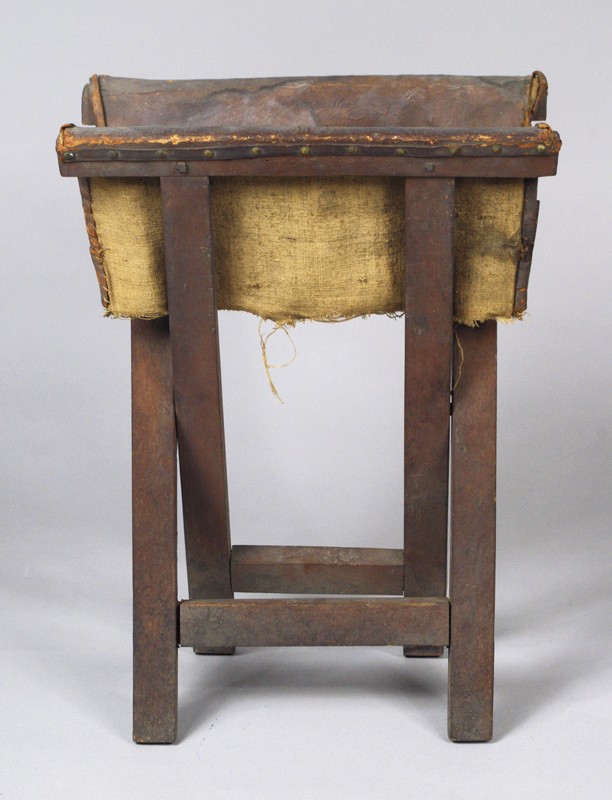
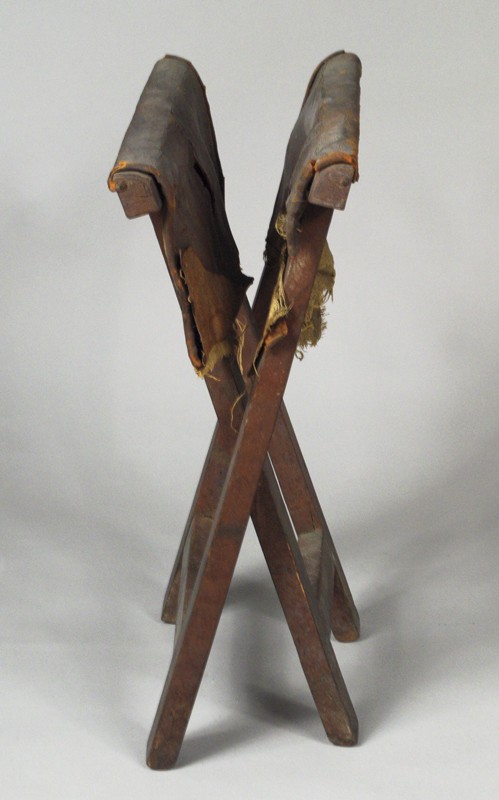
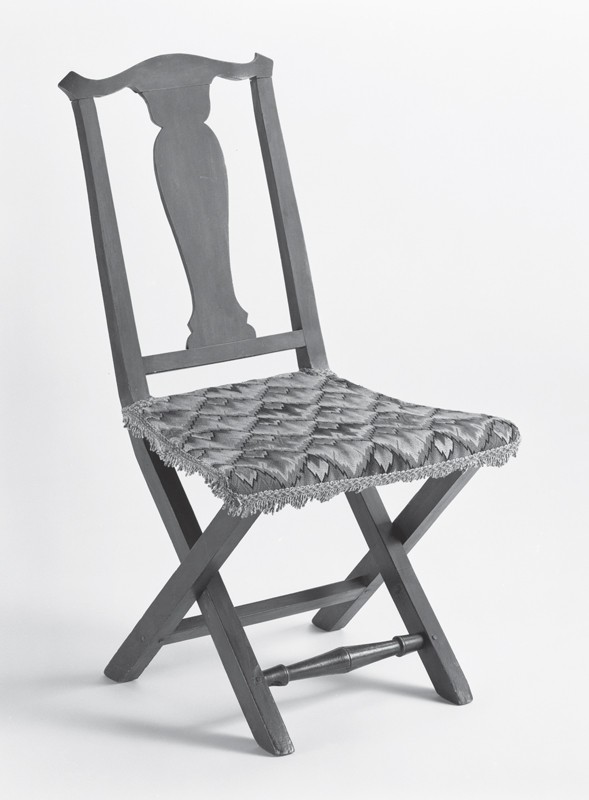
“Folding” or “clasp” stools and chairs are found in the Grant daybooks in considerable numbers. These objects likely resembled a folding leather stool used by Wethersfield, Connecticut, clergyman Reverend Elisha Williams (1694–1755) when he acted as chaplain for the Connecticut troops that took part in the Louisbourg expedition in 1745 (figs. 1, 2). The expedition was organized in Boston, and Reverend Williams undoubtedly acquired the stool there at that time. His name does not appear in the Grant daybooks, but at the very least we have a concrete example of what such a stool looked like. The stool has two joined frames that swivel on iron pins. The upholstery consists of a heavy linen sling to which leather covers are roughly sewn, plus some decorative brass nailing over narrow trim strips on the sides of the wooden tops of the two trestles. The seemingly utilitarian nature of this object, which is in somewhat poor condition (the leather covers and linen seat are torn apart in the middle), is deceptive. All furniture for use in military contexts had overt elite connotations, because the officers who owned them belonged to the wealthy, educated class of society. In addition, these stools were not inexpensive, for reasons that ought to be obvious. The frames required eight mortise-and-tenon joints, and the upholstery required some labor-intensive sewing. The first reference to clasp stools in September 1738 priced them at sixteen shillings each, when the cost of a side chair frame with vasiform back, cabriole legs, and a loose seat without upholstery was twenty-six shillings (fig. 3). In many instances no covers are cited, and it is possible that sixteen shillings was the base price for the frame plus the heavy linen sling. However, in January 1732 Captain Thomas Gray bought “4 Leath[e]r folding Stools” for fourteen shillings each. A maritime association for folding stools is demonstrated in an April 1732 sale to John Fitch for “6 folding Stooles” (12/6 each) for £3.15 and “Curts. of Crimson Chainy for ye State roo[m]” for £ 2.17.3. A stateroom is either the captain’s cabin or a room reserved for better passengers onboard a ship.[2]
Folding stools are to be distinguished from other stools listed in the daybooks. Nathaniel Green purchased a “Joynstool” for ten shillings in September 1729, undoubtedly much like its seventeenth-century ancestors. In April 1738 Joseph Dowse paid £1.10 for “covg. 8 stools with green harrateen.” These may have been folding stools, but they may have been joined stools with either loose seats or covered over the rails. Unquestionably joined were “6 Crooked foot Stools @32/” ordered by Peter Faneuil in August 1739, along with “1 Comd do.,” a commode or close stool.[3]
Another form that probably was used in ship’s cabins was the sea chair or clasp chair. The single reference to a sea chair dates from April 1739, when Robert Watt bought “2 Sea chair” for three shillings. That price suggests that they may have been simple rush seated chairs with one or two slats. Far more substantial were the “6. Clasp chairs @25 [s]” purchased by Peter Fanieul in January 1738 or the “12 Clasp Chars for Eastwich” at twenty-seven shillings apiece, purchased by Charles Apthorp in June 1742. The latter order may have been for a ship named “Eastwich.” Did these clasp chairs fold side-to-side like the modern director’s chair, or did they fold fore-and-aft, like the well-known Boston folding chair illustrated in figure 3?[4]
Allied to folding chairs and stools were certain low-priced forms of beds listed in the daybooks, among them sea beds, cot beds, and pallet beds. The exact meaning of these terms is not clear from the entries. Sea beds appear in the very first pages of the first daybook (1728–1737), when Jacob and Jonathan Wendell bought one for twenty-one shillings in January 1728. Another sold to Nathaniel Carrington in October 1730 for seventeen shillings, but it was purchased along with a bed, bolster, and pillows stuffed with fifteen pounds of down, bringing the total cost to £2.13.9. Two alternate interpretations are possible. A sea bed may have been some kind of hammock, but the simplest hammocks without wooden headpieces and tailpieces could not have accommodated a down mattress, bolster, and pillows. The amount of money involved mostly went into the heavy linen and sewing. If the linen was simply tacked or laced to a wooden headpiece and a tailpiece, that would have cut down on the expense of hand-sewn grommets that the simplest hammocks were hung with. Without question the more expensive sea beds were intended for the captain’s quarters.[5]
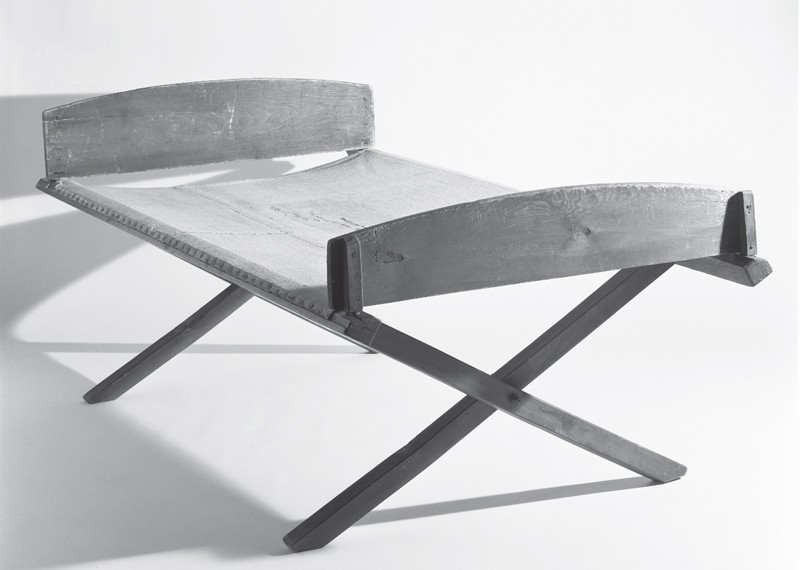
A cot bedstead is far more intelligible because an example survives from the eighteenth century (fig. 4). A June 1730 sale to Samuel Tolly or Jolly included “2 flagg bottom Stools” costing nine shillings and “1 Cott wth a Duck bottom” costing two pounds. This sort of bedstead folded from side to side. The purchaser may have already owned a down bed and other fixtures, or he may have intended to use the bedstead onboard ship without those fixtures.[6]
Quite common in the daybooks are pallet bedsteads. The term pallet has a verbal relationship to straw, from the French word paille, hence one might expect that the pallet bedstead was intended for a straw-stuffed and quilted bed or mattress. The entries do little to illuminate this. Nathaniel Green bought “1 pallet bedstead and bottom” for £2.4 in September 1729, but he also bought a down bed for it. In March 1744, Samuel Allen paid £2.7 for “1 Pallatt Bedstd ” and £2.13 for “1 Bottom[,] line[,] nails[,] and nailing on.” At a cost of five pounds, Allen’s bed was not a cheap object. It might be that the term pallet referred not to the bed or mattress, but to the style of the frame. Perhaps it was simply a low bedstead. A purchase by Charles Bowler in February 1744 for “1 Bedstead for Negro” costing £1.15 00 is no help, for it does not specify if the bedstead had a sacking bottom or what sort of bed went on it.[7]
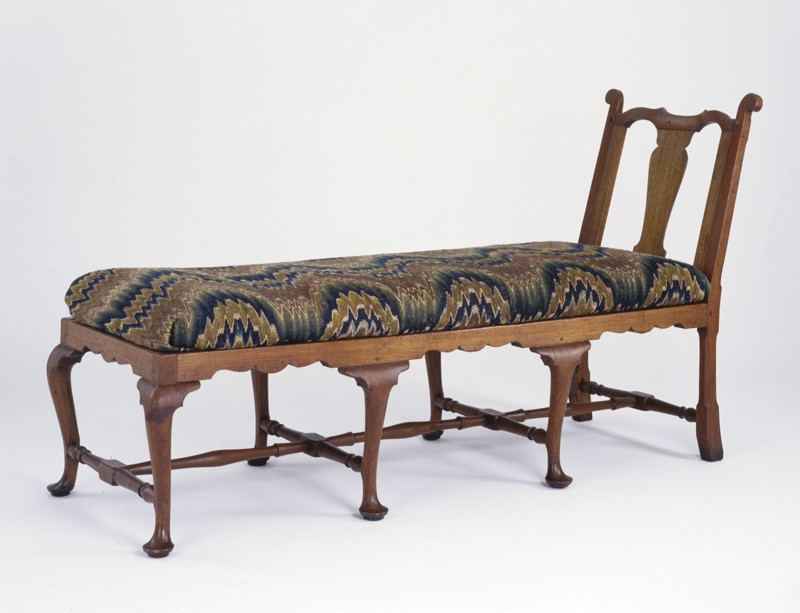
Couches are the most problematic form found in the daybooks (fig. 5). They do not survive in great numbers, but the daybooks have entries for many of them. As a group, modern collectors have never been enthralled with couches, and they have rarely provided the correct textile fixtures for that form. Curators dislike couches because they take up considerable space in a room or on a platform and do not have significantly more stylistic content than a corresponding side chair. As the contemporary (and then successor) to the double-chair or two-armed couch of the seventeenth century (see fig. 1 in Robert F. Trent and Mark Anderson’s article in this volume), one-ended couches have much the same structure. Period illustrations suggest that couches were used with one long side set against the wall, and they may have functioned occasionally as a seat for two people, as well as a seat for a single, semi-recumbent occupant. Grant’s daybook entries indicate that couches were ordered en suite with sets of chairs, to the extent that couches almost certainly functioned in parlors as a sort of settee. Grant’s couches all had a laced sacking bottom tacked to the seat rails, much like that provided for bedsteads. The sacking bottom supported what was termed a squab. The squab could be stuffed with various materials, including feathers, horsehair, or carded wool. The swiveling back frame, which could be held at various positions by chains, was always upholstered to match the covers of the squab and padded by a loose pillow, often stuffed with wool to make it stiff so it would not slump. A much-quoted April 22, 1707 letter from Samuel Grant’s master, Thomas Fitch (1669–1736), to Captain Benjamin Faneuil makes some pithy comments on the old-fashioned “Cromwellian” couch and describes how the one-ended couch was furnished:
Leather couches are as much out of wear as Steeple crown’d hats, cane Couches or others we make like them w[i]th. a quilted pad are cheaper, more fash[ionab]ll, easie, and usefull, ye price of ym we make w[i]th pad is about [£]3.15.
The term “quilted” may describe simple tufts or tie-offs to keep the stuffing in place and does not necessarily mean a fully developed stitched hair mattress, of the sort provided for sofas fifty years later. Setting aside questions of special pleading, several entries in the Grant daybooks include couches with what must have been leather squabs. In January 1728 Grant sold Daniel and Andrew Oliver “3 Leather Couches @90/.” These couches may in fact have had stitched hair mattresses on the seats, as well as leather backs; in other words, they did not have fixed leather seats tacked to the seat frame. An August 1730 entry for a couch sold to James Davenport is far more typical:
1 Couch fframe 1/12/00
5 yards green chainy @ 5/4 01/00/08
12 yds binding 7s 00/07/00
9 ¾ [pounds] wool 16 p[ence] 00/13/00
Card[in]g do. 00/06/08
sle[e]ve silk 2/ brass nails 1/ girt web 1/ 00/04/00
bottom and bottoming 00/12/00
mak[in]g squab & pillow fill & quilting 00/09/00
chainy for d[itt]o 00/03/06
[£]05/10/04
Davenport’s couch evidently was stuffed with carded wool, although the back, with brass-nailed decoration, may have been stuffed with a skimmer of curled horsehair. Another couch made in August 1730 for John Mocke consisted of:
1 Couch frame 01/13/00
Bottom[in]g d[itt]o 00/12/00
5 yards Crimson Chainy @ 6/4 01/11/08
11 yards red bind[in[g @8 00/07/04
10ll [i. e.,pounds] Curled hair 2 2/8 00/06/08
Wool for pillo[w] carded 00/03/06
Sle[e]ve silk 2/ mak[in]g squab 00/11/00
Chains 3/6 Oxenbrigs to pack[in]g 3/ 00/06/06
[£]06 05 02
The squab for Mocke’s couch was stuffed with hair and the pillow with wool. On November 30, 1730 Nathaniel Green purchased “1 Couch frame horsebone foot” for £2.12. The upholstery and fixtures for his example included:
Bottom & bottoming 00/12/00
12 y[ar]ds binding 7s 00/07/00
14 ½ ll [i.e., pounds] best feath[e]rs 3/6 02/10/09
4 ¾ y[ar]ds Ticken 6 01/08/06
nails, Girt[web], Tax & Canvas for ye h[ea]d 00/01/08
1 Sett Chains 00/03/06
Making and filling a Couch squab loined 00/12/00
5 ¾ y[ar]ds Crimson ingr[ai]n Chainy 01/17/04
[£]10/04/09
The squab was stuffed with feathers, but no pillow was specified. Obviously feathers were the most expensive option for the squab, because they cost almost three pounds alone.[8]
The couch illustrated in figure 5 is attributed to Boston, although it (and others like it) was for many years associated with Newport. The basis for that attribution was a history of ownership for a similar couch (Metropolitan Museum of Art), a set of six side chairs, and an easy chair that reputedly descended from a member of the Eddy family of Warren, Rhode Island. A 1932 sales catalogue stated that an unspecified piece of furniture with that history was labeled by Newport cabinetmaker Job Townsend, and twenty years later decorative arts scholar Joseph Downs claimed that a 1743 bill of sale from Job Townsend for the Eddy family furniture existed. Neither the labeled object nor the Townsend bill has been located since the 1930s, and both may be apocryphal. The Eddy couch was attributed to Newport in Morrison Heckscher’s American Furniture in The Metropolitan Museum of Art II Late Colonial Period: The Queen Anne and Chippendale Styles (1985). Several articles, books, and museum catalogues illustrating similar couches have repeated the Eddy history and affirmed a Newport origin for those objects.[9]
Joan Barzilay Freund and Leigh Keno attributed the Eddy side chairs, easy chair, and couch to Boston in a 1998 article in American Furniture. The authors showed how the side chair and easy chair were stylistically and structurally linked to earlier Boston seating forms and speculated that they were likely shipped from Boston to Newport. Keno and Freund also identified a ship captain named Eddy, who regularly traveled between those ports. The authors’ article, in tandem with an earlier one by Freund, Keno, and Alan Miller, re-attributed to Boston many chairs previously ascribed to New York or Newport. Although some scholars have attempted to refute this work, Alan Miller’s forthcoming analysis of Boston Georgian seating coupled with new findings from Grant’s daybooks should put much of this controversy to rest.[10]
One final reference from Samuel Grant’s second daybook (1737–1766) introduces an ambiguity in the terminology and style of chair frames that must be kept in mind. As part of a large 1738 order that included three expensive beds and an easy chair, the mercantile firm of Osborne and Oxnard purchased the following, which was delivered to Salem, Massachusetts:
6. Black back Chairs @5 01/16/00
6. crook back ditto flag bottoms 16/ 04/16/00
6. ditto better 24/ 07/04/00
6. maple ditto w[i]th Crims[[o]n Seats 24/ 12/18/00
6. Walnutt ditto w[i]th green seats 43/ 14/08/00
6. Ditto compass seats cov[ere]d w[i]th black 65/ 19/10/00
1. Elbow ditto 05/10/00
This extraordinary line-up encompasses practically the entire range of production models for chairs, setting aside extraordinary carved ornament. There are some questions regarding the design of the frames. The first chairs listed were undoubtedly rush-seated slatbacks, with perhaps two or three slats. The next two citations are the troublesome ones. Their intermediate value and flag or rush bottoms might indicate what is commonly and erroneously termed a “country Queen Anne chair” in modern marketplace parlance. That is to say, the chairs may have had joined backs, turned fronts, and rush seats woven on blocked seat rails. The difference in price between the two sets may have had to do with a bit of carved ornament on the backs. It is unclear if the frames had turned front legs or cabriole legs. However, these two sets may have been full-blown, joined Queen Anne chairs with loose, rushed seat frames mounted on glue blocks inside the seat frames and trapped by trim strips nailed atop the seat rails. This model, widely associated with the Gaines family of Portsmouth, New Hampshire, occupied an odd niche in the market. As indicated by the prices cited above, the difference between a rush-seated joined chair and a joined chair with an upholstered seat was substantial, but this did not mean that a joined chair with a rush seat did not incorporate a great deal of pricey joinery and shaved modeling, even if it had turned front legs rather than fully modeled cabriole legs with turned feet. Further, as the citation proves, all these rush-seated options had Boston prototypes, but separating them from many subsequent provincial versions is often difficult. Much the same might be said of the “8 Chairs crook back flag bottom 28[s]/” purchased by Nathaniel Green in December 1729.[11]
ACKNOWLEDGMENTS
For assistance with this article, the author thanks Mark Anderson, Gavin Ashworth, Luke Beckerdite, Debbie Buckson, Tasha Caswell, Erik Gronning, Julia Hofer, Alan Miller, Susan Newton, Laura Parrish, Jeanne Solensky, Kasey Stewart, and Jim Wildeman.