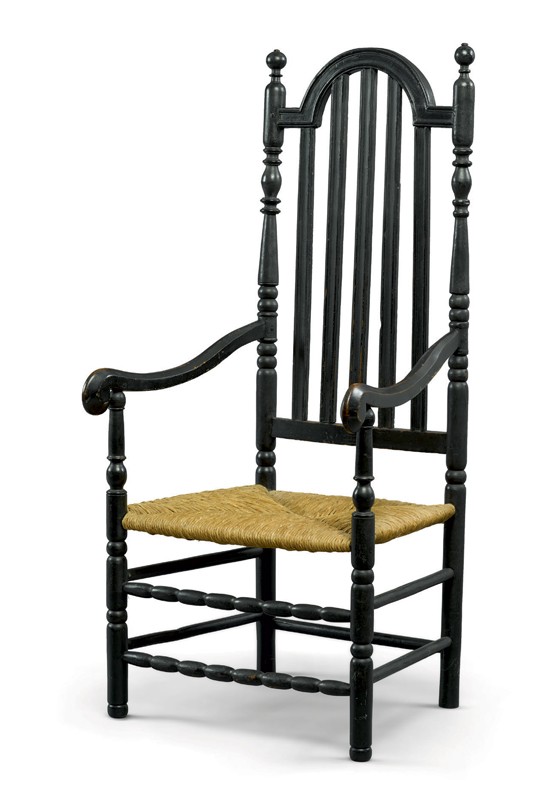
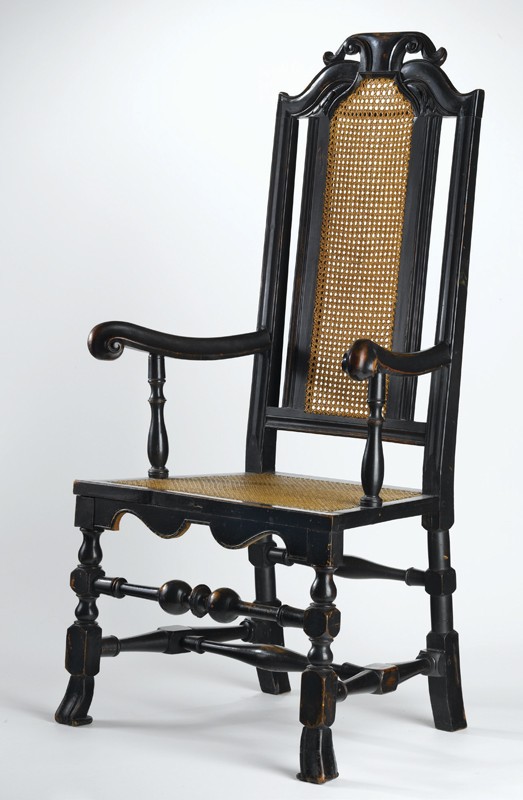
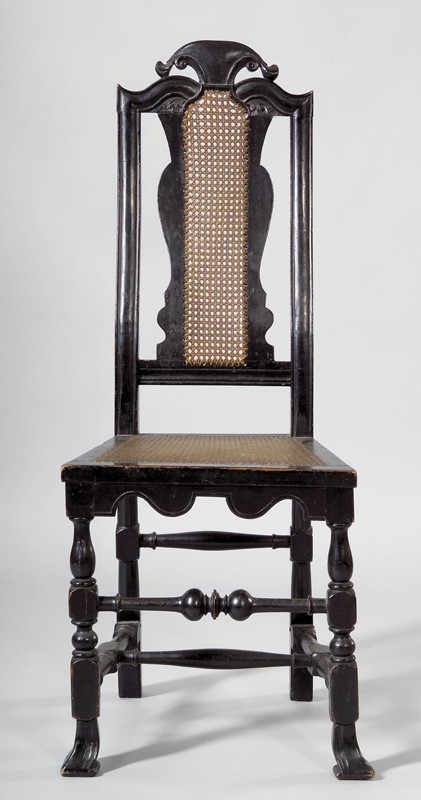
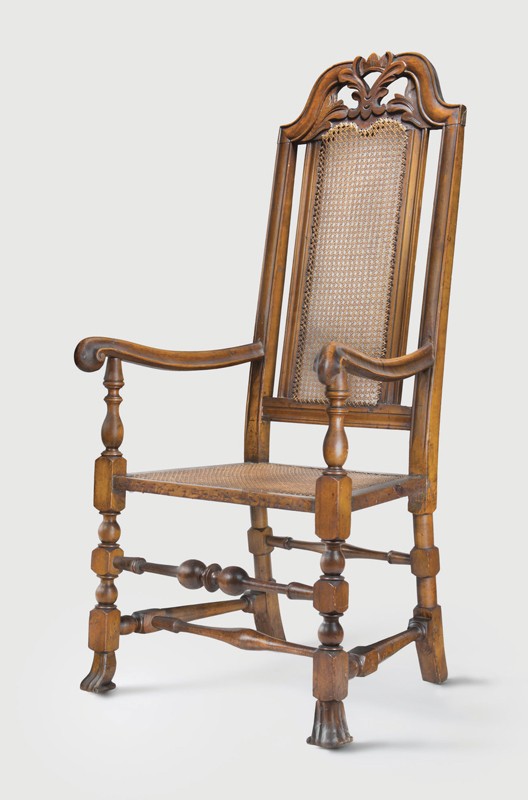
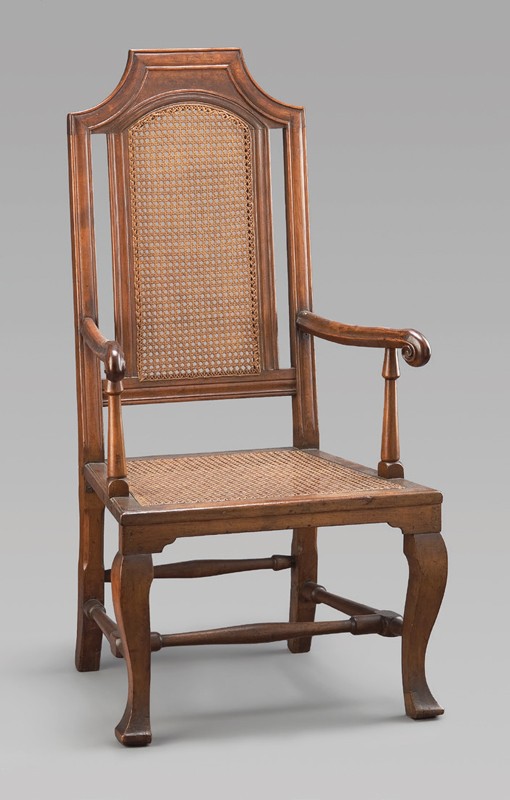
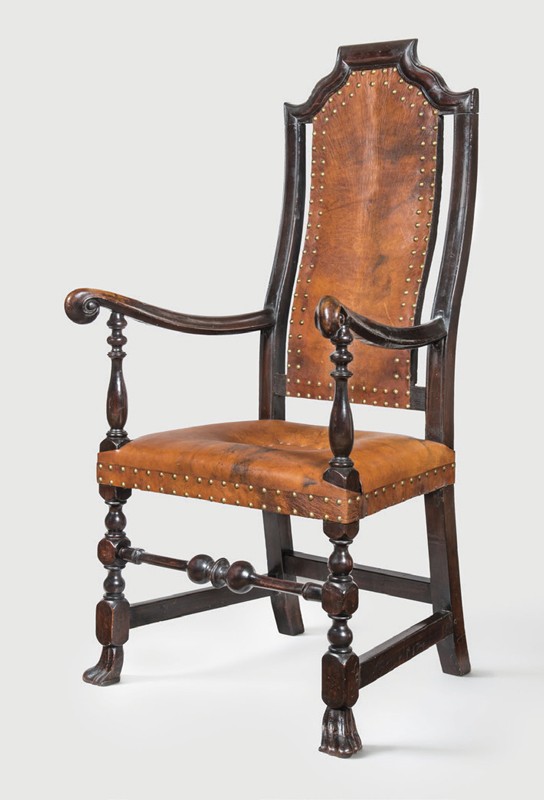
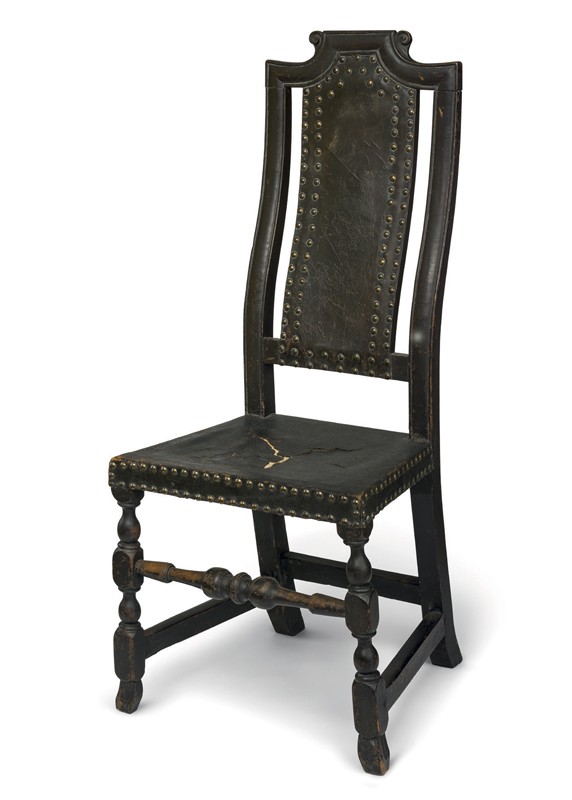
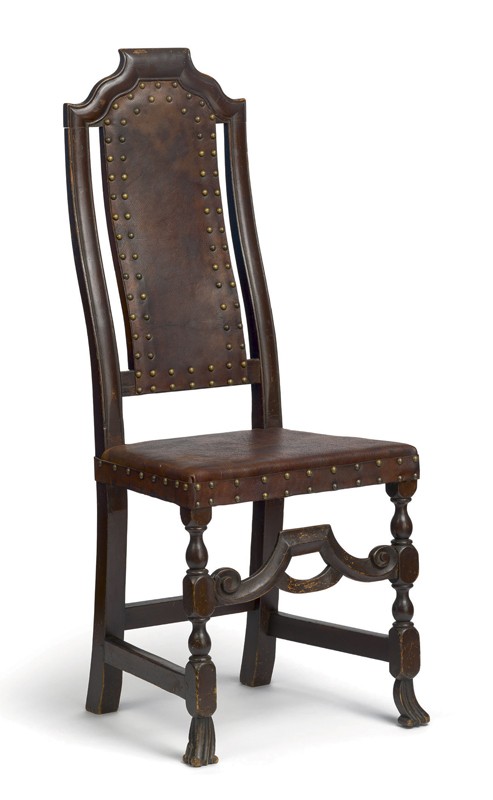
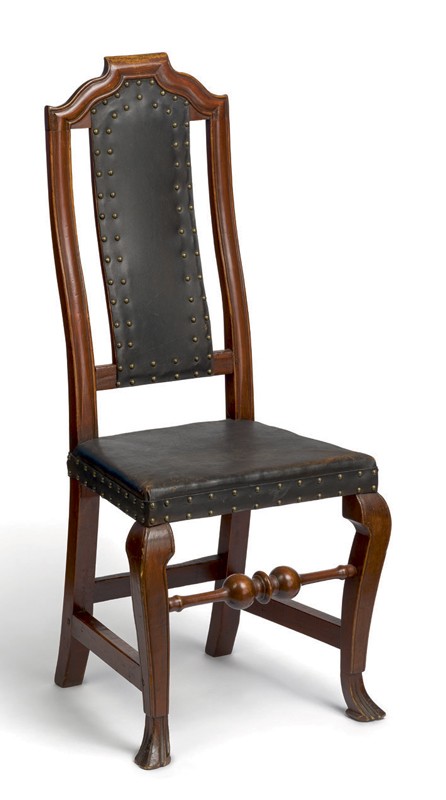
• Figure 1
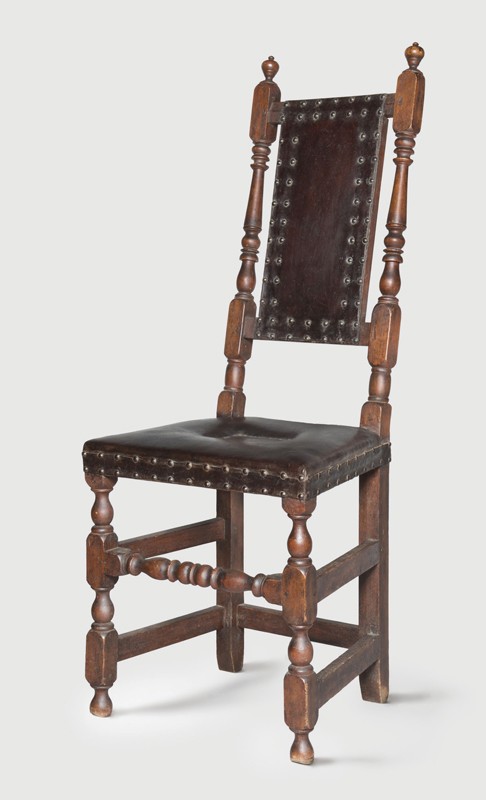
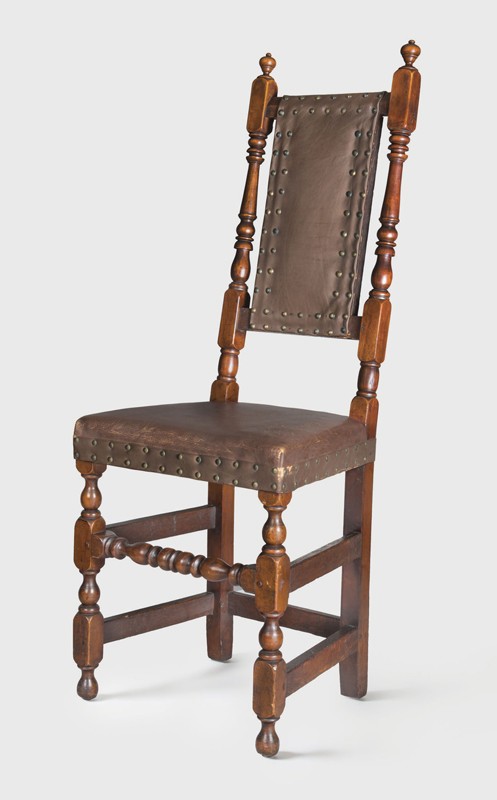
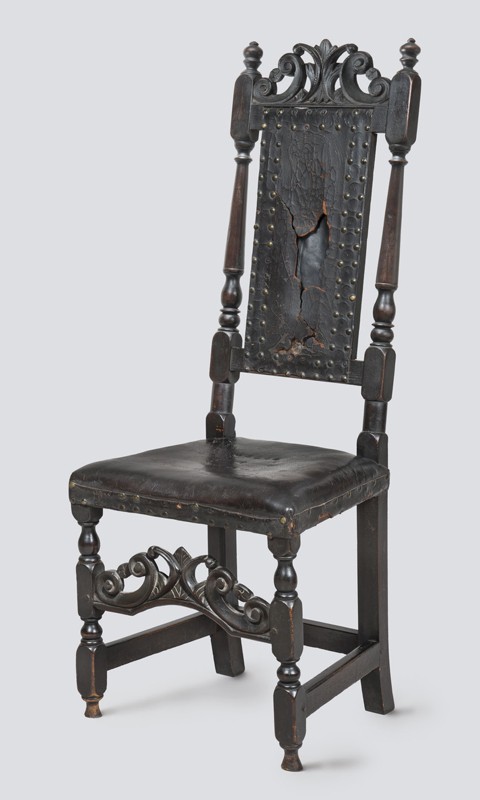
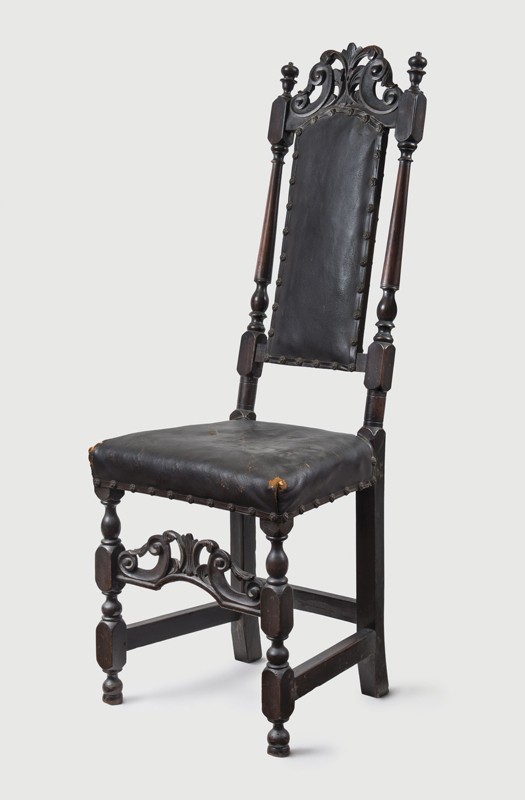
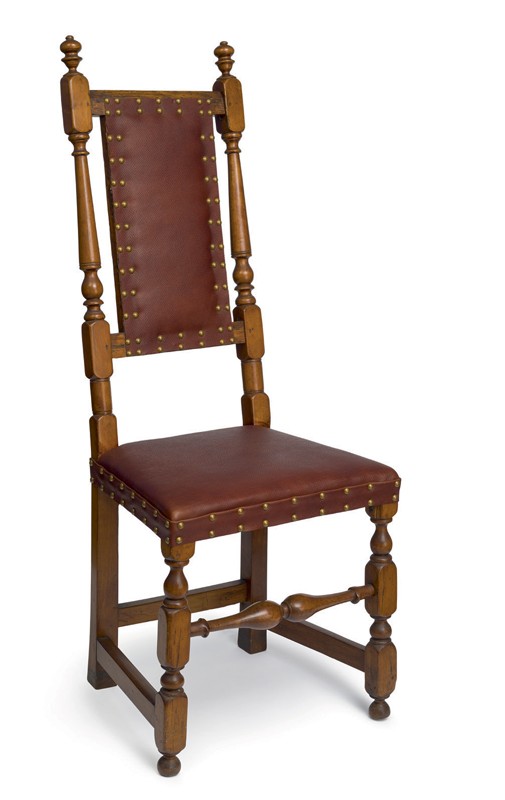
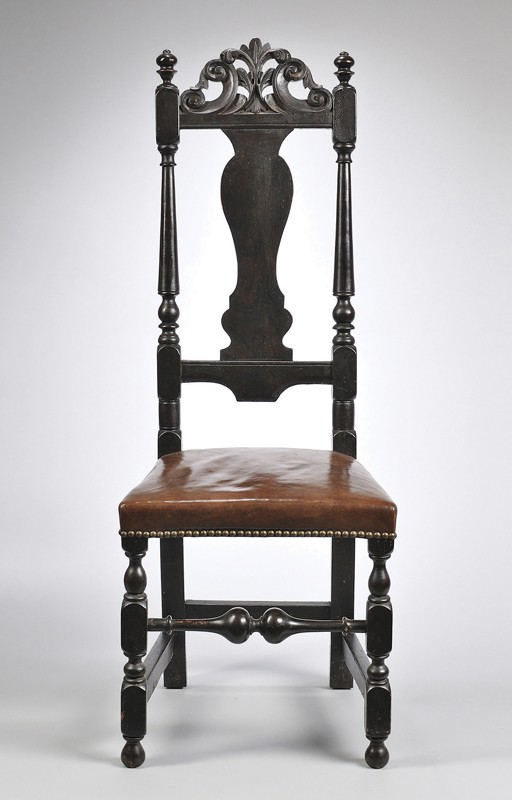
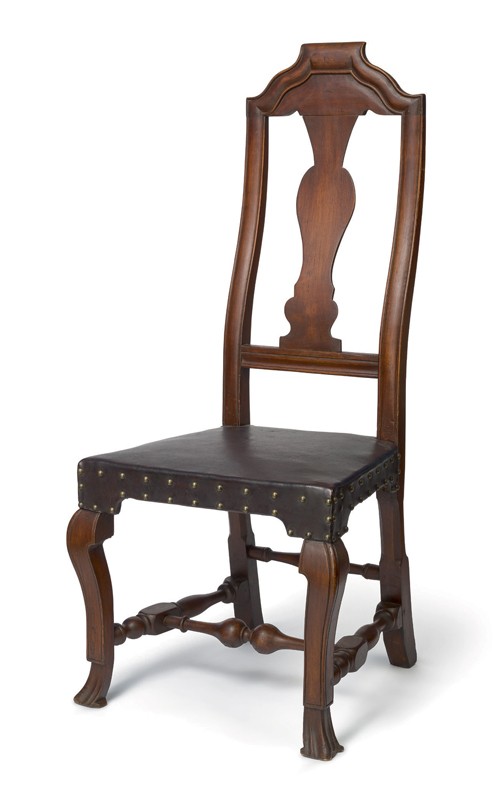
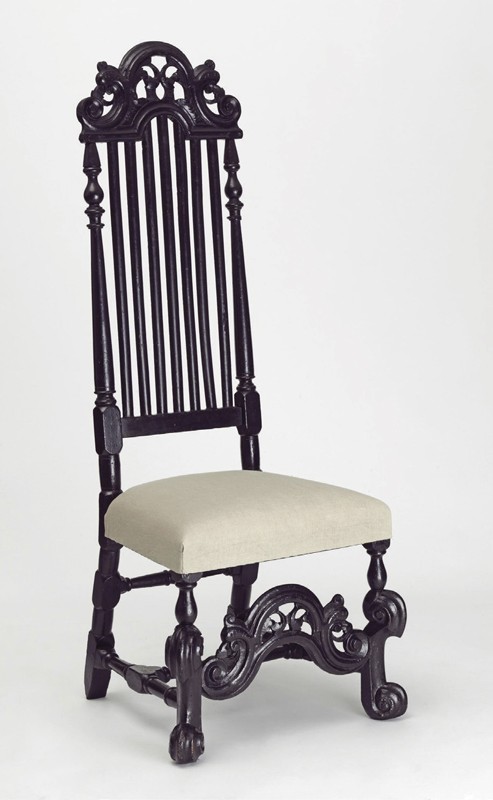
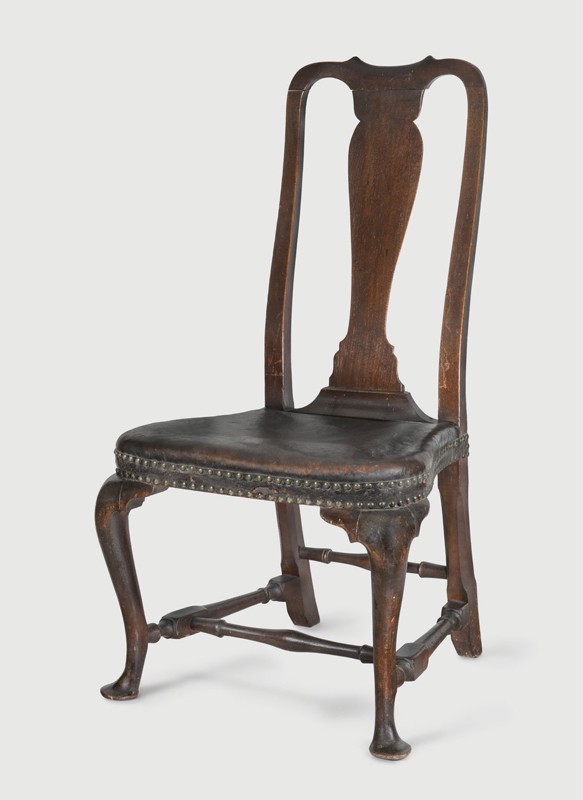
    Figure 1

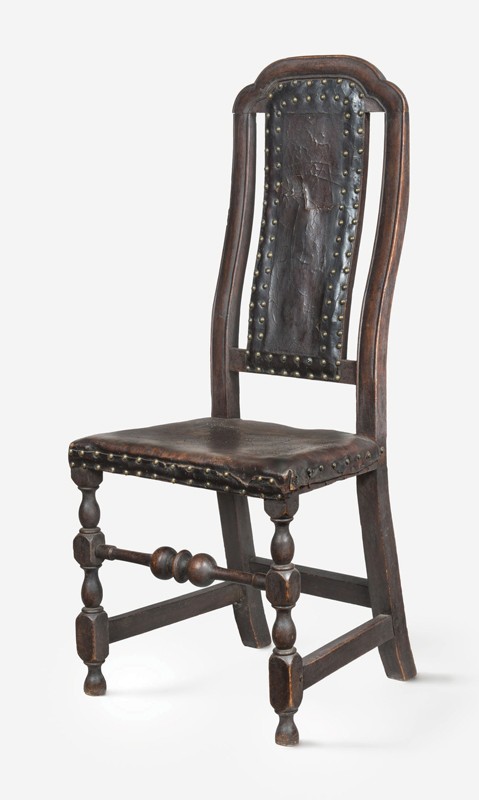
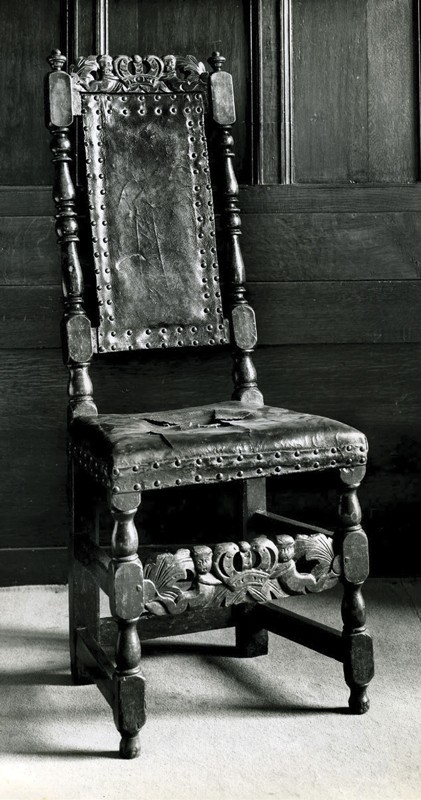
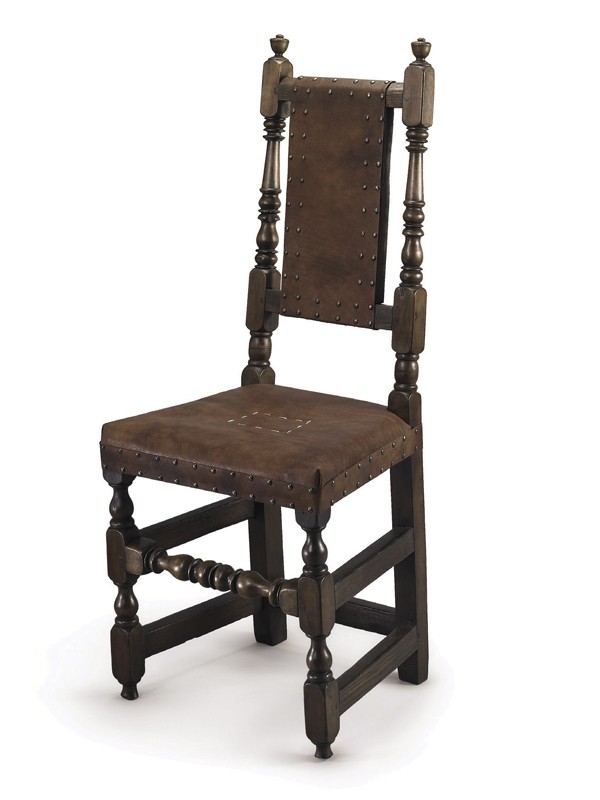
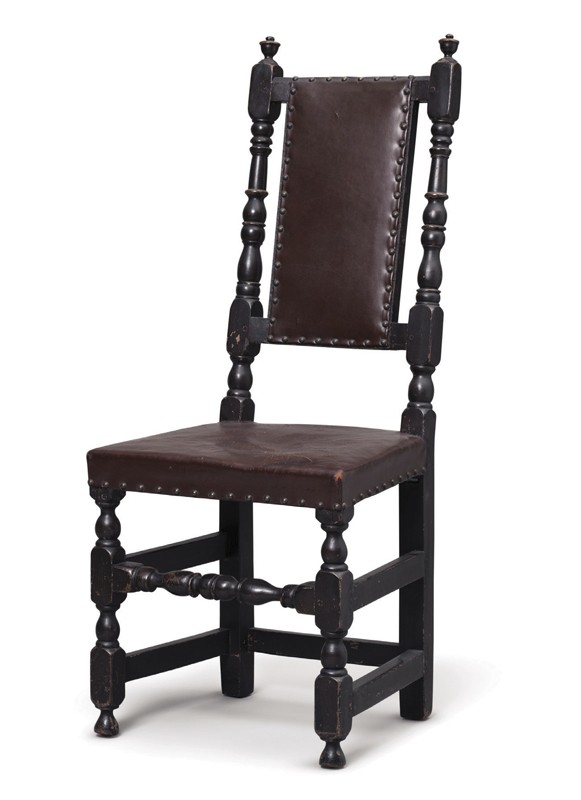
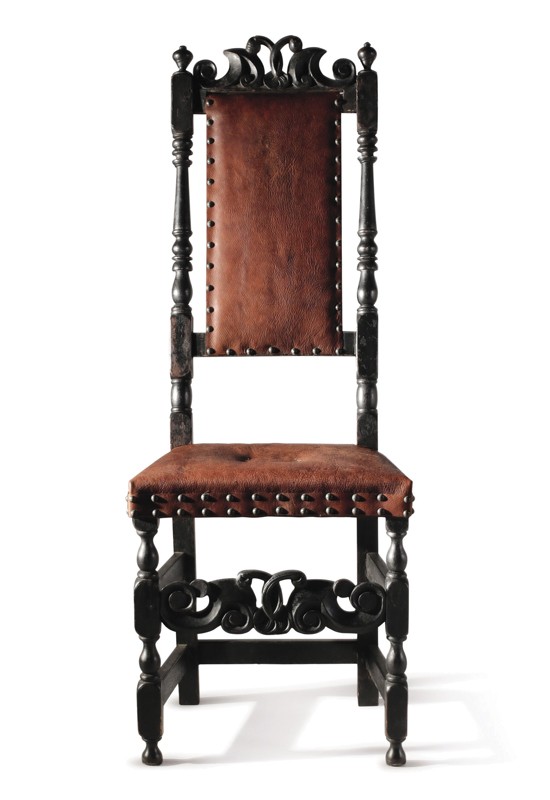
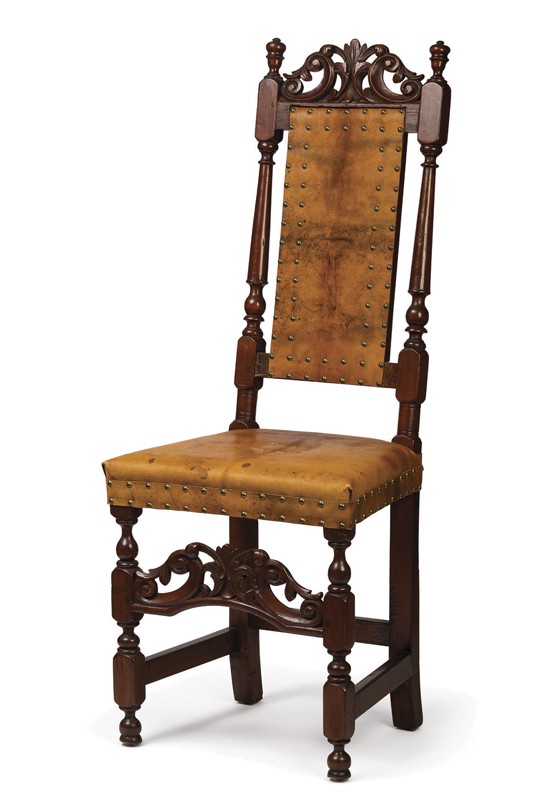
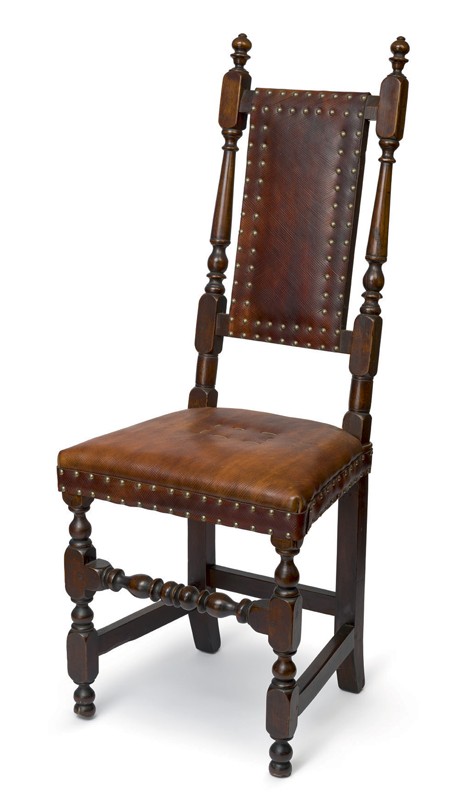
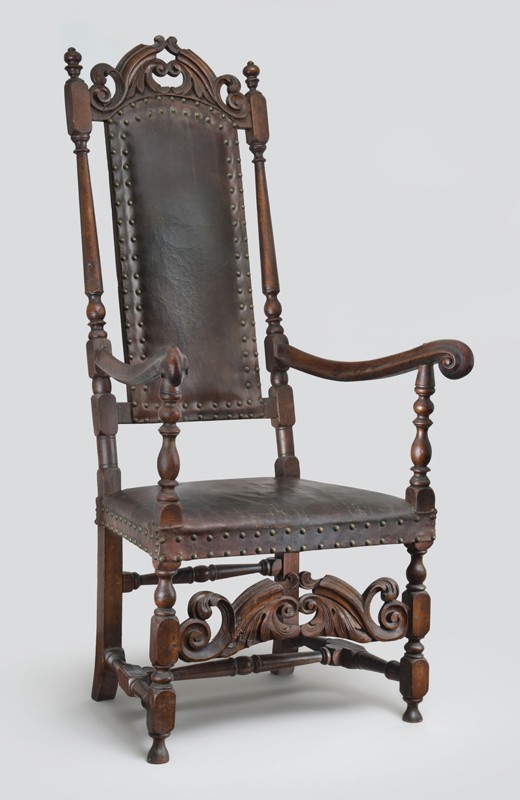
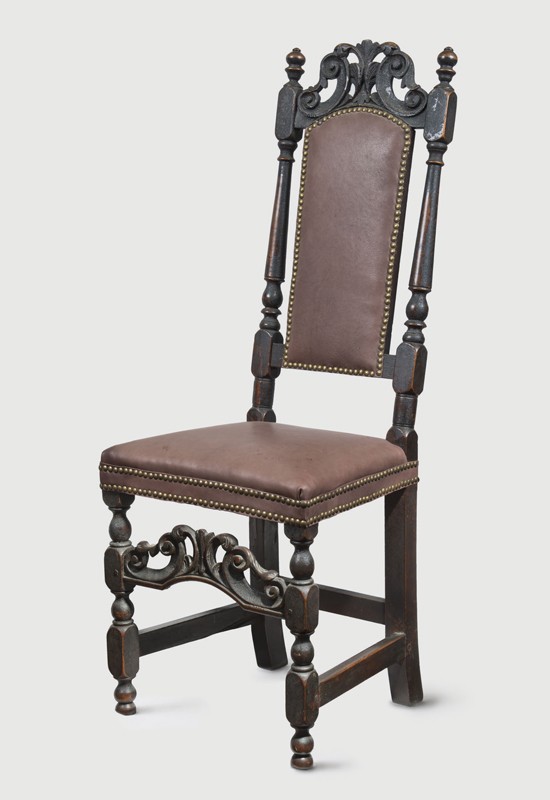
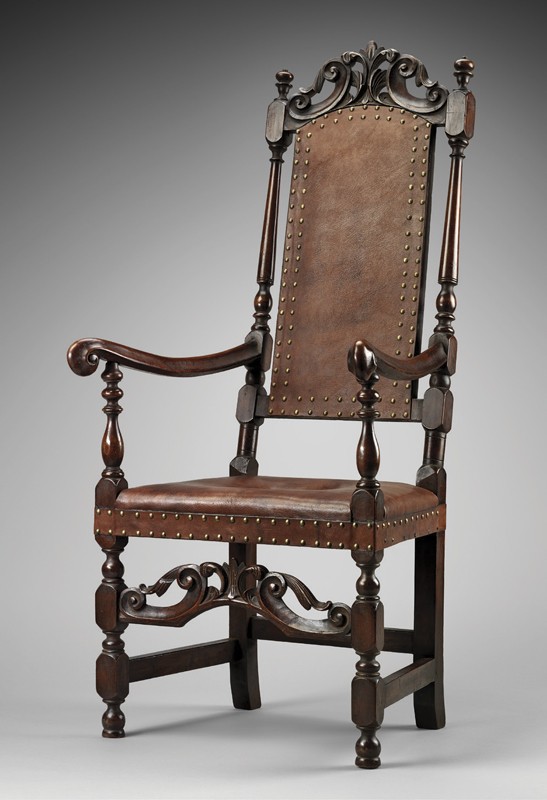
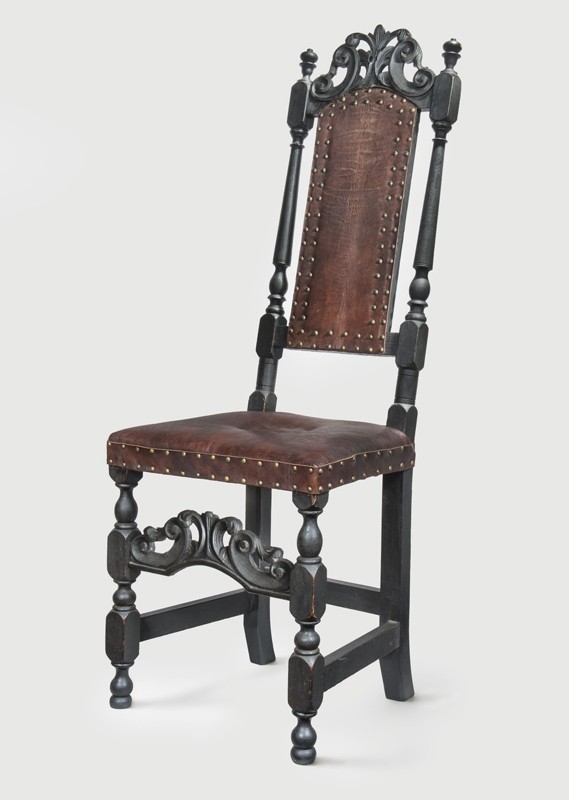
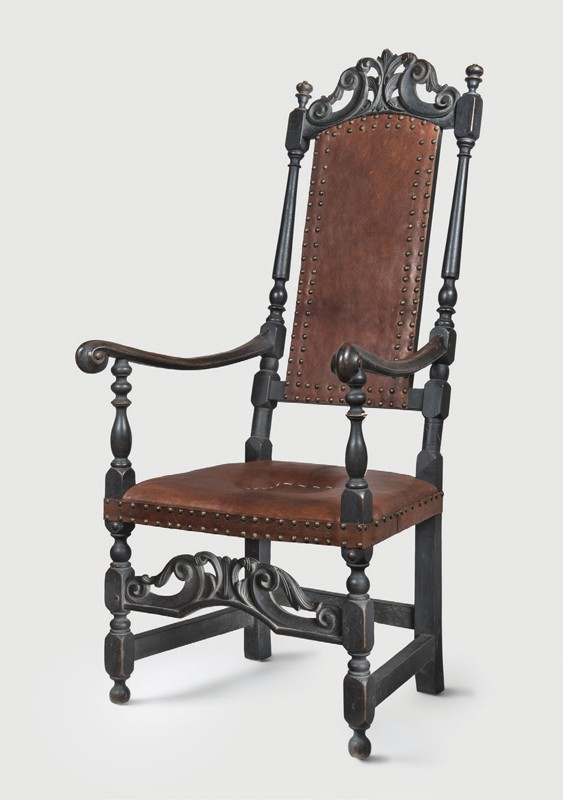
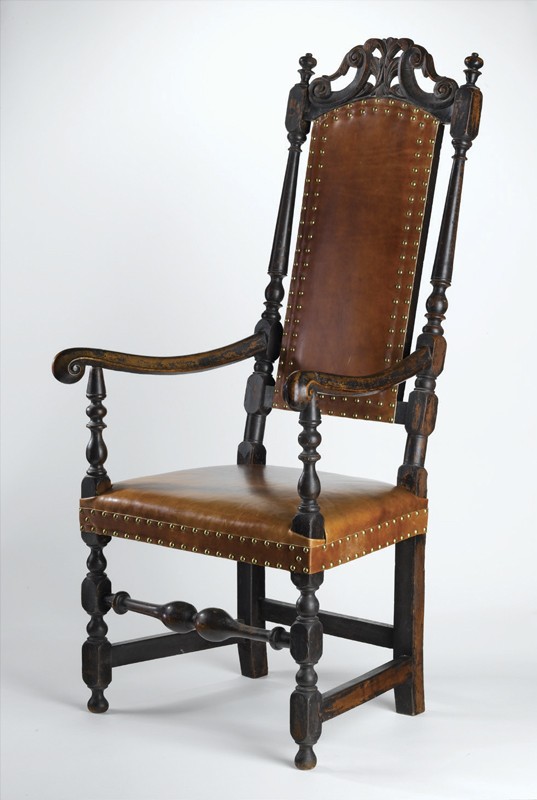
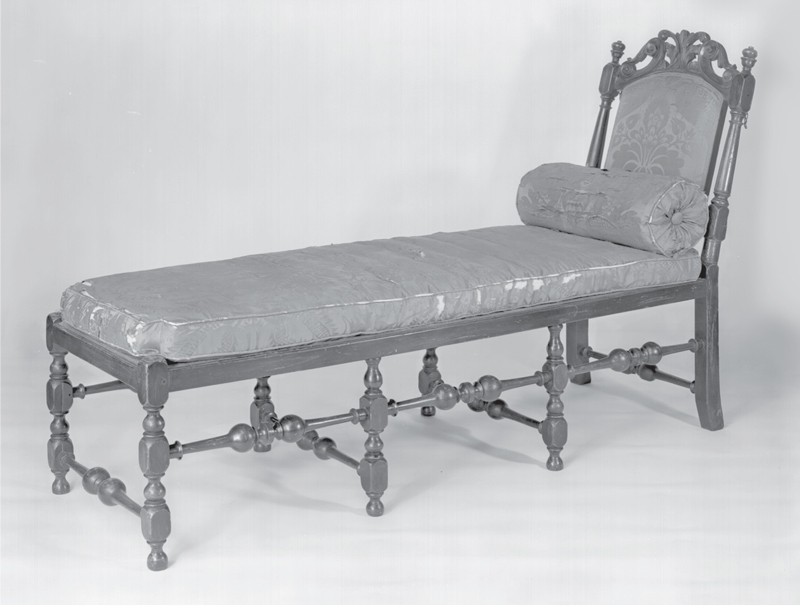
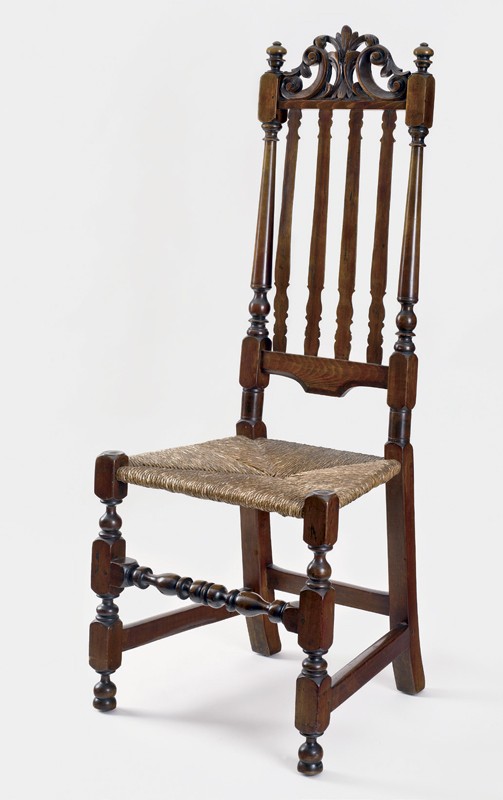
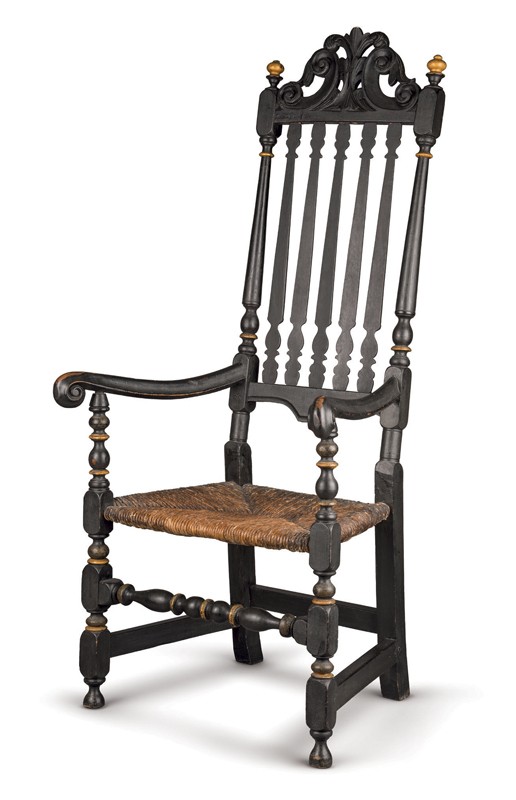
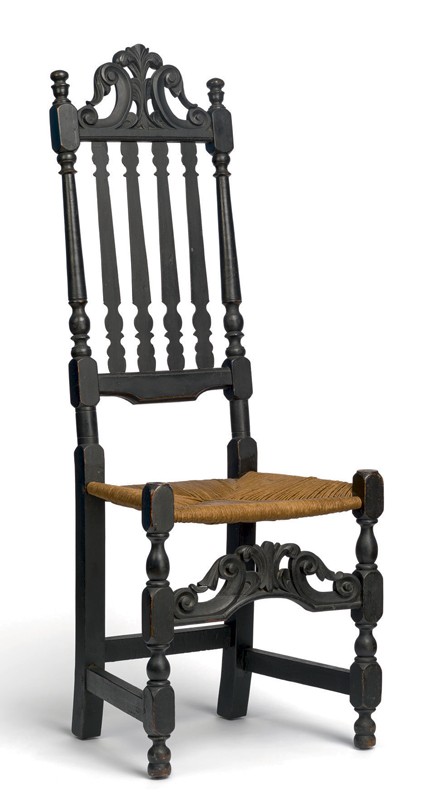
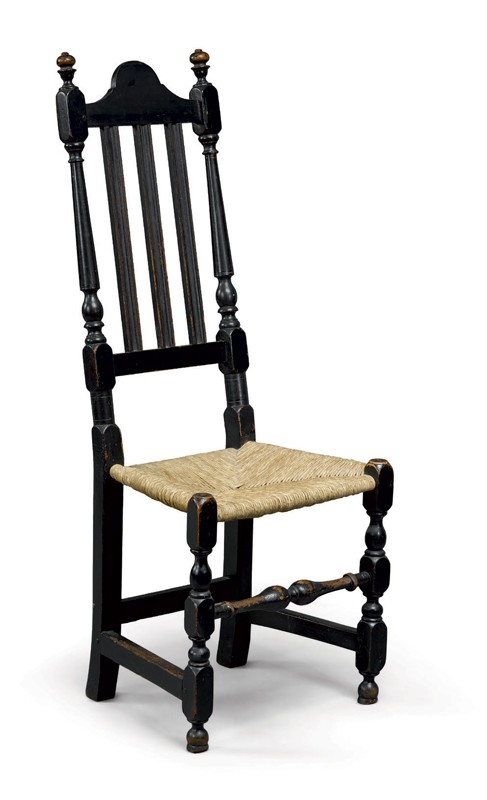
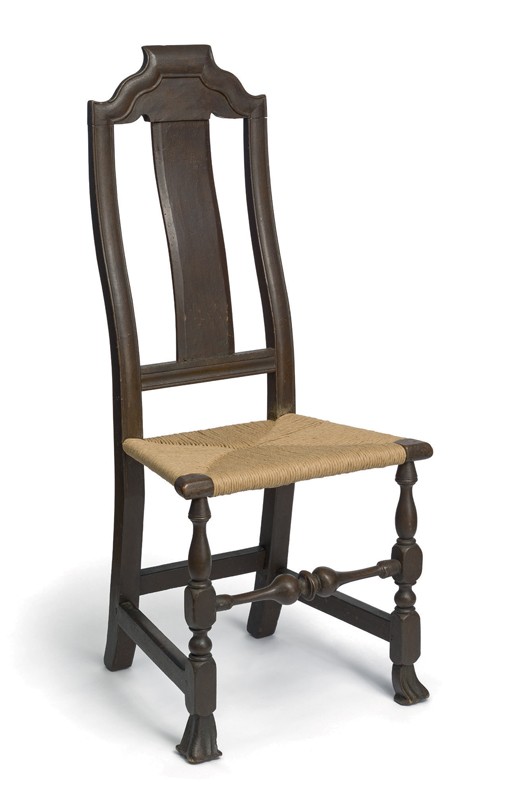
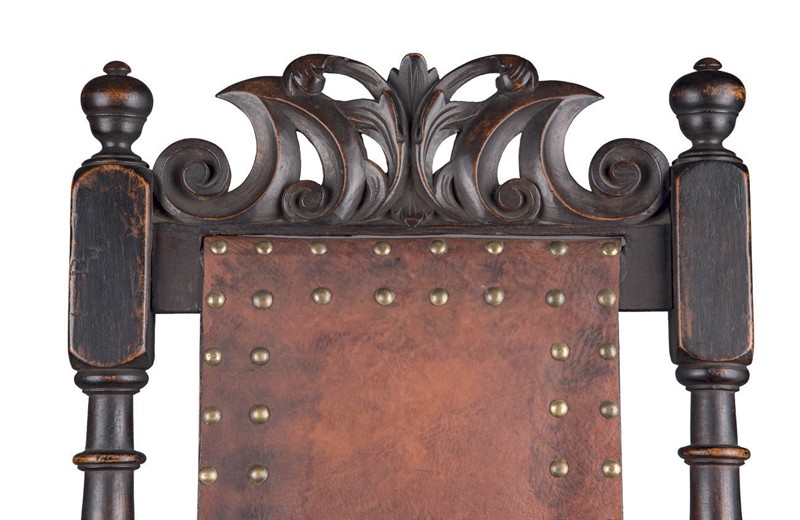
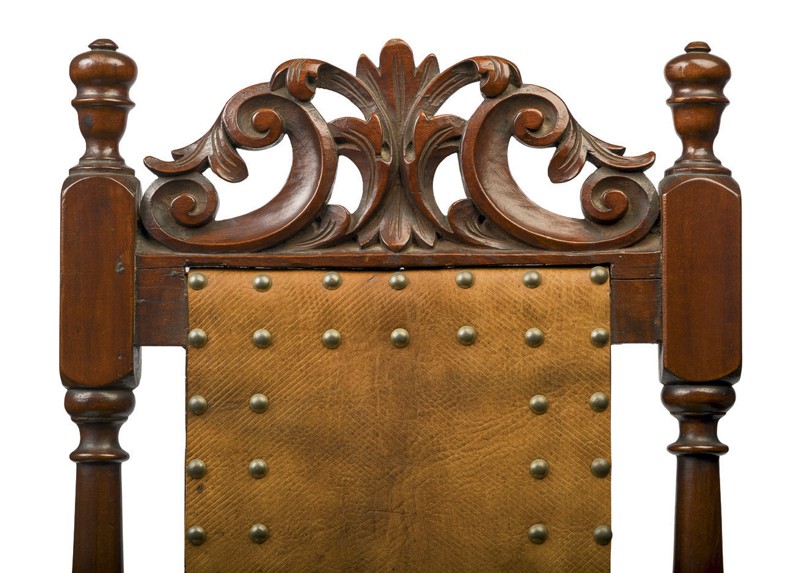
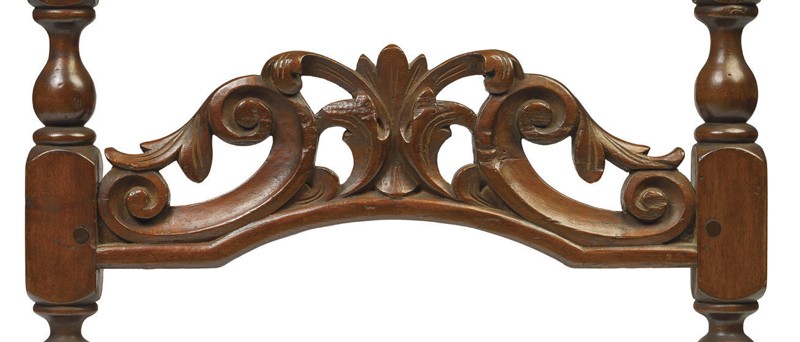
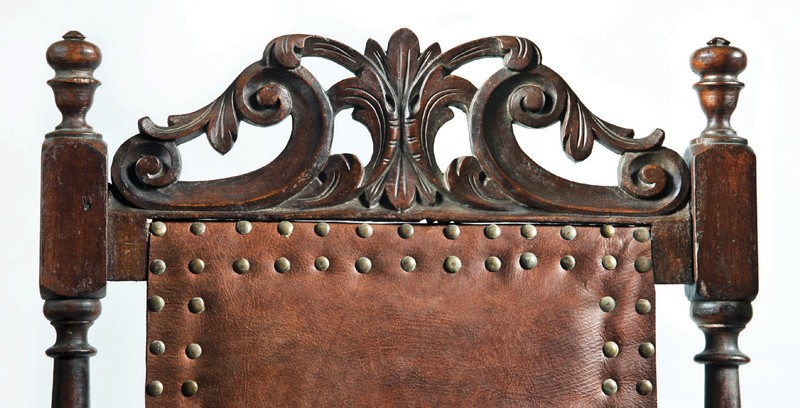
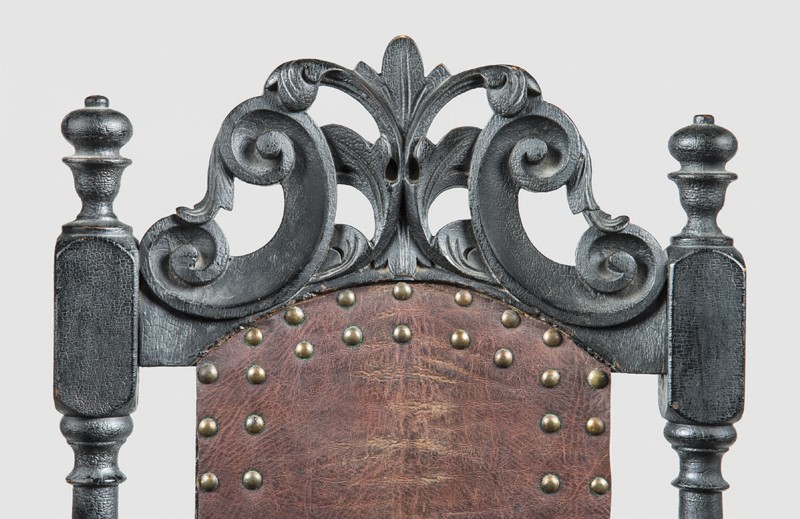
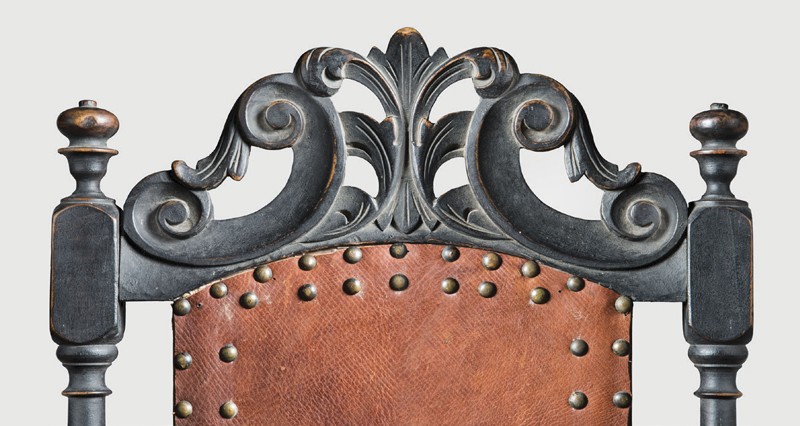
    Side chair, Boston, Massachusetts, 1720–1750. Maple and oak; original leather upholstery. H. 43 1/2", W. 18 1/4", D. 15". (Private collection; photo, Gavin Ashworth.)

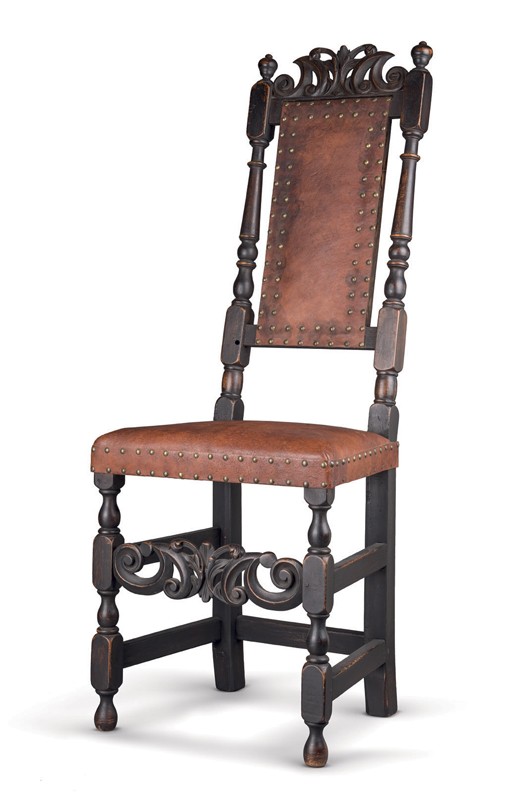
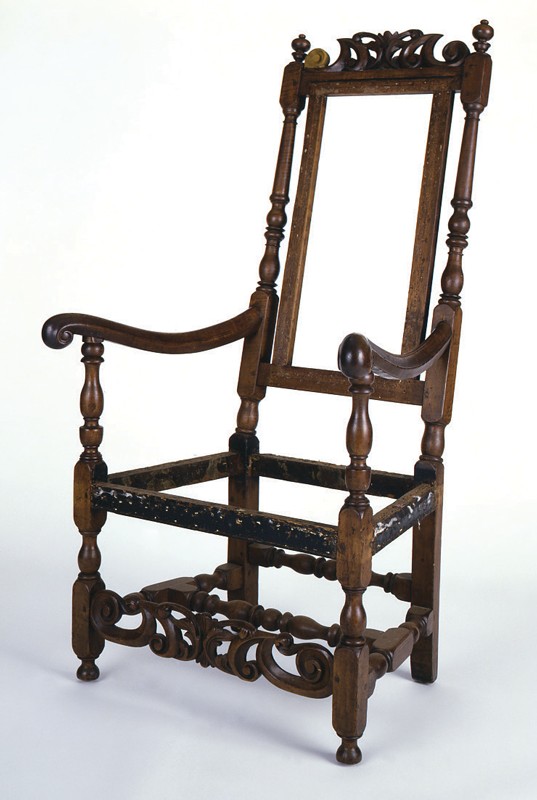
  • Figure 2
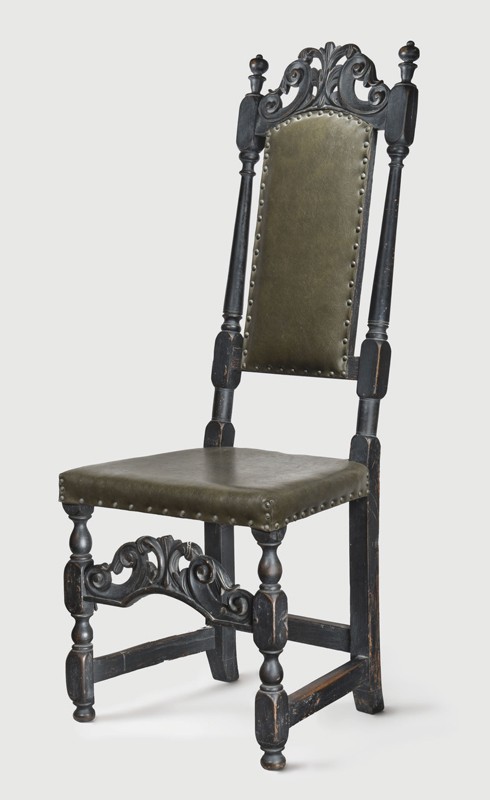
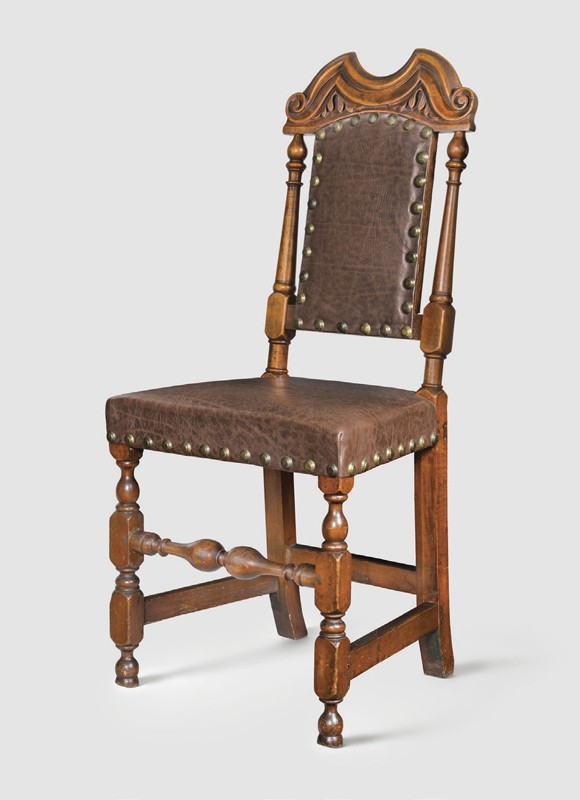
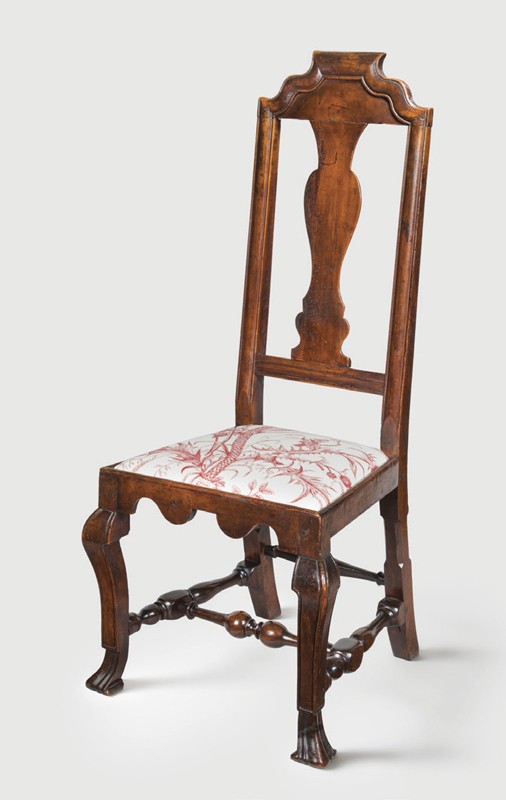
    Figure 2

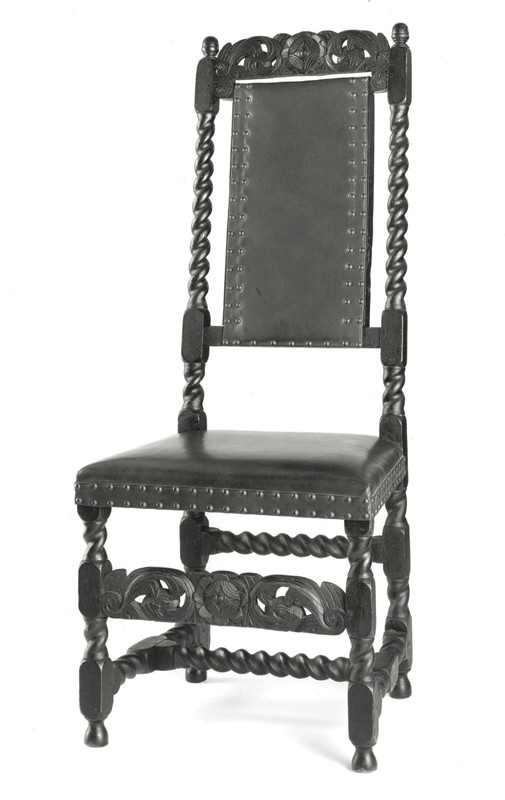
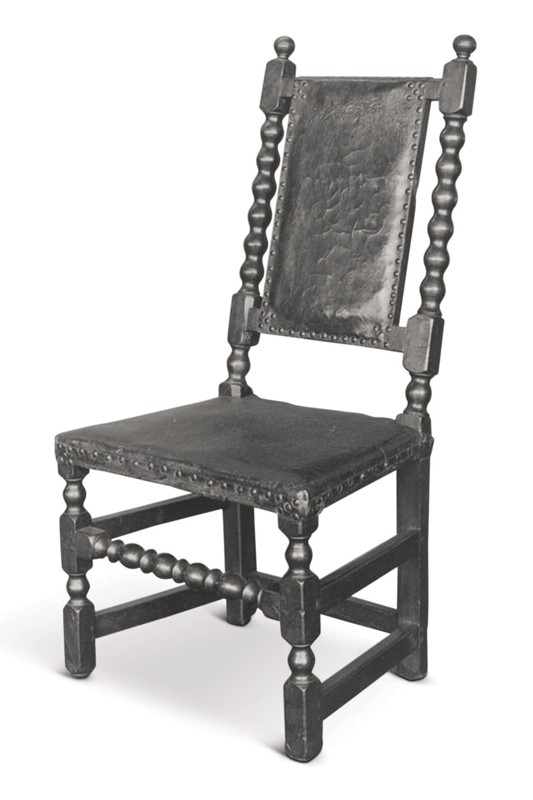
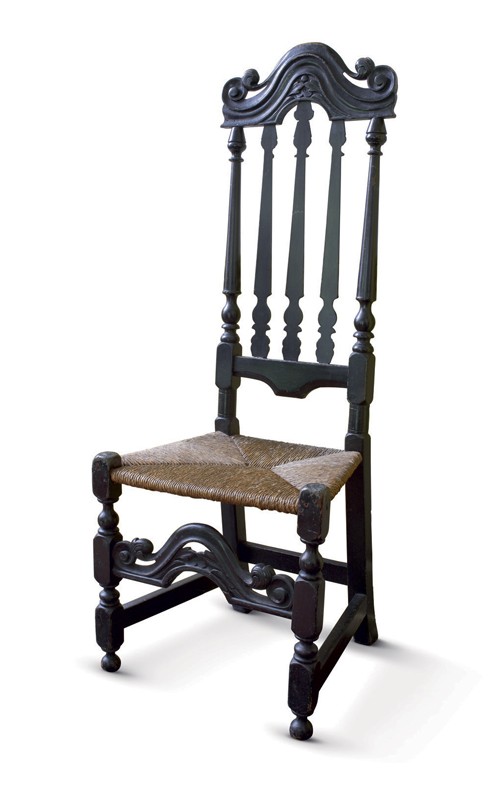
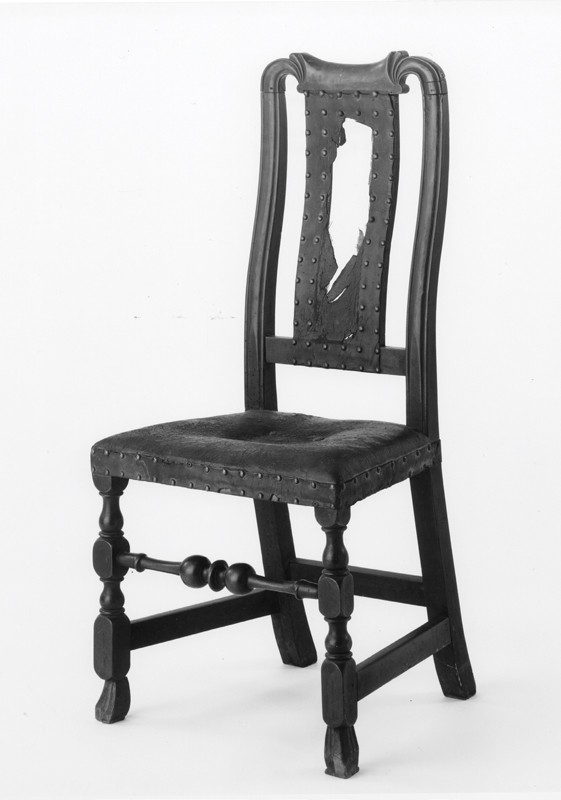
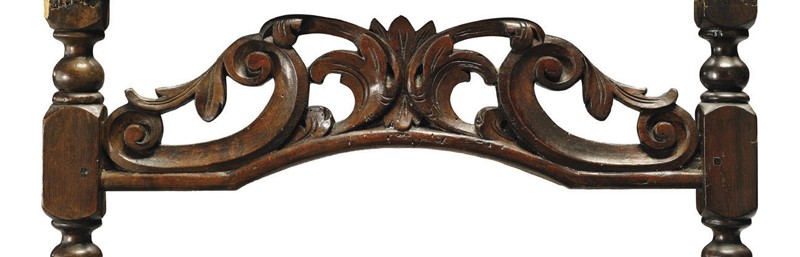
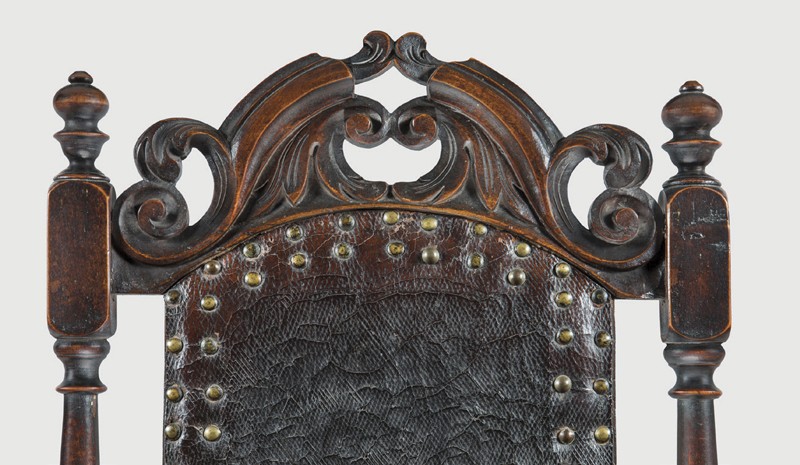
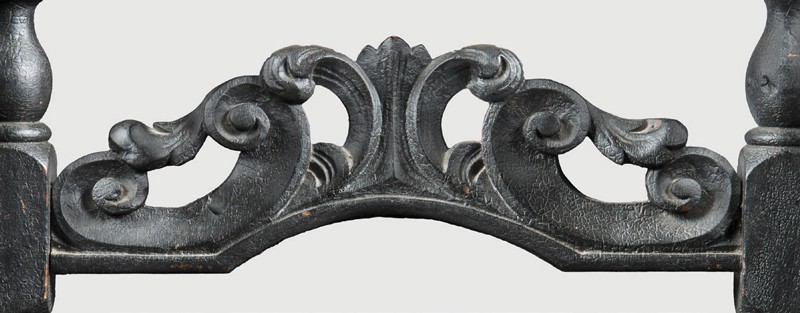
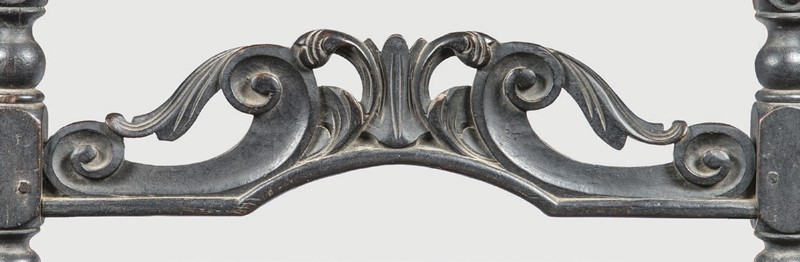
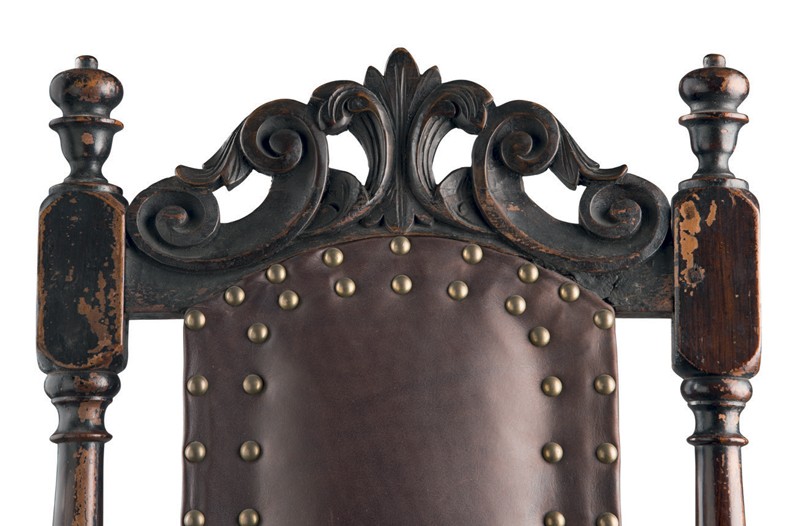
    Side chair, Boston, Massachusetts, 1685–1705. Maple and oak. H. 48", W. 20 1/4", D. 22". (Chipstone Foundation; photo, Gavin Ashworth.) This is the first American example of a slot placed in the crest to pass through the leather upholstery.

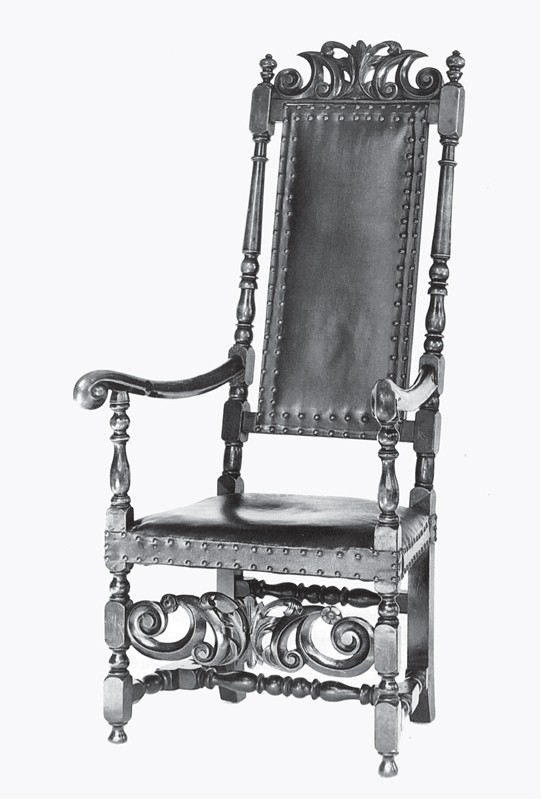
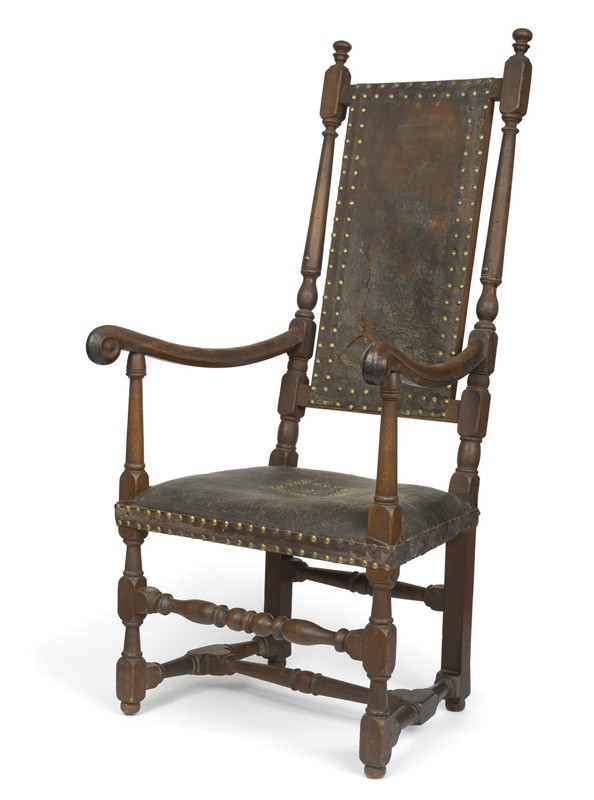
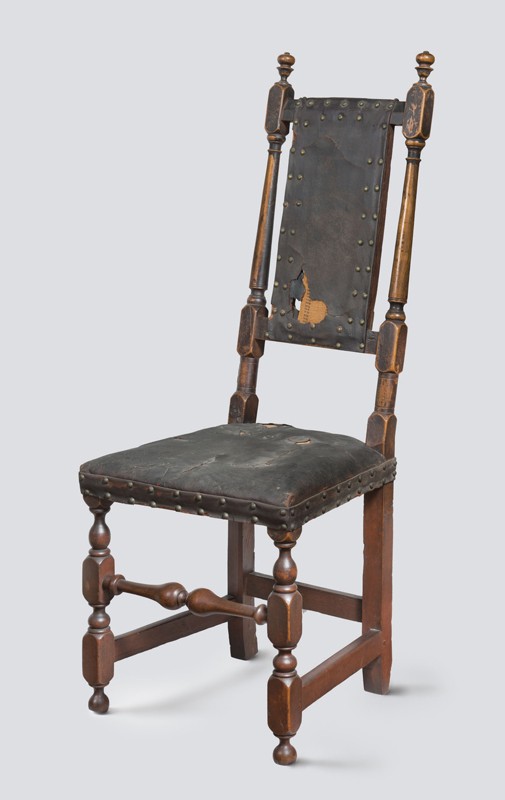
  • Figure 3
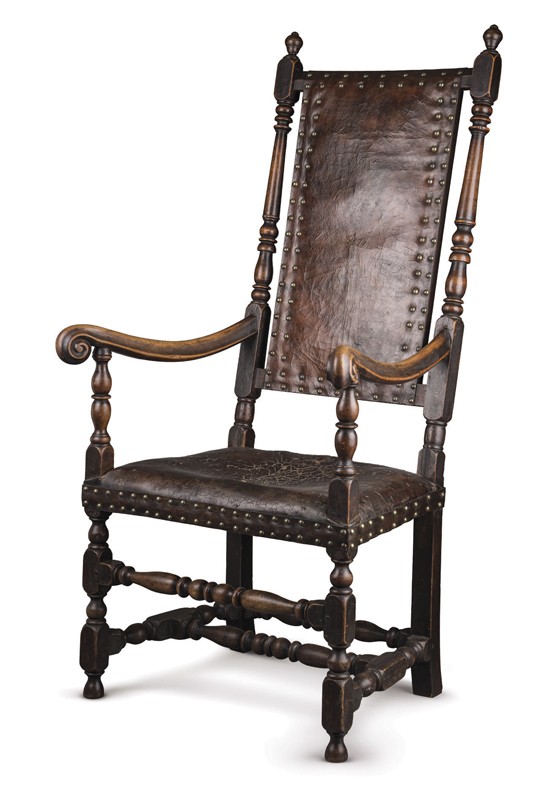
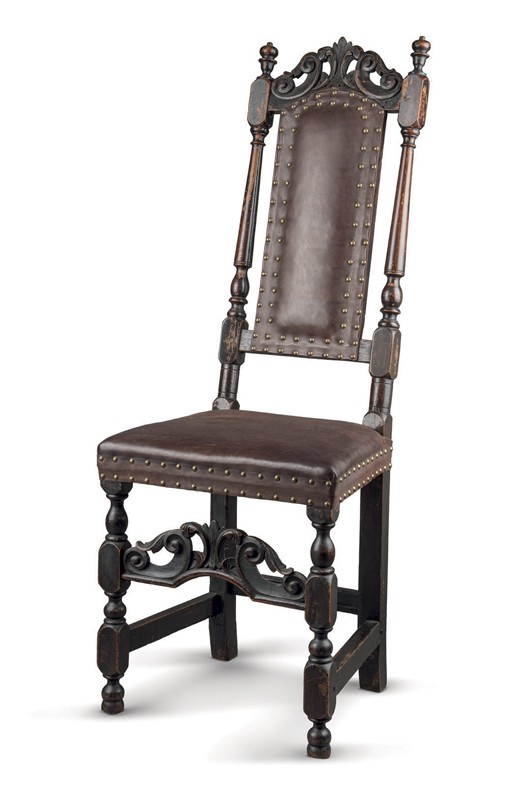
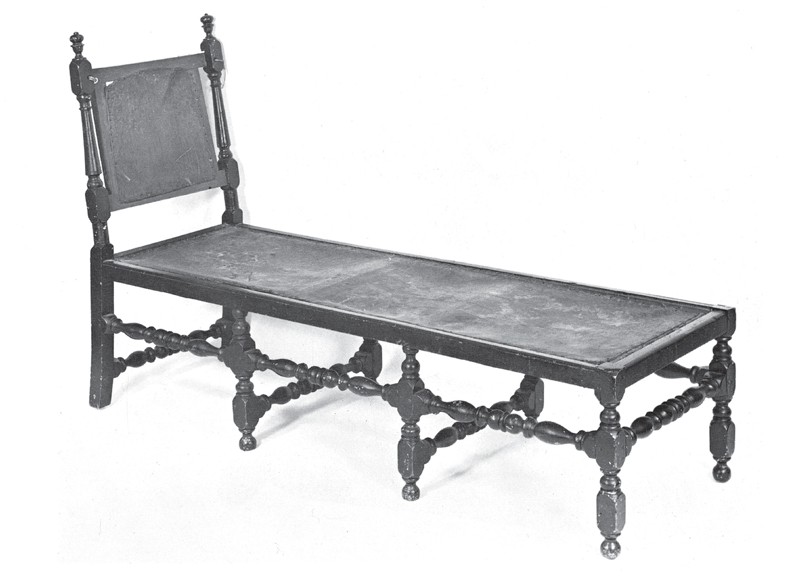
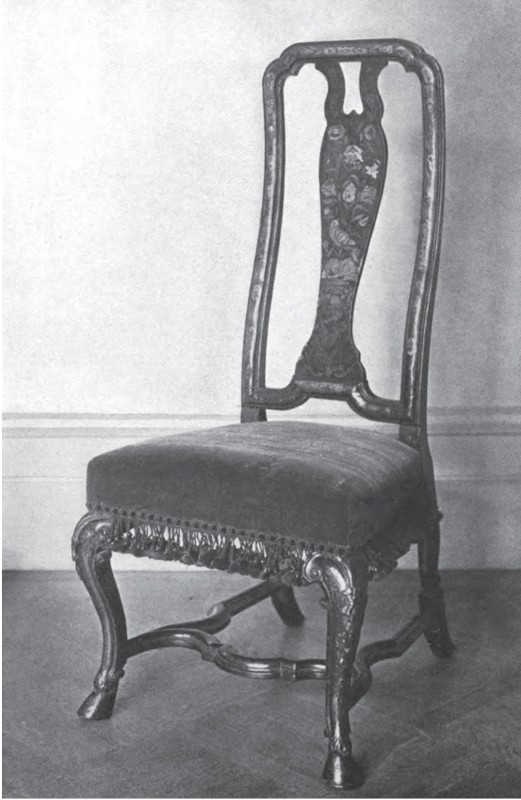
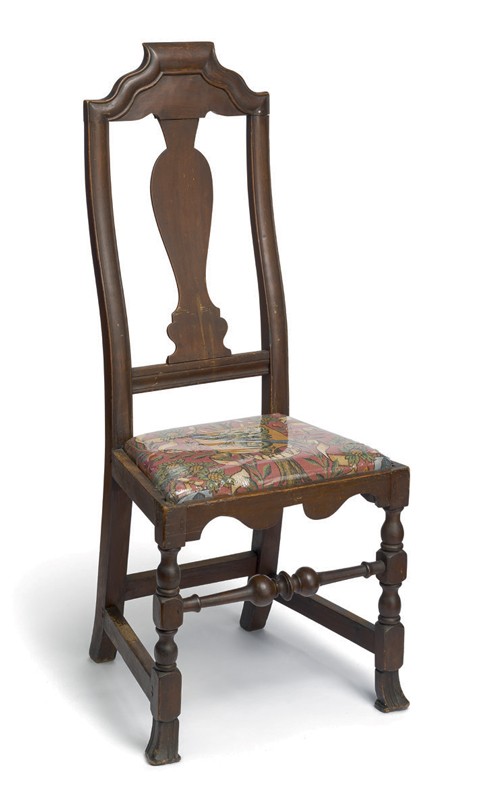
    Figure 3

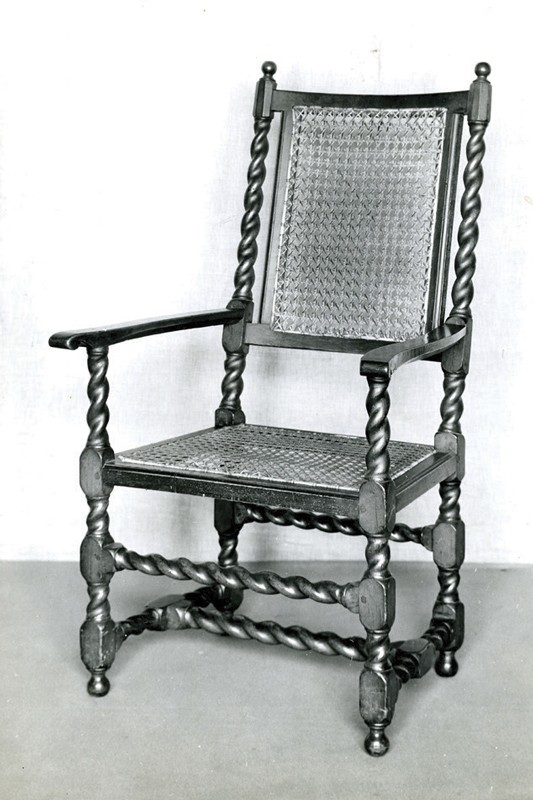
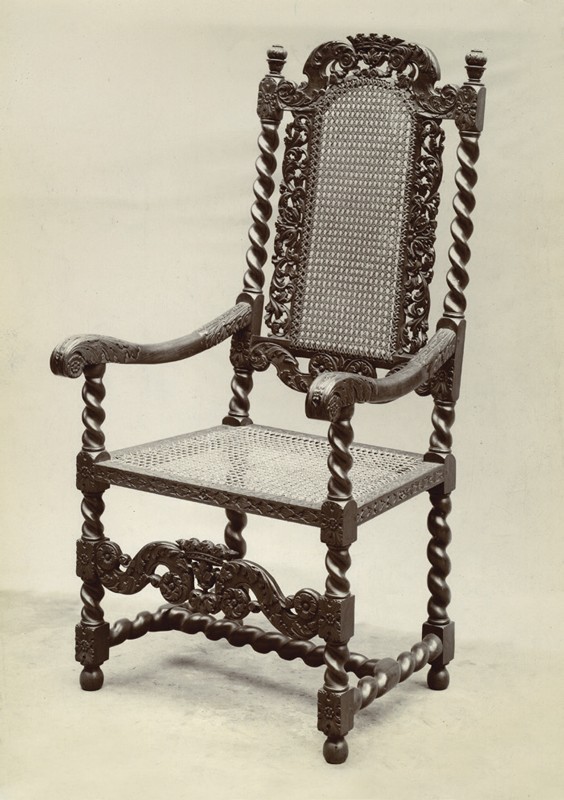
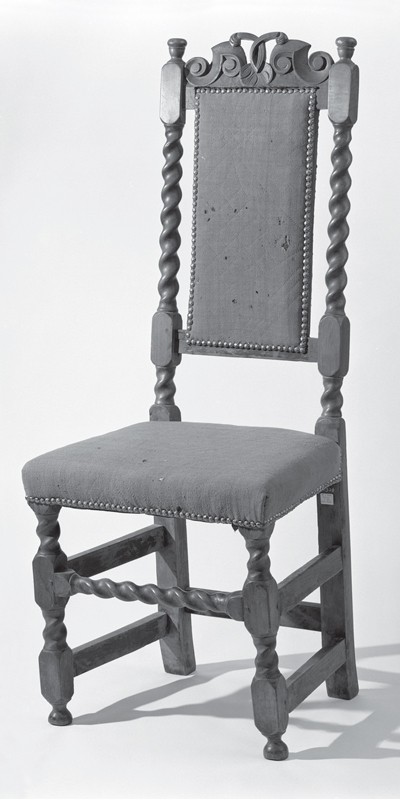
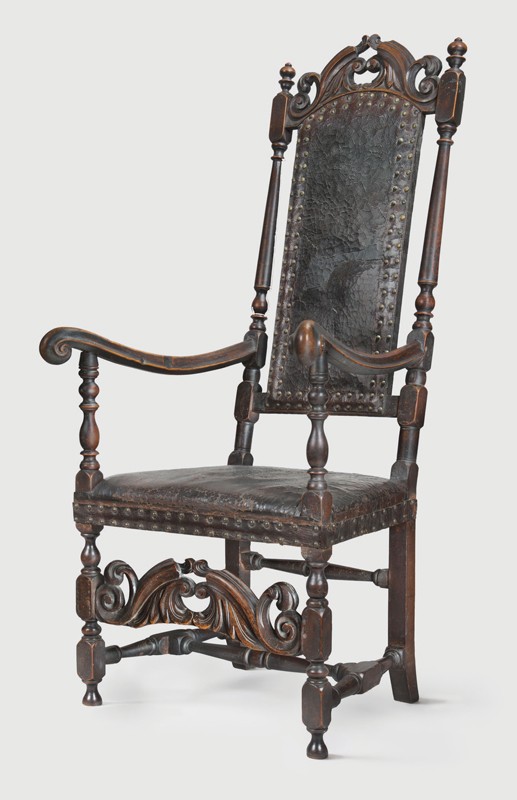
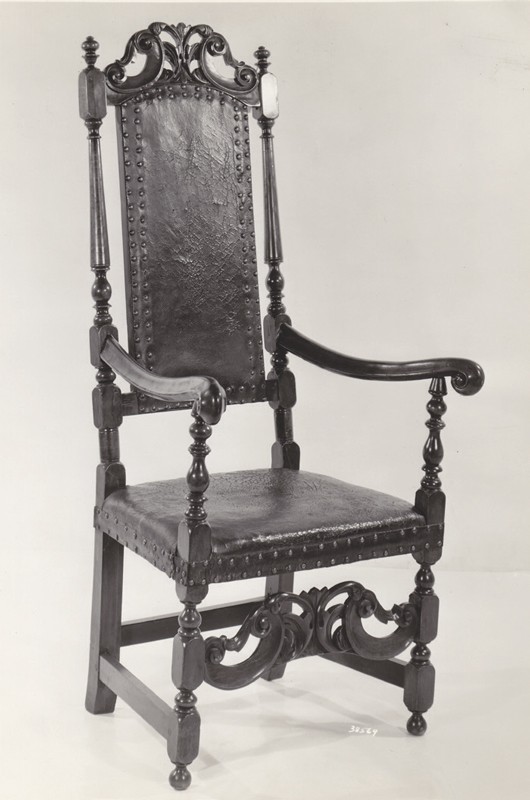
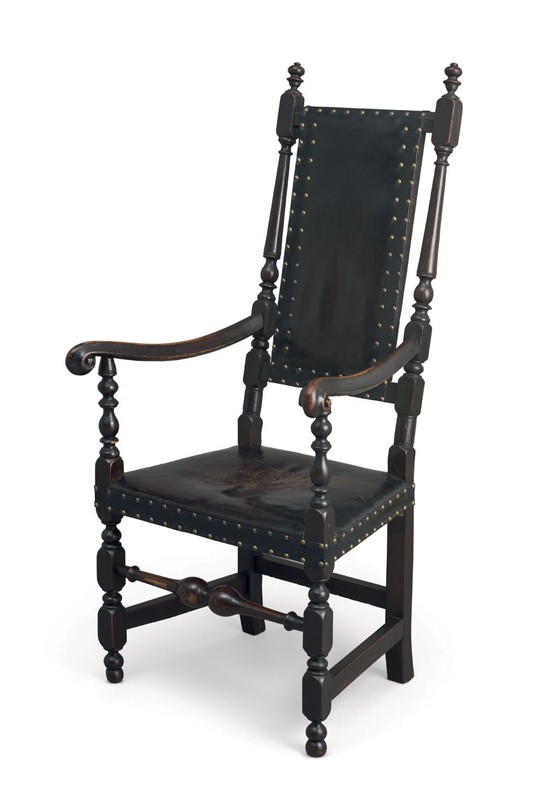
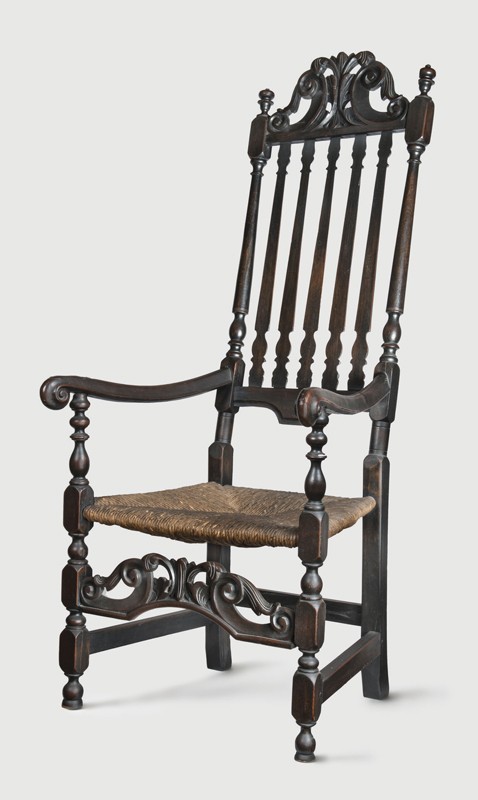
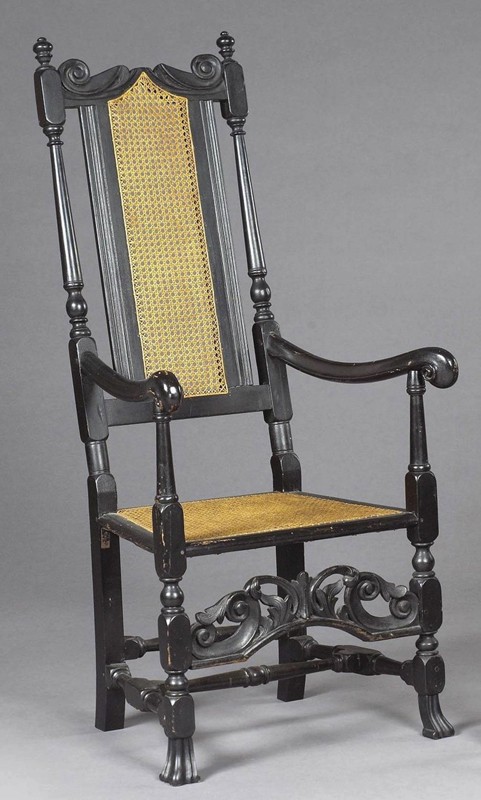
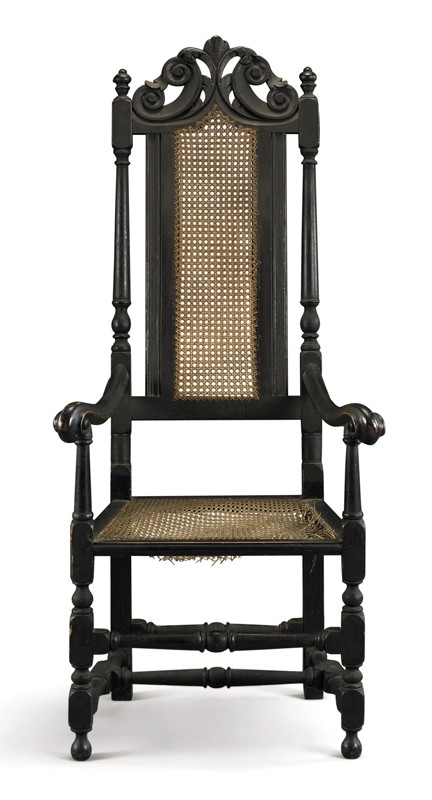
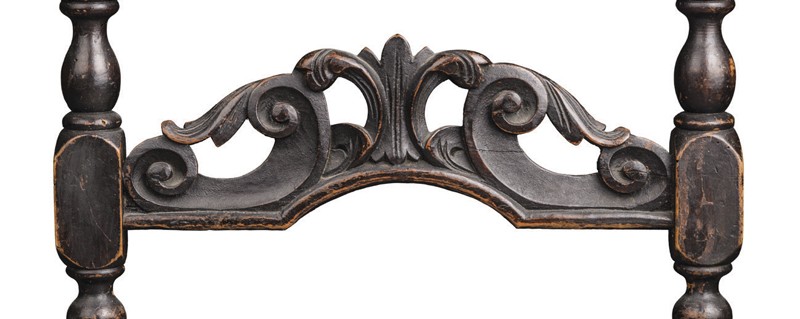
    Armchair, probably London, 1685–1700. Woods and dimensions not recorded. (Photo, Symonds Collection, Decorative Arts Photographic Collection, Winterthur Library.) The back rails of this chair have a noticeable curve or hollow.

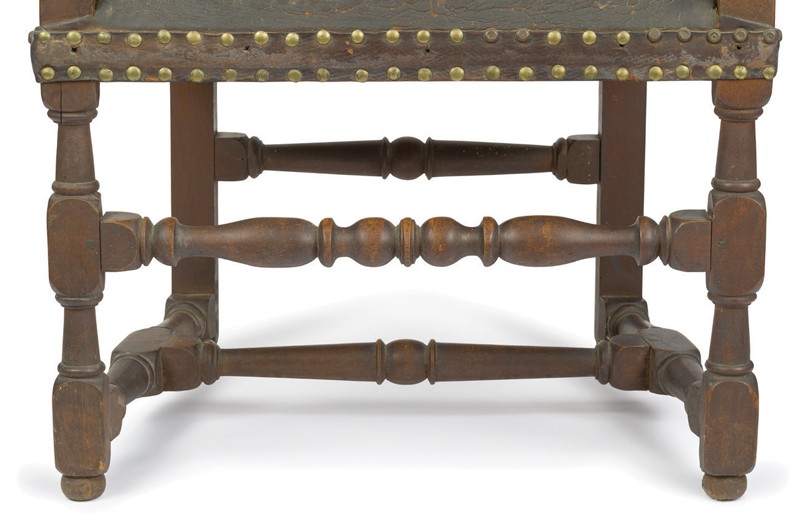
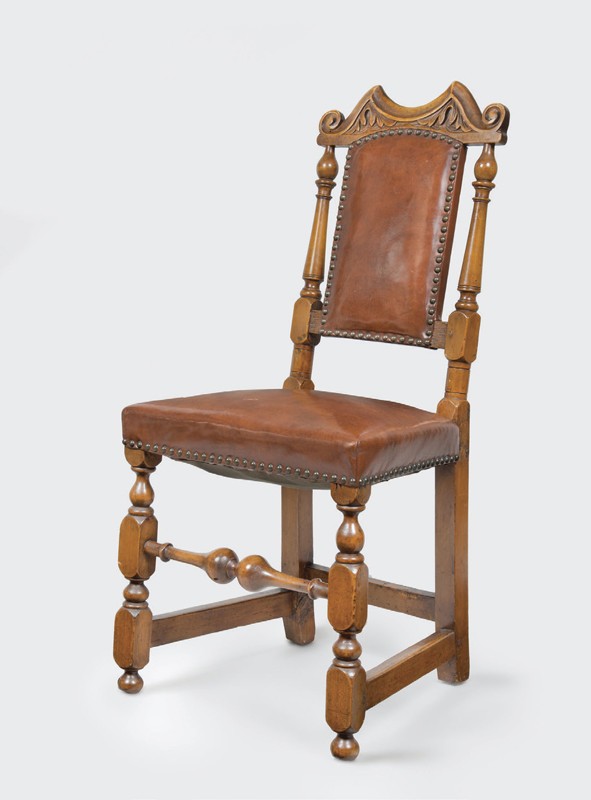
  • Figure 4
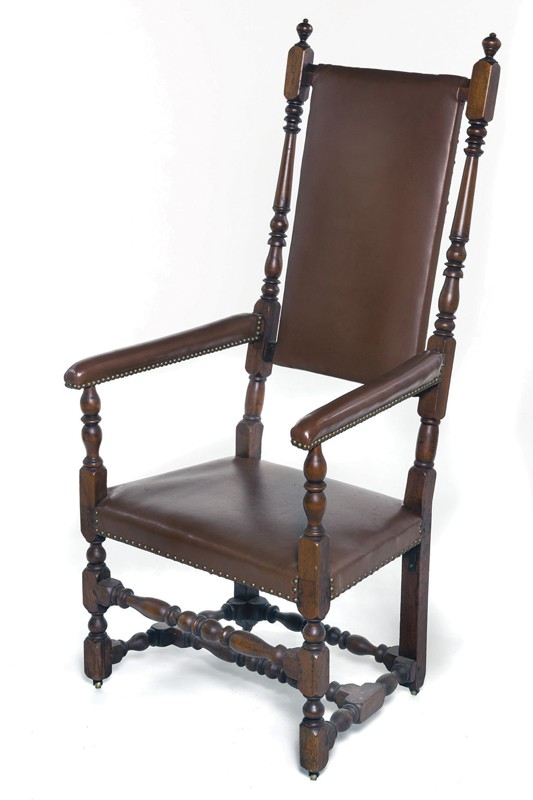
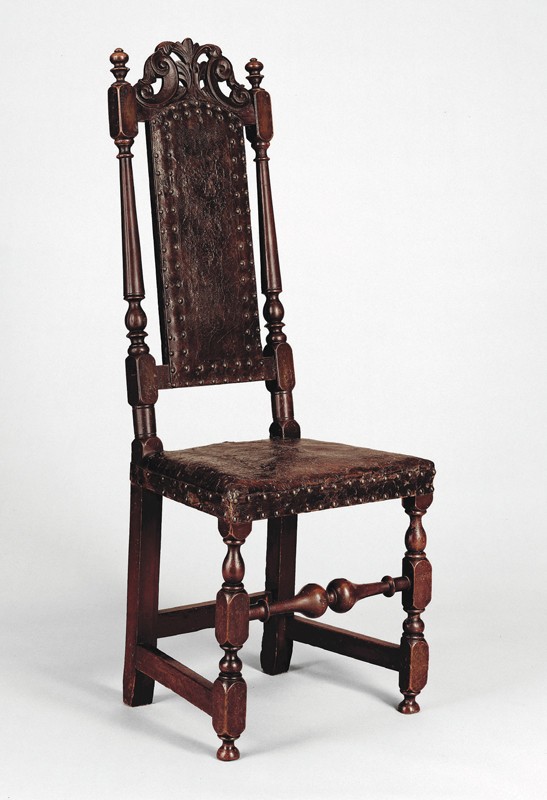
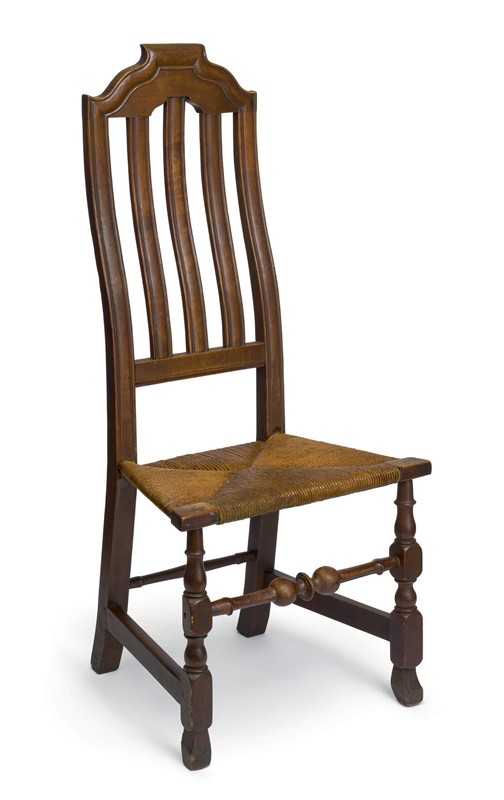
    Figure 4

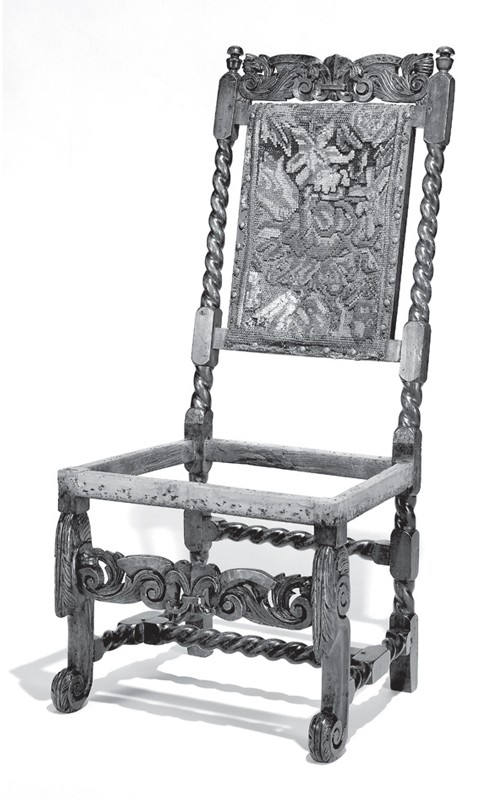
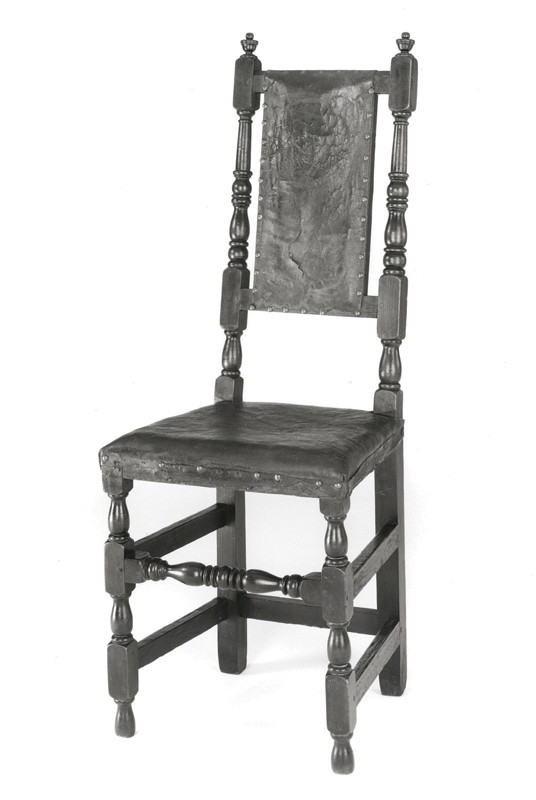
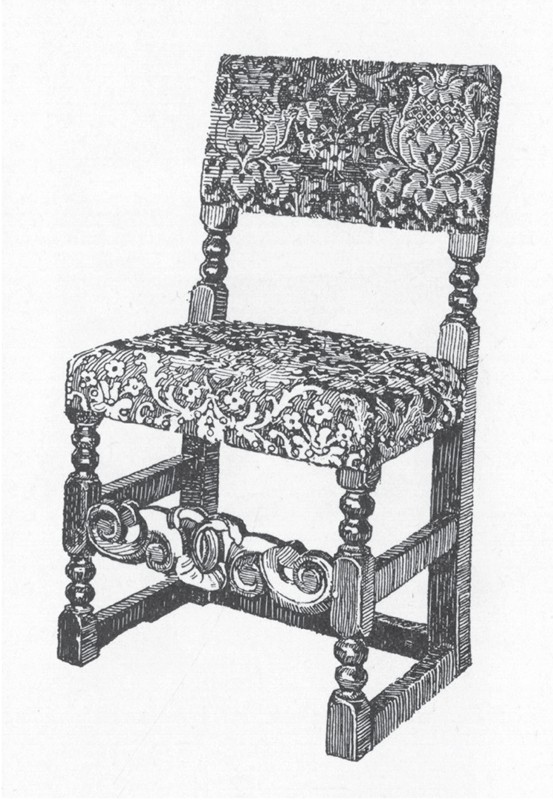
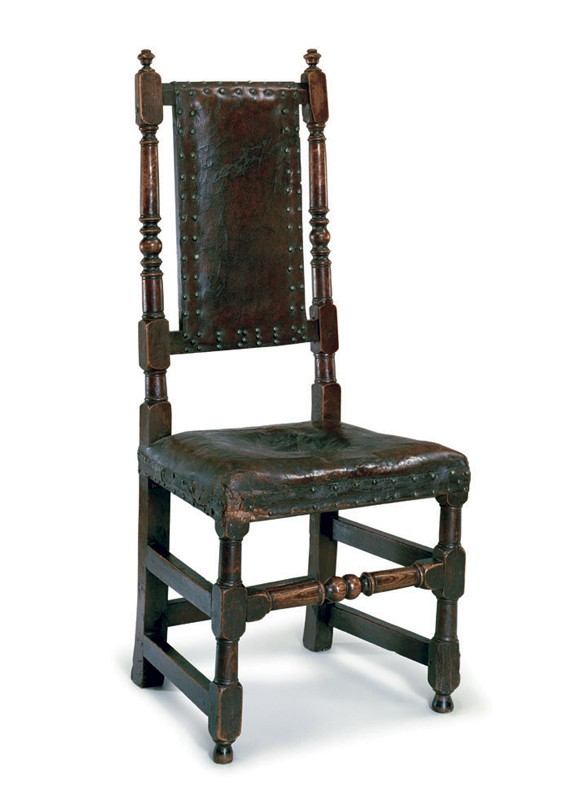
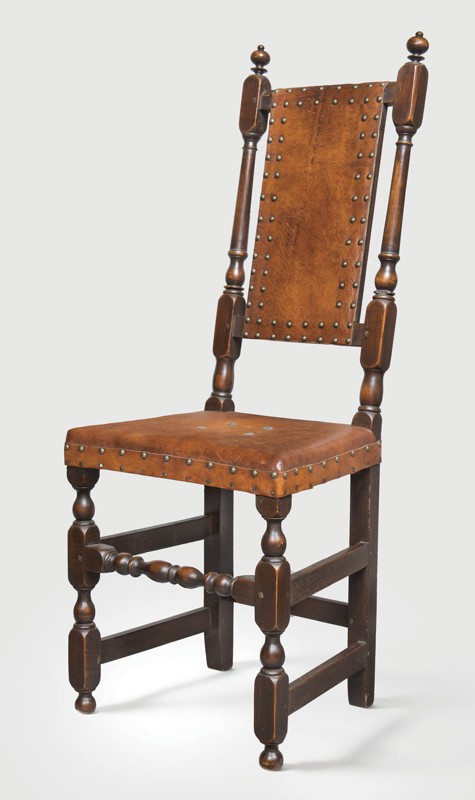
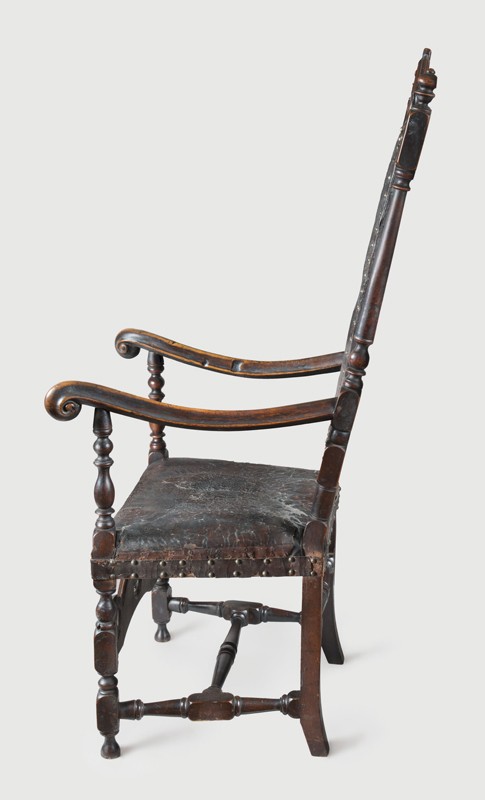
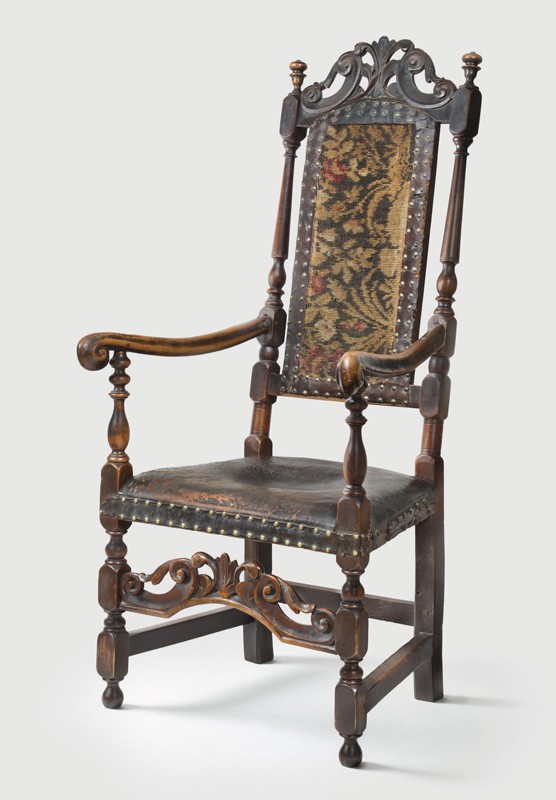
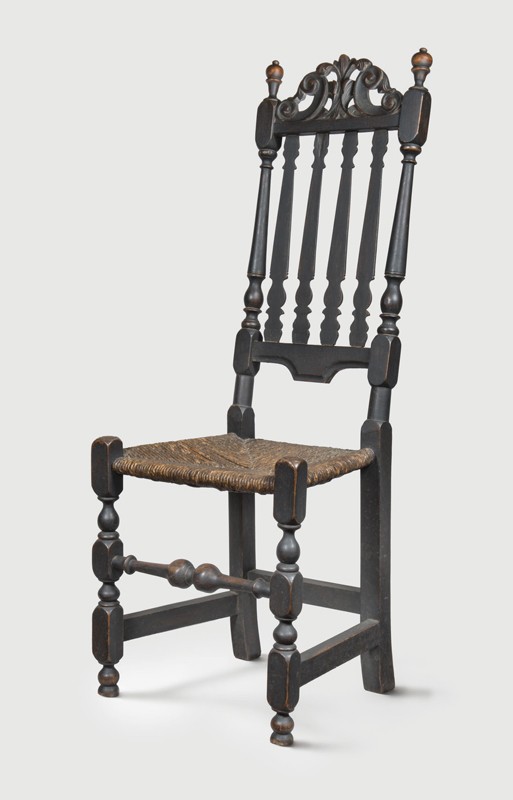
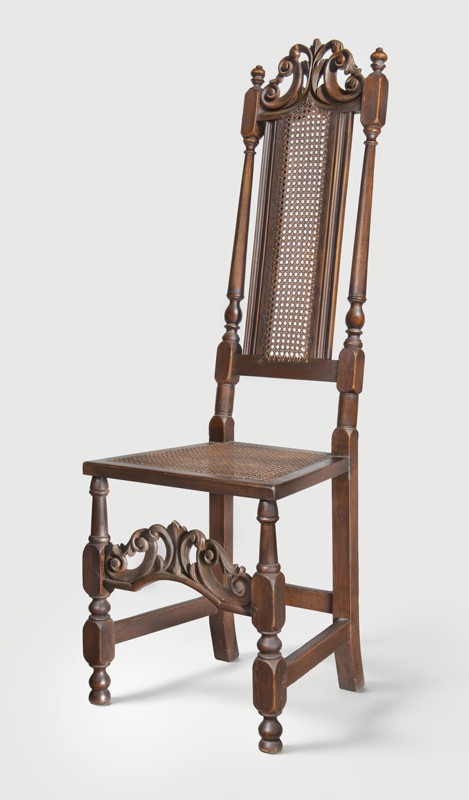
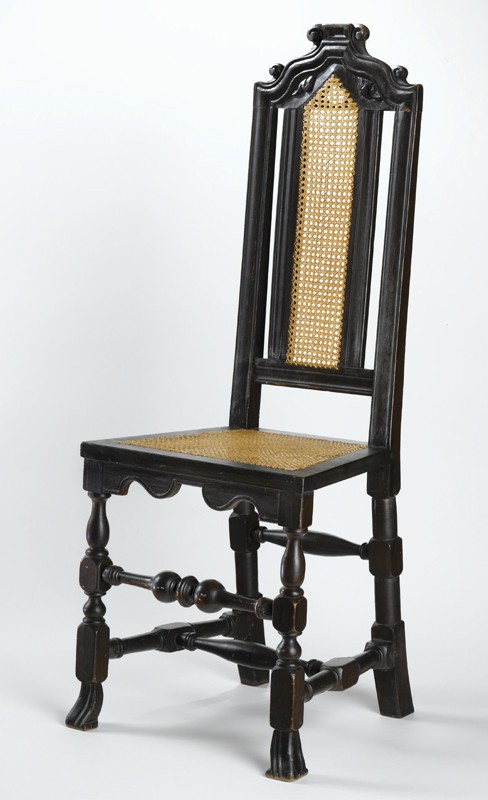
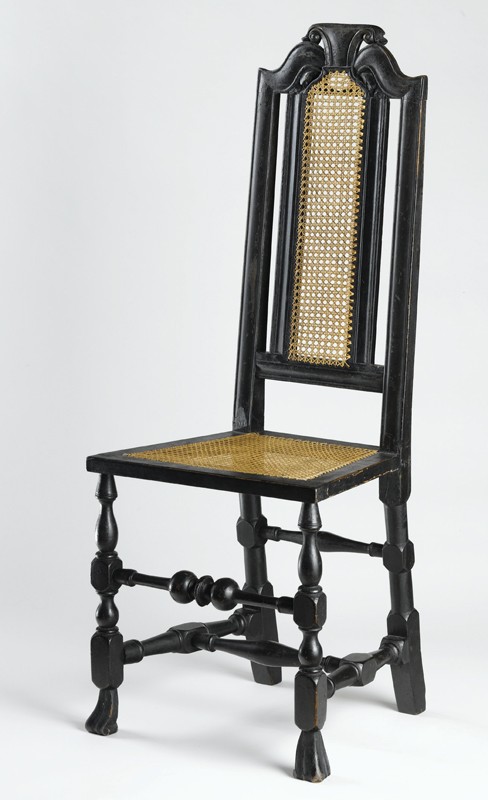
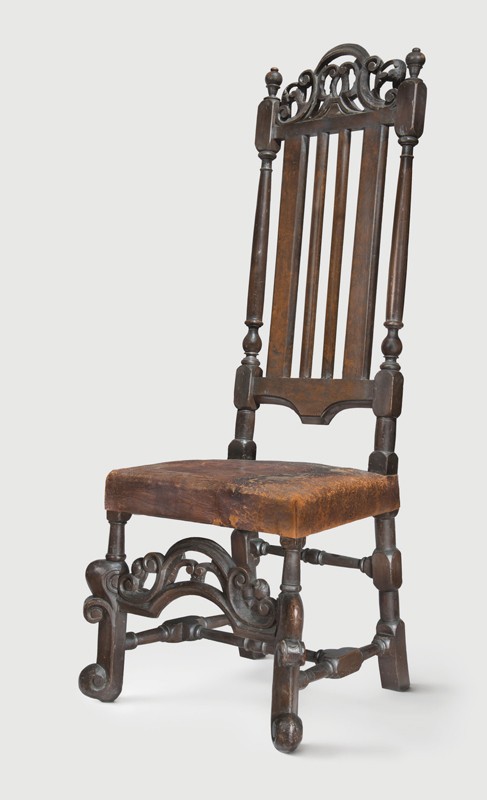
    Side chair, probably London, 1685–1700. Beech; original turkeywork upholstery. H. 48 5/8". (Courtesy, Museum of Fine Arts, Boston, gift of Mrs. Winthrop Sargent in memory of her husband Jun, 17.1629.)

  • Figure 5
    Figure 5

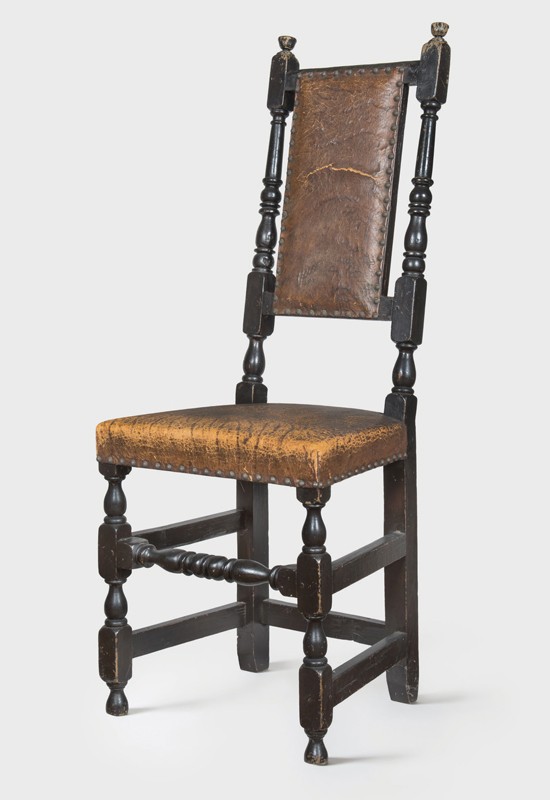
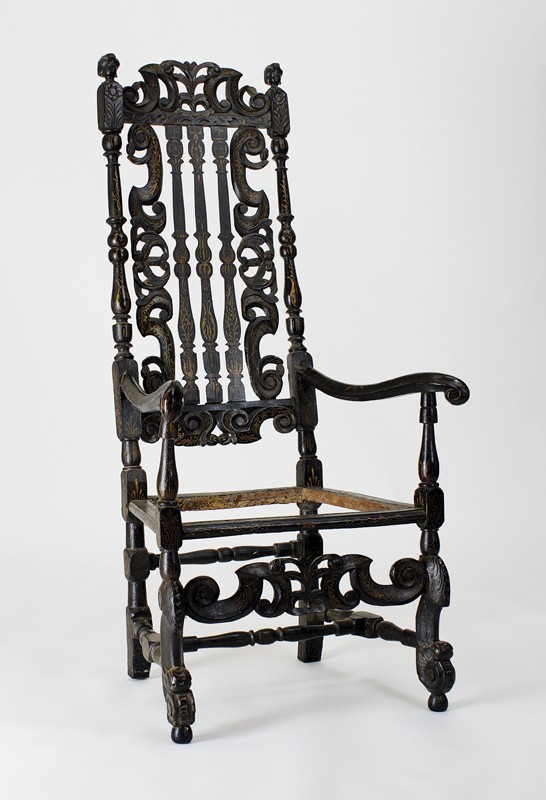
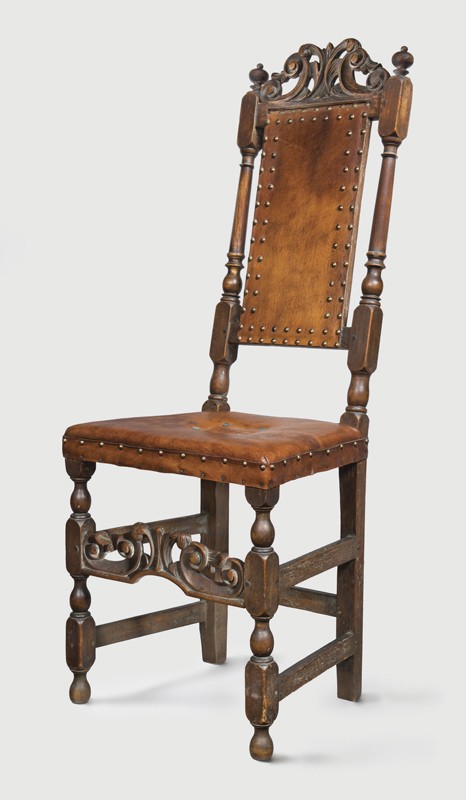
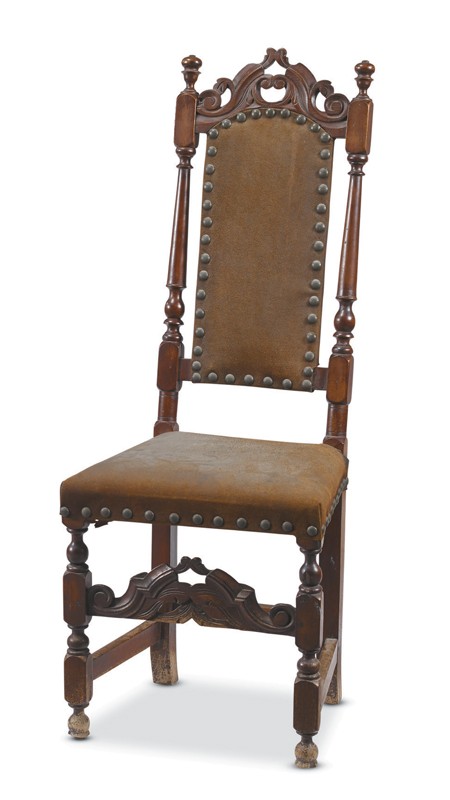
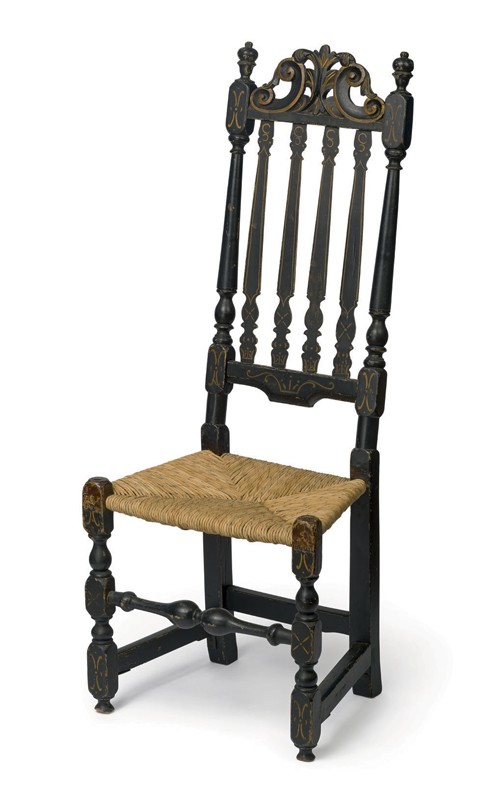
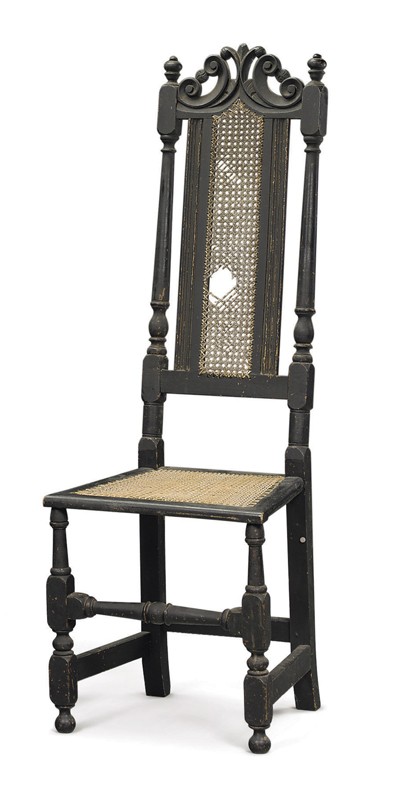
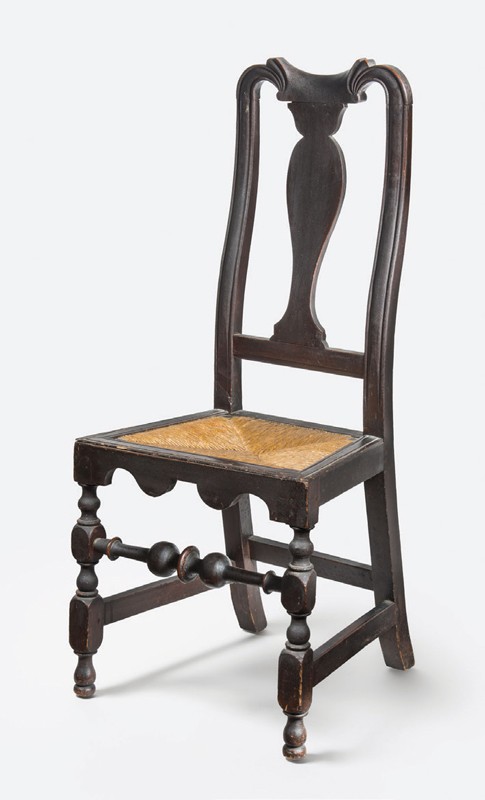
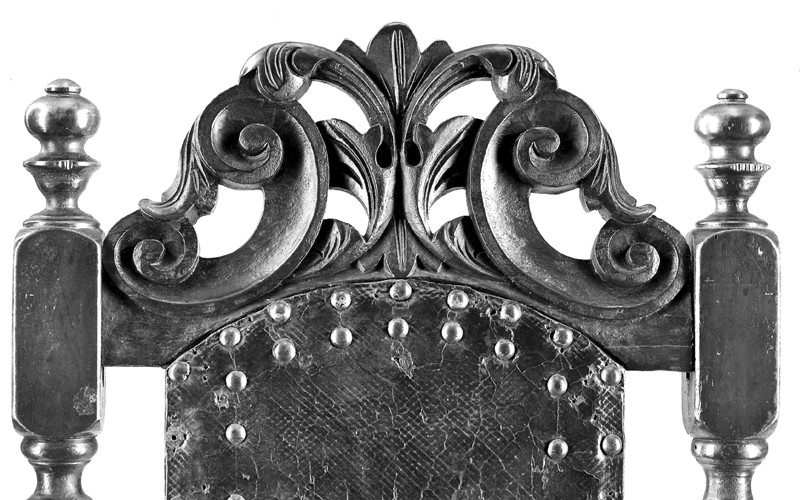
    Side chair, probably London, 1685–1700. Woods and dimensions not recorded; original leather upholstery. (Photo, Symonds Collection, Decorative Arts Photographic Collection, Winterthur Library.) The crest and lower back rails have a noticeable curve or hollow. The turnings on the back posts closely relate to those present on group B chairs (fig. 13).

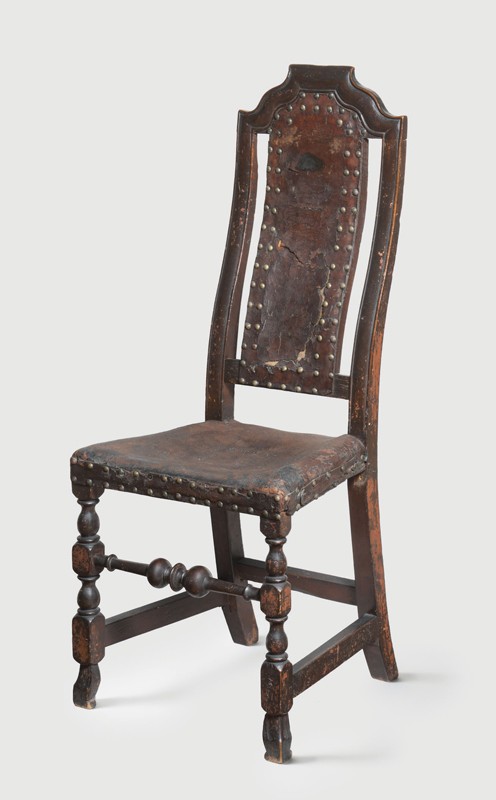
  • Figure 6
    Figure 6

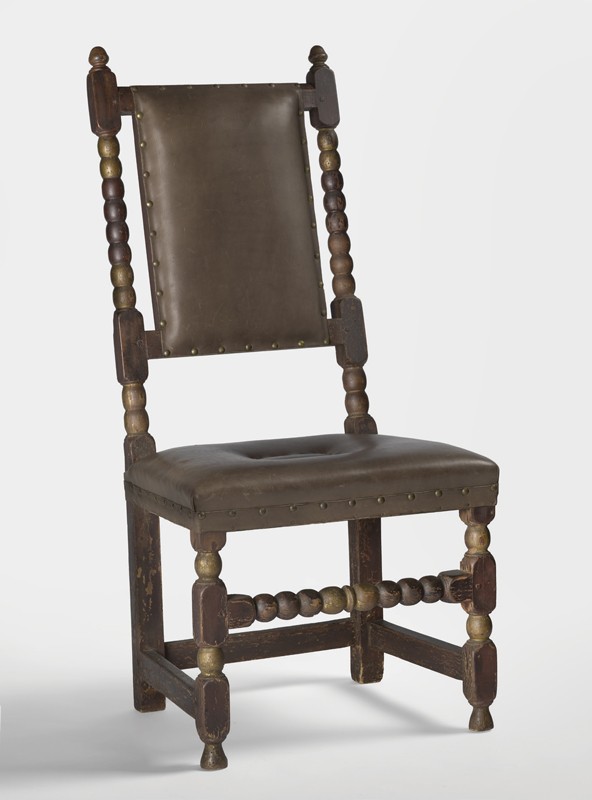
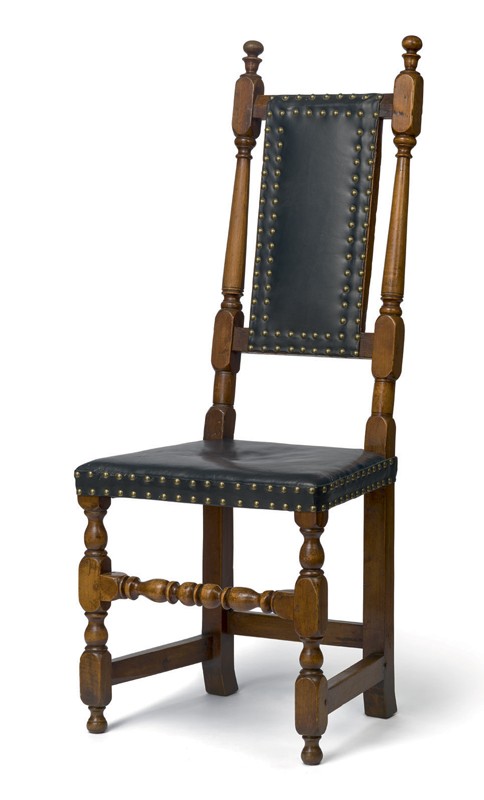
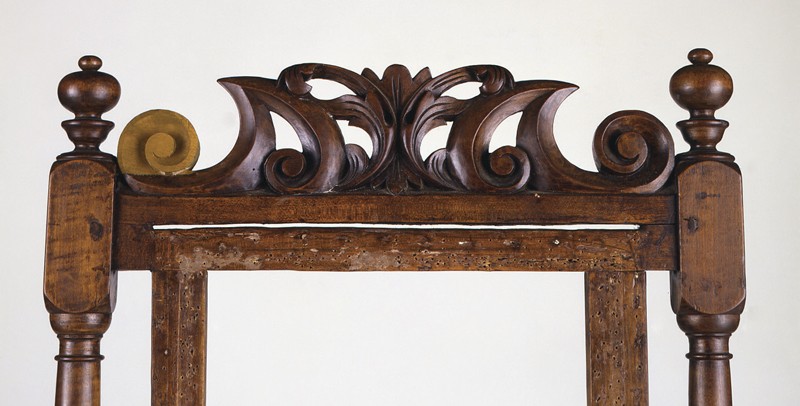
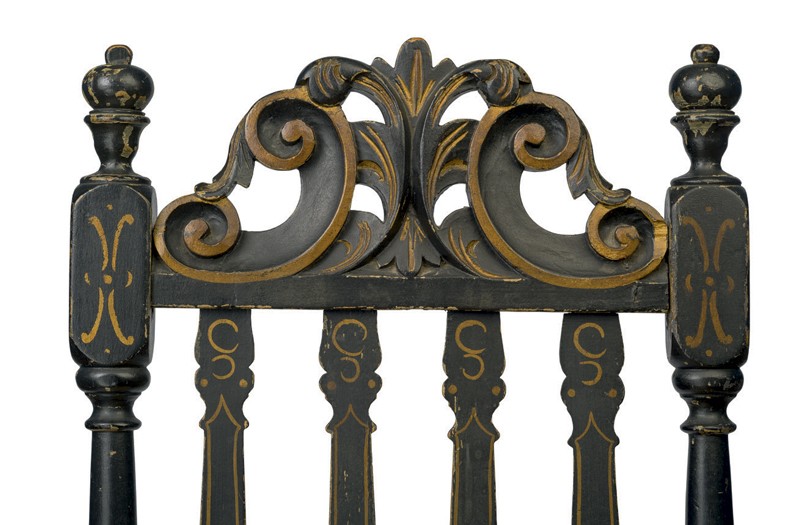
    Side chair, Boston, Massachusetts, 1685–1705. Maple and oak. H. 42", W. 20", D. 20 1/2". (Courtesy, Anne H. and Frederick Vogel III Collection for the Philadelphia Museum of Art, acc. no. 188-2016-8.) The gilding was added in the nineteenth century. This chair is the only example of the group with a single side stretcher.

  • Figure 7
    Figure 7

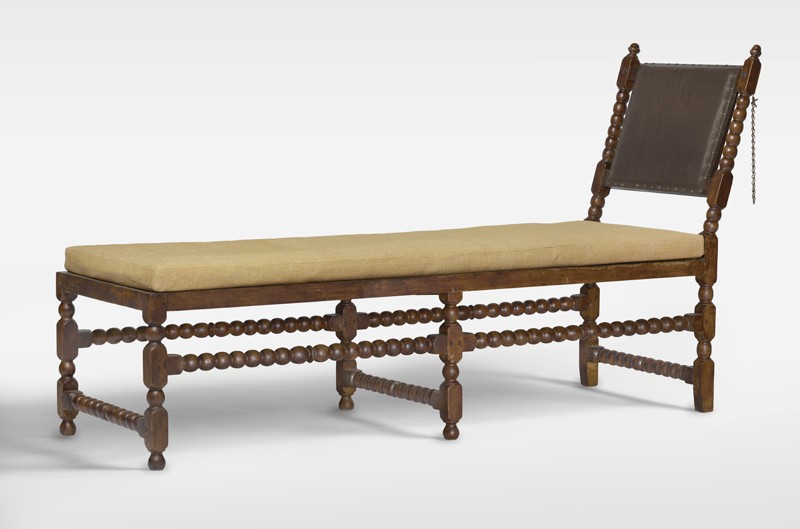
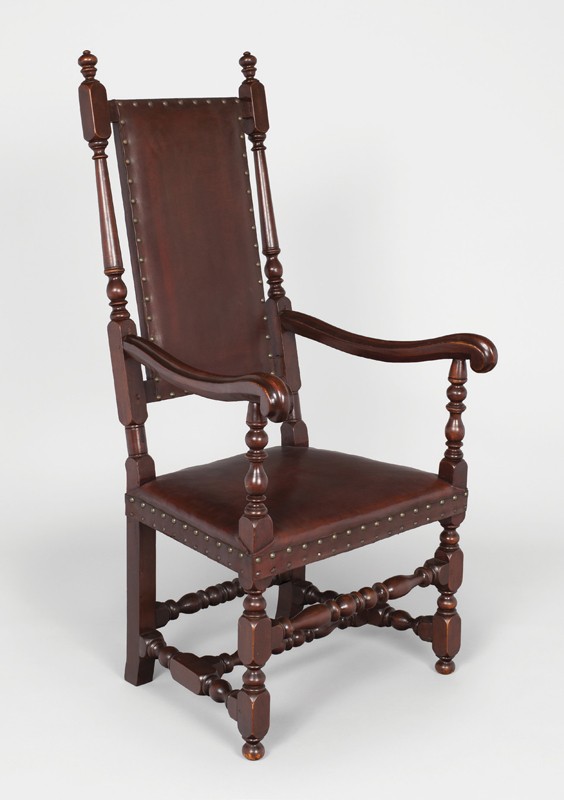
    Couch, Boston, Massachusetts, 1685–1705. Maple and oak. H. 38", W. 21 1/2", D. 84". (Courtesy, Anne H. and Frederick Vogel III Collection for the Philadelphia Museum of Art, acc. no. 188-2016-9.) This is the only ball-turned couch known, and it may have been made en suite with the side chair illustrated in fig. 6.

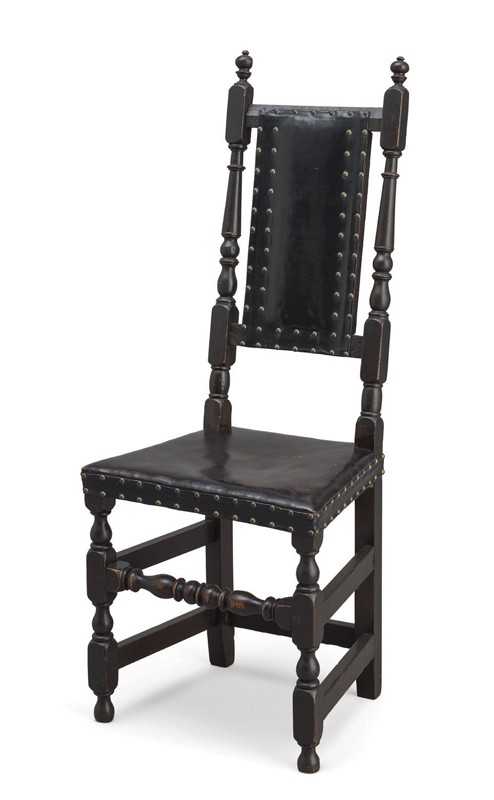
  • Figure 8
    Figure 8

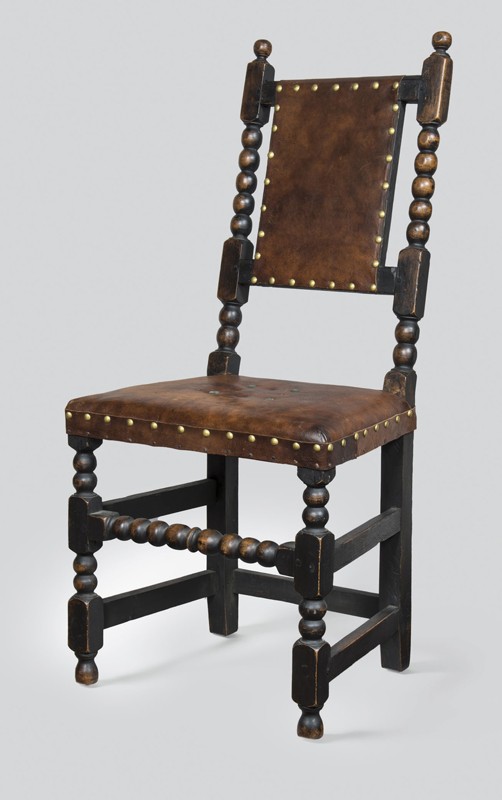
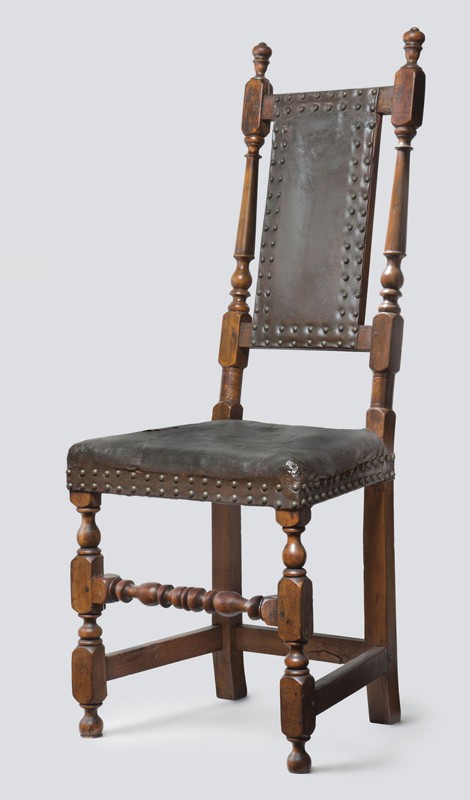
    Side chair, Boston, Massachusetts, 1685–1705. Maple and oak. H. 41 3/8", W. 19 1/2", D. 15". (Private collection; photo, Gavin Ashworth.) The back dimensions are the same as those of low-back chairs, but the orientation is vertical rather than horizontal. The nailing pattern, with brass-headed nails at the top and wrought iron tacks at the bottom, is commonly found on Cromwellian chairs.

  • Figure 9
    Figure 9

    Side chair, England, 1675–1695. Oak. H. 43", W. 21 1/2". (Courtesy, Victoria and Albert Museum, London, W.29-1928.) The feet are missing.

  • Figure 10
    Figure 10

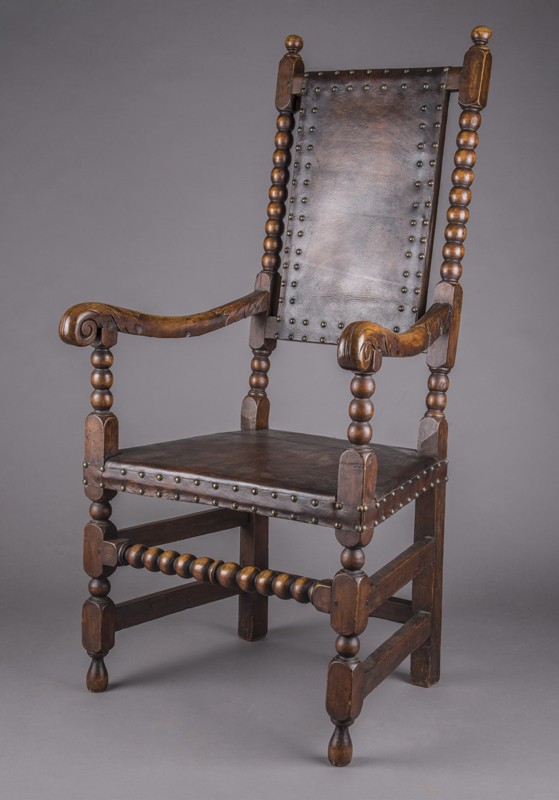
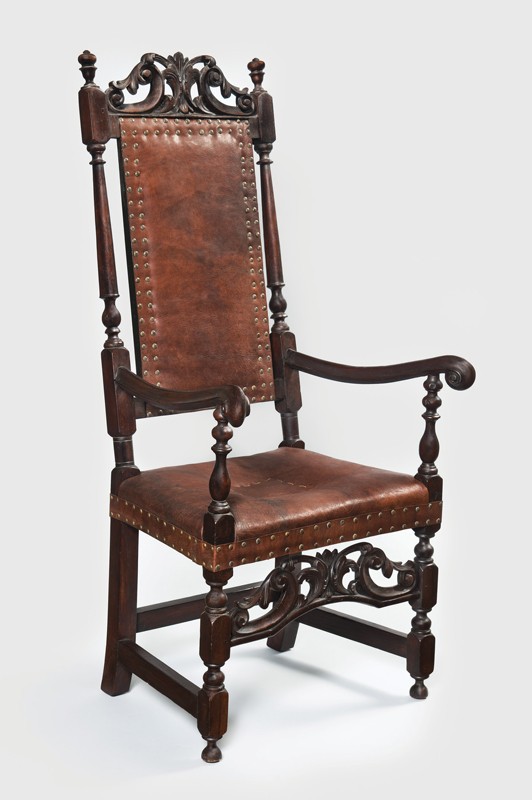
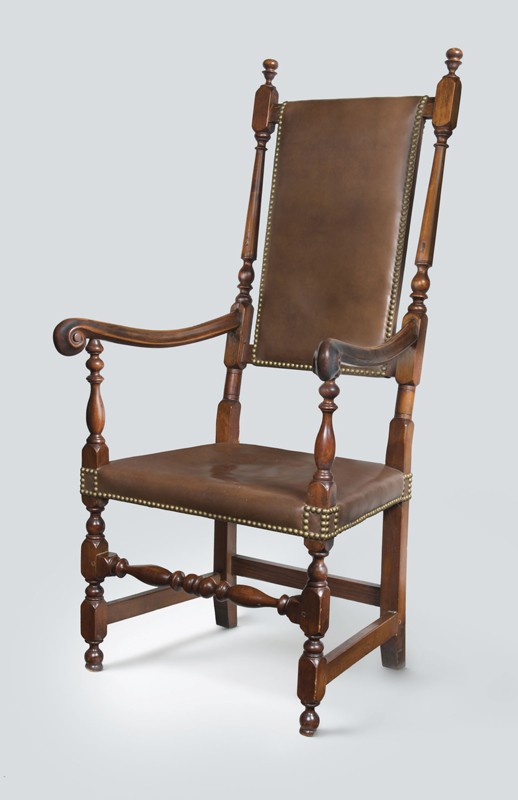
    Armchair, Boston, Massachusetts, 1685–1705. Maple and oak. H. 48 3/4", W. 23 1/2", D. 18". (Private collection; photo, Jim Wildeman.) The arms of this chair are carved with leafage and relate to those on contemporaneous English chairs like the one shown in fig. 12. The finials are identical to those on the side chair illustrated in fig. 8. The feet are restored.

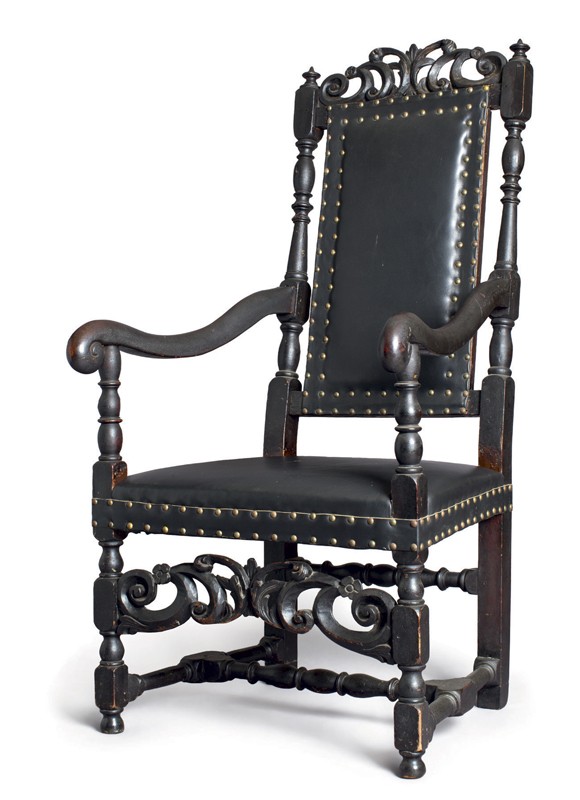
  • Figure 11
    Figure 11

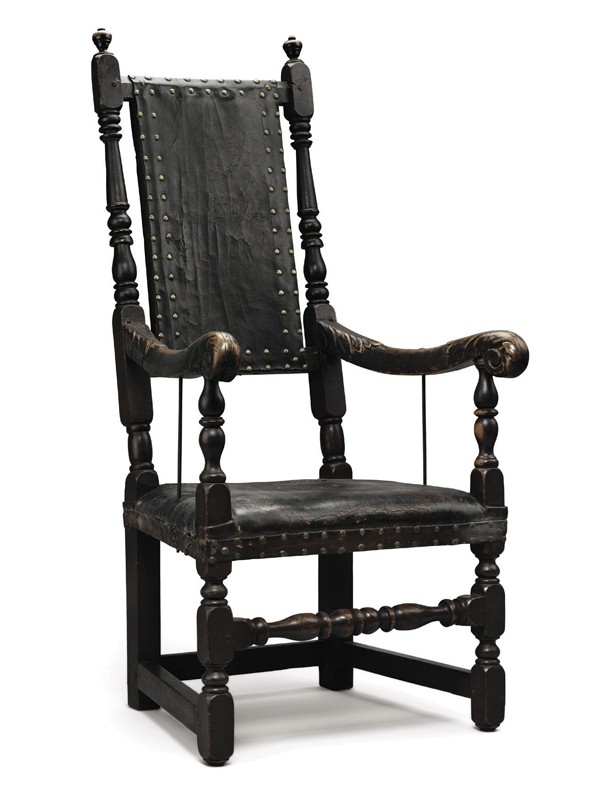
    Armchair, Boston, Massachusetts, 1695–1710. Maple and oak; original leather upholstery. H. 47 1/2", W. 23 3/4", D. 17 3/4". (Courtesy, Museum of Fine Arts, Boston; Arthur Tracy Cabot Fund, 1971.624.) The iron rods in the arms are a nineteenth-century addition, and the feet are missing but would have been like those on the side chair illustrated in fig. 16.

  • Figure 12
    Figure 12

    Armchair, probably London, 1685–1700. Woods and dimensions not recorded. (Photo, Symonds Collection, Decorative Arts Photographic Collection, Winterthur Library.)

  • Figure 13
    Figure 13

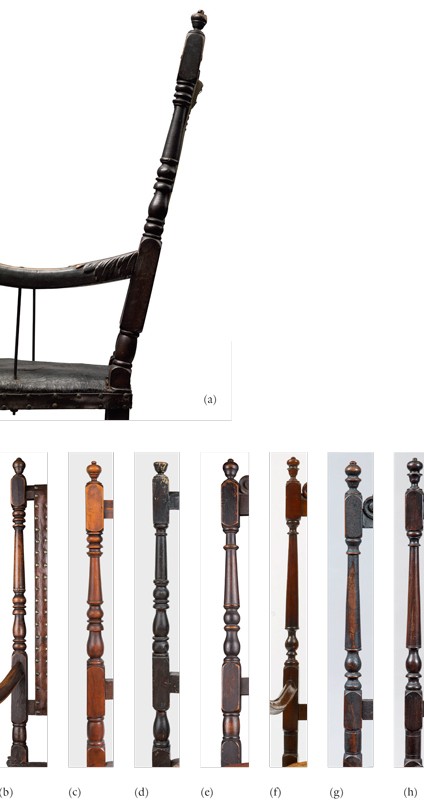
    Composite illustration showing the rear post of the
    (a) Group B armchair with foliate carved arms illustrated in fig. 11;
    (b) Group B armchair illustrated in fig 18;
    (c) Group B side chair illustrated in fig. 17;
    (d) Group B side chair illustrated in fig. 24;
    (e) Group C side chair illustrated in fig. 31;
    (f) Group D armchair illustrated in fig. 45;
    (g) Group E side chair illustrated in fig. 56;
    (h) Group F side chair illustrated in fig. 69.

  • Figure 14
    Figure 14

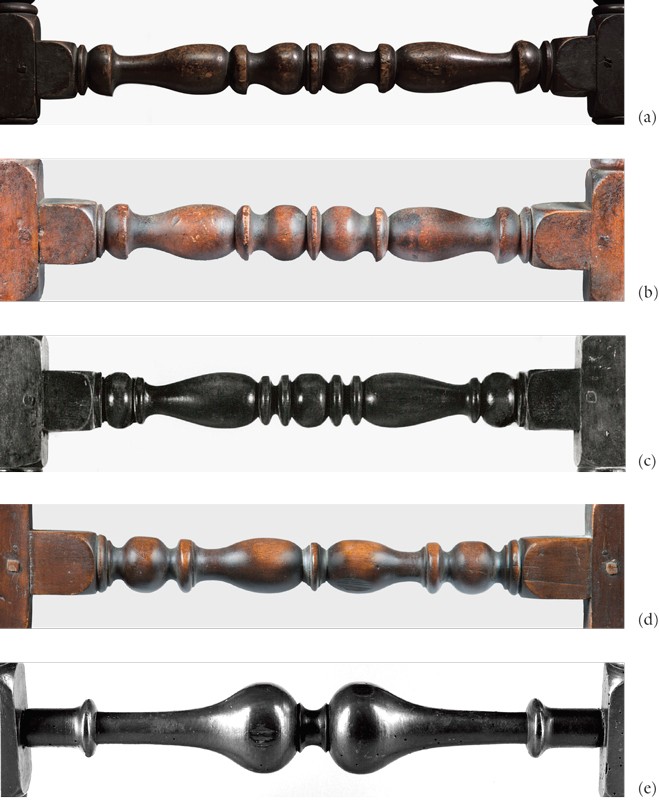
    Composite illustration showing the front stretchers of the
    (a) Group B armchair with foliate carved arms illustrated in fig. 11;
    (b) Group B side chair illustrated in fig. 16;
    (c) Group B side chair illustrated in fig. 23;
    (d) New York side chair illustrated in fig. 51;
    (e) Group E side chair illustrated in fig. 72.

  • Figure 15
    Figure 15

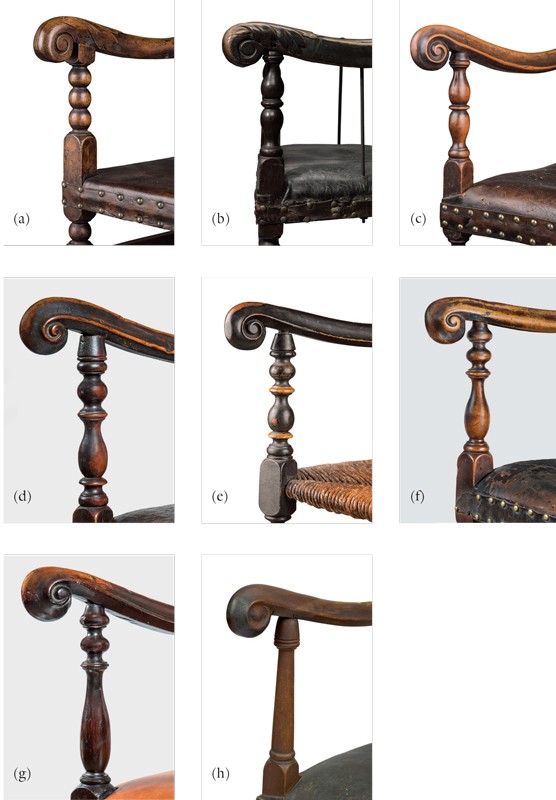
    Composite illustration showing the arm support of the
    (a) Group A armchair with foliate carved arms illustrated in fig. 10;
    (b) Group B armchair with foliate carved arms illustrated in fig. 11;
    (c) Group B armchair with scroll-carved arms illustrated in fig. 18;
    (d) Group D armchair illustrated in fig. 53;
    (e) Group E armchair illustrated in fig. 88;
    (f) Group E armchair illustrated in fig. 60;
    (g) Group F armchair illustrated in fig. 112;
    (h) Group C armchair illustrated in fig. 38 (arm scroll terminals replaced).

  • Figure 16
    Figure 16

    Side chair, Boston, Massachusetts, 1695–1710. Maple and oak. H. 46 5/8", W. 18 1/4", D. 15". (Private collection; photo, Gavin Ashworth.) This side chair has rear posts identical to those of the chairs illustrated in figs. 11, 17, 18, and 20, absent the ring and compressed ball directly below the lowermost baluster turning.

  • Figure 17
    Figure 17

    Side chair, Boston, Massachusetts, 1695–1710. Maple and oak. H. 43 3/8", W. 17 5/8", D. 14 3/8". (Courtesy, Winterthur Museum, bequest of H. F. du Pont; photo, Gavin Ashworth.)

  • Figure 18
    Figure 18

    Armchair, Boston, Massachusetts, 1695–1710. Maple and oak; original leather upholstery on the seat. H. 51 3/4", W. 24 1/2", D. 17 1/2". (Private collection; photo, Jim Wildeman.)

  • Figure 19
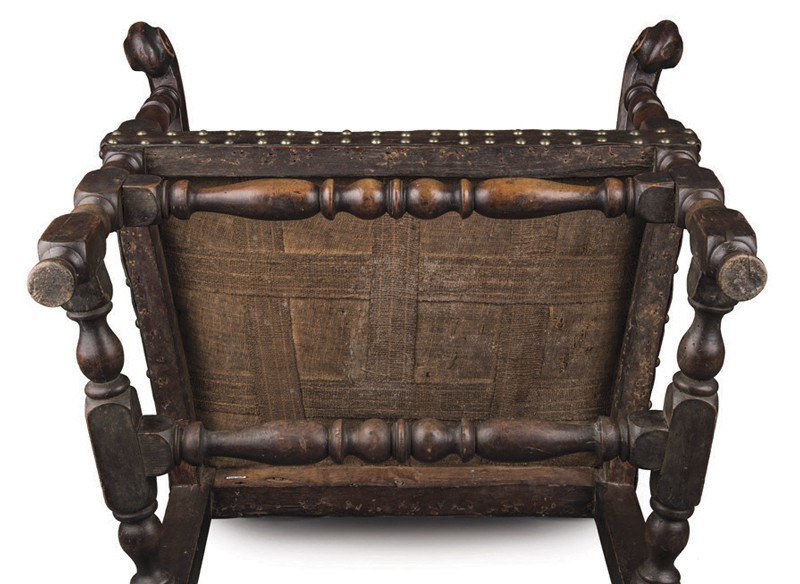
    Figure 19

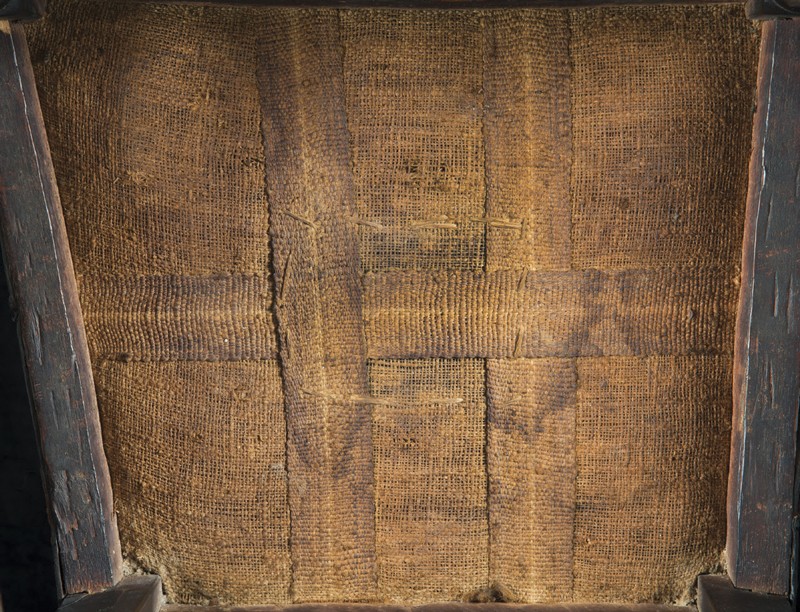
    Detail of the stretchers and the original webbing and sackcloth under-upholstery of the armchair illustrated in fig. 18. Three webbing strips are placed front to back and are woven between the two side-to-side strips. This orientation of webbing was the standard arrangement used by Boston and New York upholsterers. Uncommon are the outer front-to-back strips angled at the same degree as the side seat rails.

  • Figure 20
    Figure 20

    Armchair, Boston, Massachusetts, 1695–1710. Maple and oak. H. 51", W. 23", D. 17". (Courtesy, Historic Huguenot Street, New Paltz, N.Y., gift of Alice Hasbrouck, 1999.7240.01.) The  arms are replaced, and the feet are missing. This chair descended through the Hardenbergh family and was owned originally by Johannes Hardenbergh (ca. 1670–1745) of Ulster County, New York.

  • Figure 21
    Figure 21

    Side chair, Boston, Massachusetts, 1695–1710. Maple and oak. H. 44 5/8", W. 18 5/8", D. 16 5/8". (Courtesy, Saint Louis Art Museum, gift of Mr. and Mrs. Edward J. Nusrala, 249:1989.) The barrel turning above the seat is scored at its widest point. The urn finials diverge from the standard “muffin” variety.

  • Figure 22
    Figure 22

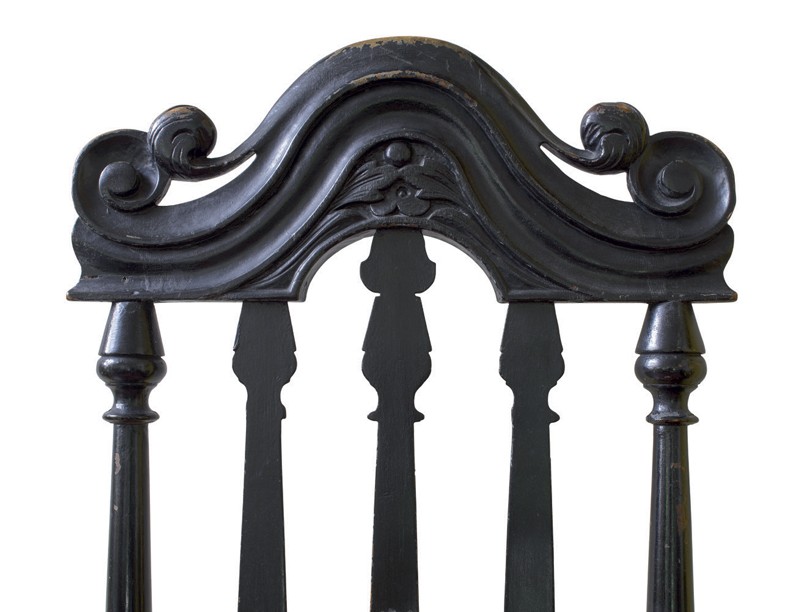
    Side chair, Boston, Massachusetts, 1695–1710. Maple. H. 45 5/8", W. 18 1/8", D. 15 1/4". (Courtesy, Milwaukee Art Museum, Layton Art Collection, L1982.116; photo, Richard Eells.) This chair descended in the family of artist Pieter Vanderlyn (ca. 1687–1778) of Kingston, New York. Pieter immigrated to New York City from the Netherlands in 1718. His arrival date suggests he acquired the chair from an earlier owner. The top and lower back rail have a noticeable curve or hollow.

  • Figure 23
    Figure 23

    Side chair, probably Boston, Massachusetts, 1700–1720. Maple and oak; original leather upholstery. H. 47 3/4", W. 18 1/2", D. 18 3/4". (Chipstone Foundation; photo, Gavin Ashworth.) This chair’s leather trim strip was secured with brass nails along the top edge and wrought iron tacks along the lower edge.

  • Figure 24
    Figure 24

    Side chair, probably Boston, Massachusetts, 1695–1710. Maple and oak. H. 43 5/8", W. 17 5/8", D. 14 3/4". (Courtesy, Winterthur Museum, bequest of H. F. du Pont; photo, Gavin Ashworth.)

  • Figure 25
    Figure 25

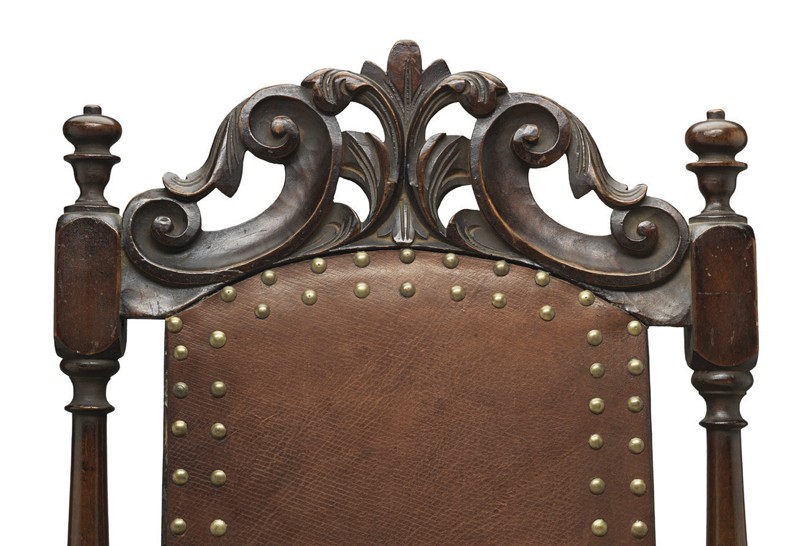
    Side chair, Boston, Massachusetts, 1695–1710. Maple and oak. H. 48 1/4", W. 17 3/8", D. 12 7/8". (Private collection; photo, Nathan Liverant and Son.) This is the only group B side chair with a carved crest rail and stretcher.

  • Figure 26
    Figure 26

    Side chair, Boston, Massachusetts, 1695–1710. Maple and oak. H. 46 3/4", W. 19", D. 17 3/8". (Private collection; photo, Scottish Rite Masonic Museum and Library.)

  • Figure 27
    Figure 27

    Side chair, Boston, Massachusetts, 1695–1705. Woods and dimensions not recorded. (Esther Singleton, The Furniture of Our Forefathers [New York: Doubleday, Page and Company, 1906], p. 183.)

  • Figure 28
    Figure 28

    Armchair, London, 1695–1705. Beech; original Japanned decoration. H. 51 3/4", W. 23 3/8", D. 17". (Private collection; photo, Bill Russell.) This armchair’s seat would have been caned. It represents the first use of “banisters” as back support in English seating furniture. The ball feet are replaced.

  • Figure 29
    Figure 29

    Armchair, Boston, Massachusetts, 1700–1715. Maple. H. 53 3/4", W. 23 7/8", D. 16 3/8". (Courtesy, Museum of Fine Arts, Boston, gift of Mrs. Charles L. Bybee, 1980.379.) The complex, asymmetrically turned arm supports are essentially half of a Boston gateleg leg turning. This chair was given to Rev. John Chester (1785–1829) of Albany,  New York, by one of his parishioners.

  • Figure 30
    Figure 30

    Side chair, Boston, Massachusetts, 1700–1715. Maple and oak. H. 46 3/4", W. 18 1/4", D. 14 3/4". (Courtesy, Colonial Williamsburg Foundation, gift of Mr. and Mrs. Miodrag R. Blagojevich, 1976-430.)

  • Figure 31
    Figure 31

    Side chair, Boston, Massachusetts, 1700–1715. Maple and oak. H. 48", W. 18", D. 14 1/2". (Private collection; photo, Jim Wildeman.)

  • Figure 32
    Figure 32

    Armchair, New York City, 1695–1715. Maple with oak and hickory. H. 47 1/2", W. 25 1/2", D. 27". (Courtesy, Historic Hudson Valley, Tarrytown, New York.) The feet and the finials are incorrectly restored.

  • Figure 33
    Figure 33

    Armchair, New York, 1700–1740. Maple. H. 50 1/2". (Courtesy, Sotheby’s Inc.) The feet are replacements.

  • Figure 34
    Figure 34

    Armchair, New York City, 1695–1710. Maple and oak. H. 52", W. 24 3/4", D. 17 1/2". (Chipstone Foundation; photo, Gavin Ashworth.) The urn and baluster turned arm supports are nearly identical to those on the rear posts of the armchair illustrated in fig. 28.

  • Figure 35
    Figure 35

    Side chair, New York City, 1695–1710. Maple and oak. H. 46 3/4", W. 18 1/4", D. 15". (Private collection; photo, Gavin Ashworth.)

  • Figure 36
    Figure 36

    Side chair, probably Boston, Massachusetts, 1705–1715. Maple and oak. H. 45 1/2", W. 18", D. 15". (Courtesy, Greene County [New York] Historical Society.) This chair descended through the Bronck family of Coxsackie, New York, and was discovered with remnants of the original Russia leather upholstery on the back.

  • Figure 37
    Figure 37

    Side chair, Boston, Massachusetts, 1705–1715. Maple and oak. Dimensions not recorded. (Courtesy, Sotheby’s, Fine American Furniture, Folk Art, Silver and China Trade Paintings including Property from the Estate of Esther Pace Kuna, New York, June 23, 1988, sale 5736, lot 445.) An early label on the chair states that it belonged to Rev. Thomas Potwine (1731–1802), who was born in Boston and moved to East Windsor, Connecticut. His grandfather was John Potwine (1668–1700), who immigrated to Boston in 1698, and his father was John Potwine (1698–1792), who was probably the chair’s first owner.

  • Figure 38
    Figure 38

    Armchair, Boston, Massachusetts, 1705–1715. Maple and oak; original leather upholstery. H. 50 1/2", W. 23 1/4", D. 17". (Courtesy, Peabody Historical Society and Museum; photo, Andrew Davis.) This chair belonged to Rev. Benjamin Prescott (1687–1777), the first pastor of South Church in Danvers (now Peabody), Massachusetts. The scrolled terminals of the arms and the feet are replaced. This chair is unique in that the original trapezoidal stitching in the seat is embellished with brass nails.

  • Figure 39
    Figure 39

    Detail of the stretchers of the armchair illustrated in fig. 38.

  • Figure 40
    Figure 40

    Side chair, probably Boston, Massachusetts, 1705–1715. Maple and oak; original leather upholstery. H. 46 1/2", W. 18", D. 15". (Courtesy, Albany Institute of History and Art, gift of James Ten Eyck, 1908.1; photo, Gavin Ashworth.) This chair descended through the Pierson family of Kingston, New York.

  • Figure 41
    Figure 41

    Detail of the original webbing and sackcloth under-upholstery of the side chair illustrated in fig. 40. The standard arrangement for webbing strips on side chairs applied by Boston and New York upholsterers was two strips front-to-back and one side-to-side. The trapezoidal-shaped stitching at the center of the seat is visible. Upholsterers would attach the webbing and then the sackcloth. The leather was roughly shaped to fit and then secured to the under-upholstery with waxed gut stitching. Grass was then stuffed in on the four sides and secured when the leather was nailed to the rails. The rough edges were concealed with trim strips of leather generally secured with double rows of decorative brass-headed nails on the front and sides, while the back edge was secured with wrought iron nails. The trim strip on the sides of this chair was secured along the top edge with brass-headed nails, but the bottom edge was secured with wrought tacks.

  • Figure 42
    Figure 42

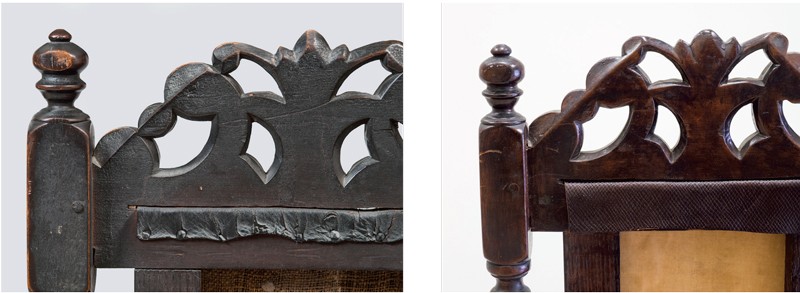
    Detail showing the back of the crest of the side chairs illustrated in figs. 36 (left) and 40 (right). The back edges of the piercings are neatly chamfered, and the edges of the C-scrolls have a simple single chamfer at a 45 degree angle. While irregular now because of shrinkage, the leather pulled through the slot on fig. 40 would have originally been cut along a straight line.

  • Figure 43
    Figure 43

    Side chair, England, 1690–1710. Ash; original leather upholstery. H. 44 1/2", W. 19", D. 16". (Courtesy, Colonial Williamsburg Foundation, 1954-990.) The cylindrical turning between the seat and the lower back rail is identical to that found on the later groups of early baroque Boston chairs.

  • Figure 44
    Figure 44

    Side chair, Boston, Massachusetts, 1705–1715. Maple and oak. H. 47 1/2", W. 18 1/2", D. 15". (Private collection; photo, Andrew Davis.)

  • Figure 45
    Figure 45

    Armchair, Boston, Massachusetts, 1705–1715. Maple and oak. H. 51", W. 24", D. 22". (Private collection; photo, Gavin Ashworth.)

  • Figure 46
    Figure 46

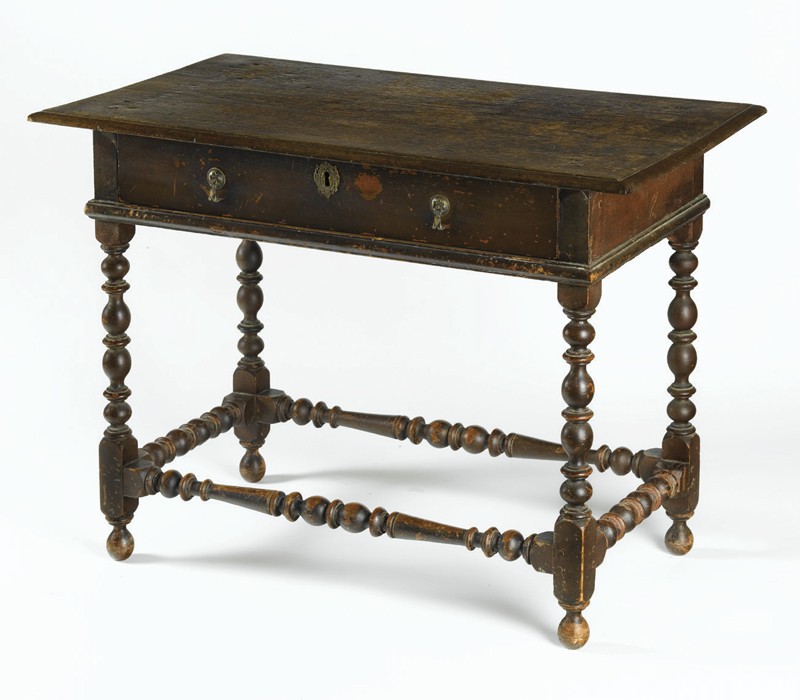
    Table, Boston, Massachusetts, 1705–1720. Maple and white pine. H. 27 3/4", W. 37 3/4", D. 21 3/4". (Private collection; photo, Gavin Ashworth.) The conical turning on the stretchers is nearly identical to that on the rear posts of group D chairs. The legs have turning identical to those on the arm supports of several of the leather-upholstered armchairs.

  • Figure 47
    Figure 47

    Side chair, Boston, Massachusetts, 1705–1715. Maple and oak; original leather upholstery. H. 48 1/2", W. 18 1/8", D. 14 1/2". (Courtesy, Wadsworth Atheneum, Wallace Nutting Collection, gift of J. Pierpont Morgan Jr., 1926.446; photo, Gavin Ashworth.) This chair descended in the Pierson family of Kingston, New York, and was first illustrated in Wallace Nutting, Furniture of the Pilgrim Century, 1620–1720 (Boston: Marshall Jones Company, 1921), p. 221, with a later crest that has now been removed. A remnant is all that remains of the lower ball on the foot.

  • Figure 48
    Figure 48

    Side chair, Boston, Massachusetts, 1705–1715. Maple and oak. H. 47 1/2", W. 19", D. 15". (Private collection; photo, Andrew Davis.)

  • Figure 49
    Figure 49

    Armchair, Boston, Massachusetts, 1705–1715. Maple. H. 48 1/2", W. 23", D. 17". (Courtesy, Art Institute of Chicago, Mr. and Mrs. William Y. Hutchinson Fund, 1989.57; photo, Art Resource, Inc.) The arms and feet are replaced; the arms would have resembled those on the armchair illustrated in fig. 45.

  • Figure 50
    Figure 50

    Side chair, New York City, 1705–1715. Maple and oak. H. 47", W. 18 1/2", D. 14 1/2". (Private collection; photo, Gavin Ashworth.)

  • Figure 51
    Figure 51

    Side chair, New York City, 1705–1715. Maple and oak. H. 45 3/4", W. 18", D. 14 1/2". (Private collection; photo, Gavin Ashworth.)

  • Figure 52
    Figure 52

    Armchair, Boston, Massachusetts, 1710–1720. Maple and oak. H. 53 1/8", W. 22 3/4", D. 17 1/2". (Courtesy, Smithtown Historical Society, gift of Mrs. Norman Parke; photo, Gavin Ashworth.) Family tradition maintained that this chair belonged to Ebenezer Smith (1712–1747). His father, Richard Smith II (ca. 1645–1720), was the chair’s probable first owner (Dean Failey, Long Island Is My Nation: Decorative Arts & Craftsmen 1640–1830, 2nd edition [Cold Spring Harbor, N.Y.: Society for the Preservation of Long Island Antiquities, 1998], no. 23. pp. 26–7).

  • Figure 53
    Figure 53

    Armchair, Boston, Massachusetts, 1710–1720. Maple and oak; original leather upholstery. H. 53 1/4", W. 22 7/8", D. 17". (Courtesy, Winterthur Museum, bequest of H. F. du Pont; photo, Gavin Ashworth.)

  • Figure 54
    Figure 54

    Side view of the armchair illustrated in fig. 53. The height and dramatic cant of the chair back would make it susceptible to falling backward if not for the rearward kick of the rear feet.

  • Figure 55
    Figure 55

    Side chair, Boston, Massachusetts, 1710–1720. Maple and oak. H. 47 1/2". (Courtesy, Freeman’s; photo, Thomas Clark.) The front stretcher is replaced. The original would have related to those on the chairs shown in figs. 52 and 53.

  • Figure 56
    Figure 56

    Side chair, Boston, Massachusetts, 1710–1730. H. 46 3/4", W. 18 1/2", D. 14 7/8". (Courtesy, Washington’s Headquarters State Historic Site, Newburgh, New York Office of Parks, Recreation and Historic Preservation, WH.1971.641; photo, Gavin Ashworth.) This chair is one of three donated by Enoch Carter to Washington’s Headquarters prior to 1858. The chairs descended through the Ver Planck (also Verplanck) family and were reputedly used as altar furniture at the Dutch Reformed Church, Fishkill, New York.

  • Figure 57
    Figure 57

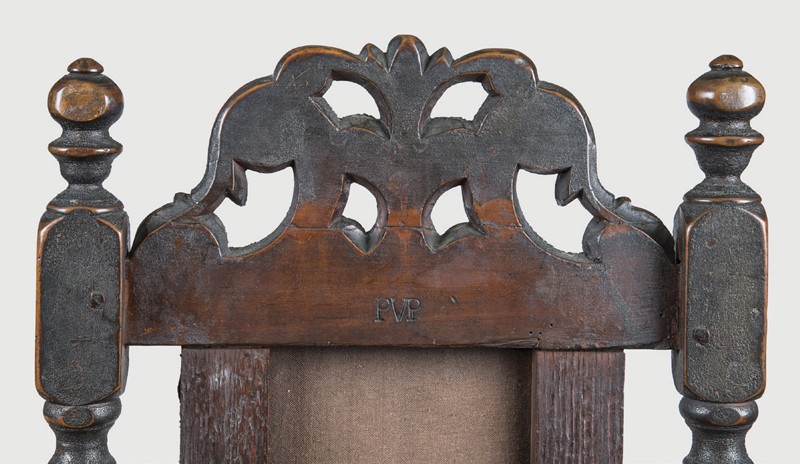
    Detail of the back of the crest of the side chair illustrated in fig. 56, showing the PVP brand. The back edges of the crest and the piercings are chamfered to lighten the crest visually when seen from the front.

  • Figure 58
    Figure 58

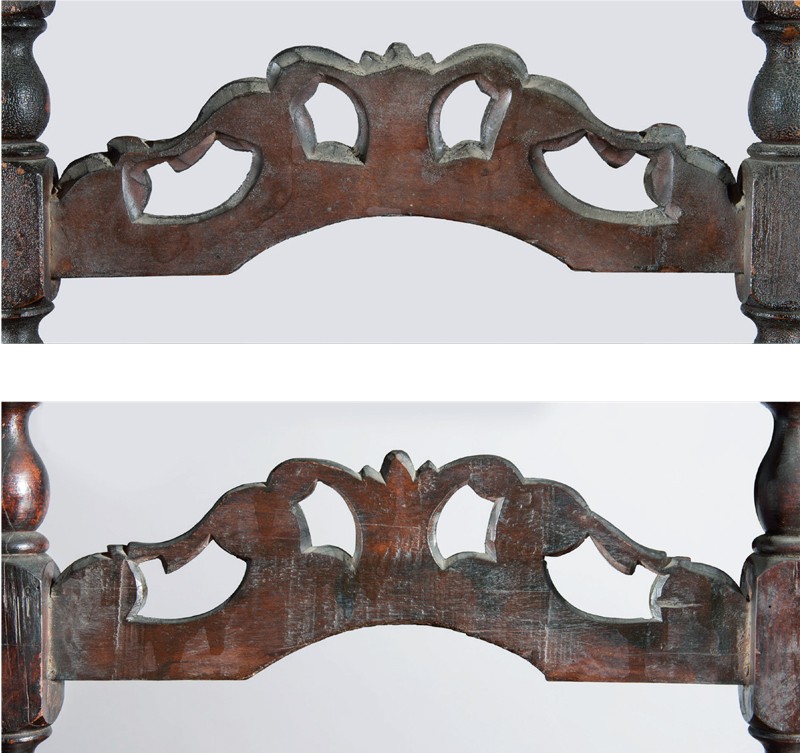
    Composite illustration showing the back of the lower stretcher of the group E side chair illustrated in fig. 56 (top) and group E side chair illustrated in fig. 69 (bottom). Boston chairmakers constructed their seating quickly and efficiently. As the saw kerfs visible here reveal, makers did not always plane the back surfaces of stretchers. The same is true of some crests.

  • Figure 59
    Figure 59

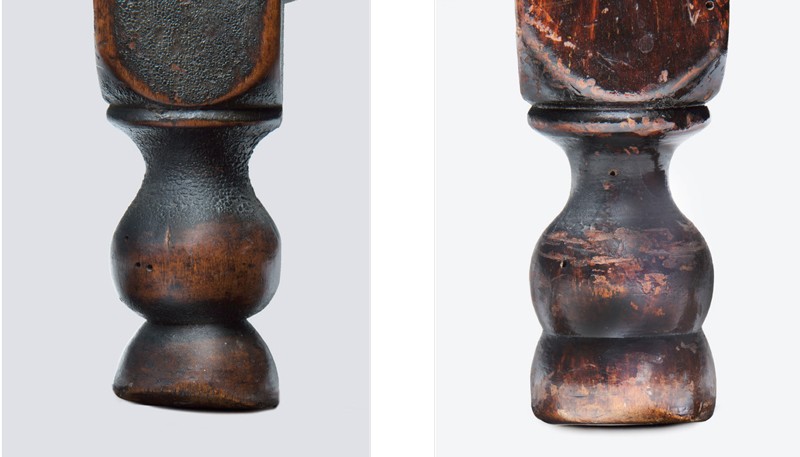
    Composite illustration showing the front turned feet of the group E side chair illustrated in fig. 56 (left) and group E side chair illustrated in fig. 69 (right). The baluster‑and-half-ball, or “double-ball,” foot was the standard for early eighteenth-century Boston chairmakers. Through centuries of use, many surviving chairs have lost the lower half‑ball if not their entire foot.

  • Figure 60
    Figure 60

    Armchair, Boston, Massachusetts, 1710–1730. Maple and oak; original leather upholstery. H. 50 1/2", W. 24 1/2", D. 23". (Courtesy, Wadsworth Atheneum, the Evelyn Bonar Storrs Trust Fund, 1994.4.1; photo, Gavin Ashworth.) While the chair’s original owner is unknown, it descended in the Schuyler and Church families of New York. The chair was purchased from a descendant of John Baker Church (1777–1818) and Angelica Schuyler (1756–1814). Angelica was the daughter of Gen. Philip Schuyler (1733–1804) and Catherine Van Rensselaer (1735–1803) of Albany. The feet and the proper right finial are replaced.

  • Figure 61
    Figure 61

    Armchair, Boston, Massachusetts, 1710–1730. Maple and oak; original leather upholstery. H. 52", W. 24 1/4", D. 21 1/4". (Courtesy, The Henry Ford, 30.557.64.) Henry Ford purchased the chair from Charles Woolsey Lyon of New York City in 1930. Lyon acquired the chair in 1901 from Mr. Stephen Schuyler of the Flats, Albany, New York. Stephen Schuyler stated that the chair originally belonged to Pieter Schuyler (1657–1724). The Flats is an area north of Albany along the Hudson River. The front stretcher is incorrectly replaced.

  • Figure 62
    Figure 62

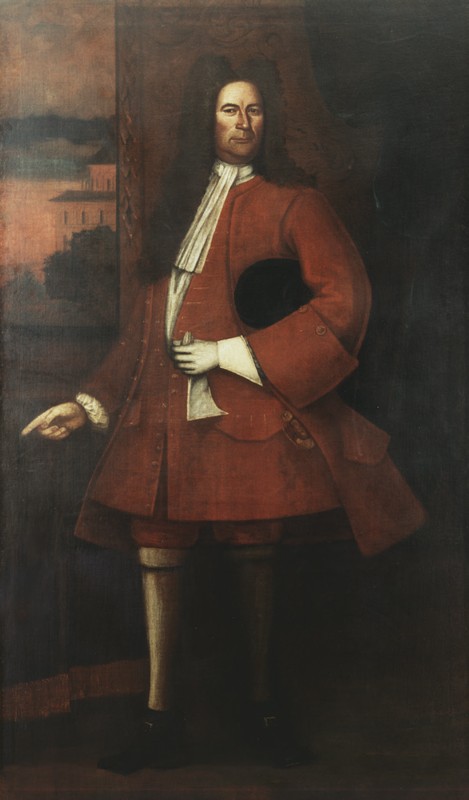
    Nehemiah Partridge (1683–ca. 1737), Pieter Schuyler, Albany, New York, ca. 1718. Oil on canvas. 87 3/4" x 51". (Courtesy, New York State Museum.)    

  • Figure 63
    Figure 63

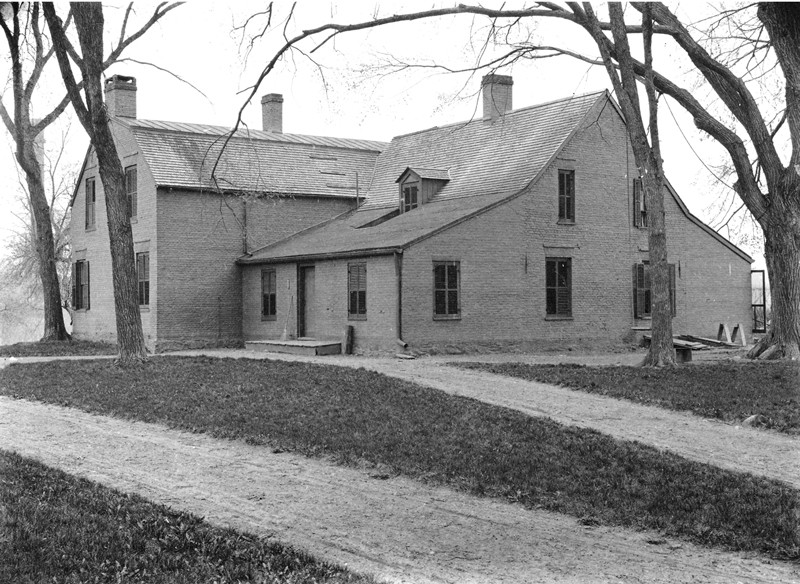
    General Philip Schuyler House, ca. 1690 with a ca. 1765 addition, Colonie Township, Albany County, New York. (Courtesy, Library of Congress, Prints & Photographs Division, HABS no. NY-3102.) This house was destroyed by fire in 1962.

  • Figure 64
    Figure 64

    Armchair, Boston, Massachusetts, 1710–1730. Maple and oak. H. 52 5/8", W. 23 1/8", D. 17". (Courtesy, Museum of Fine Arts, Boston, gift of Anne and Frederick Vogel III, 2016.538.) This chair is branded “W. MANCIUS” on the lower back rail. The feet are replaced.

  • Figure 65
    Figure 65

    Side chair, Boston, Massachusetts, 1710–1730. H. 49 3/4", W. 18 1/2", D. 14 3/4". (Private collection; photo, Gavin Ashworth.) The lower back rail is branded “W. MANCIUS”. The feet are replaced.

  • Figure 66
    Figure 66

    Composite illustration showing the brands on back of the lower back rails of the armchair illustrated in fig. 64 (left) and the side chair illustrated in fig. 65 (right).

  • Figure 67
    Figure 67

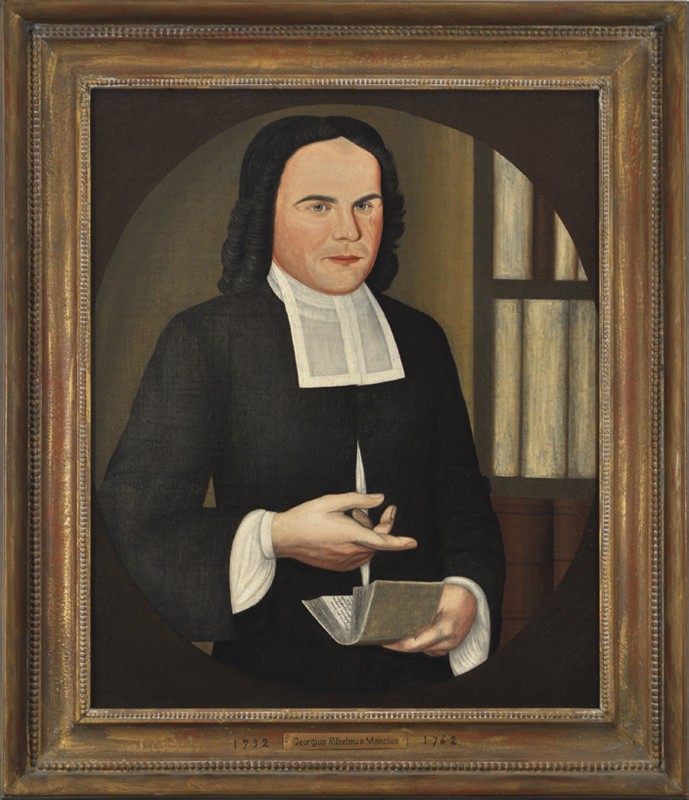
    Rev. George Wilhelmus Mancius, attributed to Pieter Vanderlyn (ca.1687–1778), Kingston, New York, ca. 1735. Oil on canvas. Measurements not recorded. (Courtesy, First Reformed Protestant Dutch Church of Kingston, New York.)

  • Figure 68
    Figure 68

    Armchair, Boston, Massachusetts, 1710–1730. Maple and oak. H. 51 3/4", W. 23 1/4", D. 16 3/4". (Private collection; photo, Gavin Ashworth.) This chair was found in Yonkers, New York. Upholstery evidence indicates that this chair’s trim strip was secured on the side seat rails with a top row of brass-headed nails and the bottom with wrought tacks.

  • Figure 69
    Figure 69

    Side chair, Boston, Massachusetts, 1710–1730. H. 49", W. 18", D. 15". (Courtesy, Washington’s Headquarters State Historic Site, Newburgh, New York Office of Parks, Recreation and Historic Preservation, WH.1971.643; photo, Gavin Ashworth.) Four chairs from this set are known. According to Israel Sack, Inc., the chairs were purchased from descendants of the Van Rensselaer family.

  • Figure 70
    Figure 70

    Side chair, Boston, Massachusetts, 1710–1730. Maple and oak. H. 47", W. 18 1/8", D. 15". (Private collection; photo, Gavin Ashworth.) The feet are replaced.

  • Figure 71
    Figure 71

    Side chair, Boston, Massachusetts, 1710–1730. Maple and oak. H. 48", W. 18 1/2", D. 14 3/4". (Private collection; photo, Jim Wildeman.)

  • Figure 72
    Figure 72

    Side chair, Boston, Massachusetts, 1710–1730. Maple and oak; original leather upholstery. H. 48", W. 17 7/8", D. 14 5/8". (Courtesy, Metropolitan Museum of Art, bequest of Mrs. J. Insley Blair, 1951, 52.77.58; photo, image copyright © Metropolitan Museum of Art. Image source: Art Resource, Inc.)

  • Figure 73
    Figure 73

    Armchair, Boston, Massachusetts, 1710–1730. Maple and oak. H. 51 1/4", W. 23", D. 16 3/4". (Private collection; photo, Gavin Ashworth.) The  upper portion of the crest rail is replaced.

  • Figure 74
    Figure 74

    Armchair, Boston, Massachusetts, 1710–1730. Maple and oak. H. 50 5/8", W. 23 1/4", D. 16 7/8". (Courtesy, Colonial Williamsburg Foundation, gift of Mr. and Mrs. Miodrag R. Blagojevich, 1976-431.)

  • Figure 75
    Figure 75

    Armchair, Boston, Massachusetts, 1710–1730. Maple and oak. H. 49 1/2", W. 23", D. 16 3/4". (Private collection; photo, Gavin Ashworth.)

  • Figure 76
    Figure 76

    Side chair, Boston, Massachusetts, 1710–1730. Maple and oak. H. 45 3/8", W. 18", D. 15 1/2". (Private collection; photo, Andrew Davis.)

  • Figure 77
    Figure 77

    Side chair, Boston, Massachusetts, 1710–1730. Maple and oak. H. 45 1/4", W. 18", D. 15". (Private collection; photo, Andrew Davis.)

  • Figure 78
    Figure 78

    Side chair, Boston, Massachusetts, 1710–1730. Maple and oak; original leather upholstery. H. 45 1/4", W. 18 1/2", D. 15 3/4". (Courtesy, Wadsworth Atheneum, Wallace Nutting Collection, gift of J. Pierpont Morgan Jr., 1926.440; photo, Gavin Ashworth.)

  • Figure 79
    Figure 79

    Side chair, Boston, Massachusetts, 1710–1730. Maple and oak. H. 38 3/8", W. 17 3/4", D. 14 3/8". (Courtesy, Winterthur Museum, bequest of H. F. du Pont; photo, Gavin Ashworth.)

  • Figure 80
    Figure 80

    Side chair, Boston, Massachusetts, 1710–1730. Maple and oak. H. 38 1/4", W. 18", D. 15 1/8". (Private collection; photo, Gavin Ashworth.)

  • Figure 81
    Figure 81

    Back stool, Boston, Massachusetts, 1710–1725. Maple. H. 44 3/4", W. 18 3/4", D. 15". (Private collection; photo, Gavin Ashworth.) The feet and upper portion of the back are replaced.

  • Figure 82
    Figure 82

    Back stool, Boston, Massachusetts, 1710–1730. Maple. H. 48 1/4", W. 19 1/2", D. 15 1/8". (Courtesy, Winterthur Museum, bequest of H. F. du Pont, 1989.506; photo, Gavin Ashworth.) The heels on this chair are quite pronounced and prevented the high-backed chair from toppling over.

  • Figure 83
    Figure 83

    Detail of the stretchers, legs, and double cyma-shaped front seat rail of the back stool illustrated in fig. 82. (Photo, Gavin Ashworth.)

  • Figure 84
    Figure 84

    Easy chair, Boston, Massachusetts, 1710–1730. Maple. H. 48 1/8", W. 31 1/2", D. 35 1/2". (Courtesy, Philadelphia Museum of Art, 125th Anniversary Acquisition, gift of Anne H. and Frederick Vogel III, 1999.)

  • Figure 85
    Figure 85

    Couch, Boston, Massachusetts, 1710–1730. Maple. Dimensions not recorded. (Richard Withington, Inc., Oliver E. Williams Collection, Pigeon Cove, Cape Ann, Massachusetts, July 27, 1966, p. 22.)

  • Figure 86
    Figure 86

    Couch, Boston, Massachusetts, 1710–1730. Maple. H. 39 1/2", L. 61". (Courtesy, Bernard and S. Dean Levy, Inc.) This couch belonged to Rev. Daniel Shute (1722–1802) and his wife, Mary Cushing (1732–1756). Shute was the pastor of the Second Parish in Hingham (now Cohasset), Massachusetts, for nearly fifty‑six years.

  • Figure 87
    Figure 87

    Side chair, Boston, Massachusetts, 1705–1715. Maple and ash. H. 49", W. 18 3/4", D. 16 3/8". (Private collection; photo, Gavin Ashworth.) This banister-back chair has a crest identical to those of the leather chairs illustrated in figs. 44 and 45.

  • Figure 88
    Figure 88

    Armchair, Boston, Massachusetts, 1710–1730. Maple and ash. H. 52 3/4", W. 23", D. 16". (Private collection; photo, Jim Wildeman.) The feet are replaced. This chair and the one shown in fig. 89 originally would have been used with a large pillow that would have filled the space between the back rail and the seat.

  • Figure 89
    Figure 89

    Armchair, Boston, Massachusetts, 1710–1730. Maple and ash. H. 52 5/8", W. 23 1/2", D. 16 5/8". (Private collection; photo, Gavin Ashworth.) This is one of only two known examples of a Boston banister-back armchair with a carved crest rail and front stretcher. The other was offered by Roderic Blackburn but had replaced finials and feet.

  • Figure 90
    Figure 90

    Side chair, Boston, Massachusetts, 1710–1730. Maple and ash. H. 49 1/2", W. 17 1/2", D. 14". (Private collection; photo, Andrew Davis.) The finials and the upper portion of the crest rail are replaced.

  • Figure 91
    Figure 91

    Side chair, Boston, Massachusetts, 1710–1730. Maple and ash. H. 46 1/2", W. 18 1/4", D. 14 3/4". (Private collection; photo, Gavin Ashworth.)

  • Figure 92
    Figure 92

    Side chair, Boston, Massachusetts, 1710–1730. Maple and ash. H. 47", W. 18 1/2", D. 14 3/4". (Private collection; photo, Andrew Davis.) This chair was embellished with gilt decoration in the late nineteenth century. This chair has lost a portion of its feet.

  • Figure 93
    Figure 93

    Side chair, Boston, Massachusetts, 1710–1730. Maple and ash. H. 47 1/2". (Courtesy, Sotheby’s, Important Americana including Property from the Collection of Joan Oestreich Kend, New York, January 21, 2017, lot 4327.)

  • Figure 94
    Figure 94

    Side chair, Boston, Massachusetts, 1710–1730, Maple and ash. H. 48 1/8", W. 18 3/4", D. 14 1/2". (Private collection; photo, Jon Lam.) This chair, like the examples illustrated in figs. 79 and 80, has its crest rail placed on top of the stiles rather than between them.

  • Figure 95
    Figure 95

    Armchair, probably London, 1705–1715. Walnut. Dimensions not recorded. (Courtesy, Victoria and Albert Museum, given by W. H. Hammond in memory of Lieut. R. M. Hammond, Circ. 525-1921.)
    The chair originally had a caned back and seat. The feet are replaced. The chairs in group E have arched crests and stretchers and turnings related to those on this chair. 

  • Figure 96
    Figure 96

    Side chair, probably London, 1705–1715. Woods and dimensions not recorded. (Photo, Symonds Collection, Decorative Arts Photographic Collection, Winterthur Museum.) This chair originally had a caned back. The double side stretchers belie its later date as indicated with its arched crest, simple conical stiles, and cylindrical turnings above the seat.

  • Figure 97
    Figure 97

    Armchair, Boston, Massachusetts, 1705–1725. Maple. H. 50 3/4", W. 25 3/4", D. 27". (Chipstone Foundation; photo, Gavin Ashworth.)

  • Figure 98
    Figure 98

    Side chair, Boston, Massachusetts, 1710–1725. Maple. H. 50 3/4", W. 17 1/2", D. 14 3/8". (Private collection; photo, Gavin Ashworth.)

  • Figure 99
    Figure 99

    Armchair, Boston, Massachusetts, 1710–1725. Maple. Measurements not recorded. (Courtesy, Northeast Auctions, New Hampshire Weekend Auction, Portsmouth, New Hampshire, November 7, 2004, lot 723.) This chair has lost the upper portion of the carved crest, and the feet are replaced.

  • Figure 100
    Figure 100

    Armchair, Boston, Massachusetts, 1710–1725. Maple and birch. H. 55". (Courtesy, ©2005 Christie’s, Important American Furniture, Folk Art, Silver and Prints, New York, January 21, 2005, sale 1474, lot 544.)

  • Figure 101
    Figure 101

    Side chair, Boston, Massachusetts, 1710–1725. Maple. H. 48 3/4". (Courtesy, ©2005 Christie’s, Important American Furniture, Folk Art, Silver and Prints, New York, January 21, 2005, sale 1474, lot 545.)

  • Figure 102
    Figure 102

    Side chair, Boston, Massachusetts, 1720–1735. Maple. H. 45 1/4", W. 18", D. 14 1/4". (Private collection; photo, Gavin Ashworth.)

  • Figure 103
    Figure 103

    Side chair, Boston, Massachusetts, 1720–1735. Maple. H. 45 1/4", W. 17 1/2", D. 14 3/4". (Private collection; photo, Gavin Ashworth.)

  • Figure 104
    Figure 104

    Armchair, Boston, Massachusetts, 1720–1740. Maple. H. 50 3/4", W. 23 3/8", D. 16 3/8". (Private collection; photo, Gavin Ashworth.)

  • Figure 105
    Figure 105

    Side chair, Boston, Massachusetts, 1720–1740. Maple. H. 45 1/2", W. 19", D. 18". (Chipstone Foundation; photo, Skinner, Inc., American Furniture & Decorative Arts, Boston, Massachusetts, February 18, 2007, sale 2349, lot 229.)

  • Figure 106
    Figure 106

    Armchair, Boston, Massachusetts, 1720–1740. Maple. H. 49 7/8", W. 24 1/4", D. 21". (Courtesy, Winterthur Museum, bequest of H. F. du Pont, 1954.528; photo, Gavin Ashworth.) This armchair descended in the Hancock family of Boston, Massachusetts. This chair is one of the earliest examples showing the placement of the medial stretchers forward.

  • Figure 107
    Figure 107

    Armchair, Boston, Massachusetts, 1725–1745. Maple. H. 44 3/4", W. 23", D. 18 3/4". (Courtesy, Museum of Fine Arts, Boston, gift of Mr. and Mrs. Henry Herbert Edes, 36.37.) This chair descended in the Edes family of Boston and South Dartmouth, Massachusetts.

  • Figure 108
    Figure 108

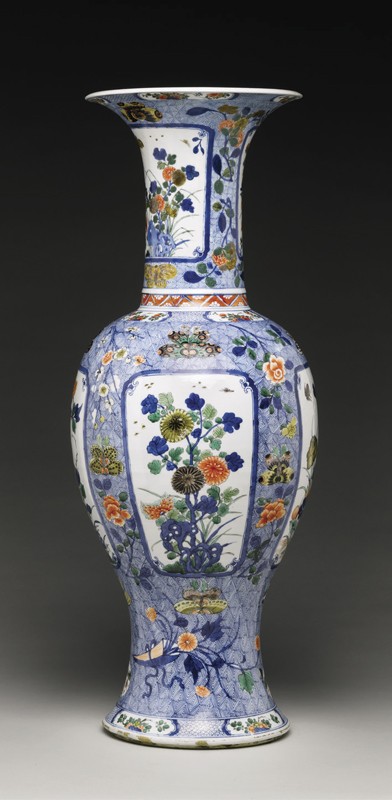
    Side chair, Boston, Massachusetts, 1725–1730. Maple and oak. H. 48 1/2". (Courtesy, Skinner Inc., Personal Collection of Lewis Scranton, Killingsworth, Connecticut, May 21, 2016, sale 2897M, lot 303.) The feet are replaced. The splat directly relates to contemporaneous Chinese vases on stands.

  • Figure 109
    Figure 109

    Baluster vase, Qing Dynasty, Kangxi Period (1662–1722). (Courtesy, Sotheby’s Inc.)

  • Figure 110
    Figure 110

    Side chair, probably London, 1715–1725. Woods and dimensions not recorded. (Helen Churchill Candee, Jacobean Furniture and English Styles in Oak and Walnut [New York: Frederick A. Stokes Company, 1916], pl. 31.)

  • Figure 111
    Figure 111

    Side chair, Boston, Massachusetts, 1720–1745. Maple and oak; original leather upholstery. H. 45 1/4", W. 17 3/4", D. 18 1/8". (Courtesy, Wadsworth Atheneum, gift of James B. Cone, by exchange, 1982.160; photo, Gavin Ashworth.) The applied carved front foot facings have been lost.

  • Figure 112
    Figure 112

    Armchair, Boston, Massachusetts, 1720–1745. Maple and oak. H. 47 3/4", W. 22 3/4", D. 16 7/8". (Courtesy, Winterthur Museum, bequest of H. F. du Pont, 1958.556; photo, Gavin Ashworth.)

  • Figure 113
    Figure 113

    Side chair, Boston, Massachusetts, 1720–1750. Maple and oak. H. 45 1/2", W. 17 1/2", D. 15". (Private collection; photo, Andrew Davis.) The applied carved front foot facings have been lost.

  • Figure 114
    Figure 114

    Side chair, Boston, Massachusetts, 1720–1750. Maple and oak. H. 45 1/2", W. 17 1/2", D. 15". (Private collection; photo, Andrew Davis.)

  • Figure 115
    Figure 115

    Side chair, Boston, Massachusetts, 1720–1750. Maple and ash. H. 44 3/4", W. 18", D. 15". (Private collection; photo, Andrew Davis.) The front scroll feet on cabriole legged chairs are not laminated because of the extra dimension of the leg stock necessary to produce the curvature.

  • Figure 116
    Figure 116

    Side chair, Boston, Massachusetts, 1720–1750. Maple and oak. H. 44 3/4", W. 19", D. 15 3/4". (Private collection; photo, Andrew Davis.)

  • Figure 117
    Figure 117

    Side chair, Boston, Massachusetts, 1728–1735. Maple and oak. H. 45 7/8", W. 19", D. 15 1/2". (Courtesy, Winterthur Museum; photo, Gavin Ashworth.)

  • Figure 118
    Figure 118

    Side chair, Boston, Massachusetts, 1720–1750. Maple and oak. H. 44 3/4", W. 18 1/4", D. 14 1/2". (Private collection; photo, Andrew Davis.)

  • Figure 119
    Figure 119

    Side chair, Boston, Massachusetts, 1720–1750. Maple. H. 44 1/4", W. 20", D. 15". (Private collection; photo, Andrew Davis.) The applied carved front foot facings have been lost.

  • Figure 120
    Figure 120

    Side chair, Boston, Massachusetts, 1720–1750. Maple and ash. H. 45 3/4", W. 19", D. 14 1/2". (Private collection; photo, Andrew Davis.) A related upholstered side chair with a solid splat is illustrated in Joan Freund and Leigh Keno, “The Making and Marketing of Boston Seating Furniture in the Late Baroque Style,” in American Furniture, edited by Luke Beckerdite (Hanover, N.H.: University Press of New England for the Chipstone Foundation, 1998), fig. 8.

  • Figure 121
    Figure 121

    Side chair, Boston, Massachusetts, 1720–1745. Maple and oak; original leather upholstery. H. 41 3/4", W. 19", D.14 3/8". (Courtesy, Newport Historical Society.) The original owner of this chair may have been William Ellery (1727–1820) of Newport, Rhode Island. William C. Cozzens (b. 1846) found it in the Ellery House, Thames Street, Newport, Rhode Island, and it was donated to the Newport Historical Society in 1855. The applied carved front foot facings have been lost.

  • Figure 122
    Figure 122

    Side chair, Boston, Massachusetts, 1725–1750. Maple and ash. H. 44 3/4", W. 18", D. 15". (Private collection; photo, Gavin Ashworth.)

  • Figure 123
    Figure 123

    Side chair, probably Boston, Massachusetts, 1710–1720. Maple. H. 52 1/8", W. 21 3/8", D. 22 1/4". (Courtesy, Winterthur Museum, bequest of H. F. du Pont, 1959.28.2; photo, Gavin Ashworth.)

  • Figure 124
    Figure 124

    Side chair, England, 1700–1710. Beech. Measurements not recorded. (Courtesy, Victoria and Albert Museum, London, W.36-1914.)

  • Figure 125
    Figure 125

    Side chair, Boston, Massachusetts, 1740–1770. Maple. H. 39 1/2", W. 22", D. 20 1/4". (Courtesy, Winterthur Museum, Museum Purchase with funds provided by Mr. and Mrs. George M. Kaufman, Mr. Martin E. Wunsch, and an anonymous donor, 1998.7; photo, Gavin Ashworth.) The trim strip of leather is applied with a double row of brass-headed nails just as chairs made in Boston were ornamented half a century earlier.

  • Figure 126
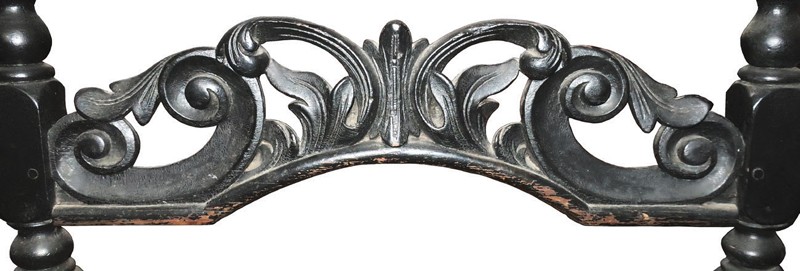
    Figure 126

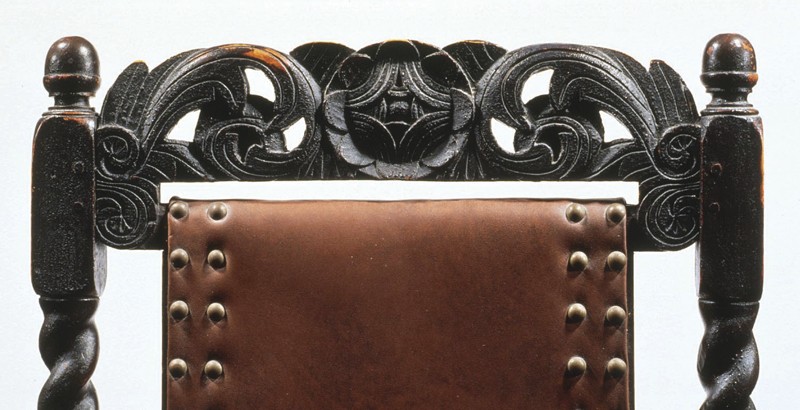
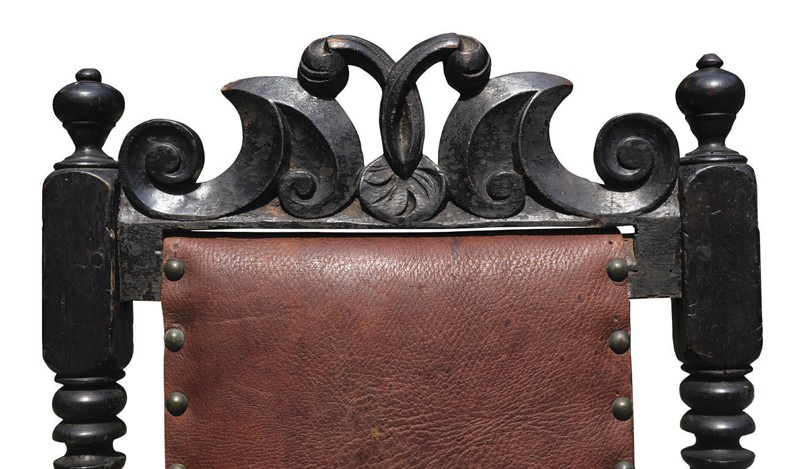
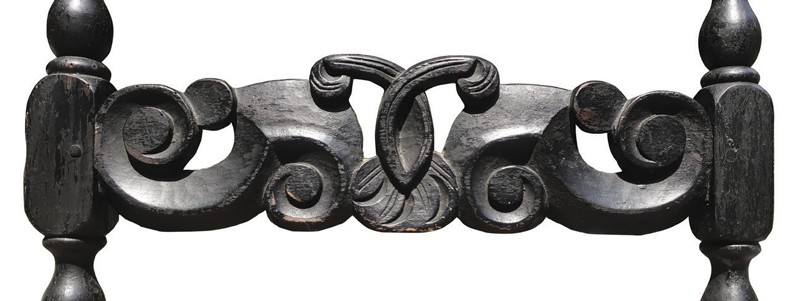
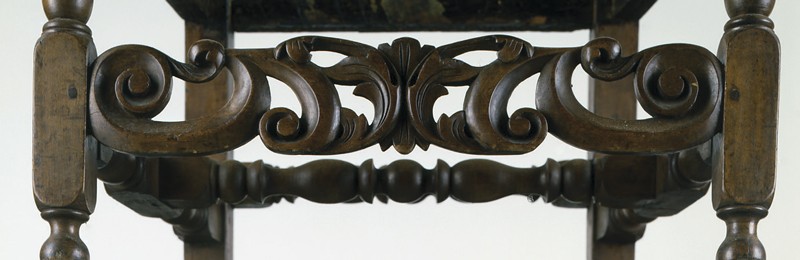
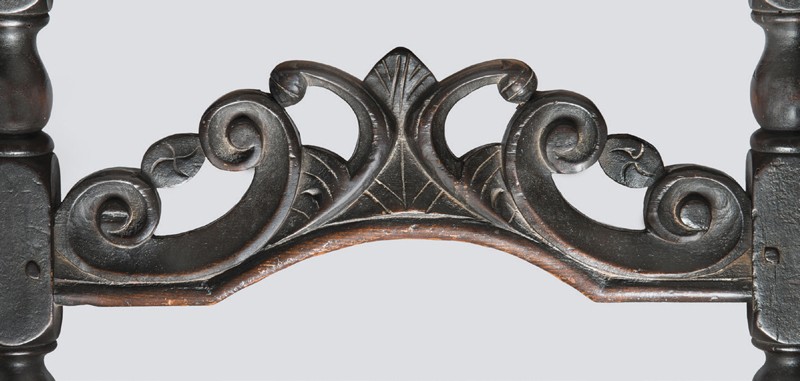
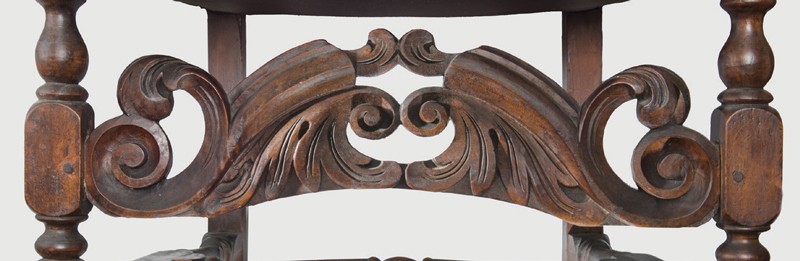
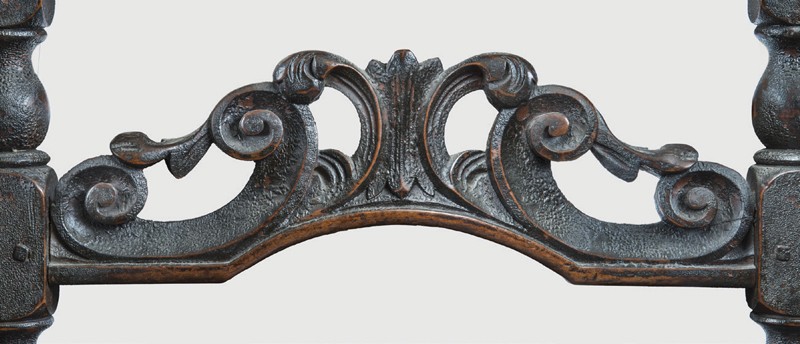
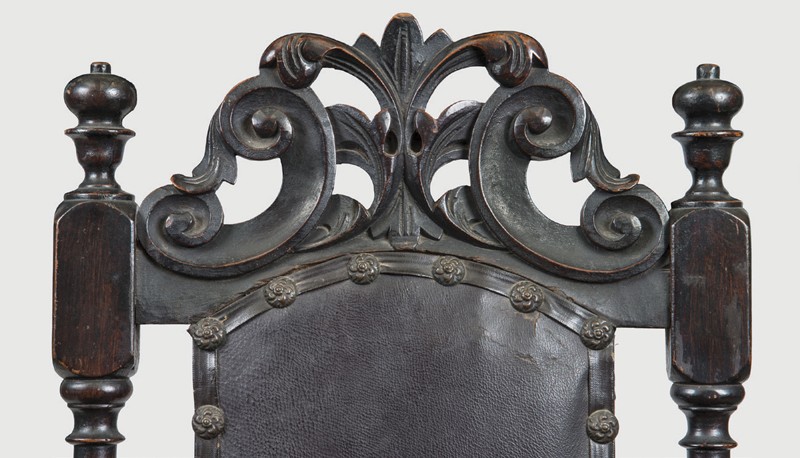
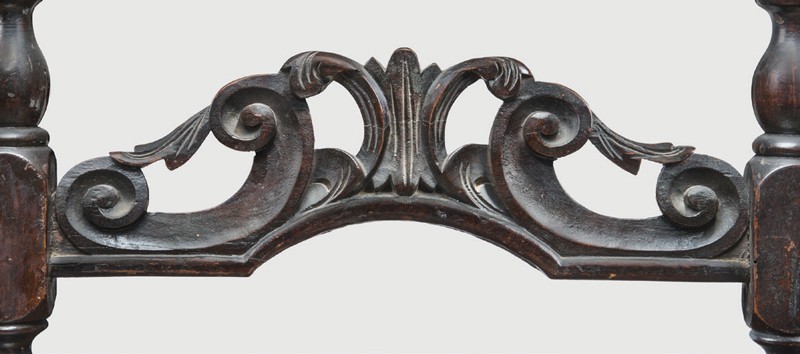
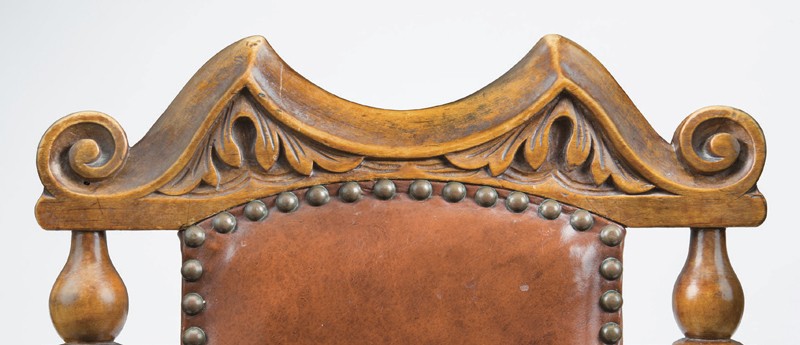
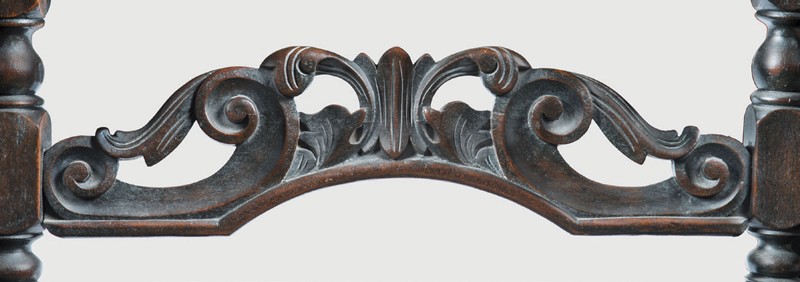
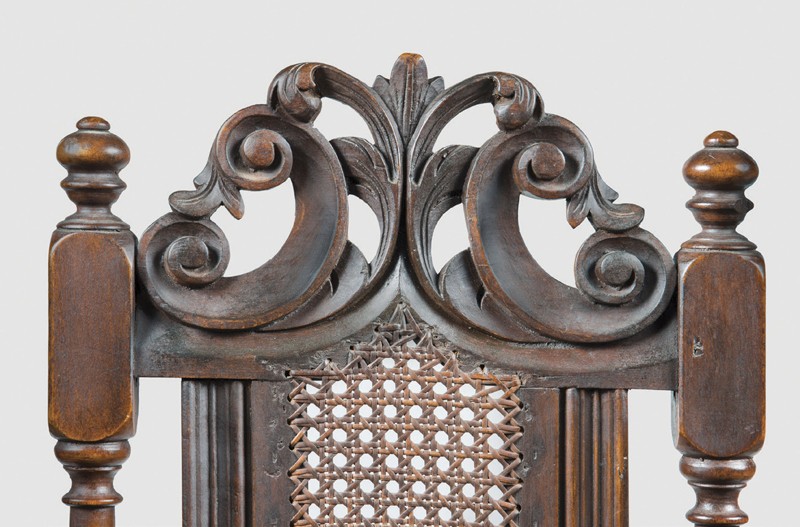
    Detail of the carved crest of the side chair illustrated in fig. 2.

  • Figure 127
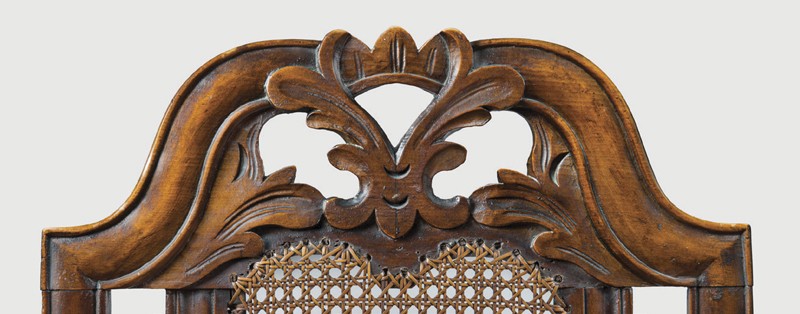
    Figure 127

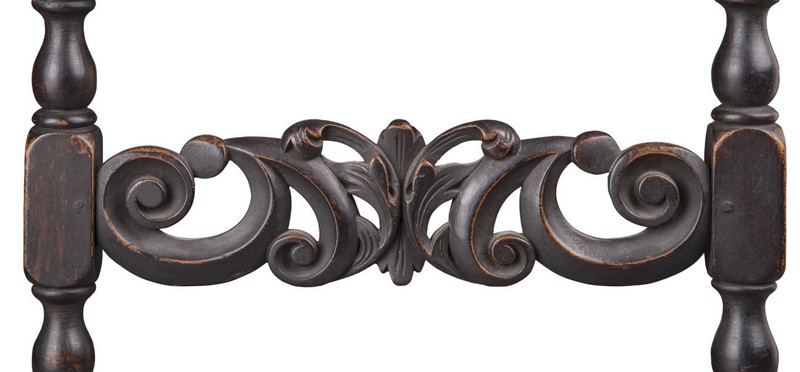
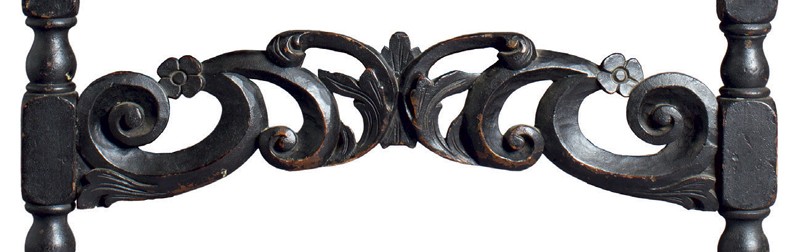
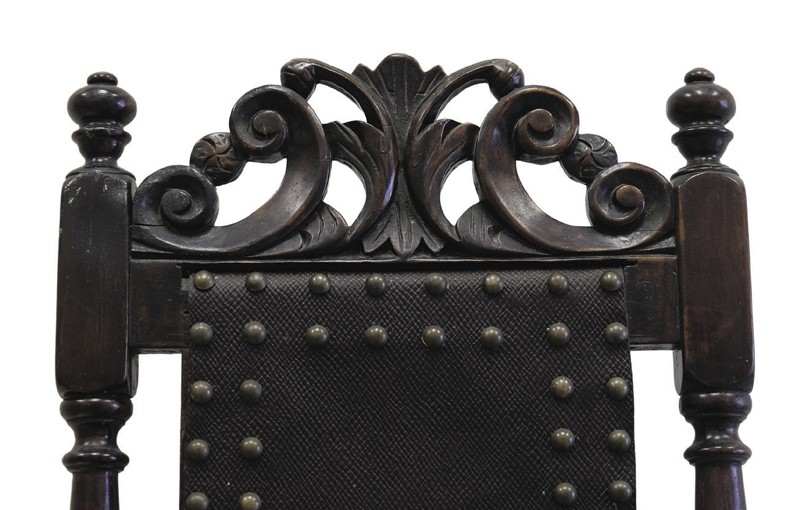
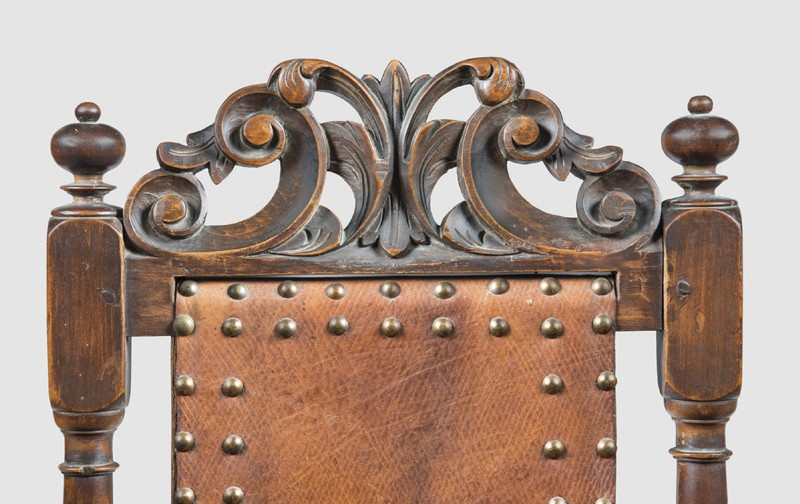
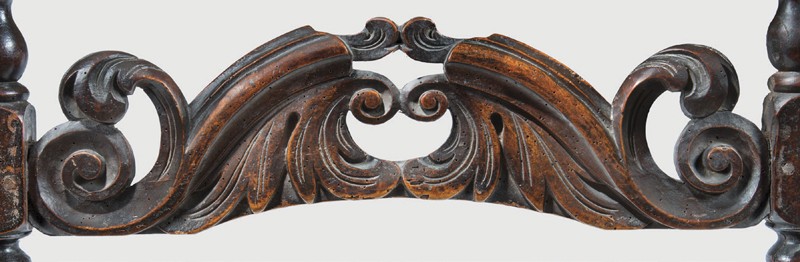
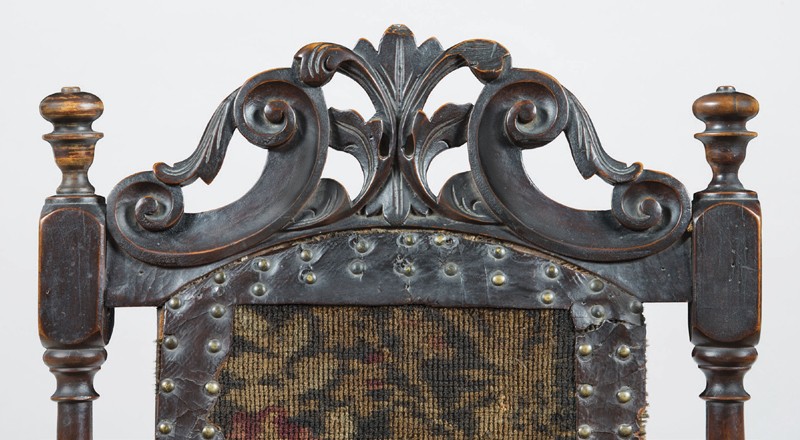
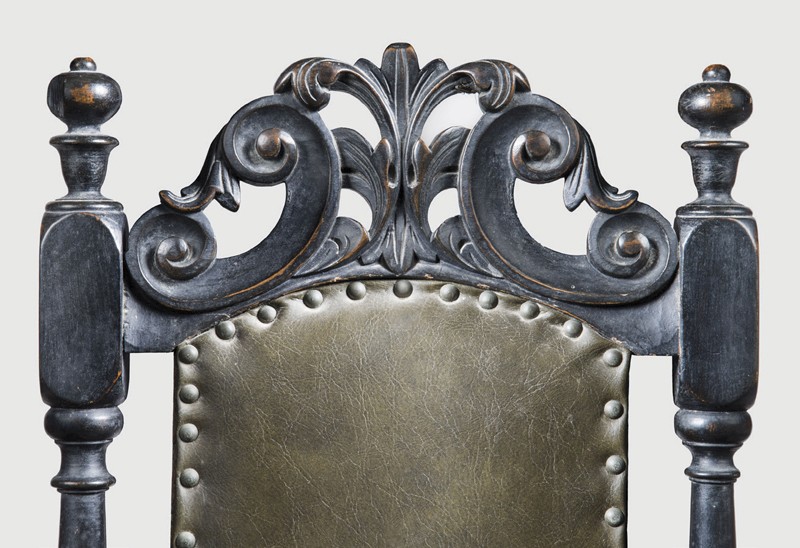
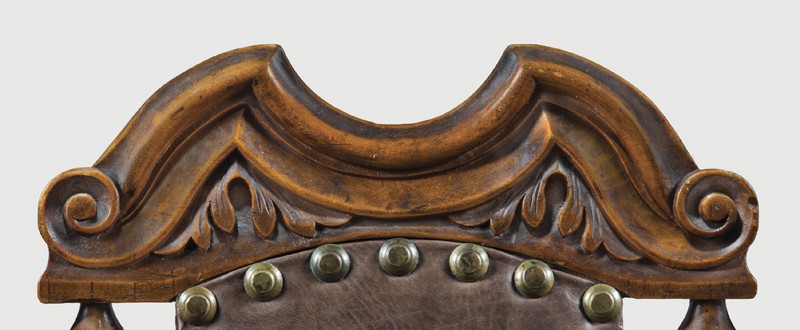
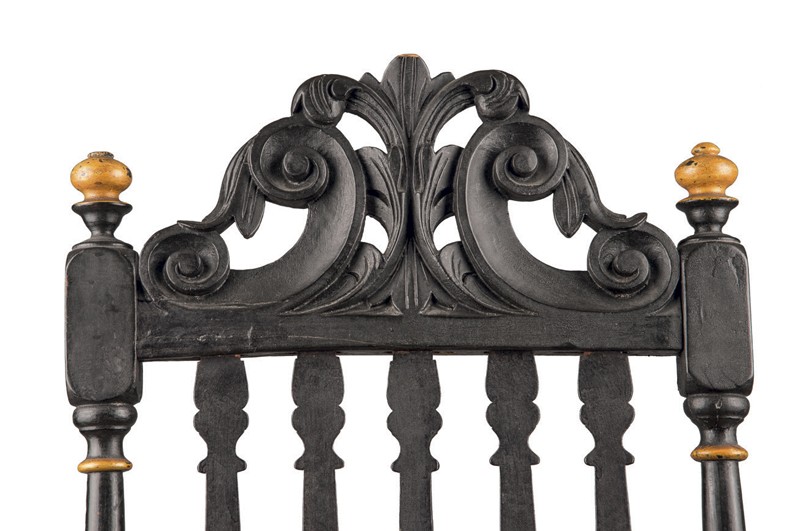
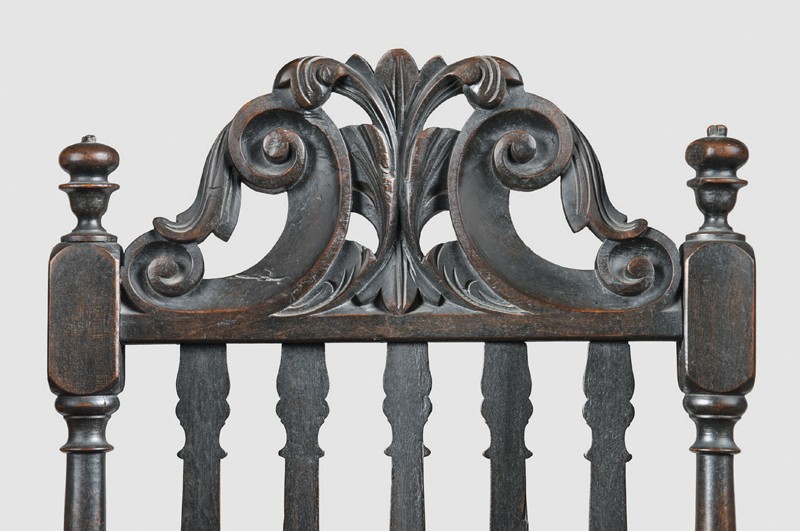
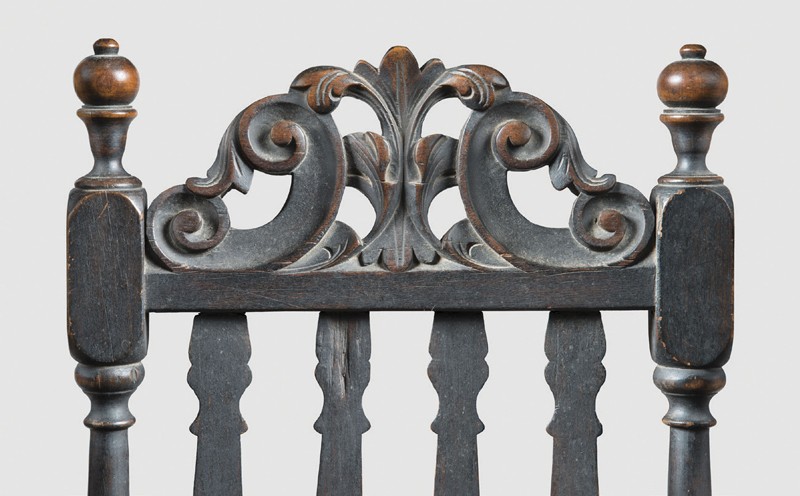
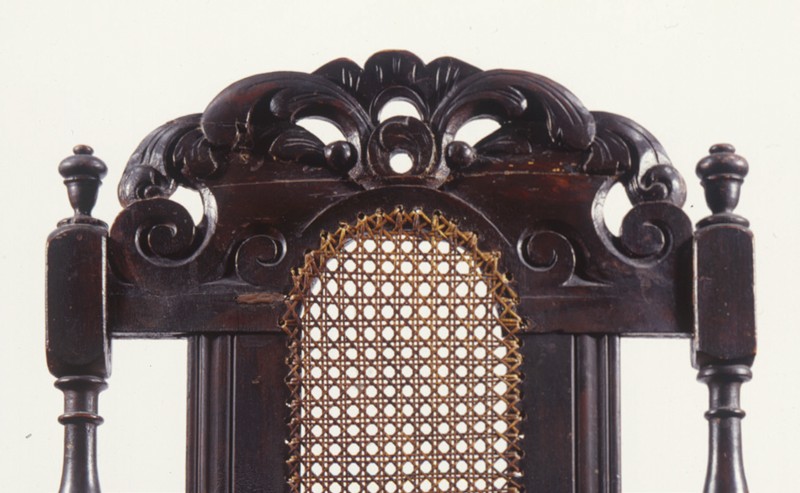
    Detail of the carved crest of the side chair illustrated in fig. 25.

  • Figure 128
    Figure 128

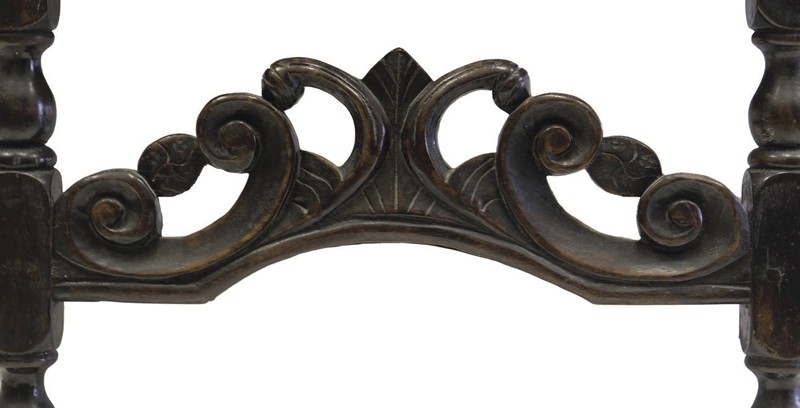
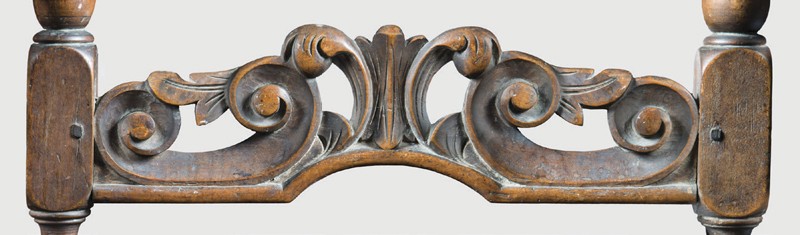
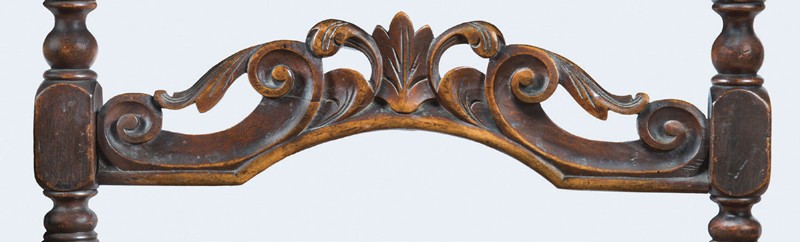
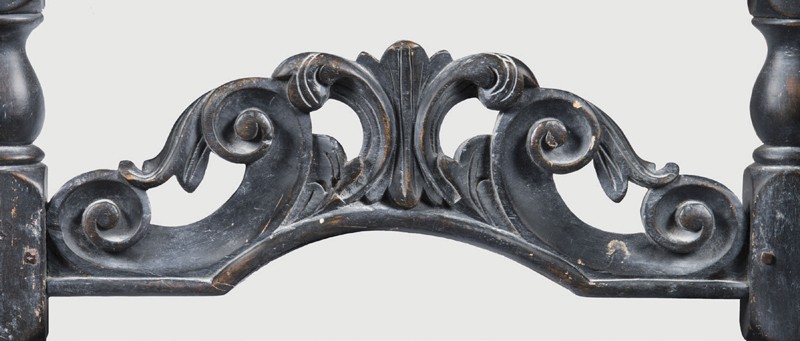
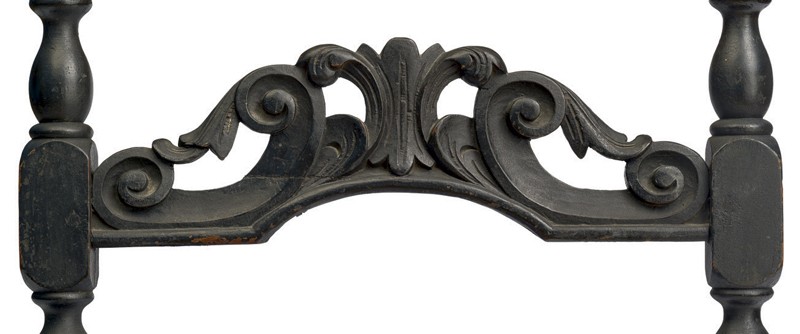
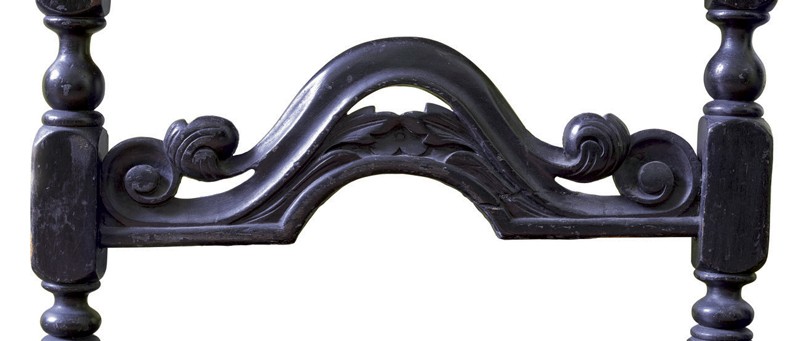
    Detail of the carved stretcher of the side chair illustrated in fig. 25.

  • Figure 129
    Figure 129

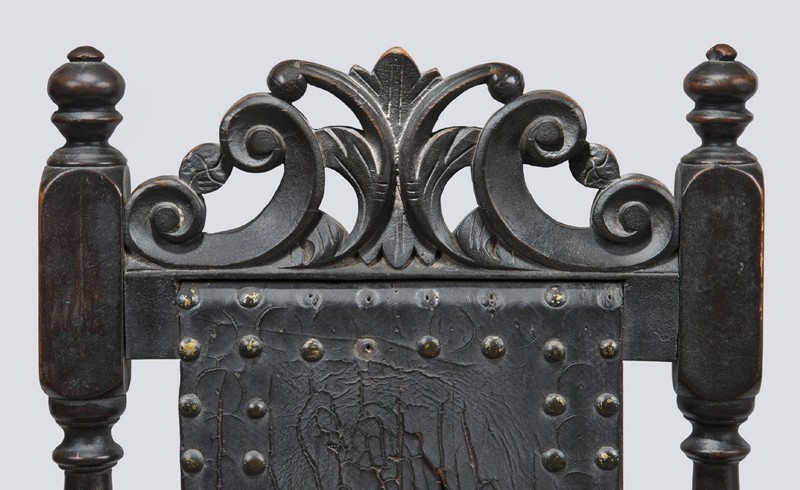
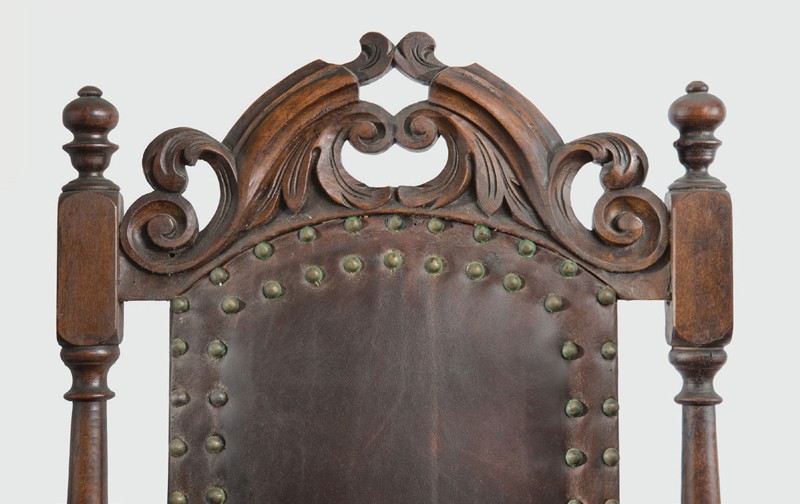
    Detail of the carved crest of the armchair illustrated in fig. 28. 

  • Figure 130
    Figure 130

    Detail of the carved stretcher of the armchair illustrated in fig. 28.

  • Figure 131
    Figure 131

    Detail of the carved stretcher of the armchair illustrated in fig. 29.

  • Figure 132
    Figure 132

    Detail of the carved crest of the side chair illustrated in fig. 31.

  • Figure 133
    Figure 133

    Detail of the carved stretcher of the side chair illustrated in fig. 31.

  • Figure 134
    Figure 134

    Detail of the carved stretcher of the armchair illustrated in fig. 32.

  • Figure 135
    Figure 135

    Detail of the carved crest of the armchair illustrated in fig. 34.

  • Figure 136
    Figure 136

    Detail of the carved stretcher of armchair illustrated in fig. 34.

  • Figure 137
    Figure 137

    Detail of the carved crest of the side chair illustrated in fig. 36.

  • Figure 138
    Figure 138

    Detail of the carved stretcher of the side chair illustrated in fig. 36.

  • Figure 139
    Figure 139

    Detail of the carved crest of the side chair illustrated in fig. 40.

  • Figure 140
    Figure 140

    Detail of the carved stretcher of the side chair illustrated in fig. 40.

  • Figure 141
    Figure 141

    Detail of the carved crest of the side chair illustrated in fig. 44.

  • Figure 142
    Figure 142

    Detail of the carved stretcher of the side chair illustrated in fig. 44.

  • Figure 143
    Figure 143

    Detail of the carved crest of the armchair illustrated in fig. 45.

  • Figure 144
    Figure 144

    Detail of the carved stretcher of the armchair illustrated in fig. 45.

  • Figure 145
    Figure 145

    Detail of the carved crest of the side chair illustrated in fig. 50.

  • Figure 146
    Figure 146

    Detail of the carved stretcher of the side chair illustrated in fig. 50.

  • Figure 147
    Figure 147

    Detail of the carved crest of the armchair illustrated in fig. 52.

  • Figure 148
    Figure 148

    Detail of the carved stretcher of the armchair illustrated in fig. 52.

  • Figure 149
    Figure 149

    Detail of the carved crest of the armchair illustrated in fig. 53.

  • Figure 150
    Figure 150

    Detail of the carved stretcher of the armchair illustrated in fig. 53.

  • Figure 151
    Figure 151

    Detail of the carved crest of the side chair illustrated in fig. 56.

  • Figure 152
    Figure 152

    Detail of the carved stretcher of the side chair illustrated in fig. 56.

  • Figure 153
    Figure 153

    Detail of the carved crest of the armchair illustrated in fig. 60.

  • Figure 154
    Figure 154

    Detail of the carved stretcher of the armchair illustrated in fig. 60.

  • Figure 155
    Figure 155

    Detail of the carved crest rail of the armchair illustrated in fig. 64.

  • Figure 156
    Figure 156

    Detail of the carved crest rail of the side chair illustrated in fig. 65.

  • Figure 157
    Figure 157

    Detail of the carved stretcher of the side chair illustrated in fig. 65.

  • Figure 158
    Figure 158

    Detail of the carved crest rail of the armchair illustrated in fig. 68.

  • Figure 159
    Figure 159

    Detail of the carved stretcher of the armchair illustrated in fig. 68.

  • Figure 160
    Figure 160

    Detail of the carved crest rail of the side chair illustrated in fig. 69.

  • Figure 161
    Figure 161

    Detail of the carved stretcher of the side chair illustrated in fig. 69.

  • Figure 162
    Figure 162

    Detail of the carved crest rail of the side chair illustrated in fig. 70.

  • Figure 163
    Figure 163

    Detail of the carved stretcher of the side chair illustrated in fig. 70.

  • Figure 164
    Figure 164

    Detail of the carved crest rail of the side chair illustrated in fig. 71.

  • Figure 165
    Figure 165

    Detail of the carved stretcher of the side chair illustrated in fig. 71.

  • Figure 166
    Figure 166

    Detail of the carved crest rail of the side chair illustrated in fig. 72.

  • Figure 167
    Figure 167

    Detail of the carved crest rail of the side chair illustrated in fig. 79.

  • Figure 168
    Figure 168

    Detail of the carved crest rail of the side chair illustrated in fig. 80.

  • Figure 169
    Figure 169

    Detail of the carved crest rail of the armchair illustrated in fig. 88.

  • Figure 170
    Figure 170

    Detail of the carved crest rail of the armchair illustrated in fig. 89.

  • Figure 171
    Figure 171

    Detail of the carved stretcher of the armchair illustrated in fig. 89.

  • Figure 172
    Figure 172

    Detail of the carved stretcher of the side chair illustrated in fig. 90.

  • Figure 173
    Figure 173

    Detail of the carved crest rail of the side chair illustrated in fig. 91.

  • Figure 174
    Figure 174

    Detail of the carved crest rail of the side chair illustrated in fig. 92.

  • Figure 175
    Figure 175

    Detail of the carved crest rail of the side chair illustrated in fig. 94.

  • Figure 176
    Figure 176

    Detail of the carved stretcher of the side chair illustrated in fig. 94.

  • Figure 177
    Figure 177

    Detail of the carved crest rail of the armchair illustrated in fig. 97.

  • Figure 178
    Figure 178

    Detail of the carved crest rail of the side chair illustrated in fig. 98.

  • Figure 179
    Figure 179

    Detail of the carved stretcher of the side chair illustrated in fig. 98.

  • Figure 180
    Figure 180

    Detail of the carved stretcher of the armchair illustrated in fig. 99.

  • Figure 181
    Figure 181

    Detail of the carved crest rail of the armchair illustrated in fig. 106.

Erik K. Gronning
Luxury of Choice: Boston's Early Baroque Seating Furniture

The comfortable and sturdy “Boston” chair, with its curved back and frame made of native maple and oak, is evidence of entrepreneurship in colonial Boston (fig. 1). The first mention of this distinctive form was documented on February 27, 1723, when Thomas Fitch (1669–1736), a prominent Boston upholsterer, billed Edmund Knight £16.4 (27s. each) for “1 doz crook’d back chairs.” Crooked or curved stiles had not been used in the colonies before then, and it was at this time that early baroque seating with turned stiles began to wane. “Boston” chairs stand as the finest representations of this important design transition from the early to the late baroque period in American seating furniture.[1]

Skilled in upholstering, Thomas Fitch was also a very enterprising merchant. As his surviving account books and letterbooks attest, he regularly sent chairs to numerous towns and cities throughout New England and the mid-Atlantic colonies. These trade routes were not transitory, but rather had been established over decades of relationships. Samuel Grant, Fitch’s apprentice, continued to use these same routes after his master’s death. The “Boston chair” design was not conceived in a moment of inspiration by Boston chairmakers. Rather, its design was derivative of seating furniture that was being imported continually from England. Before 1723 Boston chairmakers had been producing chairs in the early baroque style for over a quarter century. This article addresses this seating furniture and how chairmakers adapted their production to the changing tastes of their clients.[2]

America’s early baroque seating furniture has been discussed in numerous books and articles over the past century. The most comprehensive study is Benno M. Forman’s American Seating Furniture, 1630–1730, published in 1988. While additional chairs have surfaced since then and new research findings have been presented, to date all of the distinct Boston forms had never been assembled to demonstrate the progression from low-backed “Cromwellian” chairs to the archetypal crooked-back chair. The broad diversity of designs presented here demonstrates how the influx of imported chairs resulted in a bourgeoning of tastes in Boston and a broadening of that city’s stylistic and economic influence during the first quarter of the eighteenth century.[3]

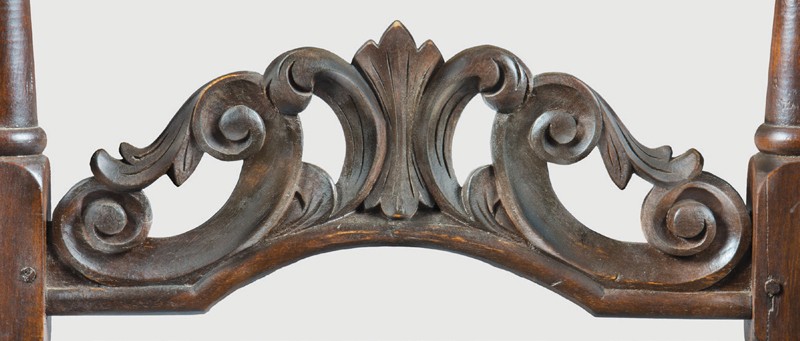
As Robert F. Trent and Mark Anderson’s article in the 2017 volume of American Furniture suggests, the high-style seating form for most middling and well-to-do colonists during the second half of the seventeenth century was the Cromwellian chair. It was not until the last fifteen years of the seventeenth century that new forms, and chairmakers well versed in making them, began to appear in Boston. With its taller back, upholstered vertical back panel, and decorative rear posts with finials, the Boston side chair shown in figure 2 (see Appendix, fig. 126) was clearly influenced by late seventeenth-century English seating (figs. 3-5). The chairs illustrated in figures 4 and 5 display a range of features that had become standard by the mid-1680s, including carved stretchers and carved crests with slots through which turkey work or leather could be pulled and secured at the back.

The origin of the side chair illustrated in figure 2 has been in dispute among furniture scholars for more than thirty years. Oswaldo Rodriguez Roque describes that object as “probably New England” in American Furniture at Chipstone (1984), whereas Neil D. Kamil attributes it to New York City in his American Furniture (1995) article. The chair descended through the Pritchard family of Boston and Milford, Connecticut. The scion of the family, Roger Pritchard (1600–1671), arrived in Boston in 1636 and died in Milford. Given Pritchard’s life dates and the chair’s probable date range for manufacture, it is impossible that he was the original owner. It is also unclear when and how the chair came to be owned by Pritchard descendants. Fortunately, the chair’s origin can be determined by its construction and design. Although the crest rail design—scrolled leaves and central flower motif—has no known American cognate, the mortise-and-tenon joinery follows the Boston practice identified by Roger Gonzales and Putnam Brown in their article in the 1996 volume of American Furniture. In addition, the chair’s finials are almost identical to those on the Boston leather-upholstered side chair and couch illustrated in figures 6 and 7.[4]

The side chairs and couch illustrated in figures 6–8 reveal how Boston chairmakers transitioned from Cromwellian seating to early baroque forms. An early date of manufacture is indicated by the back panel of the side chair shown in figure 8, which is the same size as that of a typical Cromwellian side chair but oriented vertically rather than horizontally. Whoever made this chair also made Cromwellian chairs and was directly influenced by imported English seating. An example in the collection of the Victoria and Albert Museum appears to be the antecedent of the Boston form (fig. 9).[5]

Forman divided early baroque Boston chairs into two discrete phases, those with turned rear posts and those with molded and curved rear posts. Based upon surviving examples, the author has defined five distinct groups of high-back leather-upholstered chairs with turned posts, designated as A through E. Group A includes the high-back, ball-turned chairs discussed earlier and one armchair (fig. 10). The latter example has finials identical to those on the side chair illustrated in figure 8 as well as on seating at the Metropolitan Museum of Art and the Museum of Fine Arts, Boston. Until the discovery of the armchair, only one other American example with foliate carving on its arms was known (fig. 11). Some scholars attributed these armchairs to New York and asserted that the carving reflected Dutch influence. Although the ornament may have Netherlandish antecedents, the leaf carving on the Boston chairs was most likely inspired by that on the arms of imported English cane chairs (fig. 12), which were influenced by Dutch seating. The construction of both armchairs and the turnings on the armchair shown in figure 10 match those on Boston Cromwellian chairs. The turning parallels are particularly meaningful as they relate in both shape and proportion.[6]

During the last decade of the seventeenth century, a steady stream of imported London cane and leather-upholstered chairs bombarded Boston chairmakers with new designs. The group B foliate carved armchair confirms that Boston craftsmen strove to keep abreast of the latest seating fashions (fig. 11). Though similarly constructed, chairs in groups A and B differ stylistically. Most obvious is the use of various turned elements in group B as opposed to the repetitive ball turnings typical of group A. Boston chairmakers and their patrons undoubtedly saw imported chairs with intricately turned rear posts (fig. 5) and desired to produce or own similar seating.

Group B chairs have rear posts with specific sequence turnings. The armchair shown in figure 11 has the characteristic “muffin top” finial surmounting (from top to bottom) a filleted, compressed ball; opposing filleted, echinus turnings; a tapered conical column; a bead; a compressed baluster; a ring; an ovolo; a baluster; and a ring-ball-ring. The ovolo and baluster turning combination that resembles a toadstool is the definitive hallmark of the group. Another diagnostic group B turning sequence is the “barrel” turning flanked by shallow rings on the rear posts directly above the seat. The front stretcher is the last Boston hallmark (fig. 14a). Its bilaterally symmetrical sequence of ring-ovolo-baluster-ovolo-compressed baluster-filleted ring-compressed baluster-ovolo-baluster-ovolo-fillet quickly became the standard for early eighteenth-century Boston chairmakers. The chair’s arm support turnings are analogous to the opposing baluster leg and stretcher turnings on contemporaneous Boston gateleg tables (fig. 15b). Two group B side chairs and the armchair illustrated in figure 11 have nearly identical rear posts except for the omission of the lowermost ring; the filleted ball is decreased substantially in size because of the reduced post height (figs. 13c, 16, 17). While both side chairs retain their feet and finials, their height differences indicate that chairmakers were making sets of chairs nearly indistinguishable from each other. As Gonzales and Brown noted, by the beginning of the eighteenth century Boston turners were mass producing individual components. The Cromwellian roots of group B side chairs are apparent on the retention of double side stretchers as opposed to the single stretcher on the armchair (fig. 11).[7]

Seventeenth-century Boston chairmakers offered little choice to their patrons, as is evident from the near uniformity of Cromwellian chair design. But with the importation of variously designed cane chairs at the end of the century, ambitious craftsmen were compelled to provide design options. These choices included foliate carved arms or simpler scroll arms, rectangular or turned side and rear stretchers, carved crests and stretchers, and plain crests. Fully turned stretchers like those on the armchairs illustrated in figures 18–20 were an option available to patrons, but they represented a significant cost increase over the standard rectangular forms. The same can be said of the arms on the chair shown in figure 18, which have compound downward and outward curves terminating with volutes. Their sweep and shape were almost certainly derived from the arms of imported English cane chairs. In addition to structural options, Boston chairmakers offered different finishes for their seating. On February 1, 1703, Thomas Fitch wrote William Crouch and Company, “Please to mind that what chairs ye send do not of a redish colour, but a good natural walnut, brown colour and well varnish and bot what I have writ for if not sent do most of y’or work five shills ap.”[8]

The group B armchair illustrated in figure 20 originally belonged to Johannes Hardenbergh (ca. 1670–1745) of Ulster County, New York. On April 20, 1708, he, Leonard Lewis, Philip Rokeby, William Nottingham, Peter Fauconnier, Robert Lurting, and Benjamin Faneuil received a grant of approximately two million acres of land, known as the Hardenbergh, or “Great,” Patent. Hardenbergh’s connection to Faneuil, who was one of Thomas Fitch’s agents for marketing and selling Boston seating in New York, suggests that the chair owned by Hardenbergh came from Fitch. Faneuil’s extensive mercantile ties allowed him to sell chairs to wealthy New Yorkers, as is demonstrated by both his correspondence with Fitch and the provenances of many surviving chairs.[9]

Given the significant number of chairmakers active in Boston at the turn of the seventeenth century, it is not surprising that there are several variants of the group B style chair. The sequence of turnings on the rear posts of the side chair illustrated in figure 21 are the same as those on group B armchairs (figs. 13a–c), but the finials are of a different style and the barrel turnings above the seat are scored along their center. A chair that appears to be from the same set once belonged to Margaretta Sanders (1764–1830) of Scotia, New York. Margaretta was the granddaughter of Barent Sanders (1678–1757), a prominent Albany merchant and likely the original owner of both chairs.[10]

Another group B chair descended through the Vanderlyn family of Kingston, New York (fig. 22). This example has turnings that differ markedly from the standard format (fig. 13c). They include balusters above the seat and a modified “Boston” stretcher, with a compressed ball at either end. The maker of this chair also incorporated a hollowed back (the crest rail and lower back rail have a concave curve)—a detail found on contemporaneous English leather chairs with carved crests (fig. 5). This practice was short lived, as it is not present on any later leather-upholstered chairs.[11]

Benno Forman attributed the side chair illustrated in figure 22 to New York, whereas decorative arts scholar Richard Randall postulated that an identical chair was made in the Piscataqua area of New Hampshire due to its discovery there. Gonzales and Brown identified it as a Boston product, but other possible towns of origin include Salem, Ipswich, and Newbury. All of these were wealthy communities and within Boston’s area of cultural influence. As exemplified by the Symonds shop in Salem, which was managed by James (1633–1714) and Samuel (1638–1722), these towns had craftsmen with the skill to produce chairs like the example shown in figure 22.[12]

A side chair related to the Vanderlyn example has nearly all of its original leather upholstery (fig. 23). It also has baluster turnings above the seat and balls at either end of the front stretcher, details found on the preceding side chair (figs. 14c and 22). The high front stretcher changes the proportions, and the debased turnings (with the replacement of the inner pair of balusters with a pair of reels centering a ball) of that component might initially suggest that the Vanderlyn chair and the example shown in figure 23 are not Boston products. Coincidentally, three nearly identical chairs originally belonged to Rev. Caleb Cushing (1673–1752) of Salisbury, Massachusetts. As Gonzales and Brown contend, provenance does not necessarily determine origin. The chair illustrated in figure 24 shares nearly all the attributes of the chair shown in figure 23 except that its front stretcher is a classic “Boston” variety. Therefore, while it is conceivable that these chairs could have been made in Salem or one of the other larger Essex County towns, it is more likely that they are Boston products.[13]

The earliest recorded reference to a Boston chair with a carved crest is Thomas Fitch’s September 9, 1709, letter to Benjamin Faneuil regarding the latter’s failure to sell his chairs:

I wonder the chairs did not sell; I have sold a pretty many of that sort to Yorkers since, and tho some are carv’d yet I make Six plain to one carv’d; and can’t make the plain so fast as they are bespoke, so yo may assure [them] that are customers that they are not out of fashion here. . . . I desire that you would force the sale of the chairs. . . . I also submit the price of them to your patience. It’s better to sell them than to let them lie. It might be better to have them rubbed over that they may look fresher.

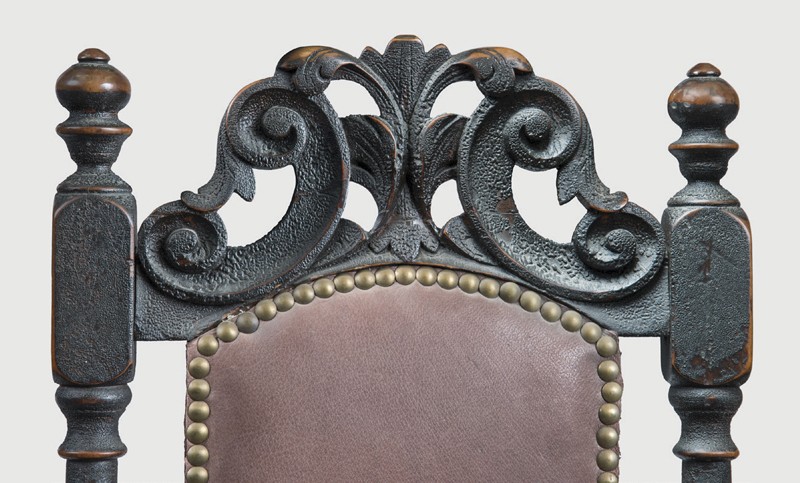
The side chair illustrated in figure 25 is the only example from group B with a carved crest. It was originally published in the 1896 folio Colonial Furniture and Interiors, compiled and photographed by Newton W. Elwell, and listed as “Furniture in Salem, Mass., 17th Century.” A side chair that once belonged to D. J. and Alice Shumway Nadeau (fig. 26) appears to be carved by the same hand as the chair shown in figure 25. A Cromwellian chair that once belonging to Charles Waters of Salem, Massachusetts, further demon-strates that various styles of chairs continued to be produced in Boston during the first decade of the eighteenth century (fig. 27). Its front stretcher is nearly identical to that of the chair illustrated in figure 25.[14]

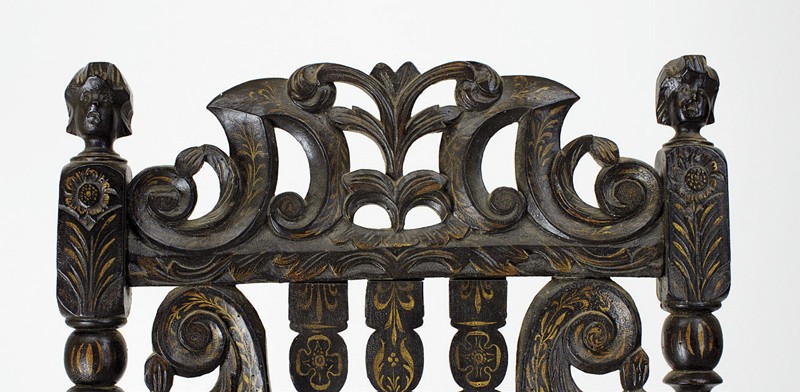
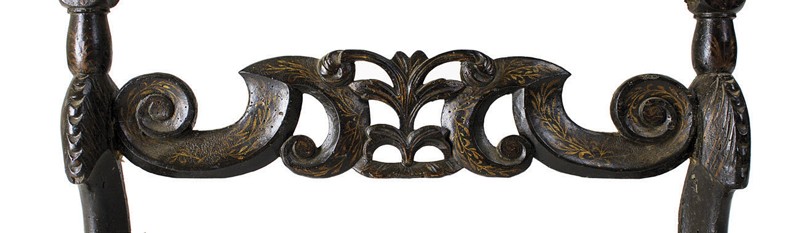
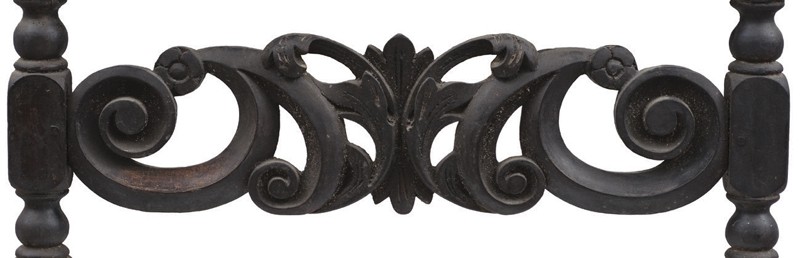
As is the case with their English counterparts, the earliest “carved topp’d” Boston chairs have crests with a horizontal slot through which the leather hide or textile of the back could be inserted, pulled tight, and attached to the backside with wrought iron tacks (see fig. 42). These early crests were designed with a broken scroll or, as royal chairmaker Thomas Roberts (active 1685–1714) identified them, a “horsebone” scroll. The body of the scroll has a medial ridge that attenuates towards the volutes and terminates in a circle. As furniture scholar Adam Bowett has noted, the horsebone scroll was a motif on English cane chairs made between 1690 and 1710 (fig. 28). Marking a departure from the English tradition, Boston carvers made the center of the volutes of different sizes and on the front stretchers added a circular device in the interstice between the volute and the break in the scroll—likely to add strength due to its being extensively pierced.[15]

The study of early Boston chairs is one of transition. Chairmakers continually updated their designs in response to the latest imported seating regularly arriving at Boston’s docks. An armchair given to Albany, New York, Rev. John Chester (1785–1829) by one of his parishioners represents the fullest maturation of group B design (fig. 29). Coinciding with this apex of form is the emergence of a new finial and rear post design allied with group C.[16]

Group C finials, with their well-defined urn-shaped bases surmounted with a slightly separated compressed ball capped with a diminutive, squat, conically shaped button or cylinder, are the earliest ascribed attribute of “second-generation” Boston leather chairs by Gonzales and Brown. The plainer turnings of the upper rear posts, with what Forman defined as a collarino or ring rather than the more complex opposing filleted echinus turnings, became the standard “Boston” post design. On the crest and stretchers of the armchair illustrated in figure 29, robust, layered leafage with sprigs emanating from pronounced deep sinuses replaces the interlaced sprigs on the carved side chair from group B (fig. 25). Another innovation in Boston chair design was the incorporation of a ball turning between the juncture of the arm and lower back rail. As the backs of chairs reached higher, -makers realized that the large square block between the stile and the barrel turning above the seat was visually too large and needed to be interrupted. A simple, compressed ball turning was their solution. The resulting chair, in its entirety, perfectly embodies the definition of baroque (fig. 29).

The back posts of two side chairs (figs. 30, 31) exhibit a divergent turning sequence. The “toadstool” turnings on the armchair shown in figure 29 are replaced with a baluster topped with a filleted ring, which is another -hallmark characteristic of group C chairs. The crest and stretcher carvings of the chair illustrated in figure 31 are merely smaller versions of those on the armchair (fig. 29); the only differences are the uncarved circular device in the stretcher and the sizes of the volute centers.[17]

With later baroque as well as rococo chairs, design books played an invaluable role in the creation of American seating furniture. Similar designs appeared in various colonial communities at vastly different times because books disseminated them in an unsystematic way. Could the variances in Boston’s early baroque seating furniture suggest that the dating of these traits and chairs in general may not be linear? Early eighteenth-century English chairmakers often changed their forms based upon both cultural and manufacturing demands, not design books. English chairmakers responded to their customers’ tastes by combining design sensibility with expeditious production, resulting in a significant upheaval in chair design during the first quarter of the eighteenth century. Boston chairmakers, in order to compete with imports, made related chairs that the American marketplace desired. Thus the development of Boston’s early baroque seating furniture was linear, driven by the ever-increasing influx of English chairs.

The early New York provenances of many leather chairs has led some scholars to attribute their origin to New York City and its environs. The reliance on provenance for attributions can be considerable, especially when combined with an apparent lack of additional information to suggest otherwise. Benno Forman, who relied on ownership histories to attribute several Boston leather chairs to New York, cited correspondence between Thomas Fitch and Benjamin Faneuil to support his argument. However, Fitch’s letterbooks actually suggest the opposite: they document the presence of a large and energetic market for Boston leather chairs in New York. Other colonial shipping records, though fragmentary, also detail the importation of Boston chairs into New York: nineteen arrived on the Dolphin of New York (Jacob Waldron, master) on May 10, 1716; the following March, the sloop Union, registered in Boston and captained by Joshua Thomas, brought a couch and twenty-five chairs; and on April 20, 1717, the sloop Warwick departed Boston for New York with a cargo including a dozen leather chairs. Although the consigners and sellers of the seating listed in these shipping records are not known, it is clear that Fitch was but one of many individuals involved in the leather chair trade between Boston and New York. On July 10, 1721, Boston merchant Edmund Knight billed -Robert Livingston of Livingston Manor, New York, £42.0.6 for “2 doz. Russia leather chairs & 3 elbow chairs.” Knight acted as Livingston’s factor in Boston. On November 10, 1722, the former wrote the latter, “Your couch is now sent by Schermerhorn & put into Mr. Van Horns bill of lading & you have enclosed Mr. [William] Down[es] note for making it.”[18]

As historian Neil Kamil surmised, New York craftsmen “did not sit idle while Fitch and others flooded the affluent New York market with -Boston leather chairs.” Kamil, Gonzales, and Brown have demonstrated that leather chairs, including elaborate carved versions, were made in New York, albeit in vastly smaller numbers. One such chair was made for Stephanus Van Cortlandt (1643–1700) or his son, Philip (1683–1748) (fig. 32). Its crest and stretcher carving, and pseudo barrel turning beneath the junction of the arm, likely reflect the maker’s desire to emulate contemporaneous Boston armchairs or imported English chairs. The Van Cortlandt chair’s upper rear post ovoid turning is a New York feature also occurring on banister-back seating (fig. 33). While the stretchers are of the same configuration as -Boston examples, the turning profiles relate to those on contemporaneous New York gateleg tables. The shape of the arms also confirms its New York attribution; they have a tube-like appearance, with a deeper curvature than Boston arms, and relate to arms on Northern European armchairs.[19]

The armchair illustrated in figure 34 is visually similar to the Boston example that belonged to Rev. John Chester (fig. 29), but the construction of the former possesses all of the attributes Gonzales and Brown associate with New York work. Its post and arm support turnings and front stretcher placement are also dissimilar from the Boston tradition. As noted by -Forman, urn turnings like those on the supports mirror details on a number of New  York gateleg tables as well as on the posts of English cane chairs (fig. 28). The arms on the chair illustrated in figure 34 are heavier than those on Boston examples, and their shape bears a closer relationship to the arms on the Van Cortlandt chair. Another difference is the design of the carved front stretcher, which uses an inverted leaf sprig to connect the interstice in the horsebone scroll rather than a flower. The most telling attribute of this chair’s origin, however, is the broad squat baluster turning located on the rear post directly above the seat; nearly all unequivocally New York early baroque leather-upholstered chairs share this attribute. A side chair likely made by the same craftsman also survives (fig. 35). Its only differing characteristics are the uncarved circular interstices in the front stretcher and the lack of a thin collarino on the rear post’s lower baluster turning.[20]

When the Chester armchair was made, the use of horsebone scrolls was waning in England. At that time, chairs with more vertical backs were in fashion, and paired C-scrolls were more effective at drawing the eye upward than horsebone scrolls. A chair that descended in the Bronck family of -Coxsackie, New York, represents a major milestone for Boston chairmakers (fig. 36). As the earliest leather-upholstered chair to incorporate a C-scroll carved crest, an upward curved C-scroll carved stretcher, and rear post composed of an elongated conical and a baluster turning, this chair stands apart from other group C seating and places it as the progenitor of group D chair design. Notwithstanding, this chair also has traditional group C features: the crest barely extends above the finials; a circular device is used in the C-scroll interstices; the lower side and rear stretchers are at the same height; and the Boston barrel turning remains above the seat.

A side chair that once belonged to Rev. Thomas Potwine (1731–1802) (fig. 37) represents a less expensive alternative to carved examples like the one shown in figure 36. Rev. Potwine was born in Boston and died in East Windsor, Connecticut. Given Potwine’s birth date, it is probable that he inherited the chair from his father, John (1698–1792) or mother, Mary (née Jackson) (1698–1766). Except for the “Boston” front stretcher, the Potwine chair has turned components virtually identical to those on the Bronck chair (fig. 36).[21]

An armchair that reputedly descended from Rev. Benjamin Prescott (1687–1777), the first pastor of South Church in Danvers (now Peabody), Massachusetts, is possibly by the maker of the Potwine chair (fig. 38). The rear post turnings are identical to those on the Bronck and Potwine chairs. Although fitted with the standard “Boston” front stretcher, the Prescott armchair is unusual in having conical turnings rather than balusters on the other stretchers and arm supports (fig. 39). Conical turnings are common on English cane chairs but rare on American leather chairs. The compressed ball turning on the rear posts, between the arm joint and lower back rail, relates to those on the Chester armchair (fig. 29).

A side chair that descended in the Pierson family of Kingston, New York, appears to be from the same shop that produced the Bronck family chair (figs. 36, 40). The former is in remarkable condition and retains its original Russia leather upholstery. The seat has two strips of webbing running from front to back and one from side to side, a configuration used by Boston upholsterers since the early seventeenth century (fig. 41). The crest and front stretcher of the Pierson and the Bronck chairs have identical carving and the same diagonal chamfer on the back edge of the crest (figs. 42, 137–140). Despite these overt similarities, the Pierson chair differs from the Bronck chair in its addition of a compressed ball turning beneath the baluster turning on the rear post and the omission of its upper side stretchers. It is also the earliest known example showing the simplification of the barrel turning (associated with groups B and C) to a cylinder. Imported English chairs similar to the example shown in figure 43 may have been the antecedent for cylindrical turnings of that type. While patron preference may account for the variance between the Pierson and Bronck chairs, the desire to expedite production is a more likely explanation. Cutting four additional mortices is time-consuming, and it is significantly easier for a turner to shape a cylinder rather than a more complex barrel turning. Combined, these alterations surely decreased the production time of the Pierson chair. It does not appear from surviving records, however, that these timesaving approaches resulted in reduced prices for consumers. The consistency of price for form in the first few decades of the eighteenth century, while factoring inflation, implies that fashion trends influenced price beyond the simple mechanics of the cost of labor.[22]

The chairs illustrated in figures 44 and 45, with their C-scrolled, carved, and slotted crest, their simplified rear posts with a single collarino at the top of an elongated cone above a baluster turning, their cylindrical turnings above the seat, and their dissimilarly sized front leg baluster turnings, are the most highly developed examples of group D seating. Some contemporaneous Boston tables exhibit similar features, like conical and baluster turnings on the stretchers and legs (fig. 46). These chairs’ rear posts, like the Pierson chair, have a cylindrical turning above the seat (fig. 13f). Here, however, the Boston turners chose to deeply score the cylinders at their ends. These marks delineate a vestige of the rings that flanked the group B and C barrel turning. Boston turners further used score marks to represent the detailed ring turning located directly above the baluster turning on the rear posts of later group E chairs. Group D chairs were the first to have a raised rear stretcher, a compressed baluster-and-ball foot, and prominent heels to aid in balancing the chair’s taller backs. Like the Pierson and Bronck chairs, the crests on group D chairs barely extend beyond the tops of the finials, which all have conical caps (figs. 141, 143). In contrast, the crest and stretcher carving has a lively three-dimensional quality. The sprig tips curve back towards the center of the C-scrolls, and deeply carved sinuses are present on both the crest and stretcher. The crest of the armchair also has an added extra embellishment of horizontally aligned parallel gouges to the midribs of the central leaf carving (fig. 143).[23]

The presence of related debased carving on chairs recovered in Essex County, Massachusetts, and southern New Hampshire might suggest that the Bronck and Pierson chairs were not made in Boston, were it not for their wood choice, joinery quality, and similarity of their turnings to other group C chairs. Boston was home to many chairmakers, turners, and carvers at the beginning of the eighteenth century. This heterogeneity of craftspeople would naturally result in the production of many similar, yet disparate, chairs. Two nearly identical plain crest group C chairs validate this supposition (figs. 47, 48). The finials on the Wadsworth Atheneum’s Pierson family chair (fig. 47) have squatter urns, and the separation between the compressed ball and urn is less defined as compared to those on a chair found in southern Maine (fig. 48). The scoring of the cylinders above the seat is handled differently between the chairs, and subtle differences are present in the rear post turnings (figs. 47, 48). As their stretcher alignment reveals, the two chairs are even constructed differently.[24]

An armchair (fig. 49) with rear post and finials identical to the example illustrated in figure 45 demonstrates that craftsmen continued to offer their clients the option of fully turned stretchers as leather chair styles evolved during the first decade of the eighteenth century. The turner of the armchair shown in figure 49 followed the established practice of not differentiating the height of the front leg balusters, which resulted in the stretcher being positioned quite high. Similar turnings can be seen on the armchair illustrated in figure 45, which has a carved stretcher set well above the ground. Proportional idiosyncrasies occurred as makers adjusted to new styles through hands-on experimentation.[25]

New York chairmakers, responding to the demand for Boston chairs, produced their own versions of group D chairs. Although closely resembling their Boston counterparts, the New York chairs have double side stretchers (which were largely abandoned by Boston chairmakers by 1710) and muted balusters above the seat (figs. 50, 51). The finials of the New York side chair illustrated in figure 50 have large compressed spheres that relate more closely to those on the armchair illustrated in figure 34 than those found on Boston seating. The rear post turnings of these New York examples are also similar, although those of the armchair shown in figure 34 have an additional baluster element. Crest height is another feature separating the New York side chair illustrated in figure 50 from contemporaneous and earlier Boston work; the crest rises above the finials rather than being approximately parallel with them. The carver of the New York chair included sinuses in the crest ornament, albeit not very deep or sculpted, but omitted them from the front stretcher (figs. 145, 146). Another New York side chair is almost identical but has a plain crest (fig. 51). As with Boston-made chairs, plain-crested chairs from New York have turned front stretchers—New York chairmakers seemingly eschewed pairs of opposing balusters, embracing instead the rarer Boston front stretcher turning with compressed spheres on either end (figs. 23, 14c, 14d).

Although chairmakers in other port cities attempted to compete with their Boston counterparts, the scarcity of early leather seating made elsewhere suggests that such endeavors met with very limited success. Some patrons may have chosen to purchase chairs from local makers to avoid the risk of damage during shipping or to guarantee that their seating was free from defects before paying, but those consumers probably represented a tiny fraction of the market. The local merchants with whom wealthy New Yorkers did business relied on their Boston counterparts, not only for seating and other goods, but also for knowledge of prevailing fashions. Consignment agreements insured that New York merchants and ship captains had a vested interest in the marketing and sale of Boston leather chairs. Thomas Fitch’s correspondence with Benjamin Faneuil documents tremendous demand. As early as 1706 the former wrote that he “could scarcely comply with those I had promised to go by sloops.” The mass production and export of Boston leather chairs gave the sellers of such seating a tremendous financial advantage, but as Fitch relayed to Faneuil on September 9, 1709, it also occasionally resulted in market saturation. Despite such concerns, it is clear that Fitch and his predecessors in the leather-chair trade had created a strong market, both locally and in New York, and that they were able and willing to adjust prices as needed.[26]

An armchair that descended in the Smith family (fig. 52) and another illustrated in figure 53 represent the apex of Boston design for baroque seating. Although both have standard group D features—finials with conical caps and rear posts with a ring above the baluster—the chairs are distinguished by having arched crests in conjunction with arched front stretchers. The crest rises significantly above the flanking finials, drastically increasing each chair’s vertical stature. To accommodate their lower stretchers, the maker used a larger baluster turning on the top section of the legs to lower the stretcher placement. The front stretcher and crest design of the armchairs and the side chair shown in figure 55 is unique, featuring large abstract leaves that rise from C-scrolls at each corner and meet above confronting C-scrolls in the center; however, the turned stretchers follow the design on the earlier Prescott armchair (fig. 38), and the arm supports are nearly identical to those on the example shown in figure 49. The makers of the Smith chair and the closely related armchair and side chair gave the heels of their rear posts more rake than normal to counter balance their extreme height (figs. 52-55). This is apparent when comparing these chairs with seating from groups A through D.[27]

Unlike the preceding group D chairs with carved crests, those assigned to group E do not have a slot for the leather upholstery. Instead, their crests have an arched reserve to accommodate a face-nailed back panel. A set of chairs bearing the brand of Philip Ver Planck (also Verplanck) (1695–1771) have this feature as well as tapered conical stiles and cylindrical double-scored turnings on the rear posts above the seat (fig. 56). As with other group D chairs. The sinuses are smaller (see fig. 151), and the upper back edges of crest and stretcher piercings are roughly chamfered (figs. 57, 58 [top]). The Ver Planck chairs do, however, have finials similar to those on group D chairs, and their front feet have more definition between the upper and lower sections than those of other Group E chairs (fig. 59 [left]). Philip Ver Planck, who lived in Albany in the 1720s, would likely have inherited these chairs; his immediate ancestors lived in New York City.[28]

Two nearly identical group E armchairs also descended through prominent New York families (figs. 60, 61). The example shown in figure 60, which retains much of its original leather upholstery, is associated with the Van Rensselaer, Schuyler, and Church families. The other armchair belonged to English colonial Gov. Pieter Schuyler (1657–1724) and resided in the ancestral family home at the Flats in Albany until Charles Woolsey Lyon purchased the chair in the early twentieth century (figs. 62, 63). The crest rail ornament on these chairs is slightly more elaborate than that on other group E seating, but both have hallmark group E features: finials capped with a squat cylinder; double-scored lines above the balusters on the rear posts; and somewhat flat carving.[29]

The group E armchair and side chair shown in figures 64–66 are branded “W. MANCIUS” for Wilhelmus Mancius (1738–1808), a doctor in Albany, New York. His father, Rev. George Wilhelmus Mancius (1706–1762), immigrated to New York from the County of Nassau (Germany) in 1730 and was pastor of the Katsbaan Reformed Church in Saugerties, New York, and the (First) Reformed Church in Kingston, New York (fig. 67). Since Rev. Mancius arrived in America after these chairs were fashionable, it is probable that either Rev. Mancius, who married Cornelia Kierstede of Kingston, or Dr. Mancius, who married Anna Ten Eyck of Albany, obtained them through their wives’ families. Both the Kierstedes and Ten Eycks were wealthy enough to afford such a lavish set. Discovered in Yonkers, New York, a fourth Group E armchair has a crest carved by a different hand (see figs. 68, 158) and provides further evidence that these chairs were assembled from components obtained from specialists.[30]

The largest surviving set of group E side chairs descended in the Van Rensselaer family (fig. 69). Although these examples are virtually identical to the Mancius side chairs, variations occur within group E. Some side chairs do not have baluster turnings on their rear posts, and some have crests lacking deeply carved sinuses and overlapping leaves (figs. 70, 71). The earliest occurrence of what became a standard front or medial stretcher for Boston baroque and early Georgian seating is on some group E chairs (fig.  14e). The archetypal component features large, bilaterally symmetrical balusters separated by a small reel (fig. 72). On group E chairs stretchers of that type are joined to the front legs with round mortises, which were easier and quicker to produce than rectangular ones. On earlier leather chairs, round mortise-and-tenon joints were only used to secure turned supports to the underside of arms. Forman speculated that the use of round mortise-and-tenon joints for front stretchers “may have reduced the price of a chair by 1s. or so and saved 14s. on a set of 12 side chairs and 2 armchairs.” He also suggested that “this may explain the shilling or so variation in the cost of chairs billed in the Fitch accounts.” The use of this new stretcher marked a pivotal point in the progression of Boston chair design, representing a variation on the “classic” Boston model that had been popular for at least fifteen  years.[31]

At no time before did patrons have such an assortment of seating choices. The group E chairs illustrated in figures 73–78 illustrate a variety of options for crests, stretchers, and arm supports, all of which affected both design and cost. The range of choices was even greater for Georgian framed seating made in Boston between 1730 and 1760, but the system of mass production and mercantilism that insured that city’s dominant role in the manufacture and export of seating in the colonies during that period had been established decades earlier.[32]

In response to the continual influx of English seating furniture, Boston chairmakers began producing different upholstered forms during the 1710s, though most of that seating is stylistically similar to contemporaneous leather chairs. The low-back leather chairs illustrated in figures 79 and 80 are the only Boston examples with crests affixed to the tops of the rear posts rather than between them. The chair illustrated in figure 79 has slightly more complex turnings, but the crests of the two examples are very similar (see figs. 167, 168).[33]

The backstools illustrated in figures 81 and 82 are the earliest American examples of this form. The former has stretchers that are smaller versions of those on the armchair illustrated in figure 49. The cylindrical turnings on the back posts above and below the rear stretcher blocks may have been derived from cane chairs. The other backstool differs in having cylindrical turnings above the seat, a bipartite front stretcher like those on several group E chairs (see figs. 72–74, 77, 78), and double-ball feet, which first occur in group D and E seating. Similarly, its conical stretchers (fig. 83) relate very closely to those on the Prescott and Smith armchairs (figs. 38, 39, 52, 53). As Forman noted, sets of high-back upholstered chairs with matching armchairs occasionally were provided en suite with a state bed for aristocratic homes in England. It is possible that these remarkable chairs were part of a much larger set and may have been made en suite with easy chairs like the example illustrated in figure 84. The front seat rail and crest rail of the easy chair relate to the double cyma-shaped front seat rail and back rails of the backstool. The easy chair’s legs and stretchers, turned in the classic “Boston” manner, demonstrate that Boston turners were proportioning their work to accommodate a variety of forms.[34]

Couches were the most costly baroque seating offered by Boston chairmakers (figs. 85, 86). In August 1723 Thomas Fitch charged Jacob Wendell £4.17.4 for “1 Couch frame and Squab of red Chainy.” Leather couches appear to have passed out of fashion in Boston by 1707. In April 1707 Fitch informed Faneuil that leather couches were “as much out of wear as Steeple crown’d hats. . . . cane couches or others we make like them wth a quilted pad are cheaper, mott: fasho[nable], easie & usefull; ye price of [those] we make wth pad is about [£]3.15.” A couch that once belonged to Rev. Daniel Shute (1722–1802) of Hingham, Massachusetts, is the only known example with a carved crest (fig. 86). It is also the earliest recorded piece of Boston seating furniture with a tripartite stretcher.[35]

By the 1710s Boston chairmakers began offering banister-back chairs with flag or rush seats as a cheaper alternative to leather chairs. No banister-back chair associated with groups A, B, or C is known, and those associated with group D are rare. The side chair illustrated in figure 87 is one of the earliest, having finials with conical caps, a ring above the baluster on the rear posts, a classic “Boston” front stretcher, and a carved crest identical to those on the leather chairs illustrated in figures 44 and 45. A related banister-back armchair has a carved crest that relates to those on group E chairs (figs. 88, 169). The crest is significantly higher than the finials, and its carving is less fluid than those associated with group D chairs. As the armchair suggests, some Boston seating has features associated with more than one group. The use of piecework accounts for some of the overlap, along with the production of transitional forms. Merchant upholsterers like Fitch could accommodate a variety of tastes, which was necessary for both commissioned work as well as for stock-in-trade, chairs made for export, and seating intended for speculative ventures.[36]

Banister-back chairs associated with group E are more common than earlier variants, though examples with carved crests and stretchers are exceptionally rare. The armchair illustrated in figure 89 is one of two known Boston examples. Differentiating it from leather-upholstered armchairs (figs. 60, 61, 64, 68), is the lack of compressed balls beneath the arm junction on the rear posts. This omission facilitated the placement of the arms slightly, creating an illusion of an even taller back. Deviating from the standard practice in leather-upholstered seating, the carver omitted the sinuses in the crest but incorporated them in the front stretcher (figs. 170, 171). The chair shown in figure 90 is one of only two known examples of a standard Boston banister-back carved crested side chair with a carved front stretcher. Its stretcher, unlike that of the chair illustrated in figure 89, is of the standard Group E design (fig. 172).[37]

Of the early Boston banister-back chairs that survive, most are similar to those illustrated in figures 91 and 92. On November 27, 1722, Boston chairmaker Edmund Perkins sold Timothy Woodbridge of Newbury, Massachusetts, “18 carved flag chairs” valued at 10s. each. Chairs of this general type have bipartite front stretchers featuring large balusters separated by a reel, yet they vary slightly in height and represent the work of different carvers and chairmakers. The chair illustrated in figure 93 is an example of one of the least costly options available, with a simple arched crest, plain rear back rail, and straight molded banisters. As with leather-upholstered seating, Boston chairmakers produced outlying variants of banister-back chairs. Related to low-back leather-upholstered chairs (figs. 79, 80), the crest of the chair shown in figure 94 rests on its rear posts and demonstrates Boston chairmakers’ continued desire to experiment with other styles.[38]

As Fitch’s correspondence with Faneuil suggests, caned chairs and couches were a fashionable and typically less expensive alternative to leather-upholstered seating. Although cane chairs were probably being made in Boston during the 1710s, the earliest documentary reference to their production is Fitch’s £25 loan to Edmund Perkins to purchase cane. The merchant upholsterer’s 1707 letter to Faneuil mentioning cane couches does not specify where they were made; Fitch probably sold both locally-made and imported cane seating. On October 6, 1725, he wrote his London factor Silas Hooper, “Cary. Litherhed bot for Mr. H[enr]y Deering Some frames, the fore feet of the same fashion . . . those Charg’d [me] . . . 14 have but 37 hiles and part of them not Walnutt.” As with leather chairs, the earliest Boston caned chairs were influenced by imported English examples (figs. 95, 96). The armchair illustrated in figure 97 may be the earliest Boston cane chair. It is made entirely of maple rather than beech or walnut, which were more commonly used in the construction of English caned chairs. The turnings of the rear posts are idiosyncratic, featuring elongated balusters separated by an ovoid element, stacked blocks at the junctures with the arms and lower back rail, and cylindrical turnings suggesting a post-1710 date.[39]

The side chair illustrated in figure 98 is the only example of Boston caned seating with a carved crest and stretcher like those on locally-made leather chairs, in this instance paralleling the examples assigned to group E. A caned armchair with a fragmentary crest appears to have been made in the same shop (fig. 99). It has a more elaborate carved stretcher and conically turned arm supports and stretchers that are identical to those on the leather-upholstered armchair illustrated in figure 38 (fig. 15h). The only surviving set of Boston caned chairs was initially acquired by Edward Wanton (1629–1716) or Joseph Wanton (1664–1754) of Newport, Rhode Island (figs. 100, 101), and these chairs, which are identical to examples shown in figures 98 and 99 except for having turned front stretchers, are the earliest established examples of Boston seating furniture shipped to Rhode Island.[40]

Due to increasing demand during the early 1720s, Boston chairmakers increased production of caned seating. This change coincided with the major design shift of the decade: replacing turned rear posts with molded posts. Easier and quicker to make, molded posts expedited construction. The chair shown in figure 102, with its straight molded posts, ogee-molded crest with carved embellishments, and tripartite stretcher, illustrates a standard Boston cane chair of the mid-1720s. The double cyma-shaped skirt adds visual mass to the front rail, as with the rest of the seat frame, and is horizontally configured for a broader caning surface. Few original skirts survive, and some chairs were made without them (fig. 103). Before the 1720s, nearly all baroque seating furniture had turned feet. The scroll, or “Spanish,” foot first appeared in Boston seating during the development of second-generation cane chairs and remained popular in local and export markets for decades.

Several other features associated with Boston seating dating from the late 1710s to the mid-1720s probably first appeared on locally-made cane chairs: back-set arm supports; “crook’d” backs; vasiform splats; forward-set medial stretchers; and square-section cabriole legs (figs. 104–107). Imported English cane chairs were the most likely source for these new designs. In Boston, earlier styles continued to thrive alongside the rapid assimilation of new ones. Inventory references and the accounts of Fitch and Samuel Grant suggest that many Boston seating forms remained popular for decades, particularly in the export trade.[41]

The side chair illustrated in figure 108 demonstrates how late leather chairs with turned posts and carved crests were made. Aside from having a baluster-shaped splat, it is identical to a group E side chair with a likely date range of 1710–1730. English chairmakers began using baluster-shaped splats, which were based on a Kangxi vase on stand, around 1720 (figs. 109, 110).[42]

Leather chairs of the type illustrated in figures 1 and 111 may have been made over a period of twenty-five to thirty years. The chair shown in figure 1 has an arched molded crest, whereas the chair shown in figure 111 has an ogee molded crest. Each has molded rear stiles, spooned backs, turned front stretchers, and rectangular side and rear stretchers. Armchair versions of both types were available, typically in pairs, for use alone or as part of a set with matching side chairs (fig. 112). A set of eleven chairs at the Pickering house in Salem, Massachusetts, has been attributed to Rev. Theophilus Pickering and purportedly dates to 1724; the close proximity of Salem to Boston and the extensive trade between both cities suggests, however, that these chairs were more likely made in Boston.[43]

The value of these later leather-upholstered Boston chairs can be determined from contemporaneous documents. On January 22, 1722, The Minutes of the Common Council of the City of New York recorded that the “Mayor Issue his Warrant to the Treasurer to pay to Cornelius Depeyster Esq or Order the Sum of fifteen pounds Six Shillings Current Money of New York being for the like Sum by him paid to Arnout Schermerhoorn for Eighteen Leather Chairs for the use of this Corporation in Common Council.” This payment equated to 17 shillings per chair. On August 5, 1729, Samuel Grant shipped to Clark, Esq. “6 Leather chairs @26s. . . . £7.16” and “1 Elbow ditto . . . £2.12.” On the same day he also sent “1 Easie Chair” valued at £8 and “12 Leather chairs @26s. . . . £15.12” to William Clear of New York. The change in prices resulted from inflation, which rose approximately forty-one percent from 1722 to 1729.[44]

Several options were available for the standard leather chair with an ogee crest. These included scroll, or “Spanish,” feet, small carved scrolls on the crest, and a carved stretcher (figs. 113, 114). Square-section cabriole legs probably became an option during the mid- to late 1720s (fig. 115), as did more complex stretchers (with the medial stretcher shifted forward) and thinner seat rails (fig. 116). As the chairs shown in figures 117 and 118 suggest, Boston chairmakers adapted the cyma shapes of cane chair skirts to front seat rails. Seats that were separately framed could be rushed or upholstered with leather or fabric. Even more economical options were available for potential buyers. The crest, rear posts, stretchers, and legs of the chairs illustrated in figures 119 and 120 are identical to those of the standard leather chair with ogee crest (fig. 111). Rushing the seat and substituting a simpler banister back or an unshaped splat for the leather-upholstered back were cost-saving deviations. On December 3, 1729, Samuel Grant charged Nathaniel Green 22s. apiece for “8 Chairs crook back flag bottom . . . £9.4.” The following February, Grant noted a sale to “Nathl Holmes 6 Leather chairs @26s. . . . £7.16.” These charges indicate that a flag bottom saved 4 shillings per chair.[45]

Some craftsmen who trained in the shops of Boston chairmakers undoubtedly moved to other coastal cities and towns. Although this mobility complicates the determination of origin in some instances, the preponderance of evidence strongly suggests that the vast majority of chairs that look like Boston examples were, in fact, made there. A side chair that descended in the Ellery family of Rhode Island illustrates this point (fig. 121). Several scholars have attributed that example to Rhode Island based largely on its provenance. However, the chair’s yolk crest excepted, its proportions, construction, carving, and turnings are all consistent with those of standard Boston chairs (figs. 1, 111). While it is conceivable that a Boston-trained craftsman who moved to Rhode Island made the Ellery chair, it is far more likely that the chair is one of the many examples exported to Rhode Island during the 1720s and 1730s. Fitch is known to have done business with Rhode Island merchants. On May 4, 1720, he charged Isaac Lopez £16.2 for “12 carvd Russia Leather Chairs & elbow.” The following month, Fitch sent two shipments of seating to Abram Guteres. Included were “2 doz Carvd Russia Leather chairs 23/ . . . £27.12” and “2 elbow Chairs Russia Leather 46/ . . . £4.2.” A small number of chairs resembling the Ellery example, but with non-Boston style turnings, survive and may be Rhode Island products.[46]

A group of “crookd” back chairs with later vasiform splats, rush seats, and double cyma-shaped front stretchers has also been attributed to Rhode Island. The example illustrated in figure 122 was originally owned by Gen. Andrew Ward V (1727–1800) of Shrewsbury, Massachusetts, and subsequently descended in the Foote family of Guilford, Connecticut. Furniture scholar Jennifer Johnson attributed a nearly identical chair to Newport based on its relationship to an example with identically turned legs that descended in the Coddington family. Notwithstanding that Johnson’s attribution is based entirely on provenance, subtle differences in the front leg and stretcher turnings from the Ellery chair may indicate a different origin. It is also possible that all of the aforementioned chairs were made in Boston by different coeval chairmakers.[47]

The passage of time and loss of daybooks, ledgers, letterbooks, and the objects themselves complicate the study of early Boston seating furniture. A unique pair of chairs, with angled C-scroll legs, banister backs, and unique crest and stretcher carving, is difficult to categorize (fig. 123). One might initially assume they were English (fig. 124), were it not for soft maple being used in their construction. However, the cylindrical turnings on the Boston chairs are scored like those on seating in groups D and E, and their conically turned stretchers are similar to those on the chairs shown in figures 38, 52, 53, 99, and 100. These seemingly aberrant chairs demonstrate that stylistic progression was not always linear; as with biological evolution, there were dead ends.

In 1735 John Oldmixon (1673–1742) noted that “a gentleman from London would almost think himself at home in Boston when he observes . . . their houses, their furniture, their tables [and] their dress.” Although Oldmixon might have been speaking somewhat hyperbolically, Boston chairmakers were quick to assimilate the latest English fashions. As new designs arrived, they were modified to accommodate established systems of mass production and to control cost. Older designs and techniques of manufacture and upholstery, however, were retained for as long as was practical and commercially viable. Although likely dating from the mid-eighteenth century, the side chair illustrated in figure 125 has over-the-rail upholstery with a trim strip and double row of brass nails—details found on Boston leather chairs made as early as 1690.

By the 1710s Boston chairmakers for the first time provided Bostonians, and American colonists at large, a luxury of choice predicated on imported designs and the rise of the colonial middle and upper classes, who could afford the cost of the varied styles of seating. Boston chairs arguably became the most successfully manufactured and marketed product of the eighteenth century. They were sought out by wealthy colonists who desired the most fashionable and highest quality forms available. Regional craftsmen could not compete with the high demand for Boston products, though they emulated those designs. Thus we should not consider provenance alone to determine the origin of an object; instead a multitude of disparate sources should be analyzed together to reach repeatedly provable conclusions. By applying such evidentiary methods, the study of colonial economics and American material culture can be greatly enhanced.

ACKNOWLEDGMENTS
For assistance with this article, the author thanks Betsy Alexandre, Gavin Ashworth, Luke Beckerdite, Roderic Blackburn, Josephine Bloodgood, Whitney Bounty, Daniel Putnam Brown, Dennis Carr, Tara Chicirda, Brandy Culp, Kelly Daniell, Ronna Dixson, Alyce Englund, Tom and Tania Evans, Stephen Fletcher, Robyn Gibson, Roger Gonzales, Tamis Groft, Joseph Gromacki, Norman and Mary -Gronning, Maureen Harper, Marianne Howard, Neil Kamil, Alexandra Kirtley, Dr. S. Kalman and Ellen Kolansky, Donald Koleman, Angelika Kuettner, Joshua Lane, Ymelda Rivera Laxton, Frank Levy, Arthur Liverant, Shelby Mattice, W. Douglas McCombs, Allison Munsell Napierski, Susan Newton, Jonathan Prown, Joshua Ruff, Tom Satterlee, Robert David Sweeney, Ashley Trainor, Robert Trent, Kevin Tulimieri, John and Marie Vander Sande, Fred and Anne Vogel, and Cara Zimmerman. The author is especially grateful to his family—Cynthia, Alexander, and Benjamin—for their encouragement, understanding, immense patience, and support.

[1]

Thomas Fitch Account Book, February 27, 1723, Massachusetts Historical Society, Boston, Mass. The following month Fitch billed Adam Towell £16.4 for “12 crookd backed Chairs” (27s. apiece). Benno M. Forman, American Seating Furniture, 1630–1730: An Interpretive Catalogue (New York: W. W. Norton, 1988), p. 335. For the initial writing on “Boston” chairs, see Richard H. Randall Jr., “Boston Chairs,” Old-Time New England 54, no. 1 (Summer 1963): 12–20. The first known English set of chairs with molded stiles and cane seats are at Canons Ashby, circa 1717. Adam Bowett, Early Georgian Furniture 1715–1740 (Woodbridge, Eng.: Antique Collectors’ Club, 2009), p. 157, pl. 4:24.

[2]

Thomas Fitch, Letterbook, 1702–1711, American Antiquarian Society, Worcester, Mass.; Thomas Fitch, Letterbook, 1714–1717, New England Historic Genealogical Society, Boston, Mass.; Thomas Fitch, Letterbook, 1723–1733, Massachusetts Historical Society, Boston, Mass.; Thomas Fitch, Account Book, 1719–1732, Massachusetts Historical Society, Boston, Mass.; Thomas Fitch, Account Book, 1732–1736, Massachusetts Historical Society, Boston, Mass.; Samuel Grant, Account Book, 1728–1737, Massachusetts Historical Society, Boston, Mass.; Samuel Grant, Receipt Book, 1731–1740, Bostonian Society, Boston, Mass.; Samuel Grant, Account Book, 1737–1760, American Antiquarian Society, Worcester, Mass.; Samuel Grant, Petty Ledger, 1755–1762, Boston Public Library, Boston, Mass.; Samuel Grant, Petty Ledger, 1762–1771, Boston Public Library, Boston, Mass. For a discussion of early Boston and the upholstery trade there, see Brock Jobe, “The Boston Furniture Industry, 1720–1740,” in Boston Furniture of the Eighteenth Century, edited by Walter Muir Whitehill, Brock Jobe, and Jonathan Fairbanks (Boston: Colonial Society of Massachusetts, 1974), pp. 20–48. Numerous Boston chairs survive with various provenances ranging from Massachusetts, New Hampshire, Rhode Island, Connecticut, and New York. A set of eight chairs descended from Robert Sanders (1705–1765) and through the Van Rensselaer family of Albany, New York (Roderic H. Blackburn, Cherry Hill: The History and Collections of a Van Rensselaer Family [Albany, N.Y.: Historic Cherry Hill, 1976], p. 66, no. 33). For a succinct discussion about these chairs, see Nancy Carlisle, Cherished Possessions: A New England Legacy (Boston, Mass.: Society for the Preservation of New England Antiquities, 2003), pp. 120–1, no. 14.

[3]

Irving Whitehall Lyon, The Colonial Furniture of New England (Boston, Mass., and New York: Houghton, Mifflin and Company, 1891), pp. 153–61. Luke Vincent Lockwood, Colonial Furniture in America, 2 vols. (New York: C. Scribner’s Sons, 1901), 2: 33–54. Wallace Nutting, Furniture of the Pilgrim Century, 1620-1720: Including Colonial Utensils and Hardware (Boston: Marshall Jones Company, 1921), pp. 235–285. Wallace Nutting, Furniture Treasury (Mostly of American Origin): All Periods of American Furniture with Some Foreign Examples in America, also American Hardware and Household Utensils (Framingham, Mass.: Old America Company, 1928), nos. 1911–2047, 2089–2091. Brock Jobe and Myrna Kaye, New England Furniture: The Colonial Era, Selections from the Society for the Preservation of New England Antiquities (Boston: Houghton Mifflin Company, 1984), pp. 318–342. Brock Jobe, “The Boston Upholstery Trade,” in America & Europe from the Seventeenth Century to World War I, edited by Edward S. Cooke Jr. (New York: W. W. Norton and Company, 1987), pp. 64–89. Neil D. Kamil, “Hidden in Plain Sight: Disappearance and Material Life in Colonial New York,” in American Furniture, edited by Luke Beckerdite and William N. Hosley (Hanover, N.H.: University Press of New England for the Chipstone Foundation, 1995), pp. 191–249. Roger Gonzales and Daniel Putnam Brown Jr., “Boston and New York Leather Chairs: A Reappraisal,” in American Furniture, edited by Luke Beckerdite (Hanover, N.H.: University Press of New England for the Chipstone Foundation, 1996), pp. 175–94. Glenn Adamson, “The Politics of the Caned Chair,” in American Furniture, edited by Luke Beckerdite (Hanover, N.H.: University Press of New England for the Chipstone Foundation, 2002), pp. 174–206. Frances Gruber Safford, American Furniture in the Metropolitan Museum of Art. I: Early Colonial Period, the Seventeenth-Century and William and Mary Styles (New York: Metropolitan Museum of Art, 2007), pp. 64–95. Philip D. Zimmerman, “The ‘Boston Chairs’ of Mid-Eighteenth-Century Philadelphia,” in American Furniture, edited by Luke Beckerdite (Hanover, N.H.: University Press of New England for the Chipstone Foundation, 2009), pp. 140–158. Ethan W. Lasser, “The Cane Chair and Its Sitter,” in American Furniture, edited by Luke Beckerdite (Hanover, N.H.: University Press of New England for the Chipstone Foundation, 2010), pp. 54–75.
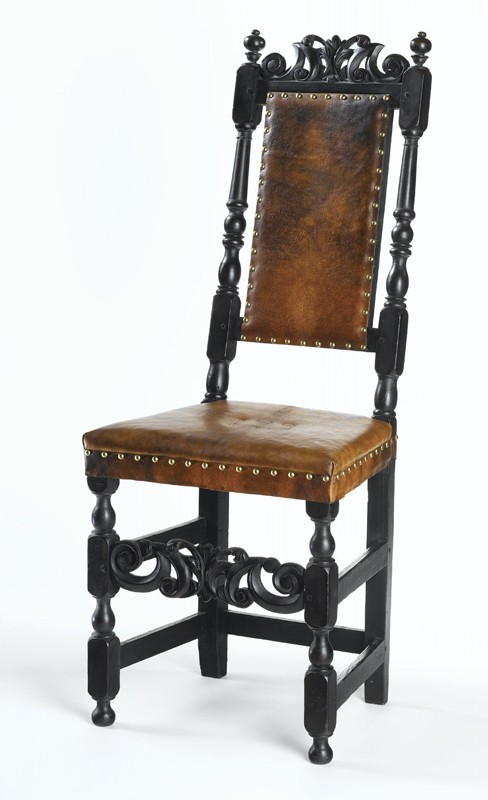
[4]

Oswaldo Rodriguez Roque, American Furniture at Chipstone (Madison: University of Wisconsin Press, 1984), pp. 107–9, no. 45. Kamil, “Hidden in Plain Sight,” p. 229. Gonzales and Brown, “Boston and New York Leather Chairs,” pp. 175–94.

[5]

Two other side chairs with spherical-shaped finials are in the collections of the Metropolitan Museum of Art and the Museum of Fine Arts, Boston. Safford, American Furniture in the Metropolitan Museum of Art. I: Early Colonial Period, pp. 71–2, no. 25. Museum of Fine Arts, Boston, acc. 1983.229 (this example has replaced inner stiles and upper and lower back rails).
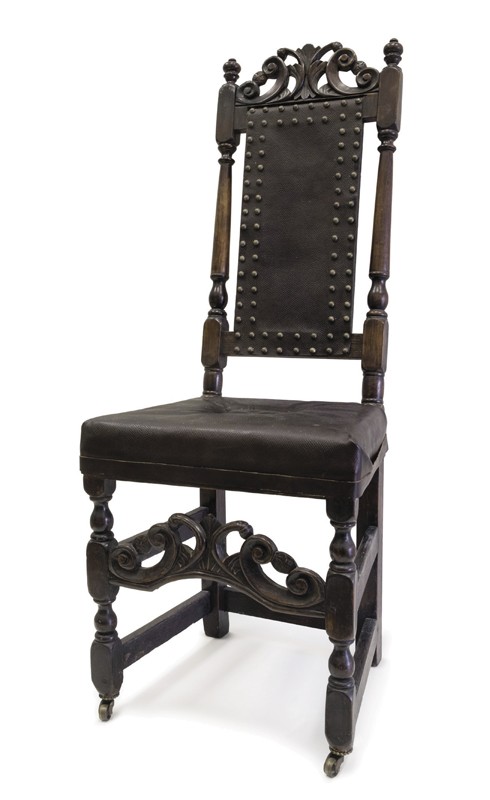
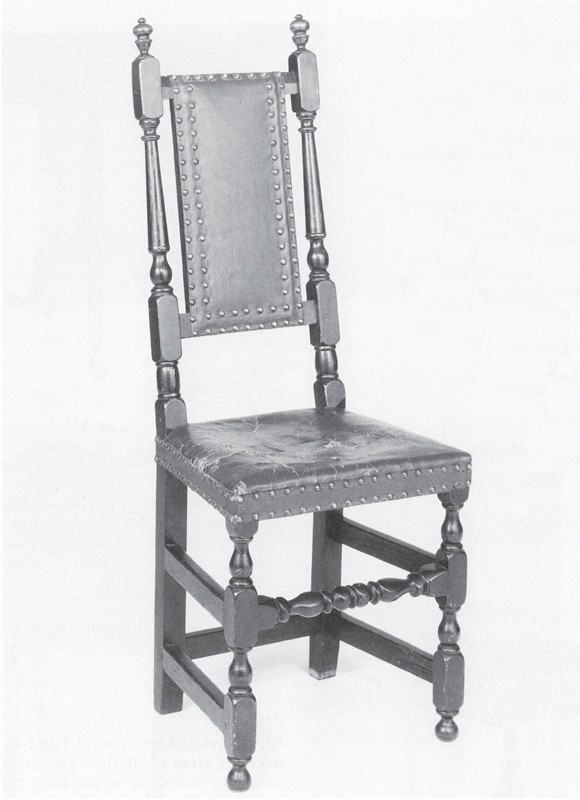
[6]

Forman, American Seating Furniture, pp. 289–90. Kamil, “Hidden in Plain Sight,” pp.  16–7. Gonzales and Brown, “Boston and New York Leather Chairs,” pp. 178–181.

[7]

A chair closely related to figures 16 and 17 was sold at Christie’s, American Furniture and Decorative Arts including English and Dutch Delft, New York, January 23, 2009, sale 2133, lot 159. Gonzales and Brown, “Boston and New York Leather Chairs,” p. 180

[8]

Thomas Fitch Letterbook, 1702-1711.

[9]

James Eldridge Quinlan, History of Sullivan County: Embracing an Account of Its Geology, Climate, Aborigines, Early Settlement, Organization; The Formation of Its Towns, with Biographical Sketches of Prominent Residents, Etc., Etc. (Liberty, N.Y.: G. M. Beebe and W. T. Morgans, 1873), p. 10.

[10]

Joseph Downs Collection of Manuscripts and Printed Ephemera, Joseph Downs Papers, collection 76, box 13, Winterthur Library, Winterthur, Del. Margaretta’s parents were Johannes Barentse Sanders (1714–1782) and Debora Jacob Glen (1721–1786). She married Killian Van Rensselaer (1763–1845) in 1791. Furniture scholar Joseph Downs noted that the chair was not listed in Killian’s 1791 inventory, but he reasoned that it came from her. An identical chair is in the Fred J. Johnston Museum in Kingston, New York, while two others are in private collections in Wisconsin and Connecticut. Ronald Bourgeault advertised a nearly identical side chair with acorn finials and a reputed Portsmouth, New Hampshire, association in Maine Antique Digest (December 1984): 40D. Another chair from possibly the same set as the Bourgeault example was sold at Sotheby’s, Important Americana, New York, January 21, 2018, sale 9805, lot 745.

[11]

See Robert Trent’s entry in American Furniture with Related Decorative Arts, 1660-1830, edited by Gerald W. R. Ward (New York: Hudson Hill Press, 1991), pp. 69–70, no. 19.

[12]

Gonzales and Brown, “Boston and New York Leather Chairs,” pp. 175–94; Forman, American Seating Furniture, pp. 320–21, fig. 174; Richard, “Boston Chairs,” pp. 12–20, fig. 4. For additional information on the Symonds family, see Martha H. Willoughby, “Patronage in Early Salem: The Symonds Shops and Their Customers,” in American Furniture, edited by Luke Beckerdite (Hanover, N.H.: University Press of New England for the Chipstone Foundation, 2000), pp. 169–84. A nearly identical side chair is in the collection of the American Museum in Britain (acc. 1960.76) and has a ring turning in place of the opposing filleted, echinus turnings. It is illustrated within the Lee Room in The American Museum, Claverton Manor, Bath (Bath: American Museum in Britain, 1975).

[13]

The chair illustrated in fig. 23 was purchased at Northeast Auctions, New Hampshire Auction, Portsmouth, New Hampshire, July 31, 1989, lot 359. Six other nearly identical chairs survive. Two descended in the Cushing family now in the collection of the Metropolitan Museum of Art (Safford, American Furniture in the Metropolitan Museum of Art. I: Early Colonial Period, pp. 72–5, no. 26); two sold at Skinner, Inc., American Furniture and Decorative Arts, Bolton, Massachusetts, June 7, 1998, lot 28 (one of which had belonged to Rev. Caleb Cushing); one with its original leather upholstery is in the Los Angeles County Museum of Art (acc. 53.19.2); two in a private collection in New Hampshire were initially sold in the spring of 1994 at Roger Chesley Auctions, Cornish, Maine, then at James D. Julia Auctions, Rockport, Maine, in April 1994 (Maine Antique Digest [May 1994]: 14C), then at Northeast Auctions, Summer Americana Auction, Portsmouth, New Hampshire, August 5, 2007, lot 1663; one with original leather is in the Hendrickson House, Wilmington, Delaware (Winterthur Museum’s Decorative Arts Photographic Collection [hereafter DAPC], acc. no. 76.472). Forman, American Seating Furniture, pp. 325–6, no. 71. For a chair nearly identical to fig. 24, see Peter Eaton, “Spectacular Vernacular,” Antiques & Fine Art 12, no. 5 (Summer 2013): 149. This chair has barrel turning above the seat as opposed to the baluster turning.
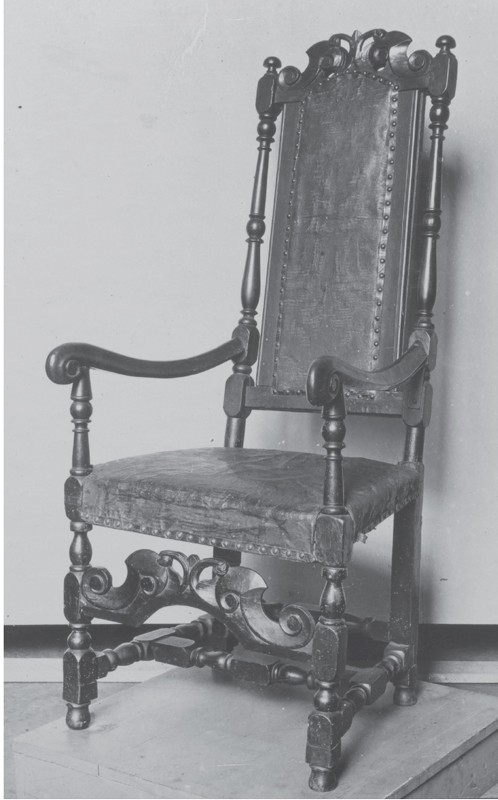
[14]

Thomas Fitch to Benjamin Faneuil, July 11, 1709, Fitch Letterbook, 1702-1711. Newton W. Elwell, Colonial Furniture and Interiors (Boston, Mass.: George H. Polley and Company, 1896), pl. 42. The chair in figure 26 was published in Ian M. G. Quimby, American Family Treasures: Decorative Arts from the D. J. and Alice Shumway Nadeau Collection (Lexington, Mass.: National Heritage Museum, 2005), pp. 19–20, no. 2, and sold at Skinner, Inc., Country Americana, Marlborough, Massachusetts, November 20, 2014, sale 2765M, lot 286. Esther Singleton, The Furniture of Our Forefathers (New York: Doubleday, Page and Company, 1906), pp. 183, 185.

[15]

A closely related English armchair (1696–1705) is illustrated in Adam Bowett, English Furniture, 1660–1714: From Charles II to Queen Anne (Woodbridge, Eng.: Antique Collectors’ Club, 2002), p. 233, pl. 8:8. 

[16]

According to an unsigned statement dated 1906 in the files of Israel Sack, Inc., John Chester gave the armchair to his sister Elizabeth, who gave it to her old nurse, after whose death it was hunted up and secured by Letitia C. Backus, wife of John Chester Backus. At Letitia’s death the chair passed to her grandson John Chester Backus Pendleton. The chair was in the Bybee Collection, Dallas, Texas, when it was nearly destroyed by fire and is now in the collection of the Museum of Fine Arts, Boston.

[17]

An unpublished side chair similar to that in figure 30 is in the Fred J. Johnston Museum in Kingston, New York, and another is in a private Connecticut collection. A very closely related side chair with remnants of a carved crest and stretcher sold at John McInnis Auctioneers, Contents of the Bass Whitney House, Newburyport, MA, Amesbury, Massachusetts, November 11, 2016, lot 39.    

[18]

Arnout Schermerhorn was a ship’s captain who, like several others, transported chairs for Fitch as well as Fitch’s apprentice, Samuel Grant. Foreman, American Seating Furniture, p. 285.
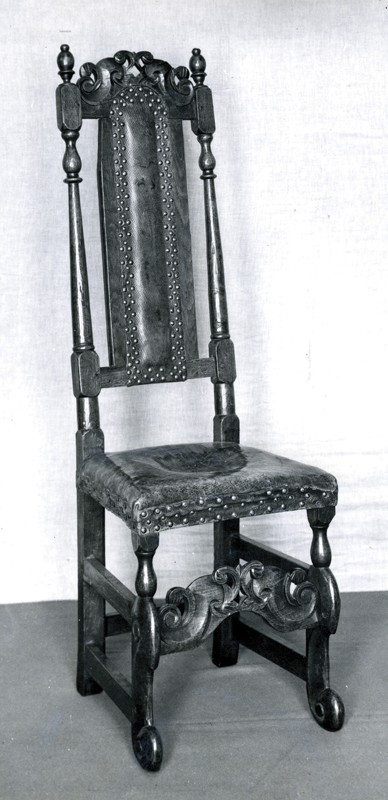
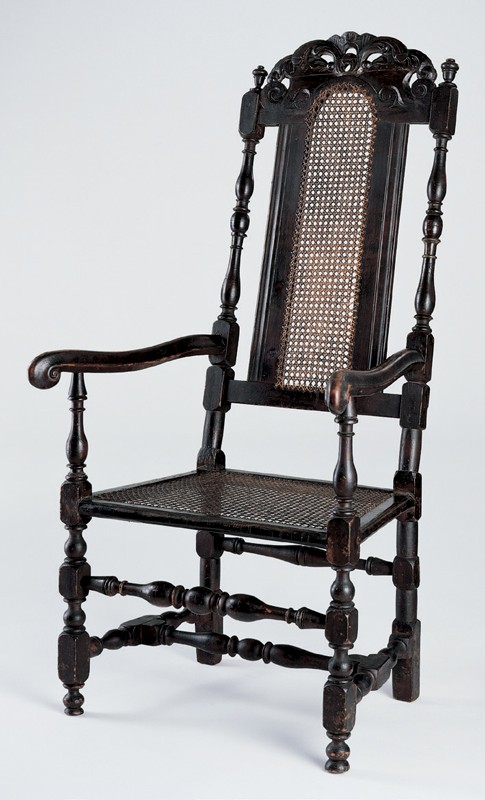
[19]

Kamil, “Hidden in Plain Sight,” p. 196. New York had few documented turners during the early eighteenth century. As listed in “The Burgers of New Amsterdam and the Freemen of New York, 1675-1866,” in Collections for the New-York Historical Society for Year 1885 (New York: New-York Historical Society, 1886), only one chairmaker is listed between 1725 and 1750, a George Elsworth (April 10, 1739); eight turners are listed between 1695 and 1725: William Bogaert (September 26, 1698), Johannes Byvanck (February 2, 1699), Johannes Tiebout (February 2, 1699), Rutgert Waldron (February 3, 1699), Peter Henyon (May 30, 1702), James Gamewell (July 4, 1704), John Willox (April 24, 1716), and Richard Armstrong (August 21, 1722). Given the sizable shipping industry in New York during the late seventeenth and early eighteenth centuries, many of the turners listed above likely worked extensively—or possibly even exclusively—on shipping-related matters.

[20]

Forman, American Seating Furniture, p. 289.

[21]

Sotheby’s, Fine American Furniture, Folk Art, Silver and China Trade Paintings including Property from the Estate of Esther Pace Kuna, New York, June 23, 1988, sale 5736, lot 445. Thomas Potwine’s grandfather, John Potwine (1668–1700), immigrated to Boston in 1698. Massachusetts Sen. George Frisbie Hoar (1826–1904) regularly used the Prescott armchair in the nineteenth century and early twentieth century. For a side chair very similar to the example illustrated in figure 35 and recovered in Windsor, Connecticut, see Patricia E. Kane, 300 Years of American Seating Furniture Chairs and Beds from the Mabel Brady Garvan and Other Collections at Yale University (Boston: New York Graphic Society, 1976), pp. 60–1, no. 39.

[22]

For a chair from the same set, see Peter Eaton, “Spectacular Vernacular,” Antiques & Fine Art 12, no. 5 (Summer 2013): 149. In the seventeenth and eighteenth centuries, Kingston, New York, was referred to as Esopus based upon the name of the native tribe that populated the area.

[23]

The chair in figure 44 was advertised by Leigh Keno American Antiques, Antiques 160, no. 5 (November 2001): 574. An unpublished side chair possibly from the same set is in the Fred J. Johnston Museum in Kingston, New York; another is in a private collection in Massachusetts (Gonzales and Brown, “Boston and New York Leather Chairs,” p. 140, fig. 13; Peter Eaton, “Spectacular Vernacular,” p. 140 [bottom left]). A pair of related chairs sold at Northeast Auctions, The Tom and Audrey Monahan Collection, Portsmouth, New Hampshire, August 4, 2001, lot 117. The armchair in figure 45 was sold at Sotheby’s, Important Americana: Furniture, Folk Art, Silver, Porcelain, Prints and Carpets including Property Sold by the Philadelphia Museum of Art, New York, January 26, 2013, sale 8950, lot 344. A related armchair in the collection of the Metropolitan Museum of Art has unfortunately undergone extensive restoration, and only its carved front stretcher, set rails, legs, and back posts are original (acc. no. 30.120.73) (see Marvin D. Schwartz, American Furniture of the Colonial Period [New York: Metropolitan Museum of Art, 1976], p. 25, no. 22).

[24]

For banister-back chairs with debased carving, see Robert F. Trent, Erik Gronning, and Alan Anderson, “The Gaines Attributions and Baroque Seating in Northeastern New England,” in American Furniture, edited by Luke Beckerdite (Hanover, N.H.: University Press of New England for the Chipstone Foundation, 2010), pp. 140–93. The chair shown in figure 48 came from a house in southern Maine and sold at Hap Moore Antiques Auctions, York, Maine, October 6, 2001 (Rose Safran, “Pilgrim Century Chair Brings $11,220,” Maine Antique Digest [January 2002]: 36D). No Boston chairs with front stretchers like that on the example illustrated in figure 47 are known on seating with carved crests. As Joan Barzilay Freund and Leigh Keno noted, “The use of patterns, structural shortcuts, and piecework purchased from turners, carvers, and other specialists gave the city’s merchants, upholsterers, and entrepreneurs a financial edge over their competitors in other ports” (see Freund and Keno, “The Making and Marketing of Boston Seating Furniture in the Late Baroque Style,” in American Furniture, edited by Luke Beckerdite [Hanover, N.H.: University Press of New England for the Chipstone Foundation, 1998], p. 1).

[25]

To facilitate installation of the arms, many Boston chairmakers chamfered the edge of the round mortice.

[26]

Kamil, “Hidden in Plain Sight,” p. 196.

[27]

Another side chair, nearly identical to the chair shown in figure 55, is in a private Connecticut collection.

[28]

Joseph Downs, “Furniture of the Hudson Valley,” Antiques 60, no. 1 (July 1951): 46. For another chair from the set with remnants of original leather, see Kamil, “Hidden in Plain Sight,” pp. 206–7, figs. 17, 18. Roderic Blackburn, “Branded and Stamped New York Furniture,” Antiques 119, no. 5 (May 1981): 1130-45. The chairs illustrated by Blackburn are not discussed in this article.

[29]

The trapezoidal stitching in the seat is approximately thirty percent larger on the armchair than a side chair.

[30]

For an image of the armchair prior to restoration, see Pook and Pook, Inc., Period Furniture, Fine Art, & Accessories, Downingtown, Pennsylvania, January 14, 2011, lot 470. A side chair branded “W. MANCIUS” is in the collection of the Museum of Fine Arts, Boston, acc. 2016.539. Another with a partially replaced crest and feet sold at Pook and Pook, Inc., Period Furniture, Fine Art, & Accessories, Downingtown, Pennsylvania, October 4, 2014, lot 453. The chair in figure 68 was sold at Hudson Valley Auctioneers, New Years Auction, Beacon, New York, January 1, 2009, lot 109. The last known armchair from this group sold at Christie’s, Fine American Furniture, Silver, Folk Art and Decorative Arts, New York, January 23, 1988, lot 245, and was subsequently advertised by Joe Kindig Antiques, Antiques 175, no. 5 (May 2009): 36.

[31]

A chair identical to the example illustrated in fig. 69 sold at Potomack Company, The Design & Decor Catalogue Auction, Alexandria, Virginia, March 31, 2007, lot 240. Forman, American Seating Furniture, p. 316. Another related chair is illustrated in Gonzales and Brown, “Boston and New York Leather Chairs,” p. 140, fig. 12. A chair very similar to that in fig. 70 is in a private Vermont collection. A chair related to the one shown in fig. 71 and once owned by antiquarian Luke Vincent Lockwood is illustrated and discussed in Joseph Downs and Ruth Ralston, A Loan Exhibition of New York State Furniture with Contemporary Accessories (New York: Metropolitan Museum of Art, 1934), no. 5. The Lockwood chair sold at Skinner, Inc., The Collection of George & Diana Neuman, Bolton, Massachusetts, May 15, 1993, lot 42. Several side chairs are related to the example illustrated in fig. 72: one is in the collection of the -Colonial Williamsburg Foundation, acc. no. 1976-428; one sold at Sotheby’s, The Highly Important Americana Collection of George S. Parker II from the Caxambas Foundation, New York, January 19, 2017, lot 2023; and another is shown in Forman, American Seating Furniture, pp. 314–6, no. 66. Entries for June 2 and 9, 1722, Fitch Account Book, 1719–1732.

[32]

A number of the chairs reviewed for this study had finials that lacked a terminal cap turning. All lacked evidence indicative of their once having one, and it is possible either that these caps were yet another option offered by chairmakers or that these chairs are the work of different turners. Freeman’s, American Furniture, Folk & Decorative Arts, Philadelphia, Pennsylvania, November 13, 2014, lot 348. For a pair of chairs related to the one shown in figure 76, see Joseph T. Butler, Sleepy Hollow Restorations: A Cross-Section of the Collection (Tarrytown, N.Y.: Sleepy Hollow Press, 1983), p. 53, no. 37. Another chair nearly identical to that in fig. 76 is in a private collection in Milwaukee, Wisconsin.

[33]

A chair related to the example illustrated in fig. 77 sold at Sotheby’s, Property from the Collection of Irvin & Anita Schorsch: Hidden Glen Farms, New York, January 20, 2016, lot 476. A chair identical to that in fig. 78 was sold at Northeast Auctions, Annual Summer Americana Auction, Portsmouth, New Hampshire, August 1, 2008, lot 471, and another was sold at Sotheby’s, Property from the Collection of Irvin & Anita Schorsch: Hidden Glen Farms, New York, January 20, 2016, lot 472.

[34]

For a closely related English back stool dating 1705–1715, see the frontispiece in Adam Bowett, English Furniture. Forman, American Seating Furniture, pp. 360-1, no. 85. For more on early American easy chairs, see: Robert F. Trent, “Boston Baroque Easy Chairs, 1705–1740,” in American Furniture, edited by Luke Beckerdite (Hanover, N.H.: University Press of New England for the Chipstone Foundation, 2012), pp. 84–115; and, Robert Trent, Seated in Comfort: A Boston Easy Chair of 1710–1725 (Milwaukee, Wisc.: Anne H. and Frederick Vogel III Collection of American Furniture and Decorative Art, 2016).

[35]

Fitch to Faneuil, April 22, 1707, Fitch Letterbook, 1702-1711.

[36]

The chair in figure 87 sold at Stair Galleries, Exposition Auction, Hudson, New York, July 11, 2009, lot 777. For a related side chair with a “Salem” carved crest (as denoted by Trent, Gronning, and Anderson, “The Gaines Attributions,” pp. 171–6), see Catalogue IV (New York: Bernard and S. Dean Levy, Inc., 1984), p. 6. The chair once belonged to the New-York Historical Society and is illustrated in Winterthur’s DAPC, acc. no. 70.3766. For a banister-back chair with a group E crest and a “Boston” front stretcher, see Skinner, Inc., American Furniture & Decorative Arts, Marlborough, Massachusetts, August 14, 2011, sale 2558M, lot 192. The armchair in figure 88 was sold at Skinner, Fine Americana, Bolton, Massachusetts, May 30, 1986, lot 293. Another banister-back armchair with a Boston stretcher is in the collection of the Philadelphia Museum of Art (acc. no. 1923.23.33)(Edward Stratton Holloway, The Practical Book of American Furniture and Decoration: Colonial and Federal [Philadelphia: J. B. Lippincott Company, 1937], pl. 6). The finials and upper portion of the crest rail are replaced.

[37]

For an image of the chair illustrated in fig. 87 when found, see Luke Vincent Lockwood, Colonial Furniture in America (New York: Charles Scribner’s Sons, 1913), pp. 40–41, fig. 463. This chair sold at Northeast Auctions, Annual Americana Auction, Portsmouth, New Hampshire, August 3–5, 2006, lot 1036. Roderick H. Blackburn Americana Art and Antiques, Kinderhook, New York, offered the other known Boston armchair with carved stretcher (B0677). Another banister-back armchair with a carved crest and stretcher formerly owned by antiquarian Benjamin Perley Poore (1820–1887) is illustrated in Frances Clary Morse, Furniture of the Olden Time (New York: MacMillian Company, 1944), p. 170, illus. 141. This chair had double turned side stretchers that relate to seating from Essex County, Massachusetts, and was tragically destroyed in a fire. Another carved crested banister-back side chair with carved front stretcher was illustrated by Roger Gonzales and Frank Cowan, Maine Antique Digest (August 1991): 48B.

[38]

For additional examples of chairs related to those in figs. 91 and 92, see Patricia E. Kane, 300 Years of American Seating Furniture, p. 60, no. 38, and Skinner, Fine Americana, Bolton, Massachusetts, March 21, 1987, lot 87. An unpublished side chair in a private Pennsylvania collection has crest and stretcher carvings that are very similar to those of the chair shown in fig. 94. Its crest, however, is captured between the chair’s rear posts, and the banisters are molded as those on the chair in fig. 93 rather than turned. November 27, 1722, Fitch Account Book, 1719–1732.

[39]

Forman, American Seating Furniture, pp. 242, 244.

[40]

Christie’s, Important American Furniture, Folk Art, Silver and Prints, New York, January 21, 2005, sale 1474, lots 544 and 545.

[41]

For a variety of Boston chairs made between 1710 and 1750, see Freund and Keno, “The Making and Marketing of Boston Seating Furniture,” pp. 1–40. In the author’s opinion, some of the cane chairs in that article are dated too early. The chair illustrated in fig. 105 sold at Skinner, American Furniture & Decorative Arts, Boston, Massachusetts, February 18, 2007, lot 229. An armchair related to the one illustrated in fig. 106 is illustrated in David B. Warren, Michael K. Brown, Elizabeth Ann Coleman, and Emily Ballew Neff, American Decorative Arts and Paintings in the Bayou Bend Collection (Houston, Tex.: Museum Fine Arts, Houston), pp. 8–9, no. F16

[42]

Bowett, Early Georgian Furniture, p. 161.

[43]

Singleton, Furniture of Our Forefathers, pp. 318, 320, and Dean A. Fales Jr., Essex County Furniture: Documented Treasures from Local Collections, 1660-1860 (Salem, Mass.: Essex Institute, 1965), no. 32. Another set of six chairs descended in the Bullard family of Holliston, Massachusetts. Skinner, Inc., American Furniture & Decorative Arts, Boston, Massachusetts, November 8, 2009, sale 2481, lot 29. By the 1720s chairmakers in Philadelphia attempted to compete with the Boston imports. A Plunket Fleeson advertisement in the Pennsylvania Gazette on June 14, 1744, stated: “Maple Chairs as cheap as from Boston” (Zimmerman, “The ‘Boston Chairs’ of Mid-Eighteenth-Century Philadelphia,” p. 142). The noted collector Titus Geesey once owned an example of a Philadelphia leather-upholstered armchair made in the “Boston” taste (Jack L. Lindsey, Worldly Goods: The Arts of Early Pennsylvania, 1680-1758 [Philadelphia: Philadelphia Museum of Art, 1999], p. 170, no. 140). A closely related side chair is in the collection of the Chipstone Foundation, Milwaukee, Wisconsin (acc. no. 1992.007) (Adamson, “The Politics of the Caned Chair,” p. 191, fig. 21); another is in the collection of the Newtown Library Company, Newtown, Pennsylvania (Forman, American Seating Furniture, p. 295, fig. 165).

[44]

Minutes of the Common Council of the City of New York. Vol. III: February 1, 1712, to November 8, 1729 (New York: Dodd, Mead and Company, 1905), p. 273. Samuel Grant Daybook, 1728–1737. John J. McCusker, Money and Exchange in Europe and America (Chapel Hill: University of North Carolina Press for the Institute of Early American History and Culture), p. 140.

[45]

For a chair related to the example shown in fig. 113, see Butler, Sleepy Hollow Restorations, p. 53, no. 38. See also Robert Bishop, The American Chair: Three Centuries of Style (New York: Bonanza Books, 1983), pp. 46–7, no. 43.

[46]

Jobe and Kaye, New England Furniture: The Colonial Era, p. 341. Jennifer N. Johnson, “The Upholstery and Chairmaking Trades of Eighteenth-Century Newport, 1730–1790” (master’s thesis, Cooper-Hewitt, 2012), pp. 54–9.

[47]

Jennifer N. Johnson, entries 43 and 44, in Patricia Kane et al., Art & Industry in Early America: Rhode Island Furniture, 1650–1830 (New Haven, Conn.: Yale University Art Gallery, 2016), pp. 249-53.

American Furniture 2018

Show all Figures only
Contents


  • [1]

    Thomas Fitch Account Book, February 27, 1723, Massachusetts Historical Society, Boston, Mass. The following month Fitch billed Adam Towell £16.4 for “12 crookd backed Chairs” (27s. apiece). Benno M. Forman, American Seating Furniture, 1630–1730: An Interpretive Catalogue (New York: W. W. Norton, 1988), p. 335. For the initial writing on “Boston” chairs, see Richard H. Randall Jr., “Boston Chairs,” Old-Time New England 54, no. 1 (Summer 1963): 12–20. The first known English set of chairs with molded stiles and cane seats are at Canons Ashby, circa 1717. Adam Bowett, Early Georgian Furniture 1715–1740 (Woodbridge, Eng.: Antique Collectors’ Club, 2009), p. 157, pl. 4:24.

  • [2]

    Thomas Fitch, Letterbook, 1702–1711, American Antiquarian Society, Worcester, Mass.; Thomas Fitch, Letterbook, 1714–1717, New England Historic Genealogical Society, Boston, Mass.; Thomas Fitch, Letterbook, 1723–1733, Massachusetts Historical Society, Boston, Mass.; Thomas Fitch, Account Book, 1719–1732, Massachusetts Historical Society, Boston, Mass.; Thomas Fitch, Account Book, 1732–1736, Massachusetts Historical Society, Boston, Mass.; Samuel Grant, Account Book, 1728–1737, Massachusetts Historical Society, Boston, Mass.; Samuel Grant, Receipt Book, 1731–1740, Bostonian Society, Boston, Mass.; Samuel Grant, Account Book, 1737–1760, American Antiquarian Society, Worcester, Mass.; Samuel Grant, Petty Ledger, 1755–1762, Boston Public Library, Boston, Mass.; Samuel Grant, Petty Ledger, 1762–1771, Boston Public Library, Boston, Mass. For a discussion of early Boston and the upholstery trade there, see Brock Jobe, “The Boston Furniture Industry, 1720–1740,” in Boston Furniture of the Eighteenth Century, edited by Walter Muir Whitehill, Brock Jobe, and Jonathan Fairbanks (Boston: Colonial Society of Massachusetts, 1974), pp. 20–48. Numerous Boston chairs survive with various provenances ranging from Massachusetts, New Hampshire, Rhode Island, Connecticut, and New York. A set of eight chairs descended from Robert Sanders (1705–1765) and through the Van Rensselaer family of Albany, New York (Roderic H. Blackburn, Cherry Hill: The History and Collections of a Van Rensselaer Family [Albany, N.Y.: Historic Cherry Hill, 1976], p. 66, no. 33). For a succinct discussion about these chairs, see Nancy Carlisle, Cherished Possessions: A New England Legacy (Boston, Mass.: Society for the Preservation of New England Antiquities, 2003), pp. 120–1, no. 14.

  • [3]

    Irving Whitehall Lyon, The Colonial Furniture of New England (Boston, Mass., and New York: Houghton, Mifflin and Company, 1891), pp. 153–61. Luke Vincent Lockwood, Colonial Furniture in America, 2 vols. (New York: C. Scribner’s Sons, 1901), 2: 33–54. Wallace Nutting, Furniture of the Pilgrim Century, 1620-1720: Including Colonial Utensils and Hardware (Boston: Marshall Jones Company, 1921), pp. 235–285. Wallace Nutting, Furniture Treasury (Mostly of American Origin): All Periods of American Furniture with Some Foreign Examples in America, also American Hardware and Household Utensils (Framingham, Mass.: Old America Company, 1928), nos. 1911–2047, 2089–2091. Brock Jobe and Myrna Kaye, New England Furniture: The Colonial Era, Selections from the Society for the Preservation of New England Antiquities (Boston: Houghton Mifflin Company, 1984), pp. 318–342. Brock Jobe, “The Boston Upholstery Trade,” in America & Europe from the Seventeenth Century to World War I, edited by Edward S. Cooke Jr. (New York: W. W. Norton and Company, 1987), pp. 64–89. Neil D. Kamil, “Hidden in Plain Sight: Disappearance and Material Life in Colonial New York,” in American Furniture, edited by Luke Beckerdite and William N. Hosley (Hanover, N.H.: University Press of New England for the Chipstone Foundation, 1995), pp. 191–249. Roger Gonzales and Daniel Putnam Brown Jr., “Boston and New York Leather Chairs: A Reappraisal,” in American Furniture, edited by Luke Beckerdite (Hanover, N.H.: University Press of New England for the Chipstone Foundation, 1996), pp. 175–94. Glenn Adamson, “The Politics of the Caned Chair,” in American Furniture, edited by Luke Beckerdite (Hanover, N.H.: University Press of New England for the Chipstone Foundation, 2002), pp. 174–206. Frances Gruber Safford, American Furniture in the Metropolitan Museum of Art. I: Early Colonial Period, the Seventeenth-Century and William and Mary Styles (New York: Metropolitan Museum of Art, 2007), pp. 64–95. Philip D. Zimmerman, “The ‘Boston Chairs’ of Mid-Eighteenth-Century Philadelphia,” in American Furniture, edited by Luke Beckerdite (Hanover, N.H.: University Press of New England for the Chipstone Foundation, 2009), pp. 140–158. Ethan W. Lasser, “The Cane Chair and Its Sitter,” in American Furniture, edited by Luke Beckerdite (Hanover, N.H.: University Press of New England for the Chipstone Foundation, 2010), pp. 54–75.

  • [4]

    Oswaldo Rodriguez Roque, American Furniture at Chipstone (Madison: University of Wisconsin Press, 1984), pp. 107–9, no. 45. Kamil, “Hidden in Plain Sight,” p. 229. Gonzales and Brown, “Boston and New York Leather Chairs,” pp. 175–94.

  • [5]

    Two other side chairs with spherical-shaped finials are in the collections of the Metropolitan Museum of Art and the Museum of Fine Arts, Boston. Safford, American Furniture in the Metropolitan Museum of Art. I: Early Colonial Period, pp. 71–2, no. 25. Museum of Fine Arts, Boston, acc. 1983.229 (this example has replaced inner stiles and upper and lower back rails).

  • [6]

    Forman, American Seating Furniture, pp. 289–90. Kamil, “Hidden in Plain Sight,” pp.  16–7. Gonzales and Brown, “Boston and New York Leather Chairs,” pp. 178–181.

  • [7]

    A chair closely related to figures 16 and 17 was sold at Christie’s, American Furniture and Decorative Arts including English and Dutch Delft, New York, January 23, 2009, sale 2133, lot 159. Gonzales and Brown, “Boston and New York Leather Chairs,” p. 180

  • [8]

    Thomas Fitch Letterbook, 1702-1711.

  • [9]

    James Eldridge Quinlan, History of Sullivan County: Embracing an Account of Its Geology, Climate, Aborigines, Early Settlement, Organization; The Formation of Its Towns, with Biographical Sketches of Prominent Residents, Etc., Etc. (Liberty, N.Y.: G. M. Beebe and W. T. Morgans, 1873), p. 10.

  • [10]

    Joseph Downs Collection of Manuscripts and Printed Ephemera, Joseph Downs Papers, collection 76, box 13, Winterthur Library, Winterthur, Del. Margaretta’s parents were Johannes Barentse Sanders (1714–1782) and Debora Jacob Glen (1721–1786). She married Killian Van Rensselaer (1763–1845) in 1791. Furniture scholar Joseph Downs noted that the chair was not listed in Killian’s 1791 inventory, but he reasoned that it came from her. An identical chair is in the Fred J. Johnston Museum in Kingston, New York, while two others are in private collections in Wisconsin and Connecticut. Ronald Bourgeault advertised a nearly identical side chair with acorn finials and a reputed Portsmouth, New Hampshire, association in Maine Antique Digest (December 1984): 40D. Another chair from possibly the same set as the Bourgeault example was sold at Sotheby’s, Important Americana, New York, January 21, 2018, sale 9805, lot 745.

  • [11]

    See Robert Trent’s entry in American Furniture with Related Decorative Arts, 1660-1830, edited by Gerald W. R. Ward (New York: Hudson Hill Press, 1991), pp. 69–70, no. 19.

  • [12]

    Gonzales and Brown, “Boston and New York Leather Chairs,” pp. 175–94; Forman, American Seating Furniture, pp. 320–21, fig. 174; Richard, “Boston Chairs,” pp. 12–20, fig. 4. For additional information on the Symonds family, see Martha H. Willoughby, “Patronage in Early Salem: The Symonds Shops and Their Customers,” in American Furniture, edited by Luke Beckerdite (Hanover, N.H.: University Press of New England for the Chipstone Foundation, 2000), pp. 169–84. A nearly identical side chair is in the collection of the American Museum in Britain (acc. 1960.76) and has a ring turning in place of the opposing filleted, echinus turnings. It is illustrated within the Lee Room in The American Museum, Claverton Manor, Bath (Bath: American Museum in Britain, 1975).

  • [13]

    The chair illustrated in fig. 23 was purchased at Northeast Auctions, New Hampshire Auction, Portsmouth, New Hampshire, July 31, 1989, lot 359. Six other nearly identical chairs survive. Two descended in the Cushing family now in the collection of the Metropolitan Museum of Art (Safford, American Furniture in the Metropolitan Museum of Art. I: Early Colonial Period, pp. 72–5, no. 26); two sold at Skinner, Inc., American Furniture and Decorative Arts, Bolton, Massachusetts, June 7, 1998, lot 28 (one of which had belonged to Rev. Caleb Cushing); one with its original leather upholstery is in the Los Angeles County Museum of Art (acc. 53.19.2); two in a private collection in New Hampshire were initially sold in the spring of 1994 at Roger Chesley Auctions, Cornish, Maine, then at James D. Julia Auctions, Rockport, Maine, in April 1994 (Maine Antique Digest [May 1994]: 14C), then at Northeast Auctions, Summer Americana Auction, Portsmouth, New Hampshire, August 5, 2007, lot 1663; one with original leather is in the Hendrickson House, Wilmington, Delaware (Winterthur Museum’s Decorative Arts Photographic Collection [hereafter DAPC], acc. no. 76.472). Forman, American Seating Furniture, pp. 325–6, no. 71. For a chair nearly identical to fig. 24, see Peter Eaton, “Spectacular Vernacular,” Antiques & Fine Art 12, no. 5 (Summer 2013): 149. This chair has barrel turning above the seat as opposed to the baluster turning.

  • [14]

    Thomas Fitch to Benjamin Faneuil, July 11, 1709, Fitch Letterbook, 1702-1711. Newton W. Elwell, Colonial Furniture and Interiors (Boston, Mass.: George H. Polley and Company, 1896), pl. 42. The chair in figure 26 was published in Ian M. G. Quimby, American Family Treasures: Decorative Arts from the D. J. and Alice Shumway Nadeau Collection (Lexington, Mass.: National Heritage Museum, 2005), pp. 19–20, no. 2, and sold at Skinner, Inc., Country Americana, Marlborough, Massachusetts, November 20, 2014, sale 2765M, lot 286. Esther Singleton, The Furniture of Our Forefathers (New York: Doubleday, Page and Company, 1906), pp. 183, 185.

  • [15]

    A closely related English armchair (1696–1705) is illustrated in Adam Bowett, English Furniture, 1660–1714: From Charles II to Queen Anne (Woodbridge, Eng.: Antique Collectors’ Club, 2002), p. 233, pl. 8:8. 

  • [16]

    According to an unsigned statement dated 1906 in the files of Israel Sack, Inc., John Chester gave the armchair to his sister Elizabeth, who gave it to her old nurse, after whose death it was hunted up and secured by Letitia C. Backus, wife of John Chester Backus. At Letitia’s death the chair passed to her grandson John Chester Backus Pendleton. The chair was in the Bybee Collection, Dallas, Texas, when it was nearly destroyed by fire and is now in the collection of the Museum of Fine Arts, Boston.

  • [17]

    An unpublished side chair similar to that in figure 30 is in the Fred J. Johnston Museum in Kingston, New York, and another is in a private Connecticut collection. A very closely related side chair with remnants of a carved crest and stretcher sold at John McInnis Auctioneers, Contents of the Bass Whitney House, Newburyport, MA, Amesbury, Massachusetts, November 11, 2016, lot 39.    

  • [18]

    Arnout Schermerhorn was a ship’s captain who, like several others, transported chairs for Fitch as well as Fitch’s apprentice, Samuel Grant. Foreman, American Seating Furniture, p. 285.

  • [19]

    Kamil, “Hidden in Plain Sight,” p. 196. New York had few documented turners during the early eighteenth century. As listed in “The Burgers of New Amsterdam and the Freemen of New York, 1675-1866,” in Collections for the New-York Historical Society for Year 1885 (New York: New-York Historical Society, 1886), only one chairmaker is listed between 1725 and 1750, a George Elsworth (April 10, 1739); eight turners are listed between 1695 and 1725: William Bogaert (September 26, 1698), Johannes Byvanck (February 2, 1699), Johannes Tiebout (February 2, 1699), Rutgert Waldron (February 3, 1699), Peter Henyon (May 30, 1702), James Gamewell (July 4, 1704), John Willox (April 24, 1716), and Richard Armstrong (August 21, 1722). Given the sizable shipping industry in New York during the late seventeenth and early eighteenth centuries, many of the turners listed above likely worked extensively—or possibly even exclusively—on shipping-related matters.

  • [20]

    Forman, American Seating Furniture, p. 289.

  • [21]

    Sotheby’s, Fine American Furniture, Folk Art, Silver and China Trade Paintings including Property from the Estate of Esther Pace Kuna, New York, June 23, 1988, sale 5736, lot 445. Thomas Potwine’s grandfather, John Potwine (1668–1700), immigrated to Boston in 1698. Massachusetts Sen. George Frisbie Hoar (1826–1904) regularly used the Prescott armchair in the nineteenth century and early twentieth century. For a side chair very similar to the example illustrated in figure 35 and recovered in Windsor, Connecticut, see Patricia E. Kane, 300 Years of American Seating Furniture Chairs and Beds from the Mabel Brady Garvan and Other Collections at Yale University (Boston: New York Graphic Society, 1976), pp. 60–1, no. 39.

  • [22]

    For a chair from the same set, see Peter Eaton, “Spectacular Vernacular,” Antiques & Fine Art 12, no. 5 (Summer 2013): 149. In the seventeenth and eighteenth centuries, Kingston, New York, was referred to as Esopus based upon the name of the native tribe that populated the area.

  • [23]

    The chair in figure 44 was advertised by Leigh Keno American Antiques, Antiques 160, no. 5 (November 2001): 574. An unpublished side chair possibly from the same set is in the Fred J. Johnston Museum in Kingston, New York; another is in a private collection in Massachusetts (Gonzales and Brown, “Boston and New York Leather Chairs,” p. 140, fig. 13; Peter Eaton, “Spectacular Vernacular,” p. 140 [bottom left]). A pair of related chairs sold at Northeast Auctions, The Tom and Audrey Monahan Collection, Portsmouth, New Hampshire, August 4, 2001, lot 117. The armchair in figure 45 was sold at Sotheby’s, Important Americana: Furniture, Folk Art, Silver, Porcelain, Prints and Carpets including Property Sold by the Philadelphia Museum of Art, New York, January 26, 2013, sale 8950, lot 344. A related armchair in the collection of the Metropolitan Museum of Art has unfortunately undergone extensive restoration, and only its carved front stretcher, set rails, legs, and back posts are original (acc. no. 30.120.73) (see Marvin D. Schwartz, American Furniture of the Colonial Period [New York: Metropolitan Museum of Art, 1976], p. 25, no. 22).

  • [24]

    For banister-back chairs with debased carving, see Robert F. Trent, Erik Gronning, and Alan Anderson, “The Gaines Attributions and Baroque Seating in Northeastern New England,” in American Furniture, edited by Luke Beckerdite (Hanover, N.H.: University Press of New England for the Chipstone Foundation, 2010), pp. 140–93. The chair shown in figure 48 came from a house in southern Maine and sold at Hap Moore Antiques Auctions, York, Maine, October 6, 2001 (Rose Safran, “Pilgrim Century Chair Brings $11,220,” Maine Antique Digest [January 2002]: 36D). No Boston chairs with front stretchers like that on the example illustrated in figure 47 are known on seating with carved crests. As Joan Barzilay Freund and Leigh Keno noted, “The use of patterns, structural shortcuts, and piecework purchased from turners, carvers, and other specialists gave the city’s merchants, upholsterers, and entrepreneurs a financial edge over their competitors in other ports” (see Freund and Keno, “The Making and Marketing of Boston Seating Furniture in the Late Baroque Style,” in American Furniture, edited by Luke Beckerdite [Hanover, N.H.: University Press of New England for the Chipstone Foundation, 1998], p. 1).

  • [25]

    To facilitate installation of the arms, many Boston chairmakers chamfered the edge of the round mortice.

  • [26]

    Kamil, “Hidden in Plain Sight,” p. 196.

  • [27]

    Another side chair, nearly identical to the chair shown in figure 55, is in a private Connecticut collection.

  • [28]

    Joseph Downs, “Furniture of the Hudson Valley,” Antiques 60, no. 1 (July 1951): 46. For another chair from the set with remnants of original leather, see Kamil, “Hidden in Plain Sight,” pp. 206–7, figs. 17, 18. Roderic Blackburn, “Branded and Stamped New York Furniture,” Antiques 119, no. 5 (May 1981): 1130-45. The chairs illustrated by Blackburn are not discussed in this article.

  • [29]

    The trapezoidal stitching in the seat is approximately thirty percent larger on the armchair than a side chair.

  • [30]

    For an image of the armchair prior to restoration, see Pook and Pook, Inc., Period Furniture, Fine Art, & Accessories, Downingtown, Pennsylvania, January 14, 2011, lot 470. A side chair branded “W. MANCIUS” is in the collection of the Museum of Fine Arts, Boston, acc. 2016.539. Another with a partially replaced crest and feet sold at Pook and Pook, Inc., Period Furniture, Fine Art, & Accessories, Downingtown, Pennsylvania, October 4, 2014, lot 453. The chair in figure 68 was sold at Hudson Valley Auctioneers, New Years Auction, Beacon, New York, January 1, 2009, lot 109. The last known armchair from this group sold at Christie’s, Fine American Furniture, Silver, Folk Art and Decorative Arts, New York, January 23, 1988, lot 245, and was subsequently advertised by Joe Kindig Antiques, Antiques 175, no. 5 (May 2009): 36.

  • [31]

    A chair identical to the example illustrated in fig. 69 sold at Potomack Company, The Design & Decor Catalogue Auction, Alexandria, Virginia, March 31, 2007, lot 240. Forman, American Seating Furniture, p. 316. Another related chair is illustrated in Gonzales and Brown, “Boston and New York Leather Chairs,” p. 140, fig. 12. A chair very similar to that in fig. 70 is in a private Vermont collection. A chair related to the one shown in fig. 71 and once owned by antiquarian Luke Vincent Lockwood is illustrated and discussed in Joseph Downs and Ruth Ralston, A Loan Exhibition of New York State Furniture with Contemporary Accessories (New York: Metropolitan Museum of Art, 1934), no. 5. The Lockwood chair sold at Skinner, Inc., The Collection of George & Diana Neuman, Bolton, Massachusetts, May 15, 1993, lot 42. Several side chairs are related to the example illustrated in fig. 72: one is in the collection of the -Colonial Williamsburg Foundation, acc. no. 1976-428; one sold at Sotheby’s, The Highly Important Americana Collection of George S. Parker II from the Caxambas Foundation, New York, January 19, 2017, lot 2023; and another is shown in Forman, American Seating Furniture, pp. 314–6, no. 66. Entries for June 2 and 9, 1722, Fitch Account Book, 1719–1732.

  • [32]

    A number of the chairs reviewed for this study had finials that lacked a terminal cap turning. All lacked evidence indicative of their once having one, and it is possible either that these caps were yet another option offered by chairmakers or that these chairs are the work of different turners. Freeman’s, American Furniture, Folk & Decorative Arts, Philadelphia, Pennsylvania, November 13, 2014, lot 348. For a pair of chairs related to the one shown in figure 76, see Joseph T. Butler, Sleepy Hollow Restorations: A Cross-Section of the Collection (Tarrytown, N.Y.: Sleepy Hollow Press, 1983), p. 53, no. 37. Another chair nearly identical to that in fig. 76 is in a private collection in Milwaukee, Wisconsin.

  • [33]

    A chair related to the example illustrated in fig. 77 sold at Sotheby’s, Property from the Collection of Irvin & Anita Schorsch: Hidden Glen Farms, New York, January 20, 2016, lot 476. A chair identical to that in fig. 78 was sold at Northeast Auctions, Annual Summer Americana Auction, Portsmouth, New Hampshire, August 1, 2008, lot 471, and another was sold at Sotheby’s, Property from the Collection of Irvin & Anita Schorsch: Hidden Glen Farms, New York, January 20, 2016, lot 472.

  • [34]

    For a closely related English back stool dating 1705–1715, see the frontispiece in Adam Bowett, English Furniture. Forman, American Seating Furniture, pp. 360-1, no. 85. For more on early American easy chairs, see: Robert F. Trent, “Boston Baroque Easy Chairs, 1705–1740,” in American Furniture, edited by Luke Beckerdite (Hanover, N.H.: University Press of New England for the Chipstone Foundation, 2012), pp. 84–115; and, Robert Trent, Seated in Comfort: A Boston Easy Chair of 1710–1725 (Milwaukee, Wisc.: Anne H. and Frederick Vogel III Collection of American Furniture and Decorative Art, 2016).

  • [35]

    Fitch to Faneuil, April 22, 1707, Fitch Letterbook, 1702-1711.

  • [36]

    The chair in figure 87 sold at Stair Galleries, Exposition Auction, Hudson, New York, July 11, 2009, lot 777. For a related side chair with a “Salem” carved crest (as denoted by Trent, Gronning, and Anderson, “The Gaines Attributions,” pp. 171–6), see Catalogue IV (New York: Bernard and S. Dean Levy, Inc., 1984), p. 6. The chair once belonged to the New-York Historical Society and is illustrated in Winterthur’s DAPC, acc. no. 70.3766. For a banister-back chair with a group E crest and a “Boston” front stretcher, see Skinner, Inc., American Furniture & Decorative Arts, Marlborough, Massachusetts, August 14, 2011, sale 2558M, lot 192. The armchair in figure 88 was sold at Skinner, Fine Americana, Bolton, Massachusetts, May 30, 1986, lot 293. Another banister-back armchair with a Boston stretcher is in the collection of the Philadelphia Museum of Art (acc. no. 1923.23.33)(Edward Stratton Holloway, The Practical Book of American Furniture and Decoration: Colonial and Federal [Philadelphia: J. B. Lippincott Company, 1937], pl. 6). The finials and upper portion of the crest rail are replaced.

  • [37]

    For an image of the chair illustrated in fig. 87 when found, see Luke Vincent Lockwood, Colonial Furniture in America (New York: Charles Scribner’s Sons, 1913), pp. 40–41, fig. 463. This chair sold at Northeast Auctions, Annual Americana Auction, Portsmouth, New Hampshire, August 3–5, 2006, lot 1036. Roderick H. Blackburn Americana Art and Antiques, Kinderhook, New York, offered the other known Boston armchair with carved stretcher (B0677). Another banister-back armchair with a carved crest and stretcher formerly owned by antiquarian Benjamin Perley Poore (1820–1887) is illustrated in Frances Clary Morse, Furniture of the Olden Time (New York: MacMillian Company, 1944), p. 170, illus. 141. This chair had double turned side stretchers that relate to seating from Essex County, Massachusetts, and was tragically destroyed in a fire. Another carved crested banister-back side chair with carved front stretcher was illustrated by Roger Gonzales and Frank Cowan, Maine Antique Digest (August 1991): 48B.

  • [38]

    For additional examples of chairs related to those in figs. 91 and 92, see Patricia E. Kane, 300 Years of American Seating Furniture, p. 60, no. 38, and Skinner, Fine Americana, Bolton, Massachusetts, March 21, 1987, lot 87. An unpublished side chair in a private Pennsylvania collection has crest and stretcher carvings that are very similar to those of the chair shown in fig. 94. Its crest, however, is captured between the chair’s rear posts, and the banisters are molded as those on the chair in fig. 93 rather than turned. November 27, 1722, Fitch Account Book, 1719–1732.

  • [39]

    Forman, American Seating Furniture, pp. 242, 244.

  • [40]

    Christie’s, Important American Furniture, Folk Art, Silver and Prints, New York, January 21, 2005, sale 1474, lots 544 and 545.

  • [41]

    For a variety of Boston chairs made between 1710 and 1750, see Freund and Keno, “The Making and Marketing of Boston Seating Furniture,” pp. 1–40. In the author’s opinion, some of the cane chairs in that article are dated too early. The chair illustrated in fig. 105 sold at Skinner, American Furniture & Decorative Arts, Boston, Massachusetts, February 18, 2007, lot 229. An armchair related to the one illustrated in fig. 106 is illustrated in David B. Warren, Michael K. Brown, Elizabeth Ann Coleman, and Emily Ballew Neff, American Decorative Arts and Paintings in the Bayou Bend Collection (Houston, Tex.: Museum Fine Arts, Houston), pp. 8–9, no. F16

  • [42]

    Bowett, Early Georgian Furniture, p. 161.

  • [43]

    Singleton, Furniture of Our Forefathers, pp. 318, 320, and Dean A. Fales Jr., Essex County Furniture: Documented Treasures from Local Collections, 1660-1860 (Salem, Mass.: Essex Institute, 1965), no. 32. Another set of six chairs descended in the Bullard family of Holliston, Massachusetts. Skinner, Inc., American Furniture & Decorative Arts, Boston, Massachusetts, November 8, 2009, sale 2481, lot 29. By the 1720s chairmakers in Philadelphia attempted to compete with the Boston imports. A Plunket Fleeson advertisement in the Pennsylvania Gazette on June 14, 1744, stated: “Maple Chairs as cheap as from Boston” (Zimmerman, “The ‘Boston Chairs’ of Mid-Eighteenth-Century Philadelphia,” p. 142). The noted collector Titus Geesey once owned an example of a Philadelphia leather-upholstered armchair made in the “Boston” taste (Jack L. Lindsey, Worldly Goods: The Arts of Early Pennsylvania, 1680-1758 [Philadelphia: Philadelphia Museum of Art, 1999], p. 170, no. 140). A closely related side chair is in the collection of the Chipstone Foundation, Milwaukee, Wisconsin (acc. no. 1992.007) (Adamson, “The Politics of the Caned Chair,” p. 191, fig. 21); another is in the collection of the Newtown Library Company, Newtown, Pennsylvania (Forman, American Seating Furniture, p. 295, fig. 165).

  • [44]

    Minutes of the Common Council of the City of New York. Vol. III: February 1, 1712, to November 8, 1729 (New York: Dodd, Mead and Company, 1905), p. 273. Samuel Grant Daybook, 1728–1737. John J. McCusker, Money and Exchange in Europe and America (Chapel Hill: University of North Carolina Press for the Institute of Early American History and Culture), p. 140.

  • [45]

    For a chair related to the example shown in fig. 113, see Butler, Sleepy Hollow Restorations, p. 53, no. 38. See also Robert Bishop, The American Chair: Three Centuries of Style (New York: Bonanza Books, 1983), pp. 46–7, no. 43.

  • [46]

    Jobe and Kaye, New England Furniture: The Colonial Era, p. 341. Jennifer N. Johnson, “The Upholstery and Chairmaking Trades of Eighteenth-Century Newport, 1730–1790” (master’s thesis, Cooper-Hewitt, 2012), pp. 54–9.

  • [47]

    Jennifer N. Johnson, entries 43 and 44, in Patricia Kane et al., Art & Industry in Early America: Rhode Island Furniture, 1650–1830 (New Haven, Conn.: Yale University Art Gallery, 2016), pp. 249-53.