• Figure 1
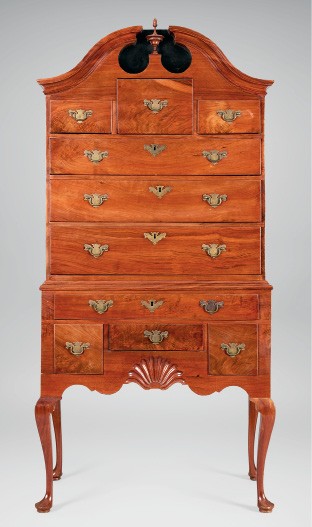
    Figure 1

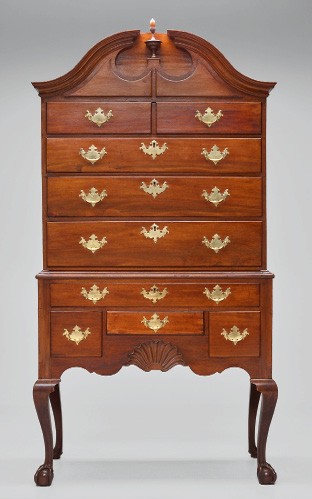
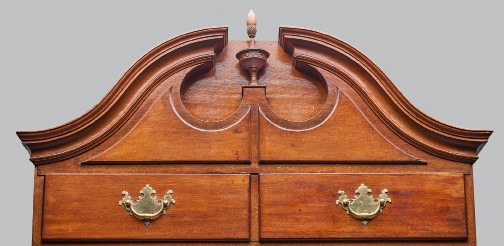
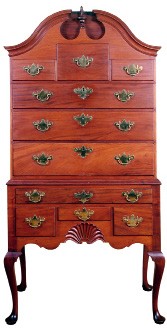
    High chest of drawers, attributed to Benjamin Peabody, Newport, Rhode Island, probably 1758. Walnut with chestnut and pine. H. 81", W. 38 1/2", D. 20 5/16". (Courtesy, New Haven Museum, bequest of Mrs. Norman Holmes Pearson; photo, Christopher Gardner.) 

  • Figure 2
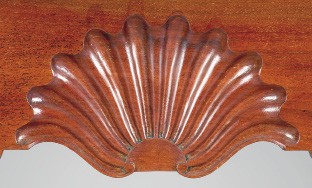
    Figure 2

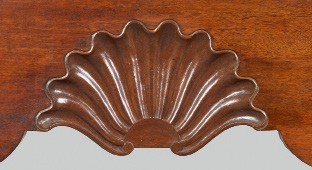
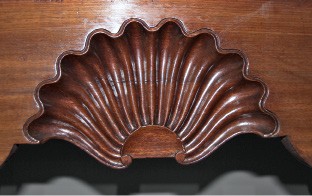
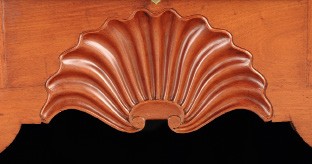
    Detail showing the shell on the high chest of drawers illustrated in fig. 1. 

  • Figure 3
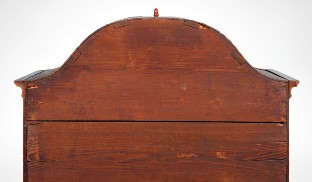
    Figure 3

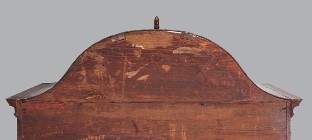
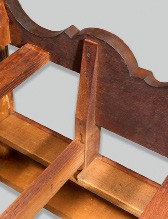
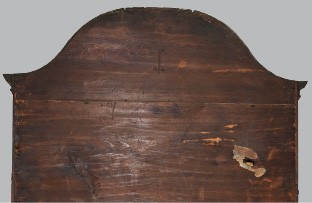
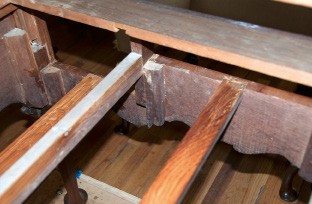
    Detail showing the transverse battens and back boards on the high chest of drawers illustrated in fig. 1.

  • Figure 4
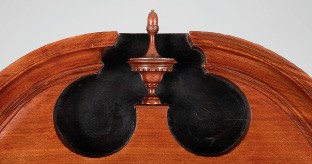
    Figure 4

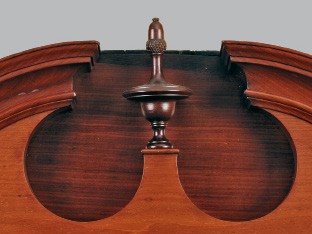
     Detail showing the finial on the high chest of drawers illustrated in fig. 1. 

  • Figure 5
    Figure 5

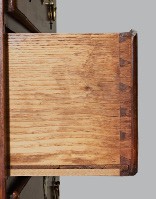
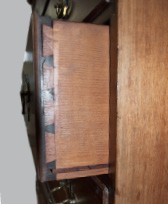
    Detail showing the drawer dovetails of the high chest of drawers illustrated in fig. 1.

  • Figure 6
    Figure 6

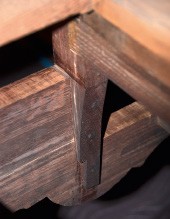
    Detail showing a vertical drawer divider on the high chest of drawers illustrated in fig. 1. 

  • Figure 7
    Figure 7

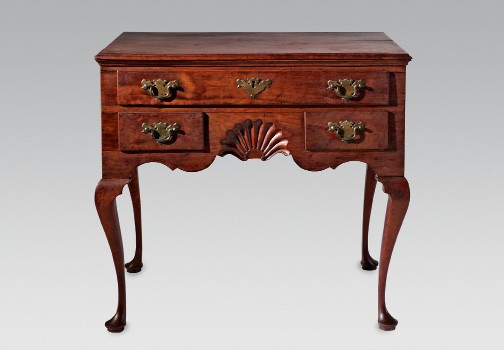
    Dressing table, attributed to Benjamin Peabody, Newport, Rhode Island, probably 1759. Walnut with chestnut. H. 31 1/2", W. 33", D. 21 1/2". (Courtesy, private collection.) 

  • Figure 8
    Figure 8

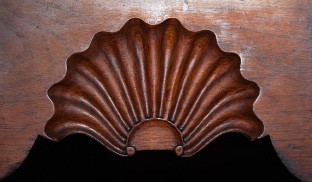
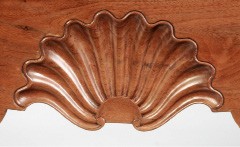
    Detail showing the shell on the dressing table illustrated in fig. 7. 

  • Figure 9
    Figure 9

    High chest of drawers, attributed to Benjamin Peabody, Newport, Rhode Island, 1765–1775. Mahogany with chestnut, white pine, and white oak. H. 83", W. 39 1/8", D. 20". (Courtesy, Yale University Art Gallery, Mabel Brady Garvan Collection.) 

  • Figure 10
    Figure 10

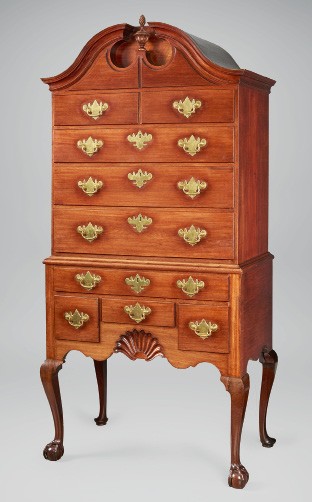
    High chest of drawers, attributed to Benjamin Peabody, Newport, Rhode Island, 1765–1775. Mahogany with chestnut and yellow poplar. H. 81 1/2", W. 39 1/2", D. 21 1/2". (Courtesy, Ott Family Collection; photo, Chris Gardner.) 

  • Figure11
    Figure11

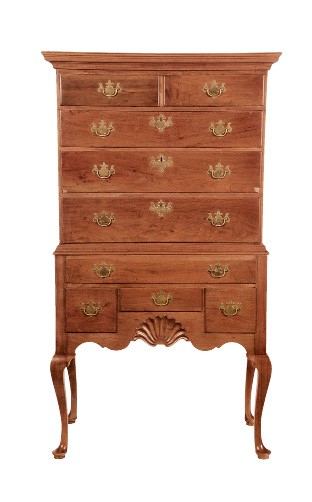
    High chest of drawers, possibly by Benjamin Peabody, Newport, Rhode Island, 1765–1775. Mahogany with chestnut and yellow poplar. H  71", W. 39 1/2", D. 22". (Courtesy, Brunk Auctions; photo, Monica Scott.) 

  • Figure 12
    Figure 12

     Detail showing the shell on the high chest of drawers illustrated in fig. 9. 

  • Figure 13
    Figure 13

    Detail showing the shell on the high chest of drawers illustrated in fig. 10.

  • Figure 14
    Figure 14

    Detail showing the shell on the high chest of drawers illustrated in fig. 11. 

  • Figure 15
    Figure 15

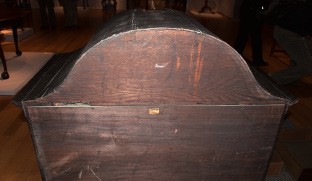
    Detail showing the battens that pierce the back boards of the pediment of the high chest of drawers illustrated in fig. 9. 

  • Figure 16
    Figure 16

     Detail showing the battens that pierce the back boards of the pediment of the high chest of drawers illustrated in fig. 10. 

  • Figure 17
    Figure 17

    Detail showing the finial on the high chest of drawers illustrated in fig. 9. 

  • Figure 18
    Figure 18

    Detail showing a vertical drawer divider on the high chest of drawers illustrated in fig. 9. 

  • Figure 19
    Figure 19

    Detail showing a vertical drawer divider on the high chest of drawers illustrated in fig. 10. 

  • Figure 20
    Figure 20

    Detail showing the drawer dovetails of the high chest of drawers illustrated in fig. 9. 

  • Figure 21
    Figure 21

    Detail showing the drawer dovetails of the high chest of drawers illustrated in fig. 10. 

  • Figure 22
    Figure 22

     Detail showing a claw-and-ball foot on the high chest of drawers illustrated in fig. 9.

  • Figure 23
    Figure 23

    Detail showing a claw-and-ball foot on the high chest of drawers illustrated in fig. 10. 

  • Figure 24
    Figure 24

    High chest of drawers, attributed to Benjamin Peabody, Newport, Rhode Island, 1755–1765. Mahogany with pine and yellow poplar. H. 78 3/4", W. 39", D. 21 1/16". (Courtesy, Newport Restoration Foundation, R.I.) 

  • Figure 25
    Figure 25

    Detail showing the finial on the high chest of drawers illustrated in fig. 24. 

  • Figure 26
    Figure 26

    Detail showing the shell on the high chest of drawers illustrated in fig. 24. 

  • Figure 27
    Figure 27

    Detail showing the transverse battens piercing the back boards of the pediment of the high chest of drawers illustrated in fig. 24. 

  • Figure 28
    Figure 28

    Detail showing the drawer dovetails of the high chest of drawers illustrated in fig. 24. 

  • Figure 29
    Figure 29

    Detail showing a vertical drawer divider on the high chest of drawers illustrated in fig. 24. 

Patricia E. Kane
An “Ingenious” Man: Benjamin Peabody, Newport Cabinetmaker

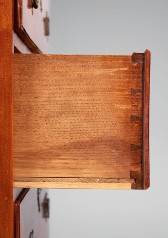
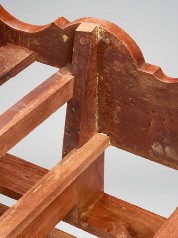
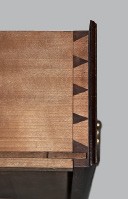
A RHODE ISLAND HIGH CHEST said to have belonged to Yale University science professor Benjamin Silliman (1779–1864) has traditionally been something of a mystery (fig. 1), including how he came to own that object. Made of walnut, the chest has familiar Rhode Island features—a closed bonnet behind the pediment oculi, a shell at the center of the lower-case skirt board (fig. 2), and dovetail joints fastening the lower-case front and back to the sides—as well as idiosyncratic details: a frieze drawer in the center of the tympanum, transverse battens under the pediment and extending through the back board (fig. 3) (a rarity in Rhode Island furniture), a finial with an acorn-shaped tip and arcaded band below a very wide reel at the top of the urn (fig. 4), dovetails that are thick-necked by Newport standards, tops of drawer sides that are flat, not rounded (fig. 5), and a horizontal divider between the two tiers of drawers in the lower case extending to the case sides. The vertical dividers flanking the center drawer in the lower case are also unusual, if not unique; they are solid primary wood rabetted to fit over the skirt. The dividers are tapered and nailed to the skirt from the back and the drawer guides are half-lapped to them (fig. 6).[1] 

A matching dressing table (fig. 7) discovered in 2017 has solved the mystery of Benjamin Silliman’s high chest. Both pieces share important details, including horizontal dividers and very similarly carved shells (fig. 8). The shells have a distinctive central element, shallowly scooped with a slightly raised outer edge merging with the serpentine rays. The edges of the central element terminate at the outer edges of the volutes from which flow the lowest rays. The indentation in the center of each volute is from the point of the compass used in their layout. A typed label glued inside the dressing table’s top drawer reads: 

This lowboy was part of the wedding outfit of Mary Fish when she married | the Rev. John Noyes on Nov. 16th, 1758. He died in 1767 leaving her a widow | with three sons. On May 21st, 1775 she married Col. Gold Selleck Silliman, whose | first wife Martha Davenport died August 1st, 1774, leaving a son, William. | They had two sons, Selleck and Benjamin, the latter being the great grandfather | of Dorothy Silliman Wright Pugsley, the present owner of the lowboy. | November 30th, 1912. 

Since Benjamin’s mother had owned the dressing table, it seems all but certain that her son inherited the matching high chest from her.[2] 

Mary Fish married the Reverend John Noyes of New Haven in 1758. She had been living in North Stonington, Connecticut, where her father, Joseph Fish (1706–1781), was the minister in the local parish. The parents of young brides in colonial America often provided furniture and other household accessories for their daughters, and Mary Fish was no exception. On August 17, 1759, Joseph wrote to his daughter and her husband in New Haven: 

We Send you, herewith (by what Hand, at writing, is unknown) A Few Articles for House Keeping. If it pleases God, we hope they are, to preserve you in Safety and give them to you, Hope you will be thankful to him therefor, & use them to his Honour—As for us, your Parents, we are Pleased & Rewarded, if we may be used as Instruments of Contributing any thing to your Conveniency of Living—” 

And among the items “We Send Loose” was a dressing table, almost certainly the example that descended to Dorothy Silliman Wright Pugsley.[3] 

Family connections explain how Mary Fish, who grew up in North Stonington and married a man from New Haven, came to own a dressing table and a matching high chest of drawers made in Rhode Island. Her mother Rebecca Peabody (Pabodie) Fish (1704–1783), was the older sister of Newport joiner Benjamin Peabody (1717–1794). No doubt Rebecca asked her brother to make furniture for Mary on her marriage. Mary likely socialized with her uncle Benjamin while attending Sarah Osborne’s school in Newport between 1751 and 1754 and may have been inspired to name her third son Benjamin after him.[4] 

Benjamin Peabody (Pabodie; Pabody), son of William and Elizabeth Peabody, was born in Little Compton, Rhode Island, in 1717. He most likely began his apprenticeship in about 1730, completing it approximately seven years later, probably in Newport. In 1745 he married Abigail Lyon (born 1722) in the Second Congregational Church, Newport. She was the sister of John Lyon Jr., with whom Peabody would later be involved in business. Peabody was first identified as a “joiner” in Newport in 1747, when he sold land in Little Compton to a John Peabody, no doubt a relative. In a Charter Party Agreement of 1749, Peabody and the Newport joiners John Cahoone and Constant Bailey rented the sloop Mary to export furniture to North Carolina. The ship’s master and owner was Peabody’s brother-in-law John Lyon, later his partner in the lumber business. The export trade, first revealed by the Charter Party Agreement, was the focus of Peabody’s business. Historian Thomas Hornsby, in his 1849 account of the Newport cabinetmaking trade, remembered Benjamin Peabody’s sending furniture to Surinam: 

All the cabinetmakers on Bridge and Washington Streets, employed a large number [of] Hands, manufacturing furniture, for which a ready market was found in New York and the West Indies. The stores of David Huntington and Benjamin Baker were also on the point; both these men were extensively engaged in manufacturing furniture, which they shipped to New York, and the West Indies . . . . Benjamin Peabody, cabinetmaker who carried on a large trade with Surinam . . . was an ingenious man. 

Between 1763 and 1767 Peabody served with John Goddard, Job Townsend Sr., or Job Townsend Jr., and Constant Bailey in the town office of surveyor of joiner’s lumber. Later in life, he may have had a commercial relationship with Newport joiner Caleb Lyndon, with whom he served as an executor for the estate of local merchant Elnathan Hammond. When Peabody died in Newport on April 15, 1794, the inventory of his tools was extensive, including 68 molding planes, 25 additional planes of various types, 15 saws, bits and bit stocks, augers, chisels, files, gimlets, gouges, holdfasts, benches, three lathes, patterns, unfinished furniture, and other assorted tools, as well as a work shop proper.[5] 

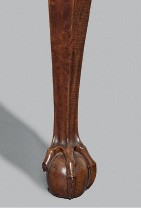
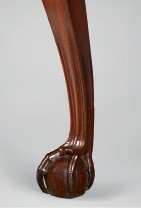
The Noyes’s dressing table and high chest of drawers provide keys to identifying other furniture made by Benjamin Peabody. Three high chests (figs. 9–11) have shells that appear to have been carved by the same hand as those on Mary Fish Noyes’s dressing table and high chest of drawers (figs. 2, 8, 12–14) and can be attributed to Benjamin Peabody. The chests illustrated in figures 9 and 10 also have rather low pediments, transverse battens that pierce the back boards (figs. 15, 16), and drawer sides with flat top edges. The finial of the chest shown in figure 9 relates to the example illustrated in figures 1 and 4 in having an acorn-shaped tip and an arcaded band at the top of the urn (fig. 17), and the “three lathes” in Peabody’s shop indicate that he was able to produce such distinctive turnings. The vertical dividers flanking the center drawer in the lower cases of two chests (figs. 9, 10; fig. 11 not examined) are like those on the Noyes example (figs. 6, 18, 19), but the former have claw-and-ball feet in the front, drawer dovetails with narrow-necked pins (figs. 20, 21), and closed pediments with typical Newport applied plaques above a pair of side-by-side drawers. The feet appear to be carved by the same hand. They share long talons with a single knuckle, sharply ridged tendons extending up the legs, and a taut rear talon (figs. 22, 23). While there is no absolute consistency in the high chests’ construction, their overall design, shell details, and claw-and-ball feet suggest they were made in the same shop. Peabody had a large business employing many craftsmen over the course of a long career. Variations in construction details are to be expected.[6] 

Two additional high chests share features with the preceding examples. One relates closely to the Noyes chest in appearance, having a central drawer in the tympanum, a rather low pediment, and a rare acorn-tipped finial (fig. 1, 24, 25). The carved shell of the chest illustrated in figure 24 is more horizontal than others in the group (figs. 2, 8, 12–14, 26); however, the shallow relief and flat lower edge of the central section and the terminus of the outer ridge at the volutes is consistent with the carving in the previous group while departing from that of other Newport shells. The pediments of the chest shown in figure 24 and that of the Noyes example (fig. 1) are also related; their interiors are open above the drawers flanking the central tympanum drawer, and their back boards are pierced by transverse battens (figs. 3, 27). Additional features linking the two chests are thick-necked, drawer dovetails and drawer sides with flat top edges (fig. 28). There are some construction differences. The vertical dividers flanking the lower center drawer of the chest shown in figure 24 are not tapered, but are rectangular and rest on the drawer opening. The dividers are secured to the front skirt by a long block on their inner face and by nails driven from the side into the skirt, and the drawer guides are tenoned to them (fig. 29). The chest illustrated in figure 24 also has a vertical batten in the back of the upper case, whereas the Noyes example does not, and the former does not have the horizontal drawer divider between the two tiers of drawers in the lower case that extends to the case sides.[7] 

As Hornsby’s account and the inventory of Peabody’s tools suggest, Peabody maintained a large shop, part of whose output was destined for the export trade. None of the six pieces discussed has a history that ties it to the export trade, while three were made for Connecticut or Rhode Island customers. While Peabody may not have been a master on the order of John Townsend, he clearly deserves to be acknowledged in the hard-working, enterprising, and ingenious ranks of Rhode Island furniture makers.[8] 

[1]

Rhode Island Furniture Archive [hereafter RIF], https://rifa.art.yale.edu/detail.htm?id=155941&type=0. Battens piercing the pediment back boards can also be observed on a high chest of drawers (RIF804), a chest-on-chest (RIF5693), and a desk and bookcase (RIF381), all by unknown makers. Different methods of constructing vertical drawer dividers occur in the work of other makers. The similarity of the drawer divider construction in the work of Benjamin Baker and John Goddard is discussed in Patricia E. Kane et al., Art and Industry in Early America: Rhode Island Furniture, 1650–1830 (New Haven, Conn.: Yale University Art Gallery, 2016), p. 302, no. 58. For the technique used by Christopher and John Townsend, see Erik Gronning and Amy Coes, “The Early Work of John Townsend in the Christopher Townsend Shop Tradition,” in American Furniture, edited by Luke Beckerdite (Hanover, N.H.: University Press of New England for the Chipstone Foundation, 2013), p. 14, figs. 23, 24. 

[2]

Nathan Liverant and Son of Colchester, Connecticut, offered the dressing table for sale at the Philadelphia Antiques Show in April 2017; see RIF6387, https://rifa.art.yale.edu/detail.htm?id=187806&type=0. 

[3]

Rev. Joseph Fish to Mary and John Noyes, August 17, 1759, box 1, folder 1, M450, Silliman Family Papers, Manuscripts and Archives, Yale University Library.

[4]

Joy Day Buel and Richard Buel Jr., The Way of Duty: A Woman and Her Family in Revolutionary America (New York: W. W. Norton and Company, 1984), pp. 18–20, 160. 

[5]

For Peabody’s birth, see James N. Arnold, ed., Vital Record of Rhode Island, 1636–1850 [hereafter Rhode Island Vital Extracts] (Providence, R.I.: Narragansett Historical Publishing Company, 1891–1912) 4:144. For Peabody’s marriage, see Rhode Island Vital Extracts 8:472. For Abigail Lyon’s birth, see Rhode Island Vital Extracts 9:512. For the first evidence of Peabody’s occupation as a joiner, see Benjamin Peabody deed to John Peabody, November 2, 1747, Little Compton Deeds, vol. 1, pp. 41-42, Little Compton [R.I.] Town Hall. For the Charter Party Agreement, see Margaretta M. Lovell, “’Such Furniture as Will Be Most Profitable’: The Business of Cabinetmaking in Eighteenth-Century Newport,” Winterthur Portfolio 26, no. 1 (Spring 1991): 59; for Peabody and Lyon as lumber merchants, see John Lyon Jr, and Benjamin Peabody v. Benjamin Nichols, executor of the estate of Jonathan Nichols, Interior Court of Common, Newport County, Record Book, vol. E, p. 478, June term 1757, case 270, Judicial Archives, Supreme Court Judicial Records Center, Pawtucket, R.I. Thomas Hornsby, “Newport, Past and Present,” Newport Daily Advertiser, December 8, 1849, as cited in Jeanne A. Vibert Sloane, “John Cahoone and the Newport Furniture Industry,” in New England Furniture: Essays in Memory of Benno M. Forman, edited by Brock Jobe (Boston: Society for the Preservation of New England Antiquities, 1987), p. 92. For Peabody as a surveyor of lumber, see Newport Mercury, June 13, 1763, p. 3; June 11, 1764, p. 3; June 10, 1765, p. 3; June 9, 1766, p. 3; and June 8, 1767, p. 3. Samuel Sanford and Caleb Lyndon, executors for the estate of Elnathan Hammond (Benjamin Peabody having deceased) deed to James Perry, October 25, 1794, Newport Deeds, vol. 5, pp. 353–54, Newport City Hall. See also Elnathan Hammond will, Newport Probate, vol. 2, pp. 281–86, Newport City Hall. Benjamin Peabody, Samuel Sanford, and Caleb Lyndon were executors. For Peabody’s death, see Rhode Island Vital Extracts 12:58. Inventory of Benjamin Peabody, July 5, 1794, Newport Probate, vol. 2, pp. 362–63, Newport City Hall. 

[6]

For the high chests see RIF1180, https://rifa.art.yale.edu/detail.htm?id=107419&type=0; RIF806, https://rifa.art.yale.edu/detail.htm?id=107045&type=0; RIF6575, https://rifa.art.yale.edu/detail.htm?id=187994&type=0. The chest illustrated in fig. 11 probably originally had a bonnet top. 

[7]

For the high chest in fig. 24, see RIF4372, https://rifa.art.yale.edu/detail.htm?id=136184&type=0 

[8]

The chest and dressing table illustrated in figs. 1 and 7 were owned by Mary Fish of Connecticut. The chest shown in fig. 10 has a history in the Robinson-Parsons family of Rhode Island. 

American Furniture 2022

Show all Figures only
Contents


  • [1]

    Rhode Island Furniture Archive [hereafter RIF], https://rifa.art.yale.edu/detail.htm?id=155941&type=0. Battens piercing the pediment back boards can also be observed on a high chest of drawers (RIF804), a chest-on-chest (RIF5693), and a desk and bookcase (RIF381), all by unknown makers. Different methods of constructing vertical drawer dividers occur in the work of other makers. The similarity of the drawer divider construction in the work of Benjamin Baker and John Goddard is discussed in Patricia E. Kane et al., Art and Industry in Early America: Rhode Island Furniture, 1650–1830 (New Haven, Conn.: Yale University Art Gallery, 2016), p. 302, no. 58. For the technique used by Christopher and John Townsend, see Erik Gronning and Amy Coes, “The Early Work of John Townsend in the Christopher Townsend Shop Tradition,” in American Furniture, edited by Luke Beckerdite (Hanover, N.H.: University Press of New England for the Chipstone Foundation, 2013), p. 14, figs. 23, 24. 

  • [2]

    Nathan Liverant and Son of Colchester, Connecticut, offered the dressing table for sale at the Philadelphia Antiques Show in April 2017; see RIF6387, https://rifa.art.yale.edu/detail.htm?id=187806&type=0. 

  • [3]

    Rev. Joseph Fish to Mary and John Noyes, August 17, 1759, box 1, folder 1, M450, Silliman Family Papers, Manuscripts and Archives, Yale University Library.

  • [4]

    Joy Day Buel and Richard Buel Jr., The Way of Duty: A Woman and Her Family in Revolutionary America (New York: W. W. Norton and Company, 1984), pp. 18–20, 160. 

  • [5]

    For Peabody’s birth, see James N. Arnold, ed., Vital Record of Rhode Island, 1636–1850 [hereafter Rhode Island Vital Extracts] (Providence, R.I.: Narragansett Historical Publishing Company, 1891–1912) 4:144. For Peabody’s marriage, see Rhode Island Vital Extracts 8:472. For Abigail Lyon’s birth, see Rhode Island Vital Extracts 9:512. For the first evidence of Peabody’s occupation as a joiner, see Benjamin Peabody deed to John Peabody, November 2, 1747, Little Compton Deeds, vol. 1, pp. 41-42, Little Compton [R.I.] Town Hall. For the Charter Party Agreement, see Margaretta M. Lovell, “’Such Furniture as Will Be Most Profitable’: The Business of Cabinetmaking in Eighteenth-Century Newport,” Winterthur Portfolio 26, no. 1 (Spring 1991): 59; for Peabody and Lyon as lumber merchants, see John Lyon Jr, and Benjamin Peabody v. Benjamin Nichols, executor of the estate of Jonathan Nichols, Interior Court of Common, Newport County, Record Book, vol. E, p. 478, June term 1757, case 270, Judicial Archives, Supreme Court Judicial Records Center, Pawtucket, R.I. Thomas Hornsby, “Newport, Past and Present,” Newport Daily Advertiser, December 8, 1849, as cited in Jeanne A. Vibert Sloane, “John Cahoone and the Newport Furniture Industry,” in New England Furniture: Essays in Memory of Benno M. Forman, edited by Brock Jobe (Boston: Society for the Preservation of New England Antiquities, 1987), p. 92. For Peabody as a surveyor of lumber, see Newport Mercury, June 13, 1763, p. 3; June 11, 1764, p. 3; June 10, 1765, p. 3; June 9, 1766, p. 3; and June 8, 1767, p. 3. Samuel Sanford and Caleb Lyndon, executors for the estate of Elnathan Hammond (Benjamin Peabody having deceased) deed to James Perry, October 25, 1794, Newport Deeds, vol. 5, pp. 353–54, Newport City Hall. See also Elnathan Hammond will, Newport Probate, vol. 2, pp. 281–86, Newport City Hall. Benjamin Peabody, Samuel Sanford, and Caleb Lyndon were executors. For Peabody’s death, see Rhode Island Vital Extracts 12:58. Inventory of Benjamin Peabody, July 5, 1794, Newport Probate, vol. 2, pp. 362–63, Newport City Hall. 

  • [6]

    For the high chests see RIF1180, https://rifa.art.yale.edu/detail.htm?id=107419&type=0; RIF806, https://rifa.art.yale.edu/detail.htm?id=107045&type=0; RIF6575, https://rifa.art.yale.edu/detail.htm?id=187994&type=0. The chest illustrated in fig. 11 probably originally had a bonnet top. 

  • [7]

    For the high chest in fig. 24, see RIF4372, https://rifa.art.yale.edu/detail.htm?id=136184&type=0 

  • [8]

    The chest and dressing table illustrated in figs. 1 and 7 were owned by Mary Fish of Connecticut. The chest shown in fig. 10 has a history in the Robinson-Parsons family of Rhode Island.