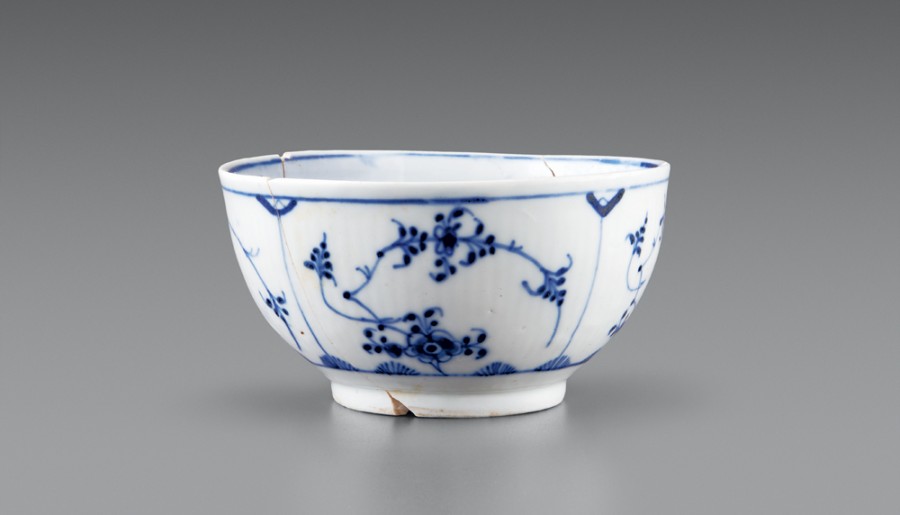
IN THE LAST QUARTER OF the eighteenth century, Philadelphia was one of the larger ports in North America, intimately inter-twined with global trade networks that moved goods between Europe, Africa, Asia, and the Americas. While many of the ceramics that arrived in the city during this period were products that have come to be expected, such as English earthenware or Chinese porcelain, this world in motion also brought some unexpected things to the shores of the Delaware River. Among these was a porcelain bowl made in Thuringia in east-central Germany (fig. 1).
The ribbed bowl, probably either a small punch bowl or a waste bowl from a tea and coffee set, is painted in underglaze blue with panels of flowers on long, curving stalks, which is often known as the Strohblumenmuster, or strawflower pattern. It was made at the Volkstedt manufactory, located in the town of Rodolstadt, in the principality of Schwarzburg-Rudolstadt (now part of the modern state of Thuringia). The factory was founded in 1760 by Georg Heinrich Macheleid (1723–1801), a theologian-turned alchemist who had developed a recipe for making hard-paste porcelain. Volkstedt was one of several small porcelain manufactories that opened in the region in the 1750s and 1760s. All specialized in making relatively simple tea and table wares for the burgeoning middle-class market, whose members aspired to fine porcelain but could not afford the high-status products of the elite royal porcelain manufactories of Meissen or Berlin.[1]
Much of what the Thuringian factories produced was in fact inspired by porcelain made at Meissen in nearby Saxony. This included the ribbed body and the painted strawflower pattern seen on this bowl. The pattern was developed at Meissen in the 1730s and based on floral decoration found on contemporary Chinese export porcelain. Relatively affordable compared to more elaborate and expensive designs that were painted in overglaze enamels, the strawflower pattern was one of the more popular ones produced by Thuringian potters in the second half of the eighteenth century.[2]
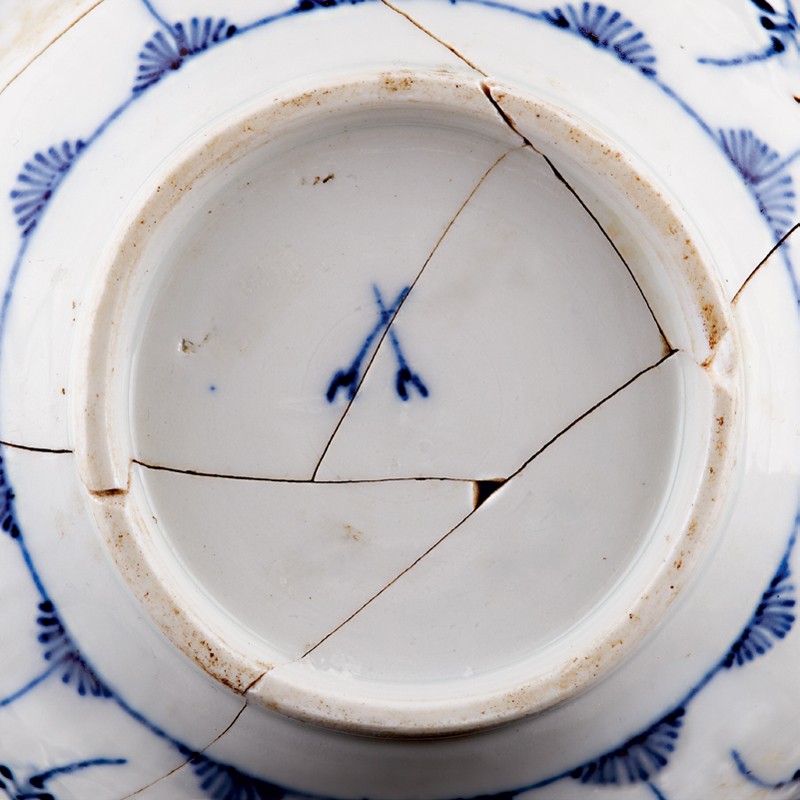
Many Thuringian factories even went so far as to copy Meissen’s mark, which was a pair of crossed swords. Volkstedt was no exception; one of its marks was a suspiciously similar pair of crossed Fürkele, which were two-pronged forks used in the mining industry (fig. 2).[3] Though the fürkele were taken from the coat of arms of the princes of Schwartzburg-Rudolstadt, Saxon officials complained that the symbol was too easily confused with Meissen’s and was a threat to their brand. After several complaints, they banned the sale of Volkstedt’s wares in Saxony in 1777.[4] While Volkstedt used several versions of the fürkele mark, this one is thought to have been in use from as early as the 1770s until about 1800.[5]
With a limited local market, Volkstedt, like other Thuringian factories, depended on the export market for survival. The firm sold its wares at Leipzig and at other German fairs in the German-speaking states, and they shipped their products to other parts of Europe--—especially Holland, Poland, Lithuania, and Russia–and to the Ottoman Empire.[6] There are also references to pieces being exported to North America, but this bowl is the first example known to the authors to have been in the United States in the eighteenth century.[7]
The bowl was excavated from a late eighteenth-century privy that straddled the boundary line between 55 and 57 Cherry Street, a street that cut through the large block between Fifth and Sixth and Race and Arch Streets.[8] As was typical for Philadelphia, each of these lots contained several dwellings: a larger house that fronted on Cherry Street and smaller tenements, or rental units, at the back of the lot opening onto Cresson’s Alley. The privy could have been dug as early as the 1770s and was filled in over time, probably being closed in the early 1800s. It is thought to have been used primarily by the residents of number 55, which was home to the family of Benjamin Cathrall, a Quaker schoolmaster and anti-slavery activist, from about 1790 to 1801.[9] However, it is likely that the residents of number 57, who in 1795 was Deborah Smith, “Gentlewoman,” and of the rear tenements of both properties, one of whom was Israel Burgo, a free Black wood sawyer, also used the privy to dispose of household waste as well.[10]
Whether representative of a single household or several, the privy contained a rich and varied collection of ceramics from Asia, Europe, and North America that is evidence of very sophisticated dining. Among these objects was a wide range of refined English earthenwares and stonewares, such as feather-edged and royal-pattern creamware, and Chinese and English blue and white porcelain. The privy also included several pieces of Philadelphia-made porcelain, including two soft-paste porcelain bowls with underglaze blue decoration similar in size to the Volkstedt bowl, made at Gousse Bonnin and George Morris’s American China Manufactory.[11] Among the non-ceramic finds from the privy were two wine bottles with Benjamin Cathrell’s seal, further reinforcing the elite status of the tablewares used by some of the residents of Cherry Street.[12]
This Volkstedt bowl joins a very small number of pieces of German porcelain known to have been in eighteenth-century America. Exactly how it got to Philadelphia is not known. One possibility is that it was acquired by an American merchant in Hamburg, Germany’s most important port and a regular destination for Philadelphia ships in the decades following the American Revolution.[13] But as German porcelain moved around Europe, it could have been acquired in any number of places frequented by visiting Americans.
ACKNOWLEDGMENTS Our thanks to Nicholas Zumbulyadis and Christian Lechelt for sharing their knoweldge on Volkstedt with us.