


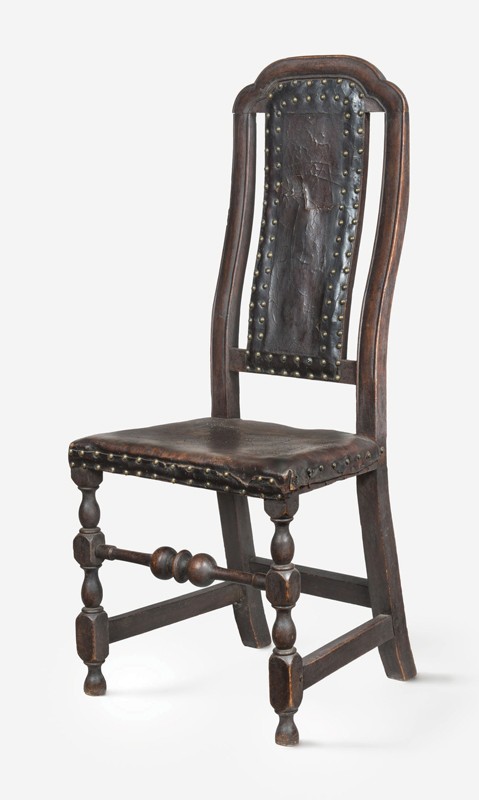
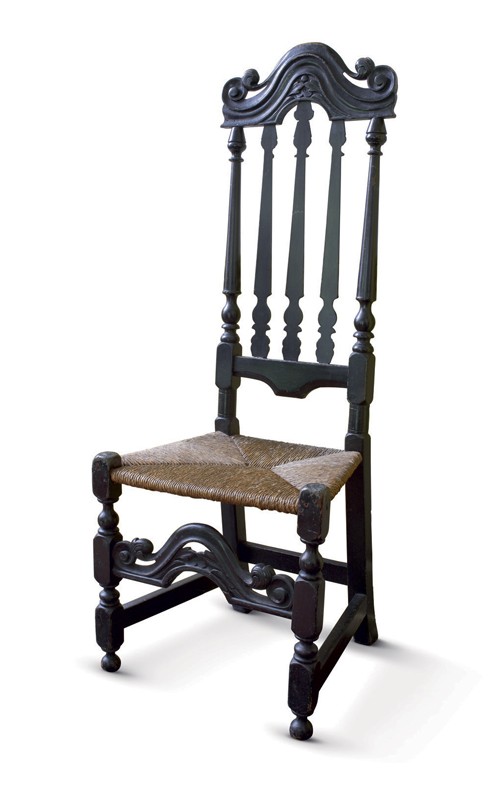
Side chair, Boston, Massachusetts, 1720–1750. Maple and oak; original leather upholstery. H. 43 1/2", W. 18 1/4", D. 15". (Private collection; photo, Gavin Ashworth.)
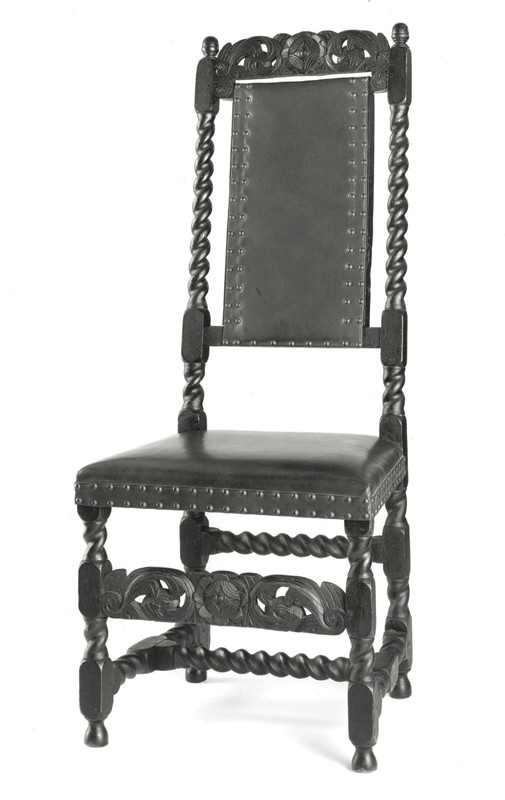
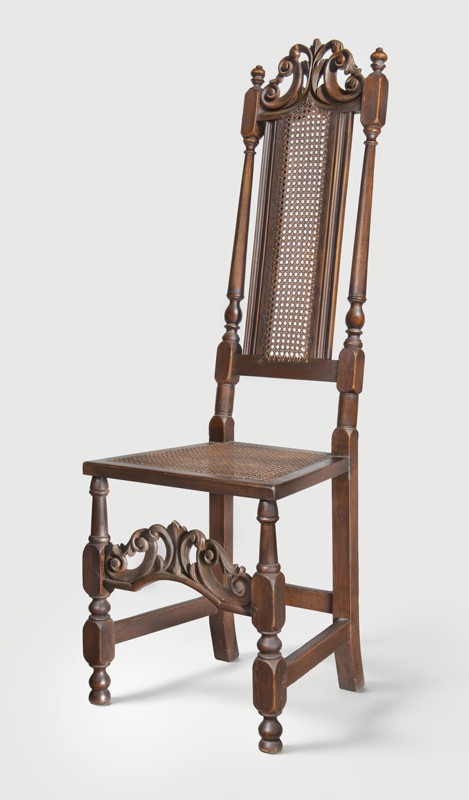
Side chair, Boston, Massachusetts, 1685–1705. Maple and oak. H. 48", W. 20 1/4", D. 22". (Chipstone Foundation; photo, Gavin Ashworth.) This is the first American example of a slot placed in the crest to pass through the leather upholstery.
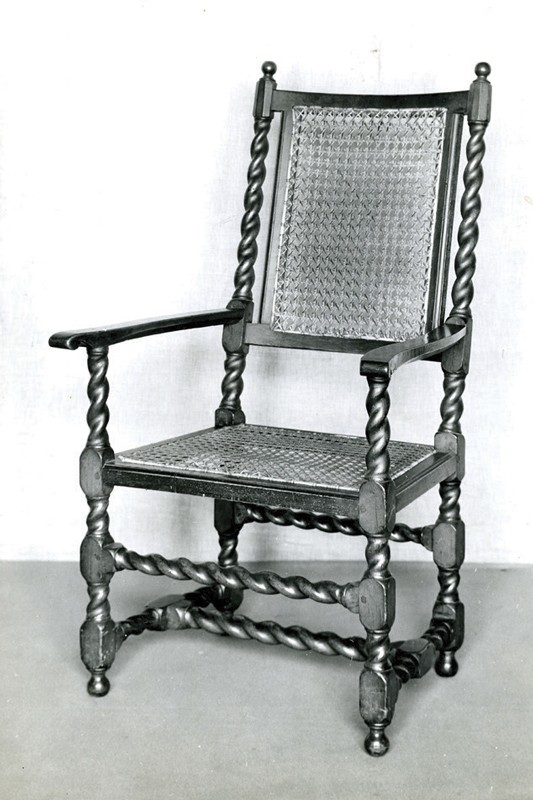
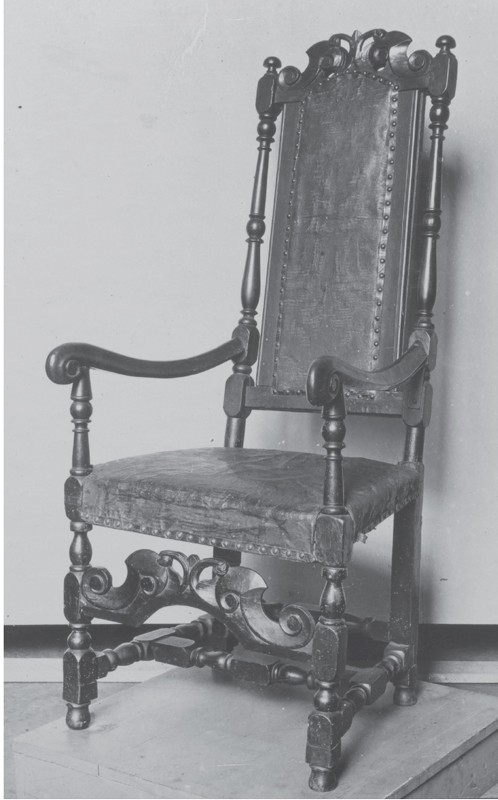
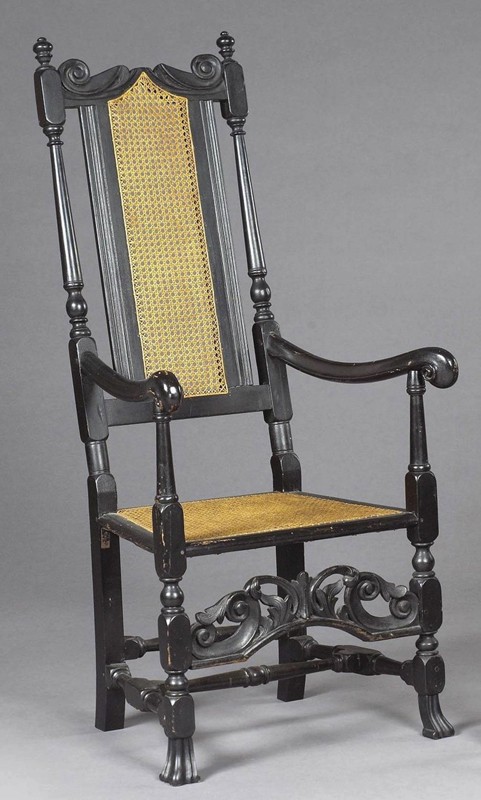
Armchair, probably London, 1685–1700. Woods and dimensions not recorded. (Photo, Symonds Collection, Decorative Arts Photographic Collection, Winterthur Library.) The back rails of this chair have a noticeable curve or hollow.
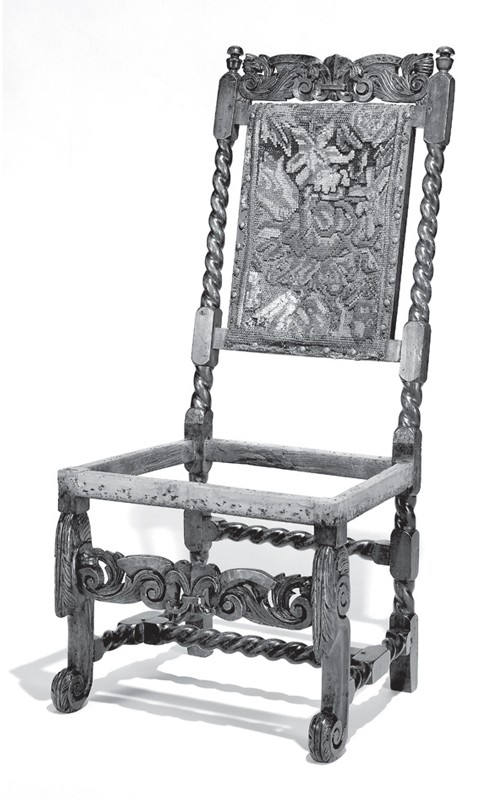
Side chair, probably London, 1685–1700. Beech; original turkeywork upholstery. H. 48 5/8". (Courtesy, Museum of Fine Arts, Boston, gift of Mrs. Winthrop Sargent in memory of her husband Jun, 17.1629.)
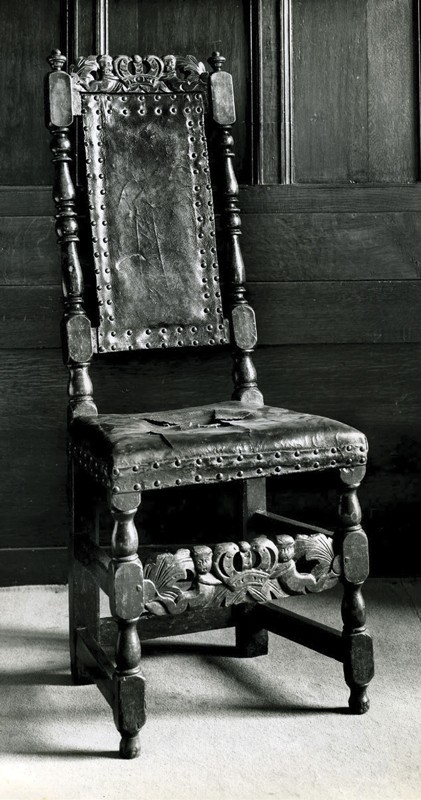
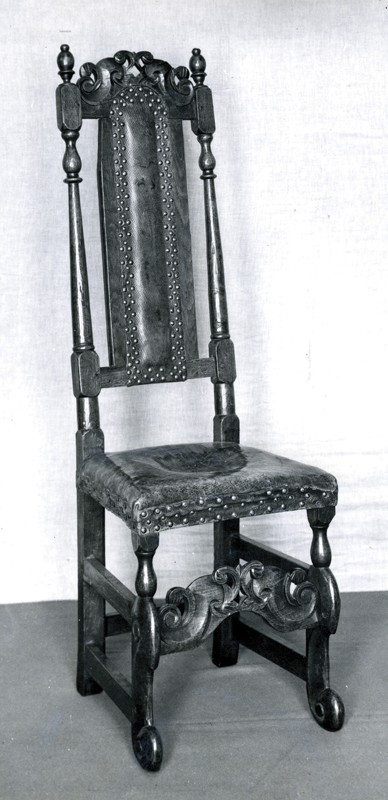
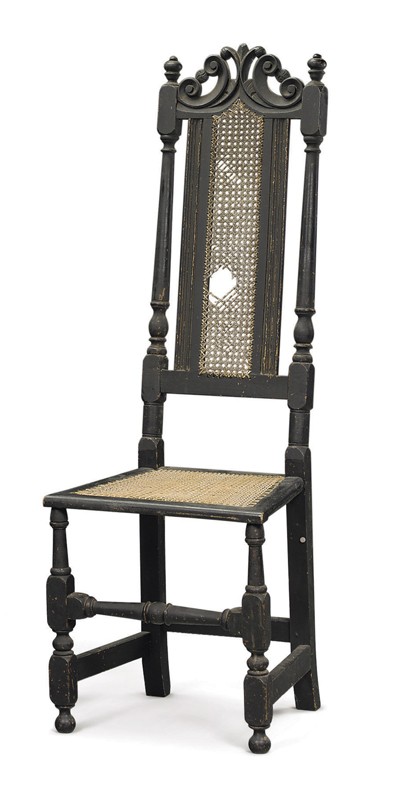
Side chair, probably London, 1685–1700. Woods and dimensions not recorded; original leather upholstery. (Photo, Symonds Collection, Decorative Arts Photographic Collection, Winterthur Library.) The crest and lower back rails have a noticeable curve or hollow. The turnings on the back posts closely relate to those present on group B chairs (fig. 13).
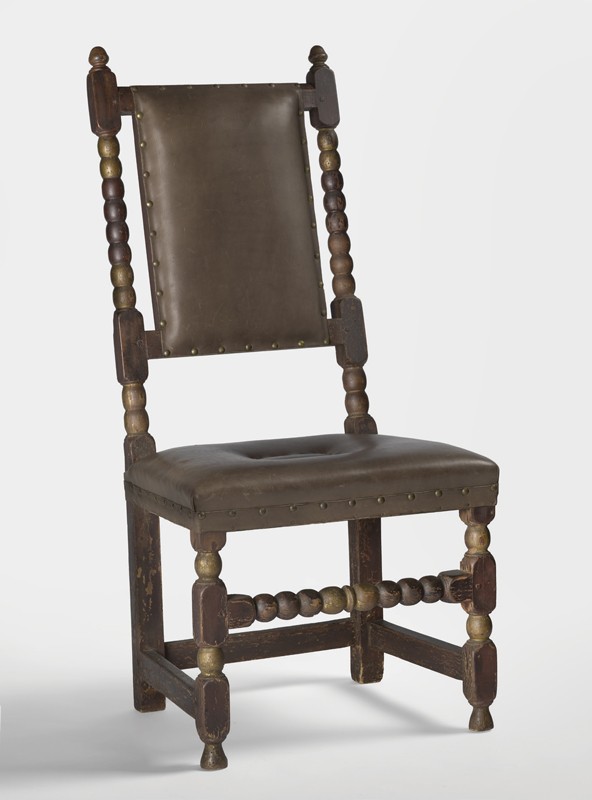
Side chair, Boston, Massachusetts, 1685–1705. Maple and oak. H. 42", W. 20", D. 20 1/2". (Courtesy, Anne H. and Frederick Vogel III Collection for the Philadelphia Museum of Art, acc. no. 188-2016-8.) The gilding was added in the nineteenth century. This chair is the only example of the group with a single side stretcher.
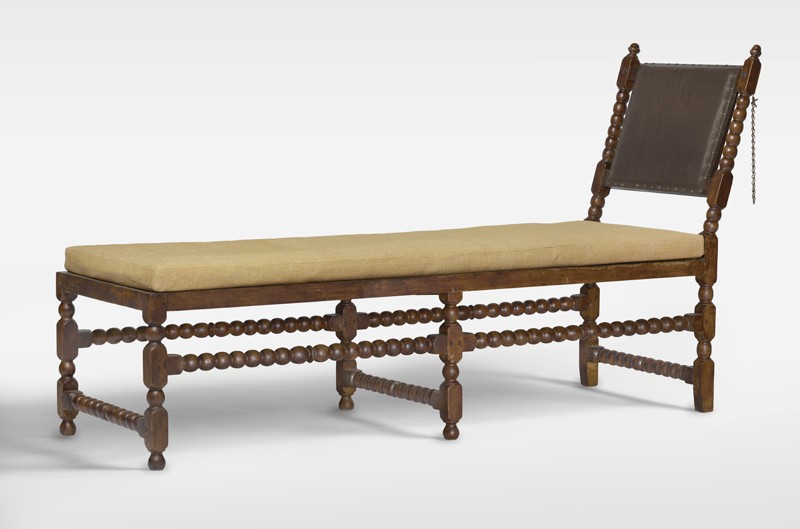
Couch, Boston, Massachusetts, 1685–1705. Maple and oak. H. 38", W. 21 1/2", D. 84". (Courtesy, Anne H. and Frederick Vogel III Collection for the Philadelphia Museum of Art, acc. no. 188-2016-9.) This is the only ball-turned couch known, and it may have been made en suite with the side chair illustrated in fig. 6.
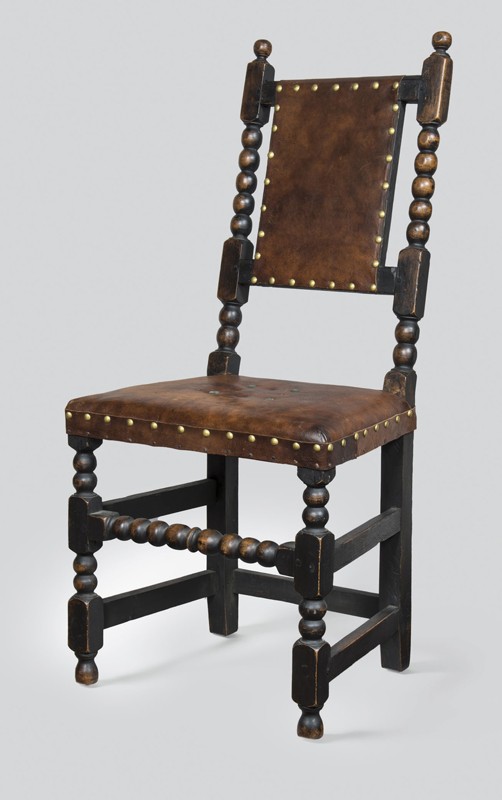
Side chair, Boston, Massachusetts, 1685–1705. Maple and oak. H. 41 3/8", W. 19 1/2", D. 15". (Private collection; photo, Gavin Ashworth.) The back dimensions are the same as those of low-back chairs, but the orientation is vertical rather than horizontal. The nailing pattern, with brass-headed nails at the top and wrought iron tacks at the bottom, is commonly found on Cromwellian chairs.
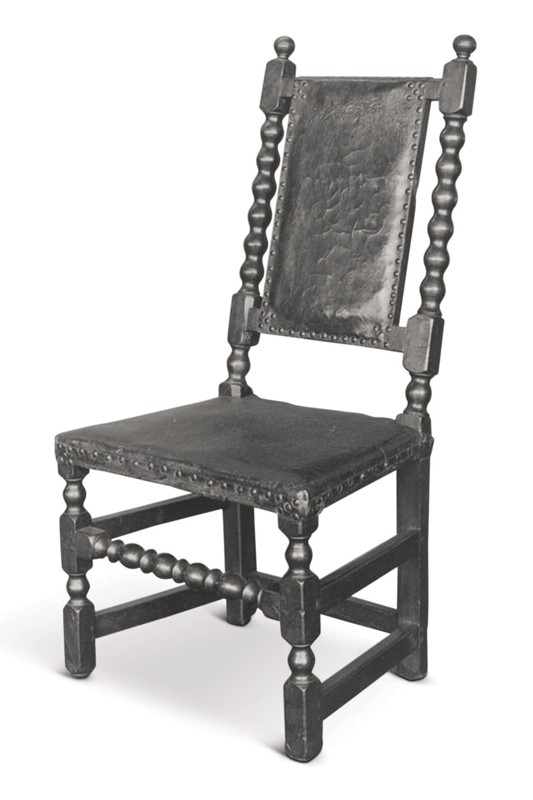
Side chair, England, 1675–1695. Oak. H. 43", W. 21 1/2". (Courtesy, Victoria and Albert Museum, London, W.29-1928.) The feet are missing.
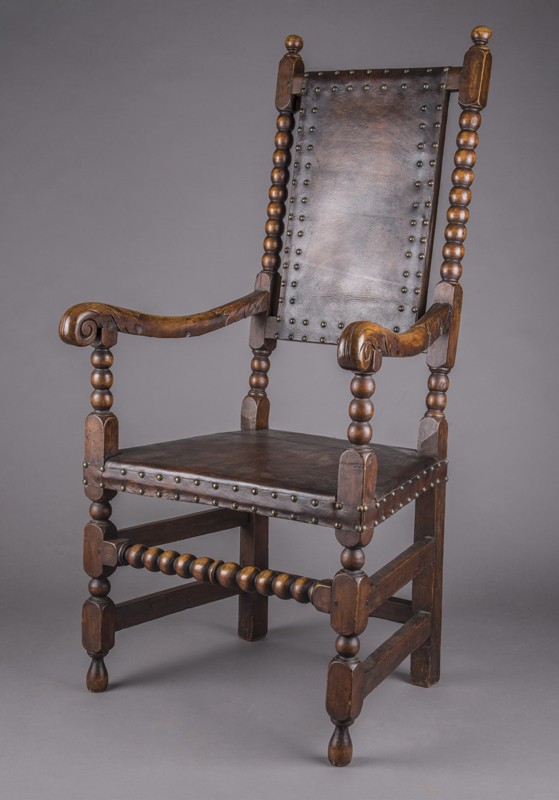
Armchair, Boston, Massachusetts, 1685–1705. Maple and oak. H. 48 3/4", W. 23 1/2", D. 18". (Private collection; photo, Jim Wildeman.) The arms of this chair are carved with leafage and relate to those on contemporaneous English chairs like the one shown in fig. 12. The finials are identical to those on the side chair illustrated in fig. 8. The feet are restored.
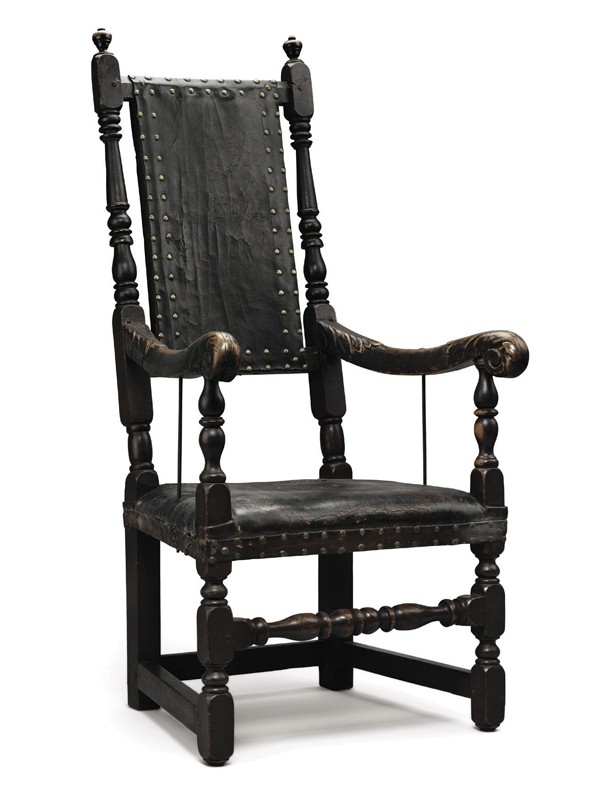
Armchair, Boston, Massachusetts, 1695–1710. Maple and oak; original leather upholstery. H. 47 1/2", W. 23 3/4", D. 17 3/4". (Courtesy, Museum of Fine Arts, Boston; Arthur Tracy Cabot Fund, 1971.624.) The iron rods in the arms are a nineteenth-century addition, and the feet are missing but would have been like those on the side chair illustrated in fig. 16.
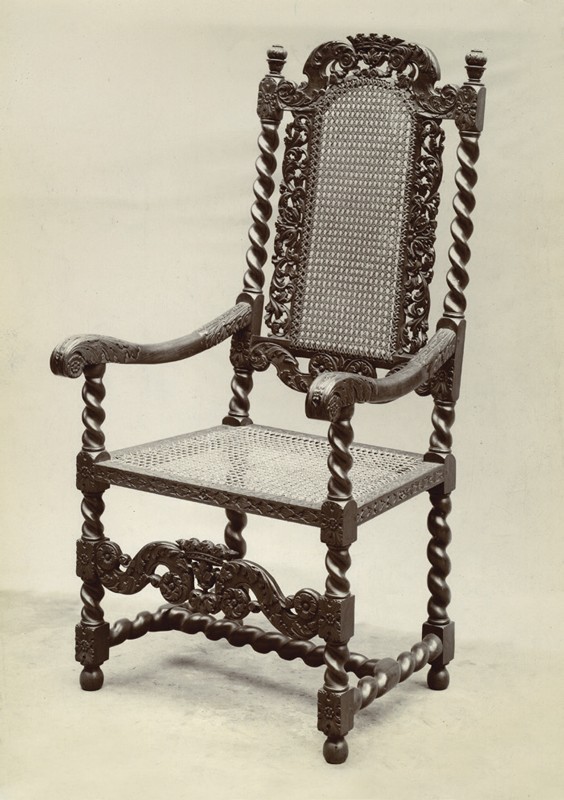
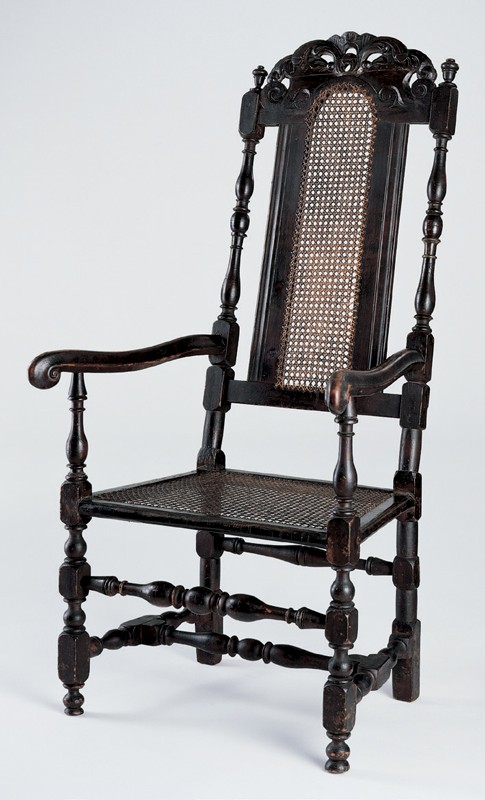
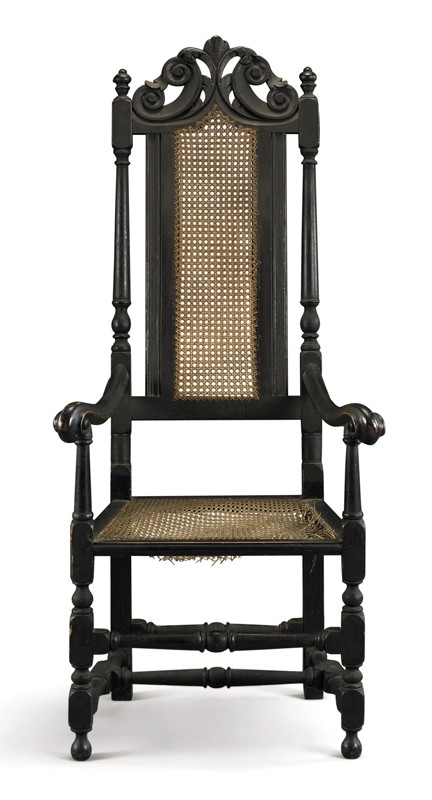
Armchair, probably London, 1685–1700. Woods and dimensions not recorded. (Photo, Symonds Collection, Decorative Arts Photographic Collection, Winterthur Library.)
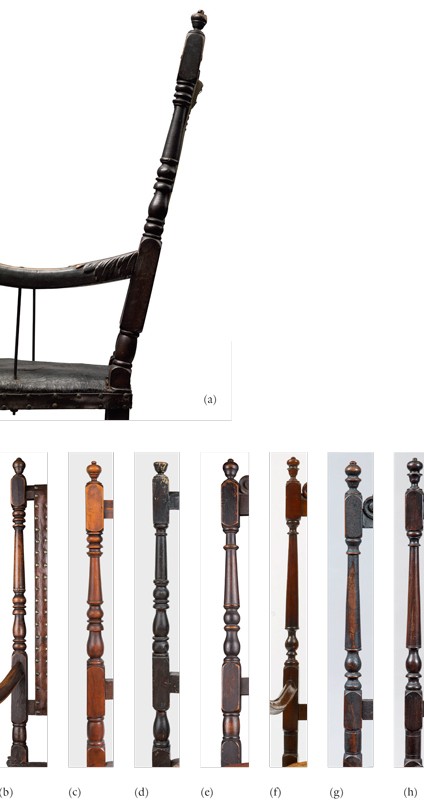
Composite illustration showing the rear post of the
(a) Group B armchair with foliate carved arms illustrated in fig. 11;
(b) Group B armchair illustrated in fig 18;
(c) Group B side chair illustrated in fig. 17;
(d) Group B side chair illustrated in fig. 24;
(e) Group C side chair illustrated in fig. 31;
(f) Group D armchair illustrated in fig. 45;
(g) Group E side chair illustrated in fig. 56;
(h) Group F side chair illustrated in fig. 69.
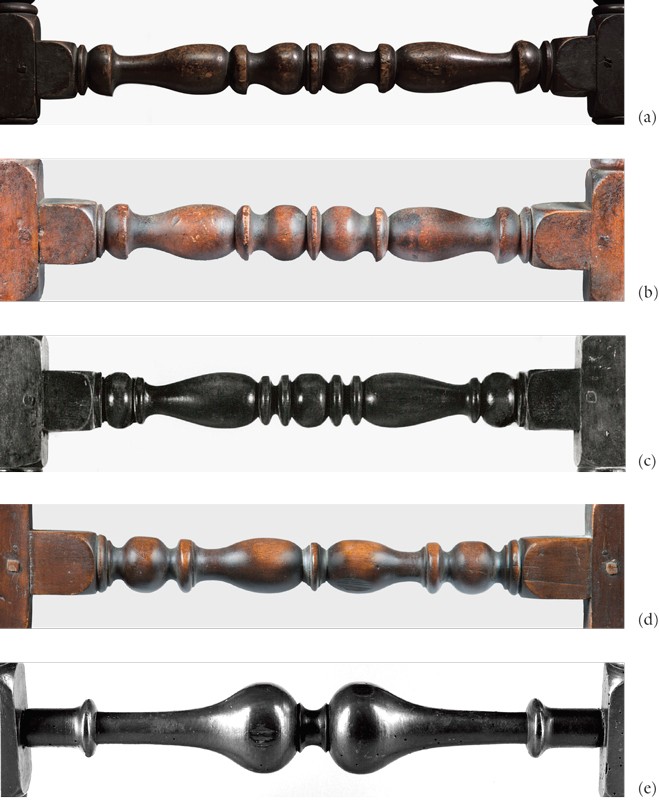
Composite illustration showing the front stretchers of the
(a) Group B armchair with foliate carved arms illustrated in fig. 11;
(b) Group B side chair illustrated in fig. 16;
(c) Group B side chair illustrated in fig. 23;
(d) New York side chair illustrated in fig. 51;
(e) Group E side chair illustrated in fig. 72.
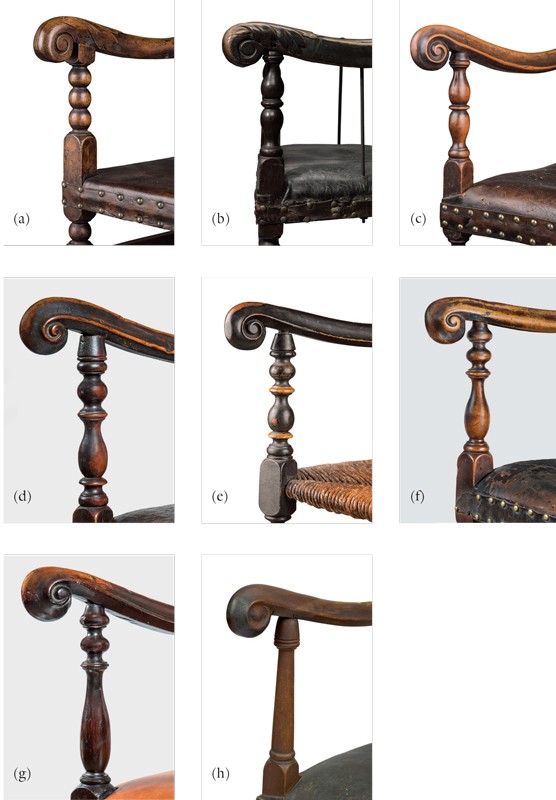
Composite illustration showing the arm support of the
(a) Group A armchair with foliate carved arms illustrated in fig. 10;
(b) Group B armchair with foliate carved arms illustrated in fig. 11;
(c) Group B armchair with scroll-carved arms illustrated in fig. 18;
(d) Group D armchair illustrated in fig. 53;
(e) Group E armchair illustrated in fig. 88;
(f) Group E armchair illustrated in fig. 60;
(g) Group F armchair illustrated in fig. 112;
(h) Group C armchair illustrated in fig. 38 (arm scroll terminals replaced).
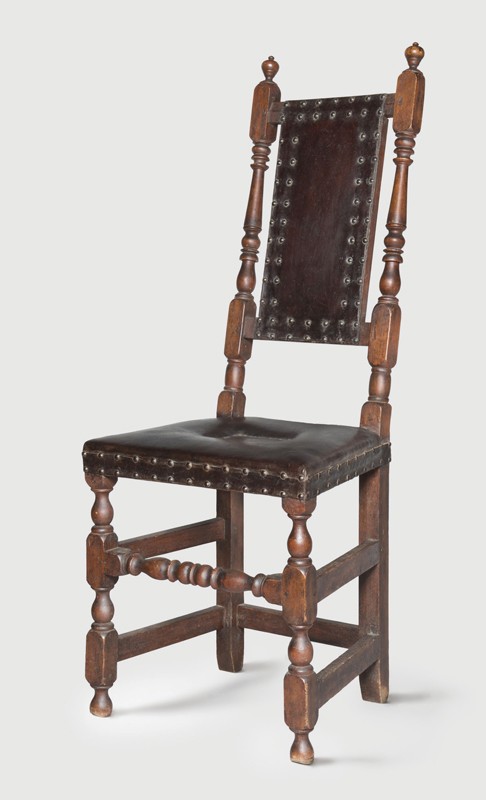
Side chair, Boston, Massachusetts, 1695–1710. Maple and oak. H. 46 5/8", W. 18 1/4", D. 15". (Private collection; photo, Gavin Ashworth.) This side chair has rear posts identical to those of the chairs illustrated in figs. 11, 17, 18, and 20, absent the ring and compressed ball directly below the lowermost baluster turning.
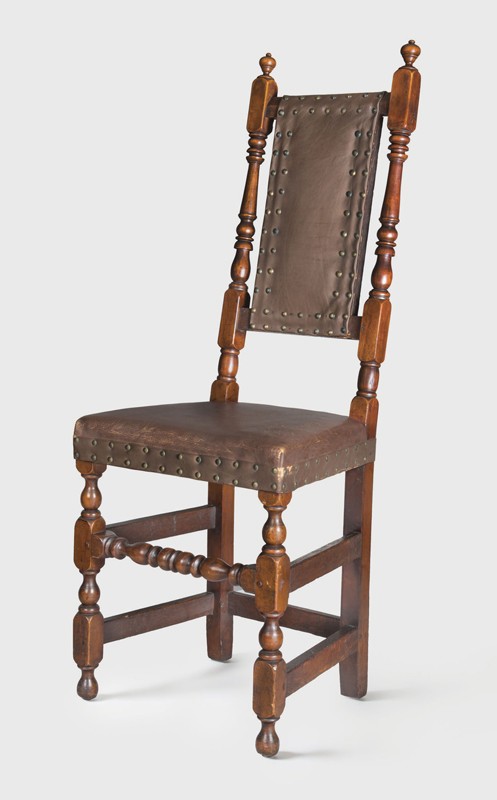
Side chair, Boston, Massachusetts, 1695–1710. Maple and oak. H. 43 3/8", W. 17 5/8", D. 14 3/8". (Courtesy, Winterthur Museum, bequest of H. F. du Pont; photo, Gavin Ashworth.)
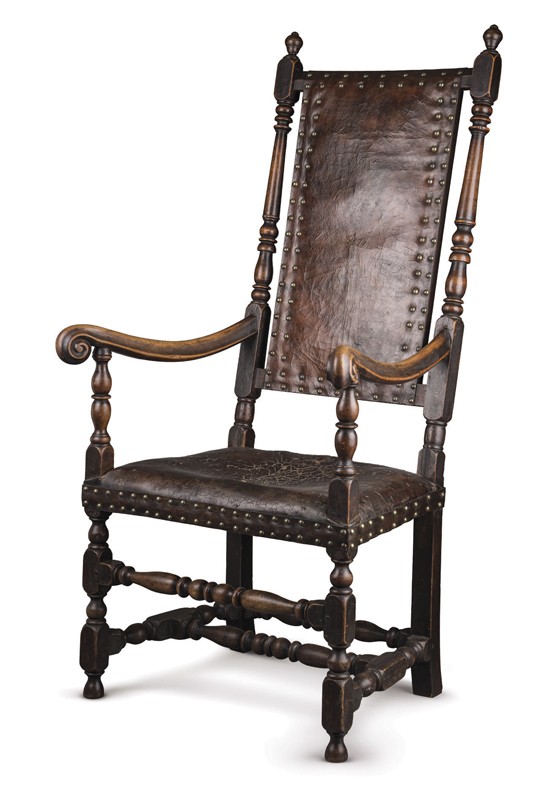
Armchair, Boston, Massachusetts, 1695–1710. Maple and oak; original leather upholstery on the seat. H. 51 3/4", W. 24 1/2", D. 17 1/2". (Private collection; photo, Jim Wildeman.)
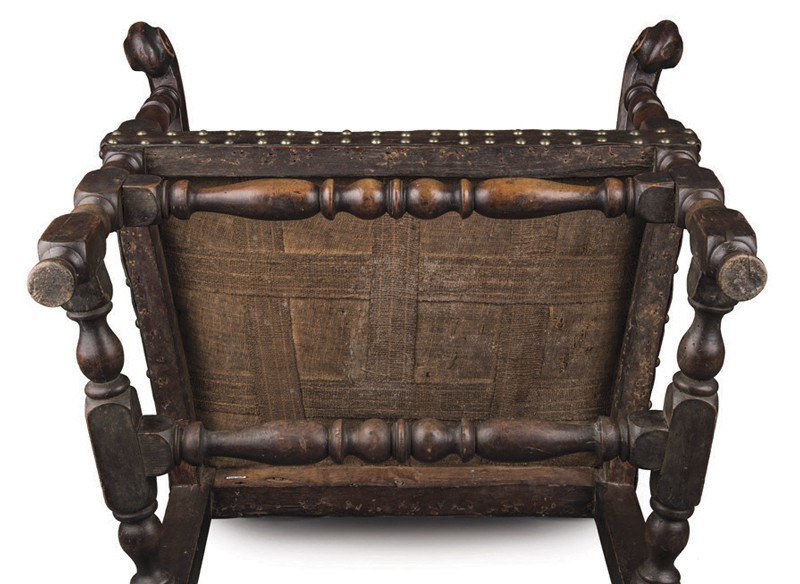
Detail of the stretchers and the original webbing and sackcloth under-upholstery of the armchair illustrated in fig. 18. Three webbing strips are placed front to back and are woven between the two side-to-side strips. This orientation of webbing was the standard arrangement used by Boston and New York upholsterers. Uncommon are the outer front-to-back strips angled at the same degree as the side seat rails.
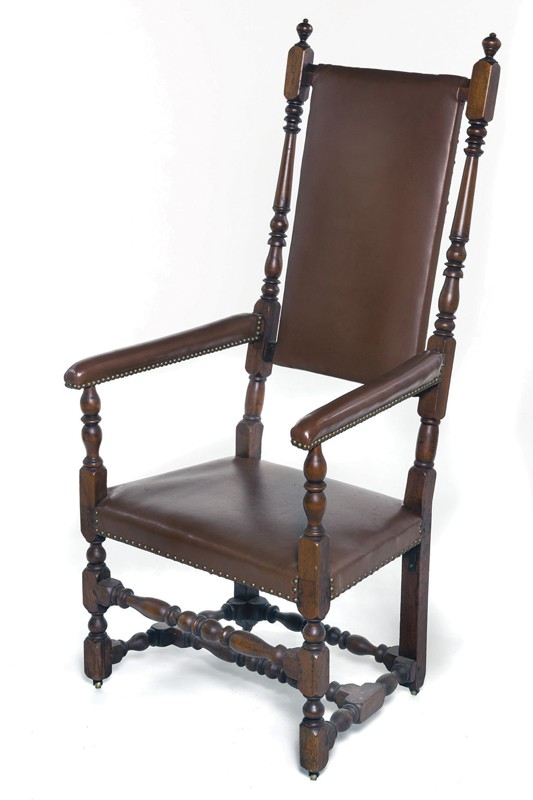
Armchair, Boston, Massachusetts, 1695–1710. Maple and oak. H. 51", W. 23", D. 17". (Courtesy, Historic Huguenot Street, New Paltz, N.Y., gift of Alice Hasbrouck, 1999.7240.01.) The arms are replaced, and the feet are missing. This chair descended through the Hardenbergh family and was owned originally by Johannes Hardenbergh (ca. 1670–1745) of Ulster County, New York.
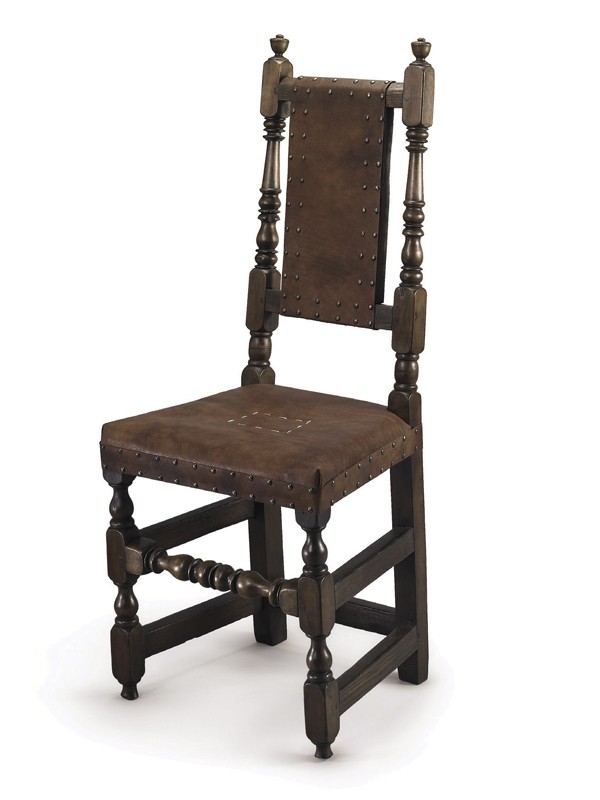
Side chair, Boston, Massachusetts, 1695–1710. Maple and oak. H. 44 5/8", W. 18 5/8", D. 16 5/8". (Courtesy, Saint Louis Art Museum, gift of Mr. and Mrs. Edward J. Nusrala, 249:1989.) The barrel turning above the seat is scored at its widest point. The urn finials diverge from the standard “muffin” variety.
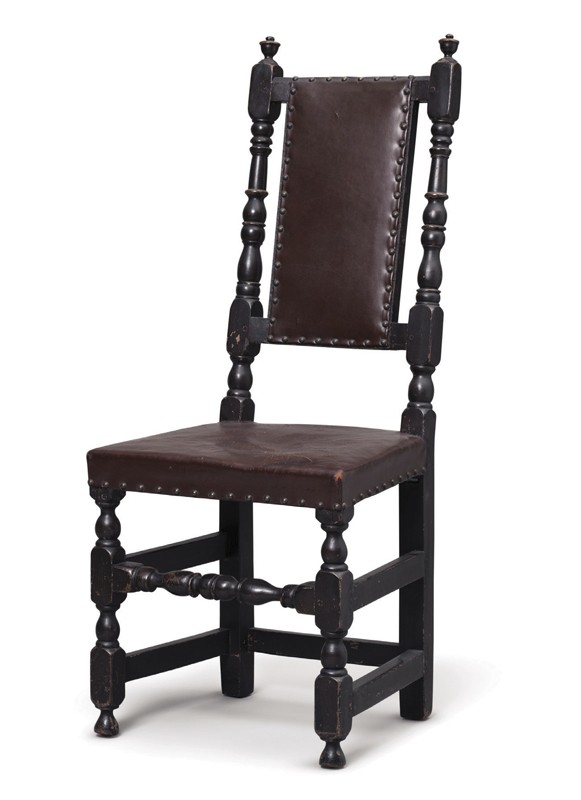
Side chair, Boston, Massachusetts, 1695–1710. Maple. H. 45 5/8", W. 18 1/8", D. 15 1/4". (Courtesy, Milwaukee Art Museum, Layton Art Collection, L1982.116; photo, Richard Eells.) This chair descended in the family of artist Pieter Vanderlyn (ca. 1687–1778) of Kingston, New York. Pieter immigrated to New York City from the Netherlands in 1718. His arrival date suggests he acquired the chair from an earlier owner. The top and lower back rail have a noticeable curve or hollow.
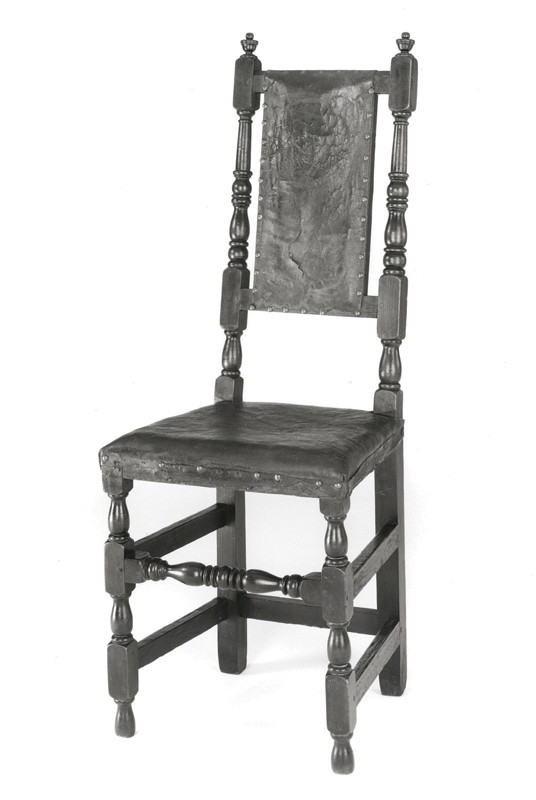
Side chair, probably Boston, Massachusetts, 1700–1720. Maple and oak; original leather upholstery. H. 47 3/4", W. 18 1/2", D. 18 3/4". (Chipstone Foundation; photo, Gavin Ashworth.) This chair’s leather trim strip was secured with brass nails along the top edge and wrought iron tacks along the lower edge.
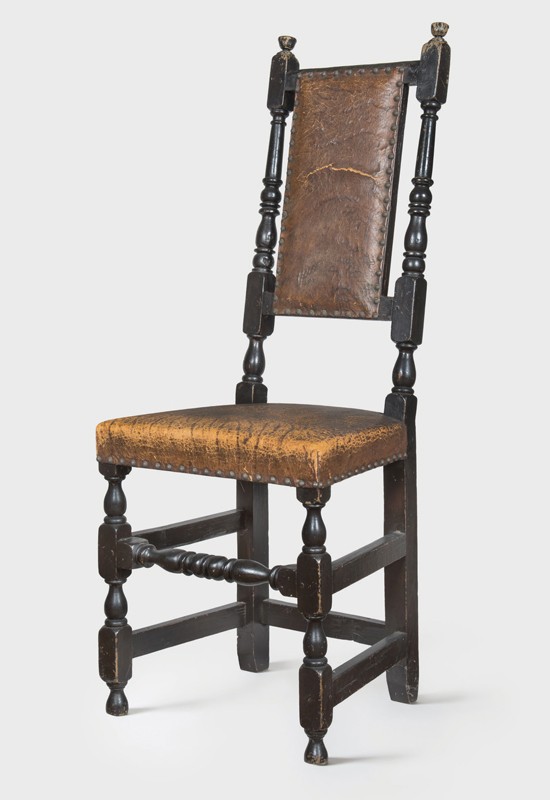
Side chair, probably Boston, Massachusetts, 1695–1710. Maple and oak. H. 43 5/8", W. 17 5/8", D. 14 3/4". (Courtesy, Winterthur Museum, bequest of H. F. du Pont; photo, Gavin Ashworth.)
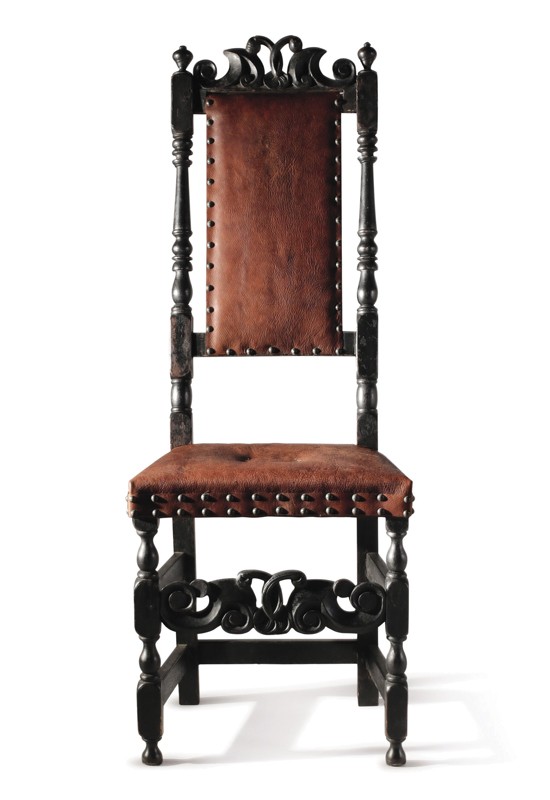
Side chair, Boston, Massachusetts, 1695–1710. Maple and oak. H. 48 1/4", W. 17 3/8", D. 12 7/8". (Private collection; photo, Nathan Liverant and Son.) This is the only group B side chair with a carved crest rail and stretcher.
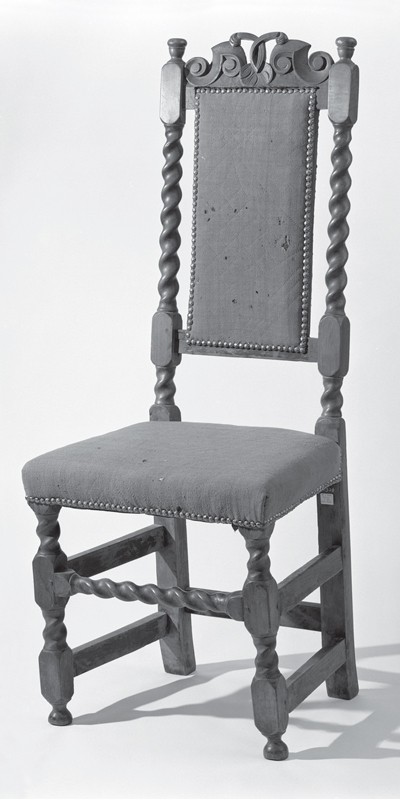
Side chair, Boston, Massachusetts, 1695–1710. Maple and oak. H. 46 3/4", W. 19", D. 17 3/8". (Private collection; photo, Scottish Rite Masonic Museum and Library.)
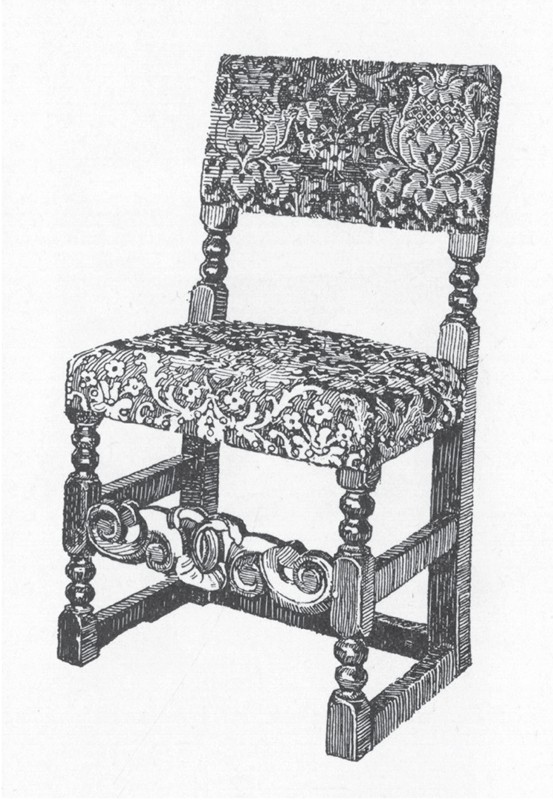
Side chair, Boston, Massachusetts, 1695–1705. Woods and dimensions not recorded. (Esther Singleton, The Furniture of Our Forefathers [New York: Doubleday, Page and Company, 1906], p. 183.)
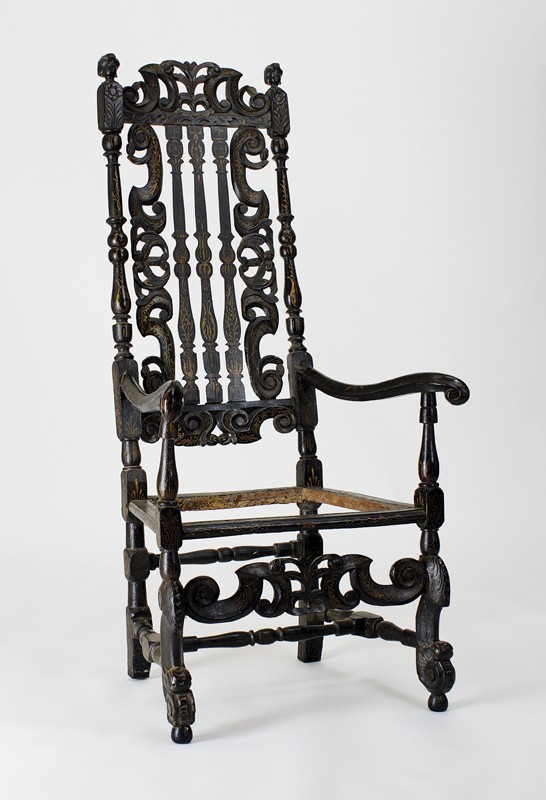
Armchair, London, 1695–1705. Beech; original Japanned decoration. H. 51 3/4", W. 23 3/8", D. 17". (Private collection; photo, Bill Russell.) This armchair’s seat would have been caned. It represents the first use of “banisters” as back support in English seating furniture. The ball feet are replaced.
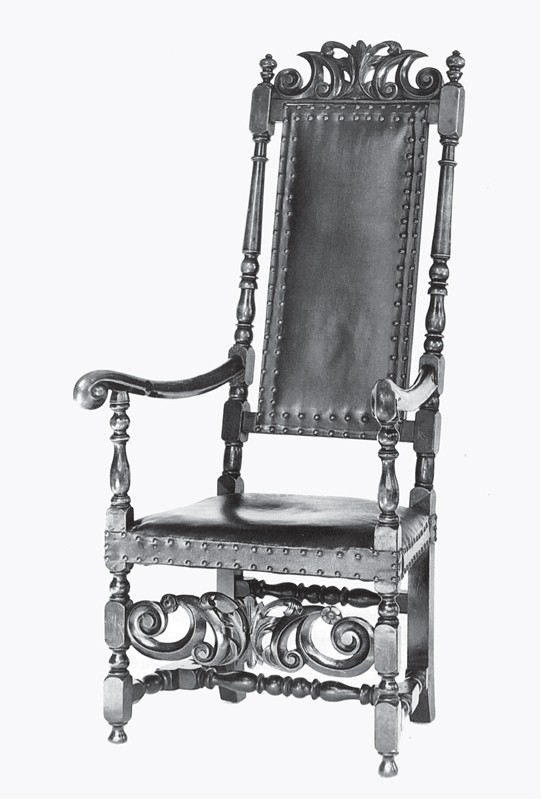
Armchair, Boston, Massachusetts, 1700–1715. Maple. H. 53 3/4", W. 23 7/8", D. 16 3/8". (Courtesy, Museum of Fine Arts, Boston, gift of Mrs. Charles L. Bybee, 1980.379.) The complex, asymmetrically turned arm supports are essentially half of a Boston gateleg leg turning. This chair was given to Rev. John Chester (1785–1829) of Albany, New York, by one of his parishioners.
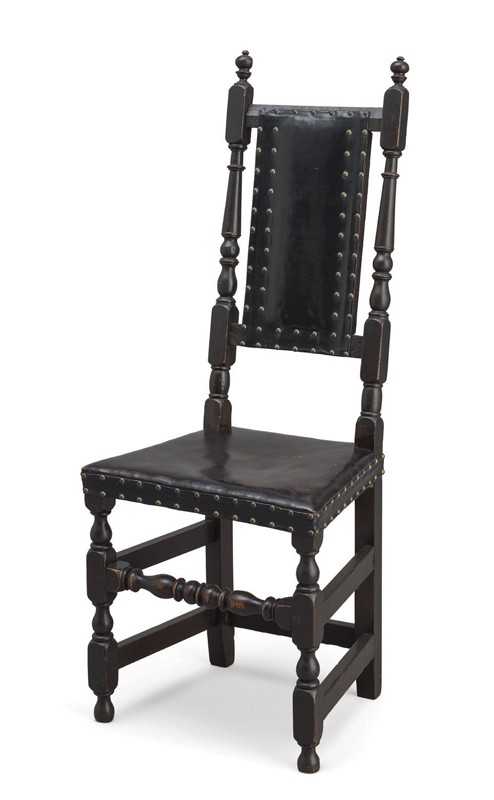
Side chair, Boston, Massachusetts, 1700–1715. Maple and oak. H. 46 3/4", W. 18 1/4", D. 14 3/4". (Courtesy, Colonial Williamsburg Foundation, gift of Mr. and Mrs. Miodrag R. Blagojevich, 1976-430.)
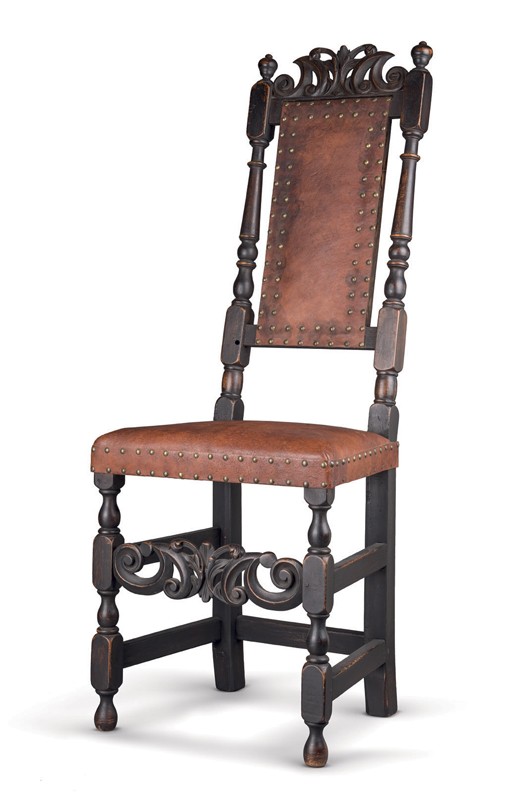
Side chair, Boston, Massachusetts, 1700–1715. Maple and oak. H. 48", W. 18", D. 14 1/2". (Private collection; photo, Jim Wildeman.)
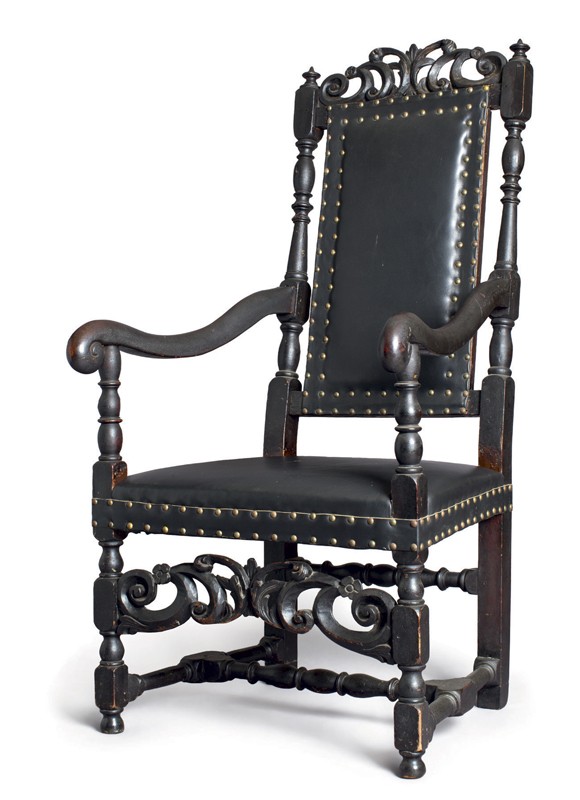
Armchair, New York City, 1695–1715. Maple with oak and hickory. H. 47 1/2", W. 25 1/2", D. 27". (Courtesy, Historic Hudson Valley, Tarrytown, New York.) The feet and the finials are incorrectly restored.
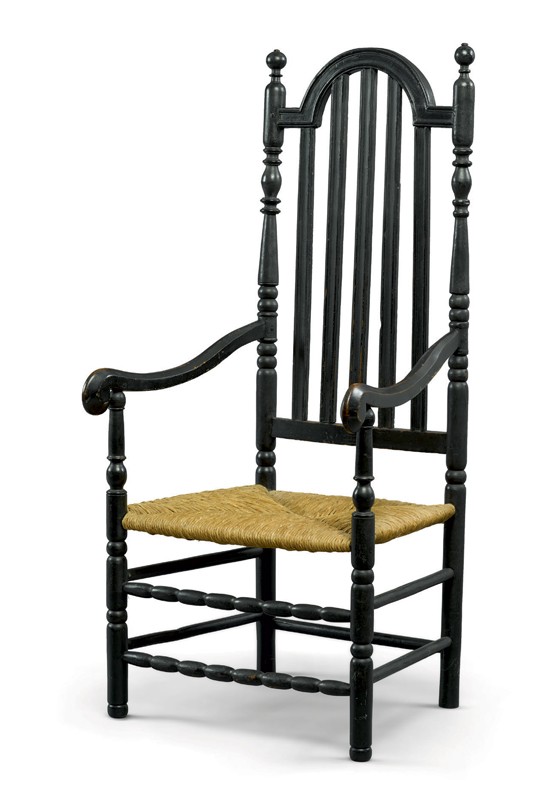
Armchair, New York, 1700–1740. Maple. H. 50 1/2". (Courtesy, Sotheby’s Inc.) The feet are replacements.
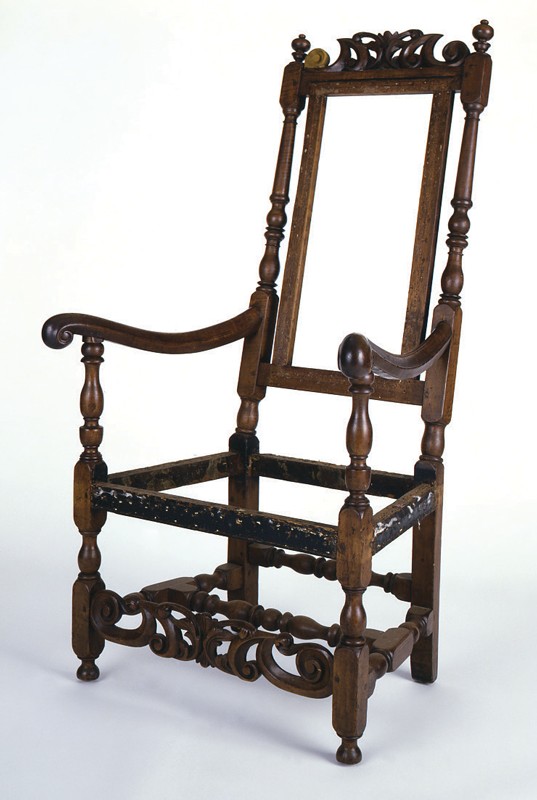
Armchair, New York City, 1695–1710. Maple and oak. H. 52", W. 24 3/4", D. 17 1/2". (Chipstone Foundation; photo, Gavin Ashworth.) The urn and baluster turned arm supports are nearly identical to those on the rear posts of the armchair illustrated in fig. 28.
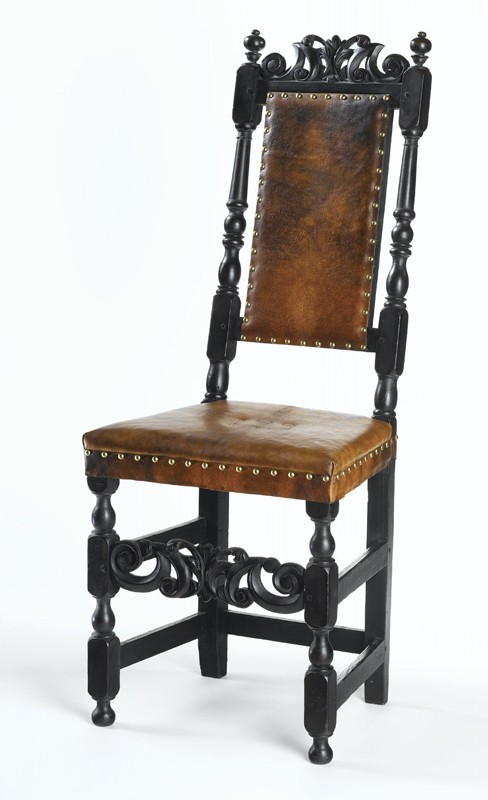
Side chair, New York City, 1695–1710. Maple and oak. H. 46 3/4", W. 18 1/4", D. 15". (Private collection; photo, Gavin Ashworth.)
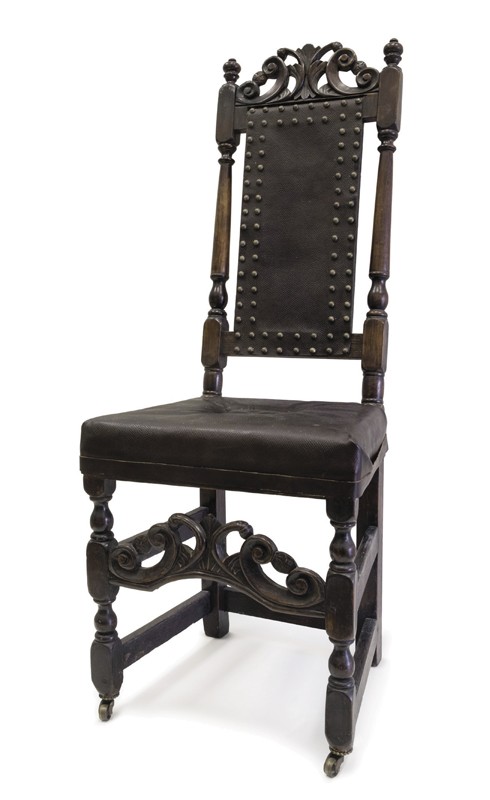
Side chair, probably Boston, Massachusetts, 1705–1715. Maple and oak. H. 45 1/2", W. 18", D. 15". (Courtesy, Greene County [New York] Historical Society.) This chair descended through the Bronck family of Coxsackie, New York, and was discovered with remnants of the original Russia leather upholstery on the back.
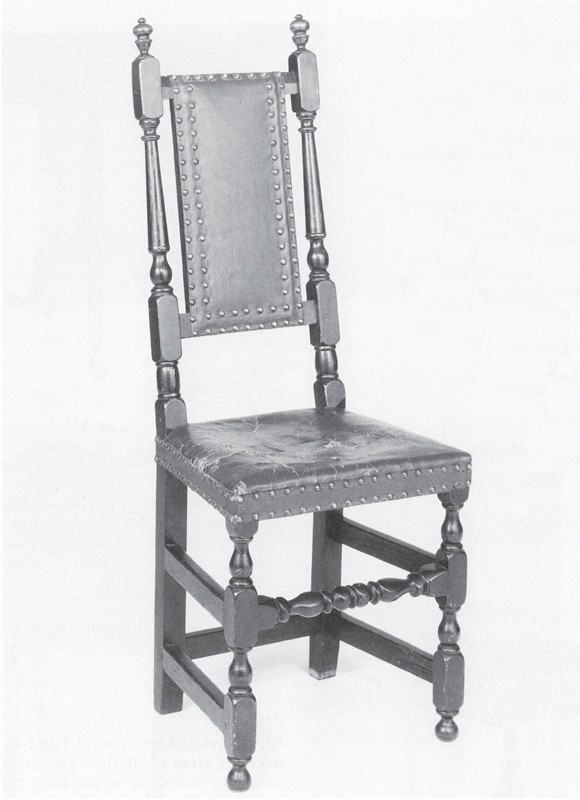
Side chair, Boston, Massachusetts, 1705–1715. Maple and oak. Dimensions not recorded. (Courtesy, Sotheby’s, Fine American Furniture, Folk Art, Silver and China Trade Paintings including Property from the Estate of Esther Pace Kuna, New York, June 23, 1988, sale 5736, lot 445.) An early label on the chair states that it belonged to Rev. Thomas Potwine (1731–1802), who was born in Boston and moved to East Windsor, Connecticut. His grandfather was John Potwine (1668–1700), who immigrated to Boston in 1698, and his father was John Potwine (1698–1792), who was probably the chair’s first owner.
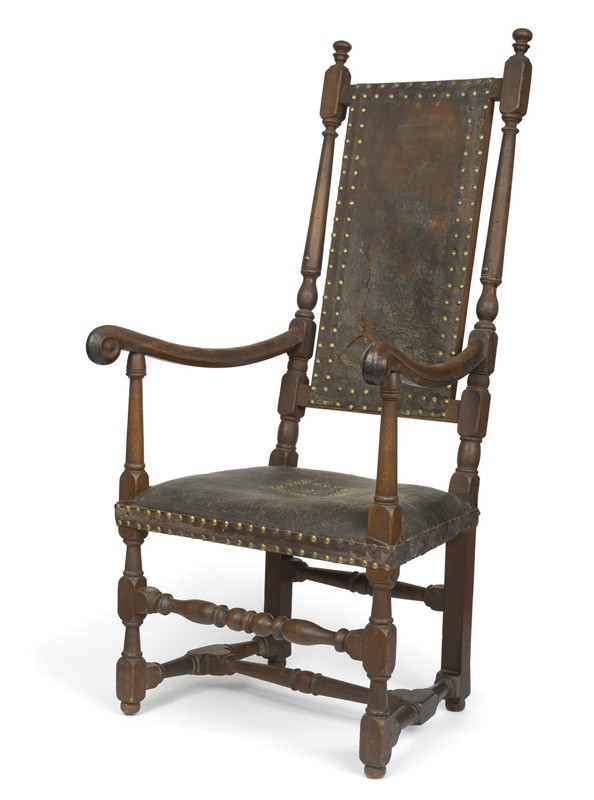
Armchair, Boston, Massachusetts, 1705–1715. Maple and oak; original leather upholstery. H. 50 1/2", W. 23 1/4", D. 17". (Courtesy, Peabody Historical Society and Museum; photo, Andrew Davis.) This chair belonged to Rev. Benjamin Prescott (1687–1777), the first pastor of South Church in Danvers (now Peabody), Massachusetts. The scrolled terminals of the arms and the feet are replaced. This chair is unique in that the original trapezoidal stitching in the seat is embellished with brass nails.
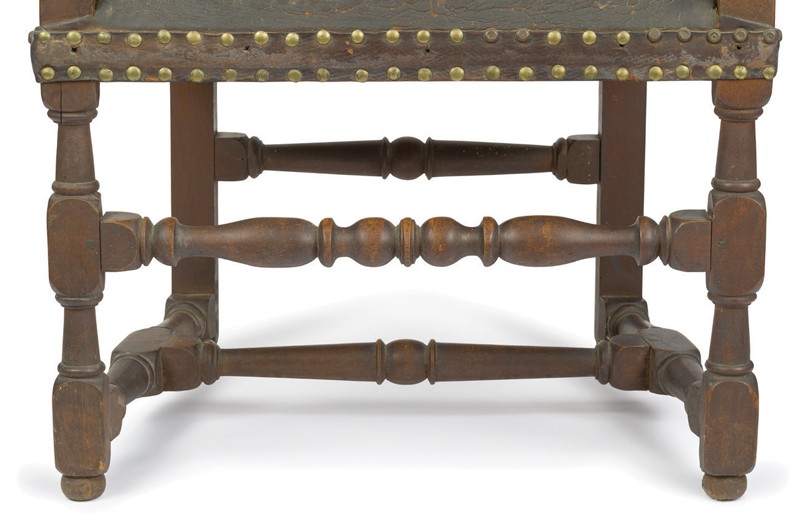
Detail of the stretchers of the armchair illustrated in fig. 38.
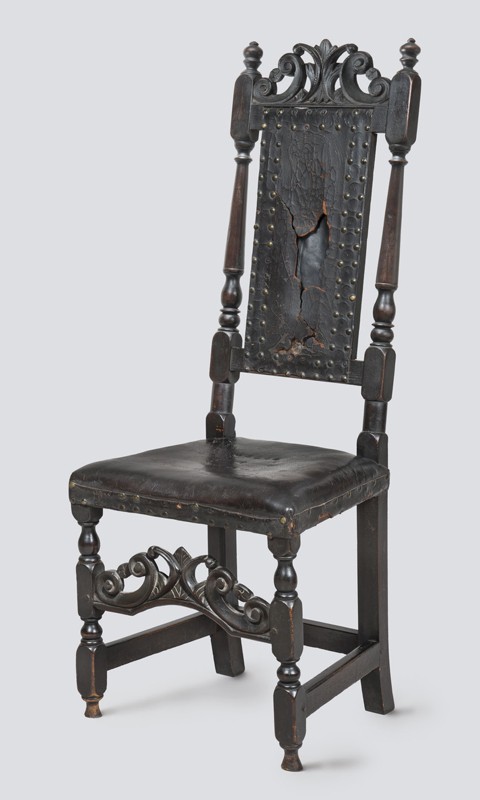
Side chair, probably Boston, Massachusetts, 1705–1715. Maple and oak; original leather upholstery. H. 46 1/2", W. 18", D. 15". (Courtesy, Albany Institute of History and Art, gift of James Ten Eyck, 1908.1; photo, Gavin Ashworth.) This chair descended through the Pierson family of Kingston, New York.
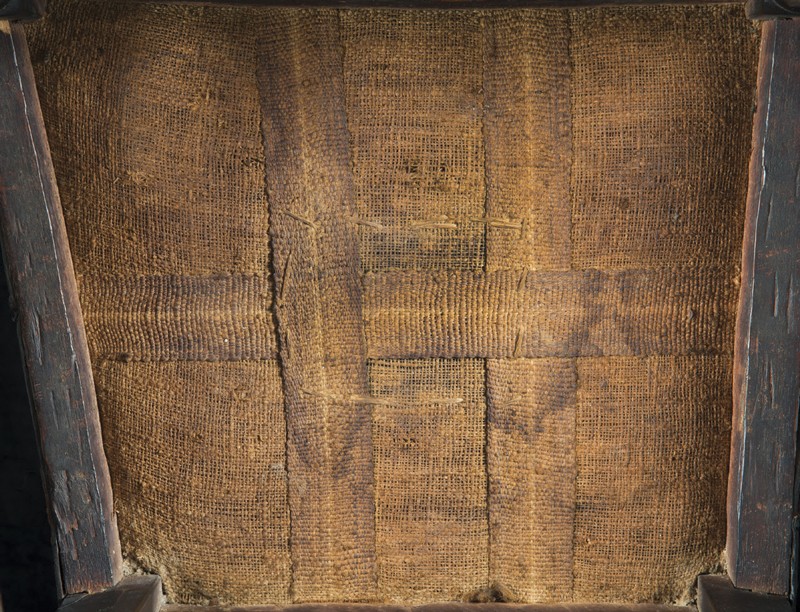
Detail of the original webbing and sackcloth under-upholstery of the side chair illustrated in fig. 40. The standard arrangement for webbing strips on side chairs applied by Boston and New York upholsterers was two strips front-to-back and one side-to-side. The trapezoidal-shaped stitching at the center of the seat is visible. Upholsterers would attach the webbing and then the sackcloth. The leather was roughly shaped to fit and then secured to the under-upholstery with waxed gut stitching. Grass was then stuffed in on the four sides and secured when the leather was nailed to the rails. The rough edges were concealed with trim strips of leather generally secured with double rows of decorative brass-headed nails on the front and sides, while the back edge was secured with wrought iron nails. The trim strip on the sides of this chair was secured along the top edge with brass-headed nails, but the bottom edge was secured with wrought tacks.
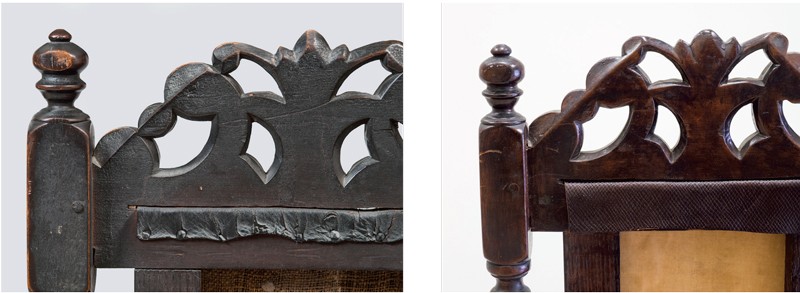
Detail showing the back of the crest of the side chairs illustrated in figs. 36 (left) and 40 (right). The back edges of the piercings are neatly chamfered, and the edges of the C-scrolls have a simple single chamfer at a 45 degree angle. While irregular now because of shrinkage, the leather pulled through the slot on fig. 40 would have originally been cut along a straight line.
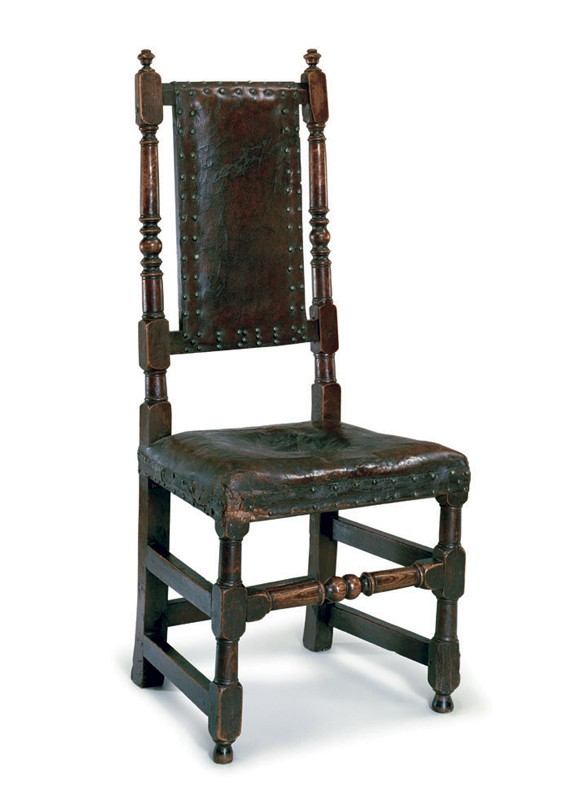
Side chair, England, 1690–1710. Ash; original leather upholstery. H. 44 1/2", W. 19", D. 16". (Courtesy, Colonial Williamsburg Foundation, 1954-990.) The cylindrical turning between the seat and the lower back rail is identical to that found on the later groups of early baroque Boston chairs.
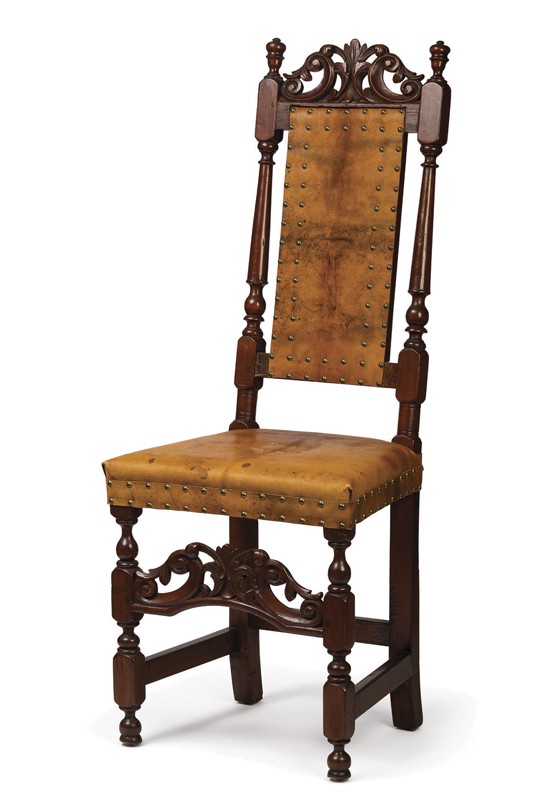
Side chair, Boston, Massachusetts, 1705–1715. Maple and oak. H. 47 1/2", W. 18 1/2", D. 15". (Private collection; photo, Andrew Davis.)
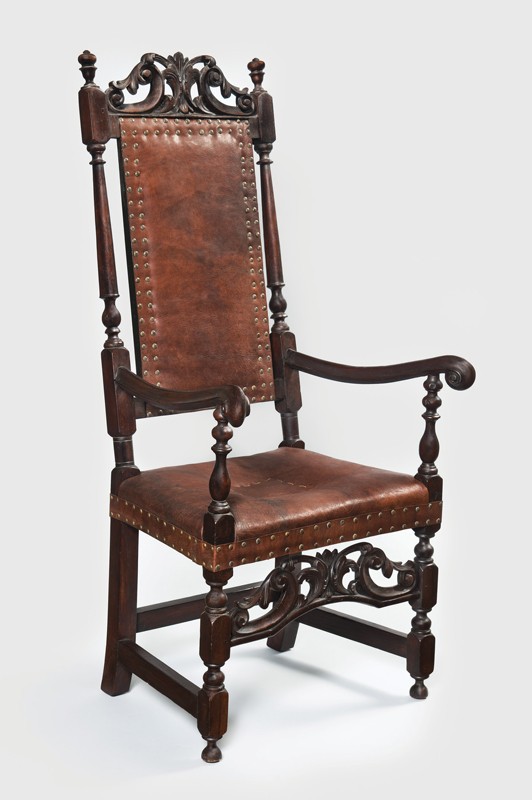
Armchair, Boston, Massachusetts, 1705–1715. Maple and oak. H. 51", W. 24", D. 22". (Private collection; photo, Gavin Ashworth.)
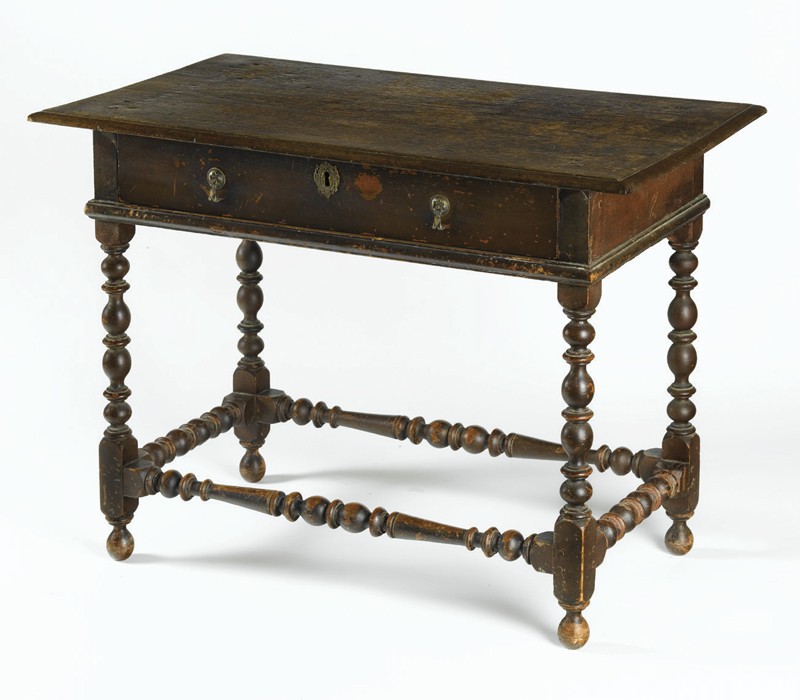
Table, Boston, Massachusetts, 1705–1720. Maple and white pine. H. 27 3/4", W. 37 3/4", D. 21 3/4". (Private collection; photo, Gavin Ashworth.) The conical turning on the stretchers is nearly identical to that on the rear posts of group D chairs. The legs have turning identical to those on the arm supports of several of the leather-upholstered armchairs.
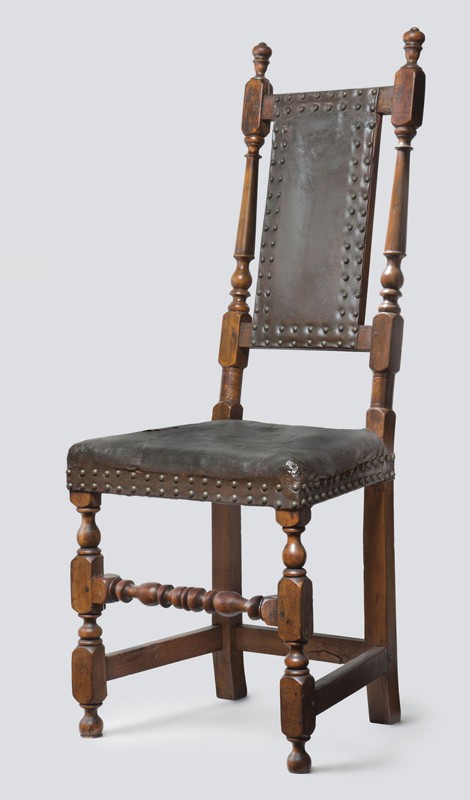
Side chair, Boston, Massachusetts, 1705–1715. Maple and oak; original leather upholstery. H. 48 1/2", W. 18 1/8", D. 14 1/2". (Courtesy, Wadsworth Atheneum, Wallace Nutting Collection, gift of J. Pierpont Morgan Jr., 1926.446; photo, Gavin Ashworth.) This chair descended in the Pierson family of Kingston, New York, and was first illustrated in Wallace Nutting, Furniture of the Pilgrim Century, 1620–1720 (Boston: Marshall Jones Company, 1921), p. 221, with a later crest that has now been removed. A remnant is all that remains of the lower ball on the foot.
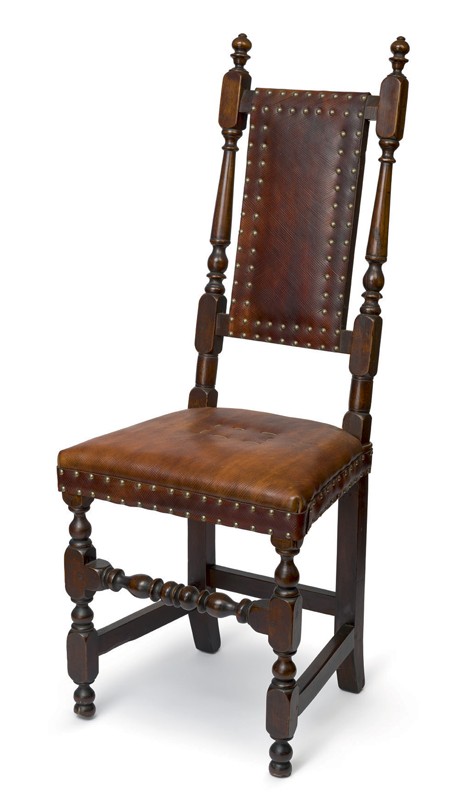
Side chair, Boston, Massachusetts, 1705–1715. Maple and oak. H. 47 1/2", W. 19", D. 15". (Private collection; photo, Andrew Davis.)
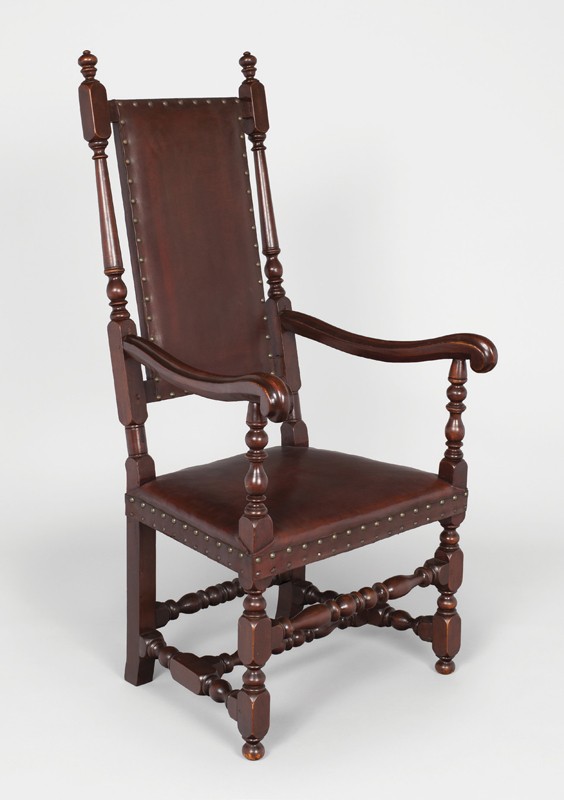
Armchair, Boston, Massachusetts, 1705–1715. Maple. H. 48 1/2", W. 23", D. 17". (Courtesy, Art Institute of Chicago, Mr. and Mrs. William Y. Hutchinson Fund, 1989.57; photo, Art Resource, Inc.) The arms and feet are replaced; the arms would have resembled those on the armchair illustrated in fig. 45.
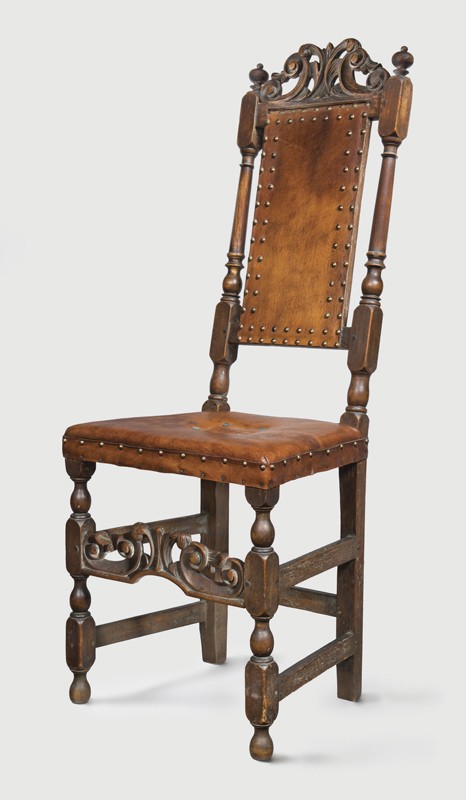
Side chair, New York City, 1705–1715. Maple and oak. H. 47", W. 18 1/2", D. 14 1/2". (Private collection; photo, Gavin Ashworth.)
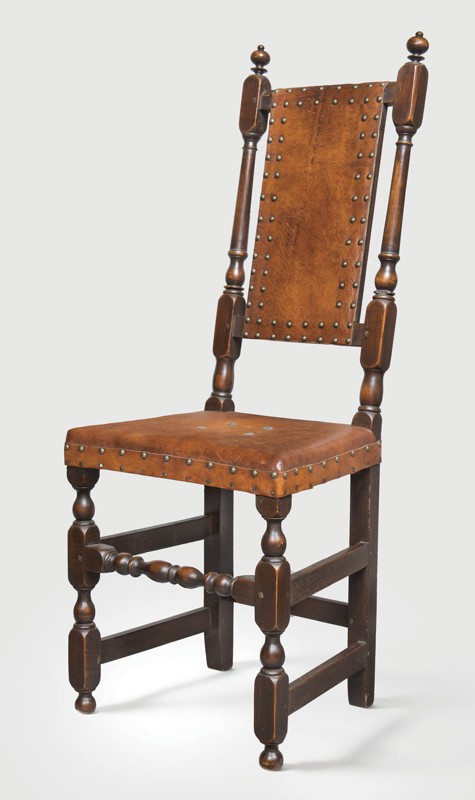
Side chair, New York City, 1705–1715. Maple and oak. H. 45 3/4", W. 18", D. 14 1/2". (Private collection; photo, Gavin Ashworth.)
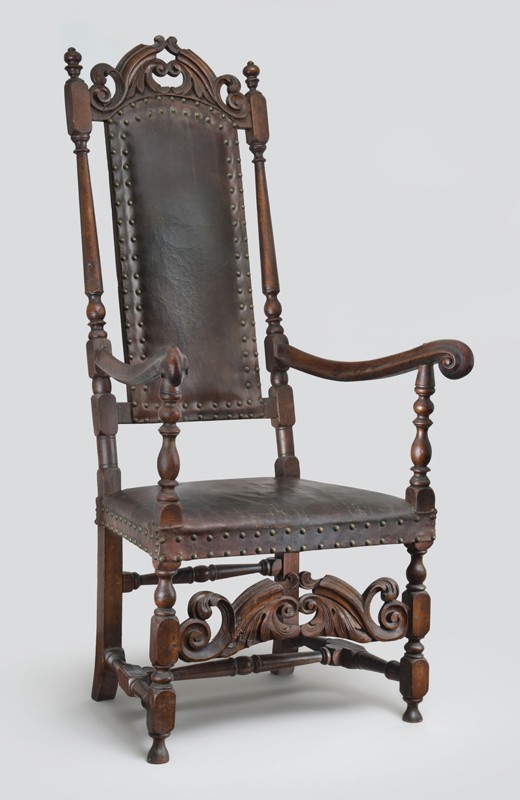
Armchair, Boston, Massachusetts, 1710–1720. Maple and oak. H. 53 1/8", W. 22 3/4", D. 17 1/2". (Courtesy, Smithtown Historical Society, gift of Mrs. Norman Parke; photo, Gavin Ashworth.) Family tradition maintained that this chair belonged to Ebenezer Smith (1712–1747). His father, Richard Smith II (ca. 1645–1720), was the chair’s probable first owner (Dean Failey, Long Island Is My Nation: Decorative Arts & Craftsmen 1640–1830, 2nd edition [Cold Spring Harbor, N.Y.: Society for the Preservation of Long Island Antiquities, 1998], no. 23. pp. 26–7).
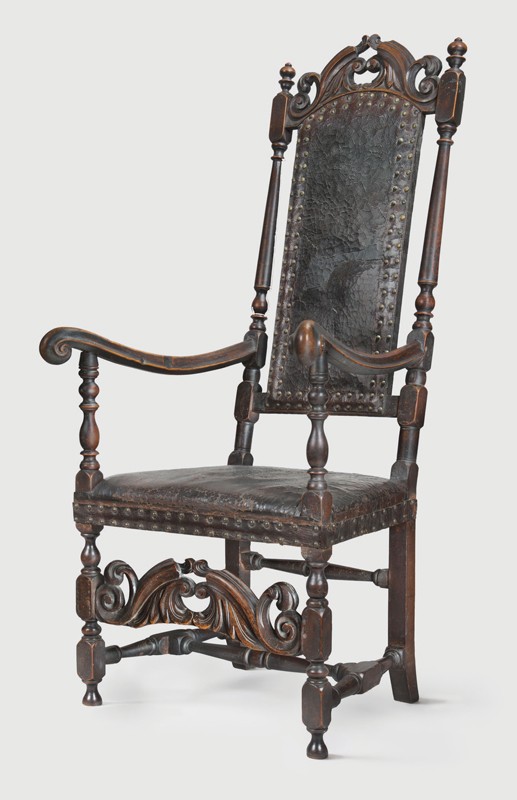
Armchair, Boston, Massachusetts, 1710–1720. Maple and oak; original leather upholstery. H. 53 1/4", W. 22 7/8", D. 17". (Courtesy, Winterthur Museum, bequest of H. F. du Pont; photo, Gavin Ashworth.)
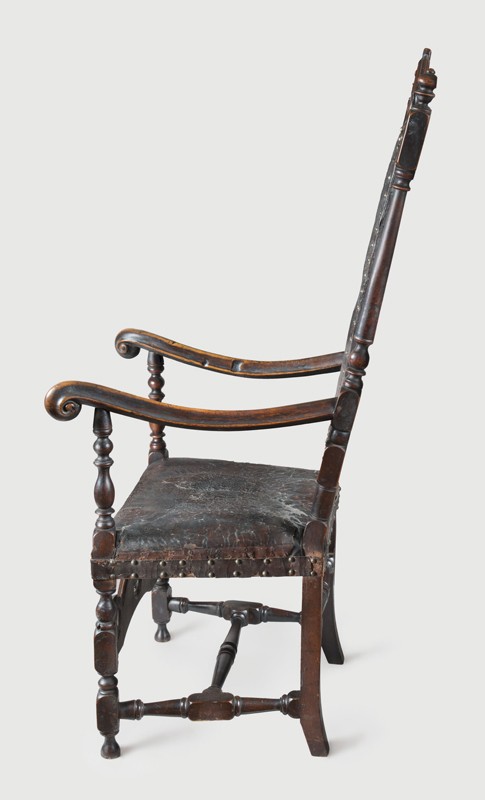
Side view of the armchair illustrated in fig. 53. The height and dramatic cant of the chair back would make it susceptible to falling backward if not for the rearward kick of the rear feet.
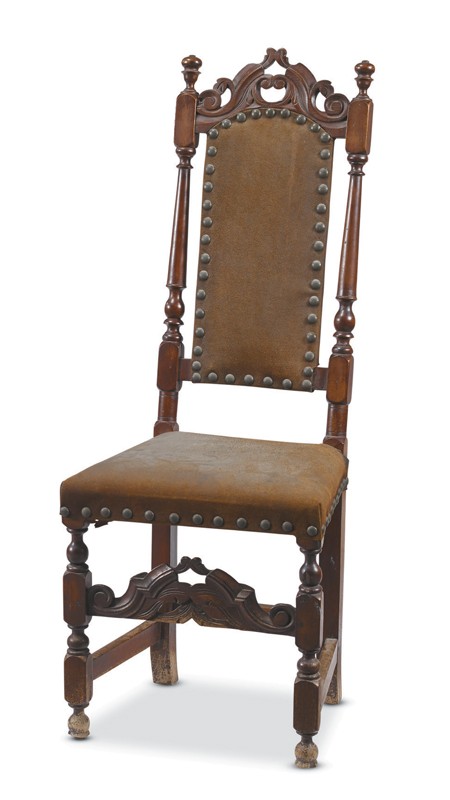
Side chair, Boston, Massachusetts, 1710–1720. Maple and oak. H. 47 1/2". (Courtesy, Freeman’s; photo, Thomas Clark.) The front stretcher is replaced. The original would have related to those on the chairs shown in figs. 52 and 53.
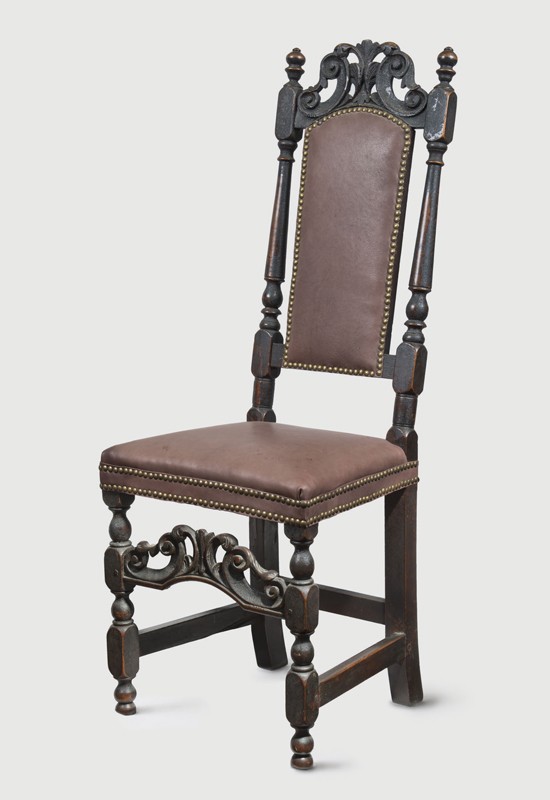
Side chair, Boston, Massachusetts, 1710–1730. H. 46 3/4", W. 18 1/2", D. 14 7/8". (Courtesy, Washington’s Headquarters State Historic Site, Newburgh, New York Office of Parks, Recreation and Historic Preservation, WH.1971.641; photo, Gavin Ashworth.) This chair is one of three donated by Enoch Carter to Washington’s Headquarters prior to 1858. The chairs descended through the Ver Planck (also Verplanck) family and were reputedly used as altar furniture at the Dutch Reformed Church, Fishkill, New York.
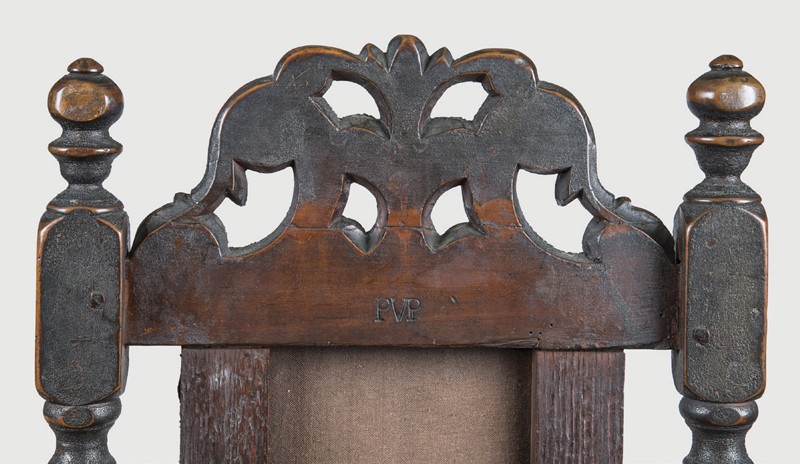
Detail of the back of the crest of the side chair illustrated in fig. 56, showing the PVP brand. The back edges of the crest and the piercings are chamfered to lighten the crest visually when seen from the front.
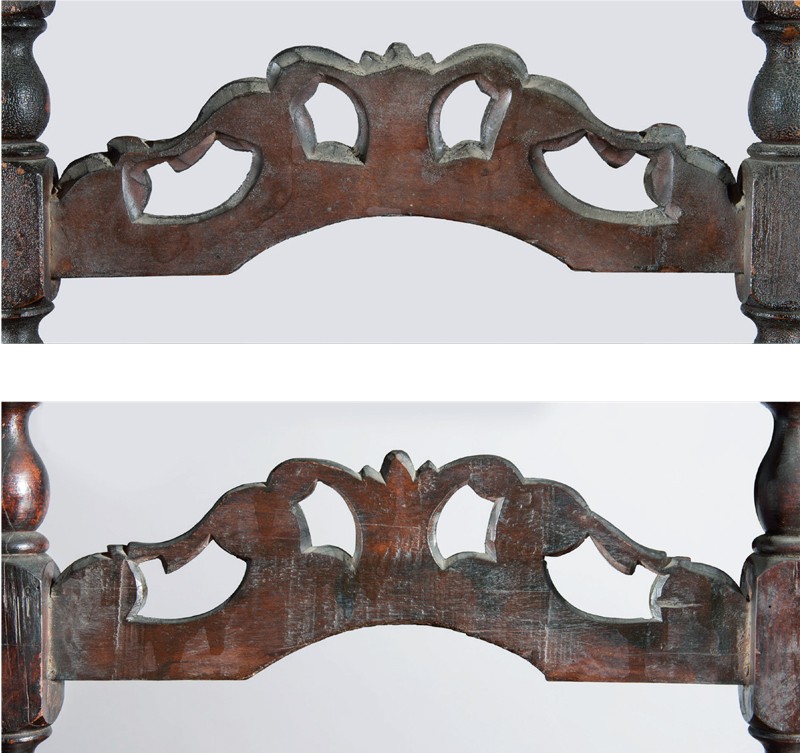
Composite illustration showing the back of the lower stretcher of the group E side chair illustrated in fig. 56 (top) and group E side chair illustrated in fig. 69 (bottom). Boston chairmakers constructed their seating quickly and efficiently. As the saw kerfs visible here reveal, makers did not always plane the back surfaces of stretchers. The same is true of some crests.
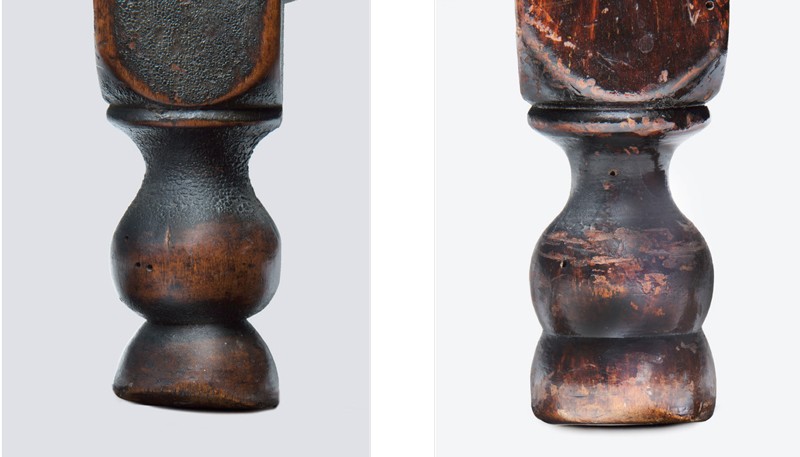
Composite illustration showing the front turned feet of the group E side chair illustrated in fig. 56 (left) and group E side chair illustrated in fig. 69 (right). The baluster‑and-half-ball, or “double-ball,” foot was the standard for early eighteenth-century Boston chairmakers. Through centuries of use, many surviving chairs have lost the lower half‑ball if not their entire foot.
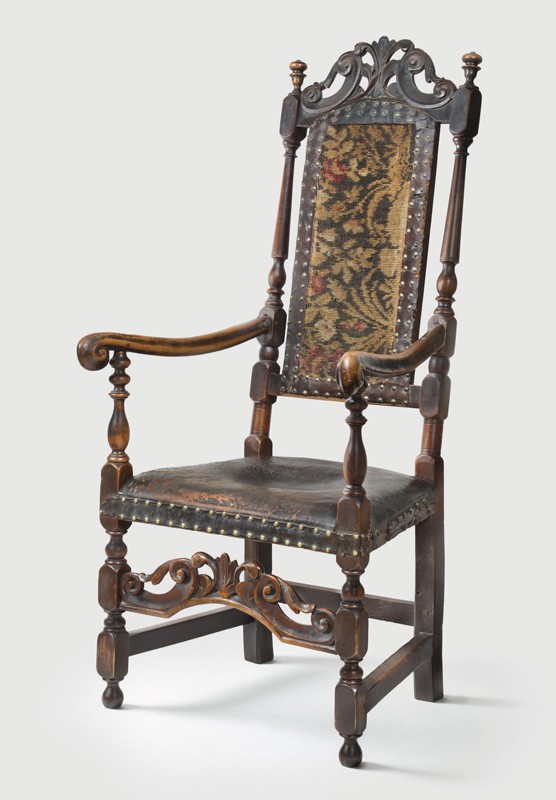
Armchair, Boston, Massachusetts, 1710–1730. Maple and oak; original leather upholstery. H. 50 1/2", W. 24 1/2", D. 23". (Courtesy, Wadsworth Atheneum, the Evelyn Bonar Storrs Trust Fund, 1994.4.1; photo, Gavin Ashworth.) While the chair’s original owner is unknown, it descended in the Schuyler and Church families of New York. The chair was purchased from a descendant of John Baker Church (1777–1818) and Angelica Schuyler (1756–1814). Angelica was the daughter of Gen. Philip Schuyler (1733–1804) and Catherine Van Rensselaer (1735–1803) of Albany. The feet and the proper right finial are replaced.
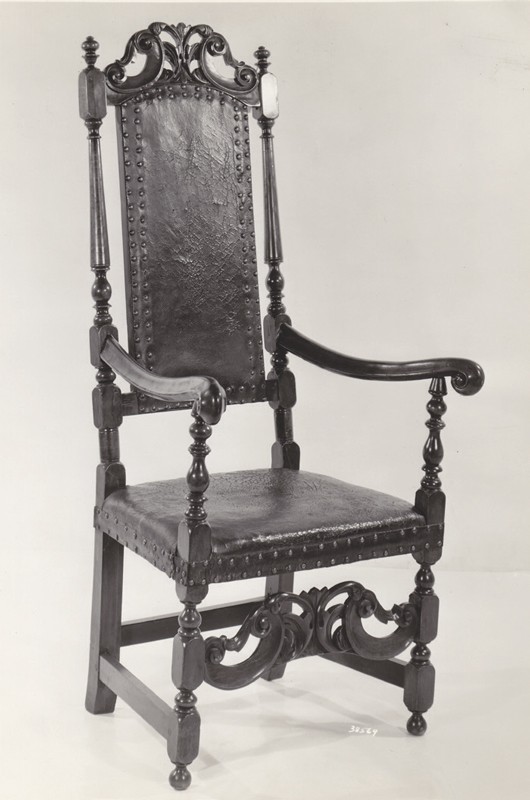
Armchair, Boston, Massachusetts, 1710–1730. Maple and oak; original leather upholstery. H. 52", W. 24 1/4", D. 21 1/4". (Courtesy, The Henry Ford, 30.557.64.) Henry Ford purchased the chair from Charles Woolsey Lyon of New York City in 1930. Lyon acquired the chair in 1901 from Mr. Stephen Schuyler of the Flats, Albany, New York. Stephen Schuyler stated that the chair originally belonged to Pieter Schuyler (1657–1724). The Flats is an area north of Albany along the Hudson River. The front stretcher is incorrectly replaced.
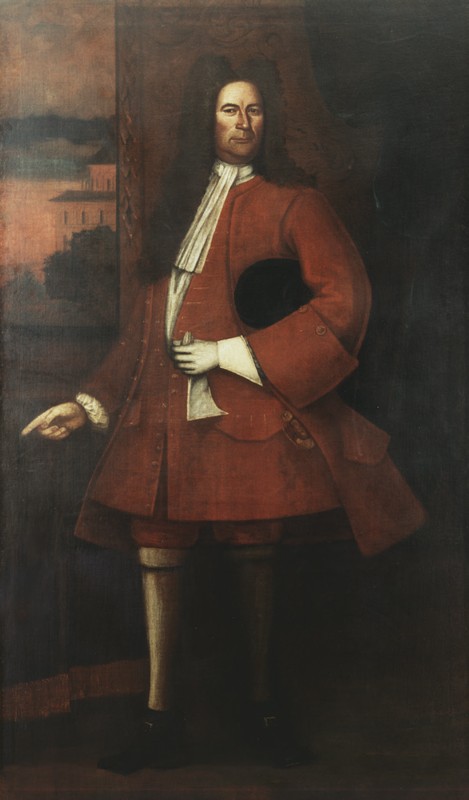
Nehemiah Partridge (1683–ca. 1737), Pieter Schuyler, Albany, New York, ca. 1718. Oil on canvas. 87 3/4" x 51". (Courtesy, New York State Museum.)
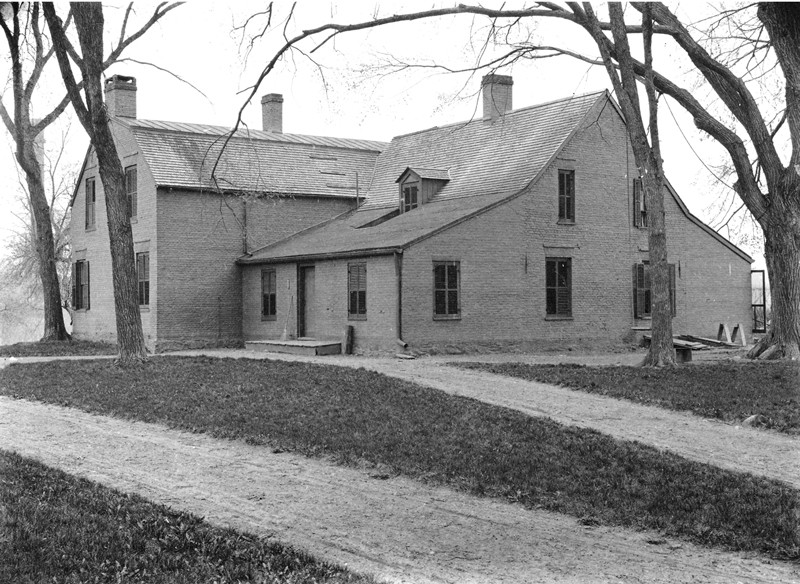
General Philip Schuyler House, ca. 1690 with a ca. 1765 addition, Colonie Township, Albany County, New York. (Courtesy, Library of Congress, Prints & Photographs Division, HABS no. NY-3102.) This house was destroyed by fire in 1962.
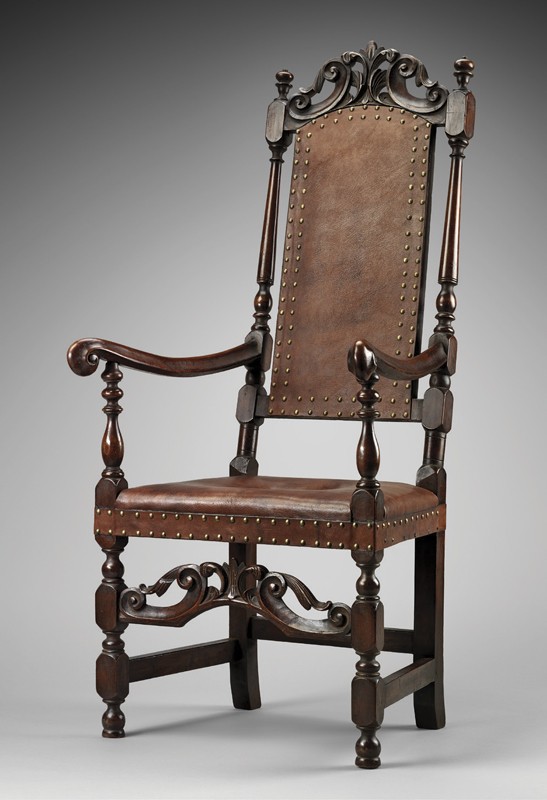
Armchair, Boston, Massachusetts, 1710–1730. Maple and oak. H. 52 5/8", W. 23 1/8", D. 17". (Courtesy, Museum of Fine Arts, Boston, gift of Anne and Frederick Vogel III, 2016.538.) This chair is branded “W. MANCIUS” on the lower back rail. The feet are replaced.
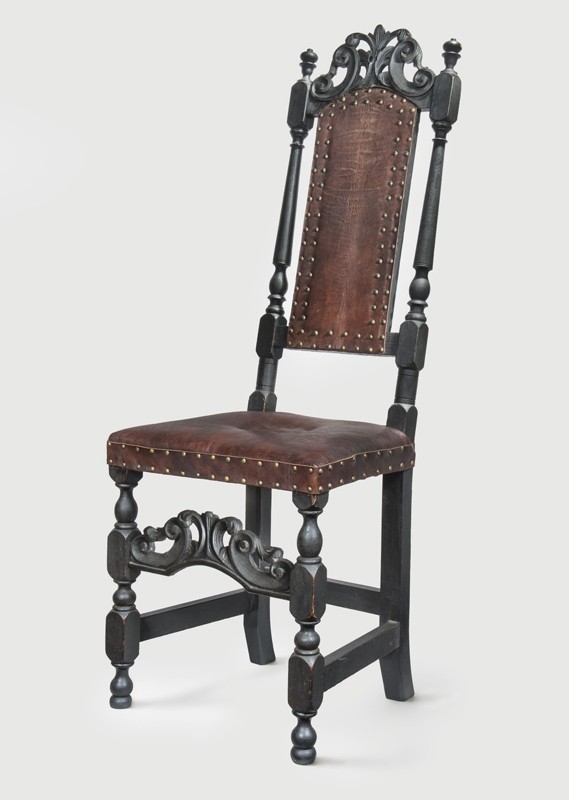
Side chair, Boston, Massachusetts, 1710–1730. H. 49 3/4", W. 18 1/2", D. 14 3/4". (Private collection; photo, Gavin Ashworth.) The lower back rail is branded “W. MANCIUS”. The feet are replaced.

Composite illustration showing the brands on back of the lower back rails of the armchair illustrated in fig. 64 (left) and the side chair illustrated in fig. 65 (right).
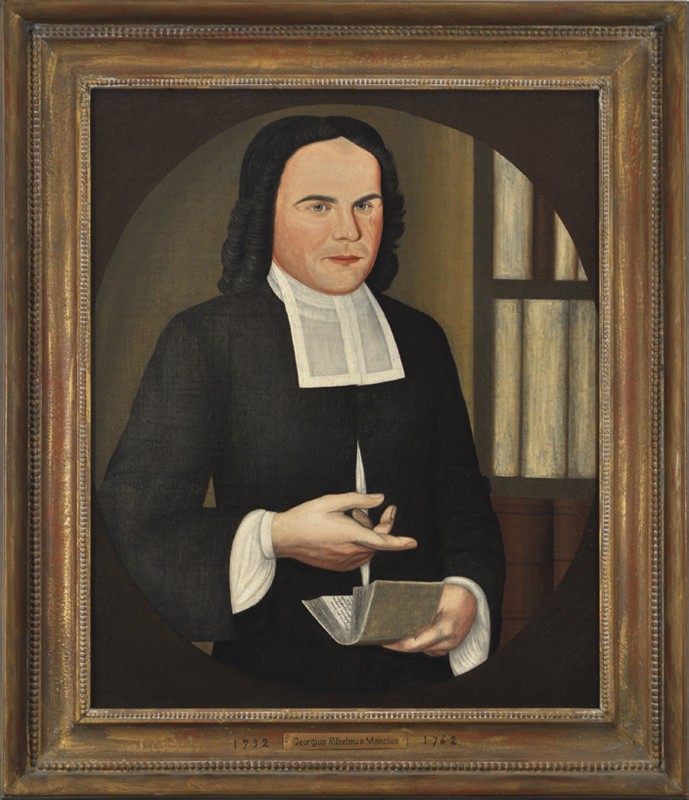
Rev. George Wilhelmus Mancius, attributed to Pieter Vanderlyn (ca.1687–1778), Kingston, New York, ca. 1735. Oil on canvas. Measurements not recorded. (Courtesy, First Reformed Protestant Dutch Church of Kingston, New York.)
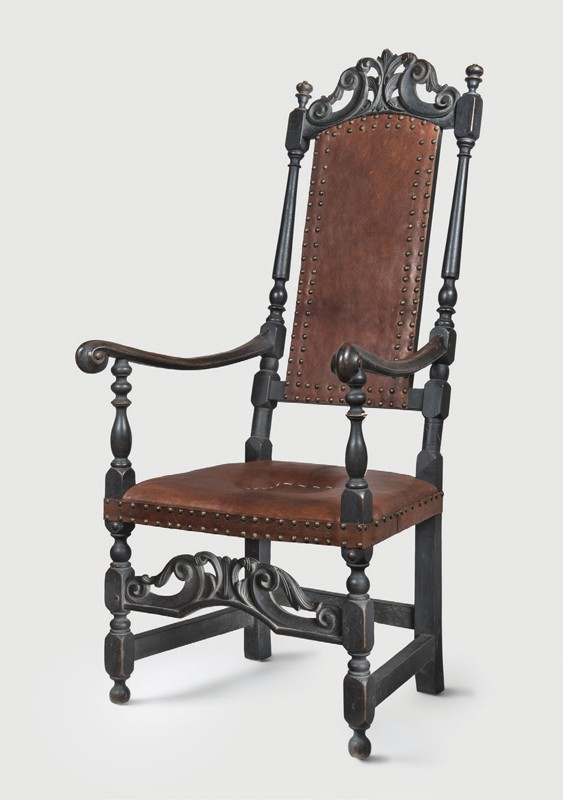
Armchair, Boston, Massachusetts, 1710–1730. Maple and oak. H. 51 3/4", W. 23 1/4", D. 16 3/4". (Private collection; photo, Gavin Ashworth.) This chair was found in Yonkers, New York. Upholstery evidence indicates that this chair’s trim strip was secured on the side seat rails with a top row of brass-headed nails and the bottom with wrought tacks.
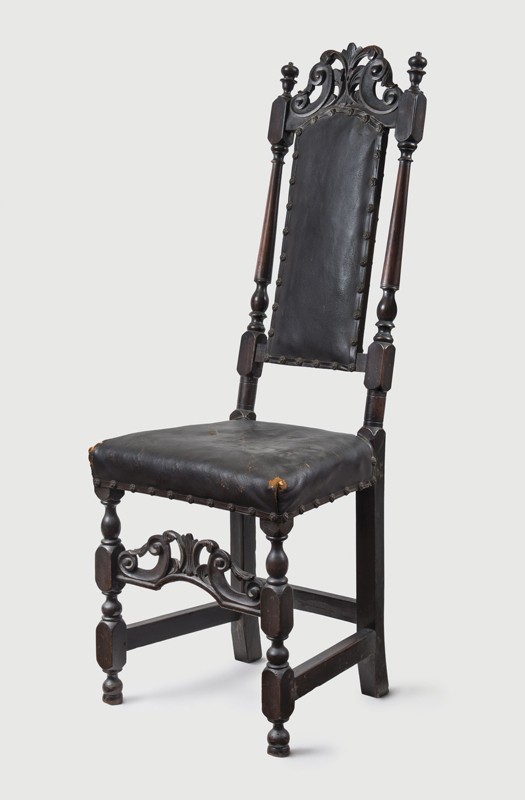
Side chair, Boston, Massachusetts, 1710–1730. H. 49", W. 18", D. 15". (Courtesy, Washington’s Headquarters State Historic Site, Newburgh, New York Office of Parks, Recreation and Historic Preservation, WH.1971.643; photo, Gavin Ashworth.) Four chairs from this set are known. According to Israel Sack, Inc., the chairs were purchased from descendants of the Van Rensselaer family.
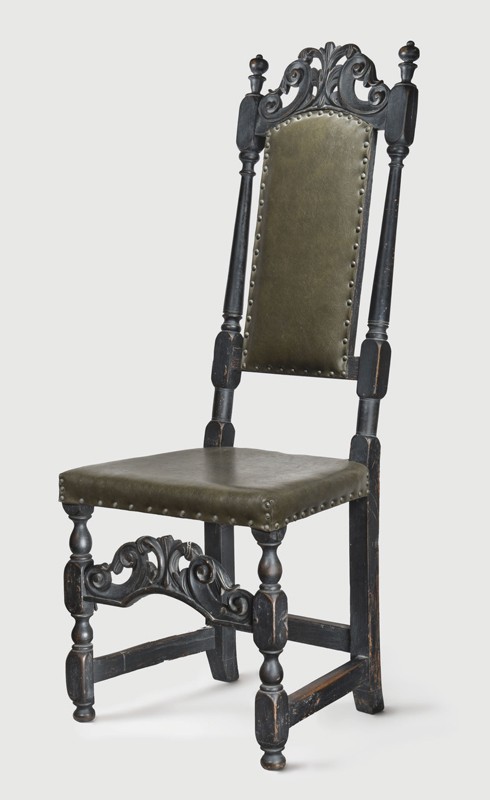
Side chair, Boston, Massachusetts, 1710–1730. Maple and oak. H. 47", W. 18 1/8", D. 15". (Private collection; photo, Gavin Ashworth.) The feet are replaced.
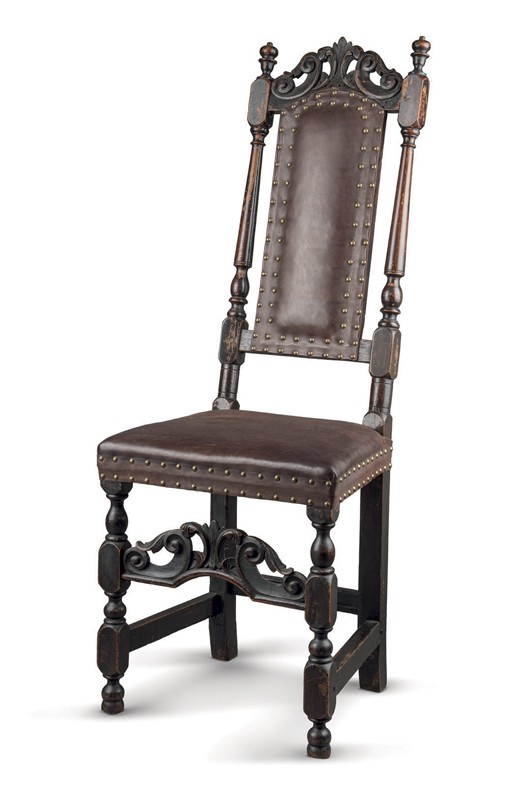
Side chair, Boston, Massachusetts, 1710–1730. Maple and oak. H. 48", W. 18 1/2", D. 14 3/4". (Private collection; photo, Jim Wildeman.)
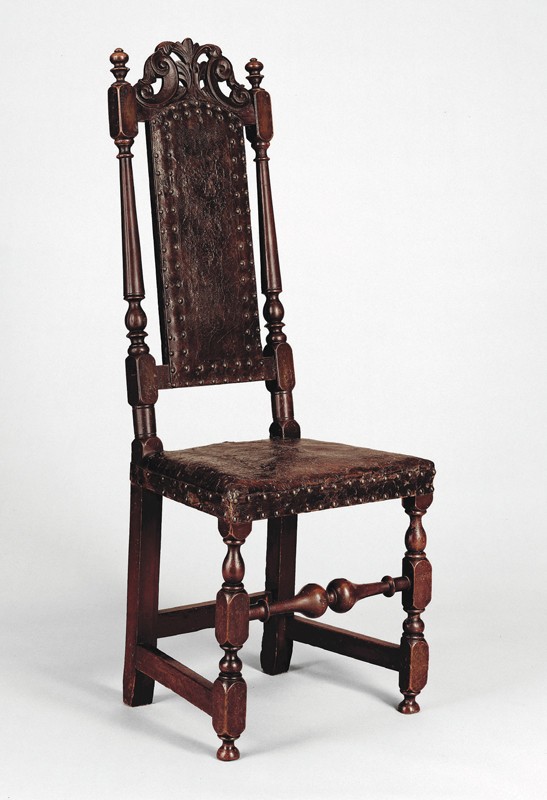
Side chair, Boston, Massachusetts, 1710–1730. Maple and oak; original leather upholstery. H. 48", W. 17 7/8", D. 14 5/8". (Courtesy, Metropolitan Museum of Art, bequest of Mrs. J. Insley Blair, 1951, 52.77.58; photo, image copyright © Metropolitan Museum of Art. Image source: Art Resource, Inc.)
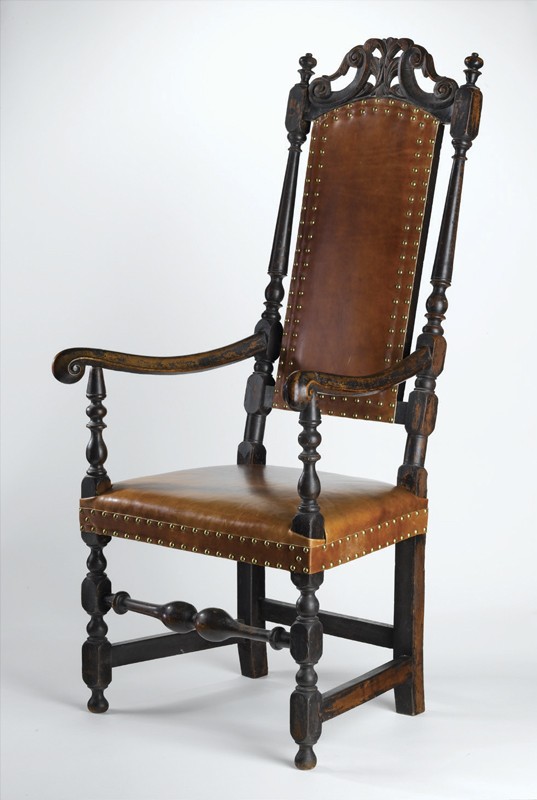
Armchair, Boston, Massachusetts, 1710–1730. Maple and oak. H. 51 1/4", W. 23", D. 16 3/4". (Private collection; photo, Gavin Ashworth.) The upper portion of the crest rail is replaced.
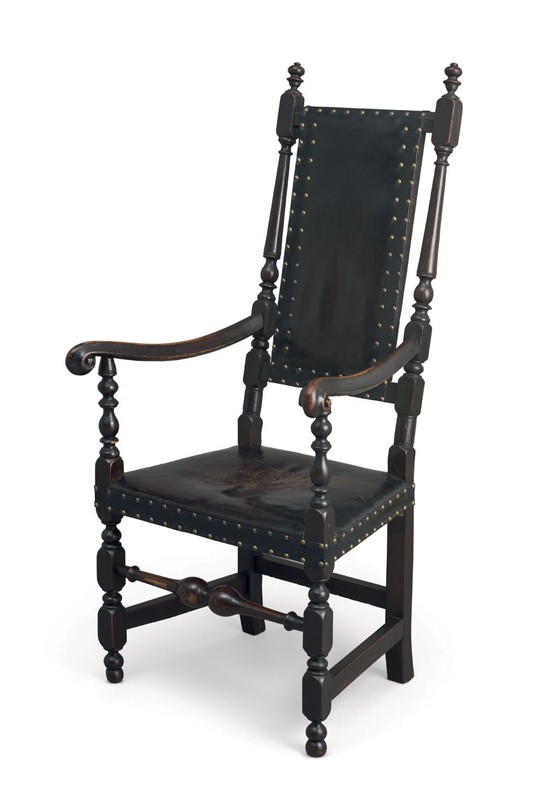
Armchair, Boston, Massachusetts, 1710–1730. Maple and oak. H. 50 5/8", W. 23 1/4", D. 16 7/8". (Courtesy, Colonial Williamsburg Foundation, gift of Mr. and Mrs. Miodrag R. Blagojevich, 1976-431.)
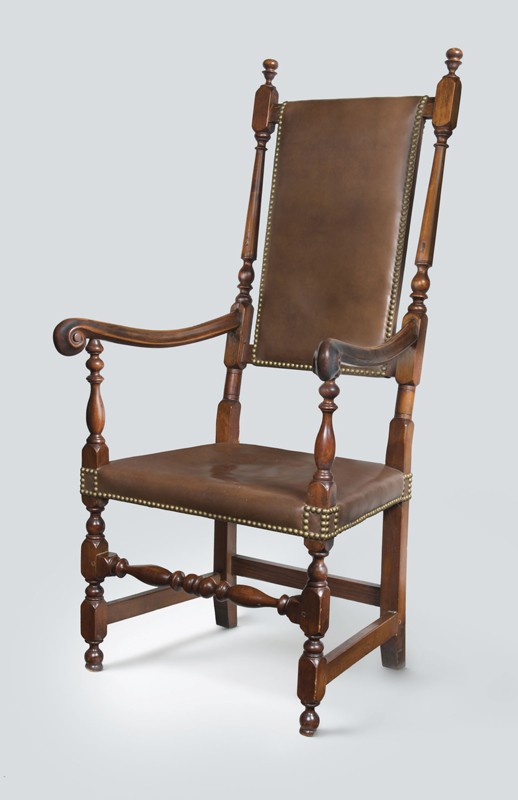
Armchair, Boston, Massachusetts, 1710–1730. Maple and oak. H. 49 1/2", W. 23", D. 16 3/4". (Private collection; photo, Gavin Ashworth.)
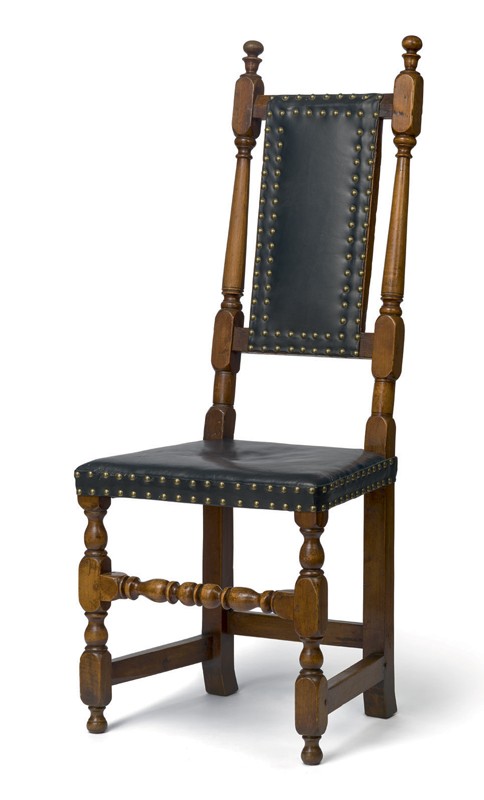
Side chair, Boston, Massachusetts, 1710–1730. Maple and oak. H. 45 3/8", W. 18", D. 15 1/2". (Private collection; photo, Andrew Davis.)
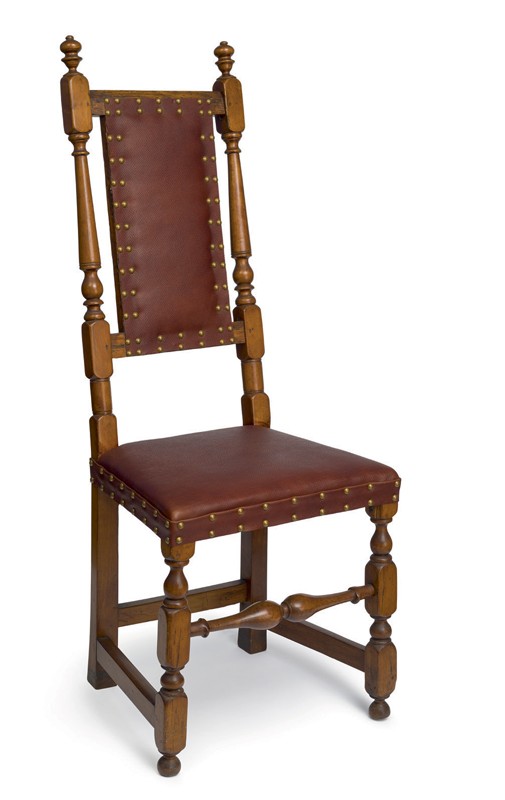
Side chair, Boston, Massachusetts, 1710–1730. Maple and oak. H. 45 1/4", W. 18", D. 15". (Private collection; photo, Andrew Davis.)
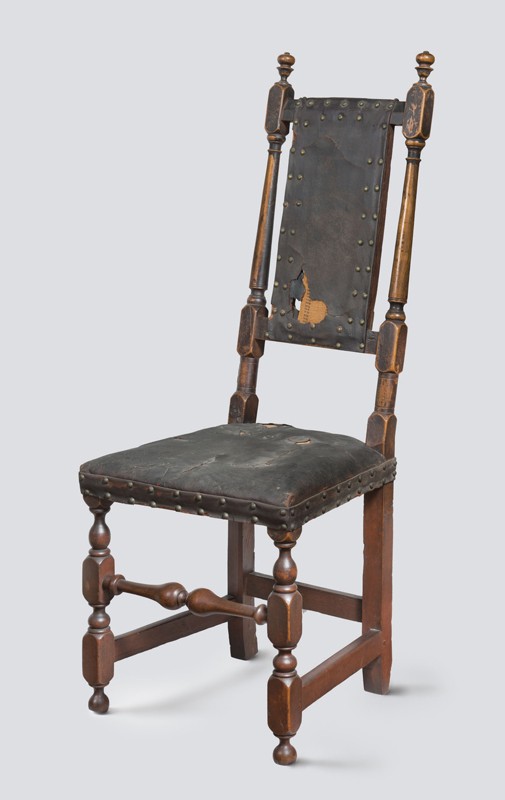
Side chair, Boston, Massachusetts, 1710–1730. Maple and oak; original leather upholstery. H. 45 1/4", W. 18 1/2", D. 15 3/4". (Courtesy, Wadsworth Atheneum, Wallace Nutting Collection, gift of J. Pierpont Morgan Jr., 1926.440; photo, Gavin Ashworth.)
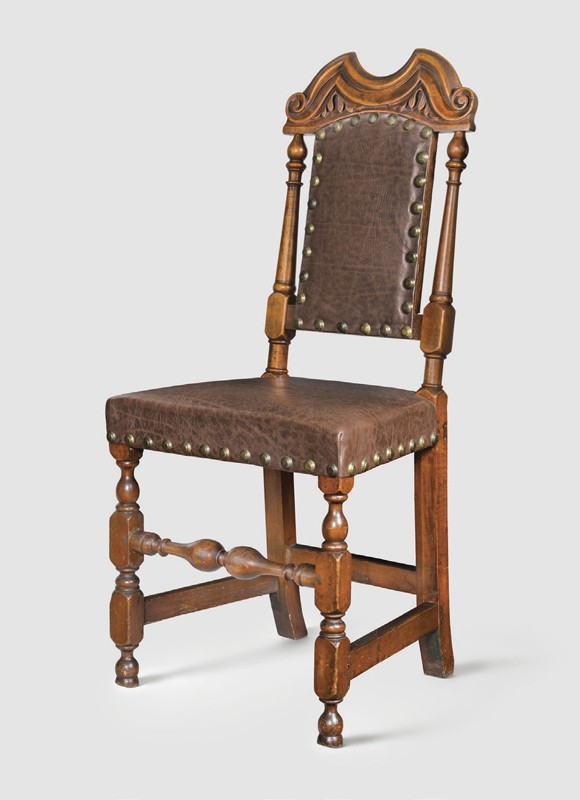
Side chair, Boston, Massachusetts, 1710–1730. Maple and oak. H. 38 3/8", W. 17 3/4", D. 14 3/8". (Courtesy, Winterthur Museum, bequest of H. F. du Pont; photo, Gavin Ashworth.)
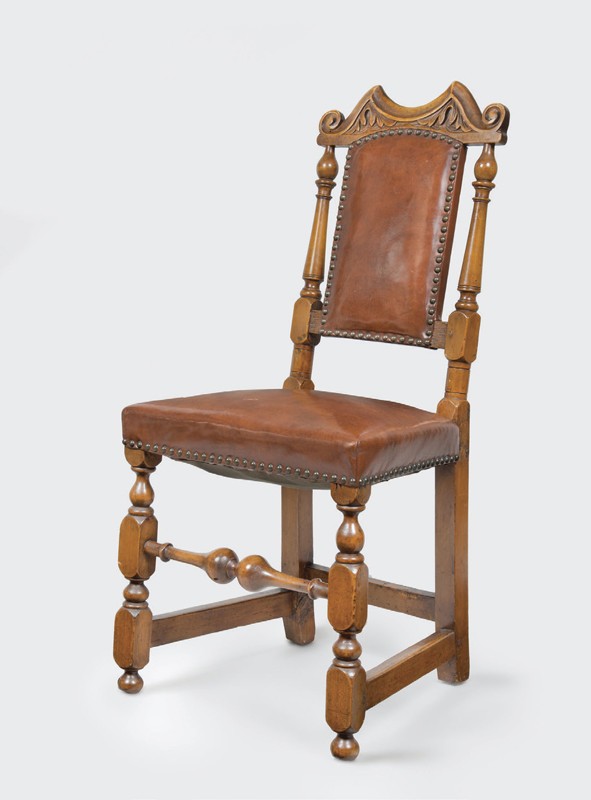
Side chair, Boston, Massachusetts, 1710–1730. Maple and oak. H. 38 1/4", W. 18", D. 15 1/8". (Private collection; photo, Gavin Ashworth.)
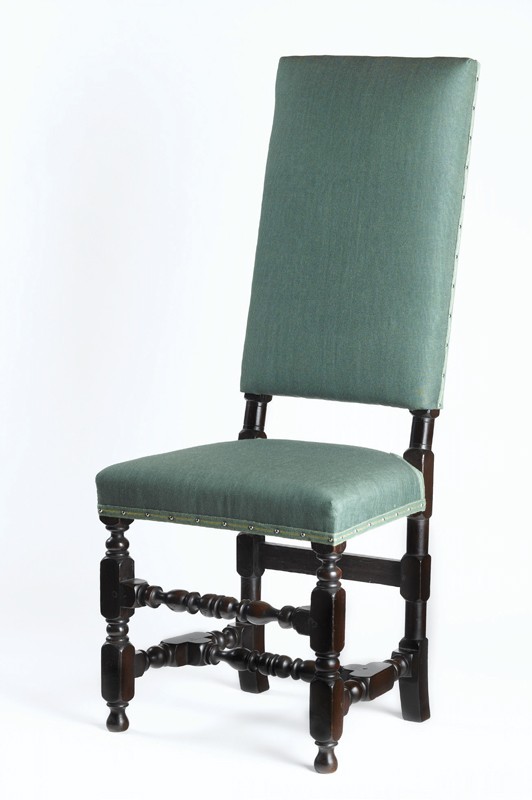
Back stool, Boston, Massachusetts, 1710–1725. Maple. H. 44 3/4", W. 18 3/4", D. 15". (Private collection; photo, Gavin Ashworth.) The feet and upper portion of the back are replaced.
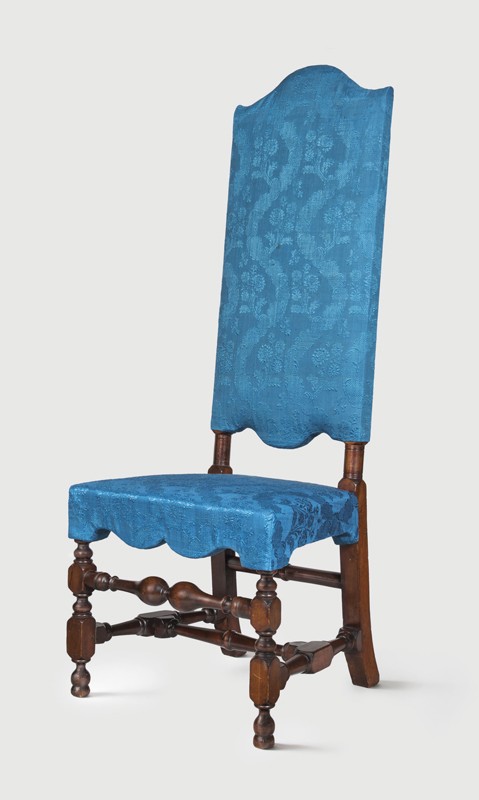
Back stool, Boston, Massachusetts, 1710–1730. Maple. H. 48 1/4", W. 19 1/2", D. 15 1/8". (Courtesy, Winterthur Museum, bequest of H. F. du Pont, 1989.506; photo, Gavin Ashworth.) The heels on this chair are quite pronounced and prevented the high-backed chair from toppling over.
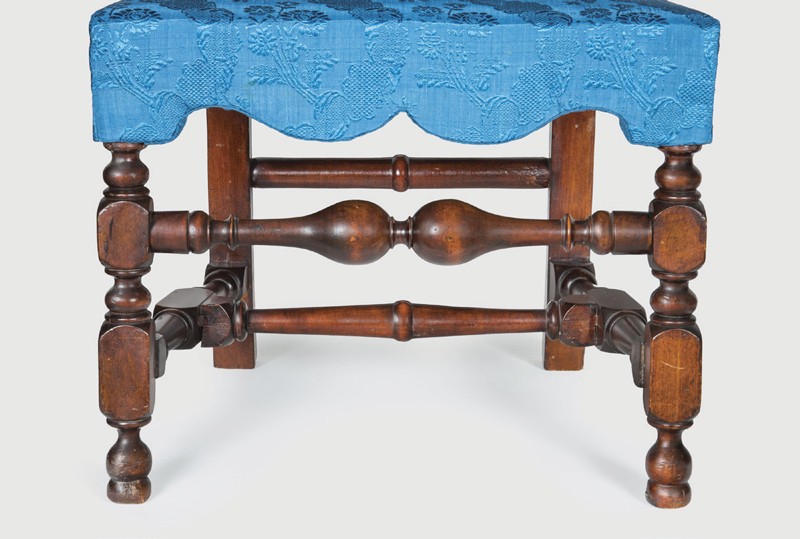
Detail of the stretchers, legs, and double cyma-shaped front seat rail of the back stool illustrated in fig. 82. (Photo, Gavin Ashworth.)
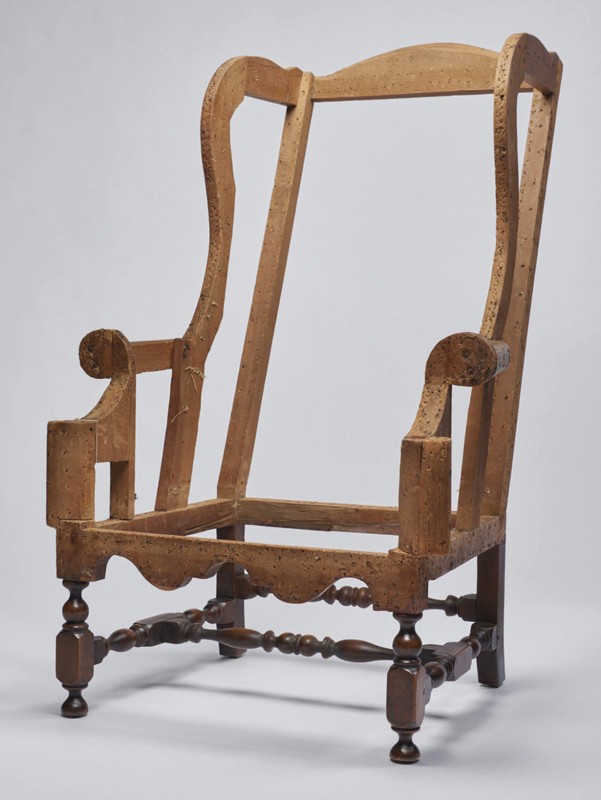
Easy chair, Boston, Massachusetts, 1710–1730. Maple. H. 48 1/8", W. 31 1/2", D. 35 1/2". (Courtesy, Philadelphia Museum of Art, 125th Anniversary Acquisition, gift of Anne H. and Frederick Vogel III, 1999.)
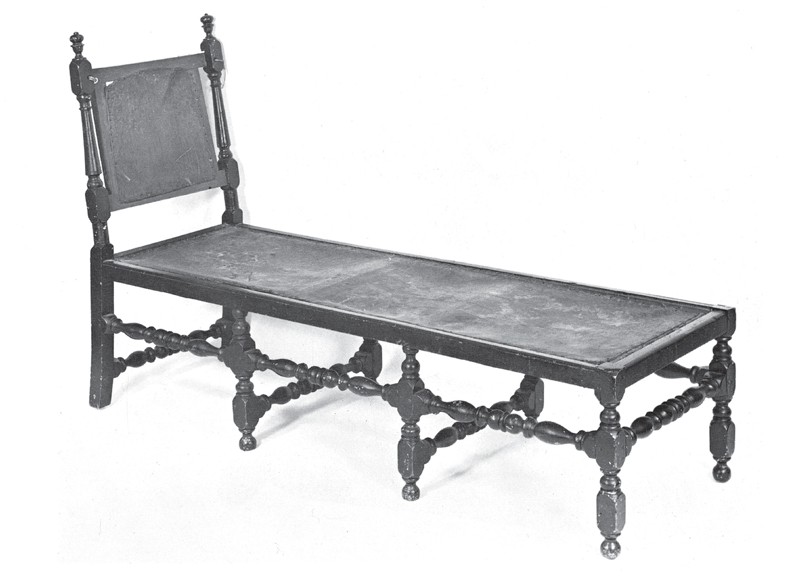
Couch, Boston, Massachusetts, 1710–1730. Maple. Dimensions not recorded. (Richard Withington, Inc., Oliver E. Williams Collection, Pigeon Cove, Cape Ann, Massachusetts, July 27, 1966, p. 22.)
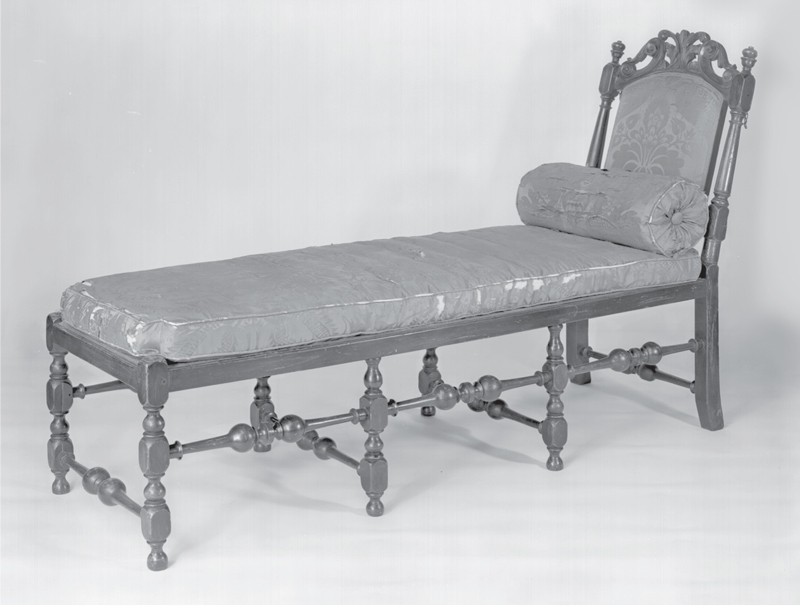
Couch, Boston, Massachusetts, 1710–1730. Maple. H. 39 1/2", L. 61". (Courtesy, Bernard and S. Dean Levy, Inc.) This couch belonged to Rev. Daniel Shute (1722–1802) and his wife, Mary Cushing (1732–1756). Shute was the pastor of the Second Parish in Hingham (now Cohasset), Massachusetts, for nearly fifty‑six years.
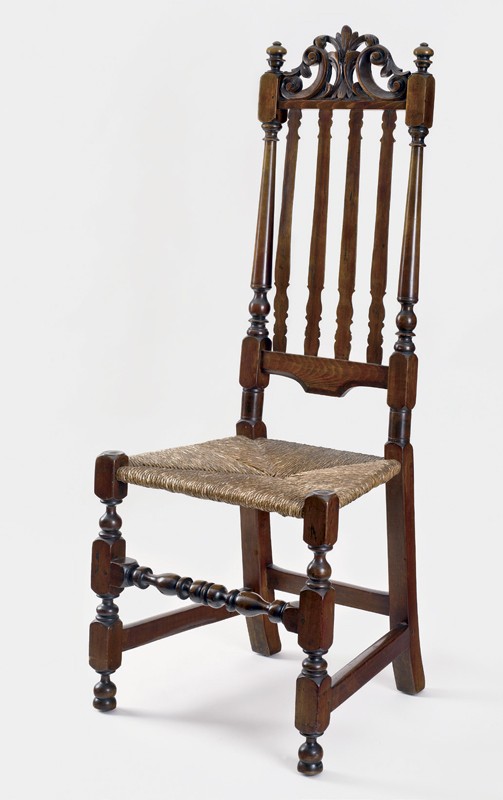
Side chair, Boston, Massachusetts, 1705–1715. Maple and ash. H. 49", W. 18 3/4", D. 16 3/8". (Private collection; photo, Gavin Ashworth.) This banister-back chair has a crest identical to those of the leather chairs illustrated in figs. 44 and 45.
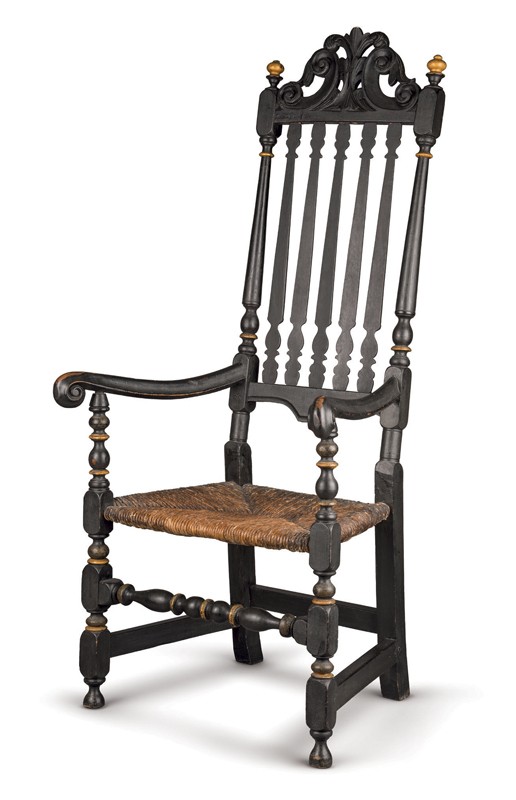
Armchair, Boston, Massachusetts, 1710–1730. Maple and ash. H. 52 3/4", W. 23", D. 16". (Private collection; photo, Jim Wildeman.) The feet are replaced. This chair and the one shown in fig. 89 originally would have been used with a large pillow that would have filled the space between the back rail and the seat.
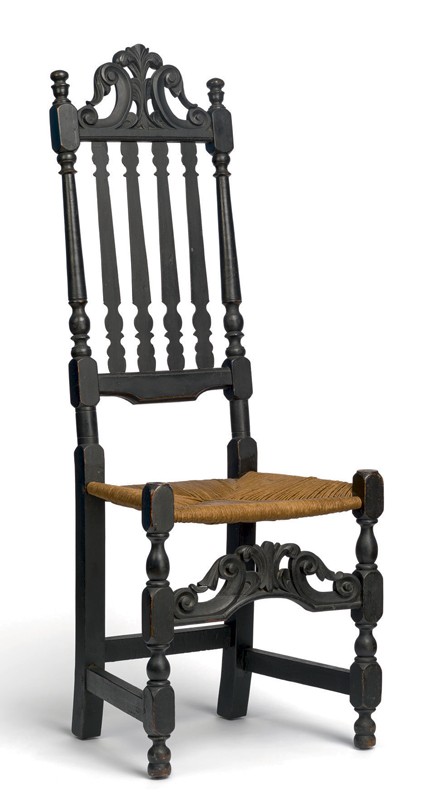
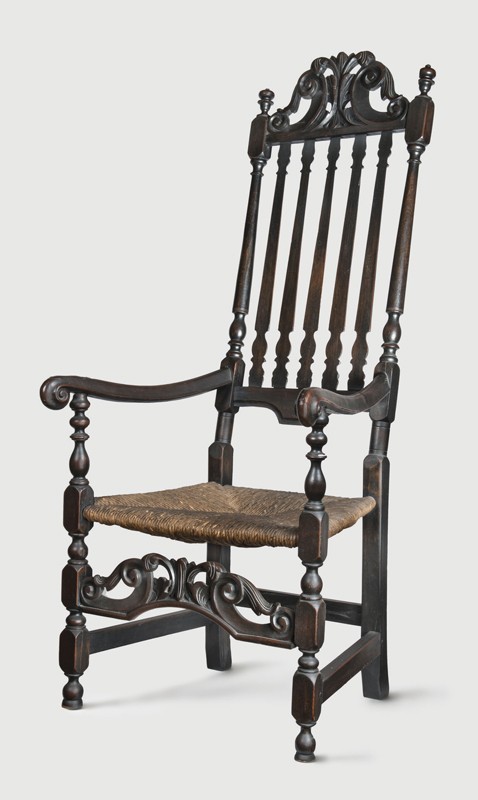
Armchair, Boston, Massachusetts, 1710–1730. Maple and ash. H. 52 5/8", W. 23 1/2", D. 16 5/8". (Private collection; photo, Gavin Ashworth.) This is one of only two known examples of a Boston banister-back armchair with a carved crest rail and front stretcher. The other was offered by Roderic Blackburn but had replaced finials and feet.
Side chair, Boston, Massachusetts, 1710–1730. Maple and ash. H. 49 1/2", W. 17 1/2", D. 14". (Private collection; photo, Andrew Davis.) The finials and the upper portion of the crest rail are replaced.
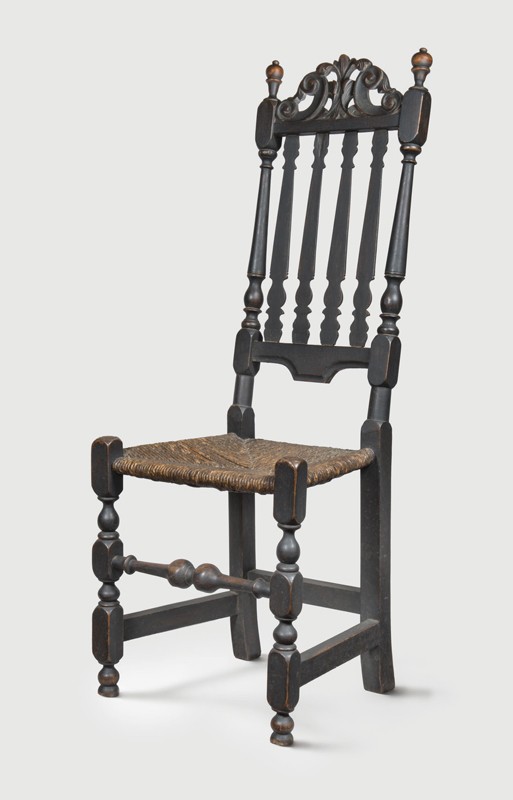
Side chair, Boston, Massachusetts, 1710–1730. Maple and ash. H. 46 1/2", W. 18 1/4", D. 14 3/4". (Private collection; photo, Gavin Ashworth.)
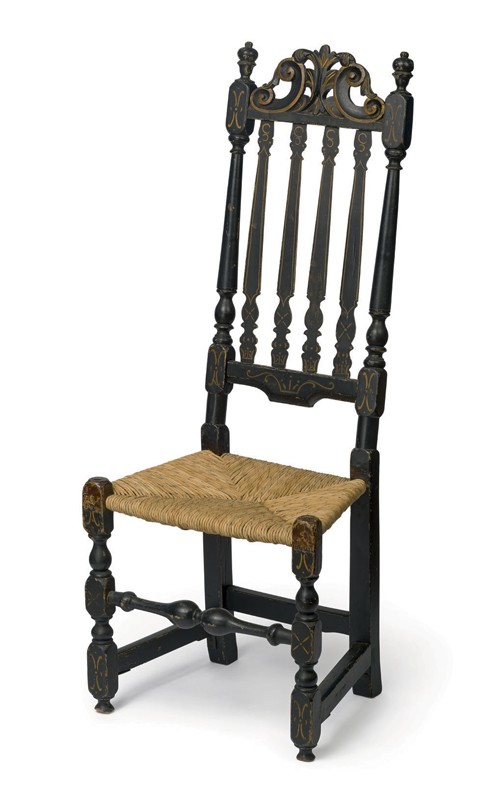
Side chair, Boston, Massachusetts, 1710–1730. Maple and ash. H. 47", W. 18 1/2", D. 14 3/4". (Private collection; photo, Andrew Davis.) This chair was embellished with gilt decoration in the late nineteenth century. This chair has lost a portion of its feet.
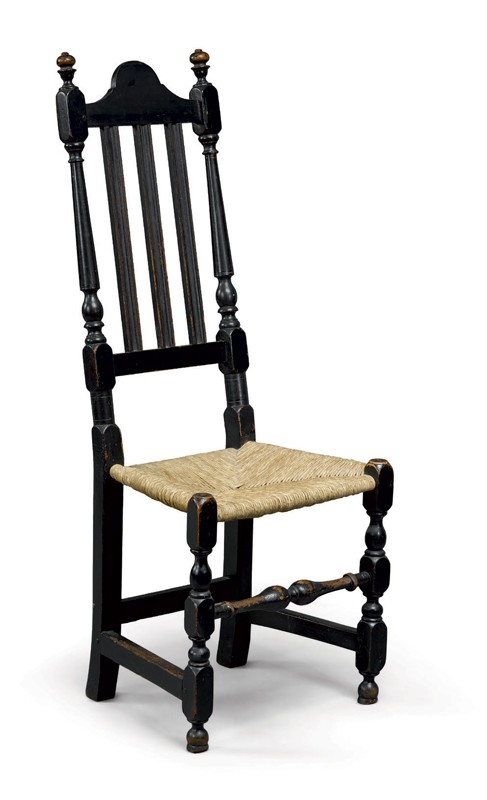
Side chair, Boston, Massachusetts, 1710–1730. Maple and ash. H. 47 1/2". (Courtesy, Sotheby’s, Important Americana including Property from the Collection of Joan Oestreich Kend, New York, January 21, 2017, lot 4327.)
Side chair, Boston, Massachusetts, 1710–1730, Maple and ash. H. 48 1/8", W. 18 3/4", D. 14 1/2". (Private collection; photo, Jon Lam.) This chair, like the examples illustrated in figs. 79 and 80, has its crest rail placed on top of the stiles rather than between them.
Armchair, probably London, 1705–1715. Walnut. Dimensions not recorded. (Courtesy, Victoria and Albert Museum, given by W. H. Hammond in memory of Lieut. R. M. Hammond, Circ. 525-1921.)
The chair originally had a caned back and seat. The feet are replaced. The chairs in group E have arched crests and stretchers and turnings related to those on this chair.
Side chair, probably London, 1705–1715. Woods and dimensions not recorded. (Photo, Symonds Collection, Decorative Arts Photographic Collection, Winterthur Museum.) This chair originally had a caned back. The double side stretchers belie its later date as indicated with its arched crest, simple conical stiles, and cylindrical turnings above the seat.
Armchair, Boston, Massachusetts, 1705–1725. Maple. H. 50 3/4", W. 25 3/4", D. 27". (Chipstone Foundation; photo, Gavin Ashworth.)
Side chair, Boston, Massachusetts, 1710–1725. Maple. H. 50 3/4", W. 17 1/2", D. 14 3/8". (Private collection; photo, Gavin Ashworth.)
Armchair, Boston, Massachusetts, 1710–1725. Maple. Measurements not recorded. (Courtesy, Northeast Auctions, New Hampshire Weekend Auction, Portsmouth, New Hampshire, November 7, 2004, lot 723.) This chair has lost the upper portion of the carved crest, and the feet are replaced.
Armchair, Boston, Massachusetts, 1710–1725. Maple and birch. H. 55". (Courtesy, ©2005 Christie’s, Important American Furniture, Folk Art, Silver and Prints, New York, January 21, 2005, sale 1474, lot 544.)
Side chair, Boston, Massachusetts, 1710–1725. Maple. H. 48 3/4". (Courtesy, ©2005 Christie’s, Important American Furniture, Folk Art, Silver and Prints, New York, January 21, 2005, sale 1474, lot 545.)
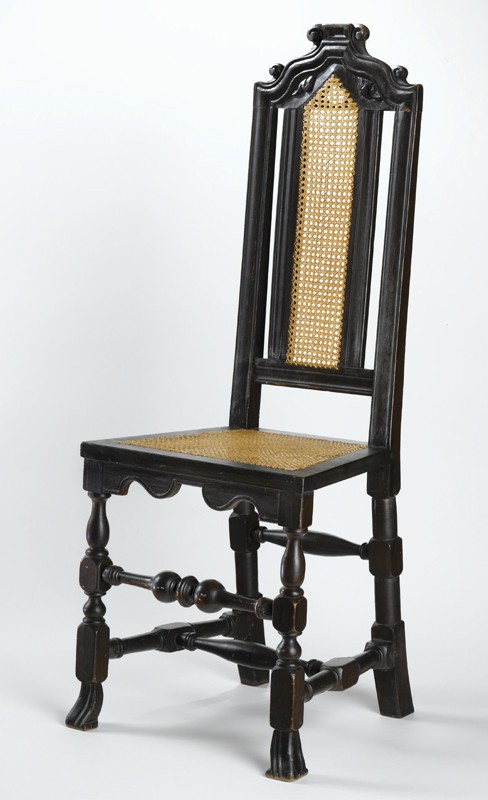
Side chair, Boston, Massachusetts, 1720–1735. Maple. H. 45 1/4", W. 18", D. 14 1/4". (Private collection; photo, Gavin Ashworth.)
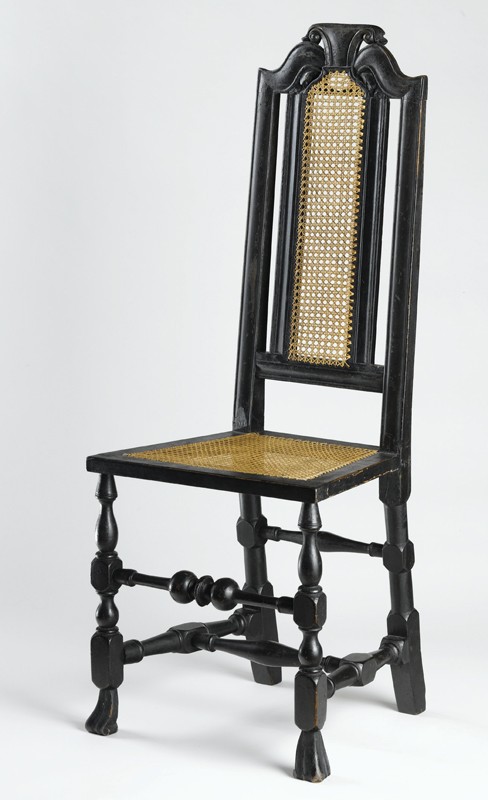
Side chair, Boston, Massachusetts, 1720–1735. Maple. H. 45 1/4", W. 17 1/2", D. 14 3/4". (Private collection; photo, Gavin Ashworth.)
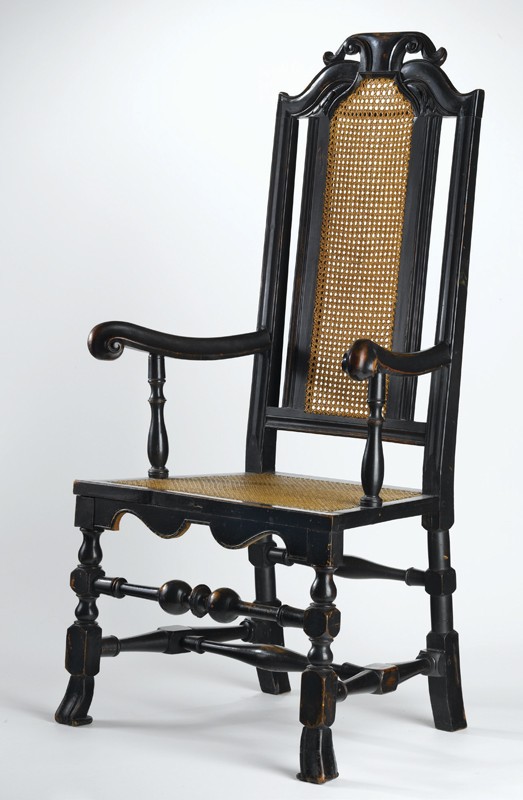
Armchair, Boston, Massachusetts, 1720–1740. Maple. H. 50 3/4", W. 23 3/8", D. 16 3/8". (Private collection; photo, Gavin Ashworth.)
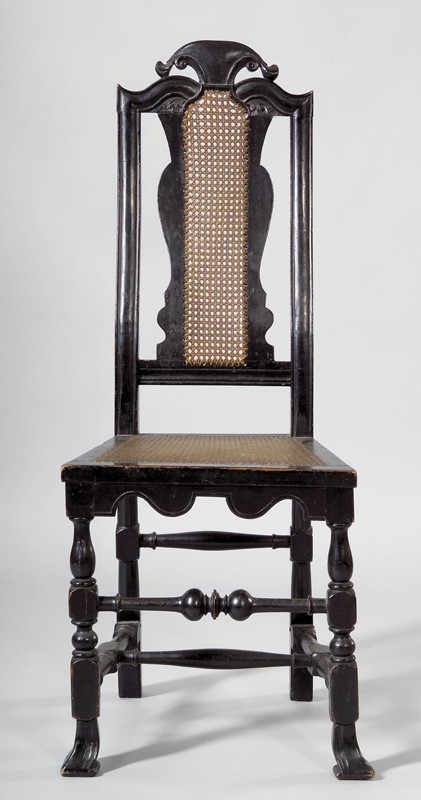
Side chair, Boston, Massachusetts, 1720–1740. Maple. H. 45 1/2", W. 19", D. 18". (Chipstone Foundation; photo, Skinner, Inc., American Furniture & Decorative Arts, Boston, Massachusetts, February 18, 2007, sale 2349, lot 229.)
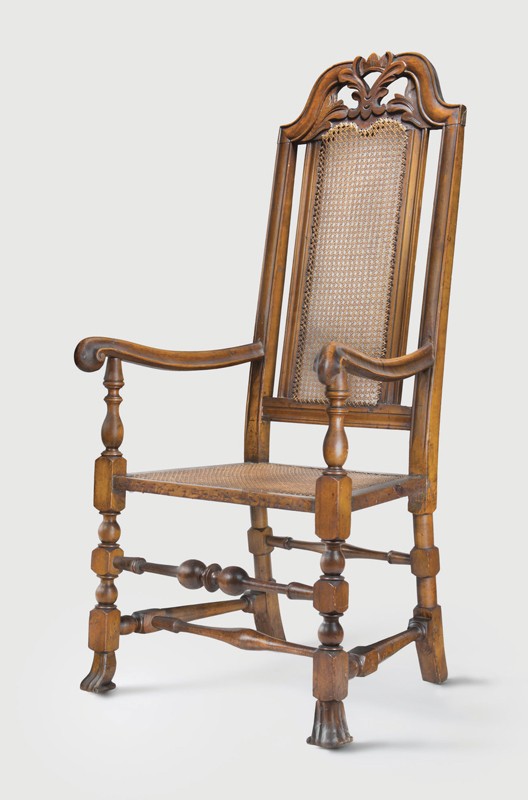
Armchair, Boston, Massachusetts, 1720–1740. Maple. H. 49 7/8", W. 24 1/4", D. 21". (Courtesy, Winterthur Museum, bequest of H. F. du Pont, 1954.528; photo, Gavin Ashworth.) This armchair descended in the Hancock family of Boston, Massachusetts. This chair is one of the earliest examples showing the placement of the medial stretchers forward.
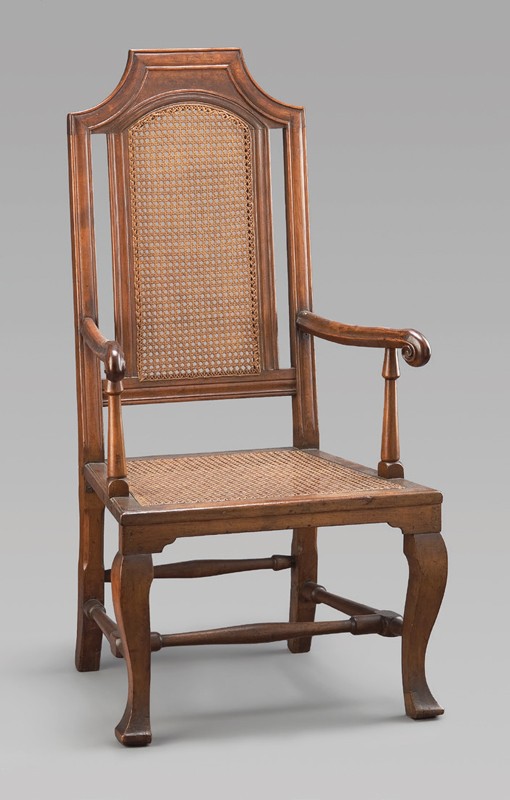
Armchair, Boston, Massachusetts, 1725–1745. Maple. H. 44 3/4", W. 23", D. 18 3/4". (Courtesy, Museum of Fine Arts, Boston, gift of Mr. and Mrs. Henry Herbert Edes, 36.37.) This chair descended in the Edes family of Boston and South Dartmouth, Massachusetts.
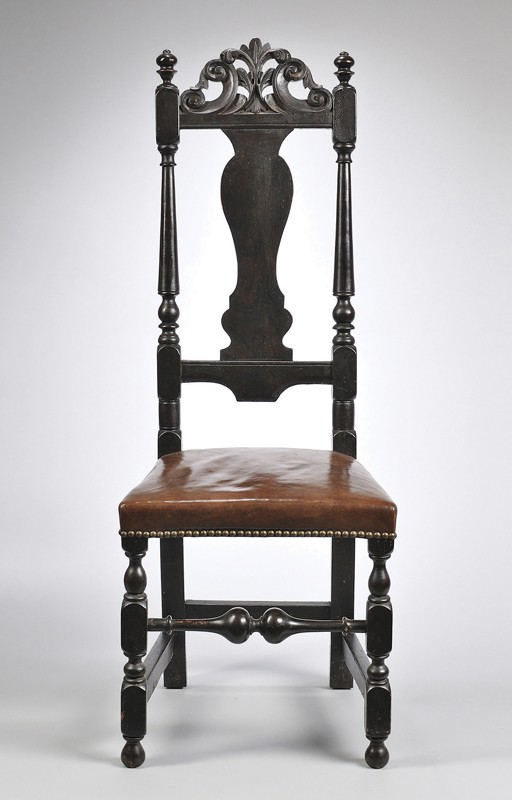
Side chair, Boston, Massachusetts, 1725–1730. Maple and oak. H. 48 1/2". (Courtesy, Skinner Inc., Personal Collection of Lewis Scranton, Killingsworth, Connecticut, May 21, 2016, sale 2897M, lot 303.) The feet are replaced. The splat directly relates to contemporaneous Chinese vases on stands.
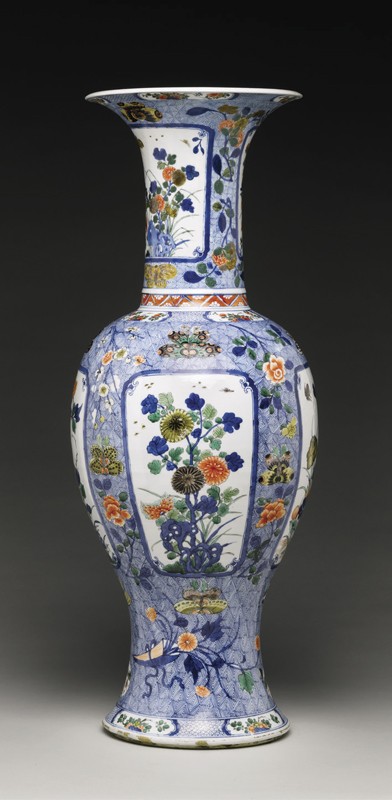
Baluster vase, Qing Dynasty, Kangxi Period (1662–1722). (Courtesy, Sotheby’s Inc.)
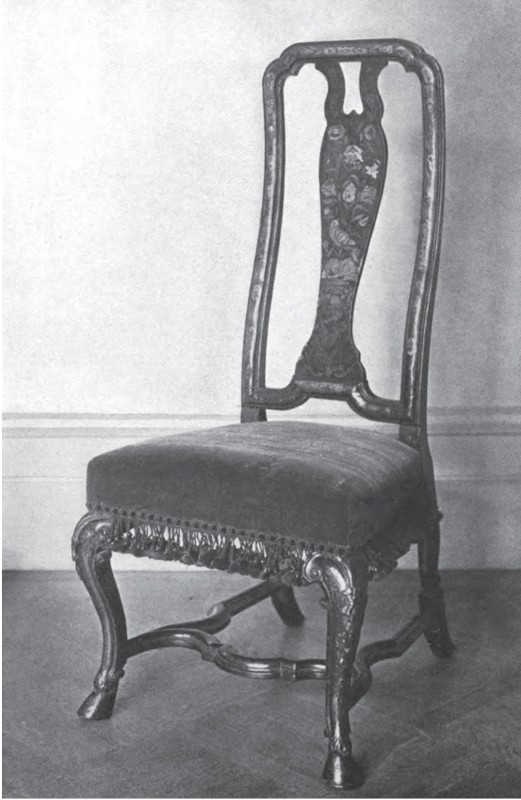
Side chair, probably London, 1715–1725. Woods and dimensions not recorded. (Helen Churchill Candee, Jacobean Furniture and English Styles in Oak and Walnut [New York: Frederick A. Stokes Company, 1916], pl. 31.)
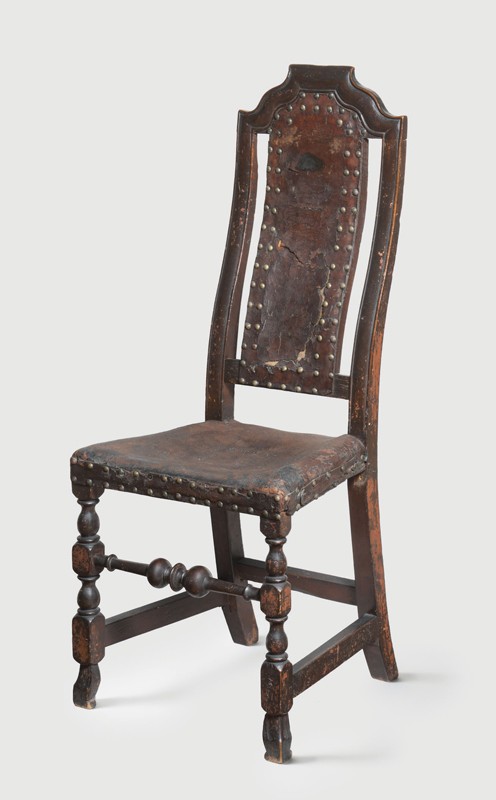
Side chair, Boston, Massachusetts, 1720–1745. Maple and oak; original leather upholstery. H. 45 1/4", W. 17 3/4", D. 18 1/8". (Courtesy, Wadsworth Atheneum, gift of James B. Cone, by exchange, 1982.160; photo, Gavin Ashworth.) The applied carved front foot facings have been lost.
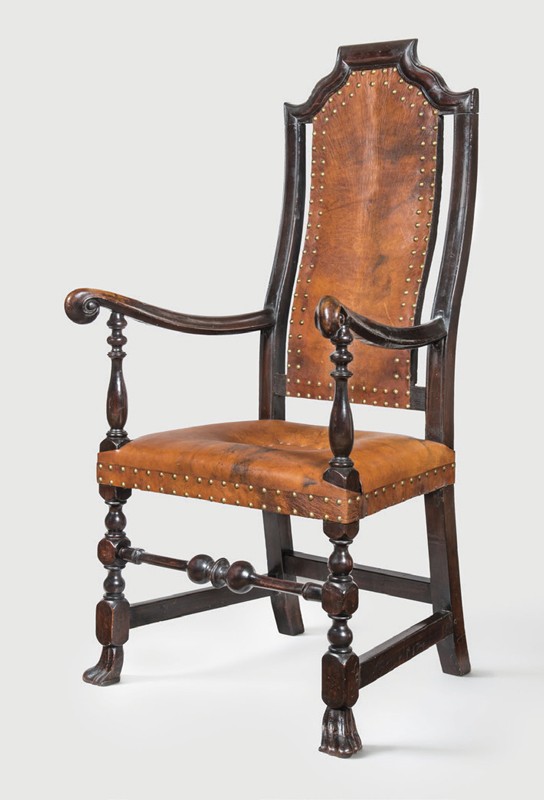
Armchair, Boston, Massachusetts, 1720–1745. Maple and oak. H. 47 3/4", W. 22 3/4", D. 16 7/8". (Courtesy, Winterthur Museum, bequest of H. F. du Pont, 1958.556; photo, Gavin Ashworth.)
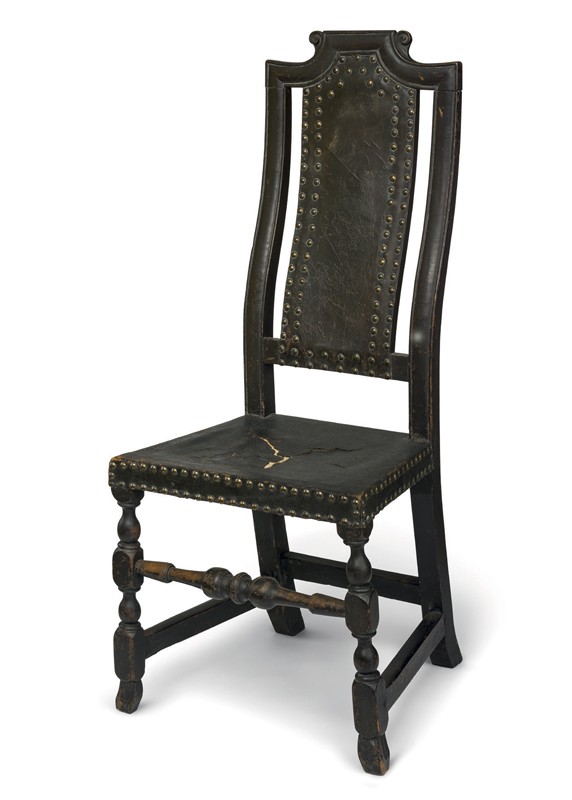
Side chair, Boston, Massachusetts, 1720–1750. Maple and oak. H. 45 1/2", W. 17 1/2", D. 15". (Private collection; photo, Andrew Davis.) The applied carved front foot facings have been lost.
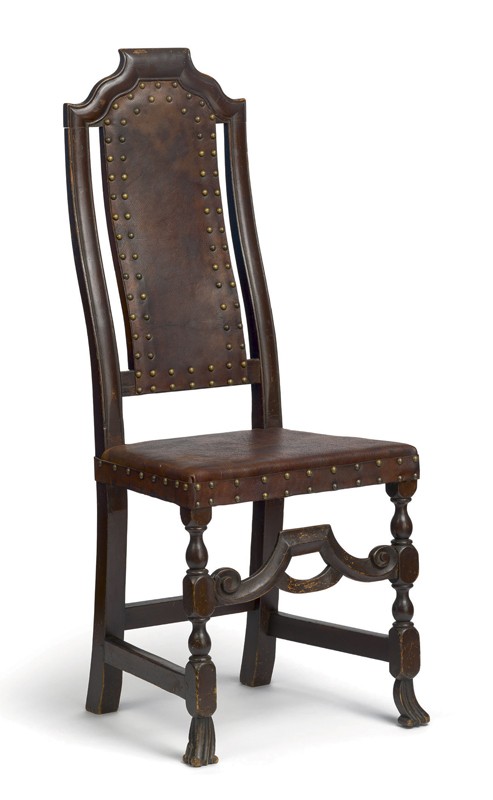
Side chair, Boston, Massachusetts, 1720–1750. Maple and oak. H. 45 1/2", W. 17 1/2", D. 15". (Private collection; photo, Andrew Davis.)
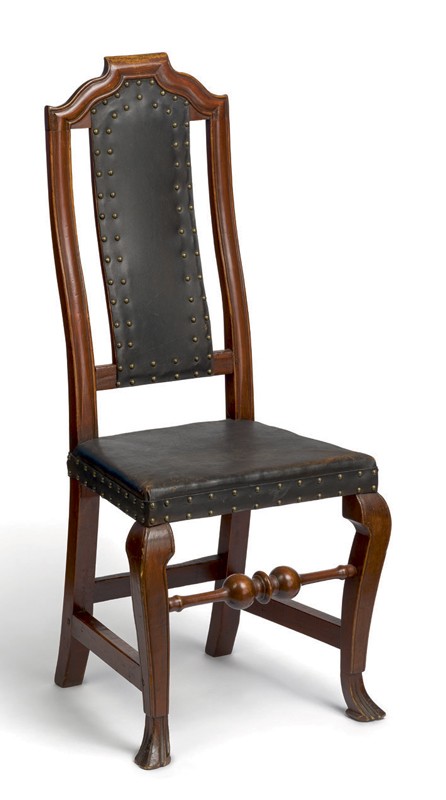
Side chair, Boston, Massachusetts, 1720–1750. Maple and ash. H. 44 3/4", W. 18", D. 15". (Private collection; photo, Andrew Davis.) The front scroll feet on cabriole legged chairs are not laminated because of the extra dimension of the leg stock necessary to produce the curvature.
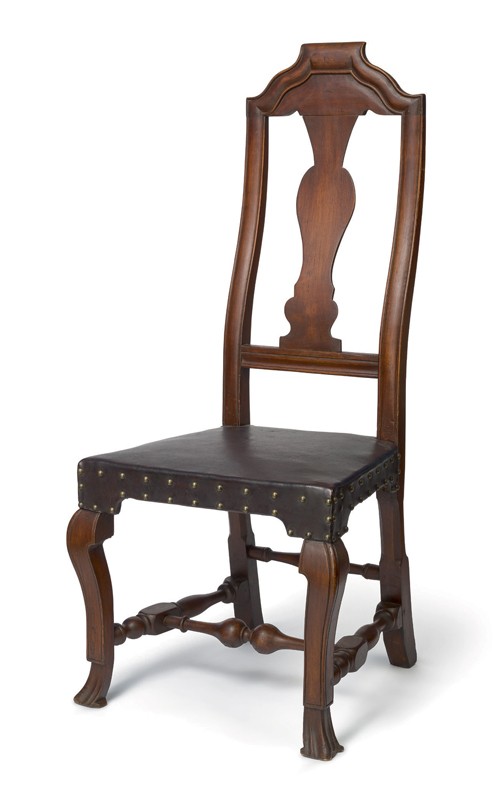
Side chair, Boston, Massachusetts, 1720–1750. Maple and oak. H. 44 3/4", W. 19", D. 15 3/4". (Private collection; photo, Andrew Davis.)
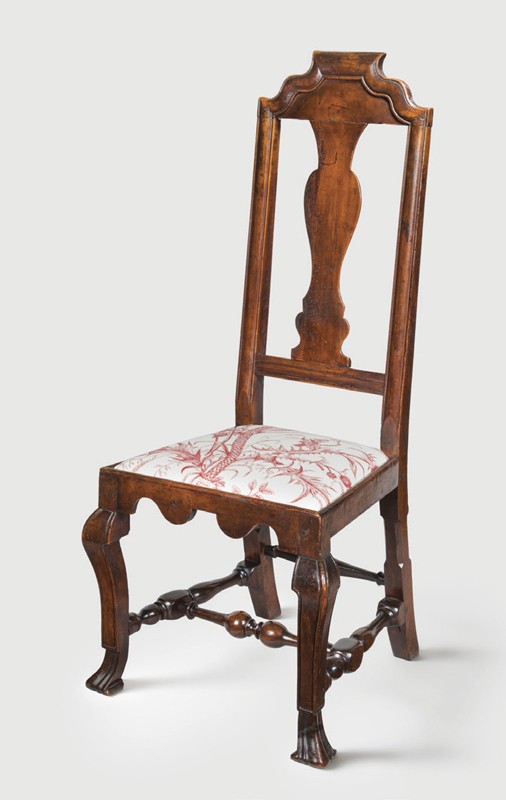
Side chair, Boston, Massachusetts, 1728–1735. Maple and oak. H. 45 7/8", W. 19", D. 15 1/2". (Courtesy, Winterthur Museum; photo, Gavin Ashworth.)
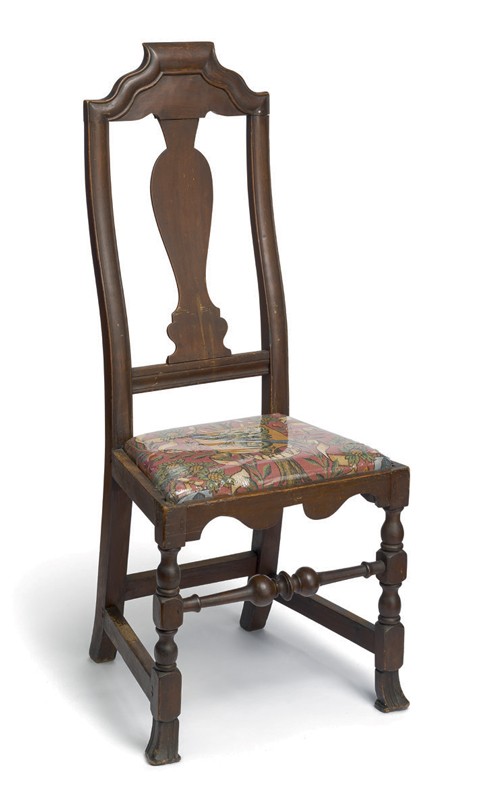
Side chair, Boston, Massachusetts, 1720–1750. Maple and oak. H. 44 3/4", W. 18 1/4", D. 14 1/2". (Private collection; photo, Andrew Davis.)
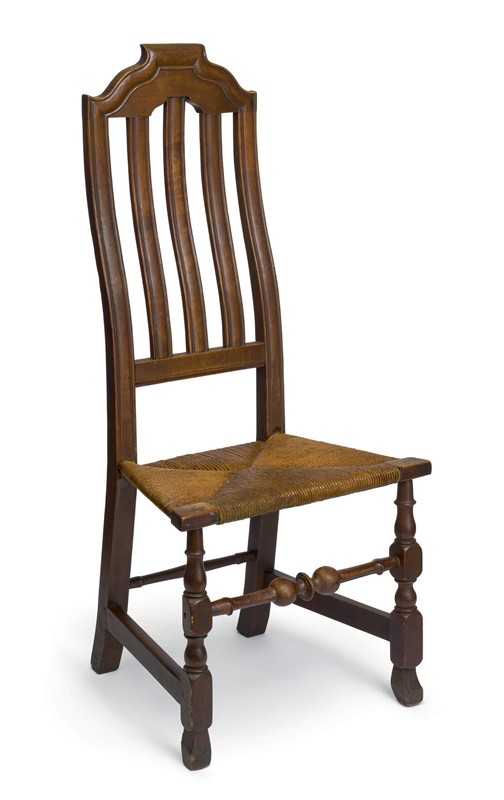
Side chair, Boston, Massachusetts, 1720–1750. Maple. H. 44 1/4", W. 20", D. 15". (Private collection; photo, Andrew Davis.) The applied carved front foot facings have been lost.
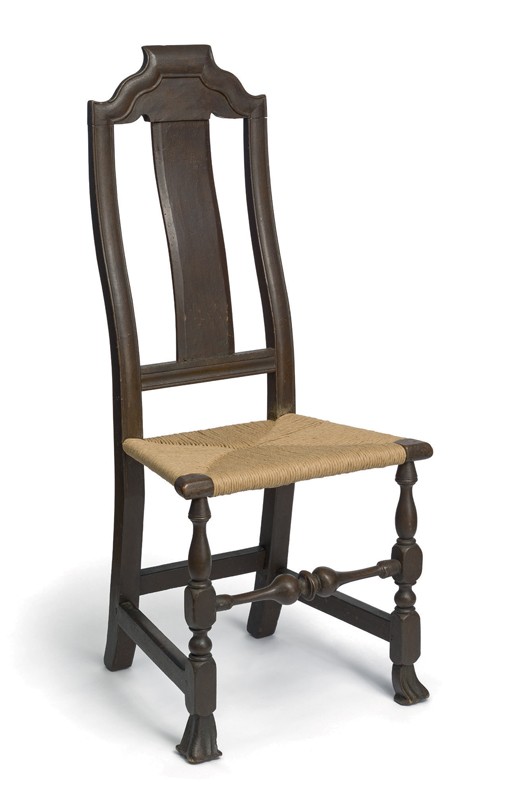
Side chair, Boston, Massachusetts, 1720–1750. Maple and ash. H. 45 3/4", W. 19", D. 14 1/2". (Private collection; photo, Andrew Davis.) A related upholstered side chair with a solid splat is illustrated in Joan Freund and Leigh Keno, “The Making and Marketing of Boston Seating Furniture in the Late Baroque Style,” in American Furniture, edited by Luke Beckerdite (Hanover, N.H.: University Press of New England for the Chipstone Foundation, 1998), fig. 8.
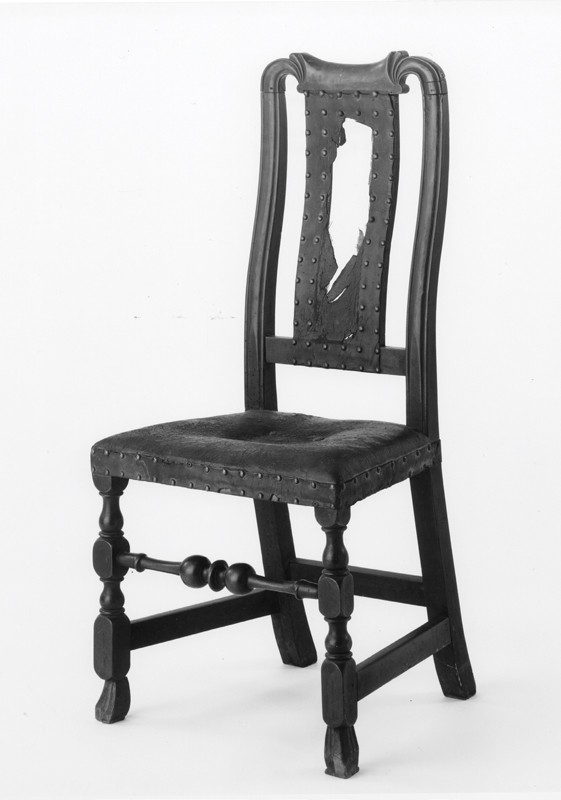
Side chair, Boston, Massachusetts, 1720–1745. Maple and oak; original leather upholstery. H. 41 3/4", W. 19", D.14 3/8". (Courtesy, Newport Historical Society.) The original owner of this chair may have been William Ellery (1727–1820) of Newport, Rhode Island. William C. Cozzens (b. 1846) found it in the Ellery House, Thames Street, Newport, Rhode Island, and it was donated to the Newport Historical Society in 1855. The applied carved front foot facings have been lost.
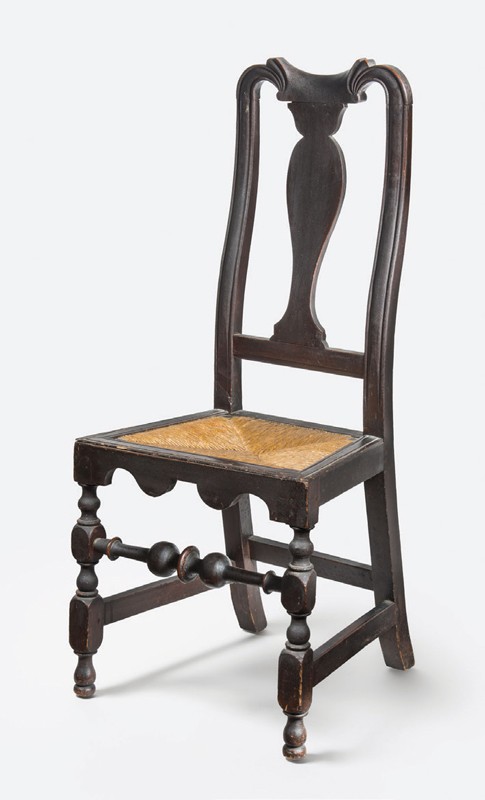
Side chair, Boston, Massachusetts, 1725–1750. Maple and ash. H. 44 3/4", W. 18", D. 15". (Private collection; photo, Gavin Ashworth.)
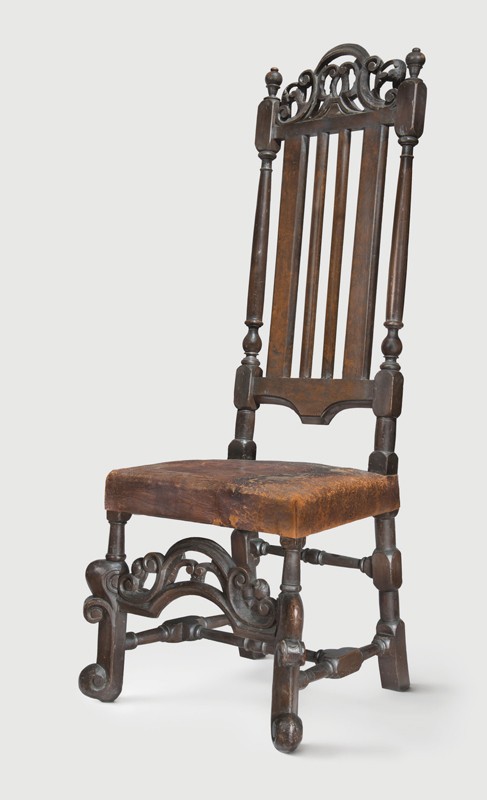
Side chair, probably Boston, Massachusetts, 1710–1720. Maple. H. 52 1/8", W. 21 3/8", D. 22 1/4". (Courtesy, Winterthur Museum, bequest of H. F. du Pont, 1959.28.2; photo, Gavin Ashworth.)
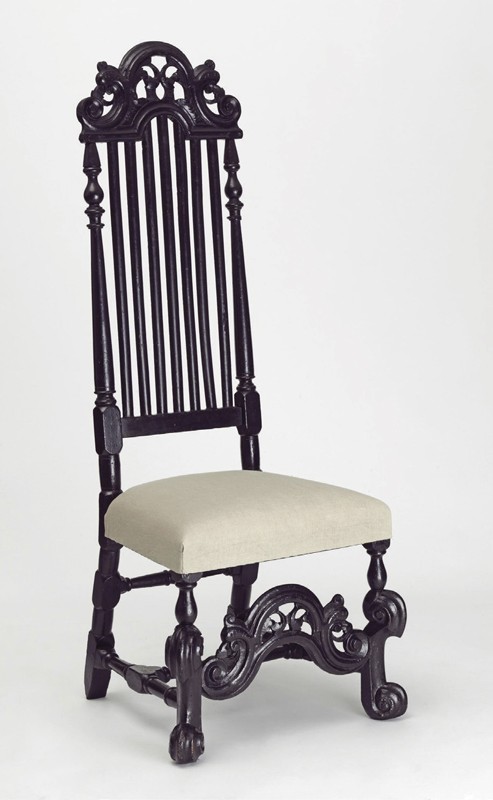
Side chair, England, 1700–1710. Beech. Measurements not recorded. (Courtesy, Victoria and Albert Museum, London, W.36-1914.)
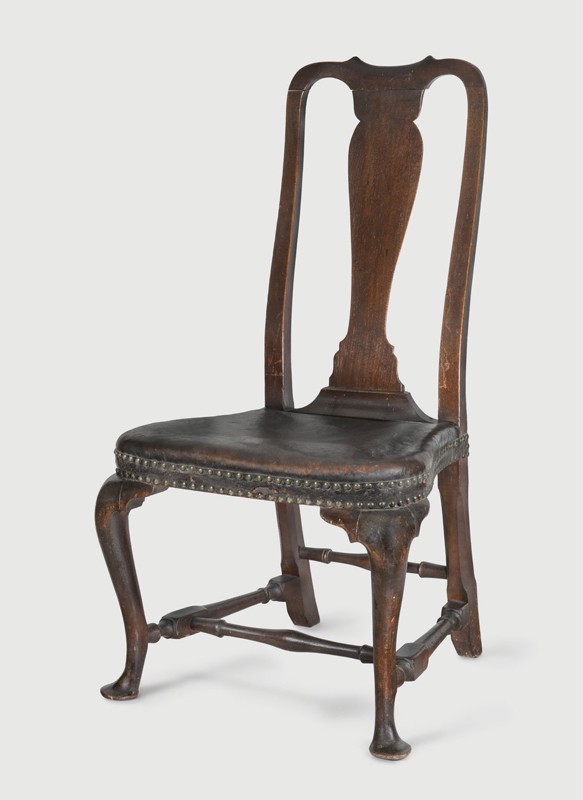
Side chair, Boston, Massachusetts, 1740–1770. Maple. H. 39 1/2", W. 22", D. 20 1/4". (Courtesy, Winterthur Museum, Museum Purchase with funds provided by Mr. and Mrs. George M. Kaufman, Mr. Martin E. Wunsch, and an anonymous donor, 1998.7; photo, Gavin Ashworth.) The trim strip of leather is applied with a double row of brass-headed nails just as chairs made in Boston were ornamented half a century earlier.
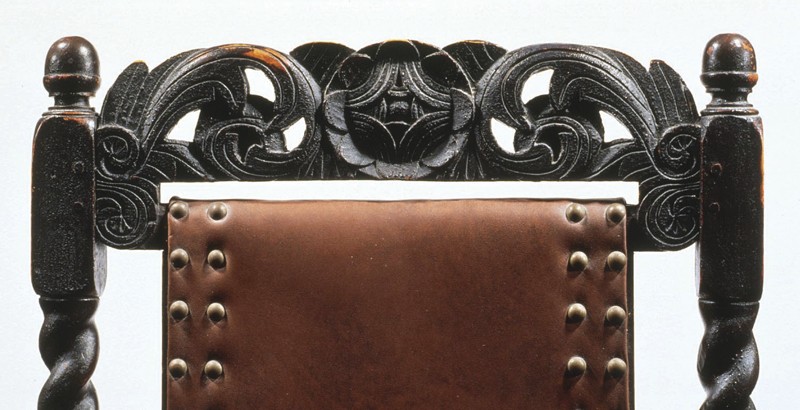
Detail of the carved crest of the side chair illustrated in fig. 2.
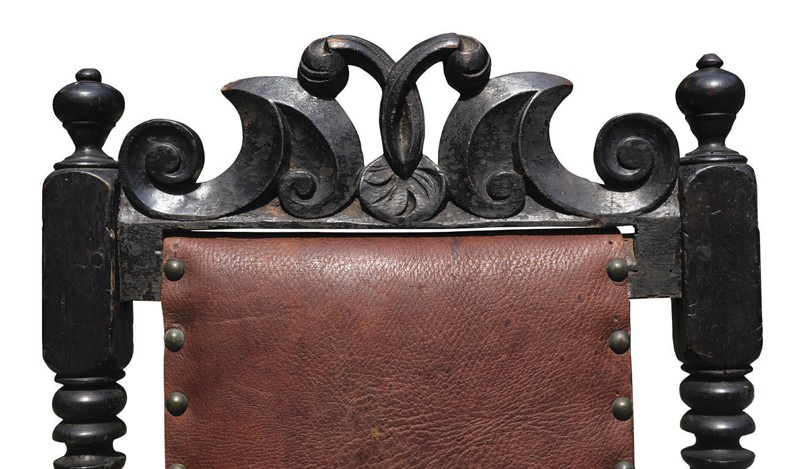
Detail of the carved crest of the side chair illustrated in fig. 25.
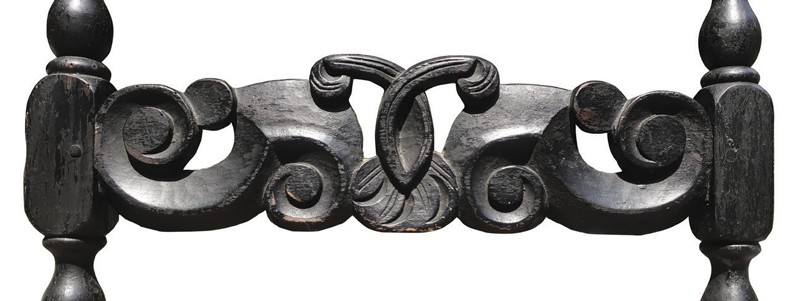
Detail of the carved stretcher of the side chair illustrated in fig. 25.
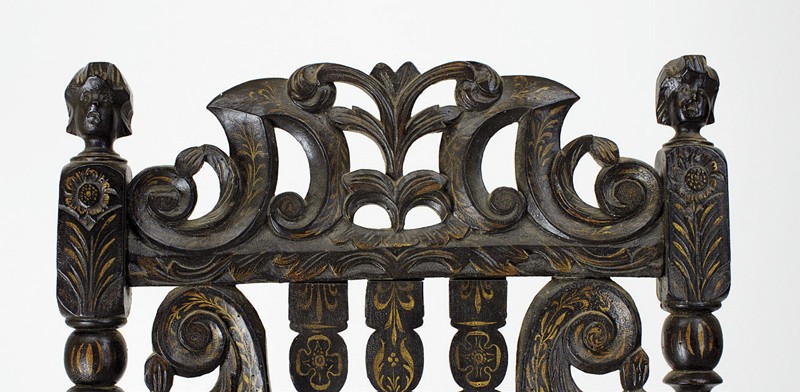
Detail of the carved crest of the armchair illustrated in fig. 28.
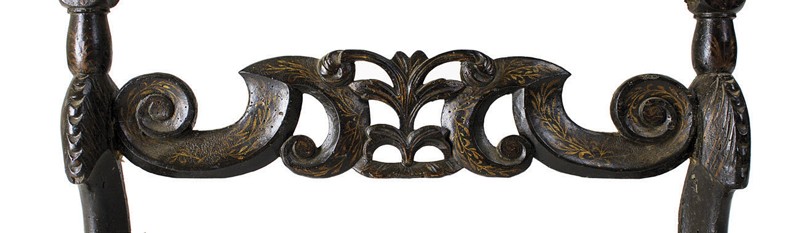
Detail of the carved stretcher of the armchair illustrated in fig. 28.
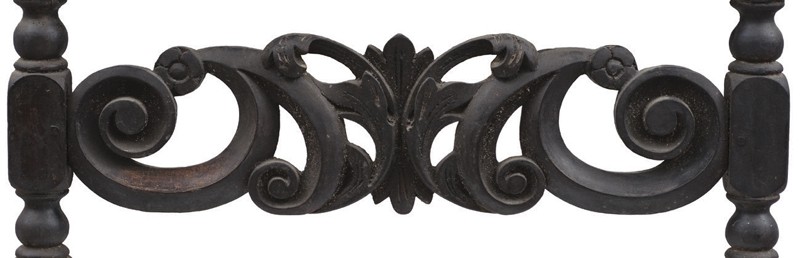
Detail of the carved stretcher of the armchair illustrated in fig. 29.
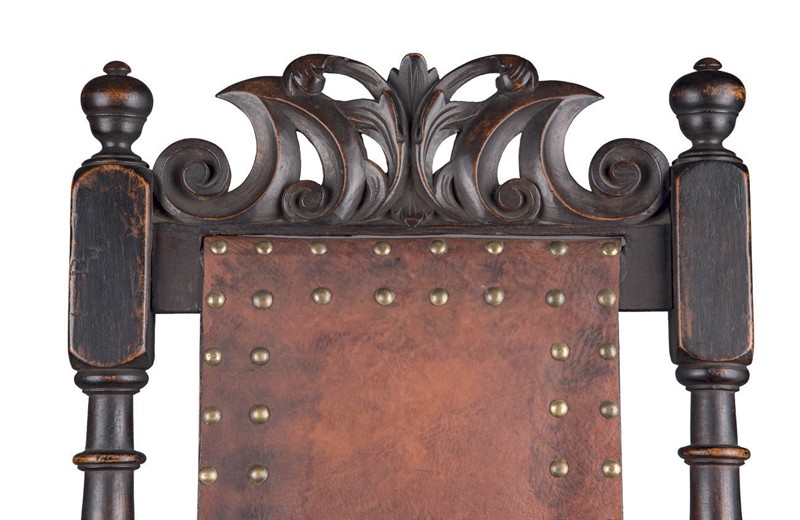
Detail of the carved crest of the side chair illustrated in fig. 31.
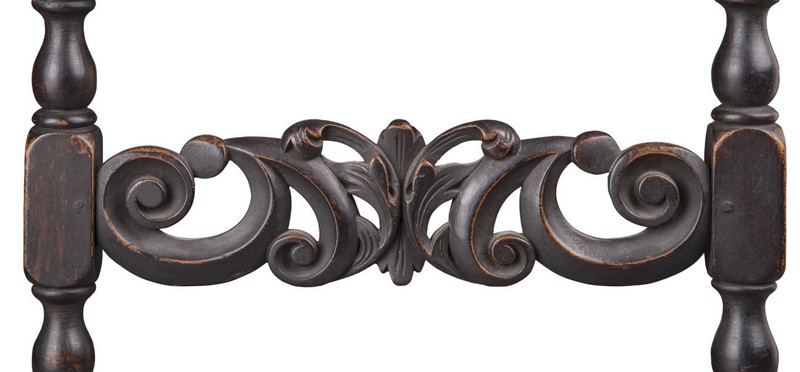
Detail of the carved stretcher of the side chair illustrated in fig. 31.
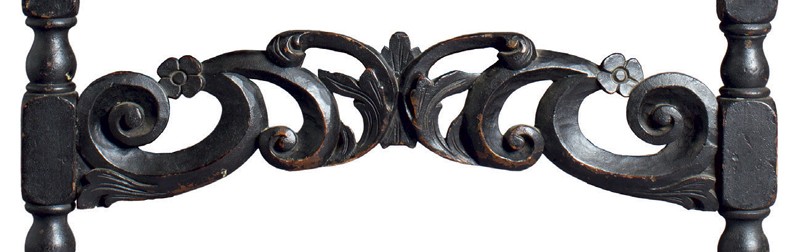
Detail of the carved stretcher of the armchair illustrated in fig. 32.
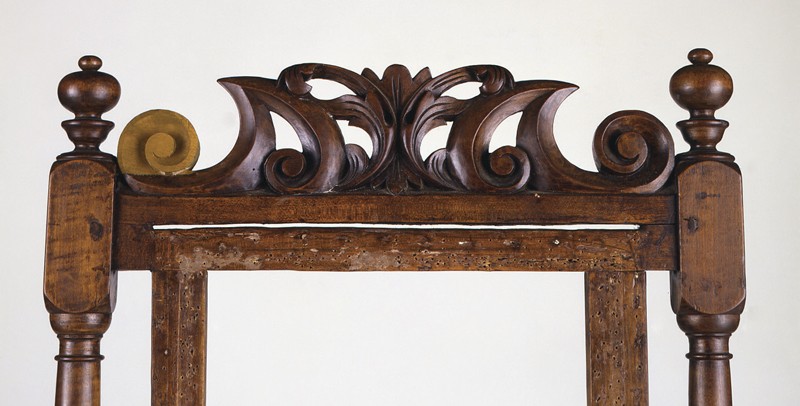
Detail of the carved crest of the armchair illustrated in fig. 34.
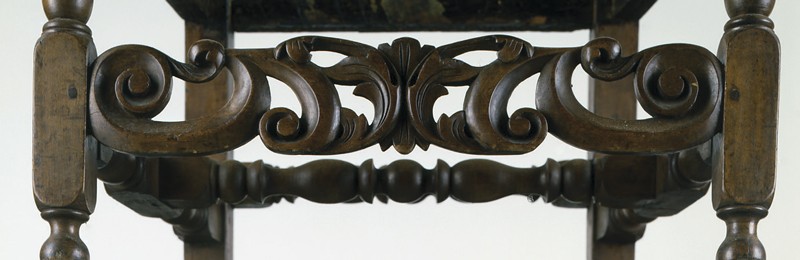
Detail of the carved stretcher of armchair illustrated in fig. 34.
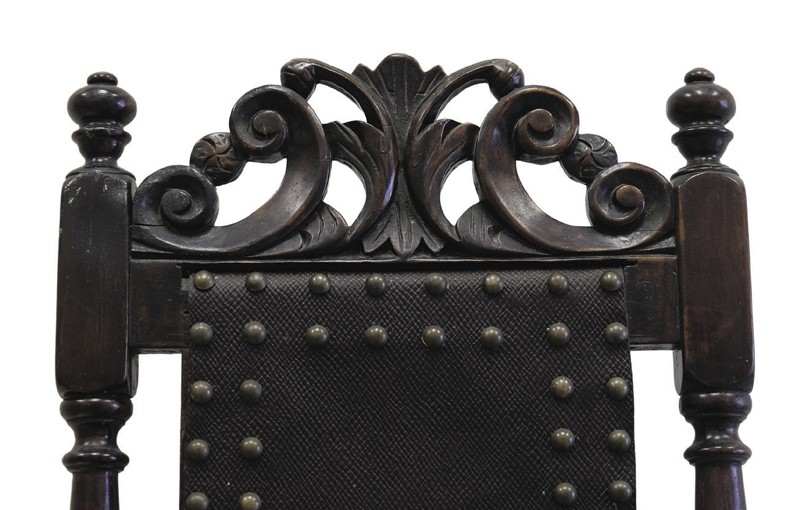
Detail of the carved crest of the side chair illustrated in fig. 36.
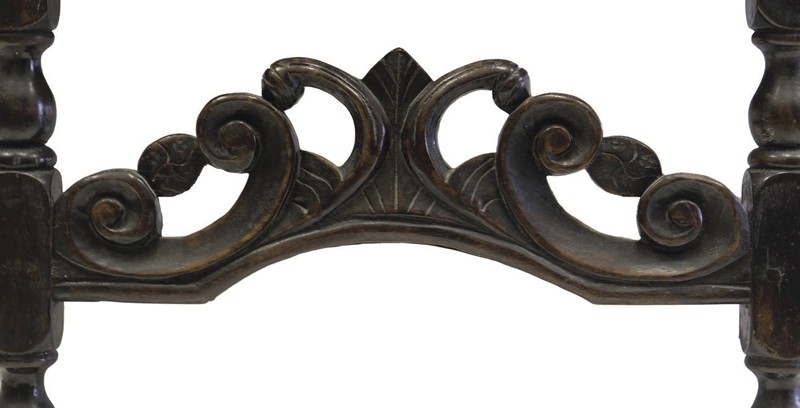
Detail of the carved stretcher of the side chair illustrated in fig. 36.
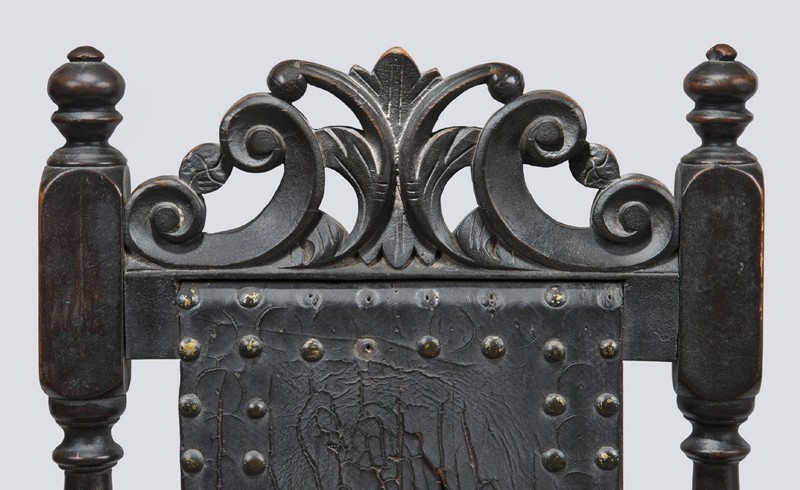
Detail of the carved crest of the side chair illustrated in fig. 40.
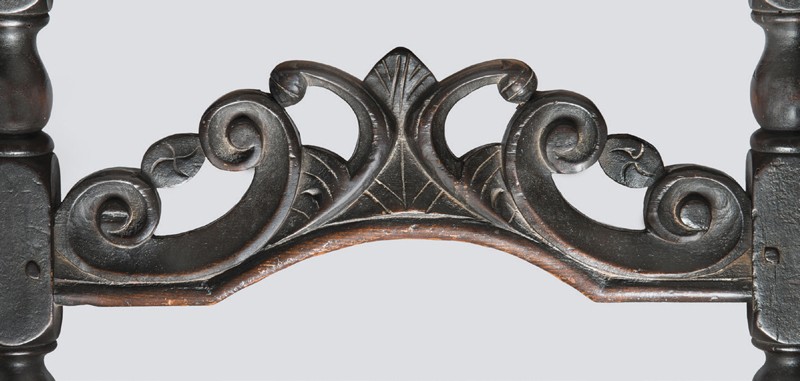
Detail of the carved stretcher of the side chair illustrated in fig. 40.
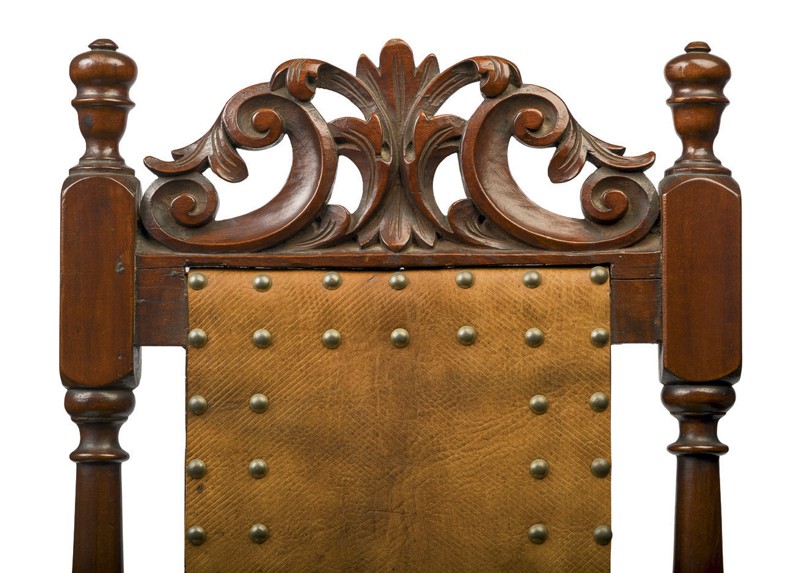
Detail of the carved crest of the side chair illustrated in fig. 44.
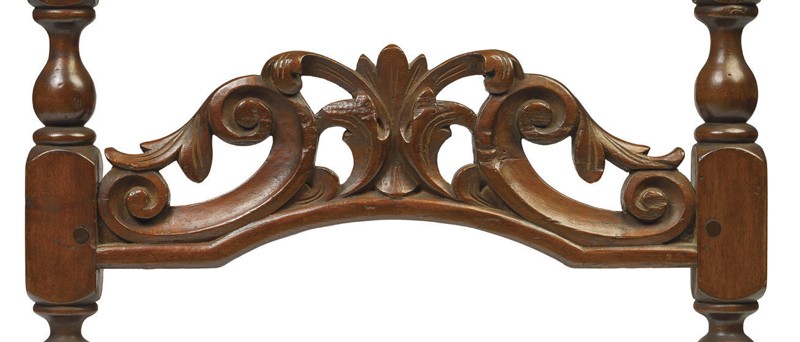
Detail of the carved stretcher of the side chair illustrated in fig. 44.
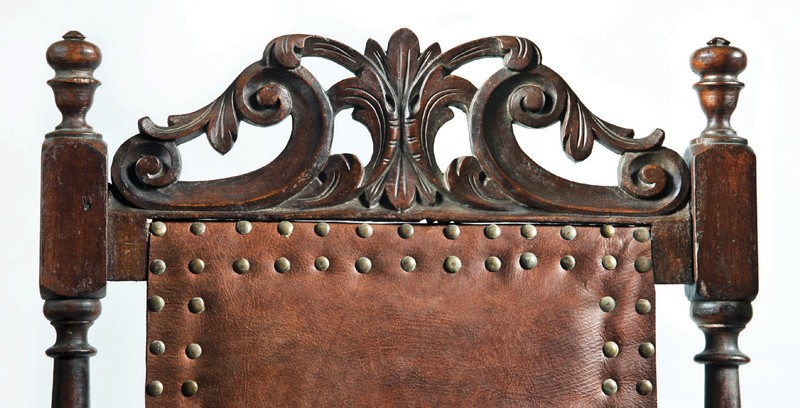
Detail of the carved crest of the armchair illustrated in fig. 45.
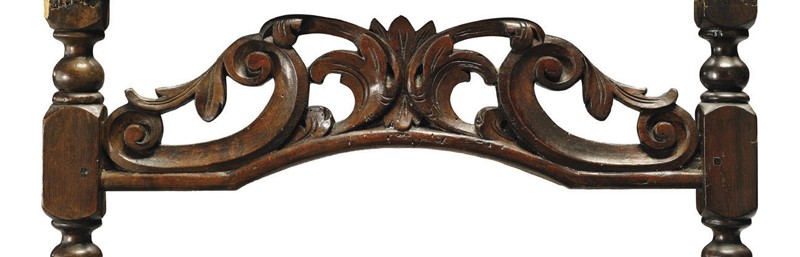
Detail of the carved stretcher of the armchair illustrated in fig. 45.
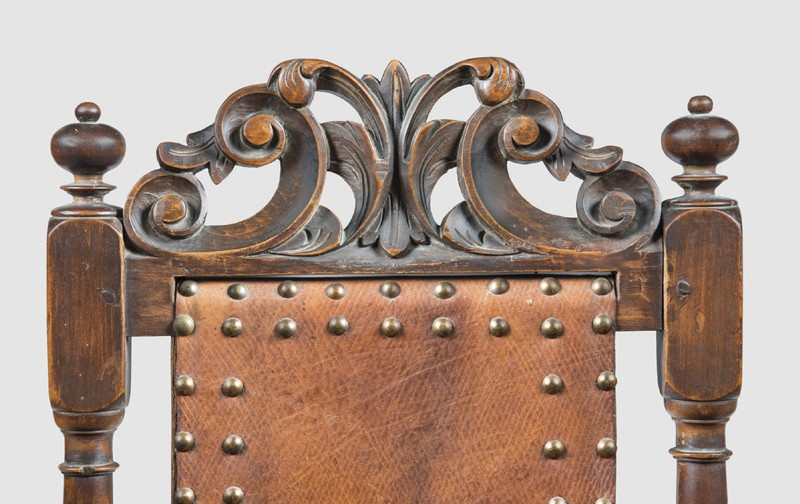
Detail of the carved crest of the side chair illustrated in fig. 50.
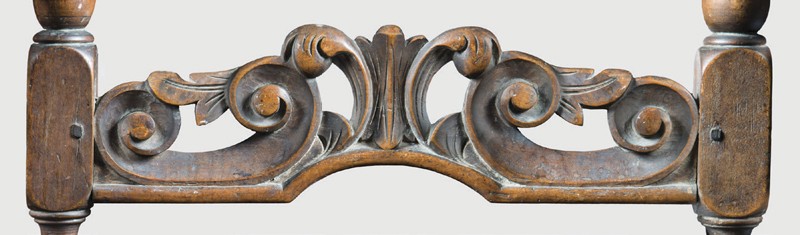
Detail of the carved stretcher of the side chair illustrated in fig. 50.
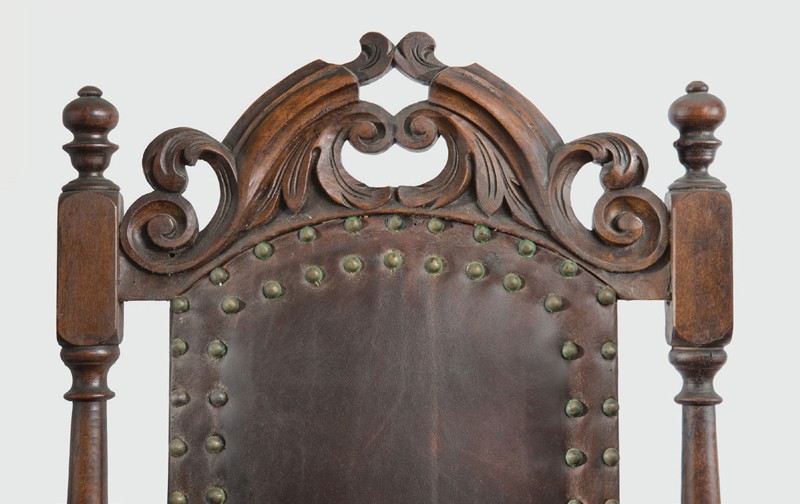
Detail of the carved crest of the armchair illustrated in fig. 52.
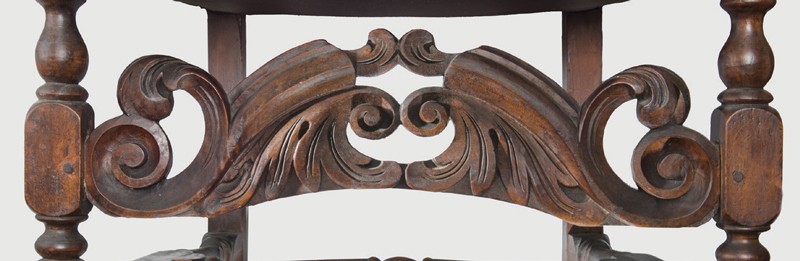
Detail of the carved stretcher of the armchair illustrated in fig. 52.
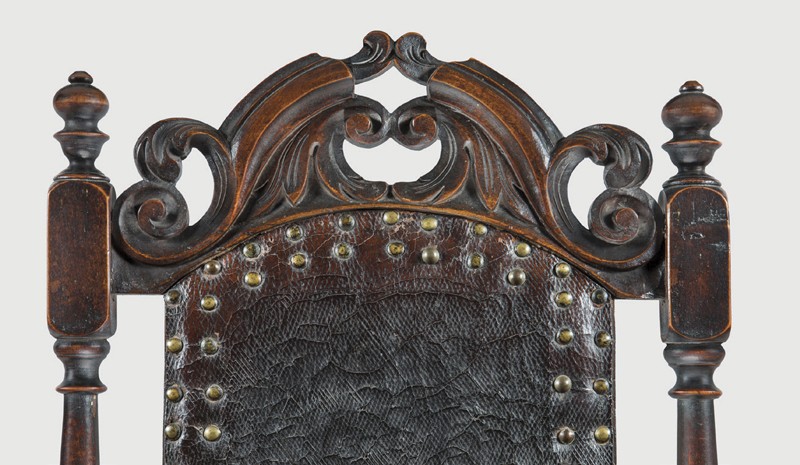
Detail of the carved crest of the armchair illustrated in fig. 53.
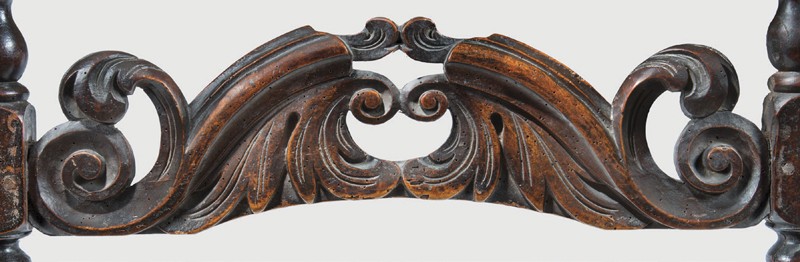
Detail of the carved stretcher of the armchair illustrated in fig. 53.
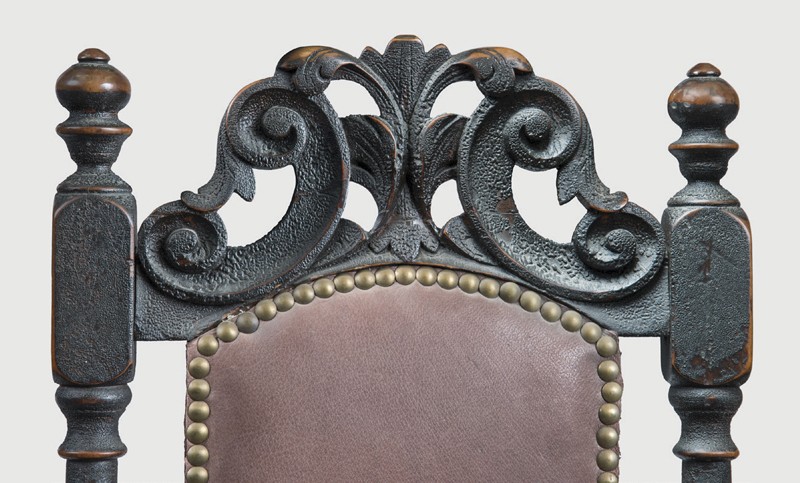
Detail of the carved crest of the side chair illustrated in fig. 56.
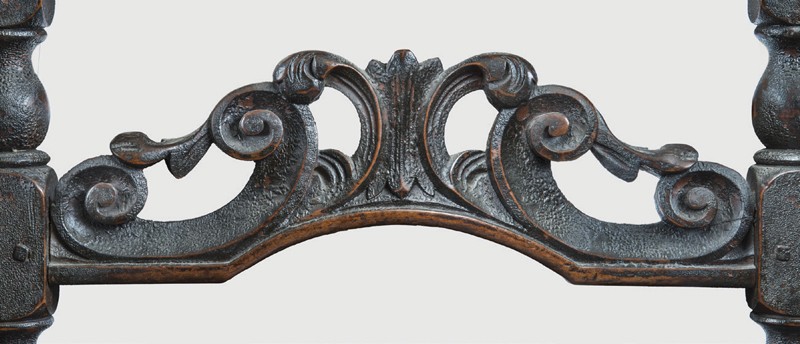
Detail of the carved stretcher of the side chair illustrated in fig. 56.
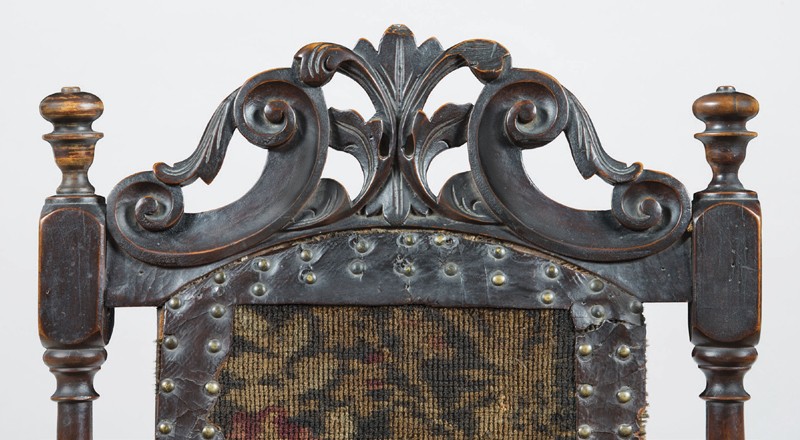
Detail of the carved crest of the armchair illustrated in fig. 60.
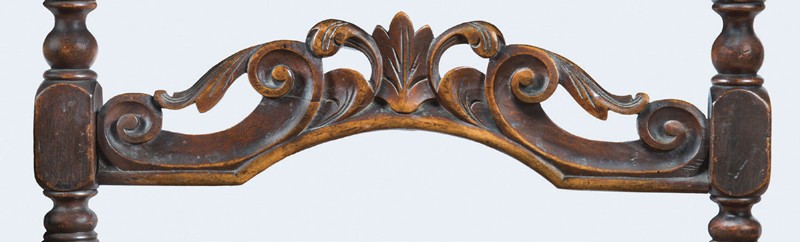
Detail of the carved stretcher of the armchair illustrated in fig. 60.
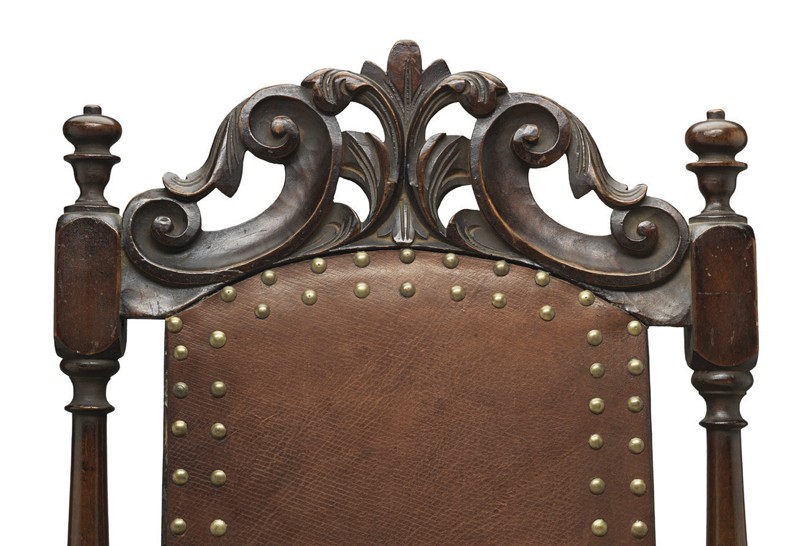
Detail of the carved crest rail of the armchair illustrated in fig. 64.
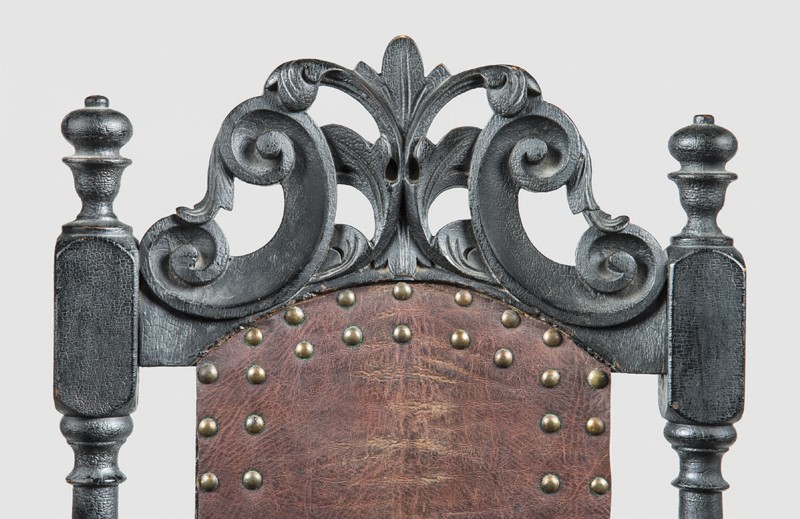
Detail of the carved crest rail of the side chair illustrated in fig. 65.
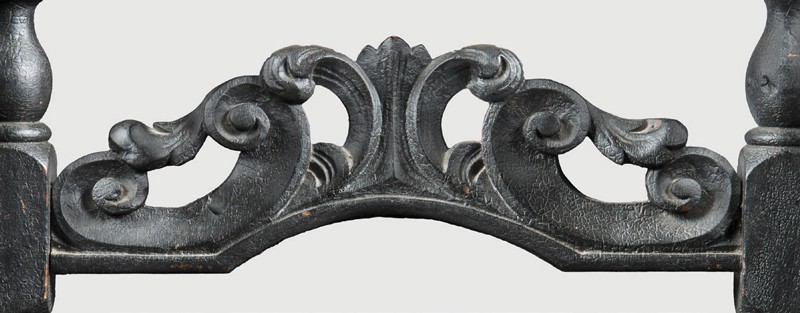
Detail of the carved stretcher of the side chair illustrated in fig. 65.
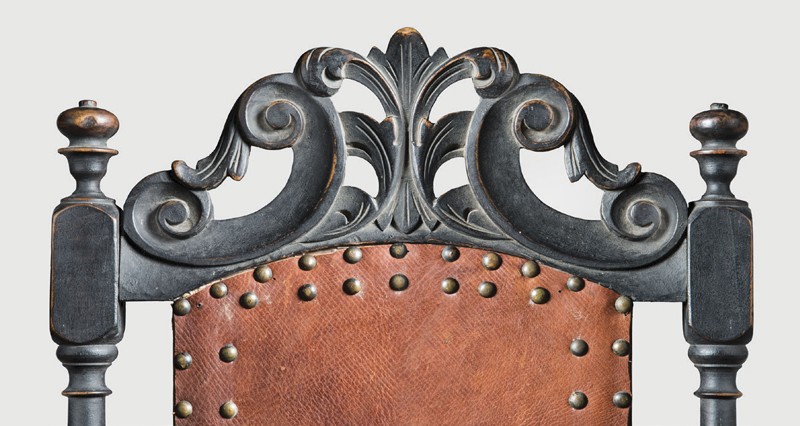
Detail of the carved crest rail of the armchair illustrated in fig. 68.
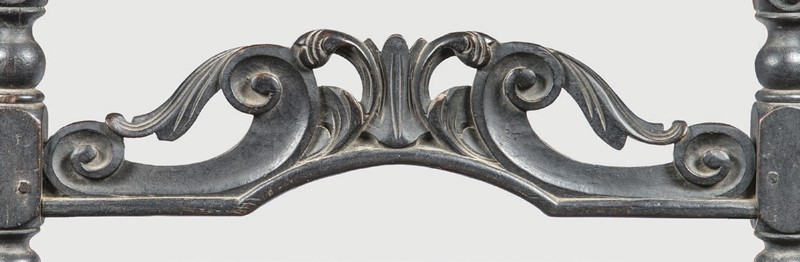
Detail of the carved stretcher of the armchair illustrated in fig. 68.
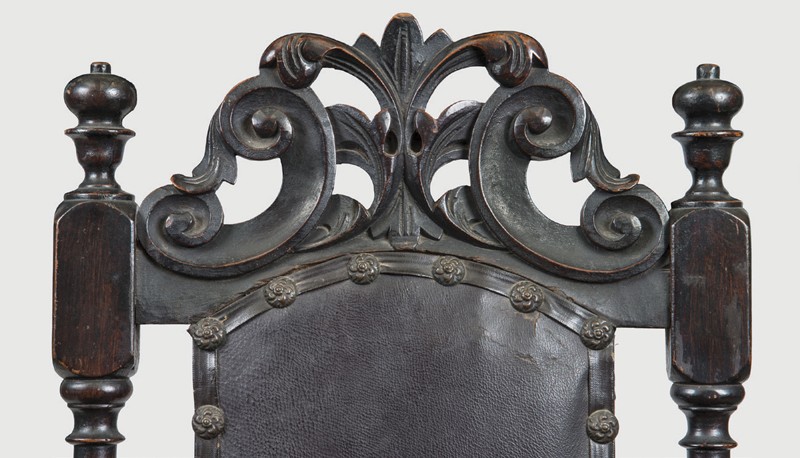
Detail of the carved crest rail of the side chair illustrated in fig. 69.
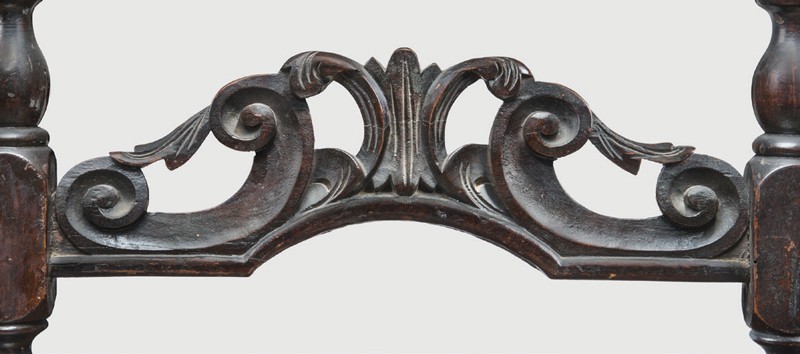
Detail of the carved stretcher of the side chair illustrated in fig. 69.
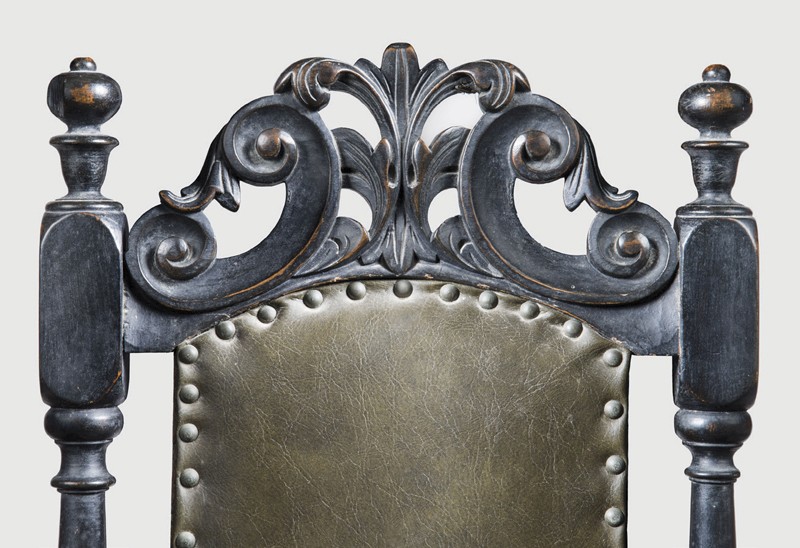
Detail of the carved crest rail of the side chair illustrated in fig. 70.
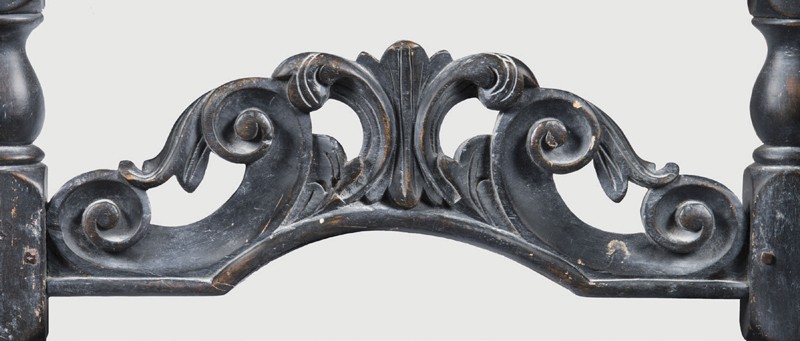
Detail of the carved stretcher of the side chair illustrated in fig. 70.
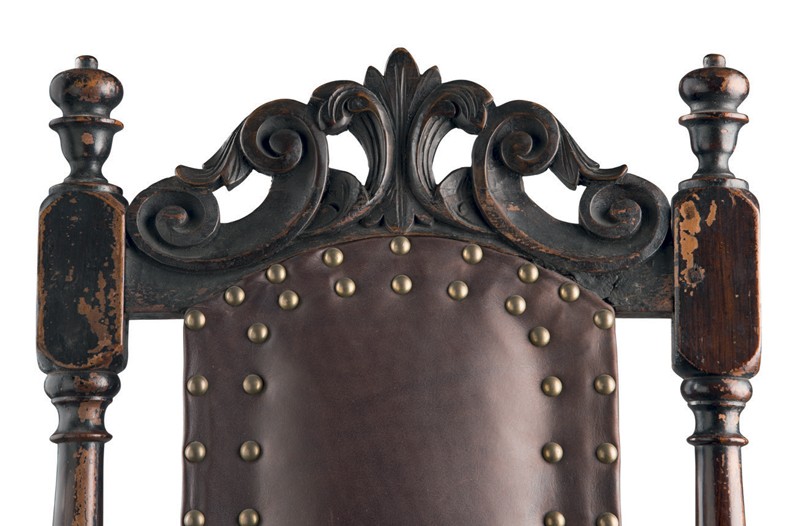
Detail of the carved crest rail of the side chair illustrated in fig. 71.
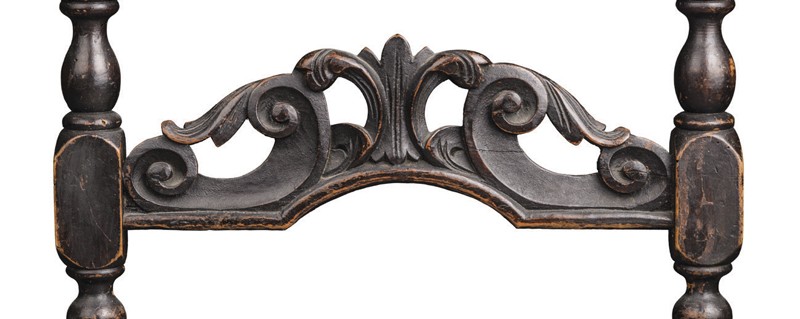
Detail of the carved stretcher of the side chair illustrated in fig. 71.
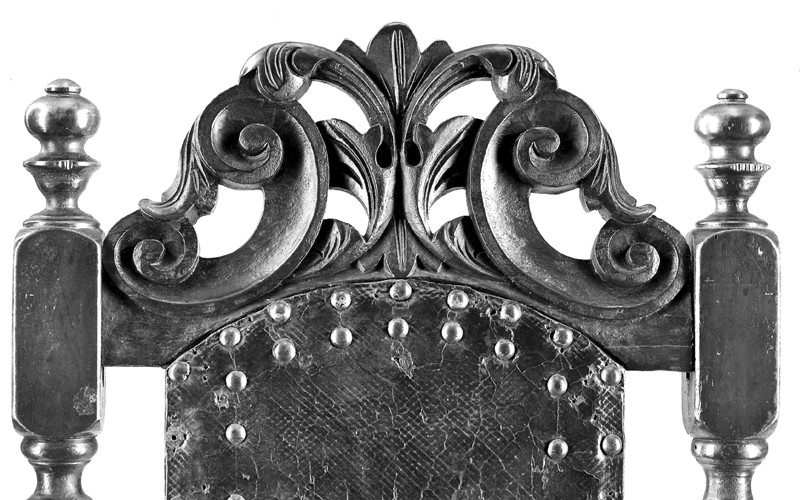
Detail of the carved crest rail of the side chair illustrated in fig. 72.
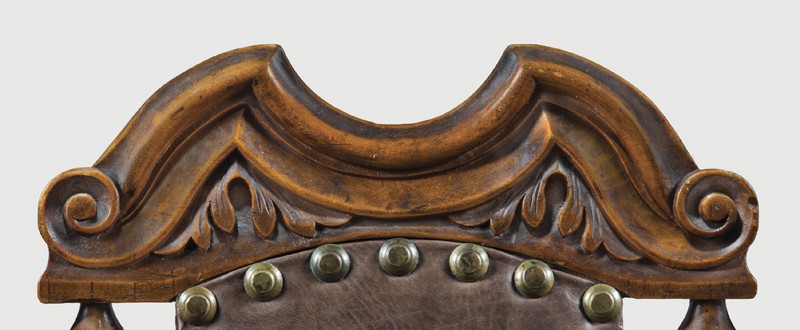
Detail of the carved crest rail of the side chair illustrated in fig. 79.
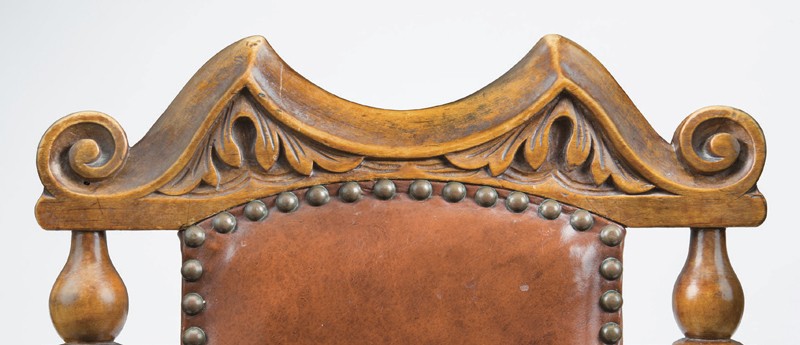
Detail of the carved crest rail of the side chair illustrated in fig. 80.
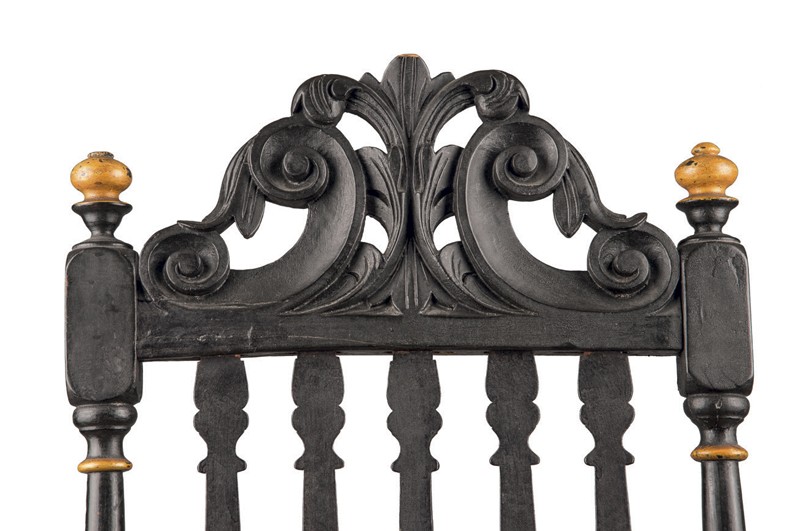
Detail of the carved crest rail of the armchair illustrated in fig. 88.
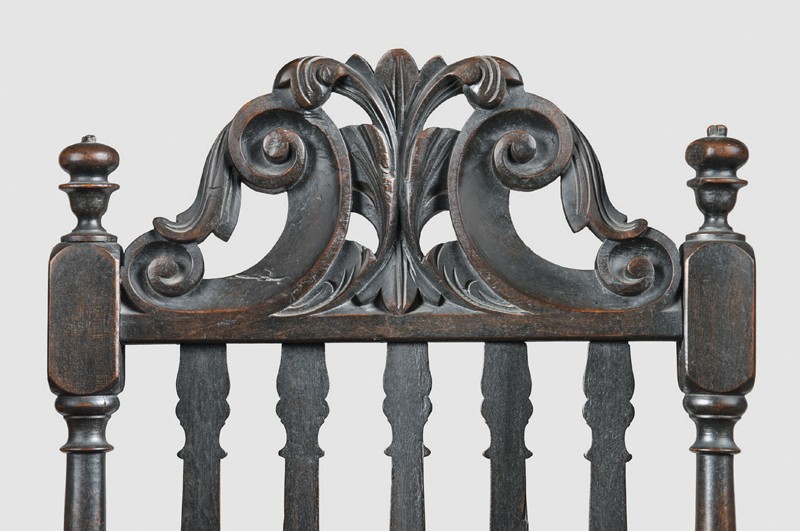
Detail of the carved crest rail of the armchair illustrated in fig. 89.
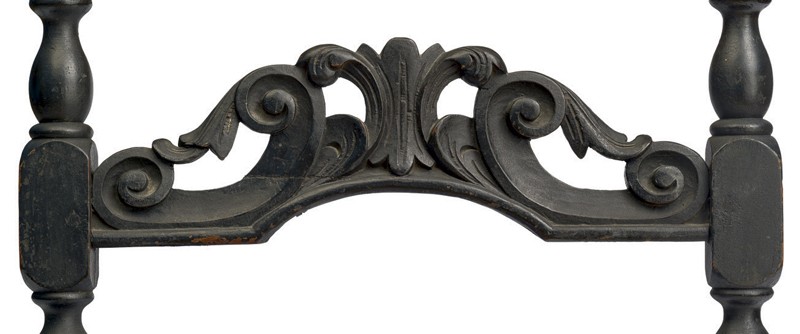
Detail of the carved stretcher of the armchair illustrated in fig. 89.
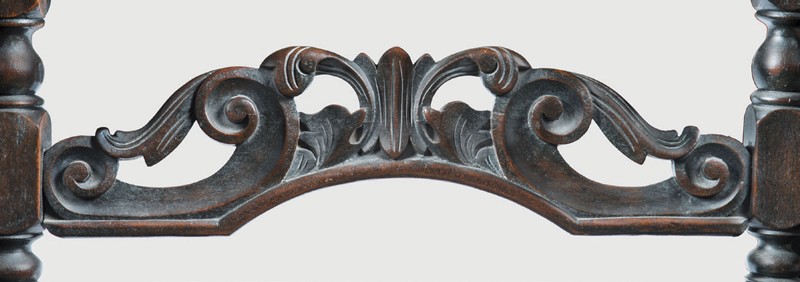
Detail of the carved stretcher of the side chair illustrated in fig. 90.
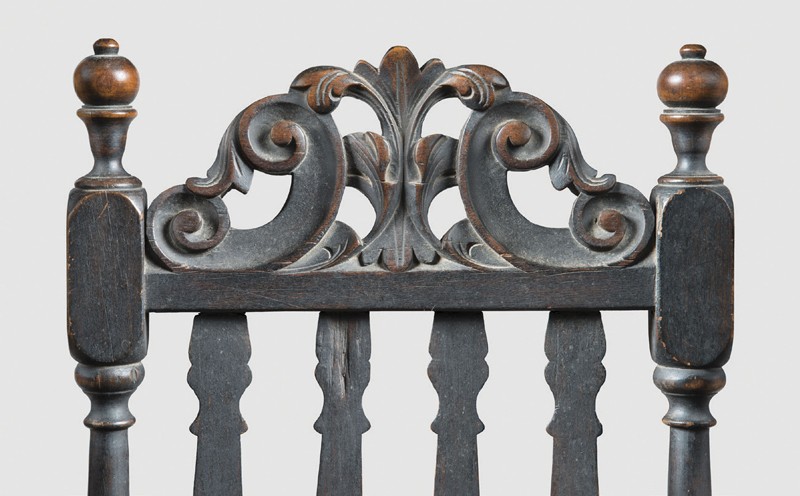
Detail of the carved crest rail of the side chair illustrated in fig. 91.
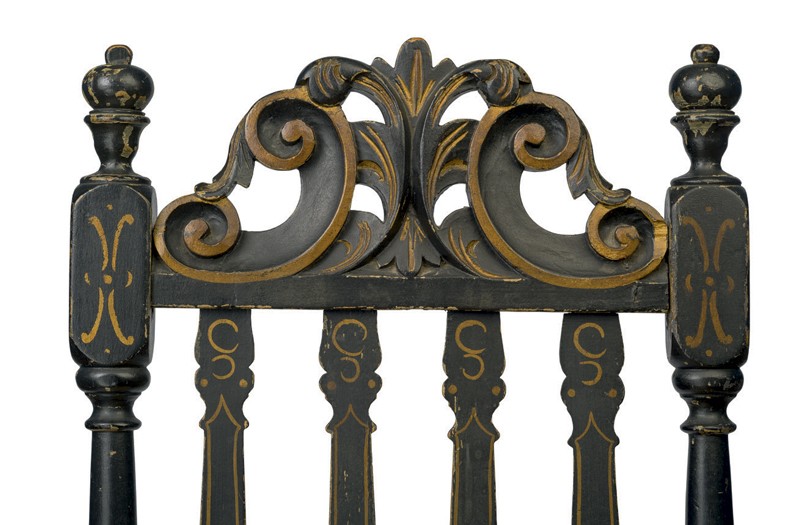
Detail of the carved crest rail of the side chair illustrated in fig. 92.
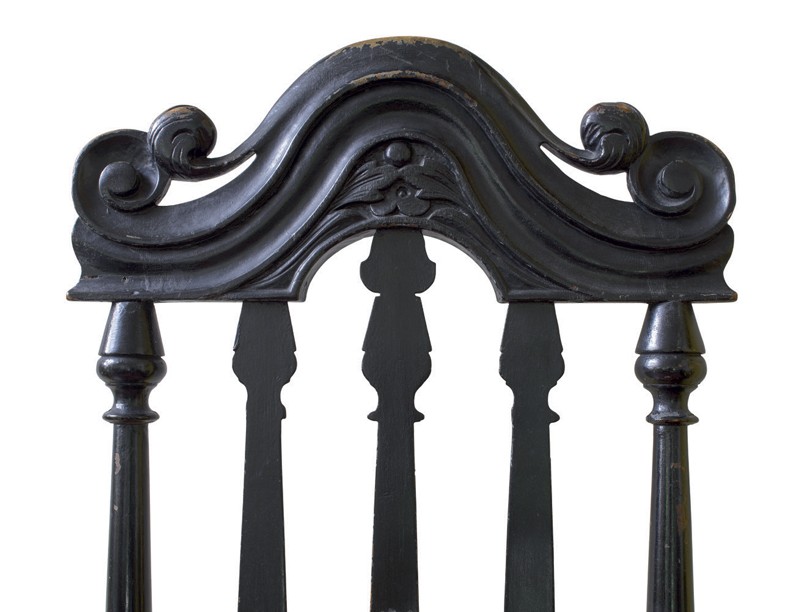
Detail of the carved crest rail of the side chair illustrated in fig. 94.
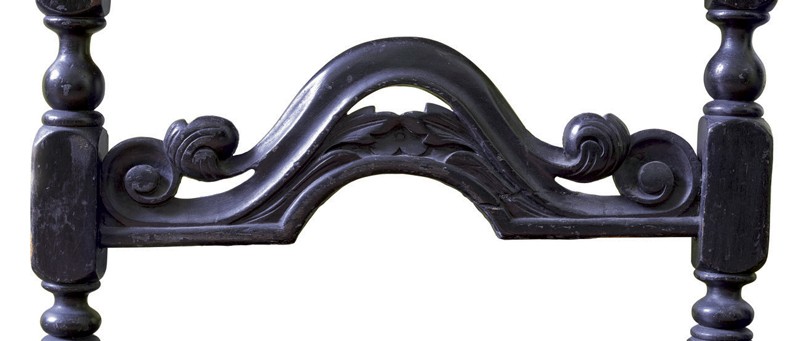
Detail of the carved stretcher of the side chair illustrated in fig. 94.
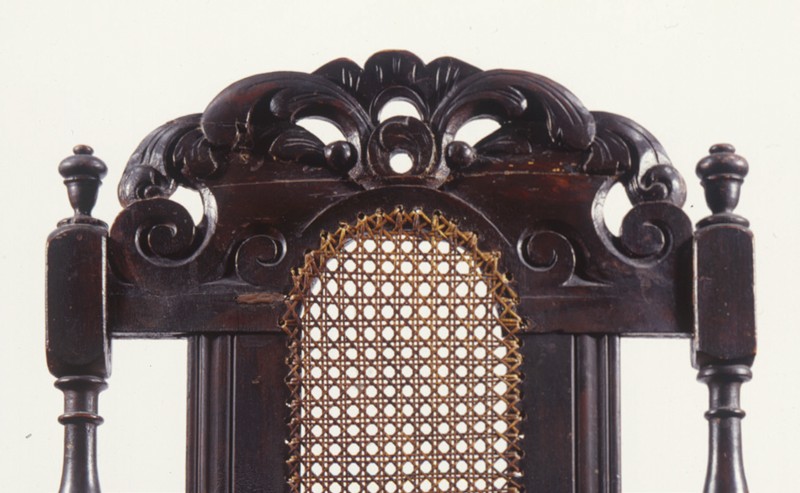
Detail of the carved crest rail of the armchair illustrated in fig. 97.
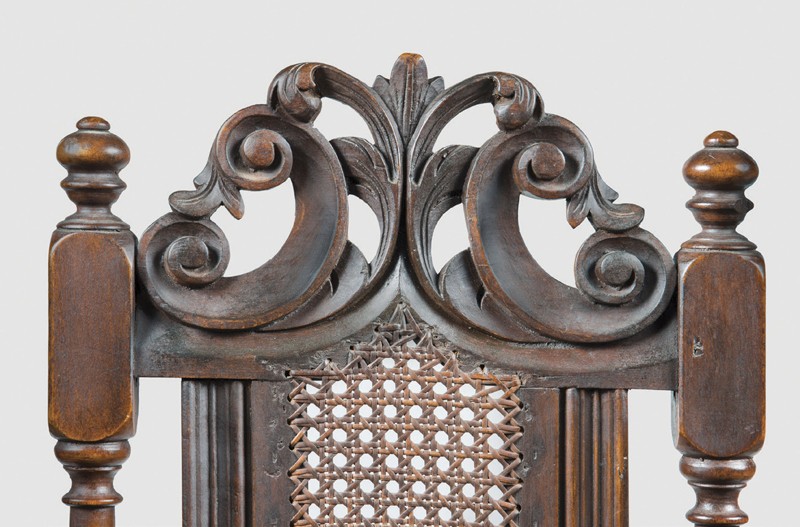
Detail of the carved crest rail of the side chair illustrated in fig. 98.
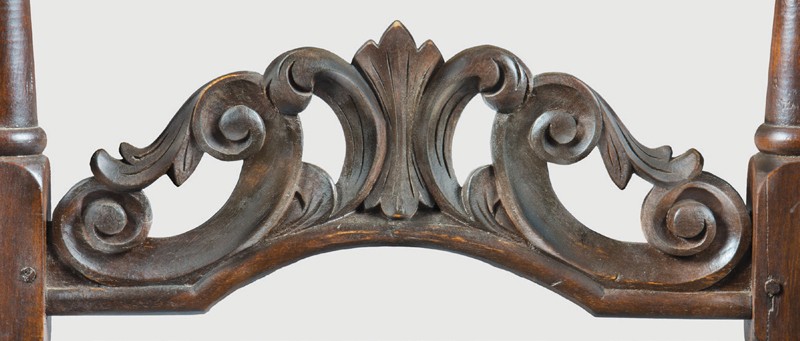
Detail of the carved stretcher of the side chair illustrated in fig. 98.
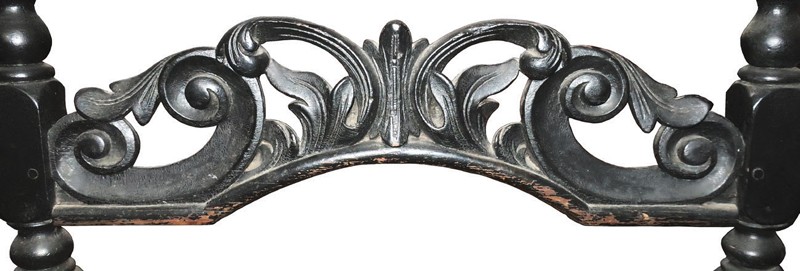
Detail of the carved stretcher of the armchair illustrated in fig. 99.
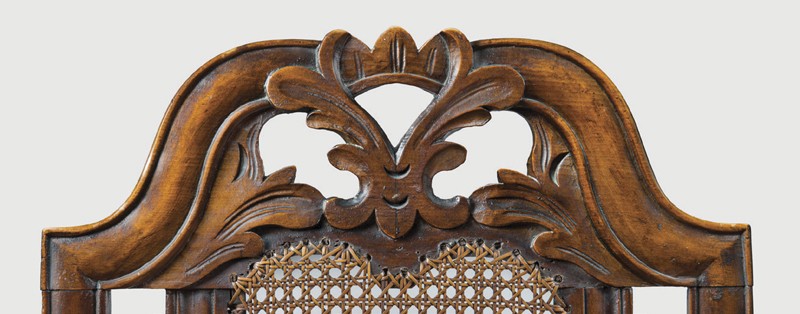
Detail of the carved crest rail of the armchair illustrated in fig. 106.