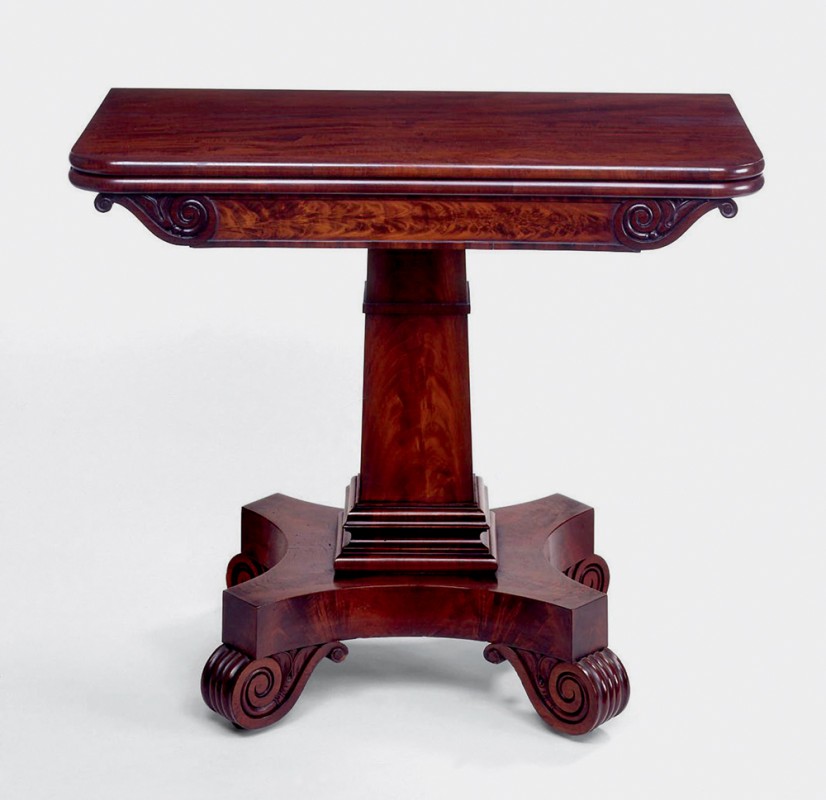
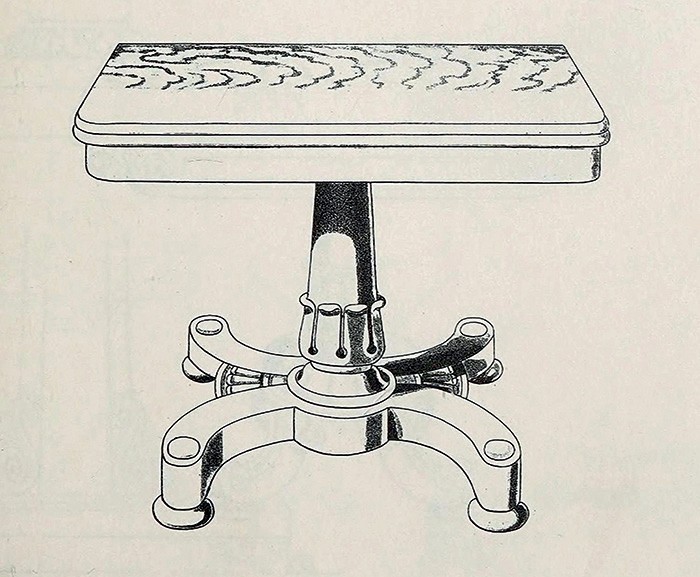
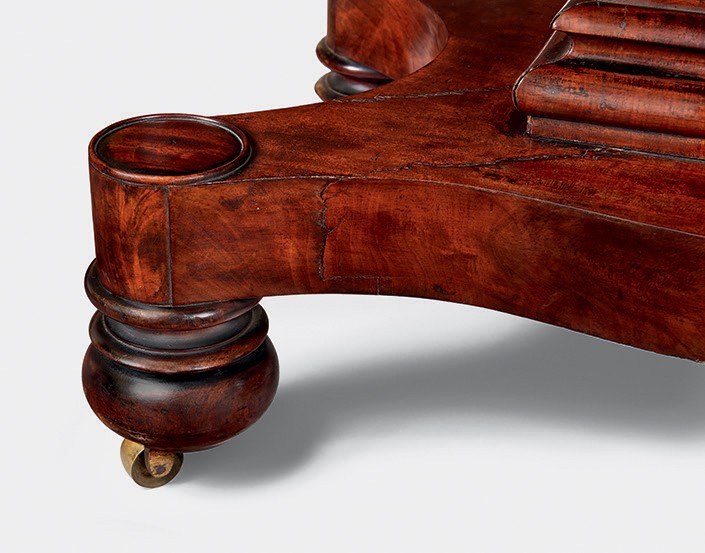
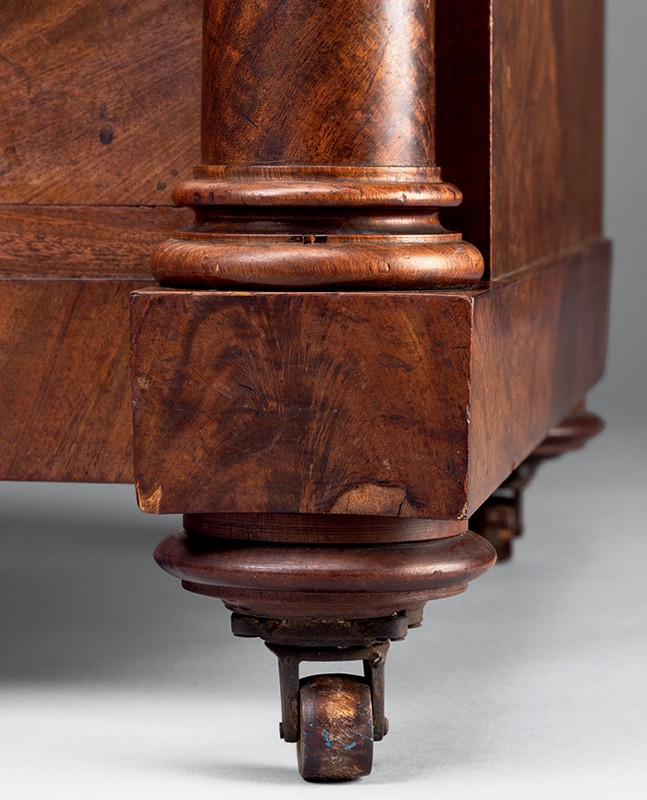
• Figure 1
    Figure 1

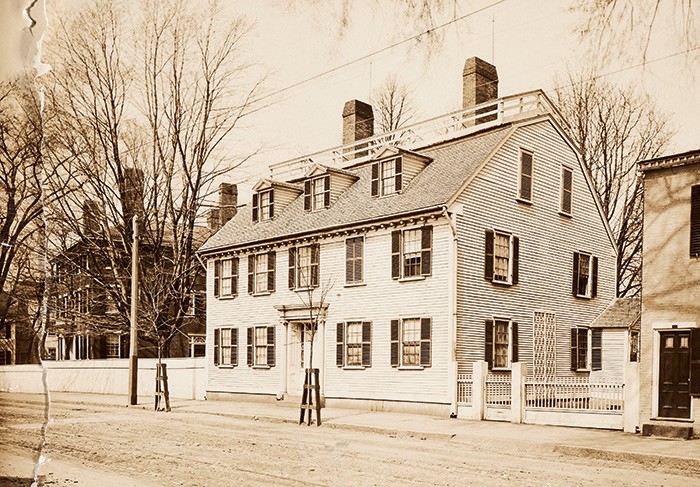
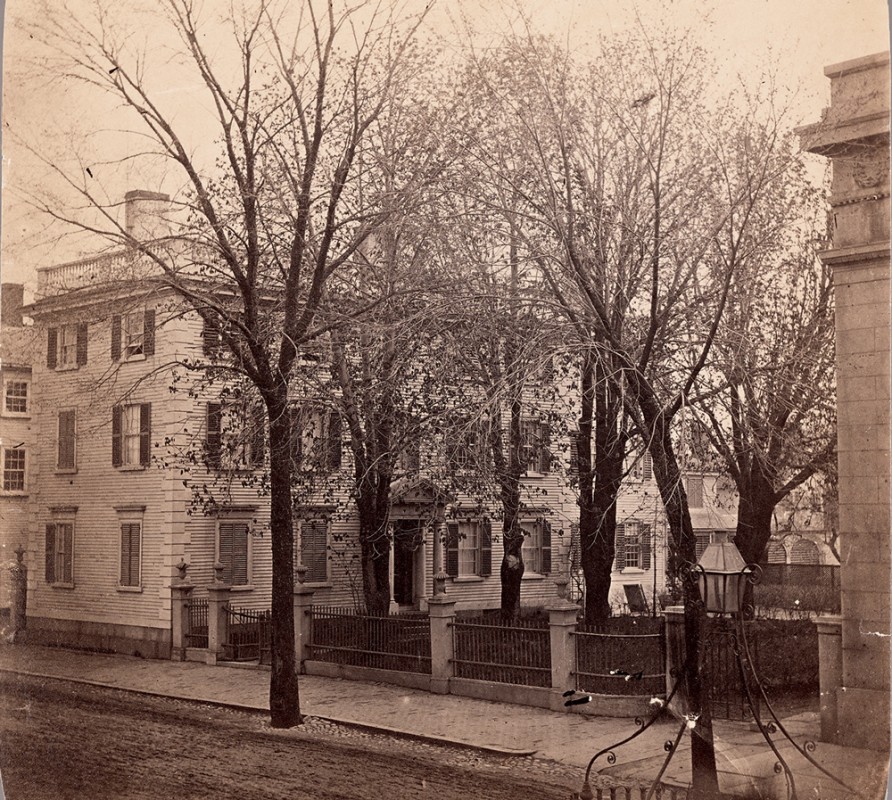
    The Ropes Mansion, 318 Essex Street, Salem, Massachusetts. Unknown photographer, ca. 1890. (Courtesy, Phillips Library, Peabody Essex Museum [Ropes Papers, box 21, folder 2].) This photograph shows the site of Mark Pitman’s cabinetmaking shop on the left side of the house with the board fence erected in the 1850s.

  • Figure 2
    Figure 2

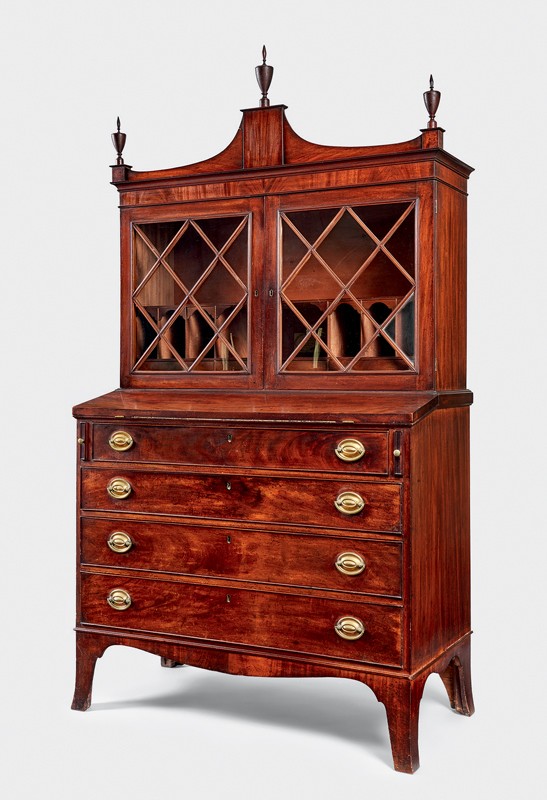
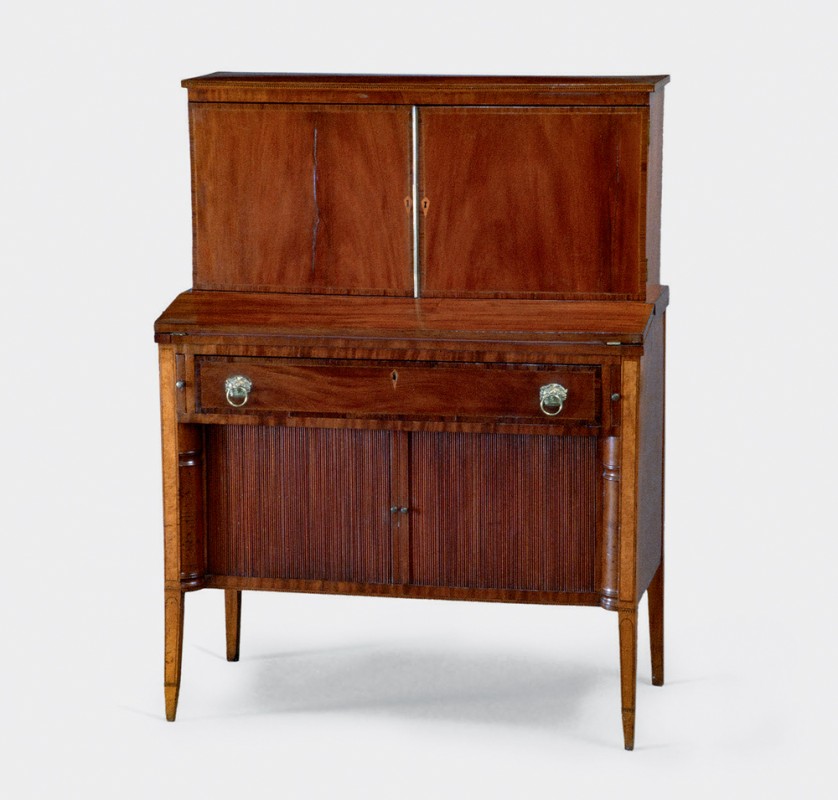
    Desk and bookcase, labeled by Mark Pitman (1779–1855), Salem, Massachusetts, 1807–1812. Mahogany, pine, glass. H. 67 1/2", W. 41 7/8", D. 20 1/2". (Courtesy, Peabody Essex Museum, given in honor of Dean Lahikainen and in memory of Anna Sterns by Anna Thurber, 2018.31.1AB; photo, Michael E. Myers.)

  • Figure 3
    Figure 3

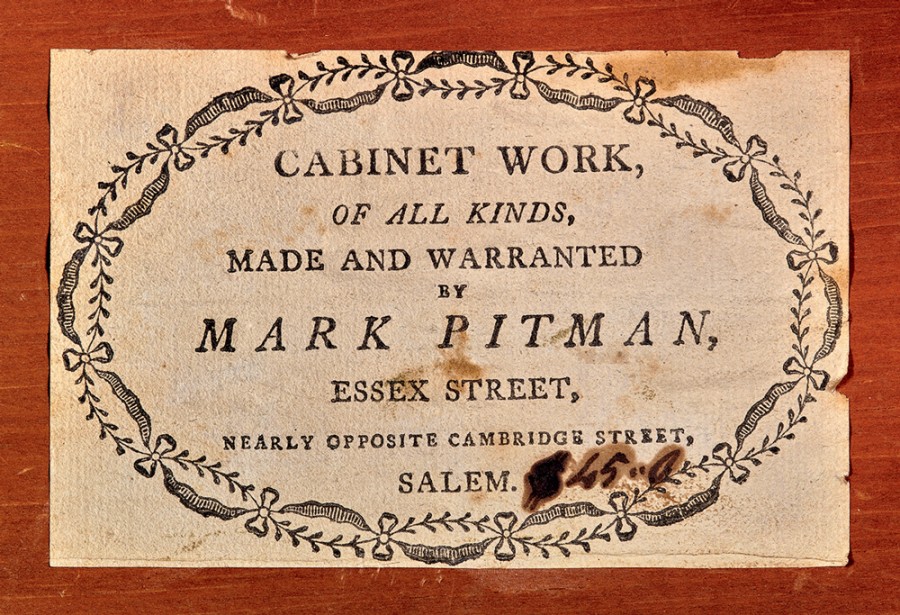
    Detail of the printed label of Mark Pitman inside the desk and bookcase in fig. 2. (Photo, Michael E. Myers.)

  • Figure 4
    Figure 4

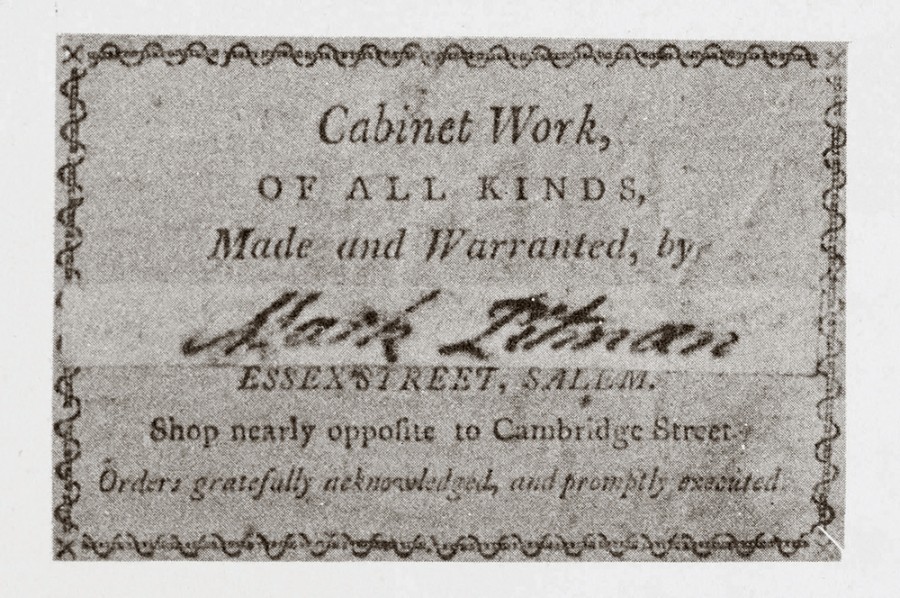
    Printed label with Mark Pitman’s handwritten signature pasted over the name of Josiah Caldwell. (Location unknown; photo, Phillips Library, Peabody Essex Museum.) Illustration from Dean A. Fales, Essex County Furniture: Documented Treasures from Local Collections, 1660–1860 (Salem, Mass.: Essex Institute, 1965), pl. 33.

  • Figure 5
    Figure 5

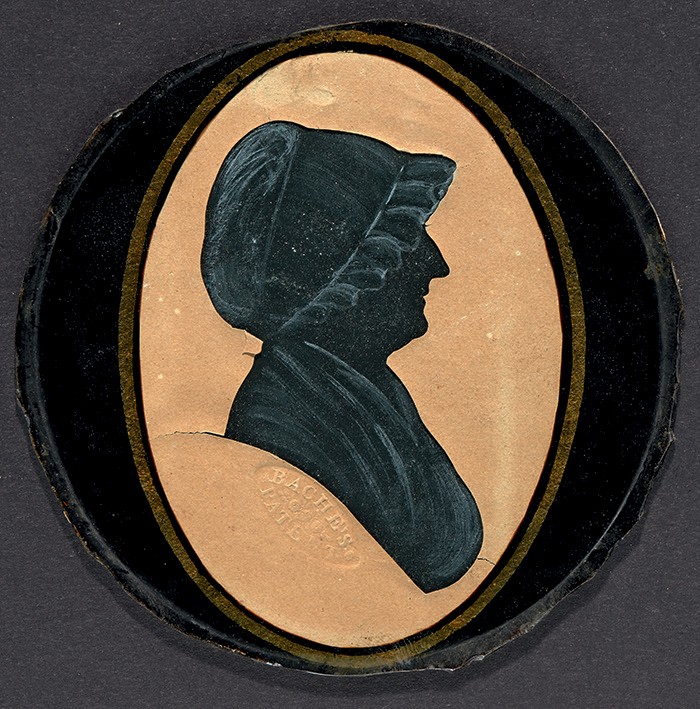
    William Bache (1771–1845), Silhouette of Elizabeth (Cleveland) Ropes (1757–1831), stamped “Bache’s Patent,” 1805. Cut paper and chalk. H. 5 3/8". (Courtesy, Peabody Essex Museum, gift of the Trustees of the Ropes Memorial, 1989, R905.1.)

  • Figure 6
    Figure 6

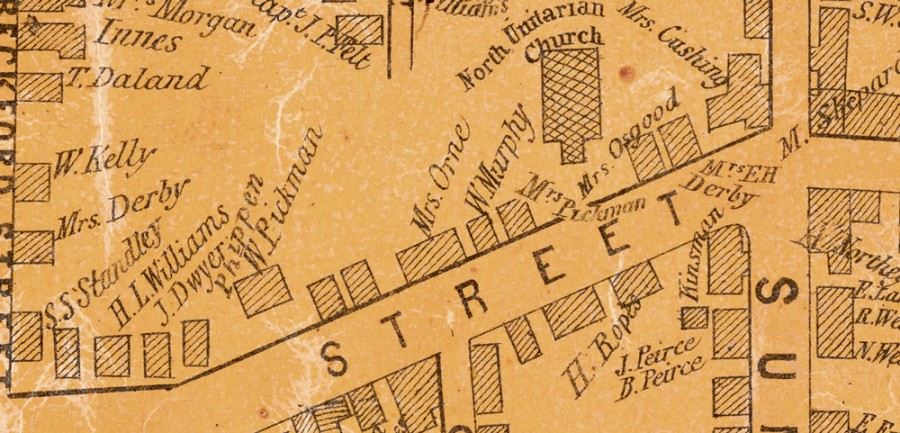
    Detail of Henry McIntyre, A Map of the City of Salem, Mass. (Philadelphia, 1851). (Courtesy, Phillips Library, Peabody Essex Museum.) The map shows the two shop buildings at 324 Essex Street next to the Ropes Mansion, marked “Mrs. Orne.”

  • Figure 7
    Figure 7

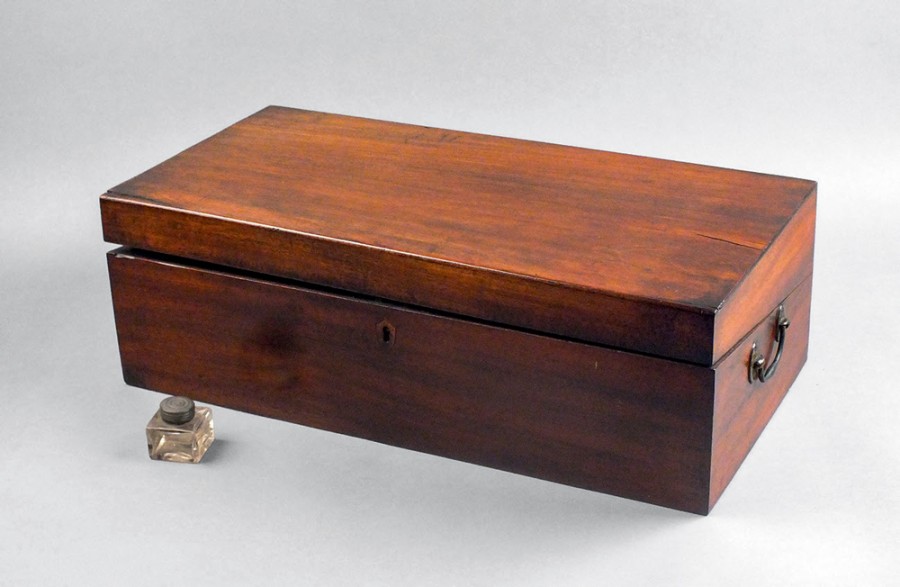
    Traveling desk by Mark Pitman, 1812. Mahogany, pine, glass, baize, brass, metal. H. 6 1/2", W. 20", D. 10". (Courtesy, Peabody Essex Museum, gift of the Trustees of the Ropes Memorial, 1989, R1129.)

  • Figure 8
    Figure 8

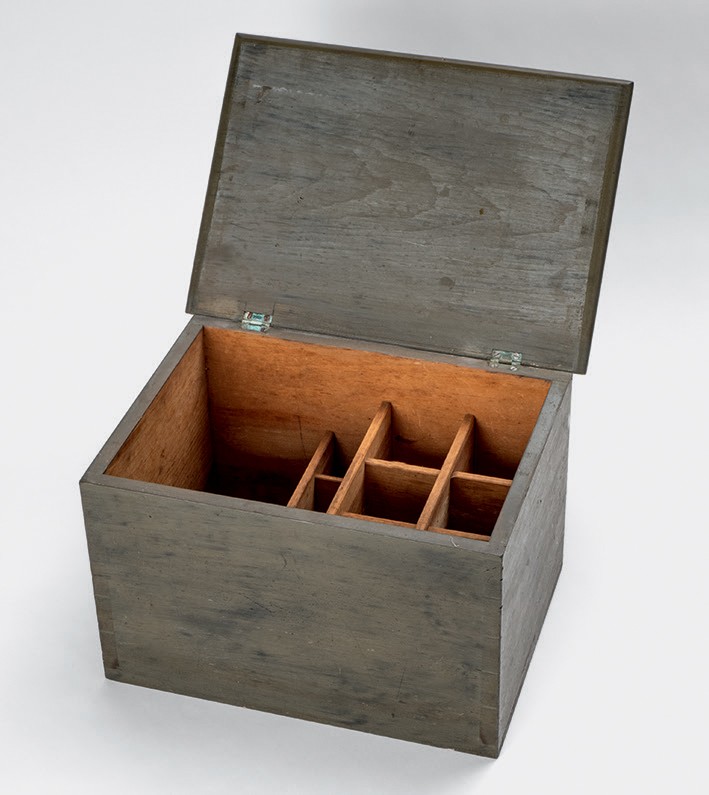
    Medicine chest by Mark Pitman, ca. 1807–1830. Painted pine, metal. H. 8 1/4", W. 13", D. 9 1/4". (Courtesy, Peabody Essex Museum, gift of the Trustees of the Ropes Memorial, 1989, R1290; photo, Dennis Helmar.)

  • Figure 9
    Figure 9

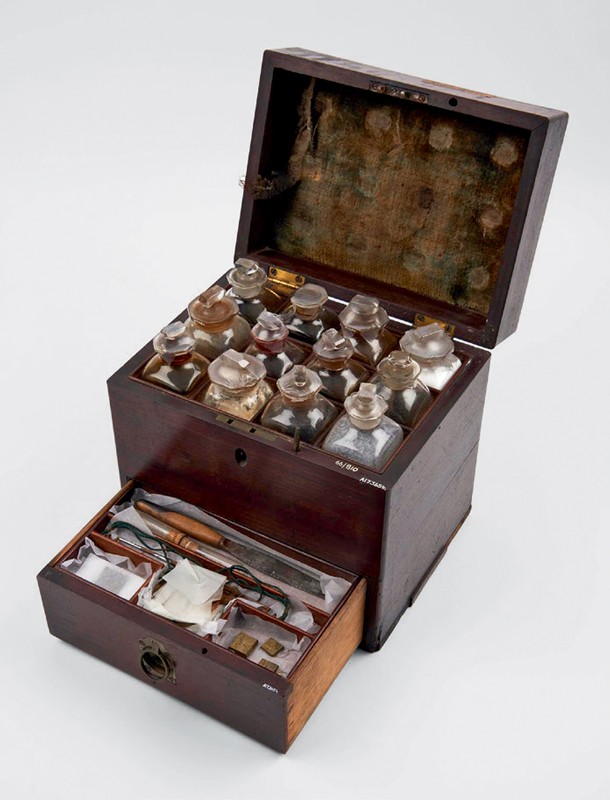
    Medicine chest containing sixteen glass bottles (ten labeled) with mixing and measuring equipment, British, 1820–1850. Mahogany, glass, brass, velvet. (Courtesy, Science Museum Group, Sir Henry Wellcome’s Museum Collection, A173654, © The Board of Trustees of the Science Museum.)

  • Figure 10
    Figure 10

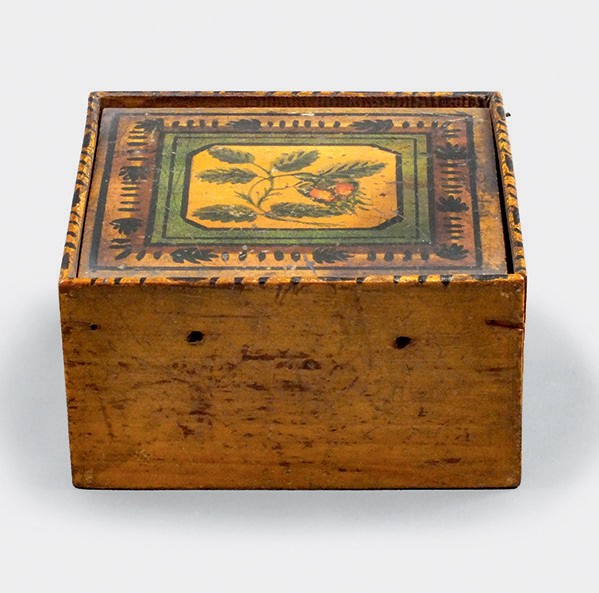
    Sewing box, attributed to Mark Pitman, ca. 1807–1836, with painted decoration possibly by Sally (Ropes) Orne (1795–1876) or Elizabth Ropes Orne (1818–1842). Maple or birch, pine, paper. H. 1 7/8", W. 3 1/2", D. 3 1/2". (Courtesy, Peabody Essex Museum, gift of the Trustees of the Ropes Memorial, 1989, R1250.)

  • Figure 11
    Figure 11

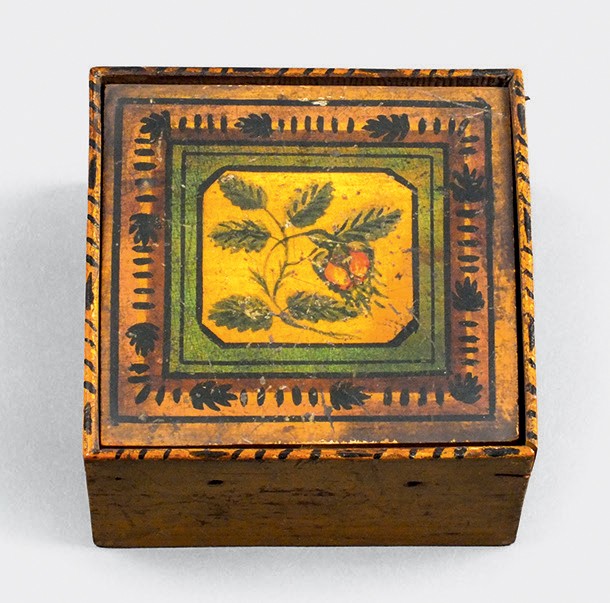
    Detail of the painted decoration on the top of the box in fig. 10.

  • Figure 12
    Figure 12

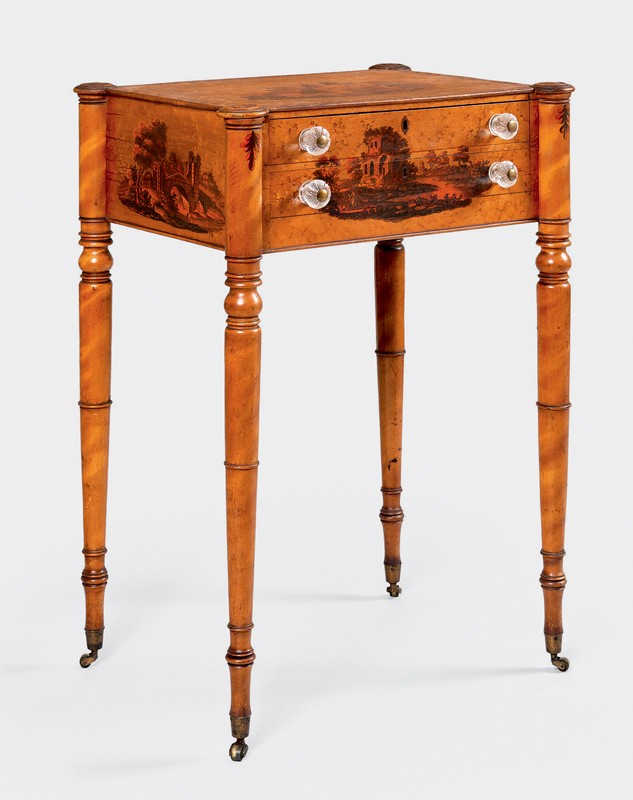
    Work table by Mark Pitman, 1810–1825, with painted decoration attributed to Elizabeth Ropes Orne (1818–1842), possibly in association with James A. Cleveland (1811–1868), 1830s. Bird’s-eye maple, mahogany, glass, brass. H. 30", W. 21 3/4", D. 16 1/2". (Courtesy, Peabody Essex Museum, gift of the Trustees of the Ropes Memorial, 1989, R1119; photo, Michael E. Myers.)

  • Figure 13
    Figure 13

    Detail of the painted decoration on the top of the table in fig. 12. (Photo, Michael E. Myers.)

  • Figure 14
    Figure 14

    Detail of the painted decoration on the front of the table in fig. 12. (Photo, Michael E. Myers.)

  • Figure 15
    Figure 15

    Detail of the painted decoration on the right side of the table in fig. 12. (Photo, Michael E. Myers.)

  • Figure 16
    Figure 16

    Detail of the painted decoration on the left side of the table in fig. 12. (Photo, Michael E. Myers.)

  • Figure 17
    Figure 17

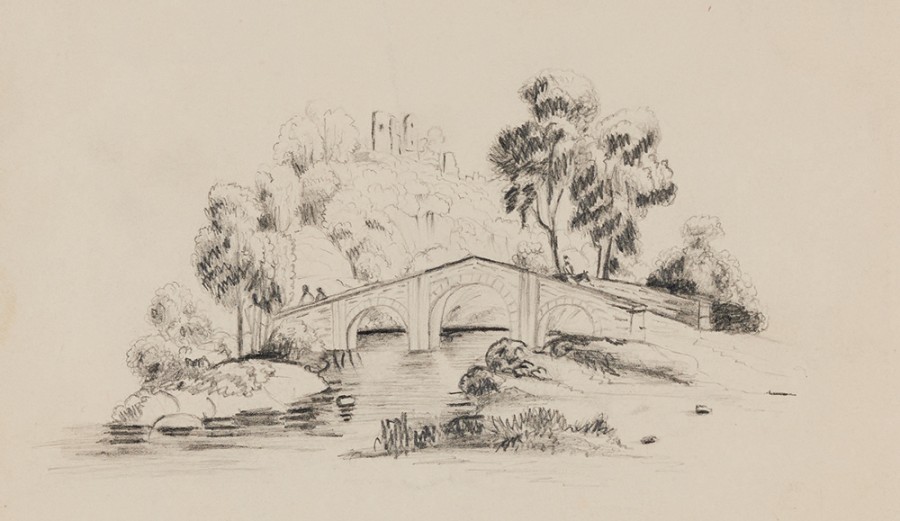
    Elizabeth Ropes Orne, Sketch of a bridge, 1830s. Graphite on paper. H. 3 1/4", W. 5 3/4" (approx.). (Courtesy, Phillips Library, Peabody Essex Museum [Ropes Papers, box 10, folder 4].)

  • Figure 18
    Figure 18

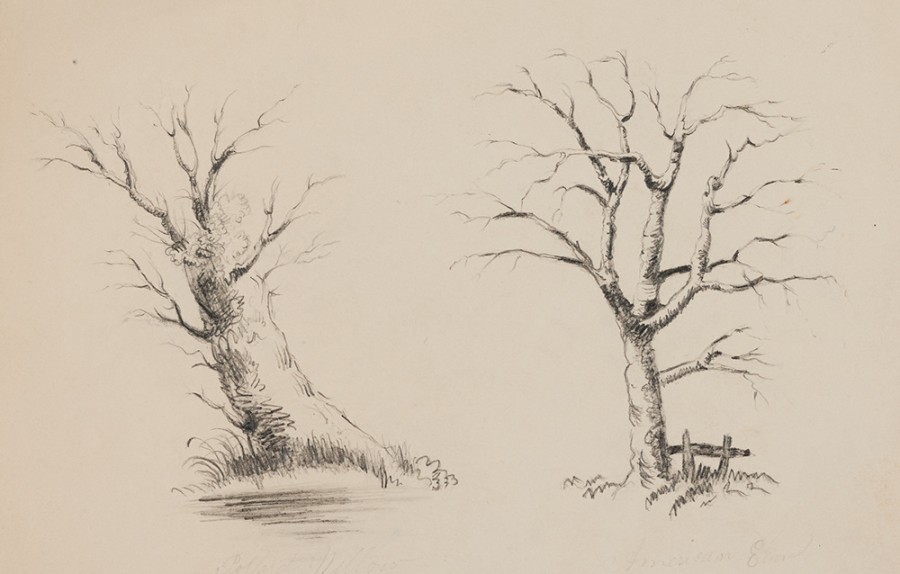
    Detail of a sketch by James A. Cleveland, 1830s. Graphite on paper. H. 4 1/2", W. 7 3/4" (approx.). (Courtesy, Phillips Library, Peabody Essex Museum [Ropes Papers, box 10, folder 4].)

  • Figure 19
    Figure 19

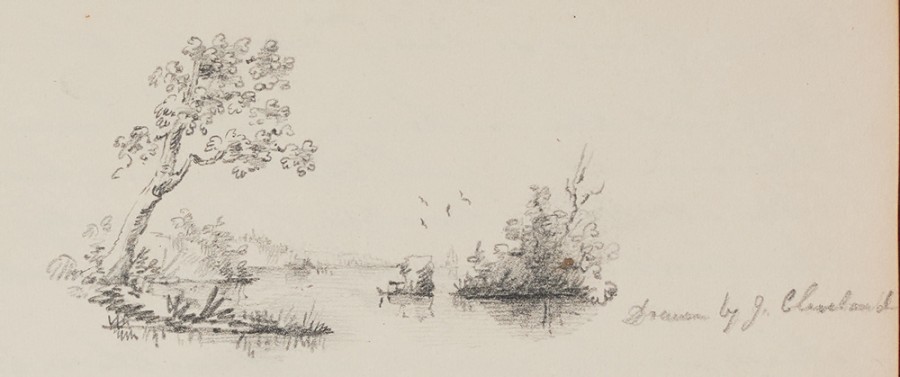
    Sketch by James A. Cleveland in Elizabeth Ropes Orne’s autograph book, 1839. Graphite on paper. H. 2 1/4", W. 5 1/2" (approx.). (Courtesy, Phillips Library, Peabody Essex Museum [Ropes Papers, box 10, folder 10].) The inscription reads: “Drawn by J. Cleveland.”

  • Figure 20
    Figure 20

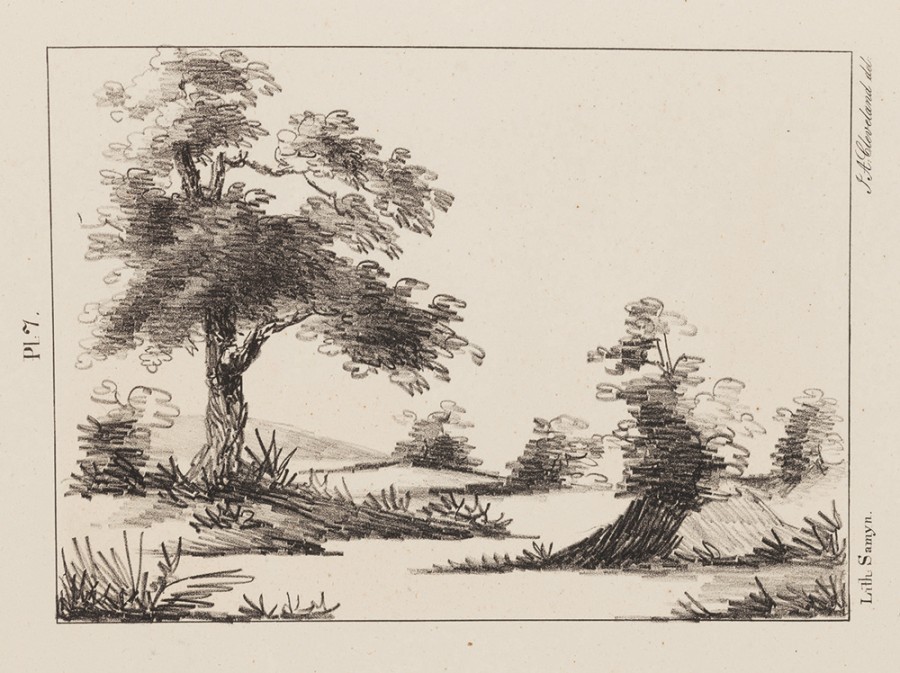
    Sketch shown on plate 7 in James Arthur Cleveland’s The Elements of Landscape Drawing (Cincinnati, 1839). Lithograph on paper. H. 9 1/2", W. 12". (Courtesy, The Metropolitan Museum of Art, Harris Brisbane Dick Fund, 1954, 54.524.76; photo, Art Resource NY.)

  • Figure 21
    Figure 21

    Detail of the painted decoration on the back of the table in fig. 12. (Photo, Michael E. Myers.)

  • Figure 22
    Figure 22

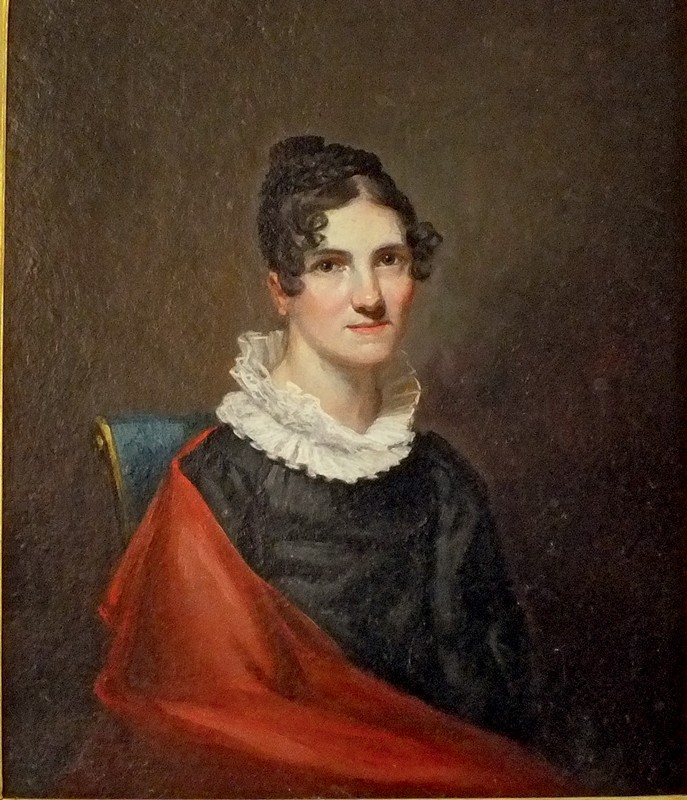
    Samuel Finley Breese Morse(1791–1872), Mrs. Joseph Orne (Sarah “Sally” Ropes), 1817. Oil on board. H. 15 1/2", W. 13 1/4". (Courtesy, Peabody Essex Museum, gift of the Trustees of the Ropes Memorial, 1989, R744.)

  • Figure 23
    Figure 23

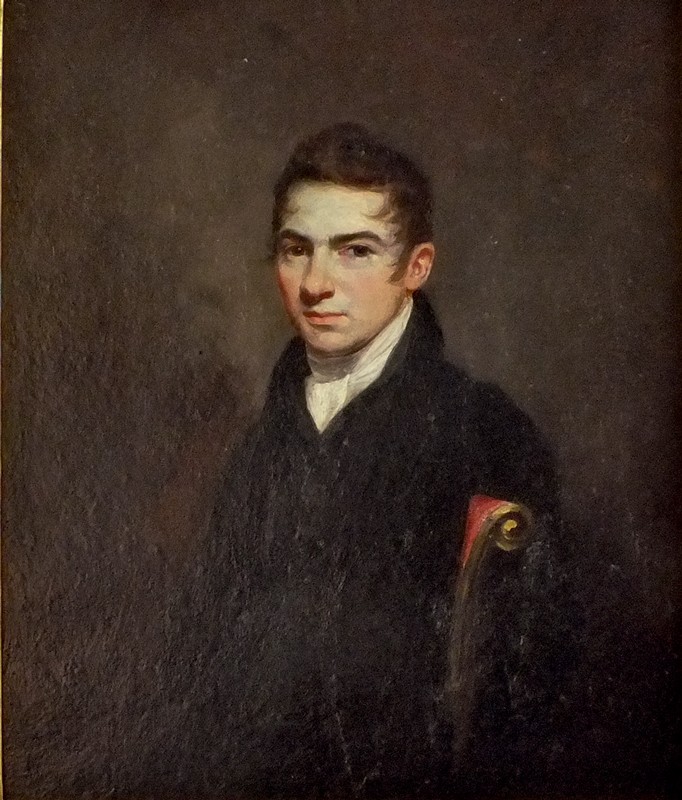
    Samuel Finley Breese Morse(1791–1872), Joseph Orne, 1817. Oil on board. H. 15 1/2", W. 13 1/2". (Courtesy, Peabody Essex Museum, gift of the Trustees of the Ropes Memorial, 1989, R745.)

  • Figure 24
    Figure 24

    Detail of a photograph of the Capt. William Orne House, Washington Street, Salem, Massachusetts, attributed to Daniel A. Clifford, ca. 1855. (Courtesy, Phillips Library, Peabody Essex Museum.) The house was designed by Samuel McIntire (1757–1811) in 1795 and was the home of Sally and Joseph Orne from 1817 to 1819.

  • Figure 25
    Figure 25

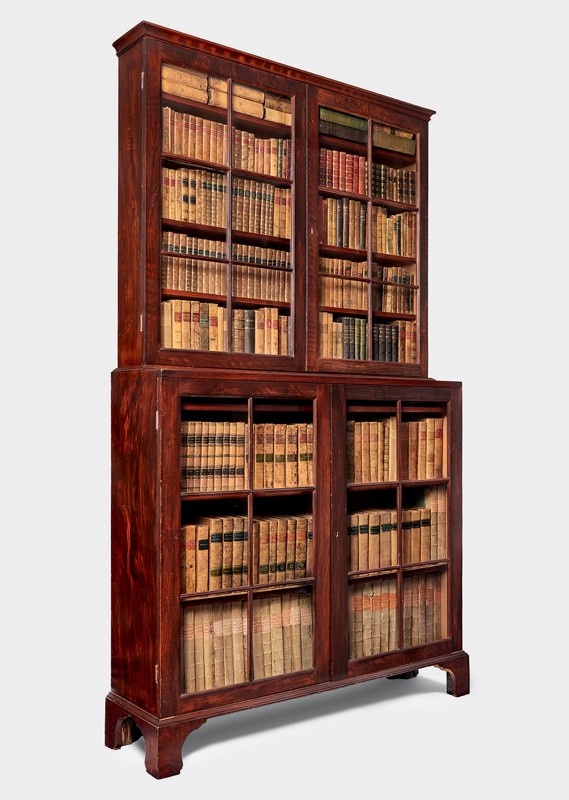
    Set of bookcases by Mark Pitman, 1816. Pine (grain-painted to simulate mahogany or rosewood), glass, metal. H. 89 1/2", W. 50 1/4", D. 14". (Courtesy, Peabody Essex Museum, gift of the Trustees of the Ropes Memorial, 1989, R1075; photo, Michael E. Myers.)

  • Figure 26
    Figure 26

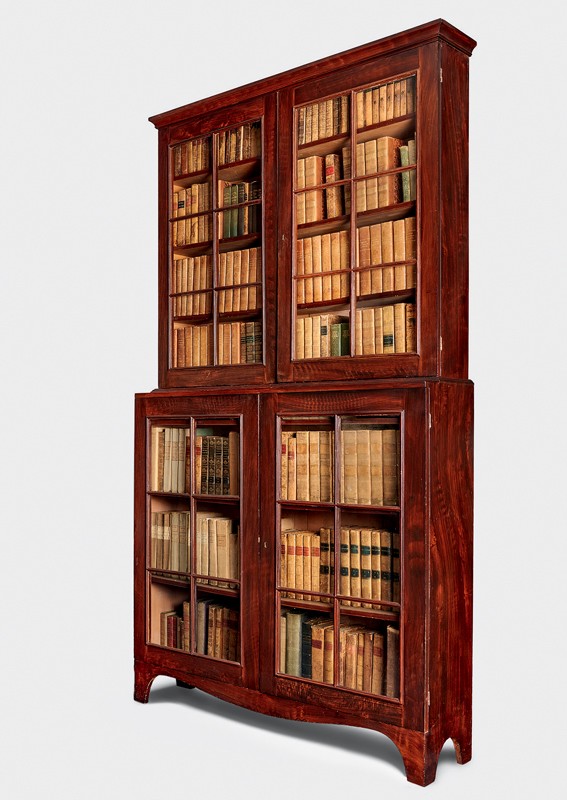
    Set of bookcases by Mark Pitman, 1818–1830s. Pine (grain-painted to simulate mahogany or rosewood), glass, metal. H. 89", W. 50", D. 12". (Courtesy, Peabody Essex Museum, gift of the Trustees of the Ropes Memorial, 1989, R1076; photo, Michael E. Myers.)

  • Figure 27
    Figure 27

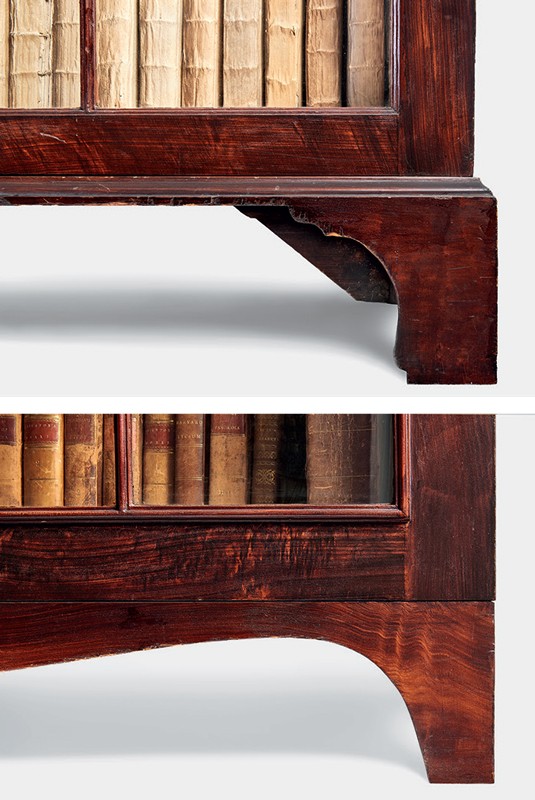
    Detail of the bracket foot, base molding, and stiles and rails on the glass door on the bookcase in fig. 25 (above); detail of the shaped skirt and bracket foot on the bookcase in fig. 26 (below). (Photos, Michael E. Myers.)

  • Figure 28
    Figure 28

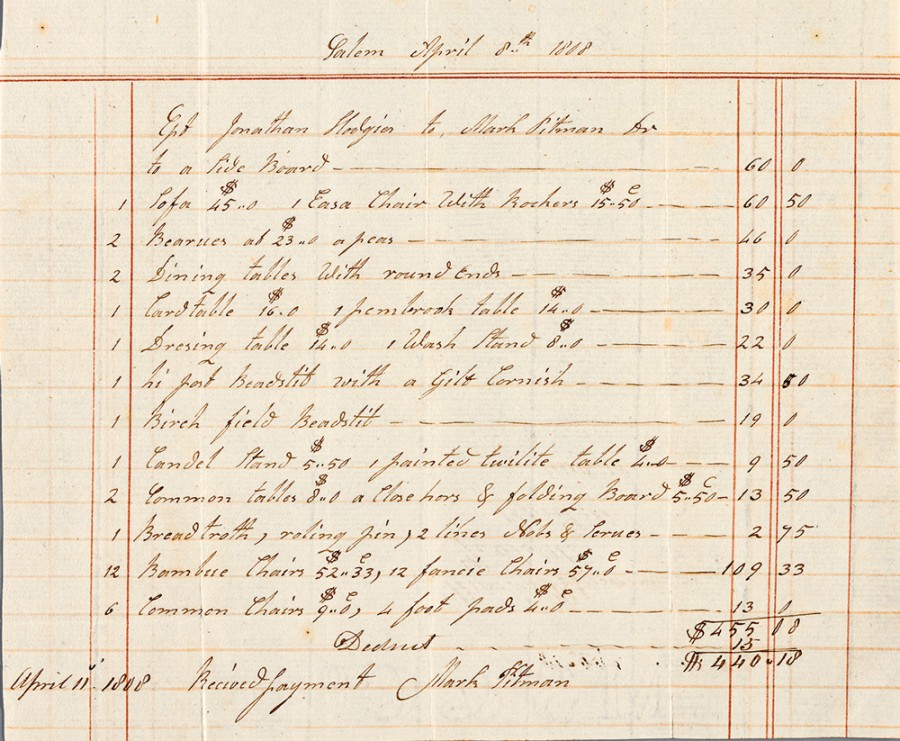
    Receipt for Capt. Jonathan Hodges from Mark Pitman, April 8, 1808, for furniture supplied for the marriage of his daughter, Elizabeth H. Hodges, to George Cleveland of Salem. (Courtesy, Phillips Library, Peabody Essex Museum [Hodges Family Papers, box 22, folder 17].)

  • Figure 29
    Figure 29

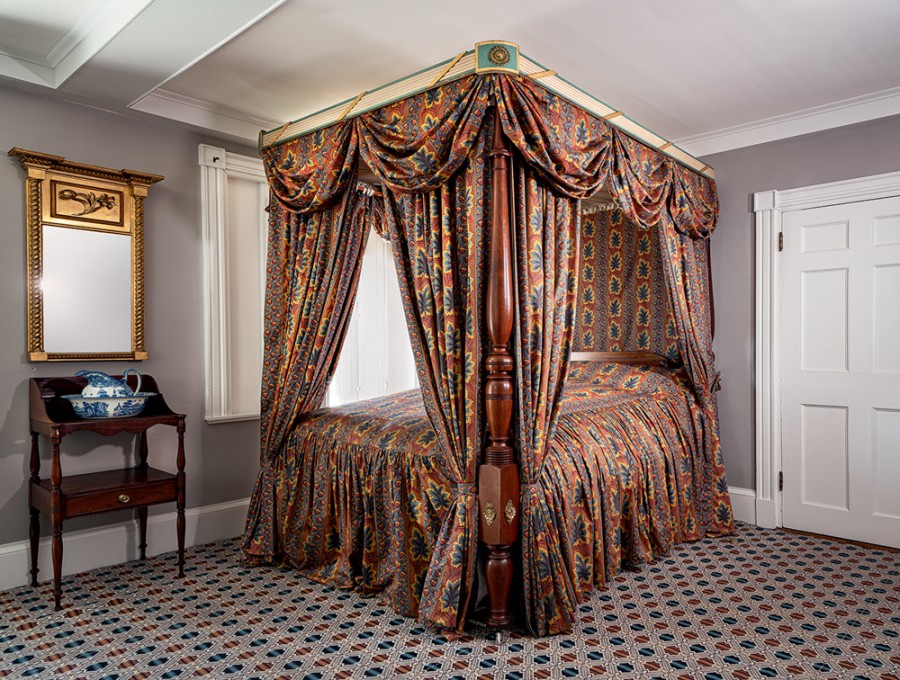
    Bedstead with painted cornice by Mark Pitman, 1816–1817. Mahogany, maple, painted pine, brass, metal, with canvas, rope, and reproduction chintz. H. 90 7/8", W. 60 1/4", D. 78 3/4". (Courtesy, Peabody Essex Museum, gift of the Trustees of the Ropes Memorial, 1989, R1104; photo, Dennis Helmar.) The bedstead was made for the wedding of Joseph and Sally (Ropes) Orne. The hangings were added in 2015 using a reproduction of the original chintz fabric (see fig. 33).

  • Figure 30
    Figure 30

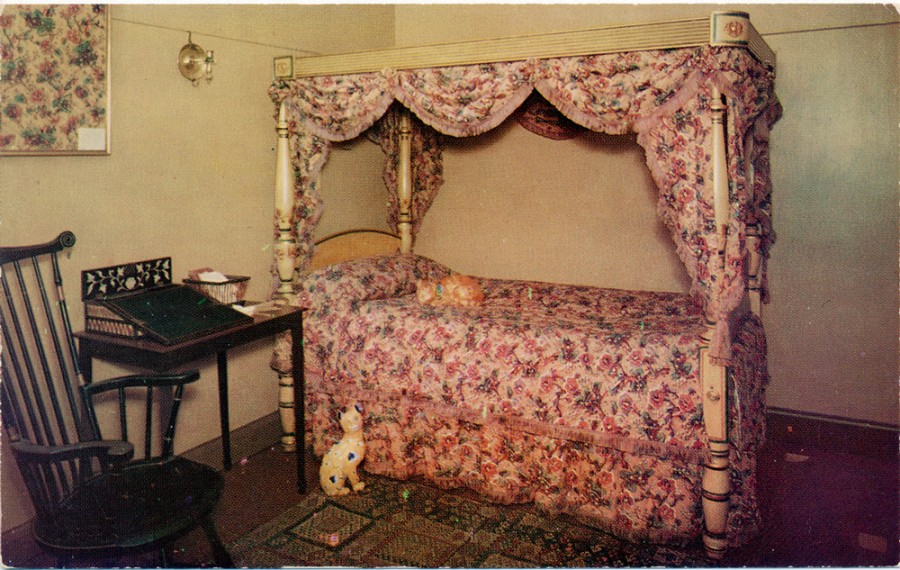
    Postcard, 1950s. Printed paper. H. 3 1/2", W. 5". (Collection of the author.) This image of the Peabody Museum of Salem’s 1950s recreation of the bedroom on Cleopatra’s Barge shows the painted bedstead commissioned for the yacht by George Crowninshield. The hangings are a reproduction of the original chintz fabric used on the bed in 1816.

  • Figure 31
    Figure 31

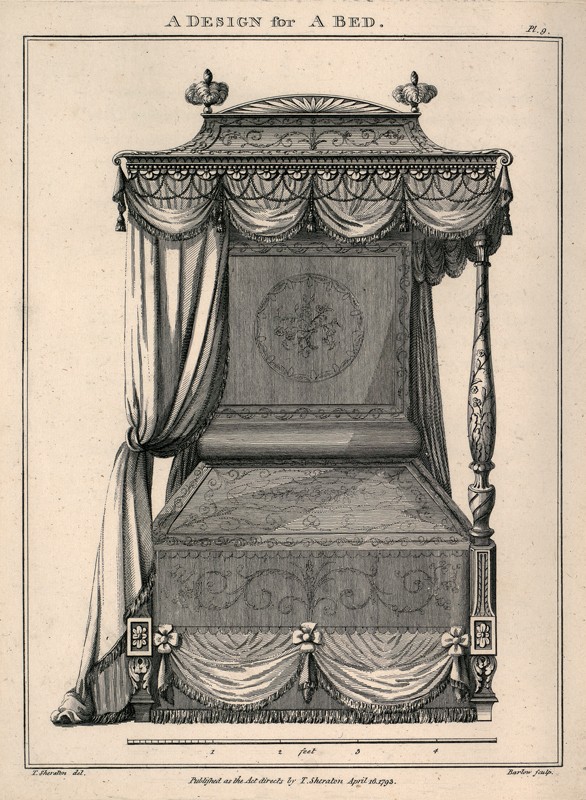
    “A design for a bed,” shown on plate 9 of Thomas Sheraton’s The Cabinet-Maker and Upholsterer’s Drawing-Book (London, 1793). (Courtesy, Yale Center for British Art, Friends of British Art.)

  • Figure 32
    Figure 32

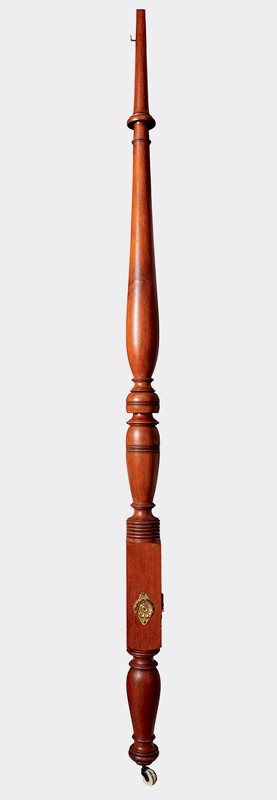
    Detail of the right front post of the bed in fig. 29. (Photo, Michael E. Myers.)

  • Figure 33
    Figure 33

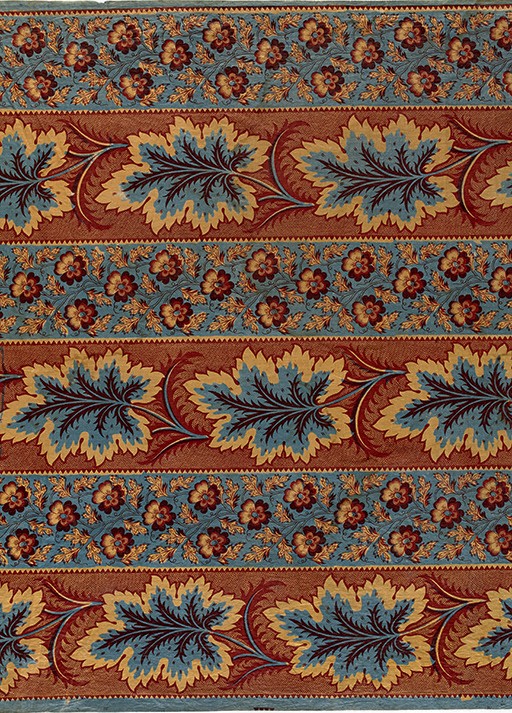
    Detail of a piece of the original English glazed cotton chintz used for bed hangings on the bed in fig. 29. (Peabody Essex Museum, gift of the Trustees of the Ropes Memorial, 1989, R1934; photo, Walter Silver.)

  • Figure 34
    Figure 34

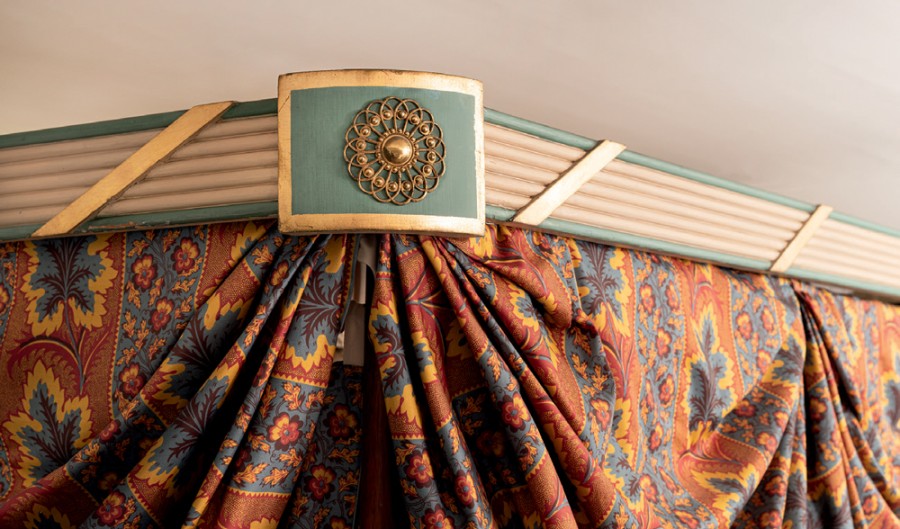
    Detail of the painted cornice with gilded medallion on the bedstead in fig. 29. (Photo, Dennis Helmar.)

  • Figure 35
    Figure 35

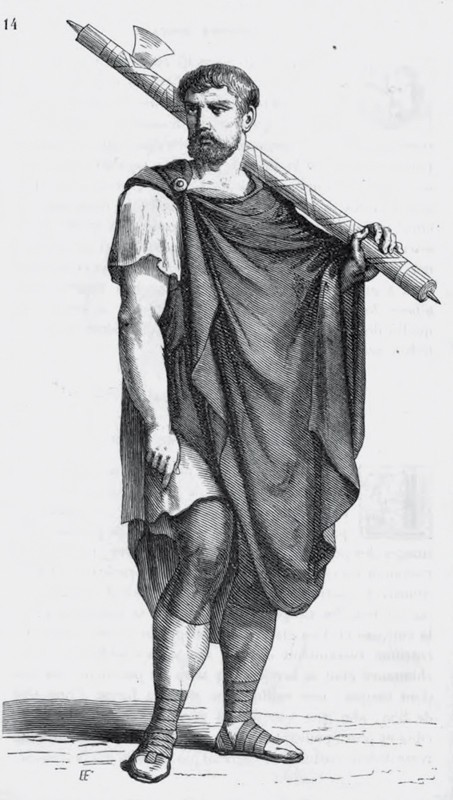
    A Roman carrying a fasces (wooden rods bound with straps around an ax head), an ancient symbol of united strength and power, from Cesare Vicellio and Ambroise Firmin-Didot’s Costumes anciens et modernes = Habiti antichi et moderni di tutto il mundo (Paris, 1860), pl. 4. (Courtesy, Indiana University; photo, HathiTrust Digital Library.)

  • Figure 36
    Figure 36

    Design for a “Bed Pillar” (detail) shown on plate 106 of George Hepplewhite’s The Cabinet-Maker and Upholsterer’s Guide (London, 1794). (Courtesy, Phillips Library, Peabody Essex Museum.) The upper reeded column is entwined with faux straps in imitation of a Roman fasces.

  • Figure 37
    Figure 37

    Field bedstead by Mark Pitman, 1817–1825. Mahogany, maple, pine, canvas, rope, brass, metal. H. 85", W. 59 1/4", D. 79". (Courtesy, Peabody Essex Museum, gift of the Trustees of the Ropes Memorial, 1989, R1078; photo, Kathy Tarantola.)

  • Figure 38
    Figure 38

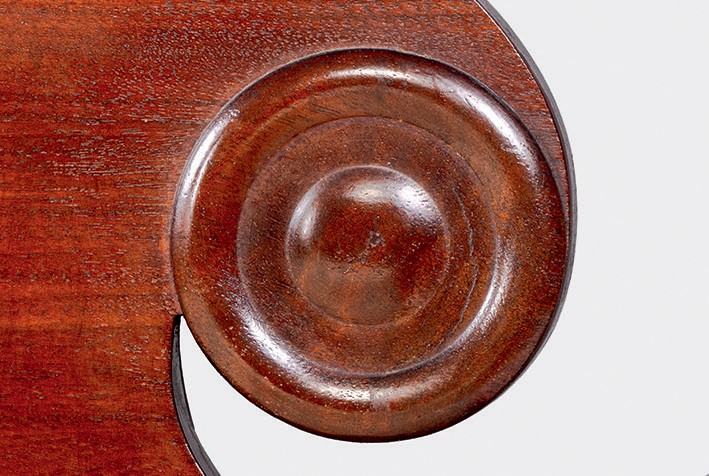
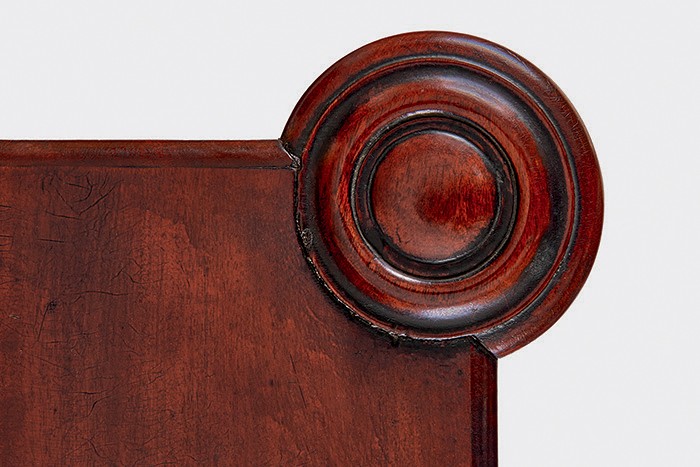
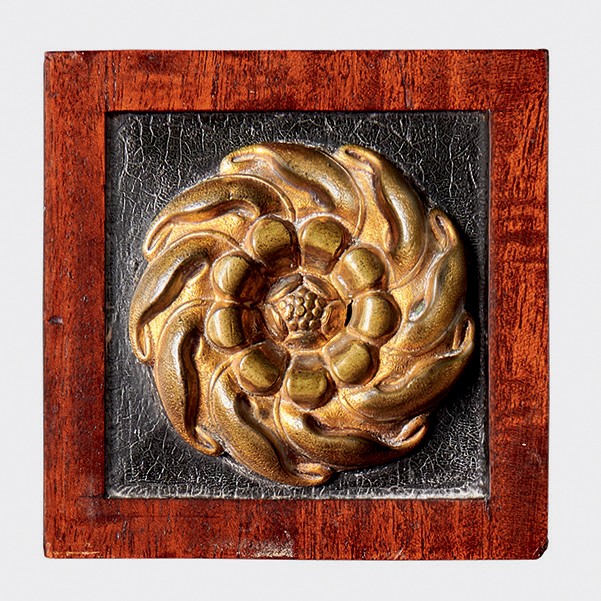
    Detail of the circular mahogany disc applied to the scroll on the headboard of the bedstead in fig. 37. (Photo, Kathy Tarantola.)

  • Figure 39
    Figure 39

    Detail of the pressed brass cap covering the metal bolt used to secure the front post to the side rail of the bedstead in fig. 37. (Photo, Kathy Tarantola.)

  • Figure 40
    Figure 40

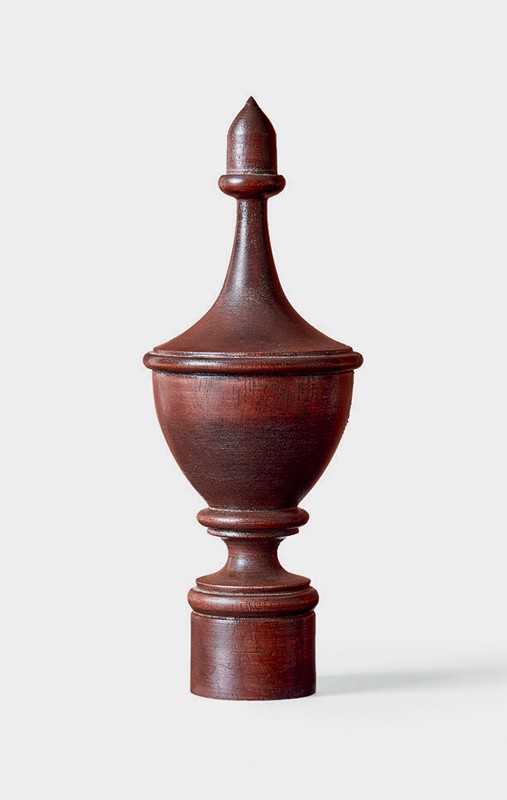
    Detail of the turned urn finial on the tester of the bedstead in fig. 37. (Photo, Michael E. Myers.)

  • Figure 41
    Figure 41

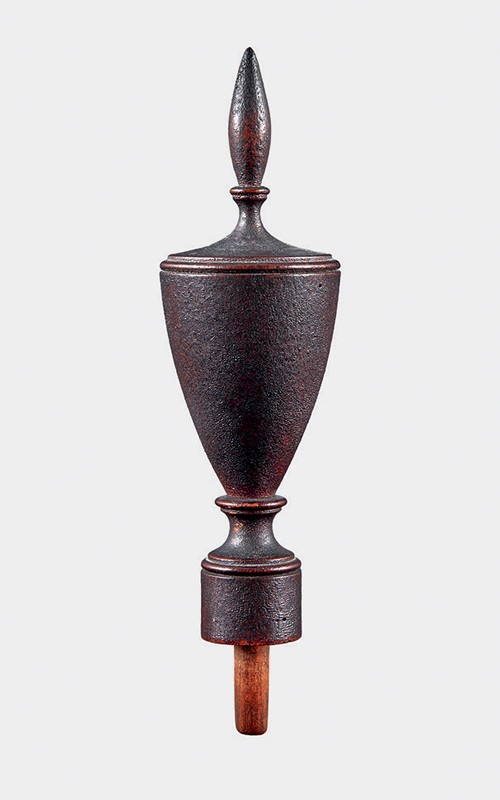
    Detail of the turned urn finial on the cornice of the desk and bookcase in fig. 2. (Photo, Michael E. Myers.)

  • Figure 42
    Figure 42

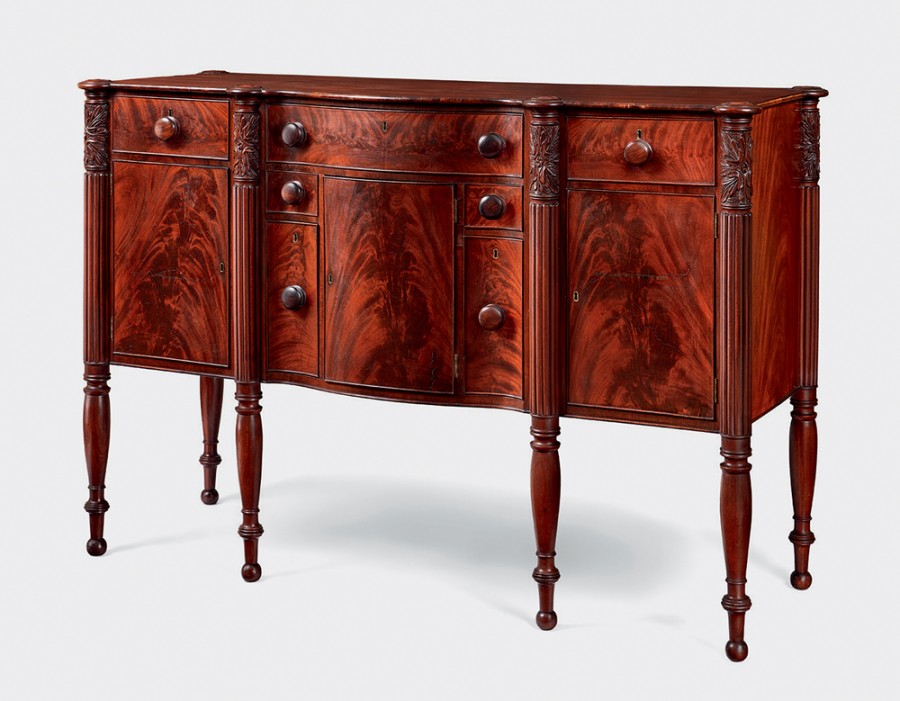
    Sideboard by Mark Pitman, 1817–1818. Mahogany, mahogany veneer, pine, metal. H. 42", W. 61 1/4", D. 22". (Courtesy, Peabody Essex Museum, gift of the Trustees of the Ropes Memorial, 1989, R1063; photo, Michael E. Myers.)

  • Figure 43
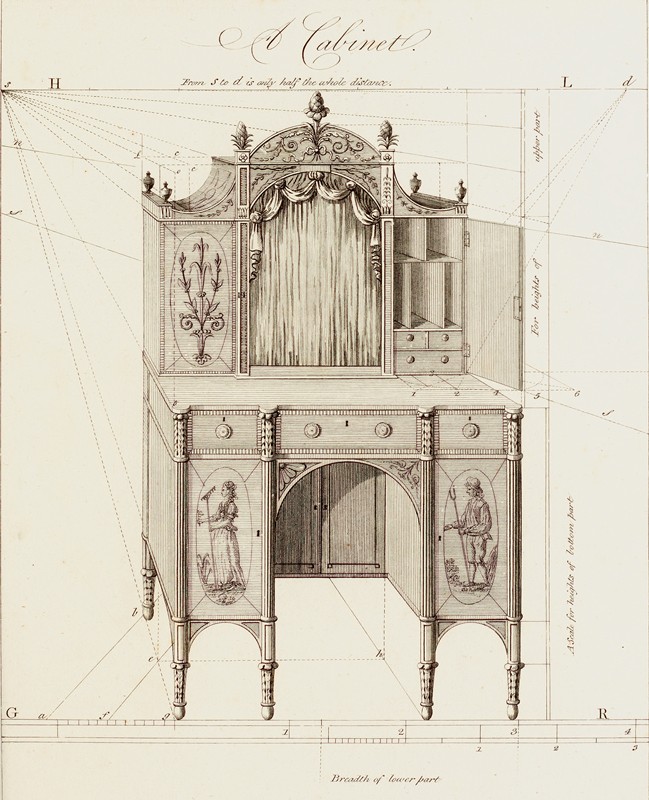
    Figure 43

    Design for “A Cabinet,” shown on plate 48 of Thomas Sheraton’s The Cabinet-Maker and Upholsterer’s Drawing-Book (London, 1793). (Courtesy, Phillips Library, Peabody Essex Museum.) The lower section is similar in form to the sideboard in fig. 42.

  • Figure 44
    Figure 44

    Detail of an ovolo cap on the top of one of the engaged columns on the sideboard in fig. 42. (Photo, Michael E. Myers.)

  • Figure 45
    Figure 45

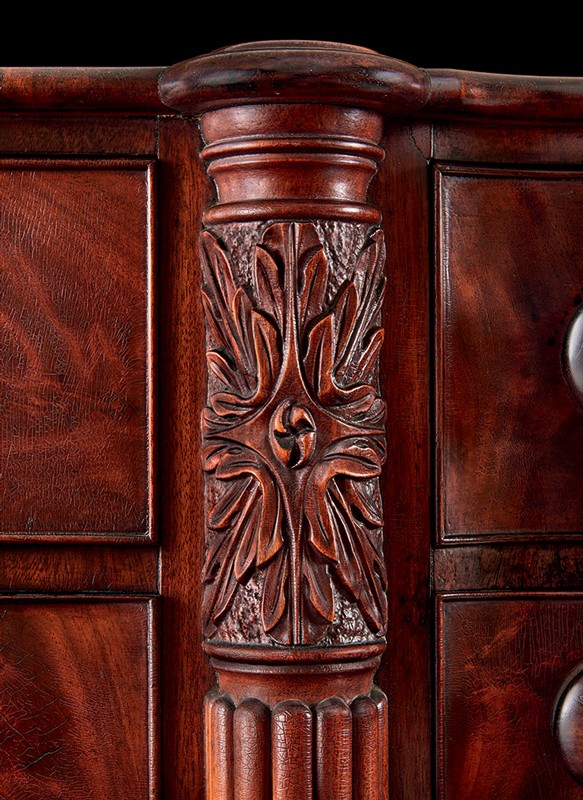
    Detail of the carved floral motif on one of the engaged columns on the sideboard in fig. 42. (Photo, Michael E. Myers.)

  • Figure 46
    Figure 46

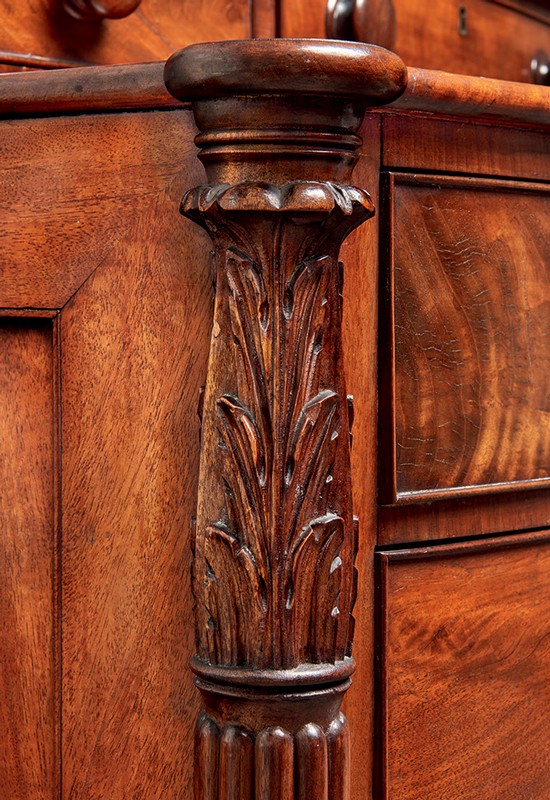
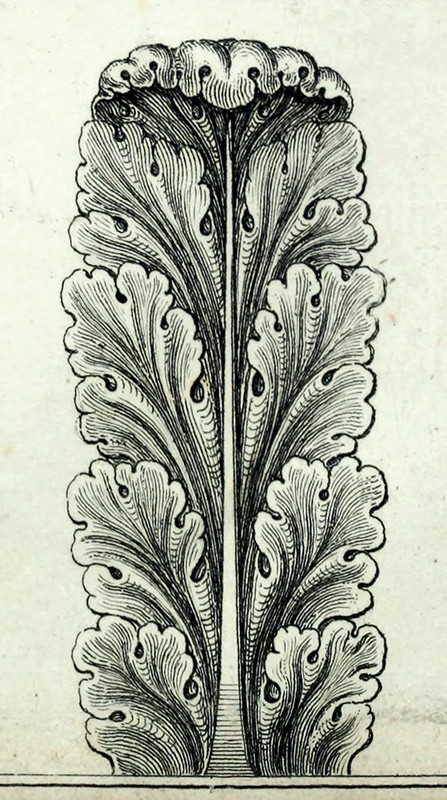
    Detail of the acanthus-leaf carving on one of the engaged columns on the dressing chest in fig. 50. (Photo, Michael E. Myers.)

  • Figure 47
    Figure 47

    Detail of a design for “Ornament for a Tablet and Various Leaves,” shown on plate 11 of Thomas Sheraton’s The Cabinet-Maker and Upholsterer’s Drawing-Book (London, 1793). (Courtesy, Getty Research Institute; photo, HathiTrust Digital Library.)

  • Figure 48
    Figure 48

    Secretary with tambour doors labeled by Mark Pitman, 1800–1810. Mahogany, birds-eye maple, Eastern white pine, oak, brass, bed ticking. H. 52 1/4", W. 38 1/4", D. 19". (Courtesy, Hood Museum of Art, Dartmouth College, purchased through a bequest from Lulu C. and Robert L. Coller, Class of 1923, F.984.19.)

  • Figure 49
    Figure 49

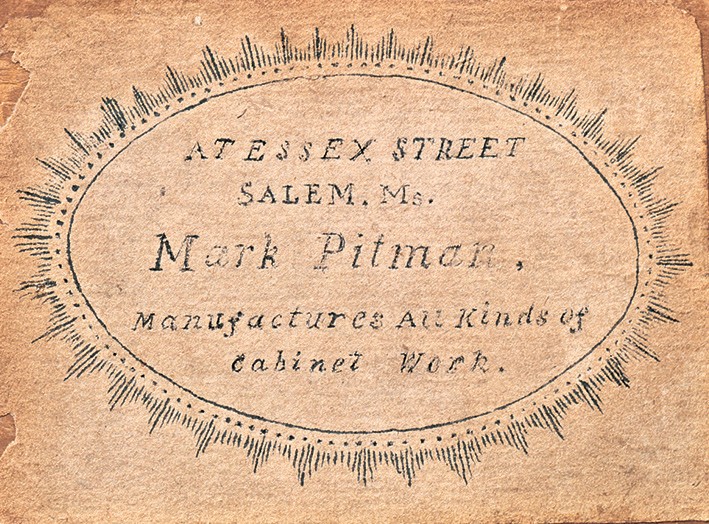
    Detail of the label on the secretary in fig. 48.

  • Figure 50
    Figure 50

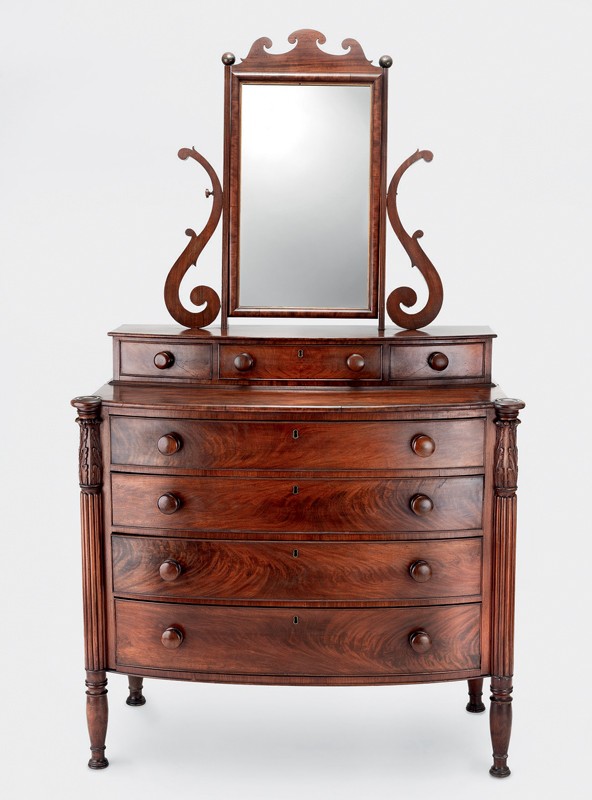
    Dressing chest with attached looking glass by Mark Pitman, 1817–1818. Mahogany, mahogany veneer, pine, mirror glass, painted brass. H. 71", W. 44", D. 22 1/2". (Courtesy, Peabody Essex Museum, gift of the Trustees of the Ropes Memorial, 1989, R1112.AB; photo, Dennis Helmar.)

  • Figure 51
    Figure 51

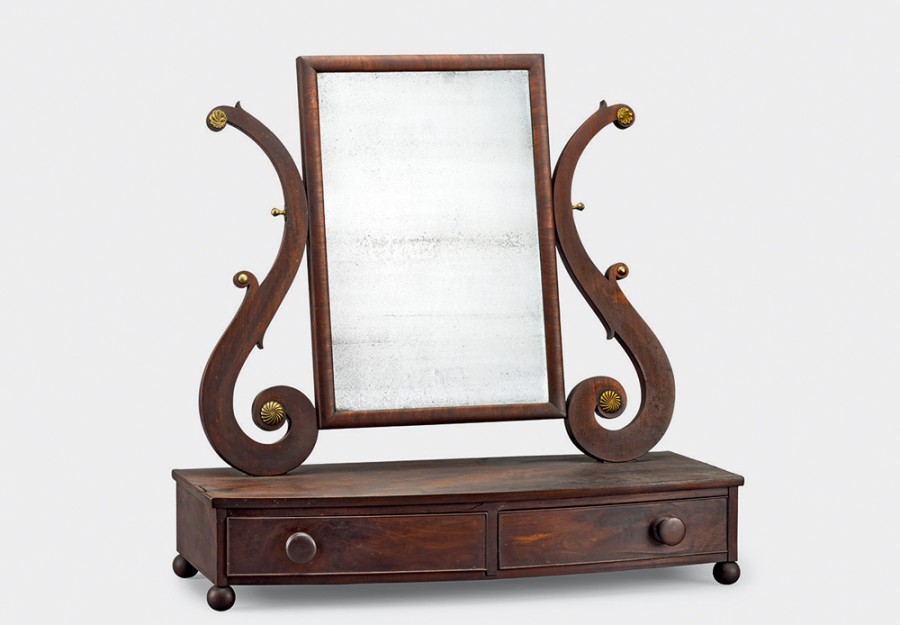
    Dressing glass by William Hook (1777–1867), Salem, Massachusetts, 1818. Mahogany, mahogany veneer, white pine, mirror glass, metal, brass. H. 27", W. 27 1/2", D. 11 1/2". (Courtesy, Peabody Essex Museum, gift of the estate of George Rea Curwen, 1900, 4134.83; photo, Kathy Tarantola.) This dressing glass was made for use on top of a bow front chest of drawers, also in the Peabody Essex Museum’s collection (4134.82).

  • Figure 52
    Figure 52

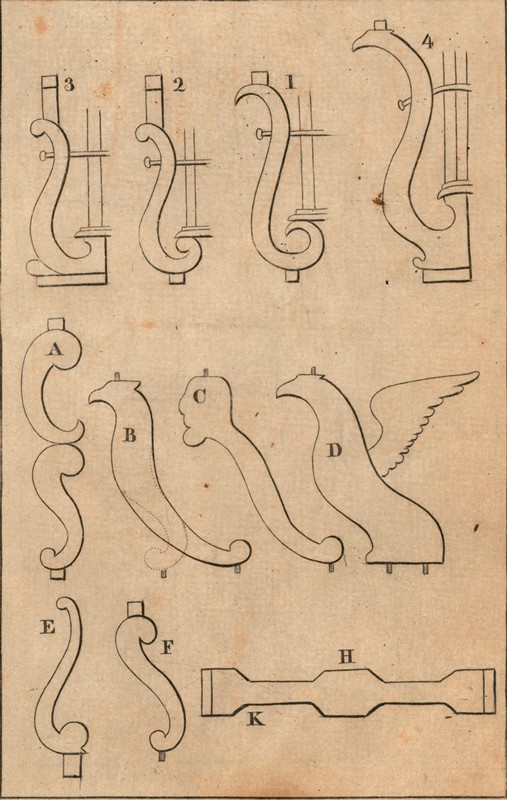
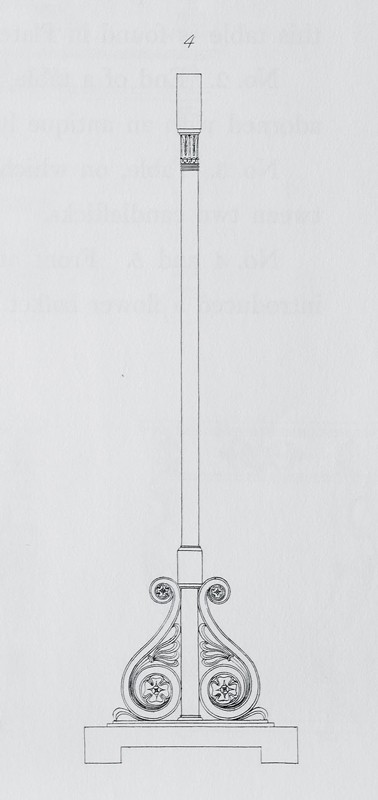
    Designs for brackets shown on plate 5 of the New-York Society of Cabinet Makers’ The New-York Book of Prices for Manufacturing Cabinet and Chair Work (New York, 1817). (Courtesy, The Metropolitan Museum of Art, Harris Brisbane Dick Fund, 1939.) Several of the illustrated designs are in imitation of the ancient lyre and similar to the brackets on the dressing glasses in figs. 50 and 51.

  • Figure 53
    Figure 53

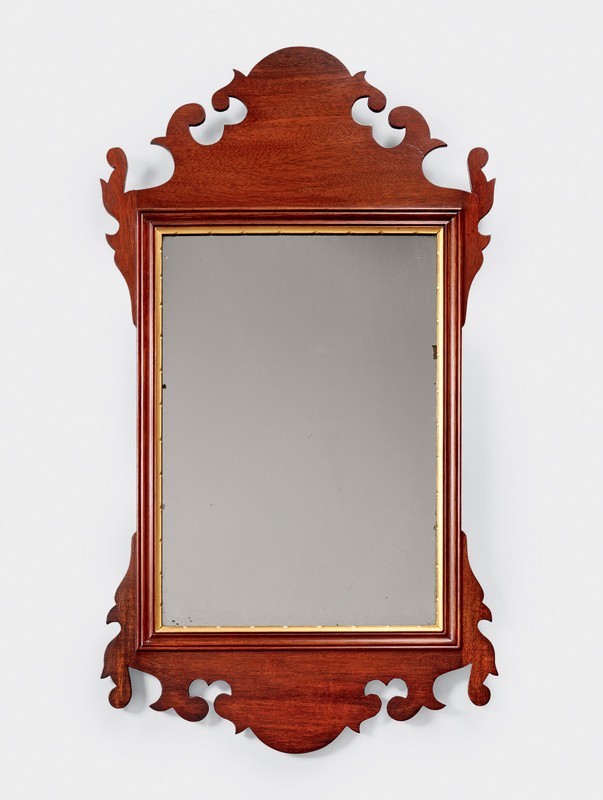
    Looking glass, Boston or Salem, possibly by Mark Pitman, 1800–1820. Mahogany, pine, mirror glass. H. 17 7/8", W. 31 3/8". (Courtesy, Peabody Essex Museum, gift of the Trustees of the Ropes Memorial, 1989, R1116; photo, Michael E. Myers.)

  • Figure 54
    Figure 54

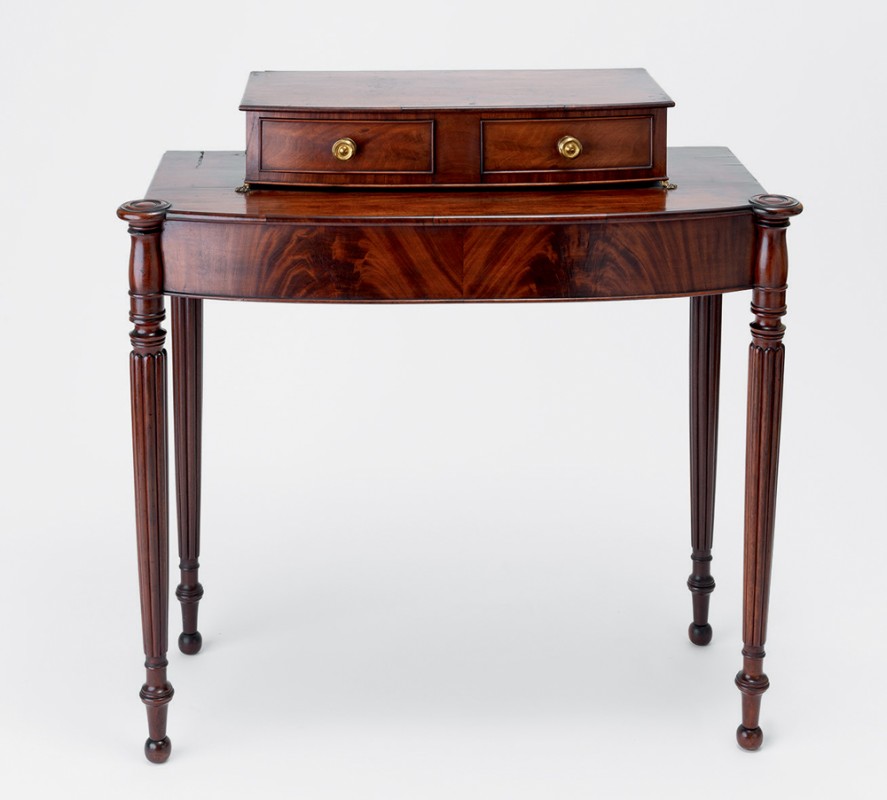
    Dressing table by Mark Pitman, 1817–1818. Mahogany, mahogany veneer, pine, brass. H. 38", W. 39", D. 17". (Courtesy, Peabody Essex Museum, gift of the Trustees of the Ropes Memorial, 1989, R1111.AB; photo, Dennis Helmar.) The chalk inscription “Bottom” in Pitman’s handwriting is on the underside of the drawer unit.

  • Figure 55
    Figure 55

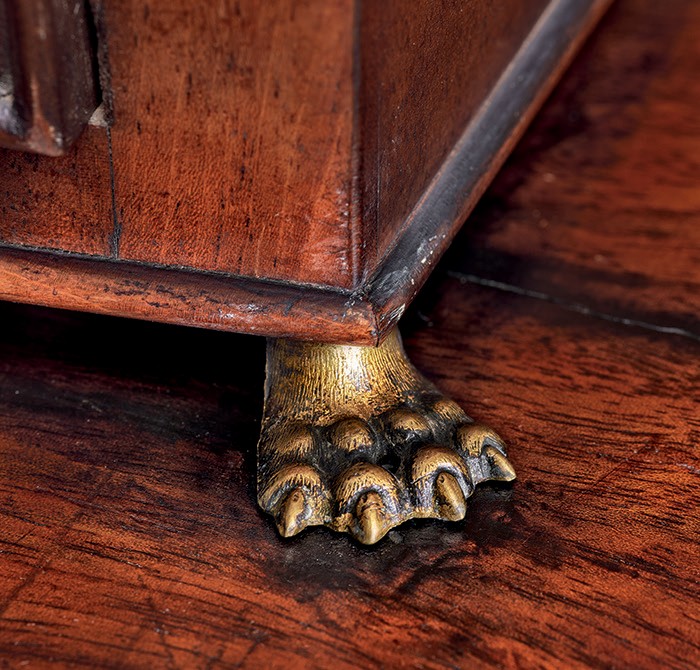
    Detail of a pressed brass foot imitating a lion paw on the drawer unit on the dressing table in fig. 54. (Photo, Michael E. Myers.)

  • Figure 56
    Figure 56

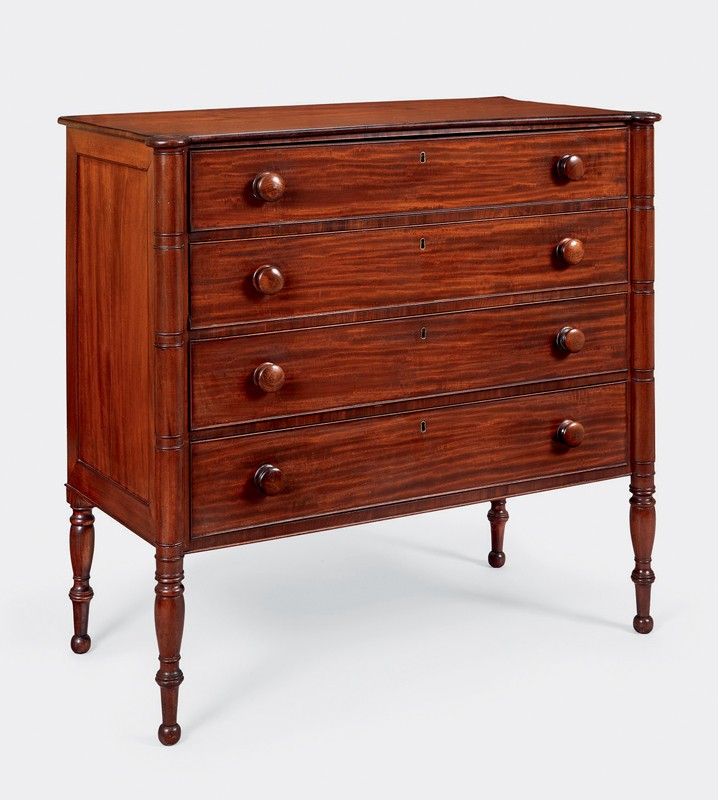
    Chest of drawers by Mark Pitman, 1817–1818. Mahogany, mahogany veneer, pine. H. 41", W. 43", D. 21 3/4". (Courtesy, Peabody Essex Museum, gift of the Trustees of the Ropes Memorial, 1989, R1082; photo, Michael E. Myers.)

  • Figure 57
    Figure 57

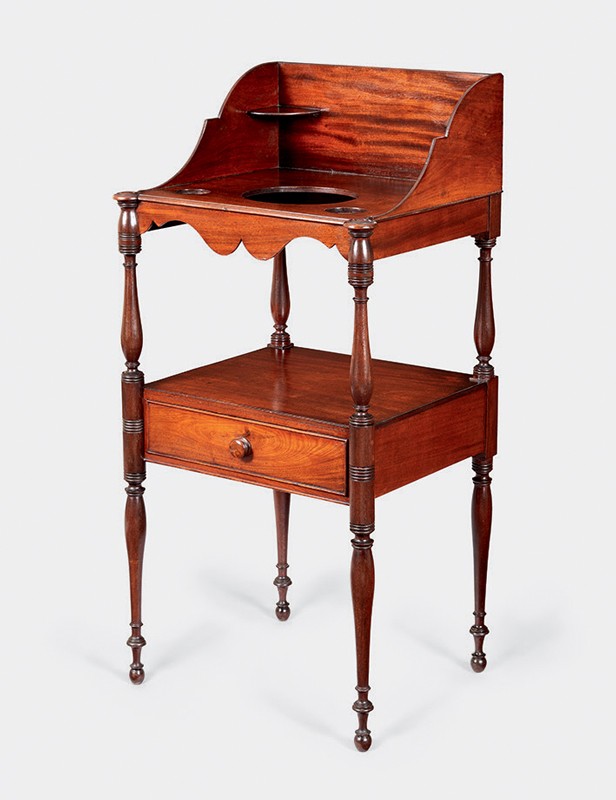
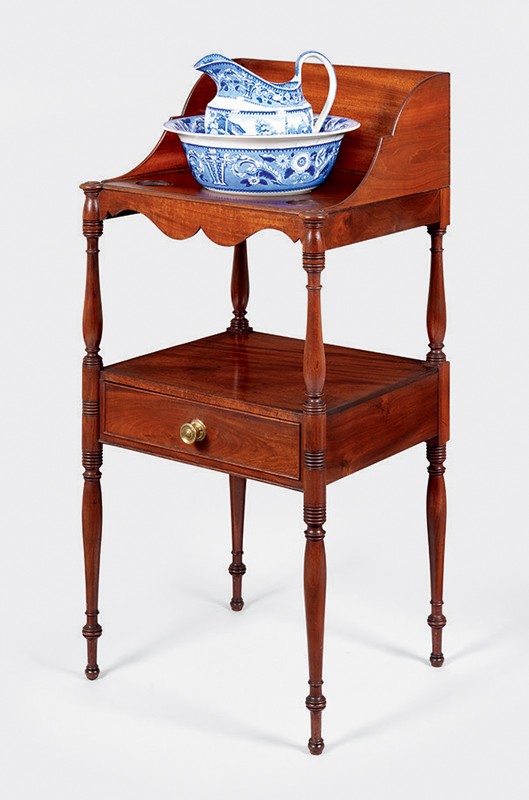
    Washstand by Mark Pitman, 1817–1818. Mahogany, mahogany veneer, pine. H. 39 1/2", W. 19 1/2", D. 16 1/2". (Courtesy, Peabody Essex Museum, gift of the Trustees of the Ropes Memorial, 1989, R1081; photo, Michael E. Myers.)

  • Figure 58
    Figure 58

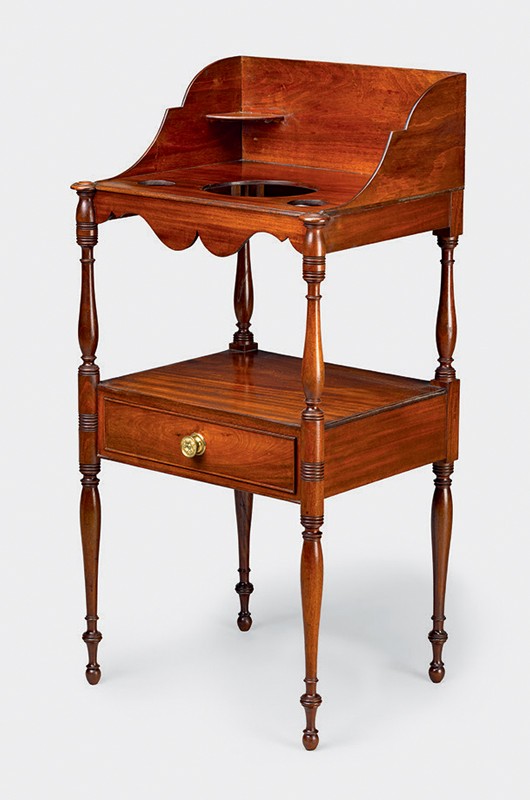
    Washstand by Mark Pitman, 1817–1818. Mahogany, mahogany veneer, pine, brass. H. 39 1/2", W. 19 1/2", D. 16 1/2". (Courtesy, Peabody Essex Museum, gift of the Trustees of the Ropes Memorial, 1989, R1125; photo, Kathy Tarantola.)

  • Figure 59
    Figure 59

    Washstand by Mark Pitman, 1817–1825. Mahogany, mahogany veneer, pine, brass. H. 39 3/4", W. 19 1/2", D. 16 3/4". (Courtesy, Peabody Essex Museum, gift of the Trustees of the Ropes Memorial, 1989, R1105, washstand and R361.AB, ewer and basin; photo, Michael E. Myers.) Shown with an ewer and basin, English transfer-printed pottery, ca. 1817. The wash set is one of four purchased by the Ornes in 1818 and used with their washstands.

  • Figure 60
    Figure 60

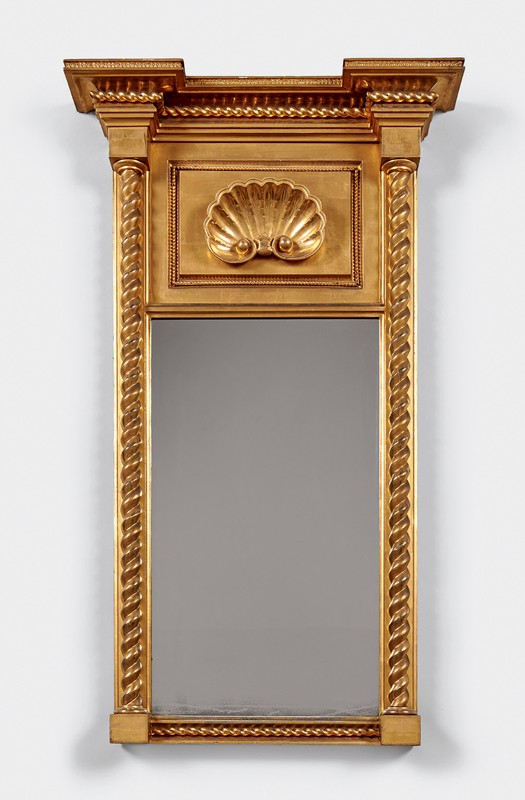
    Looking glass with a shell ornament, Boston or Salem, Massachusetts, ca. 1817. Gilded wood, pine, mirror glass. H. 38 1/4", W. 22 3/4". (Courtesy, Peabody Essex Museum, gift of the Trustees of the Ropes Memorial, 1989, R1083; photo, Michael E. Myers.) The Ornes purchased the mirror in 1817 to hang above one of their washstands.

  • Figure 61
    Figure 61

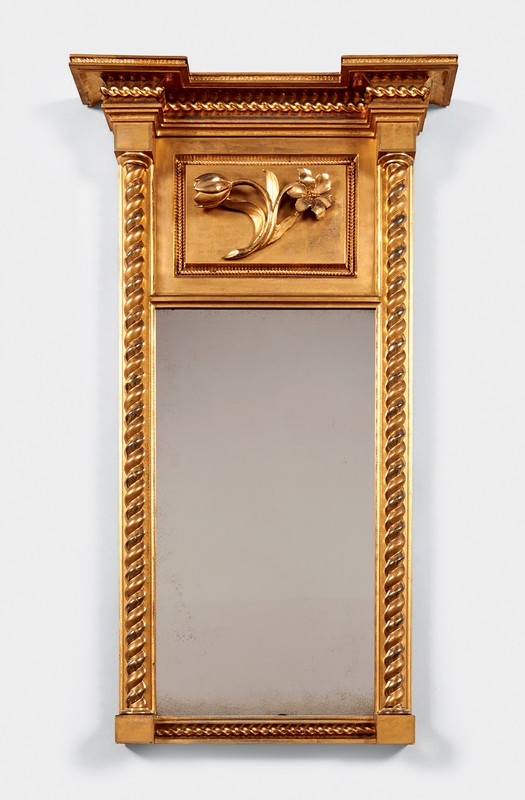
    Looking glass with floral ornaments, Boston or Salem, Massachusetts, ca. 1817. Gilded wood, pine, mirror glass. H. 39 1/2", W. 22 1/4". (Courtesy, Peabody Essex Museum, gift of the Trustees of the Ropes Memorial, 1989, R1106; photo, Michael E. Myers.) The Ornes purchased the mirror in 1817 to hang above one of their washstands.

  • Figure 62
    Figure 62

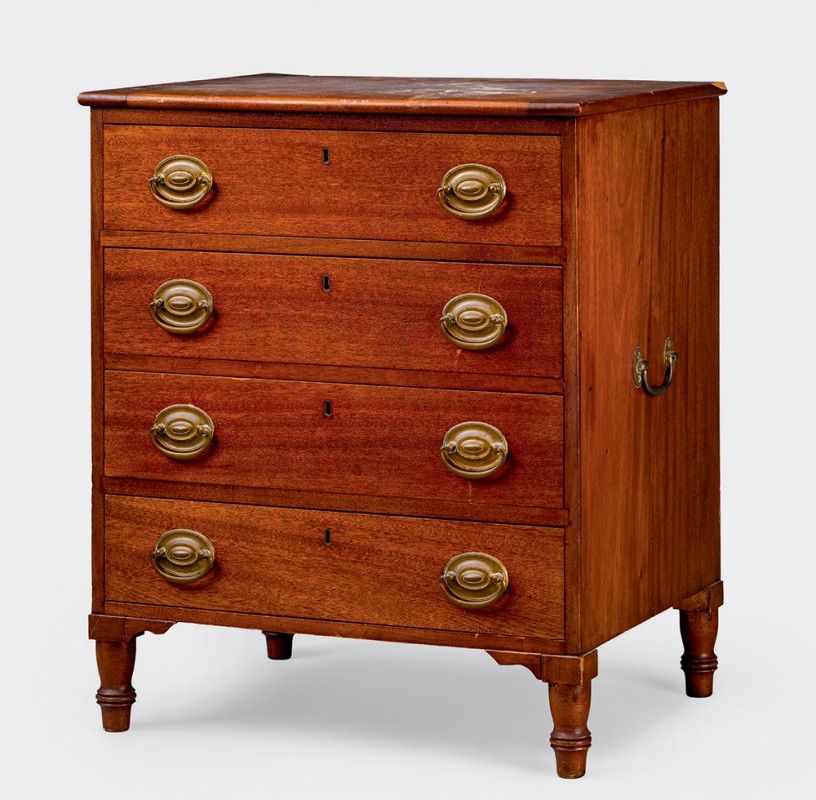
    Night table by Mark Pitman,1817–1818; altered into a four-drawer display chest, ca. 1900. Mahogany, pine, brass. H. 29 1/2", W. 25", D. 18 3/4". (Courtesy, Peabody Essex Museum, FIC2019.7.1; photo, Kathy Tarantola.)

  • Figure 63
    Figure 63

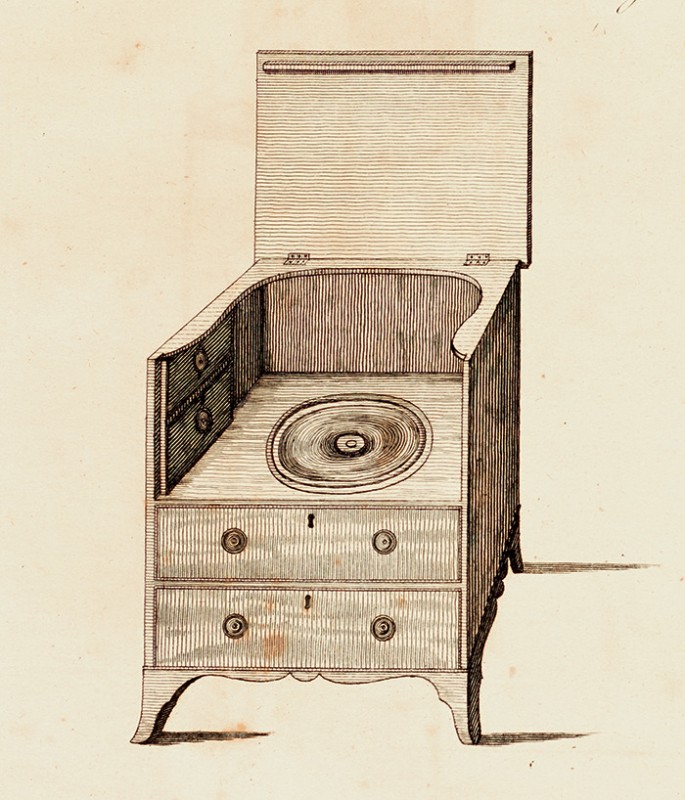
    Design for a night table (detail), shown on plate 82 of the third edition of George Hepplewhite’s The Cabinet-Maker and Upholsterer’s Guide (London, 1794). (Courtesy, Phillips Library, Peabody Essex Museum.)

  • Figure 64
    Figure 64

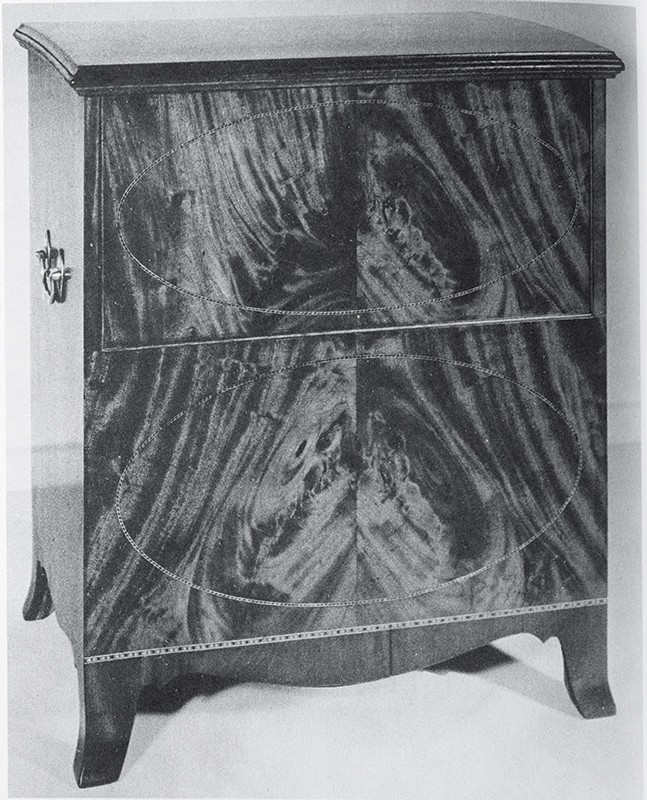
    Commode or night table by Elijah Sanderson (1751–1825), Salem, Massachusetts, ca. 1800. Mahogany, mahogany veneer, white pine, brass. H. 29 1/2", W. 25 3/4", D. 19". (Private collection; photo, Phillips Library, Peabody Essex Museum.) Illustrated in Dean A. Fales Jr.’s Essex County Furniture: Documented Treasures from Local Collections, 1660–1860 (Salem, Mass.: Essex Institute, 1965), pl. 37.

  • Figure 65
    Figure 65

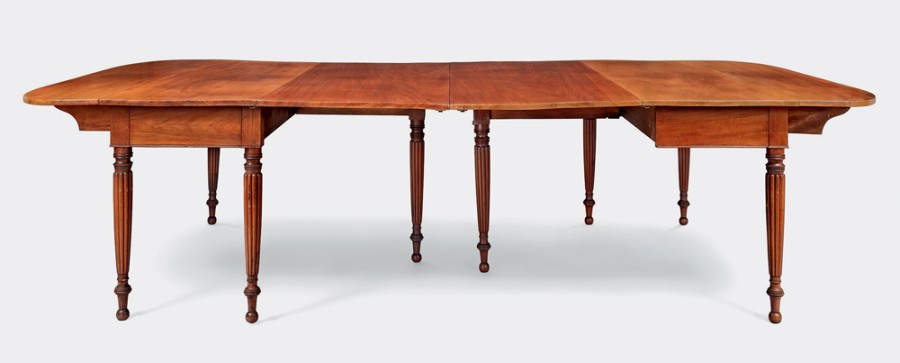
    Two-section dining table by Mark Pitman, 1817–1818. Mahogany, mahogany veneer, pine, metal. Each section, H. 28 1/2", W. 54", L. 56" (fully open) (total table length 112"). (Courtesy, Peabody Essex Museum, gift of the Trustees of the Ropes Memorial, 1989, R1070; photo, Michael E. Myers.)

  • Figure 66
    Figure 66

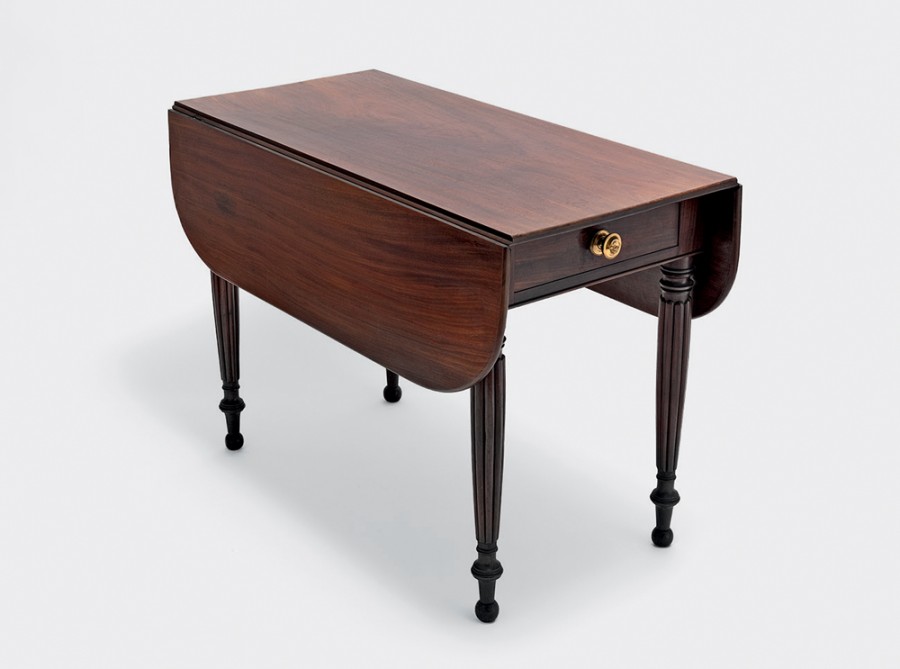
    Pembroke table by Mark Pitman, 1817–1818. Mahogany, mahogany veneer, pine, brass, metal. H. 28 1/2", W. 42", D. 31". (Courtesy, Peabody Essex Museum, gift of the Trustees of the Ropes Memorial, 1989, R1068; photo, Dennis Helmar.)

  • Figure 67
    Figure 67

    Detail of the brass pull with thistle motif on the drawer of the table in fig. 66. (Photo, Dennis Helmar.)

  • Figure 68
    Figure 68

    Armchair, probably New York City, ca. 1817. Multiple woods, rush, and paint. H. 32 1/2", W. 20". (Courtesy, Peabody Essex Museum; gift of the Trustees of the Ropes Memorial, 1989, R1069.2.) This armchair was from a set purchased by Sally and Joseph Orne about 1817 to be used with the dining table in fig. 65. Two armchairs and four side chairs survive in the collection from what was likely a larger set.

  • Figure 69
    Figure 69

    “Landscape” painted side chair, probably New York City, 1816. Multiple woods, rush and paint. H. 33 1/4", W. 18", D. 16". (Courtesy, Peabody Essex Museum, gift of Arthur R. Sharp, Jr. and Mary Silsbee Sharp, 1972, M8541; photo, Kathy Tarantola.) This side chair was from a set used for dining on George Crowninshield’s yacht Cleopatra’s Barge.

  • Figure 70
    Figure 70

    William Brown Jr.’s advertisement for “FANCY CHAIRS” in the Mercantile Advertiser (New York, N.Y.), February 15, 1816. (Courtesy, New-York Historical Society.)

  • Figure 71
    Figure 71

    Pier glass with a cornucopia and grapes motif, Salem or Boston, Massachusetts, 1817. Gilded and ebonized wood, mirror glass. H. 45", W. 22", D. 2 1/2". (Courtesy, Peabody Essex Museum, gift of the Trustees of the Ropes Memorial, 1989, R1066; photo, Michael E. Myers.) This looking glass was purchased by the Ornes in 1817 for their dining room to coordinate with the painted black and gold chair in fig. 68.

  • Figure 72
    Figure 72

    The Pitman dining furniture and other table accessories owned by Sally and Joseph Orne, installed in 2015 in the dining room that had been remodeled in 1835–1836 in the Ropes Mansion. (Courtesy, Peabody Essex Museum; photo, Kathy Tarantola.)

  • Figure 73
    Figure 73

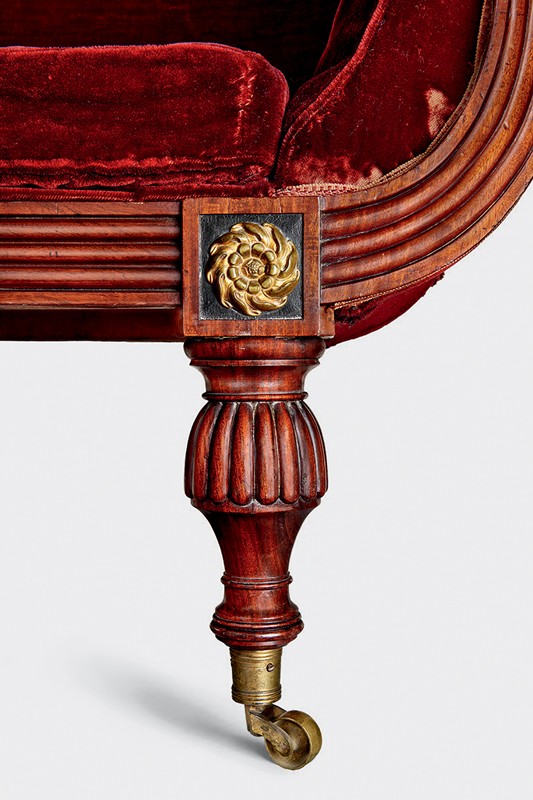
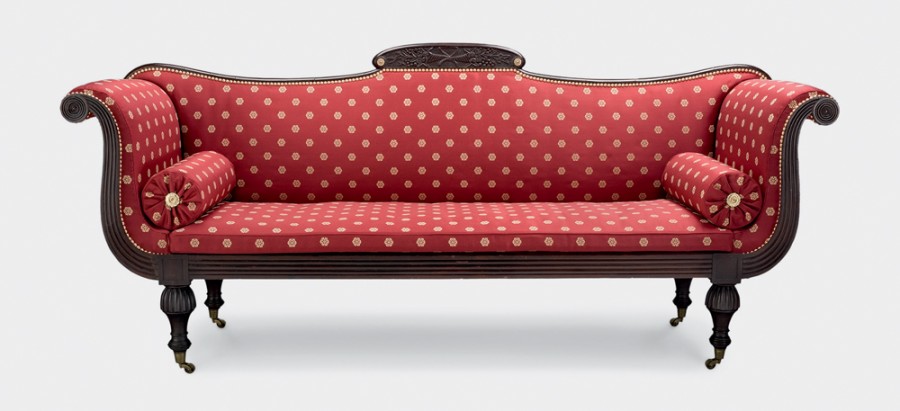
    Grecian style sofa by Mark Pitman, 1817–1818. Mahogany, maple, pine, brass, with red wool upholstery from the 1890s. H. 38", W. 84 1/4", D. 24 1/4". (Courtesy, Peabody Essex Museum, gift of the Trustees of the Ropes Memorial, 1989, R1048; photo, Dennis Helmar.)

  • Figure 74
    Figure 74

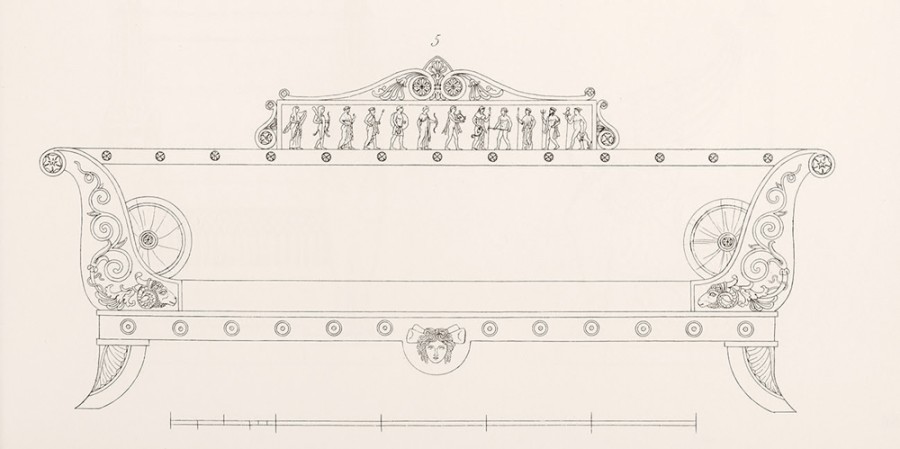
    Design for a “Grecian Sofa,” shown on plate 73 of Thomas Sheraton’s The Cabinet Dictionary (London, 1803). (Courtesy, Phillips Library, Peabody Essex Museum.)

  • Figure 75
    Figure 75

    Detail of a front leg of the sofa in fig. 73. (Photo, Michael E. Myers.)

  • Figure 76
    Figure 76

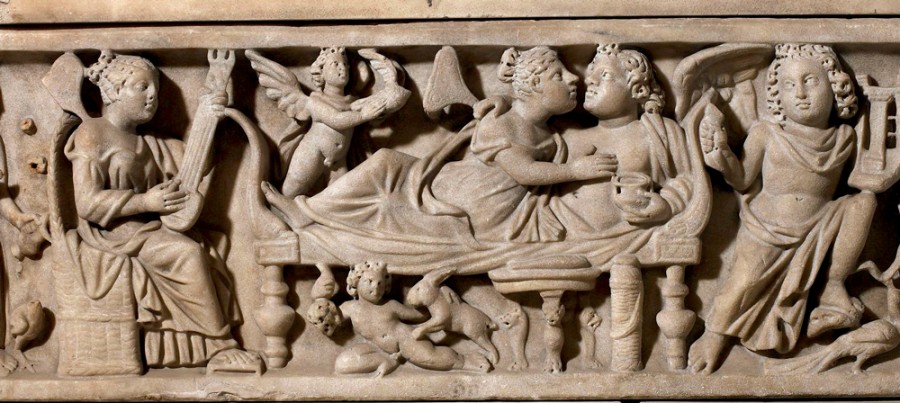
    Detail of child’s sarcophagus depicting the marriage feast of Cupid and Psyche, Roman, 3rd century CE. Proconnesian marble. (Courtesy and © The Trustees of the British Museum.) The couple are seated on a sofa similar in form to the sofas in figs. 73 and 77.

  • Figure 77
    Figure 77

    Grecian style sofa by Mark Pitman, carving attributed to Samuel Field McIntire (1780–1819), ca. 1815. Mahogany, maple, with modern upholstery. H. 37 1/2", W. 85", D. 24 1/2". (Courtesy, Peabody Essex Museum, gift of Mrs. Robert Johnston, 1984, 136133; photo, Dennis Helmar.) The sofa was made for the family of Jonathan Peele Saunders (1785–1844).

  • Figure 78
    Figure 78

    Design for a settee (detail), shown on plate 18 of Thomas Hope’s Household Furniture and Interior Decoration (London, 1807). (Courtesy, Phillips Library, Peabody Essex Museum.)

  • Figure 79
    Figure 79

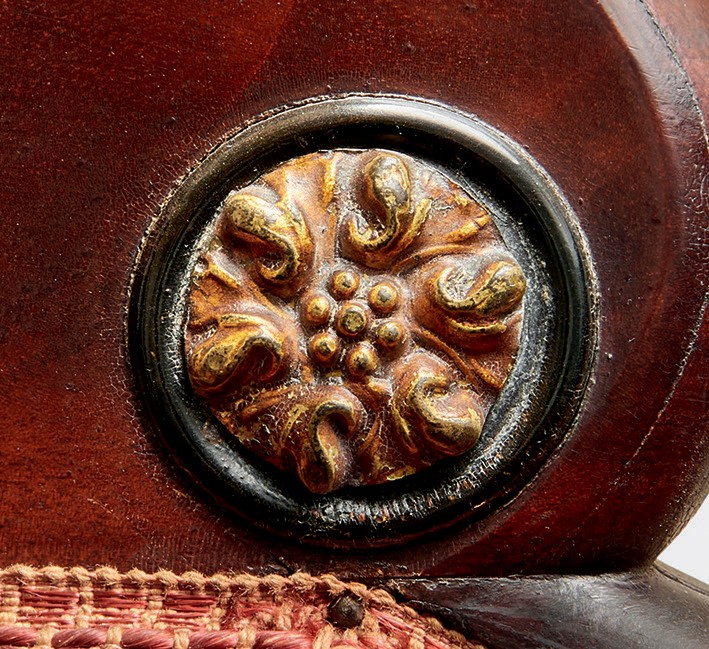
    Detail of the brass floral mount on the crest rail of the sofa in fig. 73. (Photo, Michael E. Myers.)

  • Figure 80
    Figure 80

    Detail of the brass floral mount on the arm of the sofa in fig. 73. (Photo, Michael E. Myers.)

  • Figure 81
    Figure 81

    Detail of the brass floral mount on the front seat rail of the sofa in fig. 73. (Photo, Michael E. Myers.)

  • Figure 82
    Figure 82

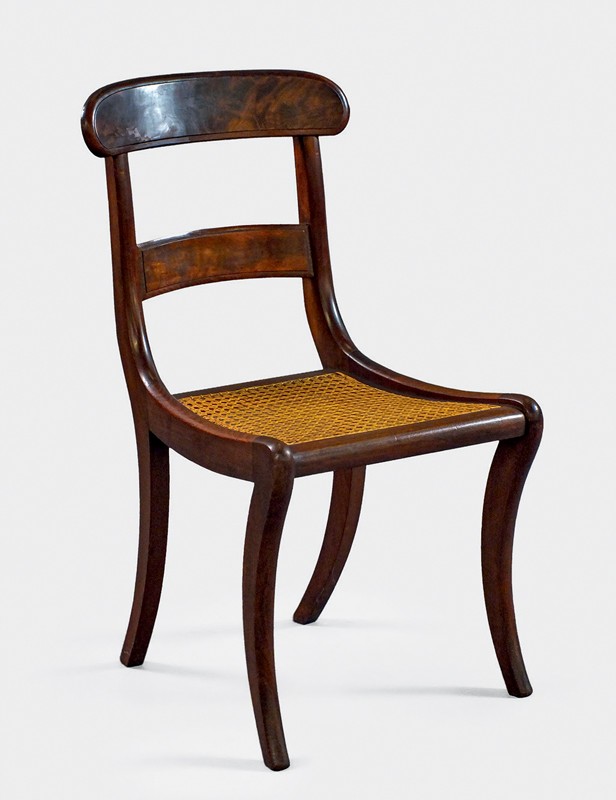
    Side chair (from a set of ten) by Mark Pitman, 1817–1818. Mahogany, mahogany veneer, cane. H. 33", W. 17", D. 18". (Courtesy, Peabody Essex Museum, gift of the Trustees of the Ropes Memoral, 1989, R1131.1.)

  • Figure 83
    Figure 83

    Side chair, attributed to Isaac Vose and Son, Boston, Massachusetts, with Thomas Wightman, carver, 1824–1825. Mahogany, birch, modern upholstery. H. 33", W. 19", D. 17". (Private collection; photo, David Bohl.) This chair is from a set originally owned by Samuel Atkins Eliot and Mary Lyman Eliot.

  • Figure 84
    Figure 84

    Easy chair by Mark Pitman, 1817–1818. Mahogany, various hardwoods, later upholstery. H. 40 1/2", W. 28 1/2", D. 30". (Courtesy, Peabody Essex Museum, gift of the Trustees of the Ropes Memorial, 1989, R1114; photo, Dennis Helmar.)

  • Figure 85
    Figure 85

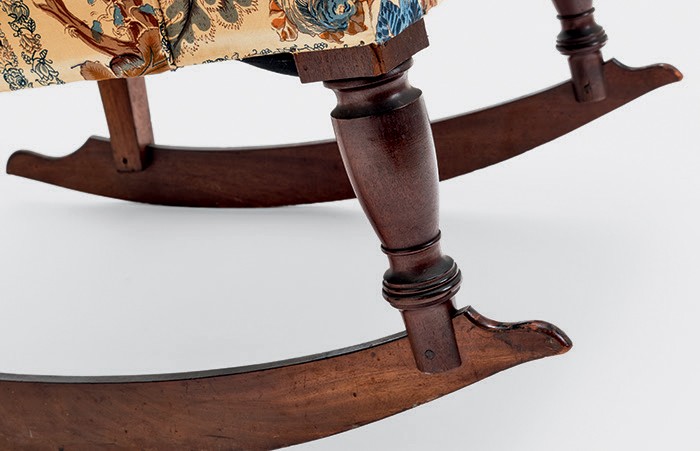
    Detail of the front leg and rocker on the easy chair in fig. 84. (Photo, Dennis Helmar.)

  • Figure 86
    Figure 86

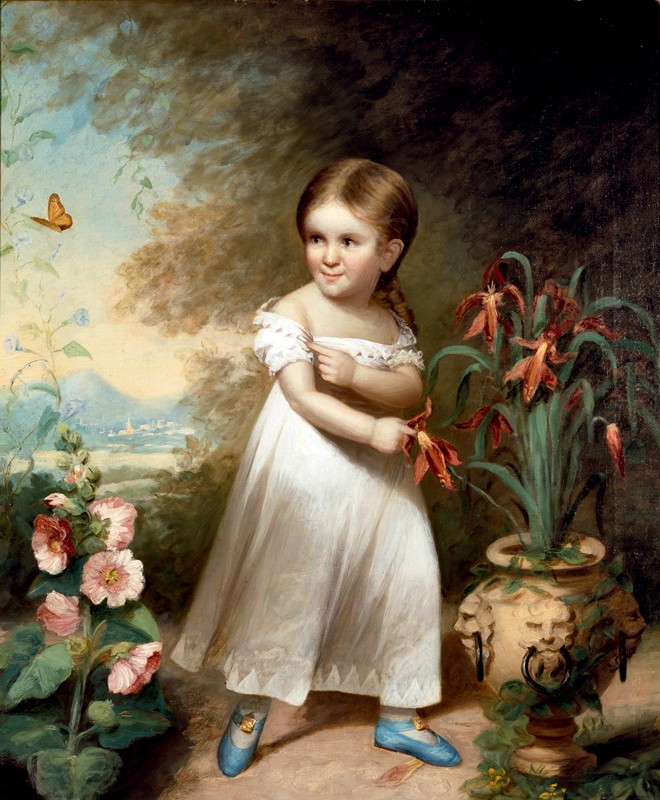
    James Frothingham (1786–1864), Elizabeth Ropes Orne, ca. 1822. Oil on canvas. H. 42", W. 35" (Courtesy, Peabody Essex Museum, gift of the Trustees of the Ropes Memorial, 1989, R746.)

  • Figure 87
    Figure 87

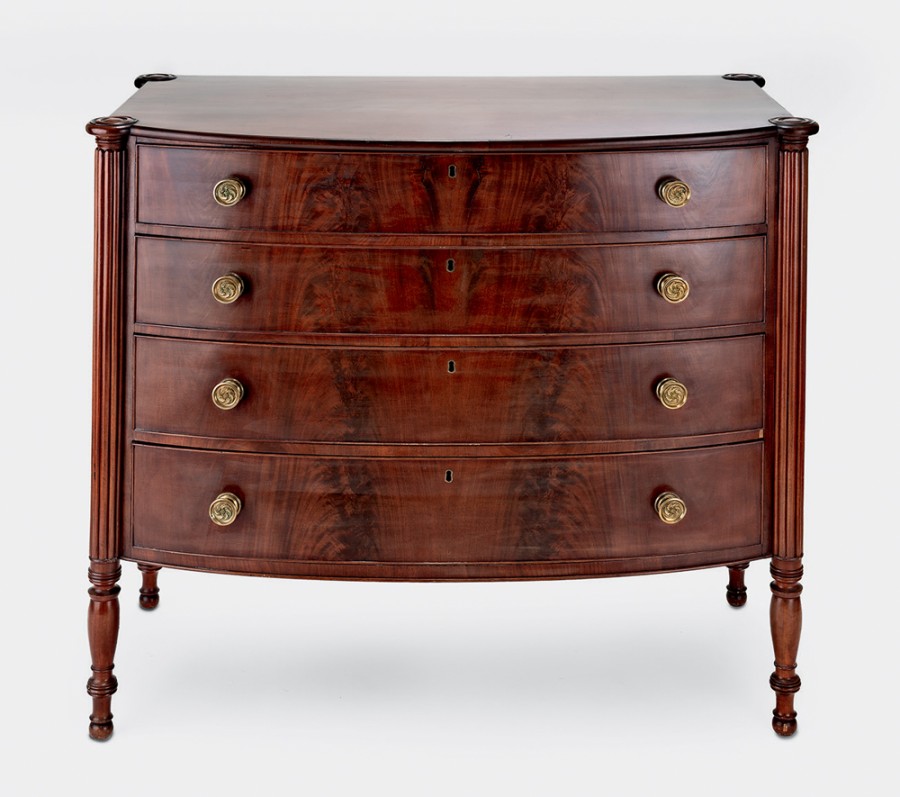
    Bow front chest of drawers by Mark Pitman, 1810–1825. Mahogany, mahogany veneer, pine, brass. H. 39 1/2", W. 44 1/4", D. 20 1/2". (Courtesy, Peabody Essex Museum, gift of the Trustees of the Ropes Memorial, 1989, R1113; photo, Dennis Helmar.)

  • Figure 88
    Figure 88

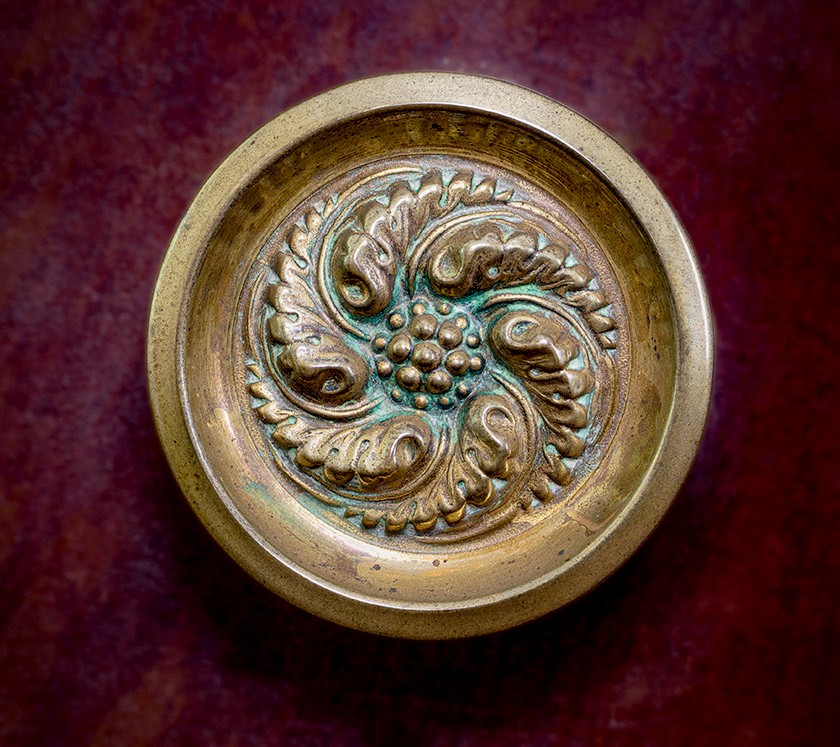
    Detail of the brass drawer pull with sea shell motif on the chest of drawers in fig. 87. (Photo, Dennis Helmar.)

  • Figure 89
    Figure 89

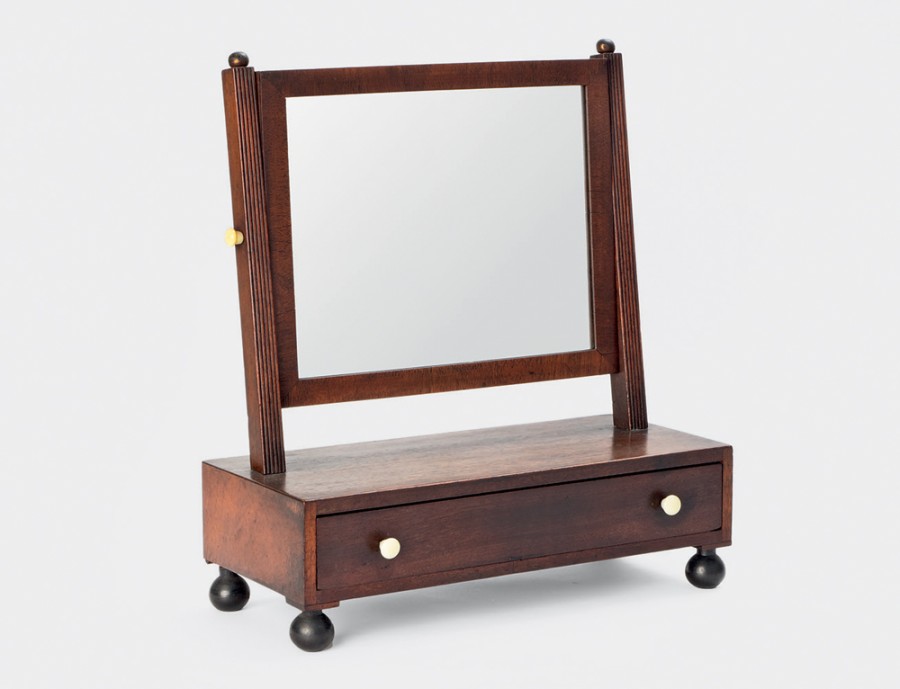
    Dressing box with attached looking glass by Mark Pitman, 1817–1825. Mahogany, mahogany veneer, pine, ivory, metal, mirror glass. H. 16 1/2", W. 14 7/8", D. 6 1/2". (Courtesy, Peabody Essex Museum, gift of the Trustees of the Ropes Memorial, 1989, R1103; photo, Dennis Helmar.)

  • Figure 90
    Figure 90

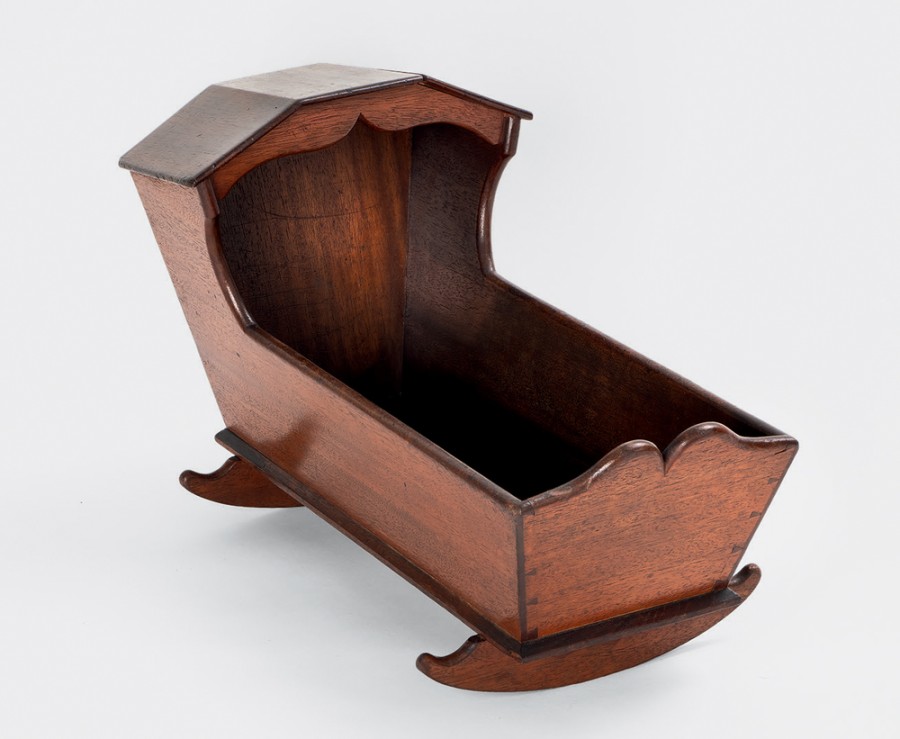
    Toy cradle by Mark Pitman, 1820–1830. Mahogany. H. 8 1/2", W. 14", D. 7 1/2". (Courtesy, Peabody Essex Museum, gift of the Trustees of the Ropes Memorial, 1989, R1098; photo, Dennis Helmar.)

  • Figure 91
    Figure 91

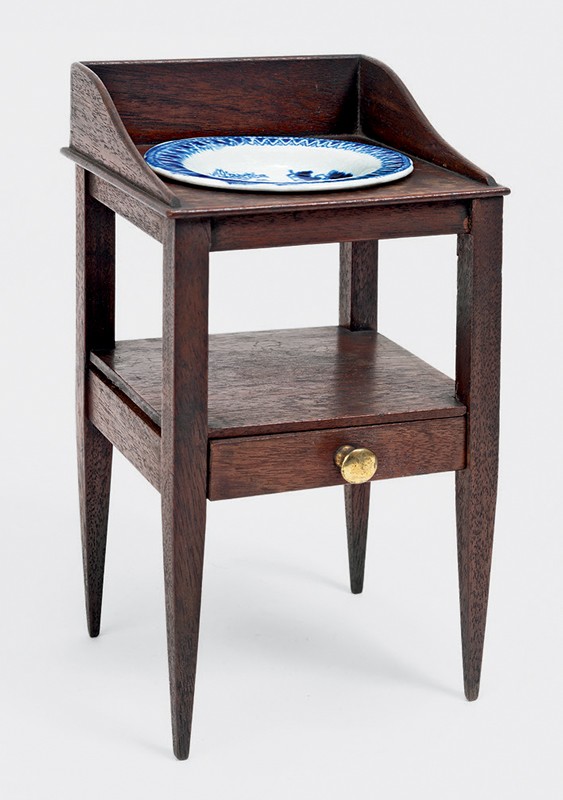
    Toy washstand by Mark Pitman, 1820–1830. Mahogany, brass. H. 8 1/4", W. 4 1/2", D. 4 1/2". (Courtesy, Peabody Essex Museum, gift of the Trustees of the Ropes Memorial, 1989, R1099, washstand and R351.2, plate; photo, Dennis Helmar.) Shown with miniature plate, English, ca. 1825.

  • Figure 92
    Figure 92

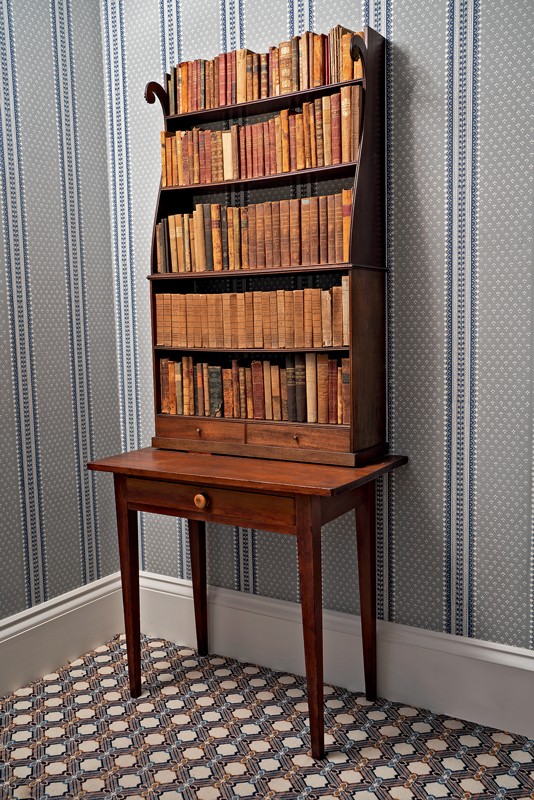
    Two-part bookshelf with two drawers by Mark Pitman, 1828. Mahogany, mahogany veneer, pine, brass. H. 45 1/2", W. 28", D. 8 1/2". Shown on top of a single drawer table by Mark Pitman, 1807–1825. Pine, maple. H. 29", W. 32 1/4", D. 17 3/4". (Courtesy, Peabody Essex Museum, gift of the Trustees of the Ropes Memorial, 1989, R1101, R1100; photo, Dennis Helmar.)

  • Figure 93
    Figure 93

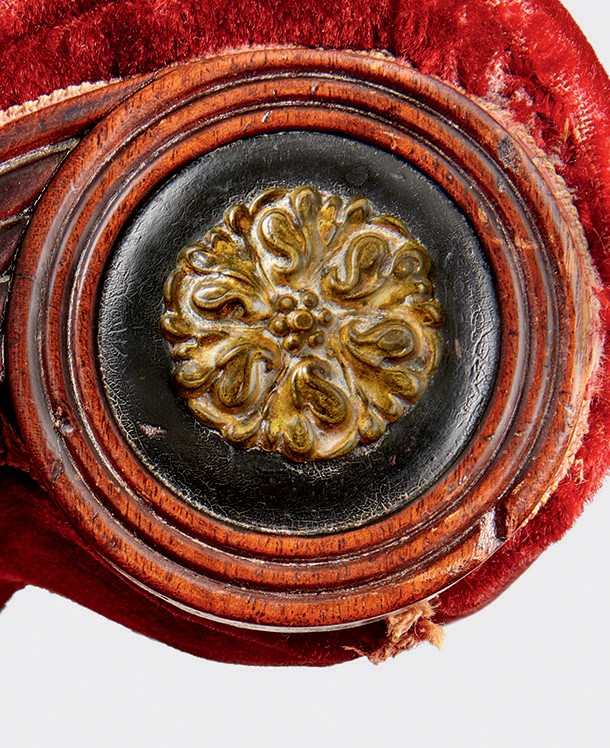
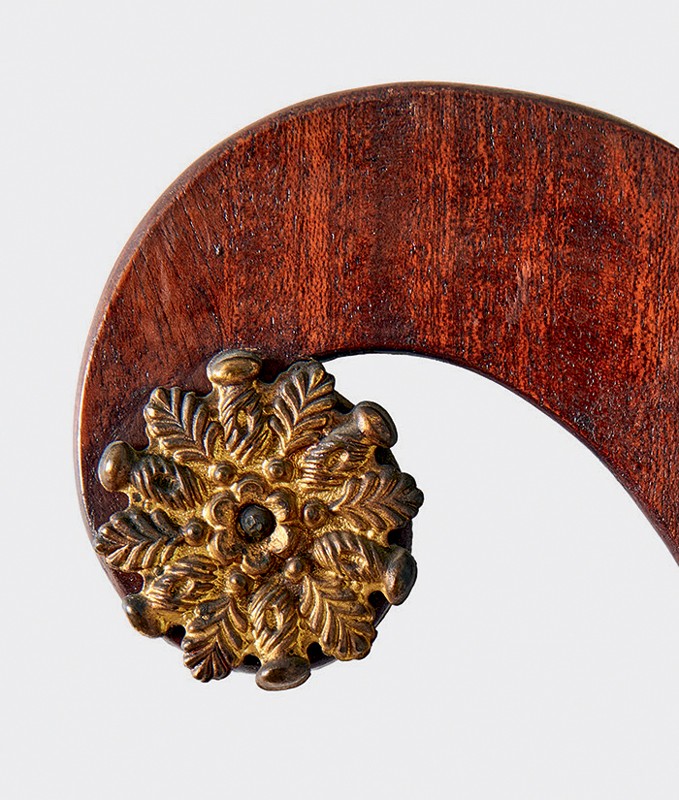
    Detail of the gilded medallion on the right scroll of the bookshelf in fig. 92. (Photo, Michael E. Myers.)

  • Figure 94
    Figure 94

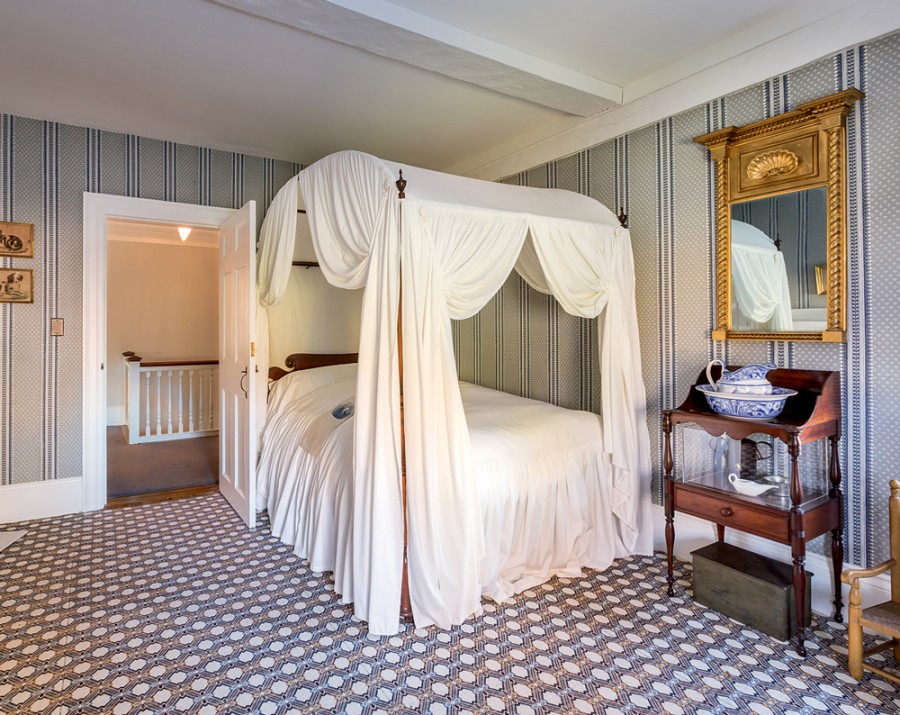
    The Elizabeth Ropes Orne bed chamber in the Ropes Mansion, containing the bedstead in fig. 37, washstand in fig. 57, and mirror in fig. 60. (Courtesy, Peabody Essex Museum, gift of the Trustees of the Ropes Memorial, 1989; photo, Allison White.) The room was restored in 2015 using reproductions of period wallpaper, ingrain carpeting, and cotton dimity bed hangings.

  • Figure 95
    Figure 95

    Grecian style Pembroke table by Mark Pitman, 1826. Mahogany, mahogany veneer, pine, unidentified wood, brass, metal. H. 29", W. 46 1/2", D. 24 1/2". (Courtesy, Peabody Essex Museum, gift of the Trustees of the Ropes Memorial, 1989, R1054; photo, Kathy Tarantola.)

  • Figure 96
    Figure 96

    Detail of the mahogany veneered panel with fillet moldings set into the end of the apron rail on the table in fig. 95. (Photo, Kathy Tarantola.)

  • Figure 97
    Figure 97

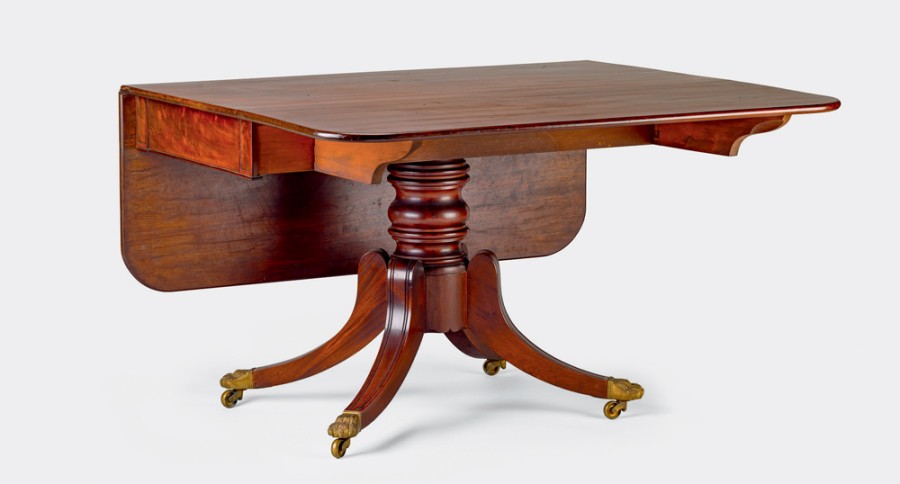
    Grecian style work table by Mark Pitman, 1828. Mahogany, mahogany veneer, pine, glass, brass, metal, paper, silk fabric. H. 28", W. 19 1/4", D. 19 1/2". (Courtesy, Peabody Essex Museum, gift of the Trustees of the Ropes Memorial, 1989, R1136; photo, Michael E. Myers.)

  • Figure 98
    Figure 98

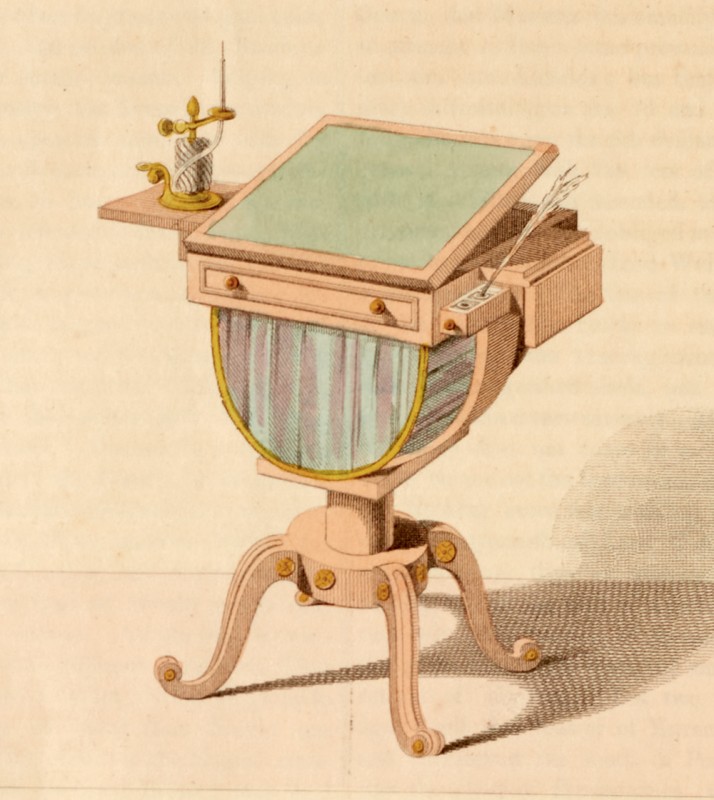
    Design for a “Ladies Work Table” (detail), shown on plate 35 of Ackermann’s Repository, no. 30 (June 1811). (Courtesy, Phillips Library, Peabody Essex Museum.)

  • Figure 99
    Figure 99

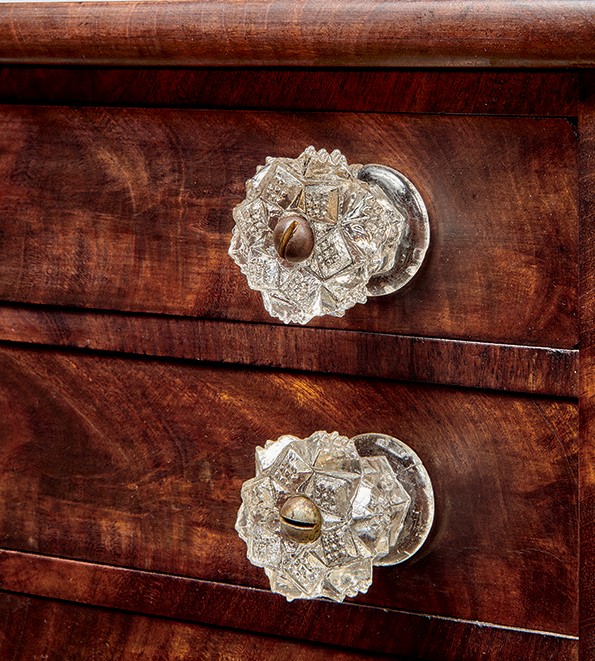
    Detail of the original cut-glass drawer pulls on the work table in fig. 97. (Photo, Michael E. Myers.)

  • Figure 100
    Figure 100

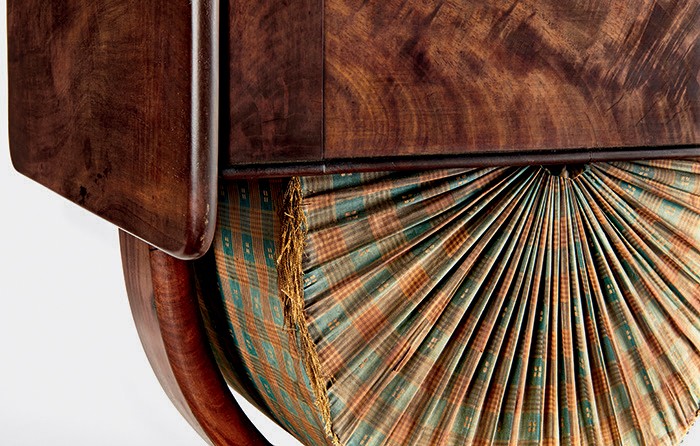
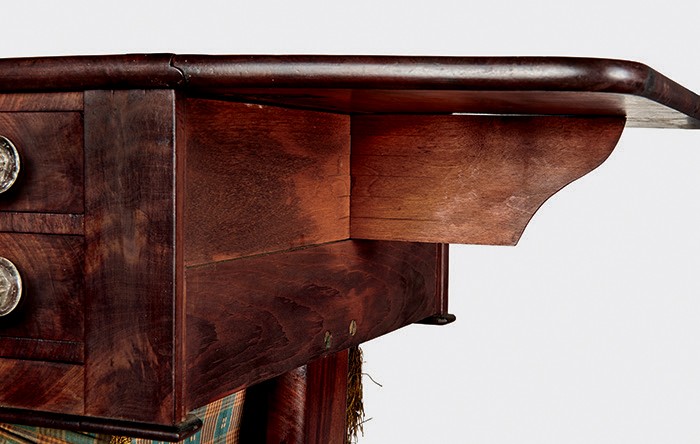
    Detail of the original plaid silk fabric, with a fragment of gold fringe, covering the storage drawer on the work table in fig. 97. (Photo, Michael E. Myers.)

  • Figure 101
    Figure 101

    Detail of the swing bracket used to support the raised leaf on the work table in fig. 97. (Photo, Michael E. Myers.)

  • Figure 102
    Figure 102

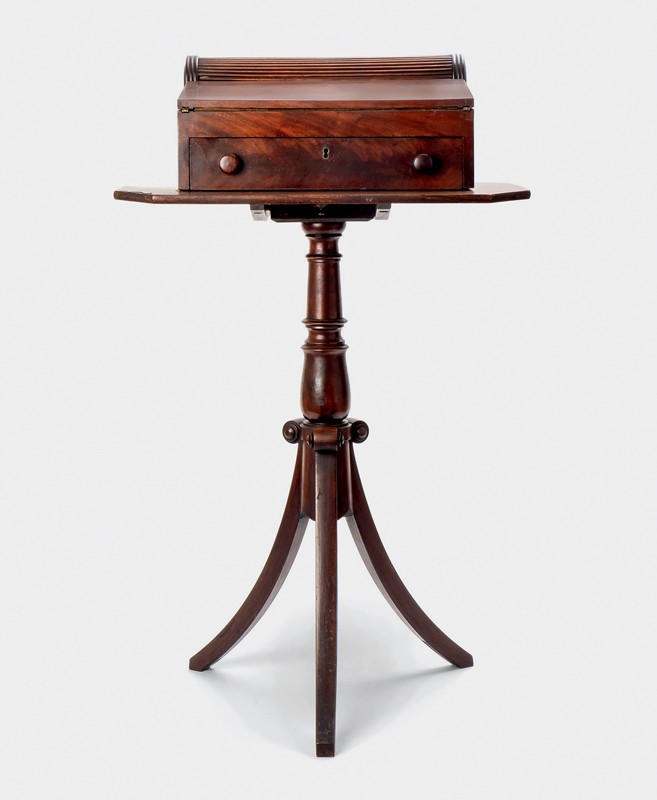
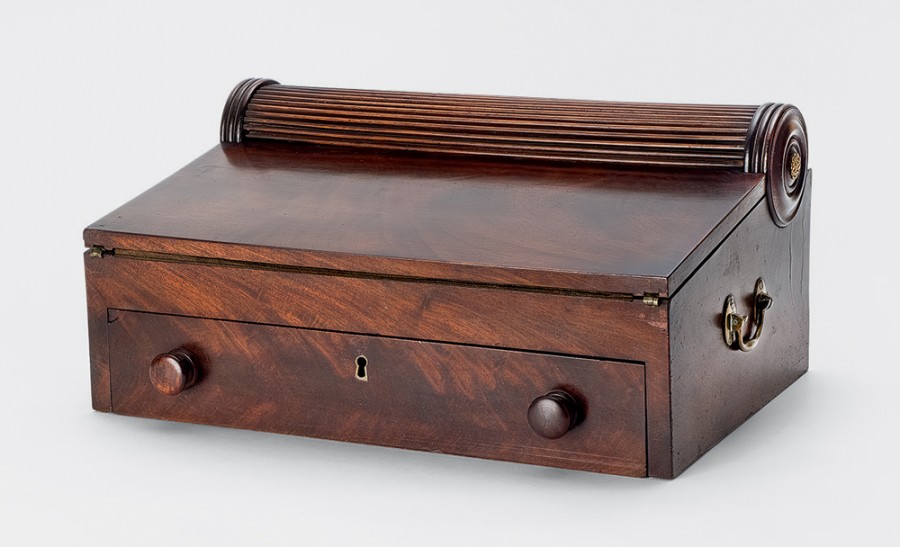
    Cylinder desk and stand by Mark Pitman, 1827 or 1828. Desk: mahogany, mahogany veneer, pine, baize fabric, brass, glass bottles with silvered caps, fabric glued to the reeds. H. 7", W. 15 1/2", D. 11 1/2". Stand: mahogany, mahogany veneer, unidentified wood, brass. H. 28 1/2", W. 21 1/4", D. 17 1/2". (Courtesy, Peabody Essex Museum, gift of the Trustees of the Ropes Memorial, 1989. R1109, R1110; photo, Dennis Helmar.)

  • Figure 103
    Figure 103

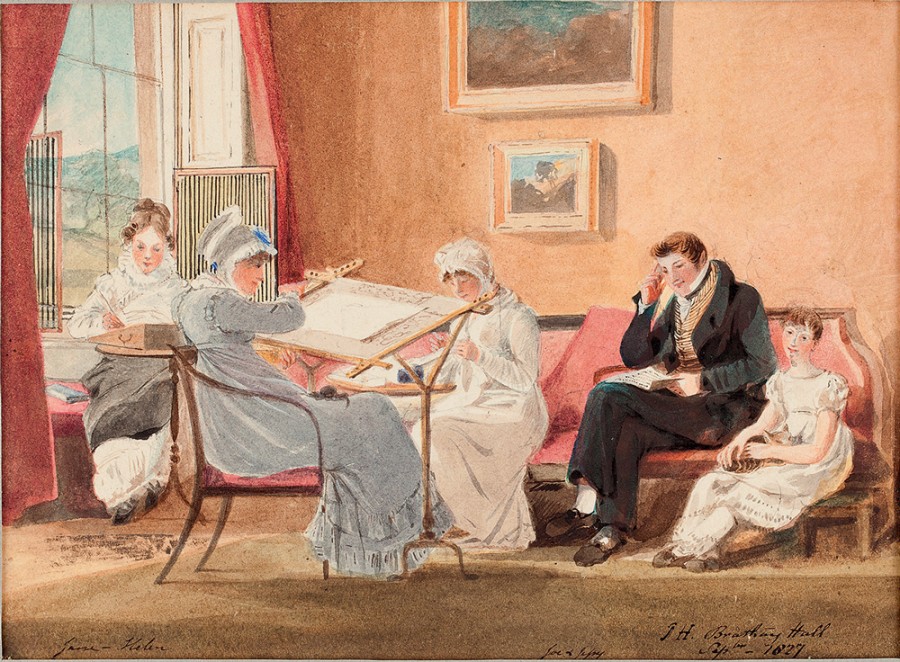
    John Harden (1772–1847), Harden Family at Brathay Hall, 1827. Watercolor on paper. Dimensions not recorded. (Courtesy, Abbot Hall, Lakeland Arts Trust, Cumbria, England.) The young woman by the window is using a lap desk on a stand similar to the one in fig. 102.

  • Figure 104
    Figure 104

    Cylinder desk by Mark Pitman shown in fig. 102. (Photo, Dennis Helmar.)

  • Figure 105
    Figure 105

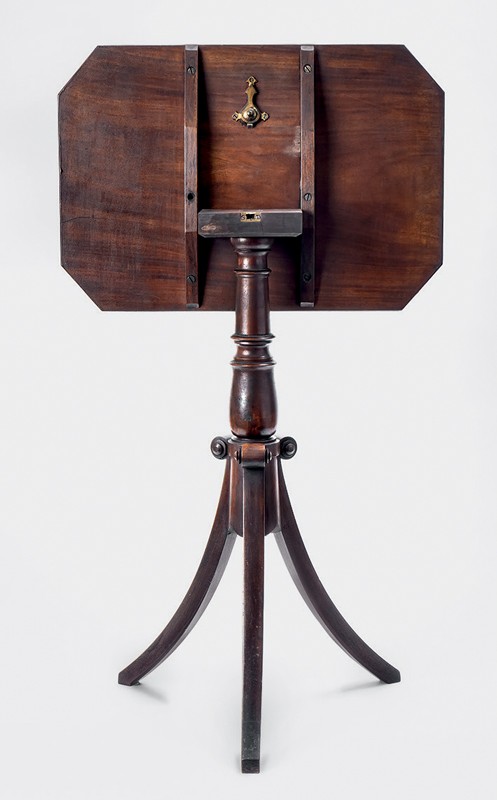
    Stand with hinged octagonal top by Mark Pitman shown in fig. 102. (Photo, Dennis Helmar.)

  • Figure 106
    Figure 106

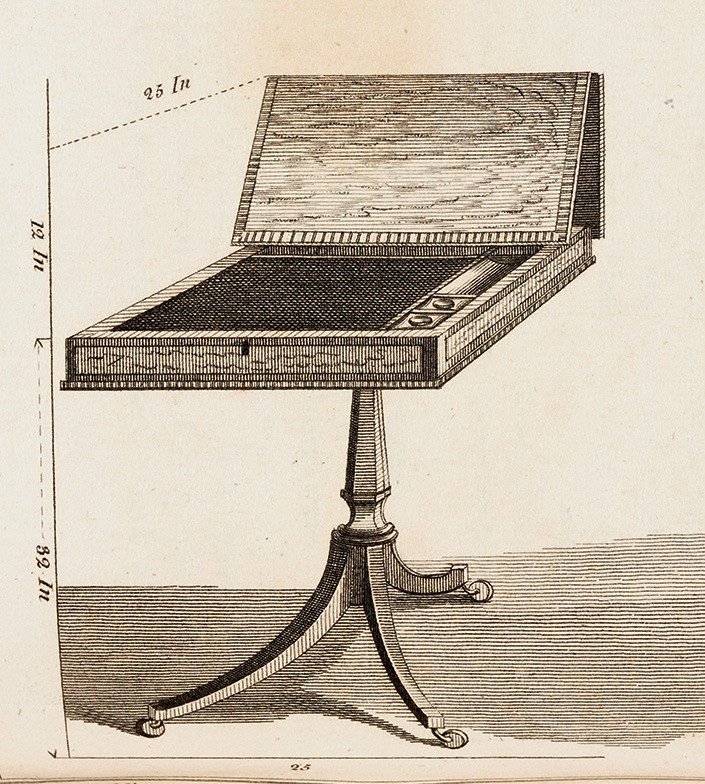
    Design for “A Lady’s Writing Table” (detail), shown on plate 71 of Thomas Sheraton’s The Cabinet Dictionary (London, 1803). (Courtesy, Phillips Library, Peabody Essex Museum.)

  • Figure 107
    Figure 107

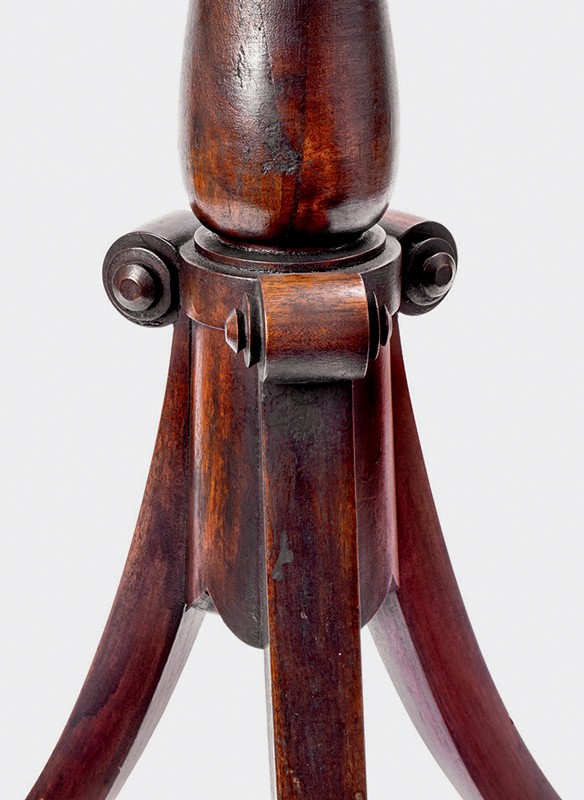
    Detail of the carved scrolls on the upper legs on the stand in fig. 102. (Photo, Dennis Helmar.)

  • Figure 108
    Figure 108

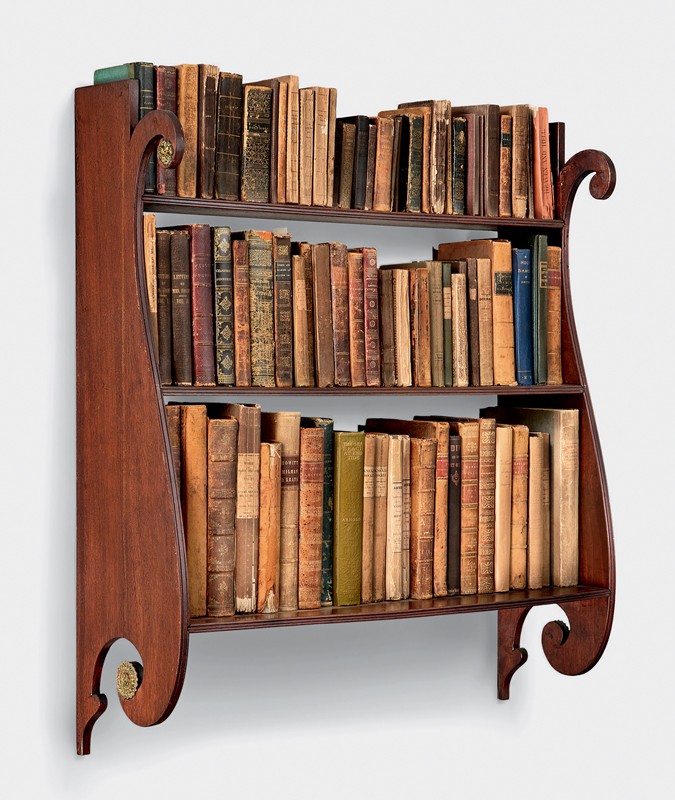
    Bookshelf by Mark Pitman,1824–1828. Mahogany, brass mounts. H. 31", W. 27 7/8", D. 8 1/4". (Courtesy, Peabody Essex Museum, gift of the Trustees of the Ropes Memorial, 1989, R1115; photo, Michael E. Myers.)

  • Figure 109
    Figure 109

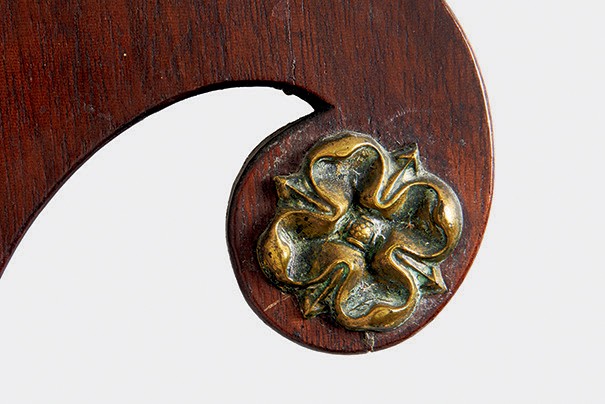
    Design for a “Profile of a dressing glass” (detail), shown on plate 14 of Thomas Hope’s Household Furniture and Interior Decoration (London, 1807). (Courtesy, Phillips Library, Peabody Essex Museum.) The scrolled brackets are similar in shape to the sides of the bookshelf in fig. 108, with a similar floral motif on the end of the upper scroll.

  • Figure 110
    Figure 110

    Detail of the brass rosette on the upper scroll of the bookshelf in fig. 108. (Photo, Michael E. Myers.)

  • Figure 111
    Figure 111

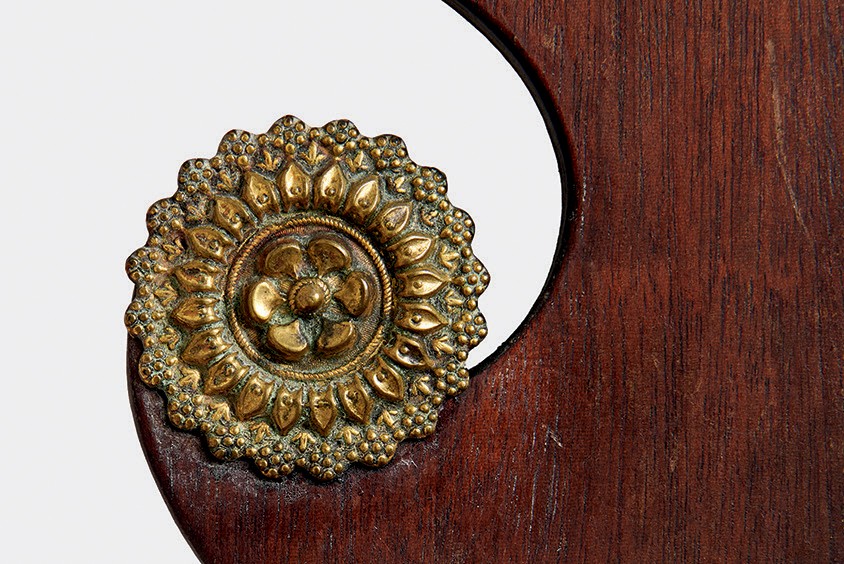
    Detail of the brass medallion on the lower scroll of the bookshelf in fig. 108. (Photo, Michael E. Myers.)

  • Figure 112
    Figure 112

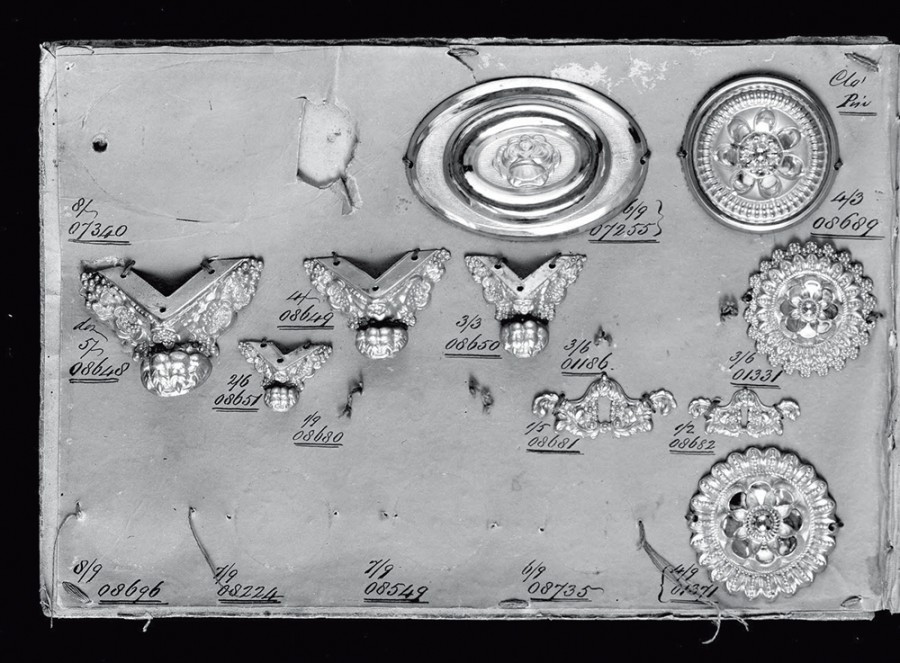
    Brass hardware sewn into the trade catalogue issued by Thomas Potts, Designs for Curtain Pins, Curtain Poles, Drawer Handles, Knob Cupboard Turns, Bed Caps, Clock Pins, Doorknobs, etc. (Birmingham, England, 1829–1833). (Courtesy, Rhode Island School of Design Museum.) The medallion marked “01331” is similar to the medallion in fig. 111 used on the bookshelf in fig. 108.

  • Figure 113
    Figure 113

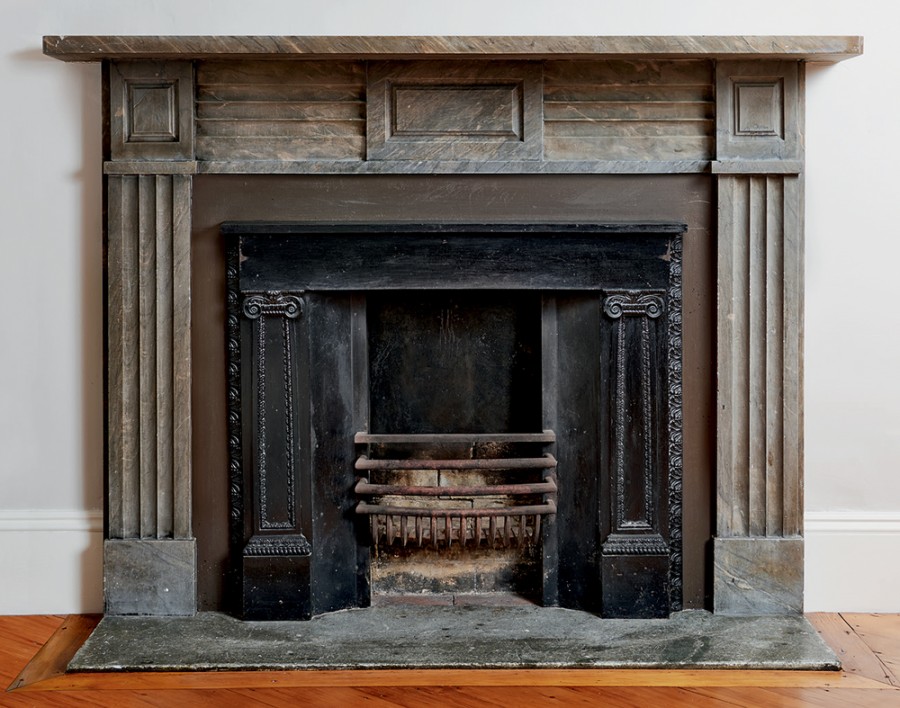
    Gray marble chimneypiece made by John Templeton, Boston, Massachusetts, 1835. H. 49 3/4", W. 68 3/4", D. (shelf) 8 1/2". (Courtesy, Peabody Essex Museum, gift of the Trustees of the Ropes Memorial, 1989; photo, Michael E. Myers.) The chimneypiece was purchased by Sally (Ropes) Orne and her sister, Abigail Ropes, for the front parlor of the Ropes Mansion during the 1835–1836 renovation; it was moved to a second-floor bedroom in 1894.

  • Figure 114
    Figure 114

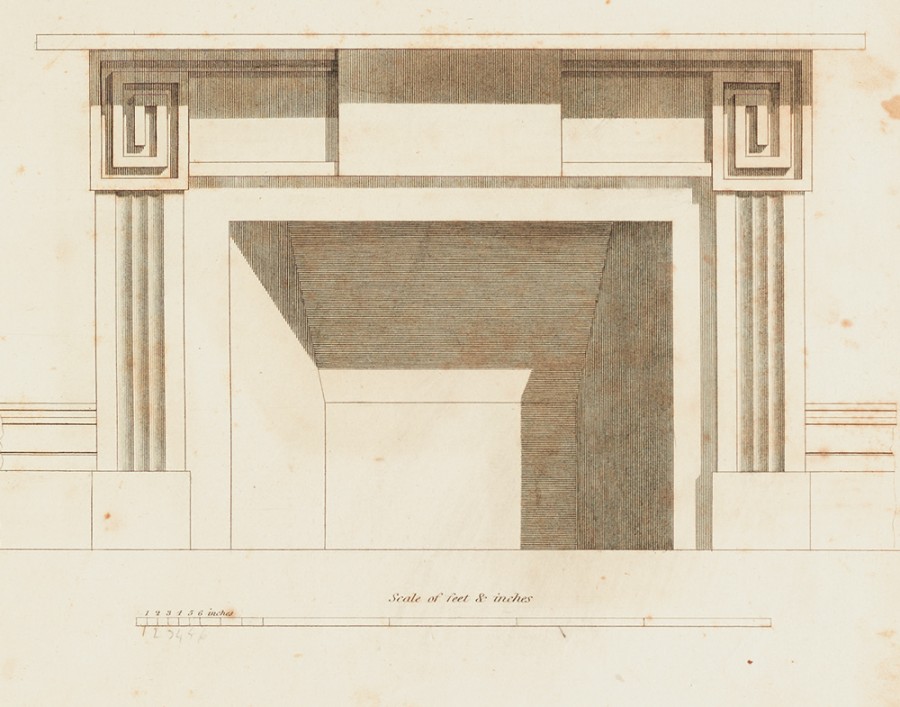
    Design for a “Chimney Piece” in the Grecian style, shown on plate 50 of Asher Benjamin’s The Practical House Carpenter (Boston, 1830). (Courtesy, Phillips Library, Peabody Essex Museum.)

  • Figure 115
    Figure 115

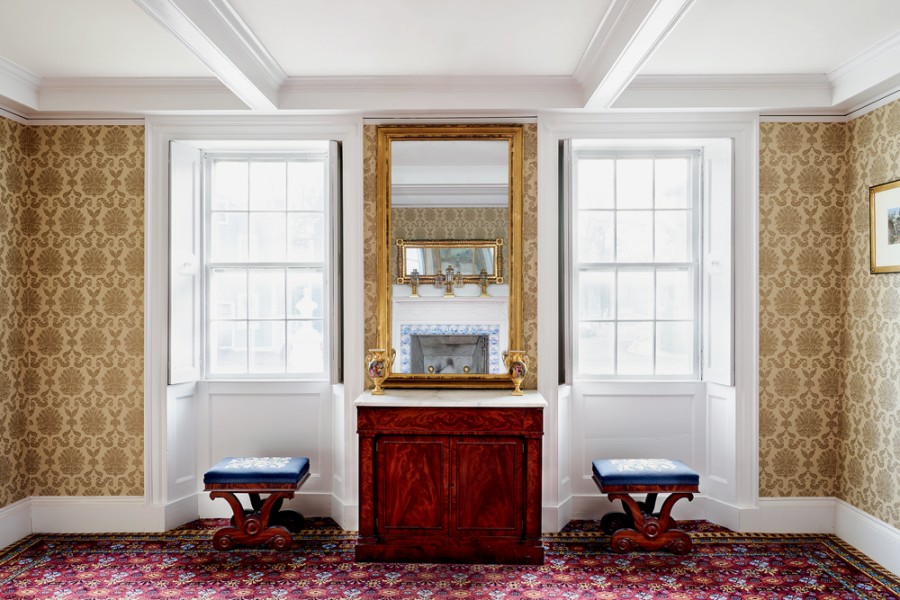
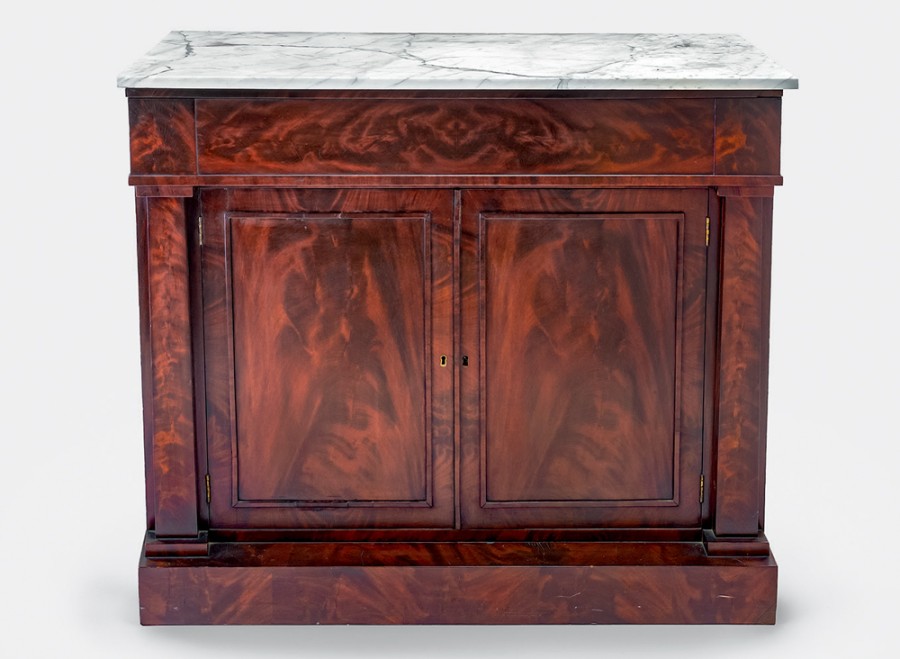
    South wall of the front parlor of the Ropes Mansion, showing the commode, pier glass, and tabourets installed as part of the 1835–1836 renovation of the room. (Courtesy, Peabody Essex Museum; photo, Michael E. Myers.)

  • Figure 116
    Figure 116

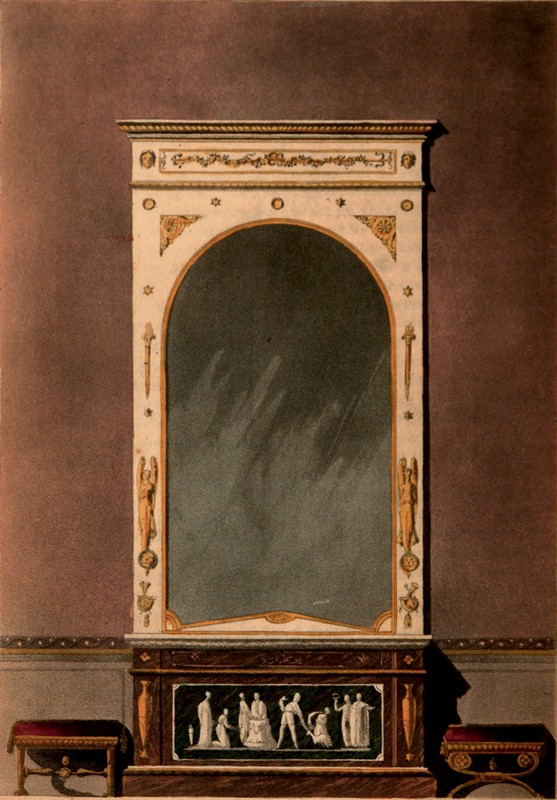
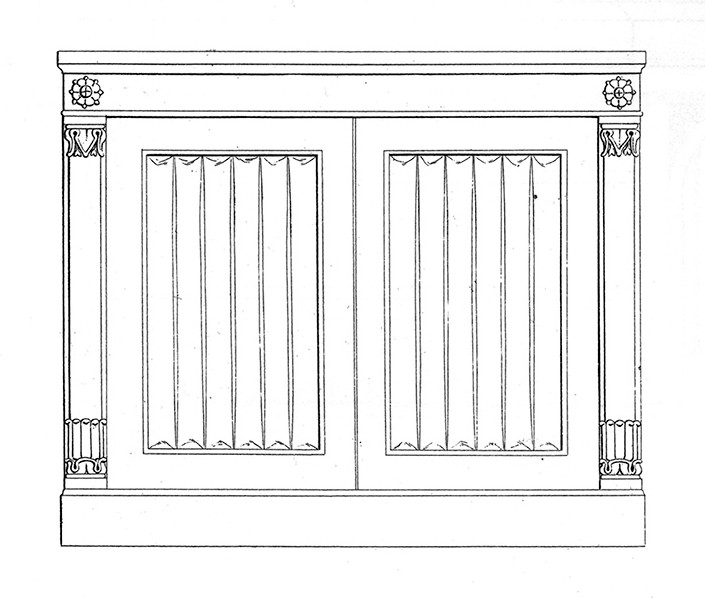
    Design for a “Commode, Pier Glass & Tabourets,” shown on plate 26 of Ackermann’s Repository, second series vol. 6, no. 35 (November 1, 1818): opp. p. 307. (Courtesy, Philadelphia Museum of Art Library; photo, Internet Archive, the American Libraries collection.)

  • Figure 117
    Figure 117

    Commode or pier cabinet by Mark Pitman, 1835–1836. Mahogany, mahogany veneer, pine, marble. H. 33 3/4", W. 40 1/4", D. 19 7/8". (Courtesy, Peabody Essex Museum, gift of the Trustees of the Ropes Memorial, 1989, R1038; photo, Dennis Helmar.)

  • Figure 118
    Figure 118

    Design for a commode (detail), shown on plate 39 of Thomas King’s The Modern Style of Cabinet Work Exemplified, in New Designs, Practically Arranged (London, 1839). (Photo, HathiTrust Digital Library.)

  • Figure 119
    Figure 119

    Tabouret (one of a pair), attributed to Kimball and Sargent, Salem, Massachusetts, 1835–1836. Mahogany, mahogany veneer, pine, modern needlework. H. 18", W. 20 3/4", D. 13". (Courtesy, Peabody Essex Museum, gift of the Trustees of the Ropes Memorial, 1989, R1037.1, .2; photo, Dennis Helmar.)

  • Figure 120
    Figure 120

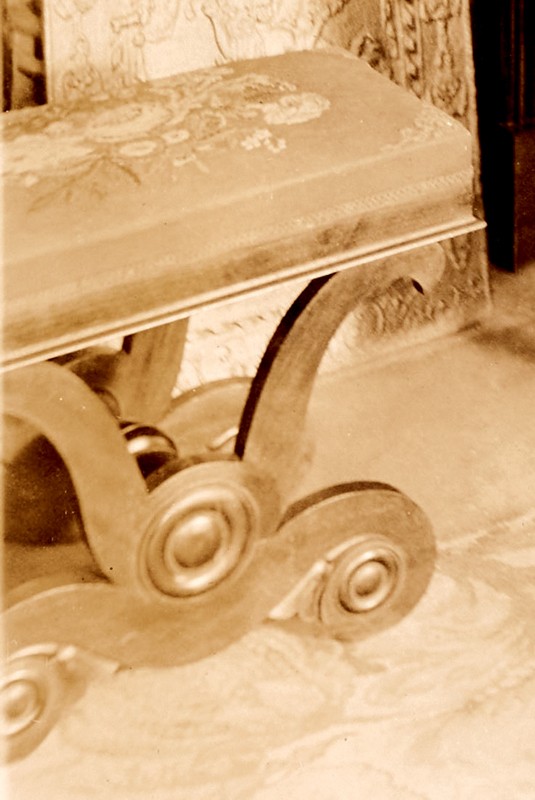
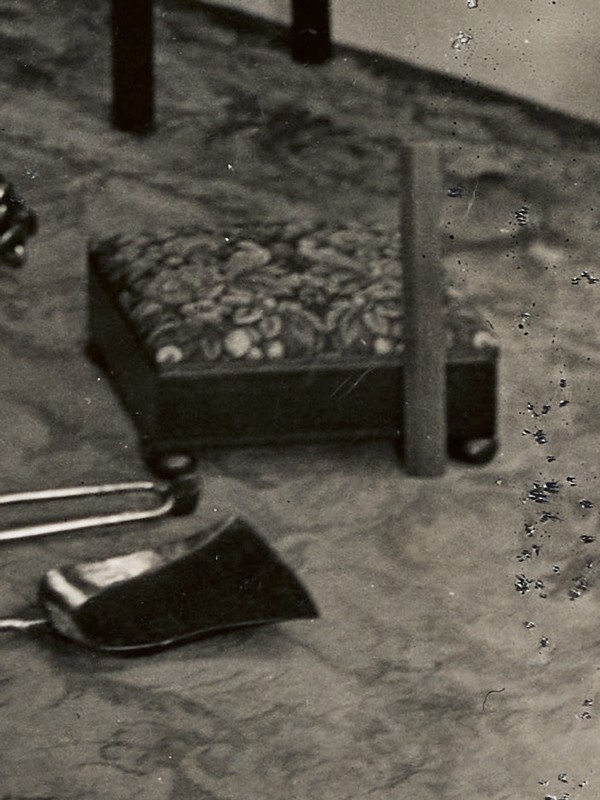
    Detail of a 1915 photograph showing the original needlepoint covering attributed to Sally (Ropes) Orne on the tabouret (or its mate) in fig. 119. (Courtesy, Phillips Library, Peabody Essex Museum [Ropes Papers, box 21, folder 3].)

  • Figure 121
    Figure 121

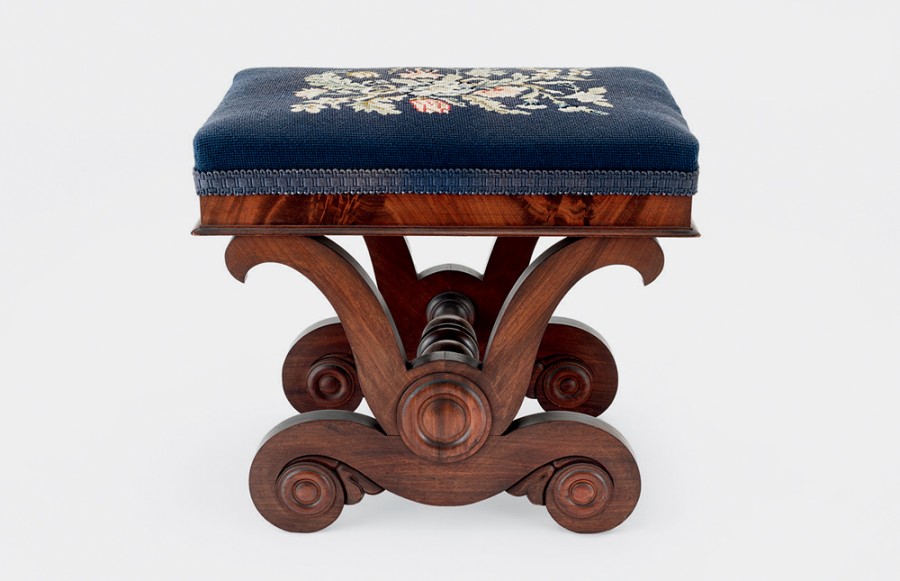
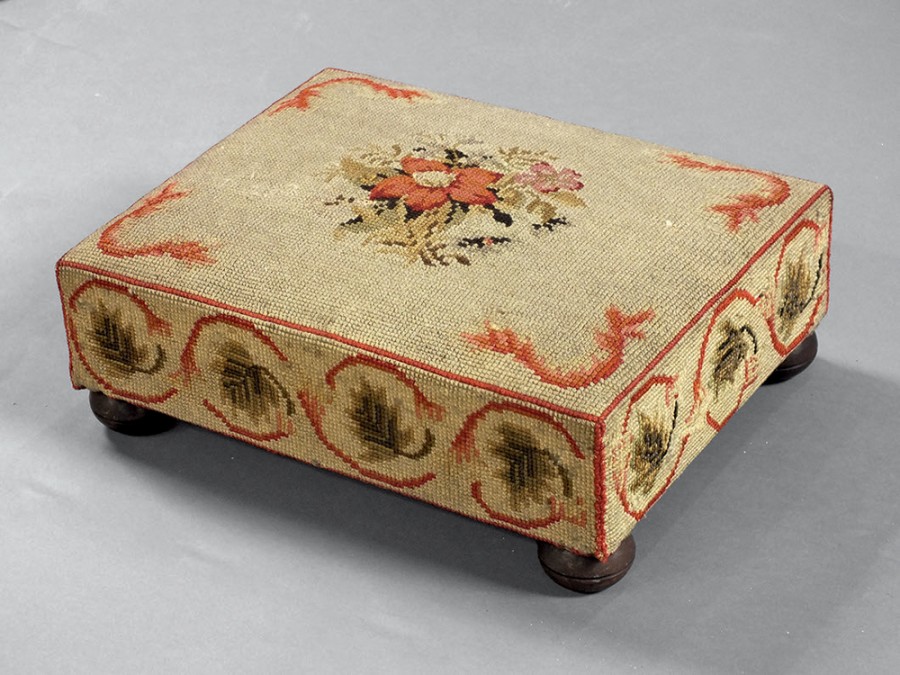
    Footstool by Mark Pitman, with needlework covering attributed to Sally (Ropes) Orne, 1830s. Mahogany, pine, wool. H. 4 5/8", W. 13 3/8", D. 10 1/2". (Courtesy, Peabody Essex Museum, gift of the Trustees of the Ropes Memorial, 1989, R1079; photo, Dennis Helmar.)

  • Figure 122
    Figure 122

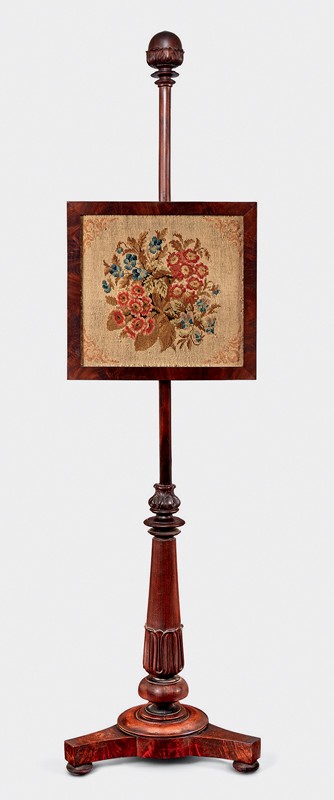
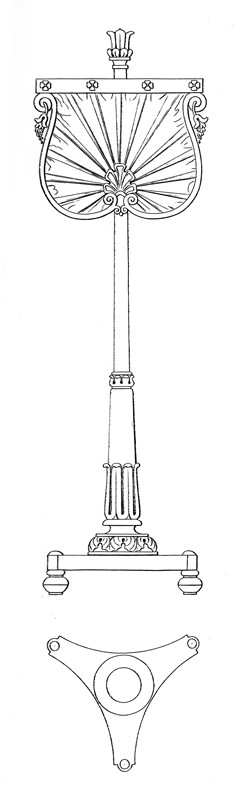
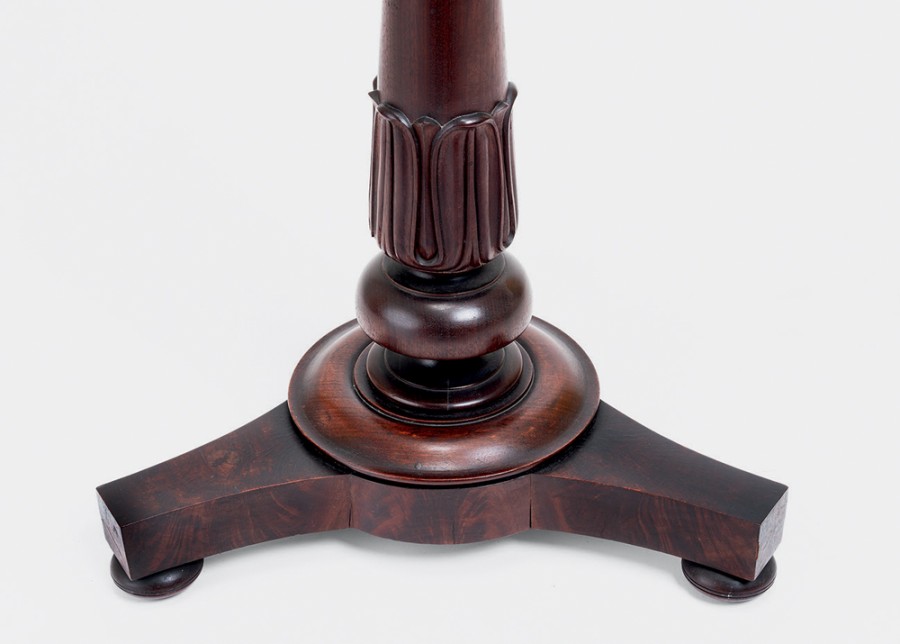
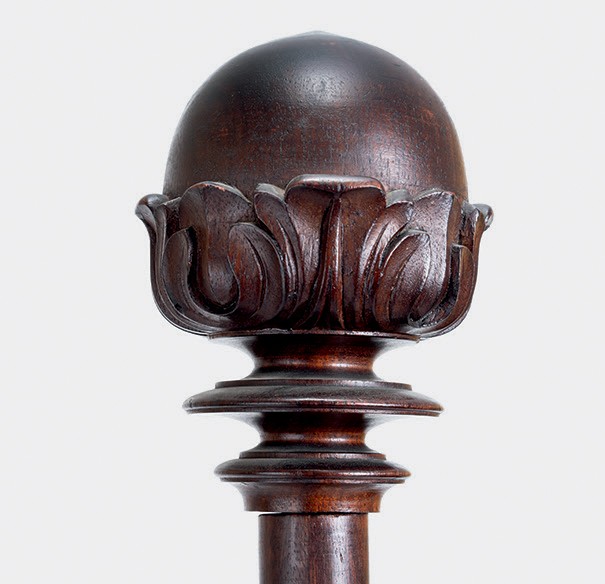
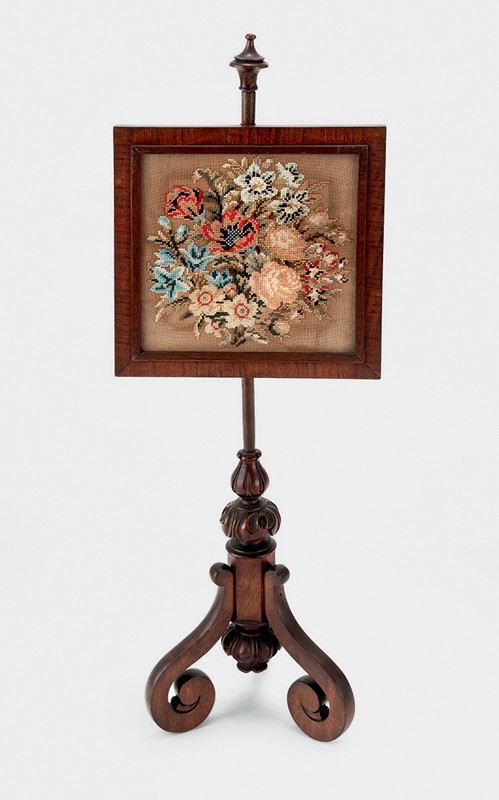
    Pole screen by Mark Pitman, with needlework attributed to Sally (Ropes) Orne, 1835–1836. Mahogany, mahogany veneer, pine, wool, silk backing fabric, glass, metal. H. 63 7/8", W. 16 7/8"; screen H. 16 1/2", W. 15 7/8". (Courtesy, Peabody Essex Museum, gift of the Trustees of the Ropes Memorial, 1989, R1055; photo, Dennis Helmar.)

  • Figure 123
    Figure 123

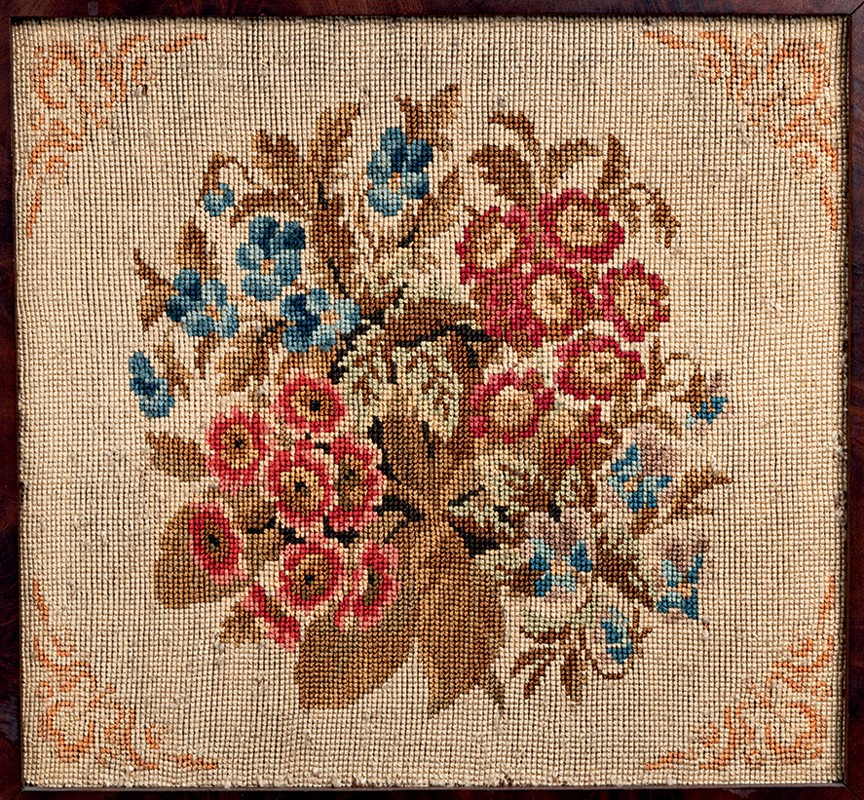
    Detail of the needlework panel on the pole screen in fig. 122. (Photo, Dennis Helmar.)

  • Figure 124
    Figure 124

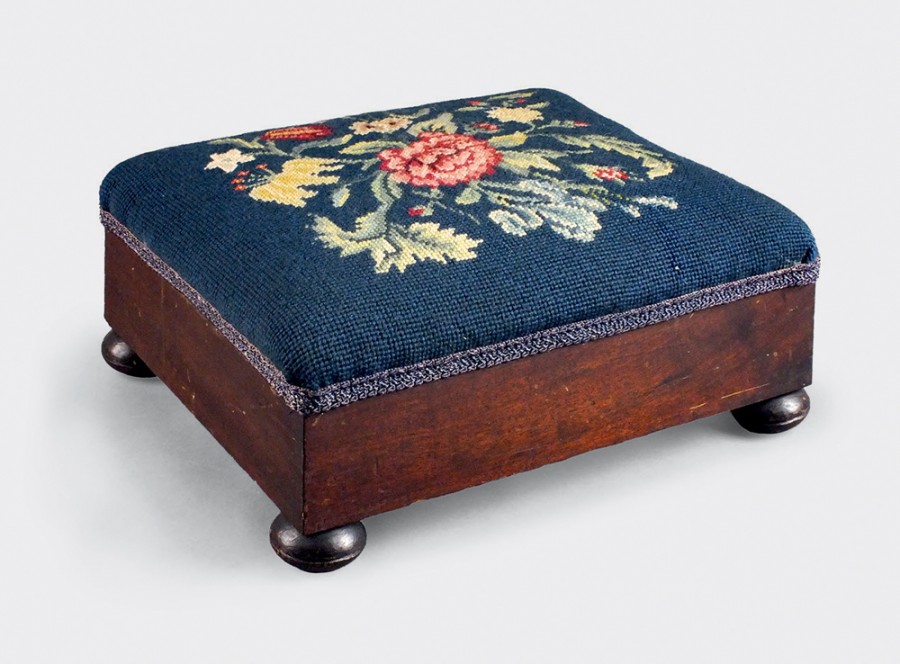
    Footstool (one of a pair) attributed to Mark Pitman, 1830s. Mahogany, mahogany veneer, pine, modern needlework. H. 6 1/4", W. 13 1/2", D. 11 1/2". (Courtesy, Peabody Essex Museum, gift of the Trustees of the Ropes Memorial, 1989, R1044.1; photo, Dennis Helmar.)

  • Figure 125
    Figure 125

    Detail of a 1915 photograph showing the original floral needlework attributed to Sally (Ropes) Orne on the footstool (or its mate) in fig. 124. (Courtesy, Phillips Library, Peabody Essex Museum [Ropes Papers, box 21, folder 3].)

  • Figure 126
    Figure 126

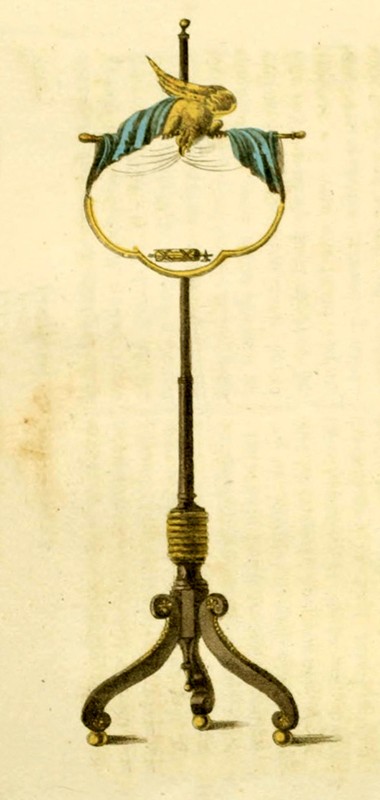
    Design for a pole screen (detail), shown on plate 5 of Thomas King’s The Modern Style of Cabinet Work Exemplified, in New Designs, Practically Arranged (London, 1839). (Photo, HathiTrust Digital Library.)

  • Figure 127
    Figure 127

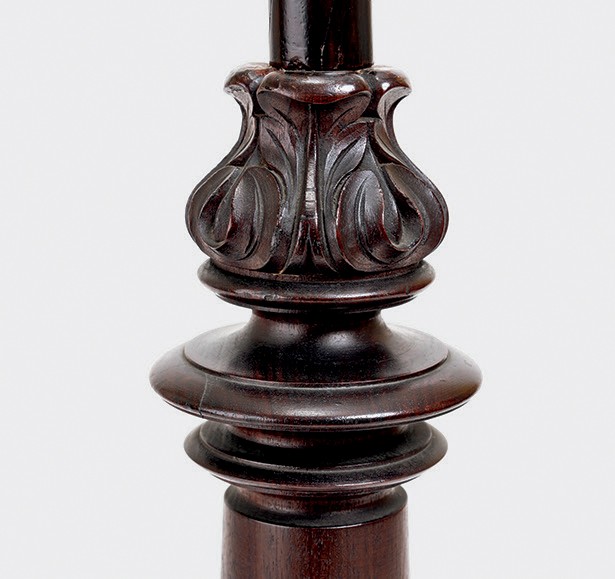
    Detail of the leaf carving on the base of the pole screen in fig. 122. (Photo, Dennis Helmar.)

  • 128
    128

    Detail of the finial with leaf carving on the pole screen in fig. 122. (Photo, Dennis Helmar.)

  • Figure 129
    Figure 129

    Detail of the leaf carving on the mid-section of the pole screen in fig. 122. (Photo, Dennis Helmar.)

  • Figure 130
    Figure 130

    Tabletop fire screen, attributed to Mark Pitman, needlework attributed to Sally (Ropes) Orne or Abigail Ropes, 1830s. Mahogany, pine, wool, silk fabric, metal, glass. H. 27 1/2", W. 8"; screen H. 9 7/8", W. 10 7/8", D.  3/4". (Courtesy, Peabody Essex Museum, gift of the Trustees of the Ropes Memorial, 1989, R1042; photo, Dennis Helmar.)

  • Figure 131
    Figure 131

    Design for a fire screen (detail), shown on plate 32 of Ackermann’s Repository 14, no. 84 (December 1815): opp. p. 348. (Courtesy, Library of the Philadelphia Museum of Art; scan, Internet Archive.) 

  • Figure 132
    Figure 132

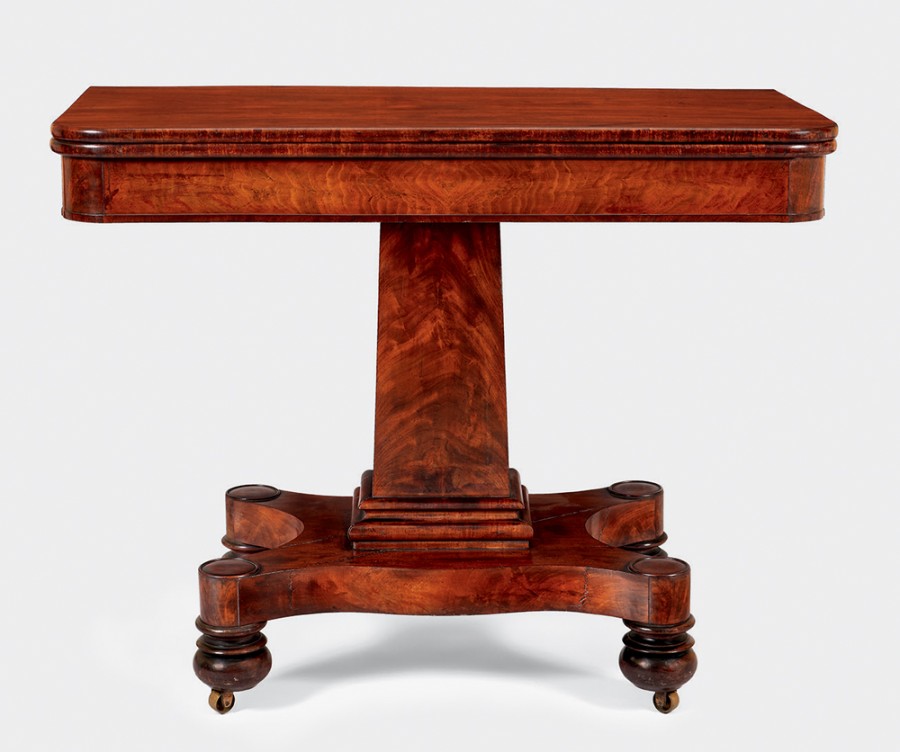
    Grecian style card table by Mark Pitman, 1830s. Mahogany, mahogany veneer, pine, metal. H. 28 1/2", W. 36", D. 17 1/2". (Courtesy, Peabody Essex Museum, gift of the Trustees of the Ropes Memorial, 1989, R1085; photo, Michael E. Myers.)

  • Figure 133
    Figure 133

    Card table (one of a pair), attributed to Thomas Seymour (1771–1848), Boston, Massachusetts, 1816. Mahogany, various woods. H. 30 7/8", W. 36 1/4", D. 18". (Courtesy, National Park Service, Adams National Historical Park.) The tables were made for Peter Chardon Brooks.

  • Figure 134
    Figure 134

    Design for a card table (detail), shown on plate 43 of Thomas King’s The Modern Style of Cabinet Work Exemplified, in New Designs, Practically Arranged (London, 1839). (Photo, HathiTrust Digital Library.)

  • Figure 135
    Figure 135

    Detail of one of the feet with domed cap and bead edge on the table in fig. 132. (Photo, Michael E. Myers.)

  • Figure 136
    Figure 136

    Detail of the turned base on the right front column of the chest of drawers in fig. 137. (Photo, Kathy Tarantola.)

  • Figure 137
    Figure 137

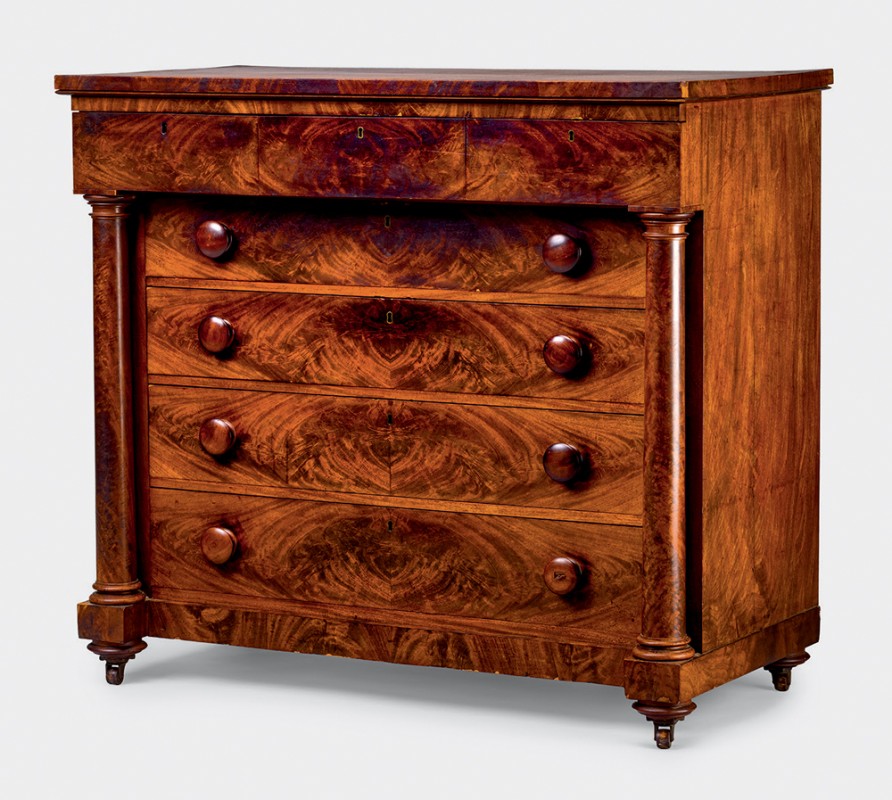
    Chest of drawers by Mark Pitman, 1833. Mahogany, mahogany veneer, pine, metal. H. 42", W. 47", D. 22". (Courtesy, Peabody Essex Museum, gift of Mary Osgood Hodges, 1918, 107547; photo, Kathy Tarantola.)

  • Figure 138
    Figure 138

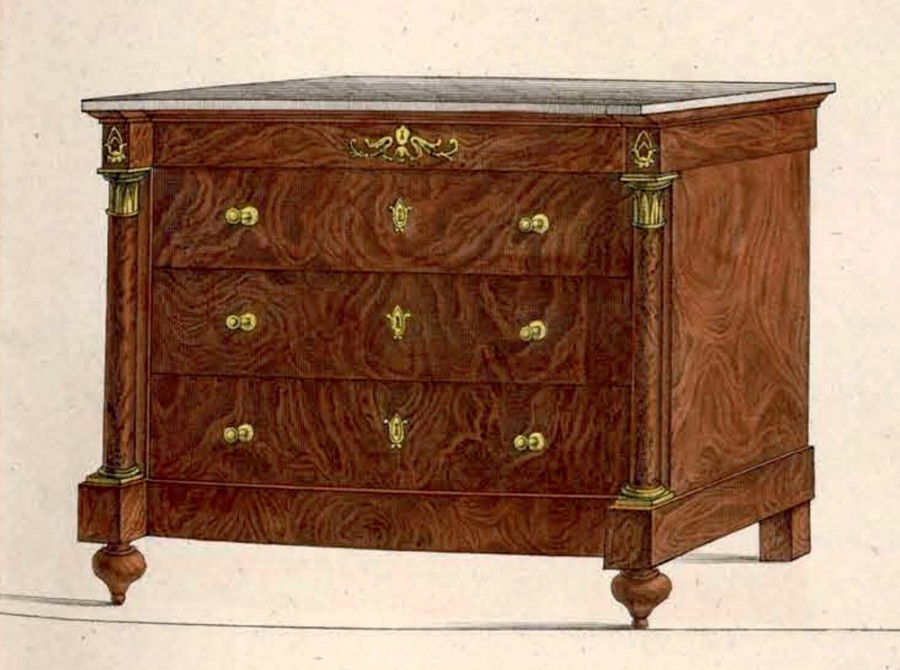
    Design for a “Commode en acajou flambé” (chest of drawers with flaming mahogany) (detail), shown on plate 328 of Pierre de La Mésangère’s Collection de meubles et objets de goût (Paris, ca. 1802–1818). (Courtesy, Bibliothèque de l’Institut national d’histoire de l’art, collections Jacques Doucet.)

  • Figure 139
    Figure 139

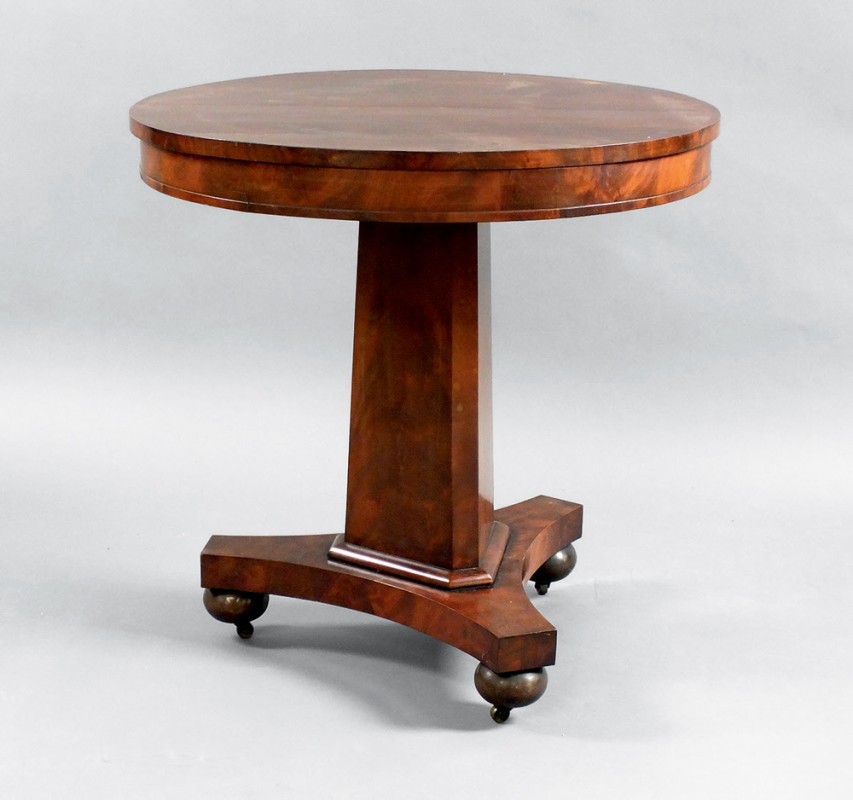
    Round-top table attributed to Mark Pitman, 1830s. Mahogany, mahogany veneer, pine, metal. H. 29 1/4", Diam. top 28 1/2". (Courtesy, Peabody Essex Museum, gift of the Trustees of the Ropes Memorial, 1989, R1128; photo, Dennis Helmar.)

  • Figure 140
    Figure 140

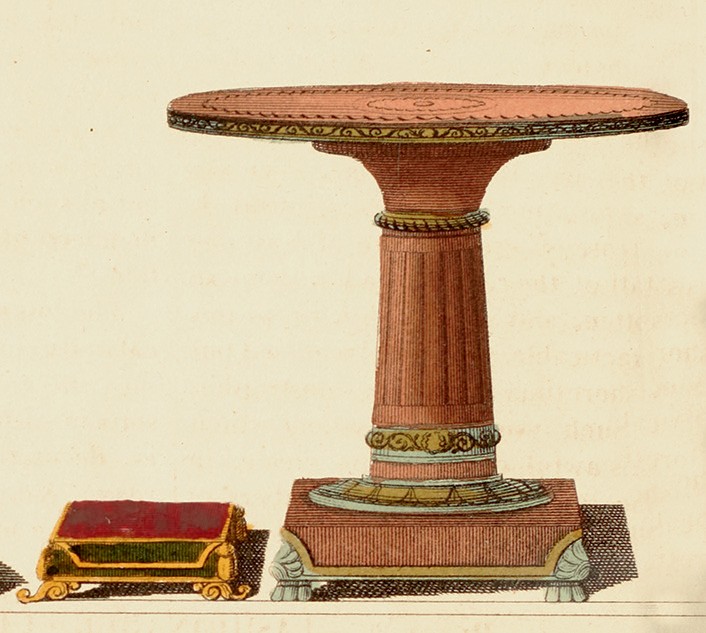
    Designs for a “Stool and Reading Table” (detail), shown on plate 30 of Ackermann’s Repository 8, no. 47 (November 1812): opp. p. 289. (Courtesy, Phillips Library, Peabody Essex Museum.)

Dean Thomas Lahikainen
A Family Legacy: Classical Furniture by Mark Pitman in the Ropes Mansion, Salem, Massachusetts

AN EXTRAORDINARY GROUP OF forty-nine examples of furniture made between 1812 and 1840 by Salem cabinetmaker Mark Pitman (1779–1855) for various members of the Ropes-Orne family survives in the Ropes Mansion, one of the historic houses owned by the Peabody Essex Museum in Salem, Massachusetts (fig. 1; Appendix A). Nine labeled forms dating from 1806 to 1814 securely establish Pitman’s early design preferences and meticulous woodworking skills (figs. 2, 3).[1] While none of the forms in the Ropes Mansion bears his label or signature, many are documented by surviving receipts, which along with other written material reveal the intimate relationship Pitman enjoyed with three generations of the family (see Appendices C and D). Between 1807 and 1853, he rented his cabinetmaking shop at 324 Essex Street from them. Its location next to the Ropes Mansion and directly across the street from his own home at 327 Essex Street assured his availability to make furniture on demand.[2] This close proximity also enabled him on a daily basis to perform other services for the family, including milk delivery, caring for the family cat, witnessing their wills, and making their coffins.

Baptized at the Tabernacle Church in Salem on June 20, 1779, Pitman was the son of mariner Joseph Pitman (d. 1794) and his wife, Bethiah (d. 1811). His marriage to Sophia Francis (d. ca. 1864) on March 10, 1799, produced a large family, including at least one son, Mark Jr. (1814–1904), who also trained to be a cabinetmaker.[3] Pitman’s training remains a matter of speculation. If he followed a traditional path and apprenticed to a cabinetmaker when he turned fourteen in 1793, his formal training would have ended in the late 1790s, perhaps followed by a few years of working as a journeyman. A slant-top desk in a private collection, bearing his bold signature and the date 1798, is his earliest known piece. Pitman’s first paper label has his hand-written signature pasted over the printed name of cabinetmaker Josiah Caldwell (dates unknown) (fig. 4).[4] While little is known of Caldwell’s career, historians have speculated that Pitman may have trained or worked with him before taking over his shop “nearly opposite Cambridge Street” and used his labels, which proclaim, “Orders gratefully acknowledged, and promptly executed.” Caldwell moved his shop farther up Essex Street next to Rev. Dr. Barnard’s house and advertised on March 16, 1810, that he “carries on the cabinetmaking business in all its branches” and has “CHAIRS of every description constantly on sale.”[5]

Pitman’s name appears among the Ropes Family Papers for the first time on a receipt dated July 16, 1807, one month after Elizabeth (Cleveland) Ropes (1757–1831) moved her family into the Ropes Mansion following an extensive renovation (fig. 5; Appendix C, no. 1). She was the second wife and widow of merchant Nathaniel Ropes III (1759–1806), who had died the previous August while the family was living at their farm in Danvers, Massachusetts. He left a good estate despite suffering from the ravages of alcoholism, which caused his premature death at the age of forty-seven.[6] He had three children from his first marriage, to Sarah Putnam (1765–1801): Nathaniel IV (1793–1885), who was away at boarding school, and daughters twelve-year-old Sarah (1795–1876), known as Sally, and eleven-year-old Abigail (1796–1839), who moved into the Ropes Mansion with their stepmother. The executors gave a $250 “allowance to widow for necessary furniture,” and Elizabeth immediately started to use some of it to buy a “pine wash stand” and a “frame for a writing desk” from Pitman (Appendix C, no. 1).[7] Pitman’s name also appears on a list of people indebted to the estate of Nathaniel Ropes III, a $100 promissory note on which Pitman was paying interest.[8]

Nathaniel Ropes III had acquired full ownership of the 1727 Ropes Mansion during the final settlement of the estate of his father, Judge Nathaniel Ropes II (1726–1774), in 1799.[9] He also inherited the empty lot on the western side of the house, where he quickly built four commercial shops around 1800. In 1809 those shops were occupied by “Benjamin Blanchard, hairdresser; Mark Pitman, cabinet maker; Nathaniel Lang, saddler; and Stephen Driver, boot and shoemaker.”[10] Pitman’s rent payment for the year 1809 is the only one to survive, being a ledger entry: “Oct.1 cash rec’d M. Pitman for rent 26.25.”[11] By 1849 the Ropes Mansion was owned by Nathaniel III’s daughter, Sally (Ropes) Orne, and in a letter from that year she expresses her frustration with being the owner of the shops because the tenants refuse to listen to her, declaring, “a woman should not have tenants.”[12] An 1851 map of Salem shows two separate structures on the shop lot (fig. 6). As indicated by Salem directories, Pitman occupied one of the shops until 1853; by 1874 both shop buildings had been demolished. The earliest known photograph of the Ropes Mansion, taken in the 1890s, shows a matched board fence running along the now empty western lot where the shops once stood (fig. 1).

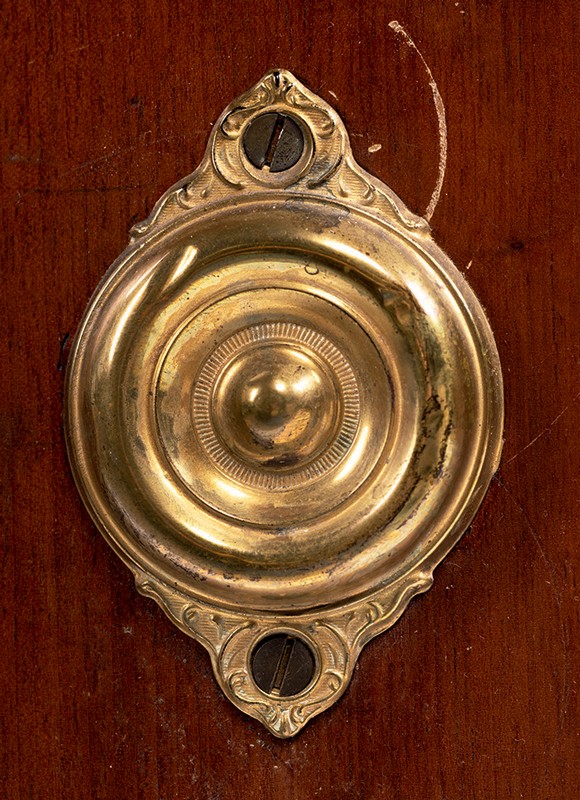
Mark Pitman is mentioned thirty-two times in receipts, account book entries, and letters that survive in the Ropes Family Papers. Spanning the years between 1807 to 1839, these records detail the multitude of tasks performed by Pitman for the family, from delivering foodstuffs and doing odd jobs around the house to making furniture. Since the Ropes household was comprised entirely of women during this period, Pitman played an important role in handling small emergencies, many relating to fixing or replacing the woodcock on the kitchen water pump, which connected to a private aqueduct system.[13] He fixed other broken things, including door hinges, the doorbell, windows, and blown-off shutters. Other domestic tasks ranged from putting up curtains, measuring land, and framing and varnishing a map. He used his woodworking skills to make utilitarian items, including a pot handle, bobbins, bed rods, small boxes, and a tray. Pitman also served as cat-sitter. While visiting her brother Nathaniel Ropes IV in Cincinnati in 1839, Sally (Ropes) Orne wrote to her cousin back in Salem, “I hope she [Mrs. Pickman, their next-door neighbor] does not think I left her [the cat] to starve, I sent both to Mr. Pitman + Marks to feed them in our absence + I hope she would not be neglected.”[14]

In addition to all of this quotidian personal interaction, the family ordered numerous pieces of fine furniture from Pitman. Surviving receipts document Pitman making twenty-nine forms, of which nine survive (Appendix C). In addition, there are forty other pieces of furniture in the house made by Pitman without a corresponding receipt. Between 1807 and 1816 Elizabeth (Cleveland) Ropes purchased a washstand, a frame for a writing desk, a table, a traveling desk, a work table, a work box, and a bedstead, of which only the table, bed, and traveling desk survive. The “mahogany traveling desk” purchased on June 16, 1812, and costing eight dollars, is a plain rectangular box with a simple inlaid light wood shield around the keyhole (fig. 7; Appendix C, no. 4). The top portion of the box folds back on hinges to abut the lower section, forming a large slanted writing surface, and the thin-hinged board in each of the sections provides access to a lower storage compartment. The green baize covering the boards, originally a single piece of fabric, is now split in the middle. The open storage area along the top edge has a removable curved tray for writing implements (with storage space below) and three wells, one with a slanted floor (perhaps for red wax sticks for sealing envelopes) and the other two for glass bottles (one with ink and the other with sand to absorb wet ink). Elizabeth was a prolific letter writer, and the brass side handles allowed her to carry the closed desk from one place to another to take advantage of the best light, heat, or cool breezes depending on the season.

Elizabeth may also have been responsible for asking Pitman to make the family’s medicine chest (fig. 8). Pitman used dovetail construction to join the sides of the plain pine box together and small brads to nail the bottom board to the sides. The front and side edges of the hinged lid are rounded. The exterior of the box is painted a mottled green, the underside of the lid a light gray, with the interior left unpainted. Thin partitions divide the space into twelve compartments of varying size to accommodate glass bottles. The arrangement follows that of several other medicine chests dating from the early nineteenth century, which retain original bottles with paper labels identifying the contents (fig. 9). The two largest spaces held bottles of bark powder: Peruvian bark to treat fever, and willow bark, a form of aspirin for treating pain. Smaller bottles contained liquids and oils, such as castor oil (a laxative), laudanum (an opium-based painkiller), and smelling salts (to revive the unconscious).[15] A pharmacist filled the labelled bottles as needed. Most commercially produced medicine chests came with a manual detailing how to combine various ingredients to treat a specific aliment. Homeowners also collected remedies from friends, family members, and their doctor; several such remedies survive among the Ropes Family Papers. Considered a standard item for the home, this box saw a great deal of use in a family that endured one medical crisis after another.

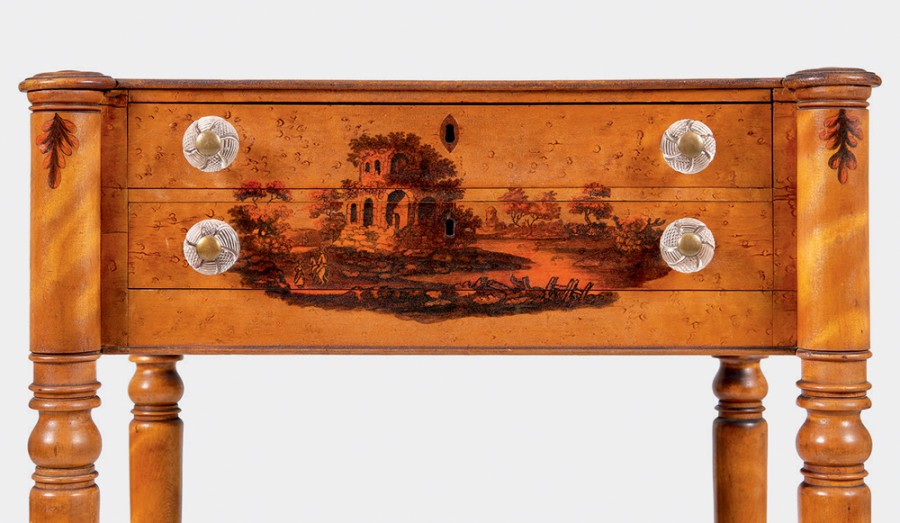
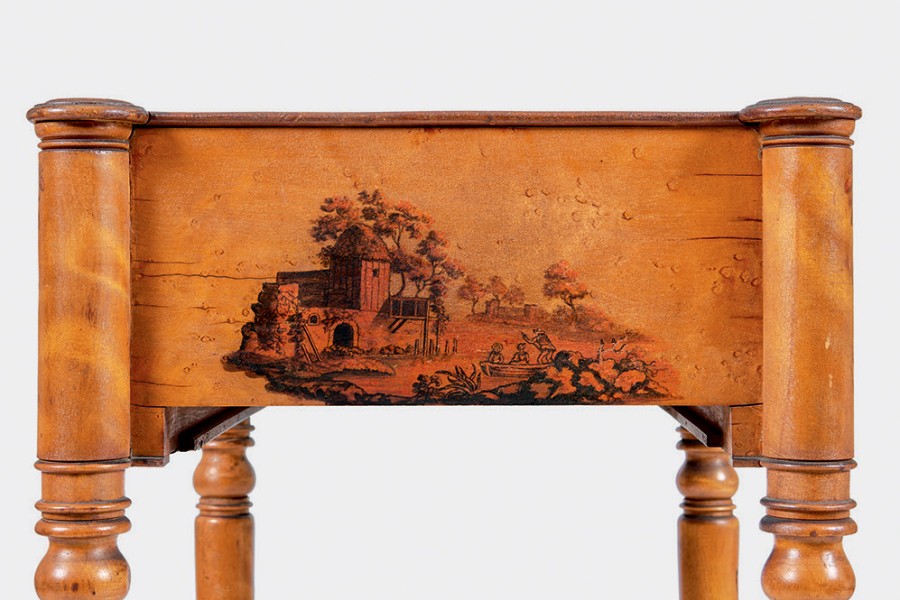
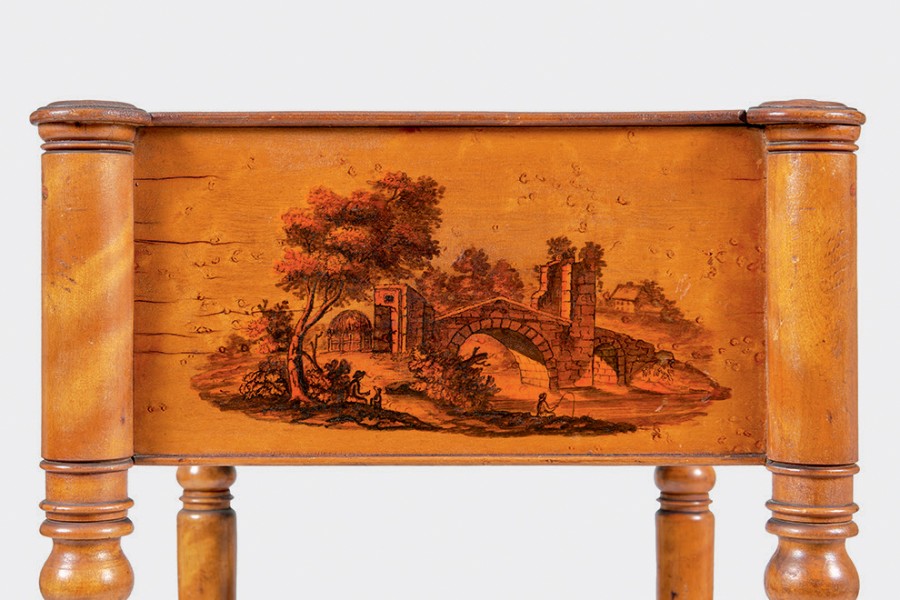
Elizabeth was well educated and took great interest in teaching her three stepchildren, especially Sally and Abigail. The girls attended Miss Hetty Higginson’s school in their early years to learn arithmetic, reading, sewing, and to cultivate artistic interests. A painted box and work table relate to this educational effort (figs. 10–12). Elizabeth Ropes paid Pitman three dollars in 1816 for “a work box,” but the price suggests it was much larger than the small box with painted decoration in the Ropes collection (Appendix C, no. 6). The construction details, notably the finely crafted partitions on the interior of the box, relate to those crafted by Pitman in the work table drawer. Two small pieces of wire inserted through the sides and into the edge of the lid serve as the hinges. Two holes on the front of the box indicate there was originally a simple handle, perhaps of string for pulling the box off a shelf. Like many sewing boxes of this period, the interior is lined with glossy paper, in this case colored a vibrant pink. The painted decoration on top, consisting of various borders surrounding a rose branch with a pink bud and leaves, is less accomplished than the painting on the work table (figs. 12–16, 21). Made of bird’s-eye maple, the work table has Pitman’s refined construction details, including the partitions dividing the upper drawer into eight compartments for sewing and writing implements. The slender turned legs have an ovolo cap set into the top surface, a feature characteristic of Pitman’s work (Appendix B, no. 6). On the right side of the case, the lower section of the rail is missing, having been part of a frame that slides out from the case with an attached cloth bag for storage.

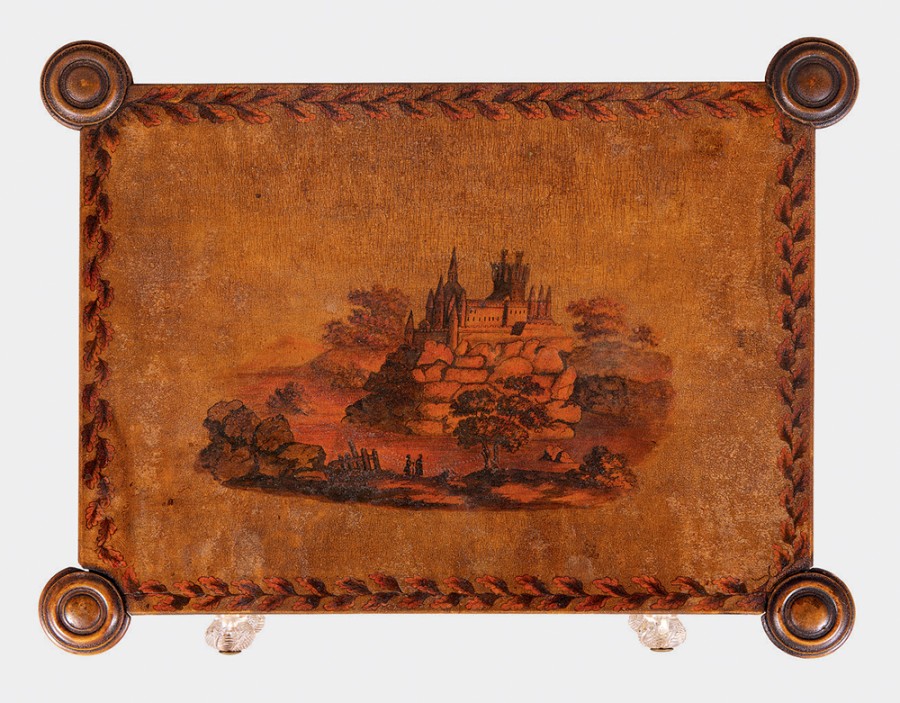
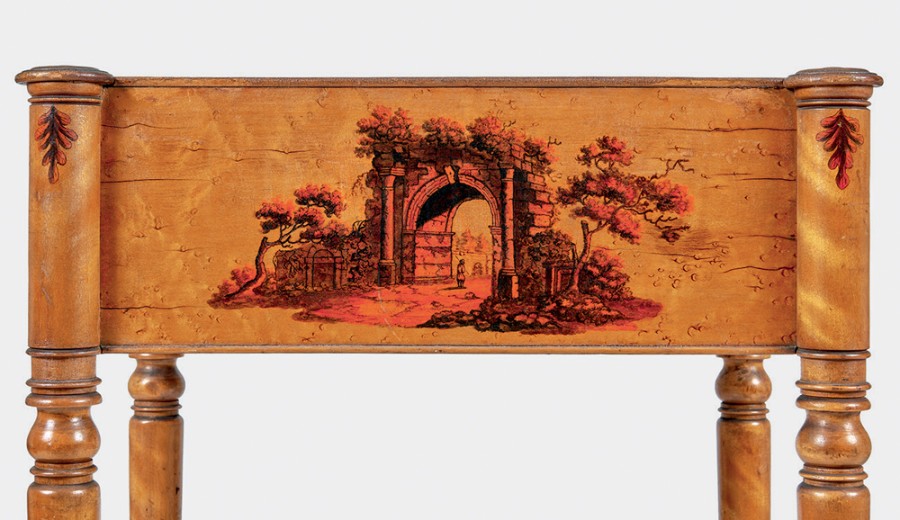
The form of the table relates closely to other two-drawer work tables produced in Essex County between 1810 and 1825, many with similar romantic landscapes painted on the sides by young women, often while attending a female academy.[16] Sally would have been fifteen in 1810, the average age of most of the other documented table artists. She may also have done the painting well after leaving school, suggested by her purchases of a paint box from Cushing and Appleton in Salem on March 7, 1822, and another one the following year.[17] The oak leaf border around the top edge was a popular motif on tables in the 1820s (fig. 13). Glass drawer knobs also came into vogue in the 1820s, and their selection is consistent with Sally’s embrace of the latest design trends. Yet despite all of this circumstantial evidence, a more plausible attribution can be made for Sally’s daughter, Elizabeth Ropes Orne (1818–1842), who seems likely to have done the paint decoration in the 1830s. A large number of drawings and watercolors in the Ropes Family Papers attributed to her are evidence of her skill, and several of them have details similar to those painted on the table. For example, the pointed arch bridge in the scene on the table’s left side is very similar to the bridge in one of her pencil sketches (figs. 16, 17).[18]

These scenes of classical ruins and idyllic landscapes possess a greater degree of sophistication than the imagery found on most other schoolgirl tables, suggesting Elizabeth may have worked with her cousin and close friend, the artist James Arthur Cleveland (1811–1868). In August of 1836, Cleveland advertised in the Salem Gazette that he was willing to give lessons in drawing providing twelve pupils signed up for the course, noting “Drawing from nature will be particularly attended to as soon as the scholars may have attained a sufficient knowledge of the rudiments.”[19] Several drawings in the Ropes collection appear to be Cleveland’s work, suggesting a student-teacher relationship with Elizabeth (fig. 18). In 1839 Cleveland and his wife traveled with Elizabeth and her mother to Cincinnati to visit her uncle, Nathaniel Ropes IV. Nathaniel gave her an expensive blank book upon their arrival, and Cleveland became the first person to make an entry, sketching a small landscape with details similar to those found on the table (fig. 19). That same year, Cleveland published his Elements of Landscape Drawing in Cincinnati, with twelve lithographed plates focused primarily on how to draw trees, many similar in detail and technique to those found on the table (figs. 20, 21).[20]

The marriage of Sally Ropes to her first cousin, Joseph Orne, on May 22, 1817, led to Pitman’s largest commission from the family (figs. 22, 23). He made at least twenty-two pieces of the furniture for the couple’s first home, a grand three-story town house designed by Salem’s most renowned architect, Samuel McIntire (1757–1811) (fig. 24). Built in 1795 for Joseph’s father (and Sally’s uncle), Captain William Orne (1752–1815), the house was prominently situated on Court Street (later renamed Washington Street), near McIntire’s imposing 1785 courthouse. Joseph acquired the house during the settlement of his father’s estate, and while he did not take legal possession until April 1, 1818, once the couple announced their engagement in 1816 they immediately started to make plans to furnish the house in a fashionable manner using the considerable fortune Joseph had also inherited from his father.[21]

At the time of their engagement, Joseph was studying theology at Harvard College in Cambridge, Massachusetts, and had already used Pitman’s services. In February of 1816, Pitman put rockers on a chair, made a bed canopy with urns, a thermometer case, and a “set of bookcases” for Joseph’s ever-growing library (Appendix C, no. 7). Only the two-part bookcase and possibly the bed canopy survive (fig. 25). A very similar bookcase was made later (fig. 26). Both bookcases consist of two separate units, with the upper case set back behind an applied molding that runs along the front and sides, crown moldings of the same design, and two doors with six panes of glass in each of the sections. They are both made of inexpensive pine grain-painted to simulate mahogany or rosewood, with an interior painted the same ocher color. Differences include the methods used for constructing the bases and installing the glass. The 1816 bookcase has a projecting base with an applied molding and straight bracket feet, and the panes of glass are set into a rabbet on the inner edges of the molded rails and stiles of the door using traditional glazing bars (fig. 27 [above]).[22] The later bookcase has a curved apron flush with the bottom rail of the lower doors; the panes of glass are held in place by a molding with an astragal bead glued along the front edges of the stiles and rails of the doors, with matching glazing bars (fig. 27 [below]). The front edges of the shelves in the later bookcase have a double bead; the shelves in the earlier bookcase are square cut and plain. Both cabinets remain filled with many of the books acquired by Joseph and Sally, offering insight into their broad interests in European and American history, literature, natural history, and religion.

While payment for the four-poster bed with gilded cornice in figure 29 is documented (see Appendix A, no. 6), surprisingly, no receipts survive for the Ornes’ wedding furniture still in the house, including a dressing table, bureau, dressing chest with attached mirror, sideboard, Pembroke table, two-part dining table, easy chair with rockers, night table, sofa, set of mahogany chairs, and three nearly identical washstands. Many of these same forms appear on a Pitman receipt listing the furniture made for the wedding of two of Sally’s relatives in 1808 (fig. 28). This receipt and several Figure 28 Receipt for Capt. Jonathan Hodges from Mark Pitman, April 8, 1808, for furniture supplied for the marriage of his daughter, Elizabeth H. Hodges, to George Cleveland of Salem. (Courtesy, Phillips Library, Peabody Essex Museum [Hodges Family Papers, box 22, folder 17].)

other orders for wedding furniture from this period provide a contextual understanding of the Ornes’ commission and suggest there was a communal agreement in the Salem region in the early decades of the nineteenth century as to what was necessary and fashionable for establishing a comfortable upper-middle-class home.[23] Sally’s first cousin, Elizabeth H. Hodges (1789–1834), married George Cleveland (1781–1840) on April 27, 1808. In the months before their wedding, the couple worked to furnish their first home in Boston. Pitman’s receipt, submitted to the bride’s father, lists the furniture he produced for the couple as well as sets of “bamboo” (Windsor chairs with simulated bamboo turnings) and “fanci” (paint-decorated) chairs that Pitman likely acquired from independent chair makers who specialized in specific forms. Pitman clearly played a large role in helping to coordinate all of the furnishings for the Boston couple and likely did the same for Joseph and Sally.

One of the more important Hodges pieces was “a high post bedstead with a gilt cornice” costing thirty-four dollars and fifty cents. The Orne bed matches that description and appears to have been a gift from Elizabeth (Cleveland) Ropes (fig. 29). She made two payments to Pitman in May of 1817 just before the Ornes’ wedding, recording an eighteen dollar payment “for a bedstead purchased last October” and an additional $9.67 to settle Pitman’s account.[24] The $27.67 total is close to what the Hodges paid. The design of the Orne bed relates closely to the bedstead made for George Crowninshield Jr. for use on Cleopatra’s Barge, America’s first ocean going luxury yacht (fig. 30). Launched in October of 1816, the boat, with its unique design and elaborate furnishings, created a public sensation. Thousands of people toured the boat before it left on its maiden voyage to Europe the following spring. Sally’s cousin, Samuel Curwen Ward (1767–1817), served as clerk on the voyage and, as a close friend of the owner, he likely provided the family with special access to view the boat.[25]

The front posts on both beds show the influence of British designer Thomas Sheraton. In his influential The Cabinetmaker and Upholsterer’s Drawing-Book (London, 1790–1793), Sheraton published a number of designs for bed pillars, noting if they should be executed in mahogany with carving or painted. The front pillar in his “Design for a Bed” has the same basic component elements as the posts on the two Salem beds, consisting of a round tapering upper shaft above an elongated urn, followed by the square rectangular section containing the brass caps covering the holes for the bolts joining the posts to the rails (figs. 31–33). The round turned foot tapers in the opposite direction from the upper shaft. The Ornes chose mahogany pillars to match the other furniture selected for their bedroom, relying on the complex and elegant turned details for the decorative effect (fig. 32). Crowninshield chose to have his posts painted, resulting in fewer turned details. On a yellow ground, green and gold banding highlight various transition points, and a grape vine and scrolling acanthus leaf ornament adorn the central parts of the post.[26]

The cornices on both beds are similar in design and retain their original paint and decorative accents. Narrow reeded boards on the front and sides are attached to a curved rectangular panel at the front corners, accented with a large brass medallion. The reeds on the Orne cornice are consistent in size and are crossed every twelve inches with a flat angled band, imitating the leather straps on a fasces, a bundle of wooden rods surrounding an axe head that served as an ancient Roman symbol of united strength and authority (figs. 34, 35). The same detail appears on a bed pillar in George Hepplewhite’s The Cabinet-Maker and Upholsterer’s Guide (London, 1788), a pattern book widely used in Salem (fig. 36). Both the Crowninshield and Orne bedsteads were originally dressed with a lively English cotton chintz. The Ornes chose a bold pattern with alternating columns of oak leaves and pansies printed in yellow, blue, and burnt orange on a honeycomb background (fig. 33).

The field bed in the Ropes collection was also likely part of the Orne wedding order, perhaps intended for the guest chamber or in anticipation of having children (fig. 37). Other documented wedding orders include a field bed, such as the “birch field bedstead” costing nineteen dollars made for the Hodges in 1808 and the “birch canopy bedstead” costing twenty-two dollars made for Lucy Hill (1783–1869) in 1810.[27] While the use of less expensive birch was common, wood analysis has revealed that the posts and backboard of the Orne field bed are made from the same mahogany used to make the larger marriage bed. The four matching posts on the Ornes’ field bed are similar to the front posts on their wedding bed, and the headboard has a similar shape with a different cap on each end of the scroll. Consisting of a simple domed circle with a plain dome in the center, the cap is similar to the brass caps on the bolt holes (figs. 38, 39). The “bed canopy with urns” Pitman made for Joseph Orne in 1816 may have been repurposed for this bed (Appendix C, no. 7). The turned details and acorn finial on the urns are more robust than the more delicate details on Pitman’s earlier urns (figs. 40, 41).

Like the bedsteads, all of the other pieces of the Ornes’ wedding furniture express Salem’s interpretation of the British Regency or late neo-classical style, inspired by various British pattern books and, more directly, by the very stylish furniture produced by Boston cabinetmakers, most notably John (1738–1818) and Thomas Seymour (1771–1848), who produced furniture for many of the leading families in Salem.[28] The sideboard Pitman made for the Ornes incorporates key characteristics of the style in Salem (fig. 42). The most prominent is the use of turned legs with bold reeding on the upper portion engaged with the case. Similar legs appear in Thomas Sheraton’s design for the lower portion of a dressing cabinet published in 1793 and in Boston work soon after 1800 (fig. 43). Like the Orne sideboard, the four front legs in Sheraton’s design divide the flat facade of the long rectangular cabinet into three bays. The two outer bays have a single drawer with a cabinet below. Pitman chose to fill the space below the central drawer with two small drawers and two bottle drawers flanking a central cabinet. The serpentine shape of this section relieves the otherwise flat facade and required additional work to create the individual curved shapes of each drawer front. While the top board in Sheraton’s design (like most Boston examples) shows smooth semi-circular projections above the engaged columns, Pitman, like most Salem cabinetmakers, preferred using a turned ovolo cap (fig. 44). Each is set partially into the top surface, with its rounded edge meeting the half-round molding applied to the edge of the top board. Salem makers also preferred legs with well-rounded ball feet and large turned wooden drawer pulls to blend visually with the rich graining of the mahogany veneer.

Carved capitals above the reeding on the legs became a hallmark of Salem case pieces, in part because of the number of skilled carvers offering their services to multiple cabinetmakers. Thomas Sheraton’s design shows carved acanthus leaves above the reeding, but Pitman chose a distinct abstracted floral motif with a star-punched background characteristic of Salem carving (fig. 45). The Ornes’ dressing chest features acanthus leaves on the capitals similar in detail to a number of the leaves in Sheraton’s drawing book, which he included for carvers to copy (figs. 46, 47). Pitman did not start using the services of master carver Joseph True (1785–1873) until May of 1819, suggesting this carving is not True’s work.[29] Pitman may have used the services of another carver, or possibly he executed this carving himself.

A review of the turned legs on all of the other pieces of Orne wedding furniture demonstrates that Pitman did all of his own turning. There is a consistent vocabulary of favorite details, always executed with precision and skill. Many turned elements on the legs line up perfectly with details on other parts of the case or frame. An early example of Pitman’s interest in turning and his shift to the British Regency style is found on a labeled desk (fig. 48). Half columns with turned details flank the lower tambour doors, providing a transition to the square tapering legs associated with his earlier style. While there are no carved details on any of the other legs adorning the Orne wedding furniture, the use of the same bold convex reeding with well-rounded tops and ball feet gives this entire suite of furniture a cohesive look of restrained classical elegance.

Thomas Seymour popularized the dressing chest with an attached mirror in Boston and made several of his finest examples for Salem residents.[30] Pitman’s dressing chest mimics Boston examples, having a three-drawer unit built into the top surface, to which is attached a rectangular looking glass (fig. 50). Pitman’s mirror is set into a simple half-round veneered frame with a gilded liner and topped with a shaped crest. The frame is attached to straight reeded standards with scrolled side supports. A metal rod inserted through the bracket, standard, and frame allows the mirror to swivel. The molded brass knob on the end of the rod and the metal ball finials on the posts have traces of the original brown paint to simulate wood. The shape of Pitman’s side brackets lacks the complex curves and gracefulness of many Boston examples, but identical brackets on a dressing box made in 1818 by William Hook (1777–1867) suggest it was favored in Salem (figs. 50, 51).[31] Based on an ancient lyre, the shape was one of the more popular motifs used to express the classical style; it appears numerous times in the 1817 edition of The New-York Book of Prices for Manufacturing of Cabinet and Chair Work (fig. 52). Like the Hook brackets, Pitman’s brackets were originally accented at the ends of the scrolls with brass medallions, now missing.

The simple shaped crest on the mirror of the Orne dressing chest relates to the frame of a wall mirror in the Ropes collection (figs. 50, 53). The shape of the crest, side brackets, and base on the wall mirror evolved in the eighteenth century and remained popular into the 1820s, evidenced by labeled mirrors by several different makers.[32] The ease of cutting the shapes from thin mahogany boards facilitated the replication of the design. Pitman may have intended this looking glass, with a distinct gilded liner in the frame, to be hung over a dressing table with a two-drawer unit on top that Pitman also made for the Ornes (fig. 54), thus imitating in appearance and function the dressing chest in figure 50. Alternatively, the Ornes may have purchased it from another maker, and it provided the inspiration for Pitman’s design of the mirror on the dressing chest.

While most Boston dressing chests have a straight facade, Salem makers preferred a swelled or bow front seen in the Orne dressing chest and dressing table (figs. 50, 54). The Hodges paid fourteen dollars for their dressing table. The capitals on the legs of the Orne table are plain (having a slight ogee cyma recta shape), with a bead at the base that meets the applied bead on the lower edge of the front and side rails. A distinguishing feature is the use of four brass paw feet to elevate the two-drawer unit about a half inch above the top surface (fig. 55). A single brass nail driven through a hole in the center of each foot attaches the unit. While the restrained look of Pitman’s larger case pieces stems in part from the use of plain turned wooden drawer pulls, he also occasionally used pressed brass pulls—in this instance to complement the brass feet.

The dressing chest and a smaller straight front four-drawer bureau in the suite have recessed panels on the sides of the cases set into stiles and rails with beaded edges, another Regency design feature (figs. 50, 56). The beading is also the dominant decorative detail on the smaller chest’s turned legs, which lack vertical reeding and carving. Three sets of double beads align with the cockbeads around the edges of the drawers. Pitman’s fondness for beading is evident throughout his work. He consistently added an applied cockbead to the lower edges of all of his case pieces, table rails, and around the edges of most drawers. Well-rounded single beads, astragal beads, and reeds (three or more beads) are also common details on his turned legs and bed pillars. On his later Grecian pieces, beads appear on the edges of the shelves in the sideboard, bookshelves, and table legs (figs. 42, 92, 95, 97, 108).

Some of Pitman’s more complicated turning appears on the delicate legs of three nearly identical mahogany washstands in the house (figs. 57–59). While the Hodges’ wedding receipt lists only one washstand costing four dollars, the Ornes appear to have ordered more, suggested by their purchase of “4 sets of ewers and basons” in 1818 for their new house.[33] Two of these sets survive, both featuring British blue transfer-printed glazed pottery with romantic ruins in a landscape setting (one set is shown in fig. 59). Two of the washstands have identical turnings and are likely part of the wedding order (figs. 57, 58). Different drawer pulls suggest they were intended for different rooms. The one with a turned wooden pull, like those on the dressing chest and bureau, may have been intended for the master bedchamber, while the one with a pressed brass pull may have served a guest chamber. The third washstand has slightly different turnings and may be part of the wedding suite, or it could have been made later for their daughter Elizabeth (fig. 59).

In each stand, Pitman provided a large circular hole in the center of the top surface to accommodate the washbowl. The hole is large enough to secure the base, yet small enough to elevate the bowl well above the varnished surface. A shaped valance along the front edge blocks the view of the base below the surface. The cyma or ogee outline of the valance is a variant of the valances on the pigeonholes in Pitman’s desks, such as the example in figure 2, and echoes the double reverse curve of the sides of the high gallery, designed to contain splashes of water. The two small semi-circular shelves in the corners of the gallery held accessories, as did the two additional holes cut into the top surface next to the washbowl—perhaps a soap dish and a drinking glass. The lower shelf provided a place to put the water pitcher after filling the basin. The single drawer below held washcloths, toothpaste, and other supplies. To complete this hygienic ensemble, the Ornes purchased several tabernacle form looking glasses to hang above the stands, including two with gilded frames that have three dimensional ornaments, one with a seashell, the other with flowers (figs. 60, 61).[34]

The Hodges receipt lists “1 painted twilight table $4,” most likely a reference to a “Night Table,” a small cabinet designed to conceal a chamber pot for use in the bedroom during the night. An altered night table by Pitman in the Ropes collection may have been part of the Orne furniture (fig. 62). Its size matches the dimensions for a night table in the Salem Cabinetmakers Price Book, “the common kind, 2 feet 4 inches, 2 feet deep without the pan [$]12.”[35] The Orne table retains the original top, back, feet, and sides with brass handles for lifting the piece, but the facade and some interior elements were altered about 1900 to turn it into a small chest of drawers. Hepplewhite’s pattern book shows multiple night table designs, including one with an open lid (fig. 63). A night table by Salem cabinetmaker Elijah Sanderson (1751–1825) has a veneered facade with two inlaid ovals, visible when the lid is closed during the day to conceal the purpose of the table (fig. 64).

It is clear from their other purchases that Sally and Joseph intended to make dining an important part of their life together. In addition to the sideboard in figure 42, Pitman made a large two-section dining table (fig. 65). The Hodges table is described on their receipt as “2 dining tables with rounded ends 35.00,” a reference to the then popular sectional tables featuring an end unit with a semi-circular top. Each section of the Orne table consists of a rectangular top, with a hinged drop leaf on either side. The smaller leaf on the end of the table has rounded corners, while the larger inner leaf is rectangular. When the smaller leaf is raised, two shaped brackets swing out from the rail to provide support. The larger leaf is supported by a single leg that swings out on the end of a fly rail; the other three legs supporting the top are fixed. These two independent sections can be configured in multiple ways to create tables of different sizes, depending on the number of guests. When both sections of the table are joined together with all four leaves raised, the table measures 112 inches long. When both leaves are folded down, an unused section could easily be stored against a wall or, more common during the period, under the staircase in the front hall.

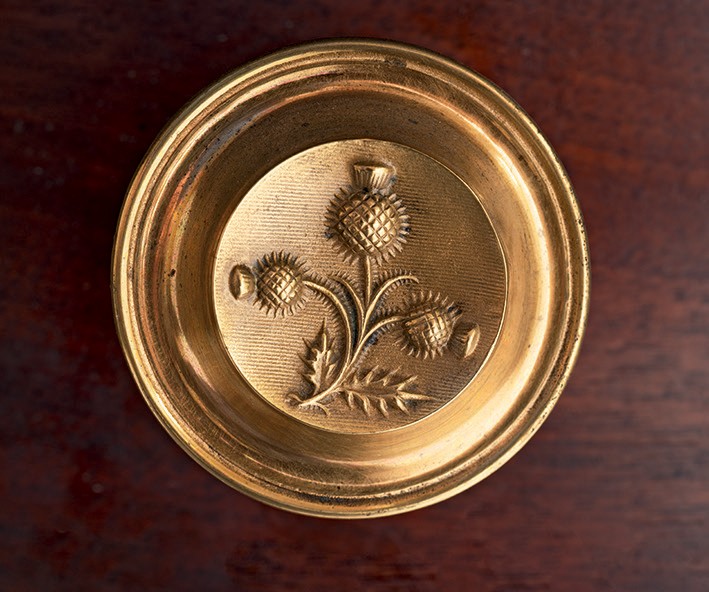
A matching Pembroke table was also made for the dining room, and it has equally sized falling leaves with rounded corners and four fixed legs of the same design as those on the dining table (fig. 66). Pitman charged the Hodges fourteen dollars for their Pembroke table. On the Orne table, a single shaped bracket swings out from the rail to support a raised leaf. The long drawer built into one end of the frame has a pressed brass pull embossed with a thistle plant, reflecting Sally’s love of Scotland and her favorite author, Sir Walter Scott (fig. 67).

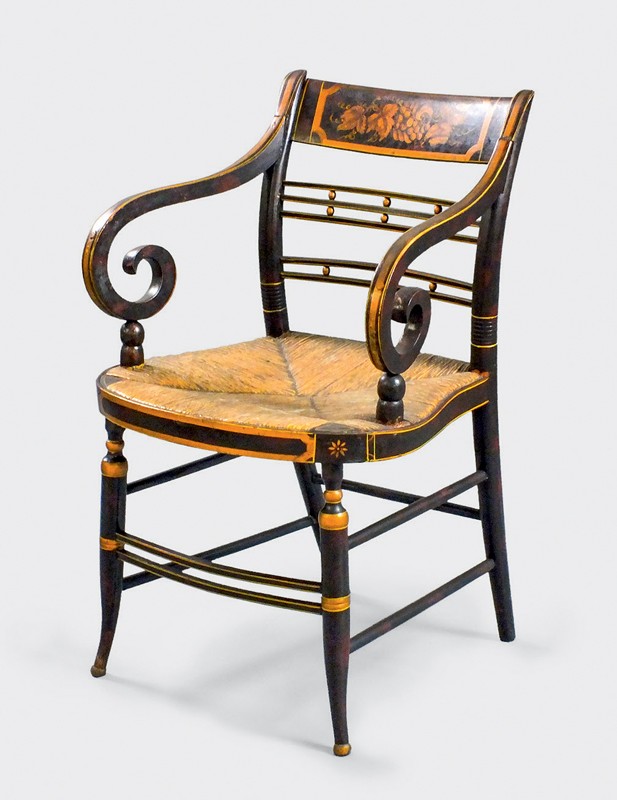
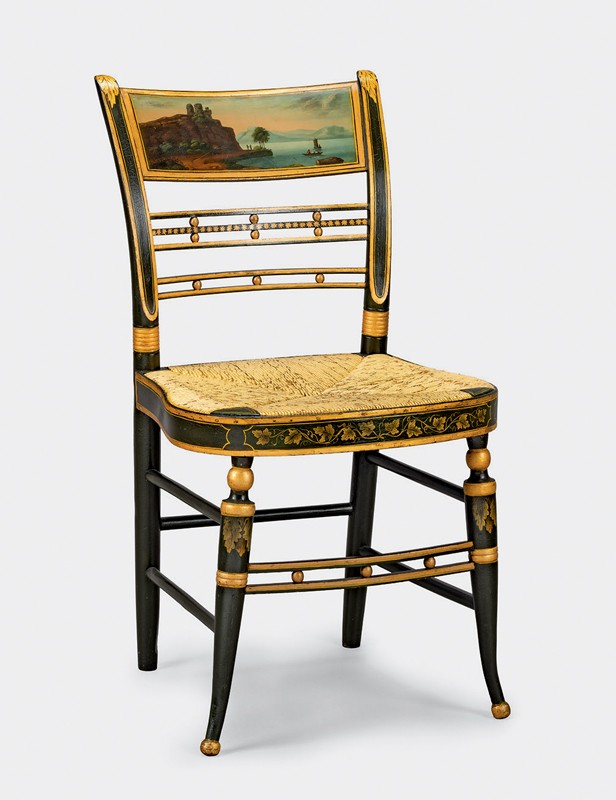
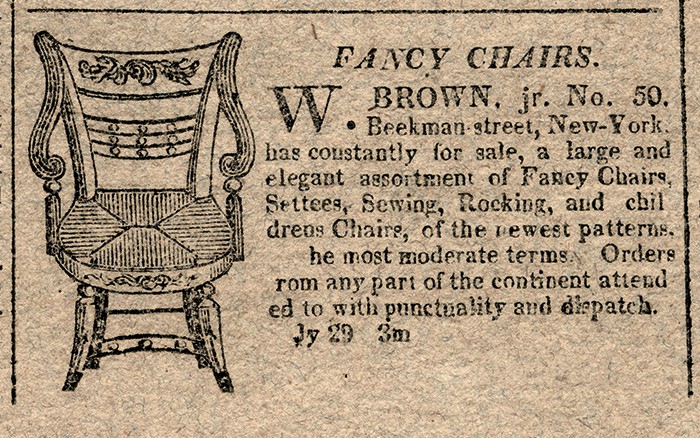
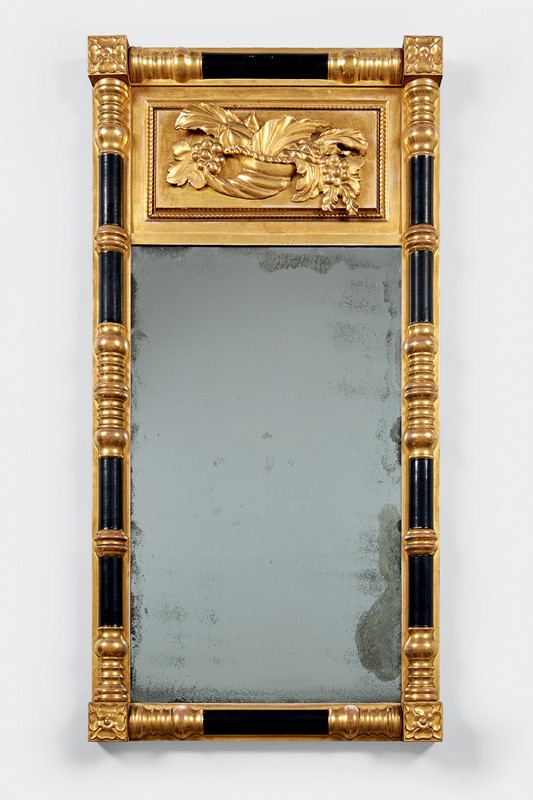
Like the Hodges, who purchased twelve fancy painted chairs, the Ornes selected a set with rush seats to use with the dining and Pembroke tables (fig. 68). Two armchairs and four side chairs survive from what was likely a larger set. The chairs are closely related in form to the painted chairs used for dining on Cleopatra’s Barge (fig. 69). Both sets likely originated in New York City, where fancy chair makers like William Brown Jr. (1785–1819) advertised similar forms and assured customers that “Orders from any part of the continent attended to with punctuality and dispatch” (fig. 70).[36] The Orne chairs have a black ground with streaks of red, which stands in sharp contrast to the gold paint used to accent various details on the arms, legs, and back. The wide crest rail features clusters of grapes with leaves. Grapes also appear flowing out of a cornucopia on the upper panel of a large pier glass purchased by the Ornes in 1817 for their dining room (fig. 71). The half-spindle frame with alternating sections of black and burnished gold is well-matched with the coloration of the chairs.

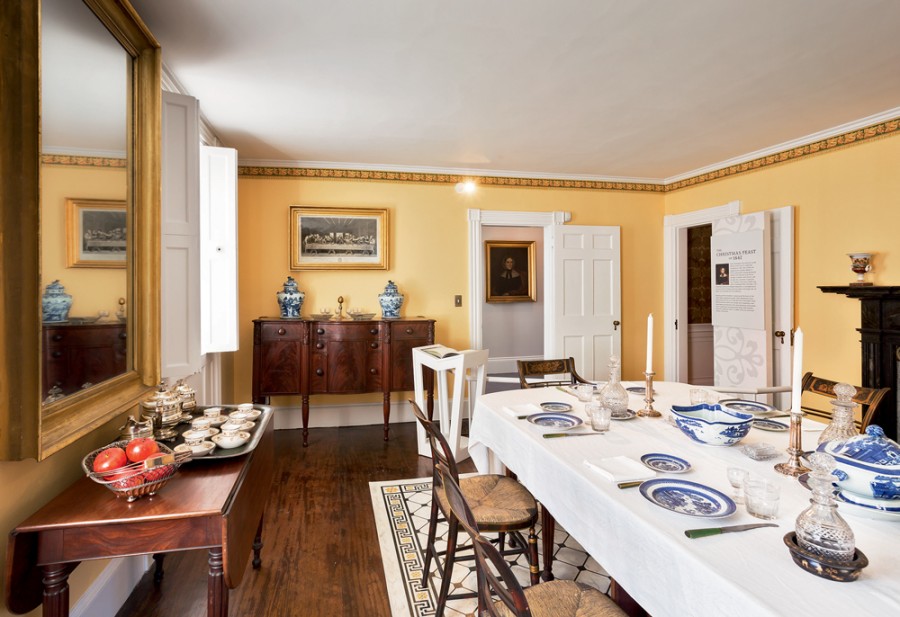
The Ornes also purchased hundreds of other dining-related wares during various shopping sprees in Salem and Boston in November and December of 1817. They bought damask tablecloths and napkins, a three hundred-plus piece Chinese export porcelain dinner service, a two hundred-piece set of Anglo-Irish cut glass, bone- and steel-handled knives and forks, and sterling silver serving spoons. Almost all of these purchases survive in the Ropes collection, providing an extraordinary opportunity to appreciate the functionality of Pitman’s dining room furniture and the role it played in creating a harmonious expression of the fashionable neo-classical style (fig. 72).

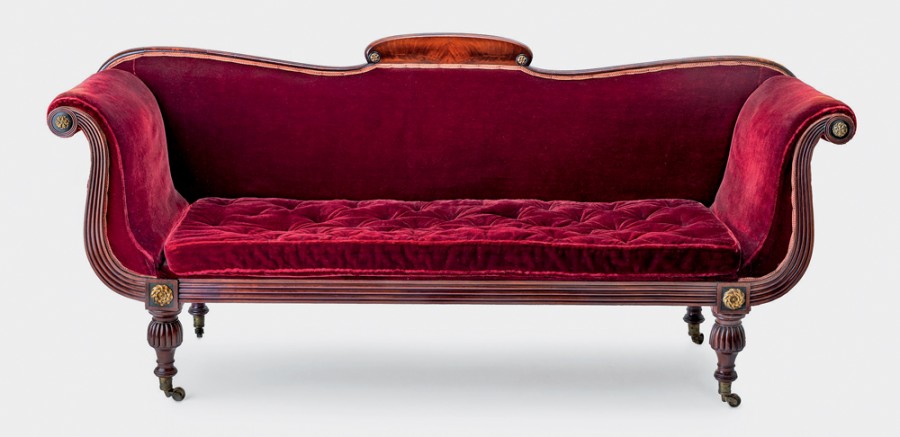
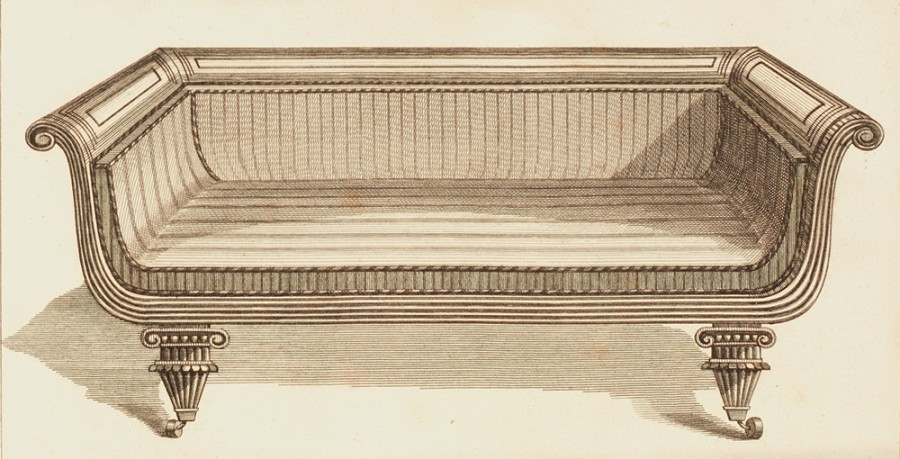
The Hodges furniture receipt lists two upholstered pieces of seating furniture, a sofa costing forty-five dollars and an easy chair with rockers costing fifteen dollars and fifty cents; both forms survive among the Orne furniture. The sofa is based on Thomas Sheraton’s design for a “Grecian Sofa” published in 1803 (figs. 73, 74). Innovative features include a back equal in height to the sides, scrolled arms, and reeded turned legs, which Sheraton called “stump” feet (fig. 75). Inspiration came from sofas with similar features depicted on various ancient archaeological artifacts, such as a Roman sarcophogus dating from the third century (fig. 76). The Ornes would have viewed their sofa as a very stylish modern expression of classical taste, reflective of their interest in ancient Greece. They owned a copy of the two-volume set of Archaeoligia Graeca, or, The Antiquities of Greece by John Potter, published in 1818, with engravings of classical buildings and artifacts. A very similar sofa has been published as being the work of Jonathan Peele Saunders (1785–1844) of Salem and made for his own wedding in 1811 (fig. 77).[37] Since there is no evidence that Saunders, who was a civil engineer, was also a cabinetmaker, both sofas can be assigned to Pitman based on the similarity of various details to other pieces of Orne furniture. These include the reeding along the front rail and arms (like the bed cornice), the treatment of the reeding and other turned details on the legs, and the use of stamped brass mounts as decorative accents.

The use of metal mounts on furniture is one of the defining decorative features of the British Regency and French neo-classical styles during the early nineteenth century. Urban American cabinetmakers used imported mounts widely, and pattern books show their effective use on most furniture forms. Thomas Hope’s design for a sofa made for his own home shows rosettes as terminal points on the ends of the arms and scrolls on the elaborate central panel on the crest rail (fig. 78). Hope noted: “These ornaments in bronze, which, being cast, may, where ever a frequent repetition of the same forms is required, be wrought at a much cheaper rate then ornaments in other materials, only producible through more tedious process of carving.”[38]

The elongated oval panel above the crest rail on the Orne sofa has small gilt brass floral medallions on the end of the curve, set within an ebonized bead (fig. 79). More elaborate medallions appear on the scrolls of the arms, and larger examples are applied above the legs on the seat rail, set within a square frame reminiscent of the panel above the legs on the ancient sofa (figs. 80, 81, 76). The maroon velvet upholstery currently on the sofa dates from the late nineteenth century. While the original covering has not been determined, the black paint around all of the medallions suggests black horsehair may have been the original covering given its wide use on seating furniture during much of the nineteenth century.

The raised panel on the crest rail of the sofa is similar in shape to the rounded end crest rails on a set of ten mahogany side chairs likely made by Pitman as part of the wedding suite or possibly added later, in the 1820s (fig. 82). The design of the chairs reflects the ancient klismos form, with saber legs on both the front and rear of the chair. Chairs of this form were being produced by Boston’s leading makers, including Isaac Vose (1767–1849), in the early 1820s, usually with a degree of carving on the crest rail and the single stay rail below (fig. 83). The only attempt at ornamentation on the Orne set is the inclusion of figured mahogany veneer on the raised panel on both the crest rail and single stay rail in the center of the back. The Orne chairs may have been fitted with cushions. In his popular serial publication Repository of Arts, Literature, Commerce, Manufacture, Fashion, and Politics (commonly known as Ackermann’s Repository), Rudolph Ackermann illustrated many different chair designs with caned seats for the parlor and dining room, with options for cushions. In one instance he noted: “the cushion, separate, secured with straps underneath.”[39]

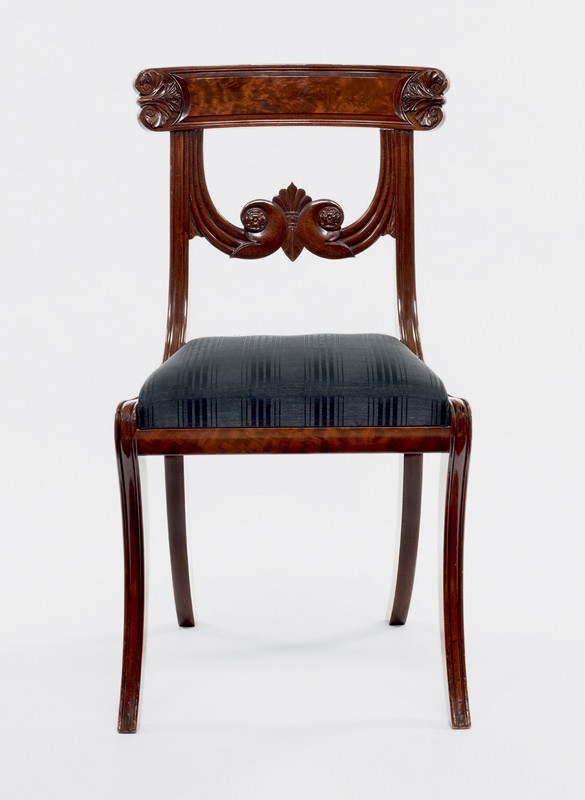
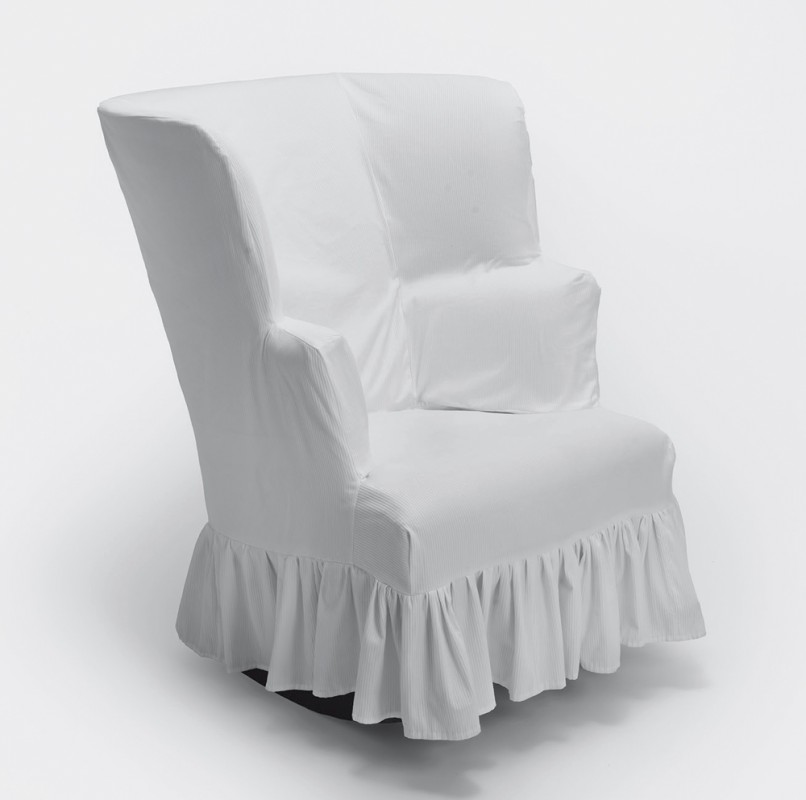
The Ornes’ easy chair with rockers has turned front legs characteristic of Pitman’s work, and his hand is also evident in the carefully chamfered glue blocks in the corner of the seat frame (figs. 84, 85). The rear legs are square with a slight taper; both front and rear legs are pinned to the well-shaped rockers. Easy chairs had been popular in New England since the early eighteenth century, traditionally made to comfort an elderly or infirm person in their bedchamber.[40] The form’s presence among the furnishings ordered by two young couples in their early twenties suggests another usage. Since most surviving easy chairs do not have rockers, Pitman’s use of them seems innovative and may be one of the reasons for their popularity with young couples anticipating children. Rocking provides comfort to a mother during pregnancy, while nursing, or when trying to get a child to fall asleep. Such a chair would also have been an ideal place to sit for long hours reading, especially during the winter when the high back and side wings added extra warmth. Joseph paid Pitman to add rockers to another chair in 1816, suggesting a clear family preference for the form. Since upholstery was an independent craft from cabinetmaking, Pitman would have turned the wooden frame over to an upholsterer for covering. Upholsterer Asa Lamson (1783–1858), who lived in the neighborhood, may well have done the original work. In 1828 he charged Elizabeth (Cleveland) Ropes six dollars and fifty cents for “a chair with stuft back.”[41] Since slipcovers were the preferred covering for an easy chair due to their changeability, a fully upholstered chair often had plain linen as the final covering.

Amid all of this furnishing activity, Joseph’s health continued to decline from the effects of consumption. He finally succumbed to the disease on September 3, 1818, at the age of twenty-two, six months after the birth of their only child, Elizabeth Ropes Orne (fig. 86). For a variety of reasons, both financial and emotional, Sally decided to sell the Orne house back to Joseph’s family. On June 14, 1819, Joseph’s sister and recent widow, Mrs. Eliza (Orne) Wetmore (1784–1821), purchased the house on the eve of her marriage to Daniel Appleton White (1776–1861).[42] Sally and her infant daughter returned to live in the Ropes Mansion with her stepmother Elizabeth and sister Abigail. She brought all of her wedding furnishings with her, causing a major upheaval in the house to accommodate them.

During the next decade, Sally continued to order furniture from Pitman to meet the family’s changing needs, and in 1825 she paid sixteen dollars for a “French birch bedstead” (Appendix C, no. 9). The term “French” on the receipt may refer to the size of the bed, being larger than a single bed but not quite a full double bed, rather than a reference to the then popular French bed with matching low head and footboard, placed against a wall with drapery suspended from the ceiling.[43] Furthermore, many artisans used the term “French” during this period to mean something in the French taste. It is not clear for whom this bed was intended. Elizabeth turned seven in 1825, and it may have been part of a refurnishing plan for her room; alternatively, it may have been acquired for another family member or servant. If this bed was used by Elizabeth during her formative years, it was later replaced by the field bed in figure 37 that she is known to have used in her room as an adult and in which she died in 1842.

In addition to the washstand in figure 59 discussed earlier, a four-drawer bureau and small dressing box are, by tradition, also associated with Elizabeth’s room (figs. 87, 89). The bow front bureau has two construction details that differ from the two wedding chests in figures 50 and 56. There are no inset panels on the sides of the case, and several plain horizontal boards cover the entire back, compared with the more complex paneled construction found on the other two chests (see Appendix B, no. 10). This suggests this could be an earlier chest or one made with simplified construction techniques because it was intended for a child’s room. The reeding on the upper legs continues almost to the top of the column without a pronounced capital. Instead of wooden drawer pulls, Pitman used pressed brass pulls embossed with spiral seashells, one of Elizabeth’s primary collecting interests, made evident by the many shells that remain on display in her bedroom (fig. 88). The single-drawer dressing box, traditionally used on top of a chest of drawers, has straight reeded posts and ebonized ball feet, features also found on small dressing boxes produced in Boston.[44] The metal ball finials are smaller versions of the balls on the posts on the larger dressing chest (fig. 50). A metal pin secures the frame of the mirror to the standards, allowing it to swivel. The turned knob on the end of each pin is made of ivory, the same material used to make the turned drawer pulls.

Pitman also made two pieces of miniature furniture for Elizabeth to play with, scaled to her favorite dolls. The toy cradle is a small version of full-size cradles popular in Salem, with a flat top hood with sloping sides and a cyma-shaped valance similar to those on Pitman’s washstands (fig. 90). The toy washstand is a simplified version of an adult washstand, with a plain gallery and single drawer with a brass knob (fig. 91). Each piece displays Pitman’s meticulous joinery and the care he took to shape even the smallest detail.

Having inherited much of her father’s wealth, Elizabeth was educated largely by private tutors, studying French, the piano, dance, and art, and she developed a voracious appetite for reading and writing. She was particularly interested in religion and the Bible and formed close relationships with a number of local clergymen. In 1828 Sally paid Pitman five dollars and fifty cents for a “set of book shelves,” likely the set in Elizabeth’s bedroom (Appendix C, no. 12). The set was custom designed to fit on top of a small pine table that served as Elizabeth’s desk (fig. 92). The simplicity of the unfinished table, with square tapering legs and a single drawer with a wooden pull, suggests it was made earlier for another purpose, possibly in 1807 or 1809.[45] In contrast, the mahogany bookshelves are elegant and finely crafted. Built as two separate sections, the lower unit has a two-drawer base with two shelves above. The upper shelf is unfinished on the top surface, with a raised molding running along the front and sides to secure the upper section. The upper unit has two shelves set back from the base, necessitating the subtle curve to the sides, which are square cut at the top. A simple scroll projects forward from the front edge ornamented with a brass rosette applied to the outer edge (fig. 93). The scoring along the edges of the shelves and sides creates a double bead. Filled with small-scale books, many with Elizabeth’s signature, the shelves appear to be the last piece of furniture Pitman made for the room.

Like her father, Elizabeth contracted consumption; after a valiant fight, she died in her bed on March 8, 1842, at the age of just twenty-four. “I never realized so forcibly what death was as on that sad occasion,” her mother later wrote, “for I had not seen one so idolized expire, the waning taper of her life seemed like an extinguishment of my own being . . . .”[46] To honor Elizabeth’s memory, Sally left the room largely intact during her remaining years, and succeeding owners did the same. Today, the room remains a quiet place to reflect on the role Pitman furniture played in the daily life of an accomplished young woman (fig. 94).

As furniture design in Salem shifted to express the bolder Grecian style, Sally kept pace by ordering new pieces of furniture. In 1826 Pitman made her a “Greashen penbrook table” for thirty dollars (fig. 95; Appendix C, no. 10). The English term “Pembroke” usually refers to a small table with falling leaves and four legs, intended for occasional use. Pitman’s version is much larger in scale, with a massive turned central pillar providing the support for the tabletop, with two falling leaves with rounded corners. Pitman added a subtle Grecian architectural detail to the ends of the frame rails, a rectangular panel fashioned from pieces of veneer with a bead at the base that projects out from the bead that runs along the central portion of the rail (fig. 96). The four concave legs with well-rounded tops abut the circular base of the column and have a bead cut along the outer edges. The bold brass foot mounts with casters have a paw toecap imitating the lion’s paw feet found on many pieces of ancient classical furniture.

Pitman used the term “Grecian” again to describe the work table he made for Sally in 1828, charging twenty-eight dollars (fig. 97; Appendix C, no. 12). The table has the same saber leg design as the Pembroke table, with a smaller version of the brass paw mounts with casters on the feet. Instead of a turned column, a curved brace on each side provides the support for the upper case. A similar work table design appears in the 1811 edition of Ackermann’s Repository, one of the more influential sources for innovative furniture designs at the time (fig. 98).[47] The cut glass knobs on the drawers were a new option in the 1820s, another indication of how closely Sally followed changing fashion (fig. 99).[48] In the open space between the braces, a semi-circular workbasket slides out on runners from the front edge of the upper case. Pitman joined multiple pieces of wood to construct the solid storage basket, lined on the interior with blue glazed paper and covered on the exterior with a green and gold plaid silk. A few remnants of the original gold fringe remain attached along one edge (fig. 100). The multiple compartments in the upper drawer held sewing supplies. When raised, the falling leaves create a large work surface, with two finger-hinged brackets identical in design to those on the Pembroke table in figure 95 providing the support (fig. 101).

Pitman’s other custom-made pieces during the 1820s reflect the family’s ongoing interest in writing and reading. In 1827 Sally paid nine dollars and fifty cents for a “sylinder desk and stand” (fig. 102 Appendix C, no. 11). While there are numerous Boston cylinder desks known, a corresponding stand specifically designed to support the desk is a rare form in American furniture.[49] Sally was apparently so pleased with the design that she ordered another set five months later costing nine dollars, perhaps as a gift for a friend or family member (Appendix C, no. 12). The ease in moving the lightweight stand around the house to take advantage of the best light and air was a key attribute. An 1827 British watercolor shows a young woman using a lap desk on a similar stand while seated next to large window with hinged sun blinds to filter the light (fig. 103).

Pitman’s desk features a tambour cover to protect the divided compartment that runs along the top edge, with spaces for pens and bottles for ink and sand. He used a version of the tambour technology on one of his earlier desks, gluing thin reeds to fabric to create the pliable retractable cover (figs. 104, 48). In this more complicated version, the cover automatically recedes into the case when the lower drawer is pulled out. The open drawer provides the support for the hinged flap, which folds down to create the writing surface. The reeds of the cover glued to fabric slide along a groove cut into the inner edge of the turned circular disks flanking the storage area. A small brass rosette ornaments the center of the outer disk. The stand has an elongated hexagonal top pinned to two cleats screwed to the underside. A brass catch allows the top to flip up when not engaged with the catch plate secured to the top of the pillar (fig. 105). The three splayed legs are reminiscent of Sheraton’s 1803 design for “A Lady’s Writing Table,” with wheels, but Pitman chose not to include casters for greater stability when writing (fig. 106). His innovative sense of design is evident in the mock scroll at the top of each leg, consisting of a drum, disc, and button (fig. 107).

In addition to the two-part bookshelf made for Elizabeth’s room in 1828, receipts indicate Pitman also made several other “book racks” and shelves, including another set in 1824 (Appendix C, nos. 8, 11). The largest shelf to survive has two upper shelves stepped back from the bottom one, necessitating the graceful S-shape of the sides (fig. 108). The S-shape, a line much admired in furniture design, referenced the ancient lyre during this period. Thomas Hope included the S-shape in many of his designs in Household Furniture and Interior Decoration (London, 1807), as can be seen in the base of a dressing glass (fig. 109). The end of each scroll in Hope’s design has a four-petal floral motif identical to the mount Pitman chose for the upper scroll on his bookshelf (fig. 110).

The larger medallion on the lower scroll is identical to one in a trade catalogue issued by Thomas Potts, a merchant in Birmingham, England (figs. 111, 112). A survey of the different mounts used by Pitman on the Orne furniture shows that several techniques were used to manufacture them, including stamping and casting, with a variety of finishes, including mercury gilding and tinted lacquers to simulate gold. Most if not all of these mounts probably came from British manufacturers in Birmingham, the leading center for this type of brass work during the period. A likely local source for these mounts was the Dean family, Salem’s leading hardware merchants. William Dean (1775–1846) imported wares directly from England and offered “cabinet trimmings” in the 1830s.[50] The only other decorative detail on the shelf features beads cut along all of the front edges of the shelves and sides.

Several of the surviving receipts in the Ropes Family Papers list multiple items or tasks Pitman performed at varying dates, indicating there was a reckoning of accounts from time to time to keep track of all that he did for the family. Many of the items listed on the receipts do not survive, including a pine wardrobe, a hat and umbrella stand, a flour stand, and an expensive Bagatelle board costing seventeen dollars (Appendix C, no. 12). Made in 1828 when Elizabeth was ten years old, this popular indoor table game challenged players to get nine balls into holes at the opposite end of the board without knocking over wooden pins placed as obstacles. The game indicates there were lively moments of entertainment in the house beyond the favored solitary activities of reading and writing.

Following the death of Elizabeth (Cleveland) Ropes in March of 1831, Pitman made her mahogany coffin, charging twenty dollars for the box and an additional five dollars for the silver plate on top engraved with her name (Appendix C, no. 13). Later that year, Sally and her sister Abigail, then the legal owner of the house, started what would become a multi-year massive renovation of the mansion to reflect the Greek revival style. As part of the renovations, Pitman made several additional pieces of furniture, as did other Salem cabinetmakers, including Thomas Needham (1780–1850), William Hook (1777–1867), and the firm of Abraham Kimball (1798–1890) and Winthrop Sargent (dates unknown).[51] These purchases from other cabinetmakers reflect the growth of new furniture retailing establishments and the manufacturing of specific forms for broader distribution at cheaper prices. They also reflect the family’s shift away from Pitman to meet all of their furnishing needs.

The dominant influence on Salem furniture design during the 1830s was Thomas King’s Modern Style of Cabinet Work Exemplified, first published in London in 1829. A copy of the 1832 edition owned by Kimball and Sargent provided inspiration for many of the pieces of furniture the firm made for George Peabody (1804–1892), one of Salem’s leading tastemakers, between 1834 and 1837.[52] Sally and Abigail joined in the enthusiasm for Kimball and Sargent’s work, purchasing one of their patent windless bedsteads and a set of mahogany chairs in 1836, as well as several other pieces.[53]

Pitman also consulted King’s pattern book when he was asked to make several pieces of furniture for the front parlor, considered the most important room in the house. Renovated in 1835–1836, the room prominently featured a new gray marble chimneypiece based on a bold Greek revival design in Asher Benjamin’s The Practical House Carpenter (Boston, 1830) and manufactured in Boston by John Templeton (dates unknown) (figs. 113, 114). The separate “iron mantel grate” for burning coal added to the firebox, purchased from Frothingham and Cross of Salem, not only improved the room’s heating, but also made a stylish statement with its ionic capitals and anthemion leaf decoration running along several of the edges.[54]

To balance the fireplace on the opposite side of the room, Pitman made a commode cabinet for the central pier between the two front windows, designed in concert with a large gilded looking glass and pair of tabourets (fig. 115). Ackermann’s Repository illustrates a “Commode, Pier Glass & Tabourets” in an 1818 interior, noting, “the apartment in which a similar arrangement should be adapted, must be previously designed in a corresponding style of Grecian symmetry or the effect and beauty would be imperfect” (fig. 116).[55]

Pitman’s commode is similar to one of the more modest commode designs in Thomas King’s pattern book, having a plain base and frieze with two doors flanked by modified columns (figs. 117, 118). Instead of using drapery in the door panels as suggested by King, Pitman inserted a veneered panel into the rails and stiles of each door, using a thin flat molding to cover the seams. The flat faux columns taper with an appropriately scaled plain rectangular capital and base. The projecting frieze is a drawer that runs the full width of the cabinet. Instead of pulls, the drawer is pulled open by placing several fingers into two concealed notches cut into the board below the drawer. The veneer on all of the surfaces reveals the rich graining of the dark mahogany, which stands in sharp contrast to the white marble top with random veins of gray.

The tabourets flanking the commode appear to be the work of Kimball and Sargent and feature an entirely original design based on the ionic capital (fig. 119). Instead of traditional volutes, an applied disc, consisting of a low relief circle with a dome in the center, fills the end of each scroll, with a slightly larger version filling the central space between. While Pitman used the same style of disc on the headboard of the bedstead in figures 37 and 38, the turning of the disc is closer to those on the bed Kimball and Sargent sold to the family in 1836, and the glue blocks holding the seat panel to the frame are uncharacteristic of Pitman’s meticulous workmanship.[56] A 1915 photograph of one of the stools shows the original needlework covering, since replaced (fig. 120). The needlework relates to several other examples of worsted work mounted on furniture in the Ropes collection made by Pitman, including a small footstool and a pole screen (figs. 121–123). Pitman also made the frames for another pair of mahogany footstools, also originally covered with needlework that was replaced in the twentieth century (figs. 124, 125).

In her 1875 will, Sally (Ropes) Orne leaves “my pole screen” to her niece, suggesting she was responsible for the needlework on the panel, footstools, and the original coverings on the tabourets.[57] All of the designs feature a scroll motif in the corners and have a cluster of flowers in the center surrounded by open space. New patterns for worsted work produced in Berlin, Germany, and the availability of more colorful wool yarn made possible by synthetic dyes caused a revival of interest in needlework, drawing, and watercolor painting in the 1830s and 1840s. Rudolph Ackermann, in presenting several designs for pole screens, commented that,

The talent for drawing, which has cultivated with so much success by some ladies of high rank, enabled them to decorate several articles of furniture in a very novel and tasteful manner. A laudable emulation in the higher circles caused this species of art to become fashionable, and an extensive variety of ornamental furniture has been produced by ladies . . . . There are few pieces of furniture so appropriate to the purpose of decoration in this style as the screen, either for the hand, or to be supported by poles . . . which may be ornamented as the taste of the amateur may suggest, either figures, landscapes, vases, flowers . . . .”[58]

In 1849, at the first applied arts fair held by the Salem Charitable Mechanic Association, the women of Salem provided the largest number of entries. One reviewer noted he was “struck with the exceeding beauty of some examples of worsted and the admirable and exquisite crayon and pencil drawings” on display. One separate category for needlework was “Tabourets,” many shown as pairs.[59]

Pitman based his pole design on one illustrated by Thomas King, having a tripod platform base with compressed bun feet and palmette or palm leaves carved around the base of the pole (figs. 126, 127). Pitman’s skill at turning and his inventive sense of design are evident in other details with turned elements alternating with areas of carving. The finial has a plain domed top above skillfully carved leaves with flaring tips, its profile echoed in the urn element mid-way down the shaft (figs. 128, 129). Pitman took special care in designing and manufacturing this piece of furniture, presumably to ensure that his most important patron received a product of the utmost stylishness. A small tabletop screen with three scrolled legs is similar to a design published by Rudolph Ackermann in 1815 (figs. 130, 131). Various carved and turned details are consistent with Pitman’s work. A square veneered frame encases an unfinished floral needlework, less refined in its execution than the needlework on the larger screen, suggesting it may be the work of another family member, possibly Sally’s sister, Abigail Ropes.

An April 22, 1828 Pitman receipt records Sally’s payment for a number of items and a thirty-dollar credit for the return of a card table, likely the same “Grecheon card table” she purchased from Pitman the previous year for the same price (Appendix C, nos. 11 and 12). The reason for the return is unknown but may have been due to its construction, wood, size, or style. The Grecian card table in figure 132 is likely Pitman’s replacement and reflects the shift to the more stylish platform base with a central pylon, a form first introduced into Boston by Thomas Seymour. One of the earlier examples is the pair of tables Seymour made for Peter Chardon Brooks in 1816, having a rectangular tapering shaft with a complex base molding similar to the molding on Pitman’s table (fig. 133).[60] Like Seymour’s tables, Pitman’s table has an iron hinge pin, which allows the leaves to rotate ninety degrees before being opened to rest on top of the table frame, and there is a well for storage built into one side of the frame. Pitman designed a different curved platform base, inspired by one of Thomas King’s designs (fig. 134). Pitman’s mimics the rounded ends of the platform, adding a circular drum topped by a disc consisting of a single bead with a slight dome in the center. King’s design features flattened ball feet, also adopted by Pitman, to which he added a section of turned rings similar in profile to the rings on the base of a column on a chest of drawers he made in 1833 (figs. 135–137).[61]

These forms demonstrate the cabinetmaker’s willingness to embrace new styles while improving his cabinetmaking skills. Displaying particularly refined joinery, the later works rely on the rich flame graining of the mahogany veneer for visual interest. The chest is similar to the “Commode en acajou flambé” (chest in flame mahogany) in the influential early nineteenth-century French pattern book Collection de meubles et objets de goût by Pierre de La Mésangère (fig. 138). A round-top table, possibly made for Abigail Ropes when a bedroom was refurnished in 1836, uses a large bolt and nut to attach the platform to the pylon similar to those used on the card table and pole screen (fig. 139). It relates to a design for a small circular “Reading Table” published in 1812 by Rudolph Ackermann (fig. 140). Ackermann further noted that the form was “expressly designed in conformity to the general taste for uniting plainness with elegance . . . . [T]his piece of furniture may be appropriated to many convenient purposes. It may be used with a portable desk for writing, for work, for the game of chess, or other amusing games that occupy two persons.”[62] In 1849 Pitman received recognition of his talents at the first exhibition of applied arts held by the Salem Charitable Mechanic Association, an organization he helped organize in 1817, for “1 toilet table, very well manufactured.”[63]

As was so often the case with the Ropes family, a long period of happy renovation ended in tragedy. In April of 1839, Abigail Ropes’ clothing caught on fire while she was carrying hot coals from a fireplace. After suffering for three weeks, she died from the burns. Pitman made her coffin, generating the last Pitman receipt to survive among the Ropes Family Papers (Appendix C, no. 14).[64] According to the Salem city directories, Pitman continued to rent his shop from the family until 1853, the most likely year of its removal from the lot. The lack of a business address for Pitman in the directory for the next few years suggests he retired. On September 27, 1855, Pitman died at his home, leaving a good estate as evidence of a successful career of making furniture for more than half a century.[65]

After Sally (Ropes) Orne’s death in 1876, her bachelor nephew Nathaniel Ropes V resided in the Ropes Mansion until his death in 1893, when his unwed sisters, Sarah, Mary, and Eliza Ropes of Cincinnati, inherited the house. With no direct descendants, they collectively decided around 1900 to leave the mansion and its vast contents to the Essex Institute to become Salem’s first historic house museum. This early act of historic preservation assured the survival of what remains the largest collection of furniture by a single Salem cabinetmaker known, covering the later period of Pitman’s long career. Equally remarkable is the survival of the vast quantity of receipts, letters, and other documents, revealing the story of Pitman’s relationship with the family and the role furniture played in helping the extended family members express their individual identities and facilitate their interests.[66]

As members of Salem’s upper middle class, the Ropes-Orne family saw furniture as a primary indicator of status and respectability; their furnishings were central to a happy domestic life. In advising her niece on how to proceed with her education, Sally (Ropes) Orne wrote:

After the attainment of a good moral character, the next thing to be sought for respectability in the world, a perfect book education & along with it a good domestic education. Never suffer yourself to think that home duties are of little consequence, believe me, they are of immense importance to the well-being & respectability of a lady.[67]

In a life repeatedly pierced by tragic loss, stylish furniture remained one of the few constant sources of joy for Sally, the chief arbiter of taste for the family. The Pitman furniture and the pieces she acquired from other local makers constitute perhaps the most compelling collection of furniture made for a single family to survive from early nineteenth-century America.

[1]

Pitman used four different printed labels during his career; three are discussed in William C. Ketchum Jr., American Cabinetmakers: Marked American Furniture 1640–1940 (New York: Crown Publishers, 1995), pp. 262–263, and two of the same design are featured in Dean A. Fales Jr., Essex County Furniture: Documented Treasures from Local Collections 1660–1860 (Salem, Mass.: Essex Institute, 1965), nos. 33, 34. The fourth label design is found on the desk with tambour doors owned by Hood Museum of Art, Dartmouth College, illustrated in fig. 48 (see no. 7 in this note, below). The nine known examples of furniture labeled by Pitman are: (1) Desk and bookcase (Peabody Essex Museum, acc. no. 2018.31), discussed in: Fiske Kimball, “Salem Secretaries and Their Makers,” Antiques 23, no. 5 (May 1933): 168–169; Margaret Burke Clunie, “Salem Federal Furniture” (master’s thesis, University of Delaware, Newark, 1976), p. 211. (2) Card table (Yale University Art Gallery, acc. no. 1976.121), discussed in: David Barquist, American Tables and Looking Glasses in the Mabel Brady Garvan and Other Collections at Yale University (New Haven: Yale University, 1992), pp. 186–188; Clunie, “Salem Federal Furniture,” pp. 208–209; Benjamin A. Hewitt, Patricia E. Kane, and Gerald W. R. Ward, The Work of Many Hands: Card Tables in Federal America 1790 –1820 (New Haven: Yale University Art Gallery, 1982), p. 14. (3) Enclosed pier table (Winterthur Museum, Garden & Library, acc. no. 59.8), discussed in: Charles F. Montgomery, American Furniture, the Federal Period (New York: Viking Press, 1966), p. 372, cat. 358; Clunie, “Salem Federal Furniture,” p. 210. (4) Desk and bookcase (present location unknown), owned by Ginsberg and Levy in 1963, discussed in Clunie, “Salem Federal Furniture,” p. 211; documented in Decorative Arts Photographic Collection (DAPC), Winterthur Museum, Garden & Library, 63.885. (5) Desk (private collection), discussed in: Fales, Essex County Furniture, no. 33; Clunie, “Salem Federal Furniture,” pp. 209–210. (6) Sideboard with Secretary Drawer (unknown location; acquired by the Essex Institute 1966, acc. no. 131,505, deaccessioned in 1973, sold at a Robert Blekicki auction in 1974), discussed in: Antiques 85, no. 3 (March 1964): 343; Clunie, “Salem Federal Furniture,” pp. 211–212. (7) Desk with Tambour Doors (Hood Museum of Art, Dartmouth College, acc. no. F.984.19) (illustrated above in fig. 48), discussed in: Israel Sack, Inc., Opportunities in American Antiques (June 1, 1974): 47; Clunie, “Salem Federal Furniture,” pp. 212–213. (8) Wing Chair (unknown location), mentioned in a letter from Fiske Kimball to Mrs. Isabel Putnam, February 9, 1932: “I have heard that you are the fortunate possessor of a fine wing chair which has the label of the Salem cabinetmaker, Mark Pitman” (box 128, Fiske Kimball Papers, Institutional Archives, Philadelphia Museum of Art). (9) Chest of Drawers (private collection, Salem, Mass.). Furthermore, there are two examples of furniture signed by Pitman: (10) Slant top Desk (private collection, Williamsburg, Va.), signed in chalk on the bottom board “Mark Pitman 1798”; and (11) Sideboard (private collection), documented in Decorative Arts Photographic Collection (DAPC), Winterthur Museum, Garden & Library, 82.979. Finally, the following pieces are unmarked but attributed to Pitman: (12) Secretary and bookcase (Museum of Fine Arts, Boston), discussed in Elizabeth Bidwell Bates and Jonathan Fairbanks, American Furniture: 1620 to the Present (New York: Richard Marek Publishers, 1981), pp. 230–231; (13) Card table (Winterthur Museum, Library & Garden, acc. no. G55.51.4), discussed in Montgomery, American Furniture, p. 329; (14) Desk and bookcase (private collection), discussed in Dean Lahikainen, “Gardner-Pingree House Original Gardner Family Furnishings” (unpublished research notes, 1980–1989, American Decorative Arts Department, Peabody Essex Museum; (15) Desk and Bookcase (Gary Sullivan Antiques, Canton, Mass., inventory no. 009027, 2019); (16) Sofa (Peabody Essex Museum, acc. no. 136133) (illustrated above in fig. 77), incorrectly attributed to J. P. Saunders in Celia Otto Jackson, American Furniture of the Nineteenth Century (New York: Viking Press, 1965), no. 68, and Fiske Kimball, “Furniture Carvings by Samuel Field McIntire,” Antiques 23, no. 2 (February 1933): 57–58; (17) Chest of Drawers (Peabody Essex Museum, gift of Mary Osgood Hodges, acc. no. 107547) (illustrated above in fig. 137), incorrectly attributed to Mark Pitman Jr. in Thomas H. Ormsbee, American Collector (April 1945): 9; Decorative Arts Photographic Collection (DAPC), Winterthur Museum, Garden & Library, 66.865.

[2]

Pitman purchased the house at 327 Essex Street on September 30, 1818: Essex Antiquarian 4, no. 11 (November 1890): 166–167.

[2]

Pitman purchased the house at 327 Essex Street on September 30, 1818: Essex Antiquarian 4, no. 11 (November 1890): 166–167.

[3]

Vital Records of Salem, Massachusetts to the End of the Year 1849, 6 vols. (Salem, Mass: Essex Institute, 1916-1925), 2: 179–181.

[4]

The Caldwell name was discovered using infra-red photography: see Clunie, “Salem Federal Furniture,” p. 207.

[5]

Rev. Dr. Thomas Barnard Jr. (1748–1814) lived at 393 Essex Street: Henry Wyckoff Belknap, Artists and Craftsmen of Essex County (Salem, Mass.: Essex Institute, 1927), p. 32. Caldwell’s advertisement ran for several weeks in the Salem Gazette (Mass.) starting March 16, 1810. Caldwell and Pitman were not founding members of the Salem Cabinet-Maker Society in 1801, see Dean Lahikainen, “A Salem Cabinetmakers’ Price Book,” in American Furniture, edited by Luke Beckerdite (Hanover, N.H., University Press of New England for the Chipstone Foundation, 2001), p. 204.

[6]

William Bentley, The Diary of William Bentley, D.D., Pastor of the East Church Salem, Massachusetts, 4 vols. (Gloucester, Mass.: Peter Smith, 1962), 3: 242.

[7]

“The Account of Elizabeth Ropes Adma. Of the Estate of Nathaniel Ropes, late of Danvers in the County of Essex . . . exhibited to Samuel Holten esqr Judge of Probate . . . April, 1809,” box 7, folder 8, Ropes Family Papers, MSS 190, Phillips Library, Peabody Essex Museum, Rowley, Massachusetts. (Hereafter cited as Ropes Papers.)
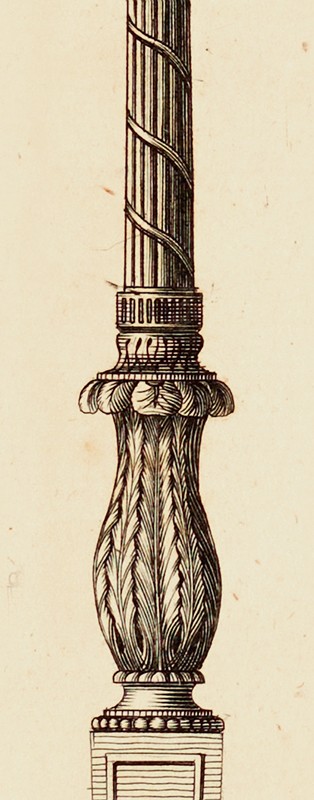
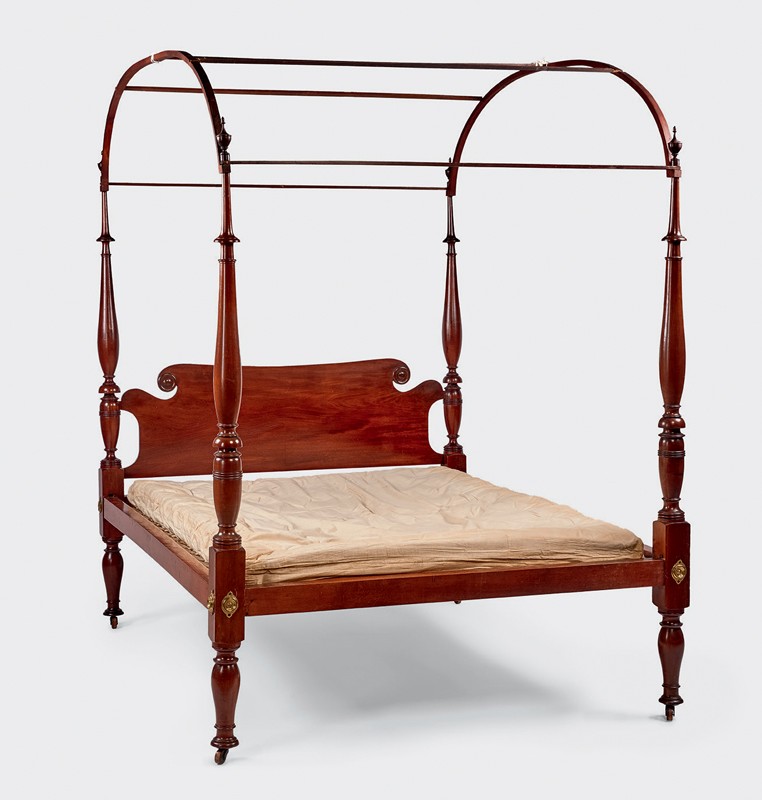
[8]

“Estimate of the Value of the Personal Estate of Nathaniel Ropes . . . Promissory Notes and Bonds,” box 7, folder 8, Ropes Papers.

[8]

“Estimate of the Value of the Personal Estate of Nathaniel Ropes . . . Promissory Notes and Bonds,” box 7, folder 8, Ropes Papers.

[9]

“This House . . . to be sold, July 1, 1799,” box 7, folder 8, Ropes Papers.

[10]

Oliver Thayer, “Early Recollections of the Upper Portion of Essex Street,” Essex Institute Historical Collections 21, nos. 7–9 (1884): 216. (Hereafter cited as EIHC.)

[11]

“The Account of Elizabeth Ropes Adma.,” p. 4, contains a list of people paying rent in October 1809.

[12]

Sally (Ropes) Orne to Sarah Ropes, April 1, 1849, box 9, folder 7, Ropes Papers.

[13]

Charles M. Endicott, “History of the Salem and Danvers Aqueduct,” EIHC 2, no. 3 (June 1860): 103–115.

[14]

Sally (Ropes) Orne to Hannah Ropes, November 20, 1839, box 9, folder 7, Ropes Papers.

[15]

George D. Hoppin, Medicine Chest and Instructive Advice: With Directions for Ships and Family Use (Providence, R.I.: John Miller, 1823).

[16]

Other Essex County work tables painted in the 1820s are discussed in: Fales, Essex County Furniture, p. 58; Paula Richter, Painted with Thread: The Art of American Embroidery (Salem, Mass: Peabody Essex Museum, 2000), pp. 70–71; Betsy Krieg Salem, Women’s Painted Furniture 1790–1830: American Schoolgirl Art (Hanover and London: University Press of New England, 2010), pp. 102, 157–161.

[17]

“Cushing and Appleton, paint box receipts, 1822 and 1823,” box 9, folder 9, Ropes Papers.

[18]

Elizabeth Ropes Orne owned a number of lithographed pages from several different drawing books, one published in Paris by Francois Delarue; see Ropes Papers, box 11, folder 5.

[19]

Cleveland’s advertisement in the Salem Gazette (Mass.) was first posted on August 2, 1836, and ran for several weeks.

[20]

James A. Cleveland, Elements of Landscape Drawing (Cincinnati, Ohio: N. G. Burgess and Co., 1839). One of the few known copies is held by the Metropolitan Museum of Art, acc. no. 54.524.76.

[21]

Fiske Kimball, Mr. Samuel McIntire, Carver: The Architect of Salem (1940; repr., Gloucester, Mass.: Peter Smith, 1966), pp. 90–91.

[22]

The base and bracket feet are similar to an early Pitman desk; see Fales, Essex County Furniture, no. 33.

[23]

“Elizabeth Hodges Wedding Outfit, 1808,” EIHC, 68 (1932): 303–304. A related receipt, dated April 15, 1808, from hardware merchant William Dean to Jonathan Hodges, lists “2 1/3 doz Staircase Eyes 6d 2/6 for Pitman,” suggesting Pitman’s services included supervising the installation of the stair carpeting for the Hodges new home: Hodges Family Papers, MH 126, box 22, folder 17, Phillips Library, Peabody Essex Museum. In December of 1819, George Hodges (1765–1827) paid cabinetmaker William Hook for a suite of furniture for the marriage of his daughter Hannah (1793–1877) to Dr. Joseph Kittridge of North Andover, discussed in: Fales, Essex County Furniture, nos. 16, 17; Barbara Adams Blundell, “Setting up House in 1821, An Account Book of Elizabeth Carter of Newbury-port,” EIHC, 113 (January 1977): 16–28; James Duncan Phillips, “A Newburyport Wedding One Hundred Years Ago,” EIHC, 87 (October 1951): 309–332.

[24]

See Appendix A, no. 6, for related bed entries in Elizabeth (Cleveland) Ropes account books.

[25]

Francis B. Crowninshield, The Story of George Crowninshield’s Yacht Cleopatra’s Barge (Boston: Privately Printed, 1913); Walter Muir Whitehill, George Crowninshield’s Yacht Cleopatra’s Barge and a Catalogue of the Francis B. Crowninshield Gallery (Salem, Mass.: Peabody Museum, 1959); Paul F. Johnston, Shipwrecked in Paradise: Cleopatra’s Barge in Hawaii, Ed Rachal Foundation Nautical Archaeology Series (College Station, Tex.: Texas A&M University Press, 2015).

[26]

Nancy Goyne Evans, “Documentary Evidence of Colored Finishes and Decoration on Bedsteads and Cornices: Late Colonial and Federal Periods,” in American Furniture, edited by Luke Beckerdite (Hanover, N.H.: University Press of New England for the Chipstone Foundation, 2014), pp. 242–244.

[27]

The wedding furniture made in Salem for Lucy Hill in 1810 is discussed in Nancy Cooper, “Some Documented Salem Furniture,” House Beautiful 69 (March 1931): 280–284, and (April 1931): 394–395.

[28]

Furniture made by the Seymours for Salem residents is discussed in Robert D. Mussey Jr., The Furniture Masterworks of John and Thomas Seymour (Salem, Mass.: Peabody Essex Museum, 2002), pp. 216–217, 246–247, 258–259, 268–269, 362–363, 438–441, 444–445.

[29]

Joseph True, Account Book of Joseph True, 1810–1858 [photostat negative], MSS 1425, Phillips Library, Peabody Essex Museum. The first entry for Pitman is May 24, 1819, the last November, 1827; all entries are for carving various furniture parts. Henry W. Belknap, “Joseph True Wood Carver of Salem and his Account Book,” EIHC 78 (1940): 132.

[30]

The dressing chest Seymour made for Elizabeth Derby West of Salem, 1808–1810, is an outstanding example of the form, now in the Peabody Essex Museum collection (acc. no. 122, 350). It is discussed in Mussey, Furniture Masterworks of John and Thomas Seymour, pp. 258–259.

[31]

Fiske Kimball, “Salem Furniture Makers. III, William Hook,” Antiques 25, no. 4 (April 1934): 145. The Hook dressing glass and related chest of drawers are in the Peabody Essex Museum collection, acc. nos. 4134.82, .83.

[32]

Looking glasses with similar frames are discussed in: Montgomery, American Furniture, pp. 267–269; Barquist, American Tables and Looking Glasses, pp. 306–308; Brock Jobe and Myrna Kaye, New England Furniture: The Colonial Era (Boston: Houghton Mifflin, 1984), pp. 458–459; Peter Benes, Old-Town and the Waterside: Two-Hundred Years of Tradition and Change in Newbury, Newburyport and West Newbury, 1635–1835: Catalogue of an Exhibition at the Cushing House Museum, Newburyport, Massachusetts (Newburyport, Mass.: Historical Society of Old Newbury, 1986), p. 76; Antiques 13, no.1 (January 1928): 30–31 (with a Kneeland and Adams label).

[33]

Receipt, “Mr. Joseph Orne Bot of Sarah Cushing,” Salem, July 9, 1818, box 9, folder 4, Ropes Papers.

[34]

These two mirrors were among five of varying size purchased in November, 1817. Receipt, “Mr. Joseph Orne to Robert Brookhouse,” Salem, November 27, 1817, box 9, folder 4, Ropes Papers.

[35]

Lahikainen, “A Salem Cabinetmakers’ Price Book,” p. 174.

[36]

Peter Kenny, Michael K. Brown, Francis F. Bretter, and Matthew Thurlow, Duncan Phyfe: Master Cabinetmaker in New York (New York: Metropolitan Museum of Art, 2011), p. 46. For a discussion of New York fancy painted chairs, see: Brock Jobe, Portsmouth Furniture: Masterworks from the New Hampshire Seacoast (Boston: Society for the Preservation of New England Antiquities, 1993), pp. 362–363; Sumpter Priddy, American Fancy: Exuberance in the Arts, 1790–1840 (Milwaukee: Chipstone Foundation/Milwaukee Art Museum, 2004), pp. 54–57, note 135–158; Nancy Goyne Evans, “The Christian M. Nestell Drawing Book: A Focus on the Ornamental Painter and His Craft in Early Nineteenth-Century America,” in American Furniture, edited by Luke Beckerdite (Hanover, N.H and London; University Press of New England for the Chipstone Foundation, 1998), pp. 99–163; Dean A. Fales, American Painted Furniture, 1660–1880 (New York: Bonanza Books, 1986), pp. 142–145.

[37]

A note attached to the frame states that the sofa was made by Saunders at the time of his marriage to Mary Adams, December 26, 1811; this attribution was published in Kimball, “Furniture Carving by Samuel Field McIntire,” pp. 57–58, and Otto, American Furniture, p. 229. Saunders’ occupation is listed as “engineer” in the first Salem Directory and City Register (Salem: Henry Whipple, 1837). He published a Plan of the Town of Salem in the Commonwealth of Massachusetts from Actual Surveys Made in 1796 & 1804 in Boston in 1820; Sarah Saunders Smith, Founders of Massachusetts Bay Colony (Pittsfield, Mass.: Sun Printing Co., 1897), p.113.

[38]

Thomas Hope, Household Furniture and Interior Decoration: Classic Style Book of the Regency Period (New York; Dover Publications, 1971), p. 40.

[39]

Pauline Agius, Ackermann’s Regency Furniture & Interiors (Wiltshire, England: Crowood Press, 1984), p. 95. For a discussion of the evolution of this chair form in Boston, see Robert D. Mussey and Clark Pearce, Rather Elegant than Showy: The Classical Furniture of Isaac Vose (Boston, Mass.: David Godine for the Massachusetts Historical Society, 2018), pp. 226–269.

[40]

Morrison H. Heckscher, In Quest of Comfort: The Easy Chair in America (New York: Metropolitan Museum of Art, 1971); Lahikainen, “Salem Cabinetmakers’ Price Book,” pp. 180–182.

[41]

Receipt, “Mrs. Ropes to Asa Lamson,” Salem, October 30, 1828, box 8, folder 9, Ropes Papers.

[42]

George W. Briggs, Memoir of Daniel Appleton White (Salem, Mass.: Essex Institute, 1864), p. 21. In a July 1, 1819, letter, Sally (Ropes) Orne wrote to her brother Nathaniel Ropes IV, “I think Nabby told you that we were settled in the mansion house + that Mrs. Wetmore has bought my house + is about to be married,”: box 9, folder 7, Ropes Papers.

[43]

Lahikainen, “A Salem Cabinetmakers’ Price Book,” p. 184. Wendy Cooper notes the term “French bed” might also refer “to a four-poster bedstead with hangings in the French taste” in Classical Taste in America, 1800–1840 (New York: Baltimore Museum of Art, 1993), p. 129.

[44]

Mussey, Furniture Masterworks, p. 25.

[45]

Pitman made a “frame for a writing desk” in 1807 and a “table and table top” in 1809 (Appendix C, nos. 1, 2).

[46]

Sally (Ropes) Orne to Hannah Ropes, September 30, 1842, box 9, folder 7, Ropes Papers.

[47]

Various copies of Ackermann’s Repository held by the Peabody Essex Museum’s Phillips Library collection came from local families, including donations by Mrs. Helen D. Lander in 1912 and Mrs. Francis H. Lee in 1916. Some of the copies bear the signature of John C. Lee (1804–1877), who built a Greek revival house at 14 Chestnut Street in 1826, not far from the Ropes Mansion.

[48]

The introduction of glass knobs in the 1820s is discussed in Montgomery, American Furniture, p. 51, and Arlene Palmer, Glass in Early America (Winterthur, Del.: Henry Francis du Pont Winterthur Museum, 1993), p. 397. Kirk Nelson, executive director of the New Bedford Museum of Glass, in an email to the author on Feb. 24, 2021, noted: “Blown and cut examples almost certainly were made before the first patent date [in the mid-1820s]. Back to 1820 and likely even earlier. Bakewell and NEGCo [New England Glass Company] undoubtedly both making them and other glass works as well. Unfortunately, there hasn’t been much research to establish specific attributions for the blown and cut glass pulls.”

[48]

The introduction of glass knobs in the 1820s is discussed in Montgomery, American Furniture, p. 51, and Arlene Palmer, Glass in Early America (Winterthur, Del.: Henry Francis du Pont Winterthur Museum, 1993), p. 397. Kirk Nelson, executive director of the New Bedford Museum of Glass, in an email to the author on Feb. 24, 2021, noted: “Blown and cut examples almost certainly were made before the first patent date [in the mid-1820s]. Back to 1820 and likely even earlier. Bakewell and NEGCo [New England Glass Company] undoubtedly both making them and other glass works as well. Unfortunately, there hasn’t been much research to establish specific attributions for the blown and cut glass pulls.”

[49]

A similar cylinder desk attributed to Thomas Seymour descended in the Crowninshield family of Salem; see Mussey, Furniture Masterworks, pp. 444–445. Another example is illustrated in Israel Sack, Inc., American Antiques from Israel Sack Collection, 10 vols. (Washington, D.C.: Highland House Publishers, 1957–1989), 2: 113, no. 765.

[50]

A medallion similar to that in fig. 111 was found in the Boston shop of Henry Hancock, illustrated in Mussey and Pearce, Rather Elegant than Showy, p. 229. For a discussion of the trade in metal mounts and the various finishes used on them during this period, see Jillian Ehninger, “‘With the Richest Ornaments Just Imported from France’: Ornamental Hardware on Boston, New York and Philadelphia Furniture, 1800–1840” (master’s thesis, University of Delaware, Newark, 1993). See also, Cooper, Classical Taste in America, pp. 184–185; Peter Kenny, Honoré Lannuier, Cabinetmaker from Paris (New York: Metropolitan Museum of Art, 1998), pp. 158–162. William Dean advertisement for hardware, Salem Gazette (Mass.), August 12, 1836. Salem merchant George Dean imported brass hardware directly from England: Hard ware: a very large assortment, imported from England [broadside], 1809, E S1 B6 1809, Phillips Library, Peabody Essex Museum.

[51]

Receipts for furniture purchased by Sally (Ropes) Orne in the 1830s from other cabinetmakers are in the Ropes Papers (box 10, folder 8).

[52]

For a discussion of Kimball and Sargent’s work in Salem, see Thomas Gordon Smith, “Thomas King British and American Furniture Design of the 1830s,” in Thomas King, Neo-Classical Furniture Designs: A Reprint of Thomas King’s “Modern Style of Cabinet Work Exemplified,” 1829 (New York: Dover Publications, Inc., 1995), pp. viii–xi.

[53]

Receipt, Mrs. Orne from Kimball and Sargent, November 14, 1836, for a patent bedstead and a clothes rack; receipt, from Kimball and Sargent, January 13, 1837, for eight mahogany chairs, box 10, folder 8, Ropes Papers.

[54]

Receipt, from John Templeton, Boston, August 1835, for “1 marble chimney piece $43/ hearthstone $8.33”; receipt, from Forthingham and Cross, Salem, August 31, 1835, for “iron mantel grate $22,” box 10, folder 8, Ropes Papers.

[55]

Agius, Ackermann’s Regency Furniture, p. 119.

[56]

Kimball and Sargent bed receipt; see note 53. The bed remains in the Ropes collection and is also branded with the firm’s name (Peabody Essex Museum, gift of the Trustees of the Ropes Memorial, 1989, R1127).

[57]

Will of Sally F. Orne of Salem, July 7, 1875, box 10, folder 2, Ropes Papers.

[58]

Agius, Ackermann’s Regency Furniture, p. 103.

[59]

Reports of the First Exhibition of the Salem Charitable Mechanic Association at the Mechanic Hall in the City of Salem, September, 1849 (Salem: Streeter and Porter, 1849), p. vii.

[60]

Mussey, Furniture Masterworks, pp. 360–361.

[61]

This chest was part of the wedding furniture made for John Hodges (1802–1882) and Mary Osgood Daland (1808–1903), who married December 15, 1833. It was given to the Essex Institute in 1918 by their daughter, Mary Osgood Hodges (b. 1839). See also, note 1, item no. 17.

[62]

Agius, Ackermann’s Regency Furniture, p. 73.

[63]

“Salem Charitable Mechanic Association Awards for Furniture, 1849,” EIHC 88 (1955): 276.

[64]

 “Deaths,” Salem Gazette (Mass.), April 26, 1839, p. 3. Pitman was a witness for the signing of Abigail Ropes’s will on December 9, 1837: box 10, folder 8, Ropes Papers.

[65]

Pitman’s will and an inventory of his estate, Massachusetts Probate Records, No. 50365; Essex Antiquarian 4 (1900): 167; “Deaths,” Salem Gazette (Mass.), September 28, 1855. In the first Salem Directory (1837), Mark Pitman Jr. is listed as a pianoforte maker, living at 46 Broad Street. He removed to the Boston area before 1842 and became a traveling salesman. He died in Cambridge, Massachusetts, on February 16, 1904.

[66]

George Francis Dow, “The Nathaniel Ropes Estate,” EIHC 40, no. 1 (1904): 1–14; Nellie Stearns Messer, “The Ropes Memorial at Salem, Massachusetts,” Old-Time New England Bulletin of the Society for the Preservation of New England Antiquities 14, no. 4 (April 1924): 149–163.

[67]

Sally (Ropes) Orne to Eliza Ropes, April 1, 1849, box 9, folder 7, Ropes Papers.

American Furniture 2024

Show all Figures only
Contents


  • [1]

    Pitman used four different printed labels during his career; three are discussed in William C. Ketchum Jr., American Cabinetmakers: Marked American Furniture 1640–1940 (New York: Crown Publishers, 1995), pp. 262–263, and two of the same design are featured in Dean A. Fales Jr., Essex County Furniture: Documented Treasures from Local Collections 1660–1860 (Salem, Mass.: Essex Institute, 1965), nos. 33, 34. The fourth label design is found on the desk with tambour doors owned by Hood Museum of Art, Dartmouth College, illustrated in fig. 48 (see no. 7 in this note, below). The nine known examples of furniture labeled by Pitman are: (1) Desk and bookcase (Peabody Essex Museum, acc. no. 2018.31), discussed in: Fiske Kimball, “Salem Secretaries and Their Makers,” Antiques 23, no. 5 (May 1933): 168–169; Margaret Burke Clunie, “Salem Federal Furniture” (master’s thesis, University of Delaware, Newark, 1976), p. 211. (2) Card table (Yale University Art Gallery, acc. no. 1976.121), discussed in: David Barquist, American Tables and Looking Glasses in the Mabel Brady Garvan and Other Collections at Yale University (New Haven: Yale University, 1992), pp. 186–188; Clunie, “Salem Federal Furniture,” pp. 208–209; Benjamin A. Hewitt, Patricia E. Kane, and Gerald W. R. Ward, The Work of Many Hands: Card Tables in Federal America 1790 –1820 (New Haven: Yale University Art Gallery, 1982), p. 14. (3) Enclosed pier table (Winterthur Museum, Garden & Library, acc. no. 59.8), discussed in: Charles F. Montgomery, American Furniture, the Federal Period (New York: Viking Press, 1966), p. 372, cat. 358; Clunie, “Salem Federal Furniture,” p. 210. (4) Desk and bookcase (present location unknown), owned by Ginsberg and Levy in 1963, discussed in Clunie, “Salem Federal Furniture,” p. 211; documented in Decorative Arts Photographic Collection (DAPC), Winterthur Museum, Garden & Library, 63.885. (5) Desk (private collection), discussed in: Fales, Essex County Furniture, no. 33; Clunie, “Salem Federal Furniture,” pp. 209–210. (6) Sideboard with Secretary Drawer (unknown location; acquired by the Essex Institute 1966, acc. no. 131,505, deaccessioned in 1973, sold at a Robert Blekicki auction in 1974), discussed in: Antiques 85, no. 3 (March 1964): 343; Clunie, “Salem Federal Furniture,” pp. 211–212. (7) Desk with Tambour Doors (Hood Museum of Art, Dartmouth College, acc. no. F.984.19) (illustrated above in fig. 48), discussed in: Israel Sack, Inc., Opportunities in American Antiques (June 1, 1974): 47; Clunie, “Salem Federal Furniture,” pp. 212–213. (8) Wing Chair (unknown location), mentioned in a letter from Fiske Kimball to Mrs. Isabel Putnam, February 9, 1932: “I have heard that you are the fortunate possessor of a fine wing chair which has the label of the Salem cabinetmaker, Mark Pitman” (box 128, Fiske Kimball Papers, Institutional Archives, Philadelphia Museum of Art). (9) Chest of Drawers (private collection, Salem, Mass.). Furthermore, there are two examples of furniture signed by Pitman: (10) Slant top Desk (private collection, Williamsburg, Va.), signed in chalk on the bottom board “Mark Pitman 1798”; and (11) Sideboard (private collection), documented in Decorative Arts Photographic Collection (DAPC), Winterthur Museum, Garden & Library, 82.979. Finally, the following pieces are unmarked but attributed to Pitman: (12) Secretary and bookcase (Museum of Fine Arts, Boston), discussed in Elizabeth Bidwell Bates and Jonathan Fairbanks, American Furniture: 1620 to the Present (New York: Richard Marek Publishers, 1981), pp. 230–231; (13) Card table (Winterthur Museum, Library & Garden, acc. no. G55.51.4), discussed in Montgomery, American Furniture, p. 329; (14) Desk and bookcase (private collection), discussed in Dean Lahikainen, “Gardner-Pingree House Original Gardner Family Furnishings” (unpublished research notes, 1980–1989, American Decorative Arts Department, Peabody Essex Museum; (15) Desk and Bookcase (Gary Sullivan Antiques, Canton, Mass., inventory no. 009027, 2019); (16) Sofa (Peabody Essex Museum, acc. no. 136133) (illustrated above in fig. 77), incorrectly attributed to J. P. Saunders in Celia Otto Jackson, American Furniture of the Nineteenth Century (New York: Viking Press, 1965), no. 68, and Fiske Kimball, “Furniture Carvings by Samuel Field McIntire,” Antiques 23, no. 2 (February 1933): 57–58; (17) Chest of Drawers (Peabody Essex Museum, gift of Mary Osgood Hodges, acc. no. 107547) (illustrated above in fig. 137), incorrectly attributed to Mark Pitman Jr. in Thomas H. Ormsbee, American Collector (April 1945): 9; Decorative Arts Photographic Collection (DAPC), Winterthur Museum, Garden & Library, 66.865.

  • [2]

    Pitman purchased the house at 327 Essex Street on September 30, 1818: Essex Antiquarian 4, no. 11 (November 1890): 166–167.

  • [2]

    Pitman purchased the house at 327 Essex Street on September 30, 1818: Essex Antiquarian 4, no. 11 (November 1890): 166–167.

  • [3]

    Vital Records of Salem, Massachusetts to the End of the Year 1849, 6 vols. (Salem, Mass: Essex Institute, 1916-1925), 2: 179–181.

  • [4]

    The Caldwell name was discovered using infra-red photography: see Clunie, “Salem Federal Furniture,” p. 207.

  • [5]

    Rev. Dr. Thomas Barnard Jr. (1748–1814) lived at 393 Essex Street: Henry Wyckoff Belknap, Artists and Craftsmen of Essex County (Salem, Mass.: Essex Institute, 1927), p. 32. Caldwell’s advertisement ran for several weeks in the Salem Gazette (Mass.) starting March 16, 1810. Caldwell and Pitman were not founding members of the Salem Cabinet-Maker Society in 1801, see Dean Lahikainen, “A Salem Cabinetmakers’ Price Book,” in American Furniture, edited by Luke Beckerdite (Hanover, N.H., University Press of New England for the Chipstone Foundation, 2001), p. 204.

  • [6]

    William Bentley, The Diary of William Bentley, D.D., Pastor of the East Church Salem, Massachusetts, 4 vols. (Gloucester, Mass.: Peter Smith, 1962), 3: 242.

  • [7]

    “The Account of Elizabeth Ropes Adma. Of the Estate of Nathaniel Ropes, late of Danvers in the County of Essex . . . exhibited to Samuel Holten esqr Judge of Probate . . . April, 1809,” box 7, folder 8, Ropes Family Papers, MSS 190, Phillips Library, Peabody Essex Museum, Rowley, Massachusetts. (Hereafter cited as Ropes Papers.)
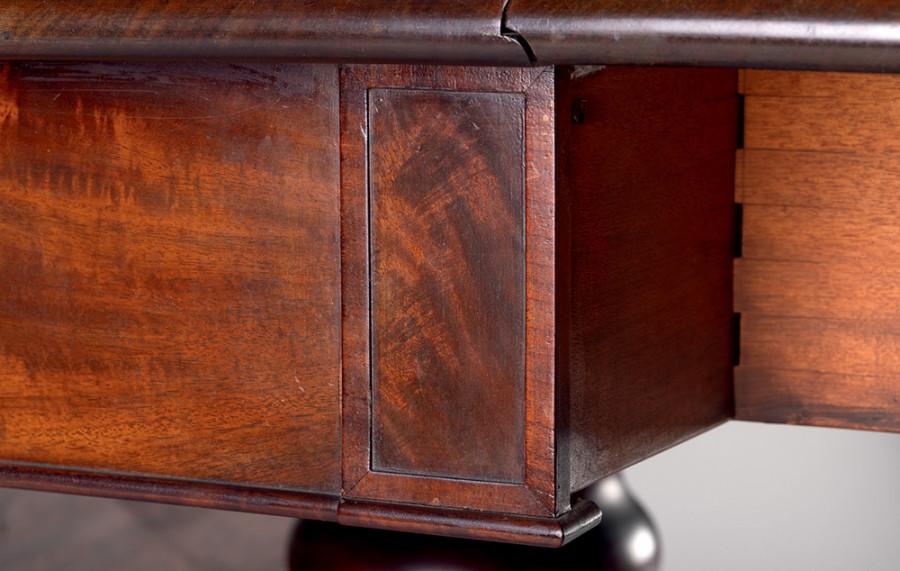
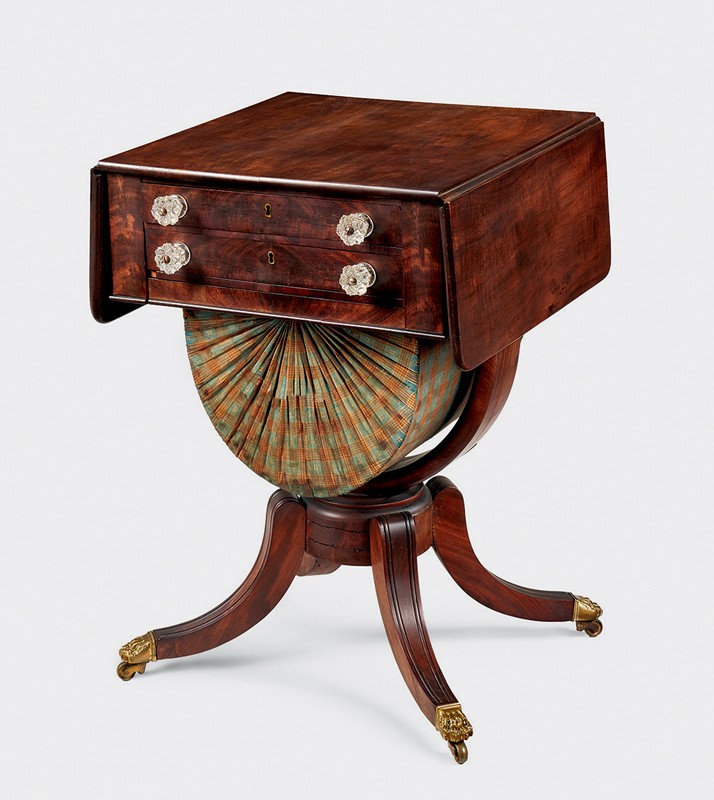
  • [8]

    “Estimate of the Value of the Personal Estate of Nathaniel Ropes . . . Promissory Notes and Bonds,” box 7, folder 8, Ropes Papers.

  • [8]

    “Estimate of the Value of the Personal Estate of Nathaniel Ropes . . . Promissory Notes and Bonds,” box 7, folder 8, Ropes Papers.

  • [9]

    “This House . . . to be sold, July 1, 1799,” box 7, folder 8, Ropes Papers.

  • [10]

    Oliver Thayer, “Early Recollections of the Upper Portion of Essex Street,” Essex Institute Historical Collections 21, nos. 7–9 (1884): 216. (Hereafter cited as EIHC.)

  • [11]

    “The Account of Elizabeth Ropes Adma.,” p. 4, contains a list of people paying rent in October 1809.

  • [12]

    Sally (Ropes) Orne to Sarah Ropes, April 1, 1849, box 9, folder 7, Ropes Papers.

  • [13]

    Charles M. Endicott, “History of the Salem and Danvers Aqueduct,” EIHC 2, no. 3 (June 1860): 103–115.

  • [14]

    Sally (Ropes) Orne to Hannah Ropes, November 20, 1839, box 9, folder 7, Ropes Papers.

  • [15]

    George D. Hoppin, Medicine Chest and Instructive Advice: With Directions for Ships and Family Use (Providence, R.I.: John Miller, 1823).

  • [16]

    Other Essex County work tables painted in the 1820s are discussed in: Fales, Essex County Furniture, p. 58; Paula Richter, Painted with Thread: The Art of American Embroidery (Salem, Mass: Peabody Essex Museum, 2000), pp. 70–71; Betsy Krieg Salem, Women’s Painted Furniture 1790–1830: American Schoolgirl Art (Hanover and London: University Press of New England, 2010), pp. 102, 157–161.

  • [17]

    “Cushing and Appleton, paint box receipts, 1822 and 1823,” box 9, folder 9, Ropes Papers.

  • [18]

    Elizabeth Ropes Orne owned a number of lithographed pages from several different drawing books, one published in Paris by Francois Delarue; see Ropes Papers, box 11, folder 5.

  • [19]

    Cleveland’s advertisement in the Salem Gazette (Mass.) was first posted on August 2, 1836, and ran for several weeks.

  • [20]

    James A. Cleveland, Elements of Landscape Drawing (Cincinnati, Ohio: N. G. Burgess and Co., 1839). One of the few known copies is held by the Metropolitan Museum of Art, acc. no. 54.524.76.

  • [21]

    Fiske Kimball, Mr. Samuel McIntire, Carver: The Architect of Salem (1940; repr., Gloucester, Mass.: Peter Smith, 1966), pp. 90–91.

  • [22]

    The base and bracket feet are similar to an early Pitman desk; see Fales, Essex County Furniture, no. 33.

  • [23]

    “Elizabeth Hodges Wedding Outfit, 1808,” EIHC, 68 (1932): 303–304. A related receipt, dated April 15, 1808, from hardware merchant William Dean to Jonathan Hodges, lists “2 1/3 doz Staircase Eyes 6d 2/6 for Pitman,” suggesting Pitman’s services included supervising the installation of the stair carpeting for the Hodges new home: Hodges Family Papers, MH 126, box 22, folder 17, Phillips Library, Peabody Essex Museum. In December of 1819, George Hodges (1765–1827) paid cabinetmaker William Hook for a suite of furniture for the marriage of his daughter Hannah (1793–1877) to Dr. Joseph Kittridge of North Andover, discussed in: Fales, Essex County Furniture, nos. 16, 17; Barbara Adams Blundell, “Setting up House in 1821, An Account Book of Elizabeth Carter of Newbury-port,” EIHC, 113 (January 1977): 16–28; James Duncan Phillips, “A Newburyport Wedding One Hundred Years Ago,” EIHC, 87 (October 1951): 309–332.

  • [24]

    See Appendix A, no. 6, for related bed entries in Elizabeth (Cleveland) Ropes account books.

  • [25]

    Francis B. Crowninshield, The Story of George Crowninshield’s Yacht Cleopatra’s Barge (Boston: Privately Printed, 1913); Walter Muir Whitehill, George Crowninshield’s Yacht Cleopatra’s Barge and a Catalogue of the Francis B. Crowninshield Gallery (Salem, Mass.: Peabody Museum, 1959); Paul F. Johnston, Shipwrecked in Paradise: Cleopatra’s Barge in Hawaii, Ed Rachal Foundation Nautical Archaeology Series (College Station, Tex.: Texas A&M University Press, 2015).

  • [26]

    Nancy Goyne Evans, “Documentary Evidence of Colored Finishes and Decoration on Bedsteads and Cornices: Late Colonial and Federal Periods,” in American Furniture, edited by Luke Beckerdite (Hanover, N.H.: University Press of New England for the Chipstone Foundation, 2014), pp. 242–244.

  • [27]

    The wedding furniture made in Salem for Lucy Hill in 1810 is discussed in Nancy Cooper, “Some Documented Salem Furniture,” House Beautiful 69 (March 1931): 280–284, and (April 1931): 394–395.

  • [28]

    Furniture made by the Seymours for Salem residents is discussed in Robert D. Mussey Jr., The Furniture Masterworks of John and Thomas Seymour (Salem, Mass.: Peabody Essex Museum, 2002), pp. 216–217, 246–247, 258–259, 268–269, 362–363, 438–441, 444–445.

  • [29]

    Joseph True, Account Book of Joseph True, 1810–1858 [photostat negative], MSS 1425, Phillips Library, Peabody Essex Museum. The first entry for Pitman is May 24, 1819, the last November, 1827; all entries are for carving various furniture parts. Henry W. Belknap, “Joseph True Wood Carver of Salem and his Account Book,” EIHC 78 (1940): 132.

  • [30]

    The dressing chest Seymour made for Elizabeth Derby West of Salem, 1808–1810, is an outstanding example of the form, now in the Peabody Essex Museum collection (acc. no. 122, 350). It is discussed in Mussey, Furniture Masterworks of John and Thomas Seymour, pp. 258–259.

  • [31]

    Fiske Kimball, “Salem Furniture Makers. III, William Hook,” Antiques 25, no. 4 (April 1934): 145. The Hook dressing glass and related chest of drawers are in the Peabody Essex Museum collection, acc. nos. 4134.82, .83.

  • [32]

    Looking glasses with similar frames are discussed in: Montgomery, American Furniture, pp. 267–269; Barquist, American Tables and Looking Glasses, pp. 306–308; Brock Jobe and Myrna Kaye, New England Furniture: The Colonial Era (Boston: Houghton Mifflin, 1984), pp. 458–459; Peter Benes, Old-Town and the Waterside: Two-Hundred Years of Tradition and Change in Newbury, Newburyport and West Newbury, 1635–1835: Catalogue of an Exhibition at the Cushing House Museum, Newburyport, Massachusetts (Newburyport, Mass.: Historical Society of Old Newbury, 1986), p. 76; Antiques 13, no.1 (January 1928): 30–31 (with a Kneeland and Adams label).

  • [33]

    Receipt, “Mr. Joseph Orne Bot of Sarah Cushing,” Salem, July 9, 1818, box 9, folder 4, Ropes Papers.

  • [34]

    These two mirrors were among five of varying size purchased in November, 1817. Receipt, “Mr. Joseph Orne to Robert Brookhouse,” Salem, November 27, 1817, box 9, folder 4, Ropes Papers.

  • [35]

    Lahikainen, “A Salem Cabinetmakers’ Price Book,” p. 174.

  • [36]

    Peter Kenny, Michael K. Brown, Francis F. Bretter, and Matthew Thurlow, Duncan Phyfe: Master Cabinetmaker in New York (New York: Metropolitan Museum of Art, 2011), p. 46. For a discussion of New York fancy painted chairs, see: Brock Jobe, Portsmouth Furniture: Masterworks from the New Hampshire Seacoast (Boston: Society for the Preservation of New England Antiquities, 1993), pp. 362–363; Sumpter Priddy, American Fancy: Exuberance in the Arts, 1790–1840 (Milwaukee: Chipstone Foundation/Milwaukee Art Museum, 2004), pp. 54–57, note 135–158; Nancy Goyne Evans, “The Christian M. Nestell Drawing Book: A Focus on the Ornamental Painter and His Craft in Early Nineteenth-Century America,” in American Furniture, edited by Luke Beckerdite (Hanover, N.H and London; University Press of New England for the Chipstone Foundation, 1998), pp. 99–163; Dean A. Fales, American Painted Furniture, 1660–1880 (New York: Bonanza Books, 1986), pp. 142–145.

  • [37]

    A note attached to the frame states that the sofa was made by Saunders at the time of his marriage to Mary Adams, December 26, 1811; this attribution was published in Kimball, “Furniture Carving by Samuel Field McIntire,” pp. 57–58, and Otto, American Furniture, p. 229. Saunders’ occupation is listed as “engineer” in the first Salem Directory and City Register (Salem: Henry Whipple, 1837). He published a Plan of the Town of Salem in the Commonwealth of Massachusetts from Actual Surveys Made in 1796 & 1804 in Boston in 1820; Sarah Saunders Smith, Founders of Massachusetts Bay Colony (Pittsfield, Mass.: Sun Printing Co., 1897), p.113.

  • [38]

    Thomas Hope, Household Furniture and Interior Decoration: Classic Style Book of the Regency Period (New York; Dover Publications, 1971), p. 40.

  • [39]

    Pauline Agius, Ackermann’s Regency Furniture & Interiors (Wiltshire, England: Crowood Press, 1984), p. 95. For a discussion of the evolution of this chair form in Boston, see Robert D. Mussey and Clark Pearce, Rather Elegant than Showy: The Classical Furniture of Isaac Vose (Boston, Mass.: David Godine for the Massachusetts Historical Society, 2018), pp. 226–269.

  • [40]

    Morrison H. Heckscher, In Quest of Comfort: The Easy Chair in America (New York: Metropolitan Museum of Art, 1971); Lahikainen, “Salem Cabinetmakers’ Price Book,” pp. 180–182.

  • [41]

    Receipt, “Mrs. Ropes to Asa Lamson,” Salem, October 30, 1828, box 8, folder 9, Ropes Papers.

  • [42]

    George W. Briggs, Memoir of Daniel Appleton White (Salem, Mass.: Essex Institute, 1864), p. 21. In a July 1, 1819, letter, Sally (Ropes) Orne wrote to her brother Nathaniel Ropes IV, “I think Nabby told you that we were settled in the mansion house + that Mrs. Wetmore has bought my house + is about to be married,”: box 9, folder 7, Ropes Papers.

  • [43]

    Lahikainen, “A Salem Cabinetmakers’ Price Book,” p. 184. Wendy Cooper notes the term “French bed” might also refer “to a four-poster bedstead with hangings in the French taste” in Classical Taste in America, 1800–1840 (New York: Baltimore Museum of Art, 1993), p. 129.

  • [44]

    Mussey, Furniture Masterworks, p. 25.

  • [45]

    Pitman made a “frame for a writing desk” in 1807 and a “table and table top” in 1809 (Appendix C, nos. 1, 2).

  • [46]

    Sally (Ropes) Orne to Hannah Ropes, September 30, 1842, box 9, folder 7, Ropes Papers.

  • [47]

    Various copies of Ackermann’s Repository held by the Peabody Essex Museum’s Phillips Library collection came from local families, including donations by Mrs. Helen D. Lander in 1912 and Mrs. Francis H. Lee in 1916. Some of the copies bear the signature of John C. Lee (1804–1877), who built a Greek revival house at 14 Chestnut Street in 1826, not far from the Ropes Mansion.

  • [48]

    The introduction of glass knobs in the 1820s is discussed in Montgomery, American Furniture, p. 51, and Arlene Palmer, Glass in Early America (Winterthur, Del.: Henry Francis du Pont Winterthur Museum, 1993), p. 397. Kirk Nelson, executive director of the New Bedford Museum of Glass, in an email to the author on Feb. 24, 2021, noted: “Blown and cut examples almost certainly were made before the first patent date [in the mid-1820s]. Back to 1820 and likely even earlier. Bakewell and NEGCo [New England Glass Company] undoubtedly both making them and other glass works as well. Unfortunately, there hasn’t been much research to establish specific attributions for the blown and cut glass pulls.”

  • [48]

    The introduction of glass knobs in the 1820s is discussed in Montgomery, American Furniture, p. 51, and Arlene Palmer, Glass in Early America (Winterthur, Del.: Henry Francis du Pont Winterthur Museum, 1993), p. 397. Kirk Nelson, executive director of the New Bedford Museum of Glass, in an email to the author on Feb. 24, 2021, noted: “Blown and cut examples almost certainly were made before the first patent date [in the mid-1820s]. Back to 1820 and likely even earlier. Bakewell and NEGCo [New England Glass Company] undoubtedly both making them and other glass works as well. Unfortunately, there hasn’t been much research to establish specific attributions for the blown and cut glass pulls.”

  • [49]

    A similar cylinder desk attributed to Thomas Seymour descended in the Crowninshield family of Salem; see Mussey, Furniture Masterworks, pp. 444–445. Another example is illustrated in Israel Sack, Inc., American Antiques from Israel Sack Collection, 10 vols. (Washington, D.C.: Highland House Publishers, 1957–1989), 2: 113, no. 765.

  • [50]

    A medallion similar to that in fig. 111 was found in the Boston shop of Henry Hancock, illustrated in Mussey and Pearce, Rather Elegant than Showy, p. 229. For a discussion of the trade in metal mounts and the various finishes used on them during this period, see Jillian Ehninger, “‘With the Richest Ornaments Just Imported from France’: Ornamental Hardware on Boston, New York and Philadelphia Furniture, 1800–1840” (master’s thesis, University of Delaware, Newark, 1993). See also, Cooper, Classical Taste in America, pp. 184–185; Peter Kenny, Honoré Lannuier, Cabinetmaker from Paris (New York: Metropolitan Museum of Art, 1998), pp. 158–162. William Dean advertisement for hardware, Salem Gazette (Mass.), August 12, 1836. Salem merchant George Dean imported brass hardware directly from England: Hard ware: a very large assortment, imported from England [broadside], 1809, E S1 B6 1809, Phillips Library, Peabody Essex Museum.

  • [51]

    Receipts for furniture purchased by Sally (Ropes) Orne in the 1830s from other cabinetmakers are in the Ropes Papers (box 10, folder 8).

  • [52]

    For a discussion of Kimball and Sargent’s work in Salem, see Thomas Gordon Smith, “Thomas King British and American Furniture Design of the 1830s,” in Thomas King, Neo-Classical Furniture Designs: A Reprint of Thomas King’s “Modern Style of Cabinet Work Exemplified,” 1829 (New York: Dover Publications, Inc., 1995), pp. viii–xi.

  • [53]

    Receipt, Mrs. Orne from Kimball and Sargent, November 14, 1836, for a patent bedstead and a clothes rack; receipt, from Kimball and Sargent, January 13, 1837, for eight mahogany chairs, box 10, folder 8, Ropes Papers.

  • [54]

    Receipt, from John Templeton, Boston, August 1835, for “1 marble chimney piece $43/ hearthstone $8.33”; receipt, from Forthingham and Cross, Salem, August 31, 1835, for “iron mantel grate $22,” box 10, folder 8, Ropes Papers.

  • [55]

    Agius, Ackermann’s Regency Furniture, p. 119.

  • [56]

    Kimball and Sargent bed receipt; see note 53. The bed remains in the Ropes collection and is also branded with the firm’s name (Peabody Essex Museum, gift of the Trustees of the Ropes Memorial, 1989, R1127).

  • [57]

    Will of Sally F. Orne of Salem, July 7, 1875, box 10, folder 2, Ropes Papers.

  • [58]

    Agius, Ackermann’s Regency Furniture, p. 103.

  • [59]

    Reports of the First Exhibition of the Salem Charitable Mechanic Association at the Mechanic Hall in the City of Salem, September, 1849 (Salem: Streeter and Porter, 1849), p. vii.

  • [60]

    Mussey, Furniture Masterworks, pp. 360–361.

  • [61]

    This chest was part of the wedding furniture made for John Hodges (1802–1882) and Mary Osgood Daland (1808–1903), who married December 15, 1833. It was given to the Essex Institute in 1918 by their daughter, Mary Osgood Hodges (b. 1839). See also, note 1, item no. 17.

  • [62]

    Agius, Ackermann’s Regency Furniture, p. 73.

  • [63]

    “Salem Charitable Mechanic Association Awards for Furniture, 1849,” EIHC 88 (1955): 276.

  • [64]

     “Deaths,” Salem Gazette (Mass.), April 26, 1839, p. 3. Pitman was a witness for the signing of Abigail Ropes’s will on December 9, 1837: box 10, folder 8, Ropes Papers.

  • [65]

    Pitman’s will and an inventory of his estate, Massachusetts Probate Records, No. 50365; Essex Antiquarian 4 (1900): 167; “Deaths,” Salem Gazette (Mass.), September 28, 1855. In the first Salem Directory (1837), Mark Pitman Jr. is listed as a pianoforte maker, living at 46 Broad Street. He removed to the Boston area before 1842 and became a traveling salesman. He died in Cambridge, Massachusetts, on February 16, 1904.

  • [66]

    George Francis Dow, “The Nathaniel Ropes Estate,” EIHC 40, no. 1 (1904): 1–14; Nellie Stearns Messer, “The Ropes Memorial at Salem, Massachusetts,” Old-Time New England Bulletin of the Society for the Preservation of New England Antiquities 14, no. 4 (April 1924): 149–163.

  • [67]

    Sally (Ropes) Orne to Eliza Ropes, April 1, 1849, box 9, folder 7, Ropes Papers.