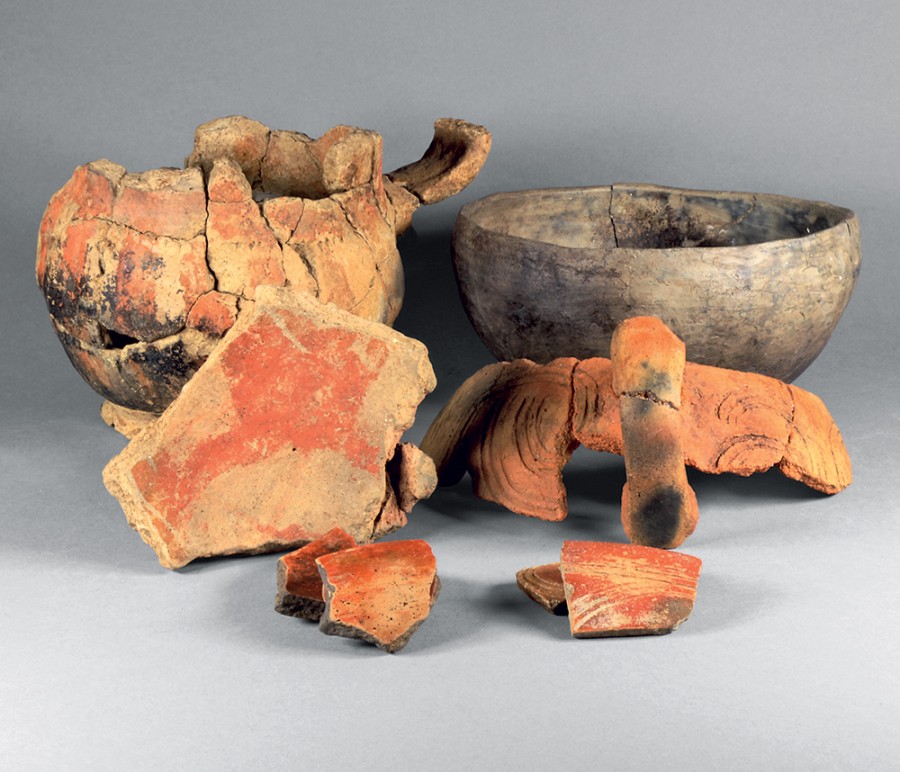
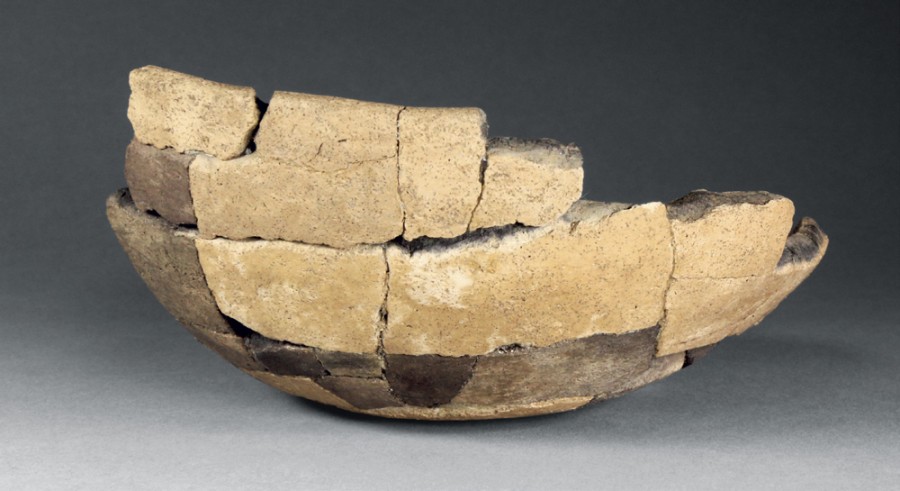
COLONOWARES ARE A DIVERSE group of hand-built, low-fired, unglazed earthenwares that occupy a middle ground in America’s ceramic history, nestled between thriving, millennia-old, Native American earthenware pottery traditions and the various earthenware, stoneware, and porcelain technologies developed in Europe, Asia, and Africa that were transplanted to the Americas over the last five centuries (fig. 1).
In 1962 Ivor Noël Hume (1927–2017), an archaeologist excavating English colonial sites in Virginia, first applied the term “Colono” to coarse earthenware vessels with shapes typical of English mugs, pitchers, plates, and chamber pots, but unglazed, burnished, and shell tempered (temper is something added to a clay body to reduce shrinkage and aid in drying). Such vessels, Noël Hume reasoned, had likely been made by Native potters in forms familiar (and presumably appealing) to colonists, for use by enslaved African and African American laborers. He called this distinctive category of pots “Colono-Indian Ware.”[1]
Decades later, South Carolina archaeologist Leland Ferguson (1941–2023) challenged the underlying premises of Colono-Indian Ware, that it was principally produced by Native American potters and must incorporate elements of European vessel forms. Ferguson marshalled considerable evidence that some vessels must be attributable to enslaved African potters. We now know that Native Americans and former West Africans had similar earthenware traditions, both peoples were placed in severely disadvantaged economic situations by European colonists, and both found their ceramics to be saleable commodities in developing colonial economies. Both groups participated in colonoware production, influenced as much by interactions with each other as with European colonizers. Ferguson concluded that “all low-fired, handbuilt pottery found on colonial sites” should fall under the more general rubric “Colono Ware.”[2]
Despite an ongoing archaeological focus on colonowares of Britain’s southern Atlantic seaboard colonies, analogous hybrid ceramics are known from numerous other colonial contexts. Many rich colonoware traditions arose in the Caribbean Islands and adjacent South American coast.[3] Pueblo-made colonowares with Spanish-influenced forms are likewise found at colonial sites in New Mexico.[4] In each colonized land, Indigenous potters brought their traditional potting methods, styles, and available clays and tempers to conversations, collaborations, and competitions with newcomers from different regions of Europe, Africa, and elsewhere in the Americas. Together they created imaginative ceramic mélanges that we are only beginning to understand and appreciate.
Two general trends in colonoware production are now apparent. In places where the principal consumers were European colonists, colono-ware vessel forms tended to be diverse and incorporated many attributes of shape and decoration copied or adapted from European vessel forms. In other situations, where the intended consumers were principally enslaved Africans, colonowares tended to be less diverse in form, mostly globular cooking jars and small hemispherical bowls.[5]
Introducing Colonowares to the Gulf South
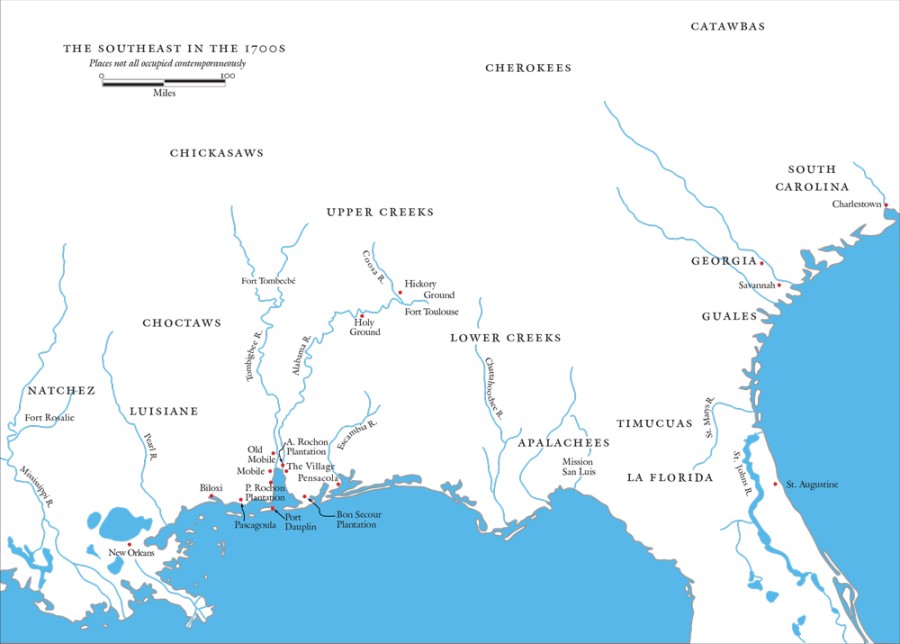
This article explores a largely overlooked region of colonoware production, the Gulf coast from Florida to Louisiana, with its own history of colonization distinct from states to the east that originated as British Atlantic Seaboard colonies (fig. 2). As happened in the Caribbean, Spaniards were the first Europeans to colonize La Florida, and the earliest colonowares in southeastern North America are found at sites of Spanish settlement. From their presidio at St. Augustine, founded in 1565 on Florida’s Atlantic coast, Spanish priests and soldiers established Franciscan missions to the north and west among the Guale and Timucua peoples, and in the 1630s among the Apalachees of the Florida panhandle, all of whom soon produced colonowares.[6]
Excavations at the site of Mission San Luis de Talimali, the administrative center of Apalachee Province from 1656 to 1704 (and now a park in urban Tallahassee, Florida) have focused primarily on Spanish structures. From the mission’s religious complex (church, friary, and kitchen), a fortified blockhouse, the Native community’s council house, and five domestic dwellings (four Spanish and one Apalachee), archaeologists have recovered several hundred fragmentary colonoware vessels. As in seventeenth-century New Mexico, Native Apalachee potters in Florida furnished Spanish colonists living in their midst with colonowares fashioned in familiar forms—tall bacins (chamber pots), brimmed plates and cups with footring bases, pitchers with flat bases and large handles, candleholders, and even long-handled skillets. These earthenware vessels are unglazed (although often decorated with red clay slip) and tempered with grog, which is crushed potsherds, the same tempering medium found in traditional Apalachee pots.[7]
Beginning in 1661 the missions of Spanish Florida endured persistent, violent raids by Native peoples residing to their north, who took captives for sale as slaves to the English in Virginia and South Carolina. Those raids culminated in a series of massive attacks by an army of Muscogee Creeks and their English allies that between 1702 and 1704 destroyed the Timucua and Apalachee missions. In addition to the thousand Native Floridians carried into slavery, thousands more fled, some to the vicinity of St. Augustine, others northward with their captive relatives into South Carolina or westward to the relative safety of two newly established colonial outposts, Spanish Pensacola (in the modern-day Florida panhandle) and French Mobile (in modern-day Alabama).[8]
Colonowares at Old Mobile, 1702–1711
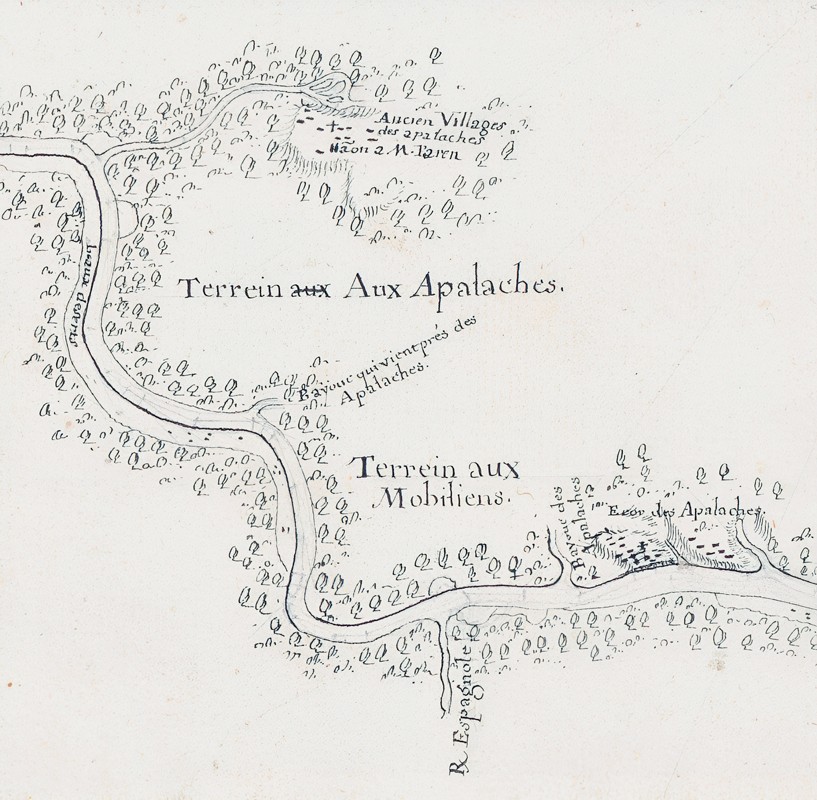
When four hundred Apalachee refugees from Mission San Luis de Talimali reached the eastern shore of Mobile Bay in August 1704, having trekked hundreds of miles in search of a new home and haven, they introduced colonoware to French colonial Louisiane. An expedition led by Pierre Le Moyne d’Iberville (1661–1706) in 1702 had established the colony’s principal settlement, called Mobile after the local Indigenous people, at Twenty- Seven Mile Bluff on the Mobile River. The Apalachees settled upriver from the French, near the confluence of the Tombigbee and Alabama Rivers, safe from the threat of further English-inspired slave raids (fig. 3). When the French relocated their own settlement to the head of Mobile Bay in 1711, the abandoned townsite came to be called Vieux Mobile, Old Mobile, which is how the historic site is known today.[9]
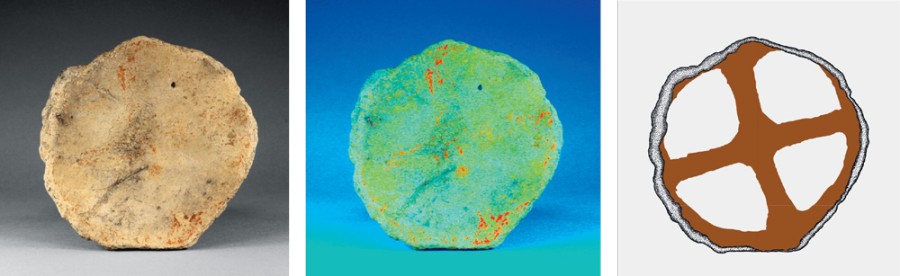
Ann Cordell’s detailed comparative study of Native-made pottery from Mission San Luis and Old Mobile provides many insights into both kinds of vessels made by Apalachee women in their homeland and in exile: traditional, and colonoware. Her sample included sherds from 223 distinct vessels excavated at Mission San Luis and sherds of 405 vessels excavated at Old Mobile (from the sites of three French dwellings, a probable tavern, and a blacksmith’s shop). Cordell microscopically examined the characteristics of each vessel’s paste—that is, the combination of clay and those tempering materials added to the clay before firing. Because potters indigenous to the Mobile area, principally the Mobilians and Tomehs, tempered their clay with crushed shells, the grog-tempered pots made by immigrant Apalachees stand out in the Old Mobile sample (fig. 4).[10]
Cordell unexpectedly discovered that two of Old Mobile’s grog-tempered pots had accompanied the Apalachees on their long walk west. A traditional Apalachee jar with a complicated stamped exterior surface and a plain vessel of unknown form have pastes identical in color, texture, grog size, and grog frequency to the predominant paste in the Mission San Luis pottery sample. Considering the absence of mica and iron concretions naturally prevalent in local clays used by Mobilian and Tomeh potters, Cordell concluded that these two pots had evidently been made from Florida clay at Mission San Luis before being carried overland more than two hundred miles by the Apalachees during their 1704 exodus. Possibly counted among the few cherished possessions of a dispersed if not dispirited people, these fragile pots may have symbolized for their owners a beloved homeland denied them forever.[11]
Once settled in their new villages, the Apalachees must have quickly realized that the sorts of colonoware vessels they had long made for Spanish colonists in Florida would likewise appeal to French colonists, their new neighbors. Because supply ships arrived from France infrequently, at roughly two-year intervals, the Mobile colonists sought out alternative sources for many necessities, including most of their food, cooking utensils, and tablewares. Native-made pottery—both traditional Indigenous forms and colonoware forms—comprise about half of the vessels found at the dwellings excavated at Old Mobile, with the remainder divided roughly equally between Spanish colonial (Mexican) and French tablewares, along with lesser quantities of Chinese porcelain. In a community of slightly more than three hundred individuals, which by 1708 included eighty Native Americans and six Africans held in slavery as household domestics, traditional Native-made jars and large bowls seem to have been favored by those tasked with meal preparation.[12]
In contrast to those traditional cookwares, nearly all of the colonoware vessels at Old Mobile were tablewares, as had also been the case at Mission San Luis. Cordell identified eighty-three brimmed plates, twenty-six pitchers, three cups or small bowls, and two candle holders (along with fifteen vessels of uncertain form) in the Old Mobile colonoware assemblage. All but seven of those colonoware vessels were tempered with grog and are probably attributable to Apalachee potters.[13]
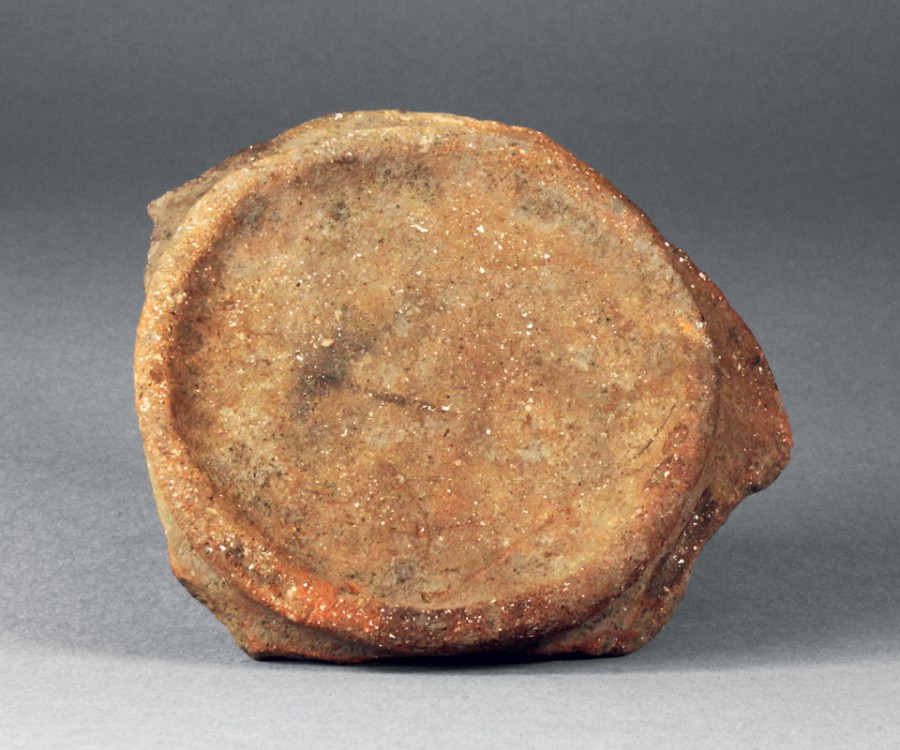
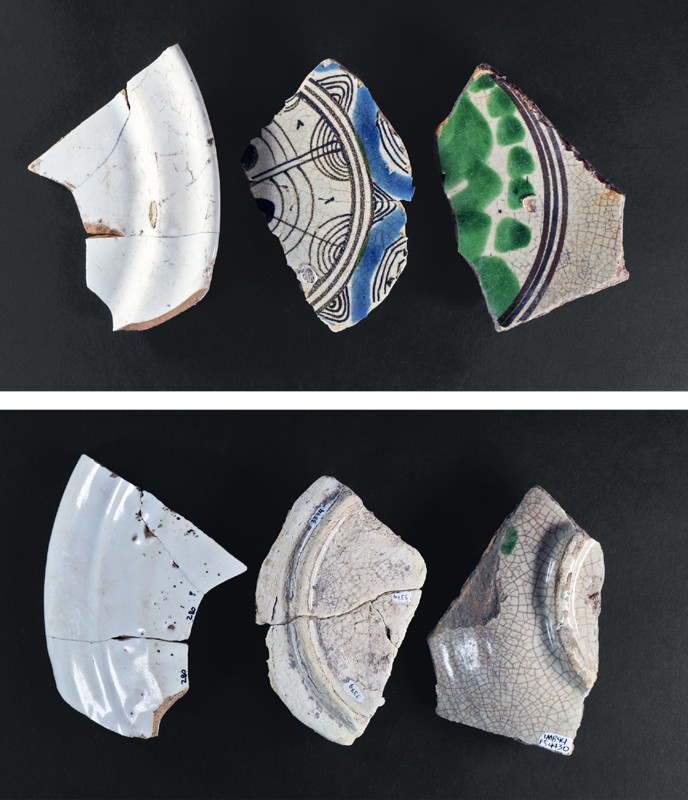
Several subtle differences between colonoware forms and decorations from Mission San Luis and Old Mobile suggest adaptations by Apalachee potters to French aesthetic sensibilities. For instance, brimmed plates (which have considerable variation in depth of the plate well, from shallow to bowl-like) are far more common at Old Mobile, whereas cups and small bowls are more prevalent at Mission San Luis. Plate bases with footrings, which were developed at Mission San Luis in imitation of Spanish majolica plates with footrings, became less common at Old Mobile. Ten of the sixty-two brimmed plate bases from Old Mobile lack a footring altogether; on another thirty-four, the footring was flattened and pushed to the edge of the base as a projecting half-round bead or bolster (fig. 5). Since early eighteenth-century French faience plates (assiettes) lack footrings, these changes in form likely happened in response to colonists’ preferences (fig. 6).[14]
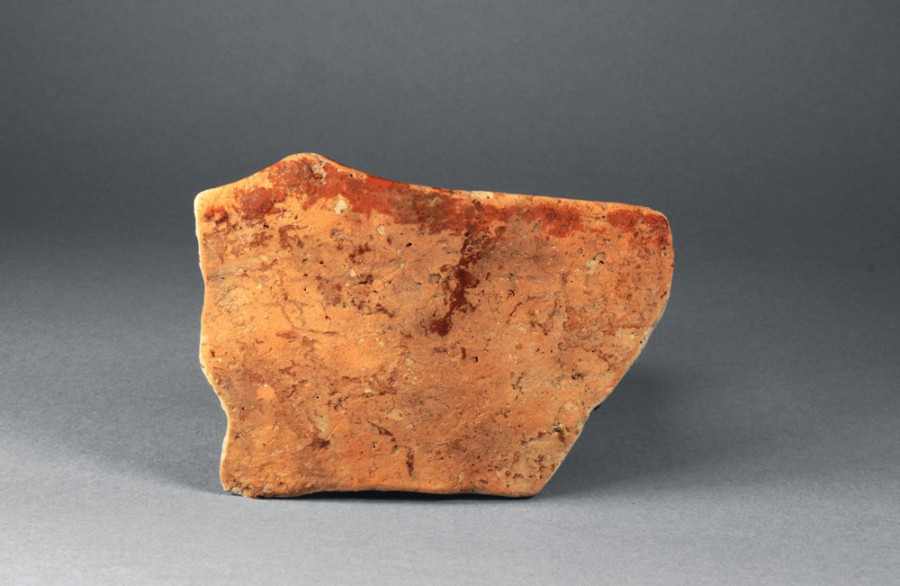
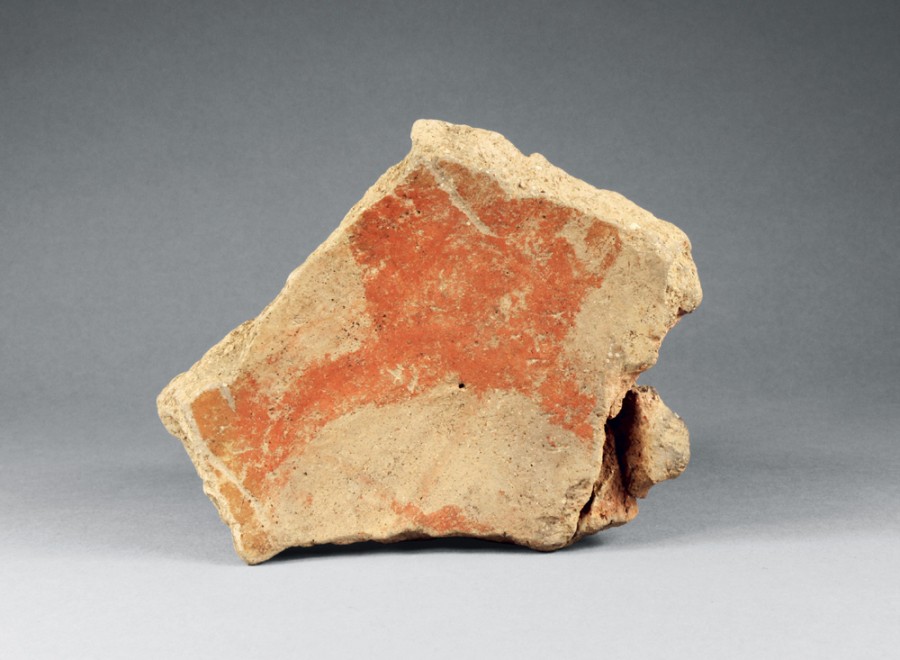
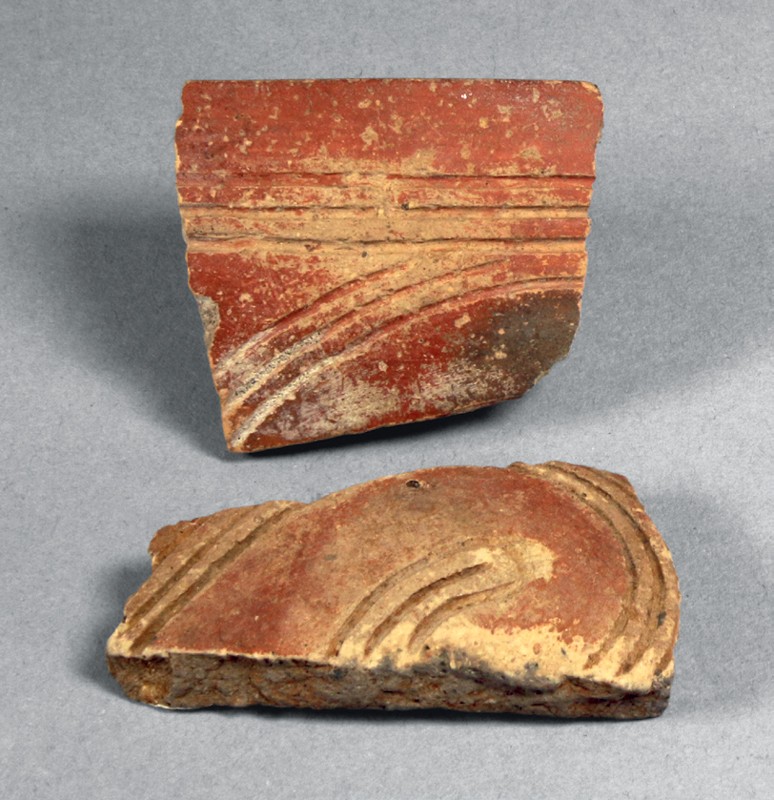
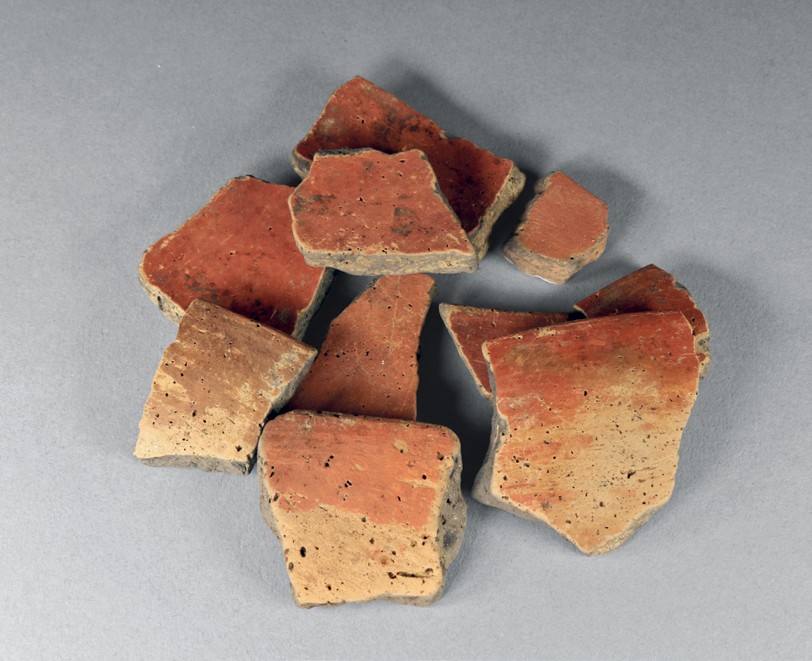
Half of the Old Mobile colonoware vessels have red filmed decorative patterns achieved by application of an iron-rich clay slip to the surface prior to firing (fig. 7). Mission Red Filmed is the name given to the Mission San Luis counterparts, representing a third of the colonoware vessels from that site. Decorative motifs on the San Luis vessels include pendant bars and triangles, as well as more complex patterns of crescents and dots, all on brimmed plate interior rims and almost always “zoned,” with the red filmed areas bounded by incised lines. The more numerous Old Mobile examples, in contrast, lack incising and have simpler decorative motifs, principally the cross-in-circle, a traditional Native sun/fire motif, or broad expanding bars radiating toward the vessel rim from a red slipped circle in the plate’s center (figs. 8, 9). The pendant triangle and pendant bar motifs probably also derive from sun symbols that pre-date European contact, although the quadripartite pendant bar motif could have been interpreted by Europeans as a Tuscan cross, conceivably more palatable to mission priests than unmistakably indigenous symbols that they would have seen as “pagan.”[15]
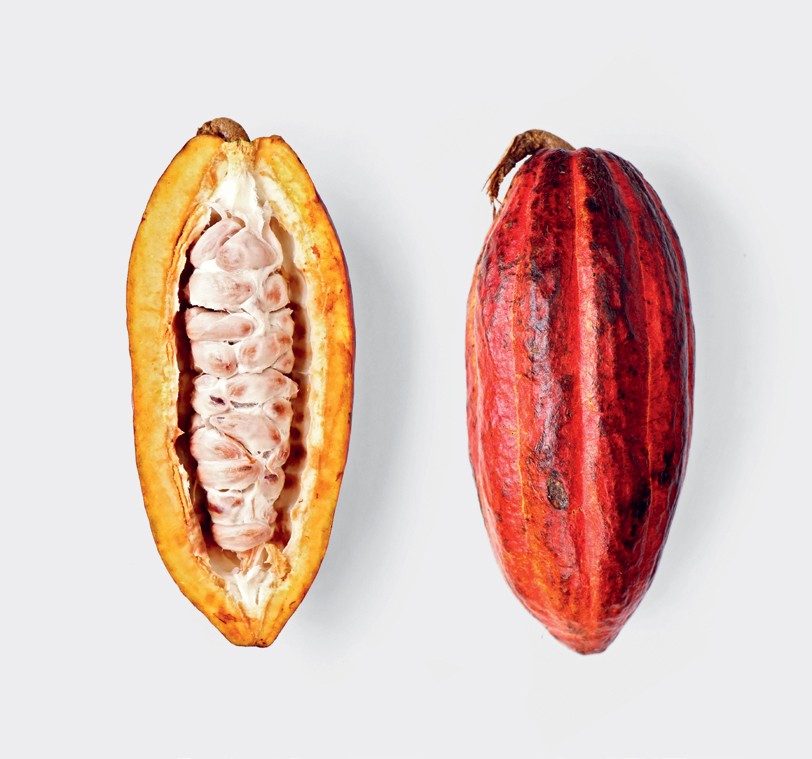
Cacao Connection
One surprising revelation to emerge from the study of Apalachee colono-wares has been our gradual recognition of their link to the worldwide trade in cacao, the source of chocolate (fig. 10). At the turn of the eighteenth century, chocolate was the most popular caffeinated beverage in both Europe and colonial America—far more so than tea, which was not yet carried to Spain’s American colonies from China on the Manila galleons. Spaniards initially controlled the cacao trade, since the tree species Theobroma cacao is native to the regions they colonized in Central and South America. It was they who adapted Indigenous methods of preparing cacao for consumption.[16]
The finely ground cacao nibs (and often other ingredients, such as sugar, cinnamon, or chili pepper) were whisked into boiling water with a molinillo, a grooved hardwood stirrer, to produce a froth. This was accomplished in a chocolatera, a distinctive vessel usually made of sheet copper with a rounded body and straight-sided neck (fig. 11). Depending upon a consumer’s social and economic status, the beverage was then consumed from cups fashioned from gourds or coconut shells, or from handleless ceramic pocillos, taller than teacups and with ring-footed bases and flaring rims. The organic accoutrements—wooden molinillos, gourds, coconut shells, and the processed cacao itself—rarely survive in archaeological contexts, but the chocolateras and pocillos do.[17]
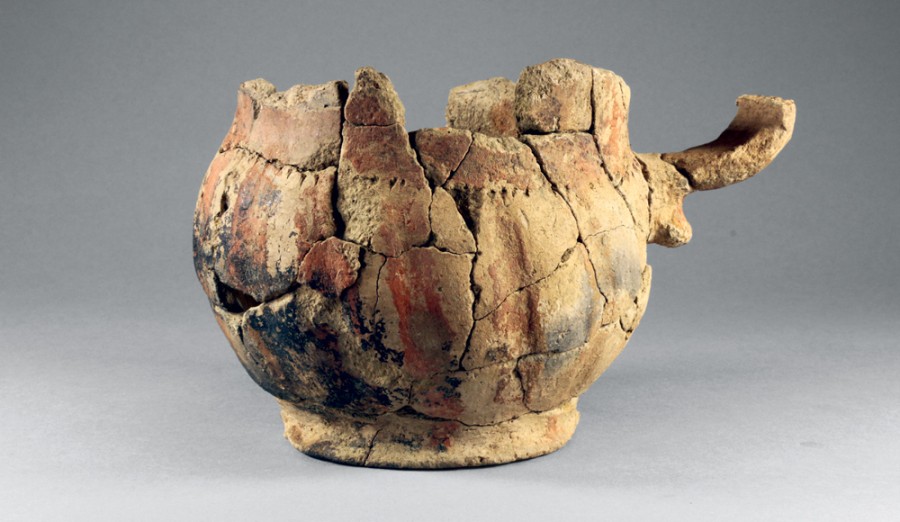
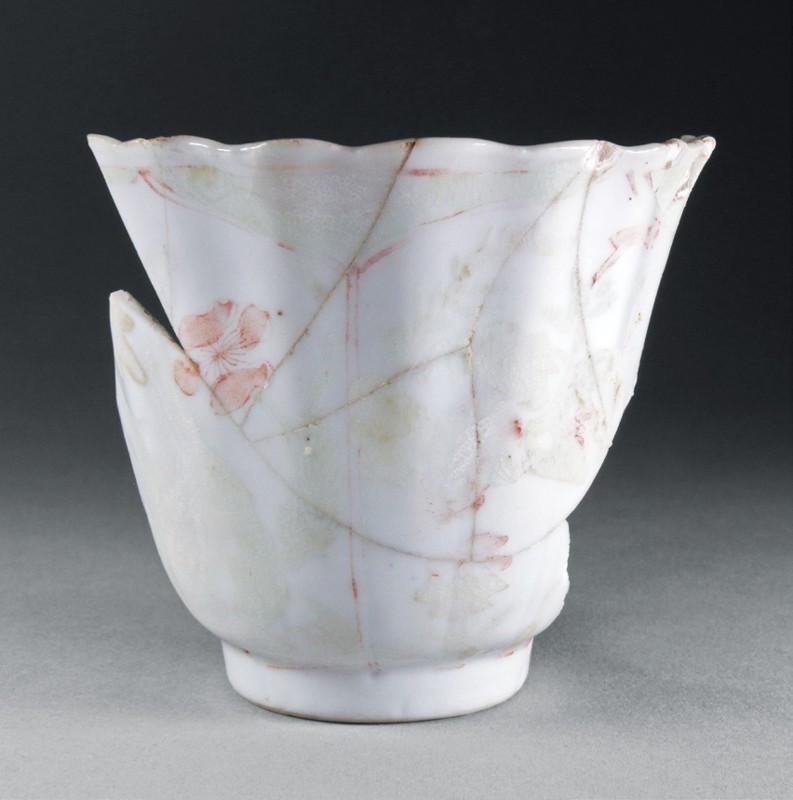
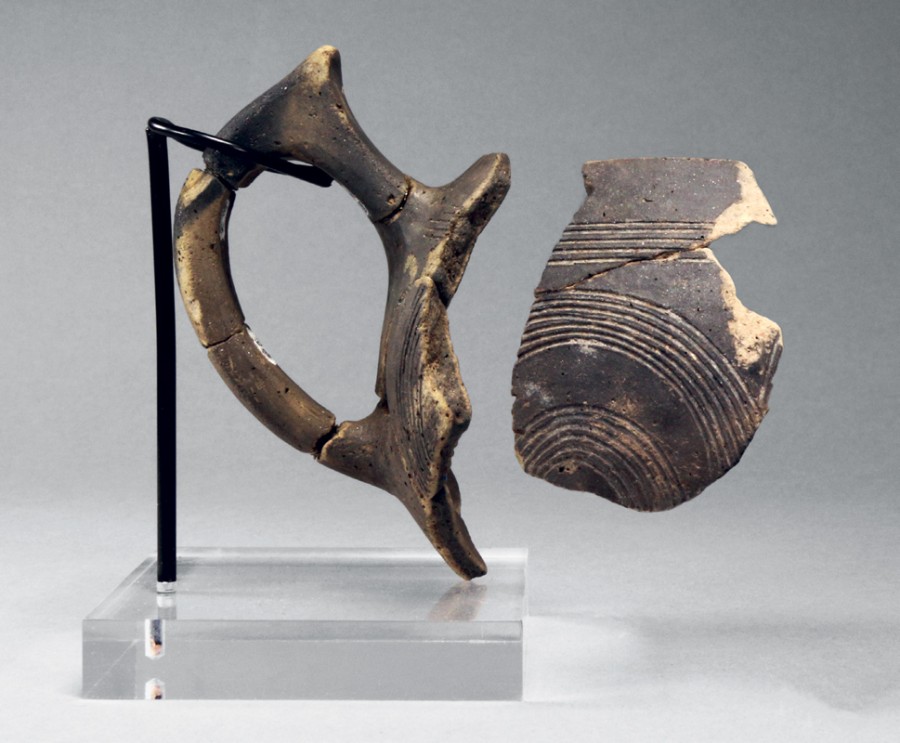
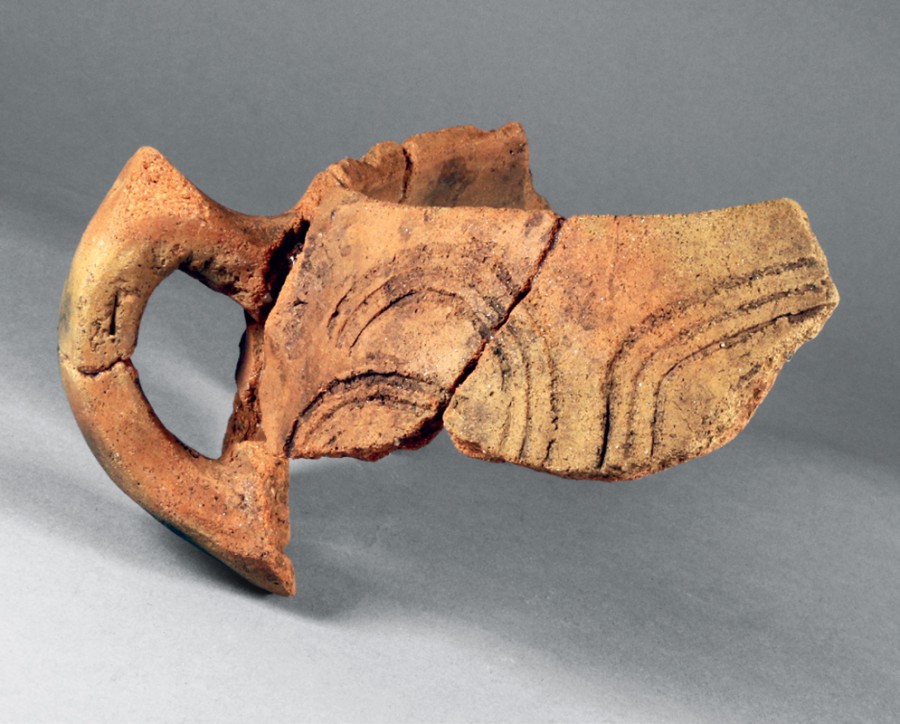
Apalachee pitchers can be identified as a colonoware form of chocolatera based on their shape (fig. 12). Cordell recognized a minimum of twenty-six from Old Mobile and thirteen from Mission San Luis, and additional examples have been found at both sites since her analysis. All of the examples share several characteristics: a flat, beaded base; a bulbous body with a narrower vertical rim collar (as seen on copper chocolateras); and an open, well-defined rim spout set opposite a wide baluster-form strap handle (similar vessels have likewise been excavated at later Spanish mission sites in California). Five of the Old Mobile pitchers have vertical grooves or flutes, reminiscent of the grooved surfaces of cacao pods, highlighted with red slip stripes. At Old Mobile, the colonoware pitchers are accompanied by Chinese porcelain pocillos—tall, handless cups with flaring rims—that were made specifically for export to European markets (fig. 13).[18]
These paraphernalia of chocolate consumption at Old Mobile shine a light on the shadow commerce that motivated many of the colonists who established this French foothold on the Gulf of Mexico, which colonial officials in Madrid had long considered a “Spanish Sea.” The French were keen to establish a base for trade (legal or otherwise) with the Spanish colonial ports of Veracruz and Havana, where furs, wine, and other contraband commanded huge profits. Chinese porcelain intercepted at Veracruz and dispersed throughout the Old Mobile settlement is clear evidence of that illicit traffic, a luxury item that would have been virtually unobtainable by people of average means in Canada or France. Less obvious, if not for the concurrence of colonoware chocolatera with elegant porcelain pocillos, is the presence of chocolate in the far reaches of colonial America. Indeed, the chocolate prepared in Apalachee colonoware pitchers at Old Mobile may itself have come from a cacao plantation purchased by Iberville in the Caribbean colony of Saint Domingue (Haiti) in 1701, while on his way to establish the Mobile settlement.[19]
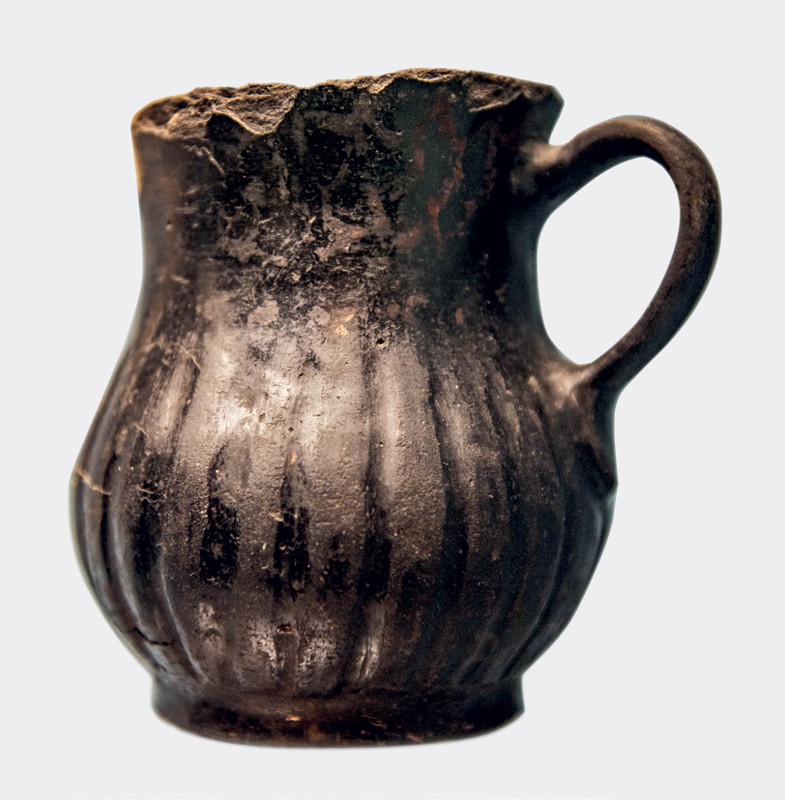
Chocolate connections revealed by these humble colonoware vessels have many threads. One suggests that this form of chocolatera may have outlasted the eighteenth-century craze for chocolate. A pitcher reportedly purchased from itinerant Catawba potters in South Carolina in 1805, now in The Charleston Museum, is strikingly similar to the Apalachee pitchers from Old Mobile, even down to the vertical grooves and traces of red paint. The South Carolina pitcher is classified as River Burnished, a type of unglazed colonoware made by Catawba potters (fig. 14). Since many Apalachees were enslaved in South Carolina, and many others resettled there during their early eighteenth-century diaspora, could they have brought the form with them and Native communities then have maintained the style for a century?[20]
A Proliferation of Colonowares across the Gulf South
None of the colonoware forms at Old Mobile has any precedent in local Indigenous pottery traditions. However, the appearance of colonoware created by Apalachee refugees from Florida inspired local Mobilian and Tomeh potters to experiment with novel vessel forms. Cordell found seven brimmed plates with shell tempering and other paste characteristics traditional of the Mobilians and Tomehs. Another twenty-seven vessels with crushed bone and grog temper are perhaps attributable to Chitimachas, originally from the lower Mississippi valley, who followed that temper recipe. In 1704 dozens of Chitimachas were enslaved by the French at Old Mobile.[21]
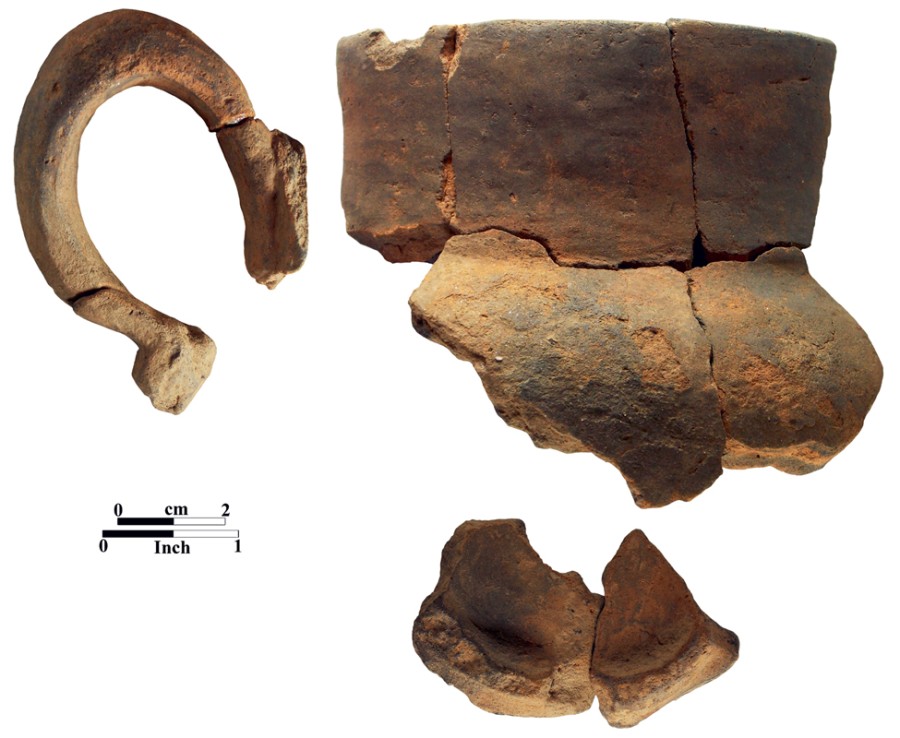
Other Native peoples began experimenting with novel vessel forms as colonial settlements spread throughout the region that the French claimed as Louisiane. Although colonowares appear in quantity only at sites of French colonial towns, forts, and plantations, small numbers were produced in Native towns. For instance, the Choctaws and Muscogee Creeks, who lived several hundred miles north of the Gulf coast, made few colonoware pots during the colonial era, mostly idiosyncratic earthenware one-offs modeled after English and French glass bottles, copper kettles, pitchers, and cups or mugs with oversize handles (fig. 15). In a study of thousands of ceramics from extensive excavations at the Upper Creek townsites of Fus Hvcce (Fushatchee), Hoithlewaulee, and Oce Vpofa (Hickory Ground), Craig Sheldon has identified only twenty-nine such colonoware vessels. All were made locally, with sand temper and paste characteristics of traditional Creek pottery. A few are decorated with traditional Creek incised motifs (fig. 16). Archaeological discoveries of these colonowares in household features reflect use of these rare forms by the Creeks themselves. Even at the early nineteenth-century townsite of Ekvncakv (Holy Ground), where more than a few residents were métis offspring of Creek mothers and European or African fathers, only three of the seventy-one vessels found during excavations at five of the town’s log cabins are colonoware forms. One, a straight-necked globular pitcher, is reminiscent of the Apalachee chocolateras from a century earlier (fig. 17).[22]
The proliferation of colonowares across the Gulf South, post-Old Mobile, was a complex phenomenon, but the story in broad outline is now fairly clear. By the 1720s, near each of the major French colonial settlements—Mobile, Biloxi/Pascagoula, New Orleans, Natchez, Natchitoches, Fort Toulouse—local Indigenous potters followed the Apalachees’ lead and began creating colonowares for sale to colonists.
In a rare written documentation of this craft, Antoine-Simon Le Page du Pratz (ca. 1695–1775), a prominent French colonist residing in the Natchez region in the 1720s, recounted years later how Natchez women made “pots of an extraordinary size, jugs with narrow openings, bowls, two-pinte bottles with long necks, pots or jugs for bear oil that hold up to 40 pintes, finally shallow and deep plates in the French style. I had some made out of curiosity on the model of my faience [French tin-glazed earthenware]; they were a quite beautiful red.”[23]
The Natchez destroyed the French settlements in their midst in 1729. When the French returned in 1732 and rebuilt Fort Rosalie, their new earthworks buried archaeological deposits from the earlier 1716–1729 barracks. Excavations there recovered twenty-five thousand Native-made potsherds, including fragments of thirty-five colonoware vessels—mostly plates, as well as two bowls, a small jar, one small and five large bottles, and a handle detached from a cup, mug, or pitcher. The plates closely resemble French faience and coarse earthenware plate forms, in the presence of a brim or marly on some and a beveled or bolstered rim on others. They also lack a footring, in contrast to the earlier Apalachee plate forms found at Old Mobile that were inspired by Spanish majolica foot-ringed plates. All but two of the Fort Rosalie colonowares have grog-tempered pastes characteristic of what is known as Addis Plain ware, which was employed by the Natchez for their traditional pottery. And all but the large bottles and handle were carefully burnished and decorated with a red clay slip, finishing techniques that have precedent in traditional Natchez wares. Most of the plates are red slipped on the interior surface only, bowls on both surfaces, and bottles on the exterior. In sum, the soldiers at Fort Rosalie ate off of and stored commodities in colonowares that emulated vessel forms familiar to the colonists but still distinctively Natchez in appearance.[24]
So Many Little Red Bowls
These sorts of Native-made colonowares inspired by European vessel forms, which appear at eighteenth-century colonial sites throughout the Gulf South, conform to Noël Hume’s original concept of colonowares as hybrid outcomes of the collision of Indigenous and European ceramic traditions. The more complex social (and ceramic) landscape that developed with the arrival of thousands of enslaved West Africans in the Louisiane colony, beginning in 1719, requires the broader definition of colonoware advocated by Ferguson—any hand-built, low-fired, unglazed earthenware pottery made by Native Americans and enslaved Africans for use in colonial contexts.[25]
This major demographic shift preceded (by a decade or so) the appearance at plantation and urban sites of substantial numbers of small, hemispherical bowls that do not differ dramatically from simple bowls made traditionally by Native or African potters. Once again, temper and ceramic paste provide important clues to the makers of the bowls. Many are tempered with finely crushed shell, fine sand, or grog, and have surfaces covered with clay slip, mostly red but also brown or black. Archaeologists in the Gulf South have generally interpreted these numerous small bowls as the productions of local Native potters. Other simple bowls tempered with coarse sand and lacking a clay slip closely resemble the Yaughan type of colonoware, found in South Carolina, that has been interpreted as the production of enslaved African potters for use on plantations.[26]
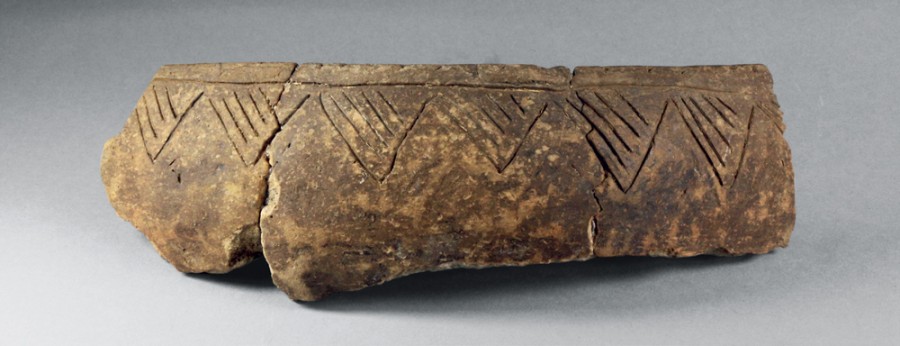
Prior to 1730 the simple, filmed bowls used in early colonial contexts seem to have been decorated by local Native potters with traditional incised motifs. Examples found at Old Mobile, Port Dauphin (Mobile’s port on the Gulf from about 1715 to 1730), and from the early years of the La Pointe-Krebs plantation in Pascagoula (about 1718 to 1735) carry curvilinear and angular incised motifs typical of locally made Mobilian and Pascagoula wares (figs. 18, 19). A red filmed bowl sherd with traditional incising characteristic of Natchez pottery has been reported from the 1720s Terre Blanche concession near Fort Rosalie, at the heart of French settlement among the Natchez.[27]
Soon afterwards, incised prototypes gave way across the Gulf South to filmed bowls lacking decoration. These became especially abundant after 1763, the end of the Seven Years’ War, when the French lost their colony. Louisiane was divided to form the Spanish colony of Luisiana, including New Orleans and lands west of the Mississippi River, and the short-lived British colony of West Florida to the east, including Mobile. Less than two decades later, by 1781, a series of military campaigns during the American Revolution brought the entire northern coast of the Gulf of Mexico under Spanish colonial control.
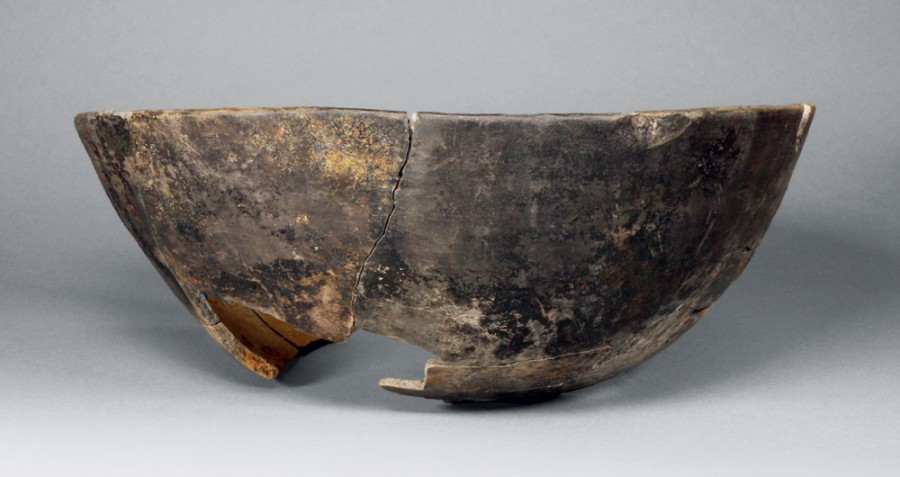
During the British and Spanish colonial eras (1763 to 1813), plain filmed bowls were widely used in Mobile and New Orleans, as well as on plantations across the region. At Pierre Rochon’s plantation on Dog River, south of Mobile, red, brown, and black filmed bowls were found in greatest abundance at the south end of the plantation, on either side of a shallow bayou, where quarters for enslaved Native Americans and Africans were clustered. In urban settings and at smaller plantations, there was less spatial segregation of living quarters for free and enslaved residents, but the simple filmed bowls are presumed to have been used principally by the enslaved (figs. 20, 21).[28]
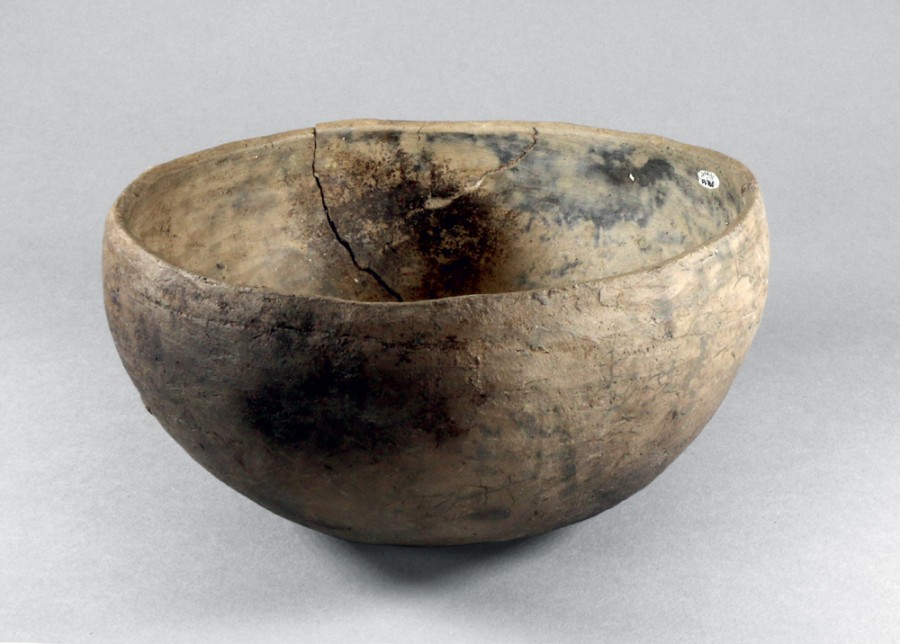
As to the identities of the potters who made the simple filmed bowls, they had multiple origins. Prior to 1763 temper and paste characteristics point to the same potters who made the Native wares near each colonial settlement. However, in 1763, nearly all of the small tribes—les petites nations, as the French called them, including the Mobilians who had produced much of the local colonowares—moved west of the Mississippi River and out of the newly defined boundaries of British West Florida. In the Mobile area, that left only the Tomehs, who joined the Choctaws. Indeed, most of the colonowares found at post-1763 sites in and around Mobile appear to be made by Choctaws, as suggested by the presence of angular shell temper, as well as traditional Choctaw combed decorations on some vessels from every site. The sudden departure of the petites nations from the central Gulf coast coincided with an influx of British colonial planters with their enslaved African work force from the Carolinas. The upsurge in quantities of sand-tempered bowls at British colonial sites in the Gulf South—bowls that conform generally to Yaughan, Lesesne Lustered, and Colonial Burnished wares, which appeared earlier in the Carolinas—probably reflects those demographic shifts, with consequently more African American colonoware production in the region (figs. 22, 23).[29]
In late eighteenth-century New Orleans, the preeminent international port on the Gulf coast, the ceramic landscape was far more complex. A detailed petrographic and chemical analysis of sherds from six eighteenth-century archaeological sites in the city by Ann Cordell and Lauren Zych has demonstrated multiple far-flung sources for unglazed pottery vessels. Shell-tempered wares, as expected, were fashioned from Tombigbee River clays available to Tomeh and Choctaw potters and from local clays in the New Orleans vicinity. Grog-tempered and bone-tempered vessels were made locally or in the Natchez area up the Mississippi River. But a surprising number of pots had exotic clays and tempers—limestone, volcanic rock, or mafic metamorphic rock—from the Caribbean or even farther afield.[30]
The Legacy of Gulf Coast Colonowares
Spanish colonial occupation of the Gulf South ended in stages, beginning in the west with the United States’ acquisition of New Orleans and the Louisiana Purchase in 1803, the Mississippi coast in 1810, Mobile in 1813, and Florida in 1821. Native-made colonoware production seems to have ended at about the same time. The latest well-dated examples from the Mobile area are small bowls made between 1798 and 1814 by Choctaw potters for use by the U.S. military garrison at Fort Stoddert, on the border of Spanish West Florida. Saturation of the regional pottery market by British manufacturers of creamware and pearlware after the War of 1812 is probably responsible for the abrupt decline in local handmade colonoware vessels. But Indigenous potters kept producing earthenware for their own use, and that may well have included colonowares, even after “Indian Removal,” the forced exodus of most Native Southerners to Oklahoma in the 1830s.[31]
African American potters also are likely to have continued practicing their craft during the transition to American rule in the Gulf South, although the ceramic history of that era remains murky. French immigrants developed a salt-glazed stoneware industry in the Mobile Bay area early in the nineteenth century, and alkaline glazed stoneware production elsewhere in the state employed African American potters, some of whom could have learned their trade making colonoware vessels, as was likely the case in South Carolina.[32]
Nothing, at this point, is known about glazed earthenware production in the Gulf South during the first decades of the nineteenth century, although sherds of unattributed wares have been found in archaeological excavations. In his authoritative overview of Alabama folk pottery, folklorist Joey Brackner has pointed to a brief passage in Bernard Romans’ (ca. 1720–1784) account of his visit to the region in the early 1770s as possible evidence for an incipient lead-glazed earthenware industry in the colonial era. In his description of colonial settlements in British West Florida, Romans mentions a place known colloquially as “The Village,” a small, ethnic French community on the eastern shore of Mobile Bay, where he found “a distribution of very fine clay, fit for manufacturing,” which Romans considered “the finest i ever saw.” This excellent clay source was located near “the village on Mobile Bay, where i have seen the inhabitants, in imitation of the Savages, have several rough made vessels thereof.”[33]
Romans seems to have suggested that the colonists used their “very fine clay” to make pottery, and that is how Brackner has interpreted him, although in fact Romans only stated that the colonists “have several rough made vessels thereof.” According to Brackner, “By ‘rough made vessels’ Romans could have meant that the British were using the coiling method of making pottery—a technique employed by both American Indians and Africans—instead of using a pottery wheel.” “More than likely,” Brackner further infers, “this pottery was lead-glazed earthenware, the most common type of pottery in colonial America.” Brackner has also written that “Romans described pottery making on the Eastern Shore of Mobile Bay during the 1770s . . . . In any case, there is no historical record of American Indians running pottery businesses in early Alabama.”[34]
In light of the foregoing summary of colonowares in the Gulf South, an alternative reading of Romans’ awkward passage suggests rather that he was describing unglazed pottery vessels “rough made” of local clays, which he interpreted as imitations of Native-made pots. Extensive archaeological surveying and excavation at plantation sites within The Village have recovered no evidence of locally made lead-glazed earthenwares and, instead, considerable quantities of unglazed colonoware pottery. We can now be reasonably certain that Romans saw products of a well-established colonoware tradition, a pottery business that Native Americans, as well as Africans, did in fact run for a century.[35]
The gendered dimensions of colonowares remain poorly understood. According to written accounts by a few observant colonists, southeastern Native potters, including those engaged in colonoware production, were invariably women and girls. This evidently was also true in eighteenth-century West Africa for traditional, hand-modeled pottery making, and we might then infer the same for African American potters creating colonowares in the colonial Southeast.[36] If that is so, then the predominance of African American men employed in stoneware production by the early nineteenth century reflects a dramatic shift in gender roles that coincides with the industrialization of ceramic production, an option generally unavailable to Native Americans in the region. We might also consider the resilience and creativity of Native and African American women who sold their potteries in colonized spaces, their successful creations of viable niche markets (for baskets as well as pots) in a male-dominated colonial economy based on slave-labor agriculture and the deerskin trade.[37]
Expanding our understanding of colonoware to include the Gulf South broadens and enriches our view of colonial America, which still too often focuses narrowly on the British colonies of the Atlantic Seaboard. Several millennia of pottery making preceded the arrival of Europeans and Africans on the Gulf coast, where that Gulf South Native ceramic tradition gave rise to forms of colonowares distinct from those that arose in the Chesapeake and Low Country regions to the east. Spanish and French ceramics inspired new forms of Indigenous pottery unseen elsewhere in North America, including vessels like the colonoware chocolateras closely tied to food customs of New Spain and the Caribbean. But a rearrangement of the imperial map at the end of the Seven Years’ War in 1763 brought British colonial planters from Virginia, Georgia, and South Carolina into the Gulf South, and with them their enslaved labor force of African Americans—some of whom had long made their own forms of colonoware. The resultant hybridized ceramic landscape was rich and varied—and is largely forgotten today. Archaeology is allowing us to rediscover the Gulf South’s colonoware history.
ACKNOWLEDGMENTS I am grateful to Ann Cordell, Ashley Dumas, Richard Fuller, Lance Green, Philippe Halbert, Jon Marcoux, Bonnie McEwan, David Morgan, Erin Nelson, Sarah Price, Craig Sheldon, Vincas Steponaitis, Ian Thompson, Martha Zierden, and Lauren Zych for references, feedback, and other assistance offered during many years of research on colonowares of the Gulf South. I am also indebted to Russell Skowronek for his groundbreaking research on chocolate-drinking accoutrements at Spanish colonial sites.