


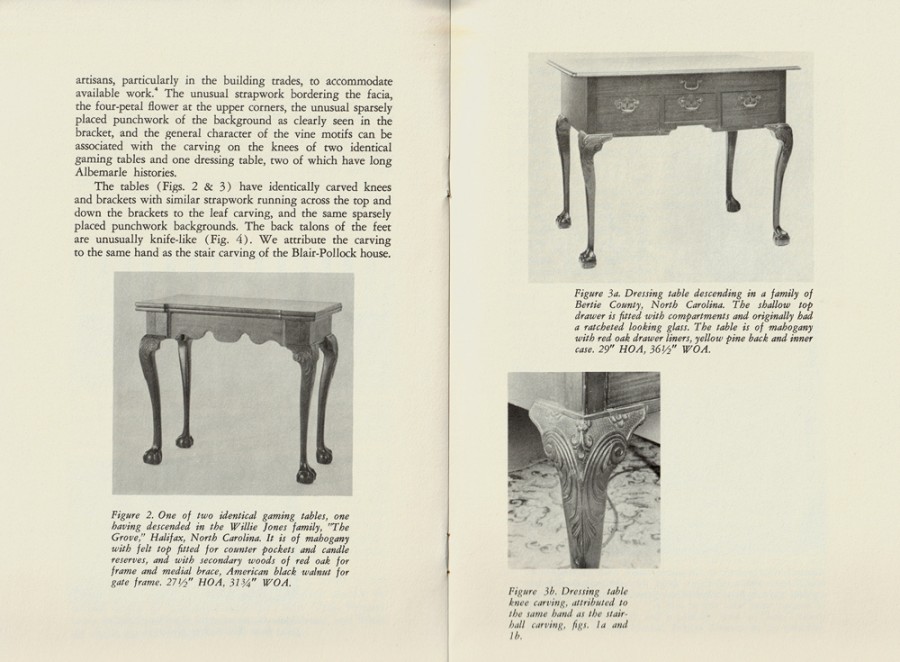
Pages from Frank L. Horton, “Carved Furniture of the Albemarle: A Tie with Architecture,” Journal of Early Southern Decorative Arts 1, no. 1 (May 1975): 14–20. (Photo, Museum of Early Southern Decorative Arts.) The two tables are illustrated below in figs. 39 and 41.
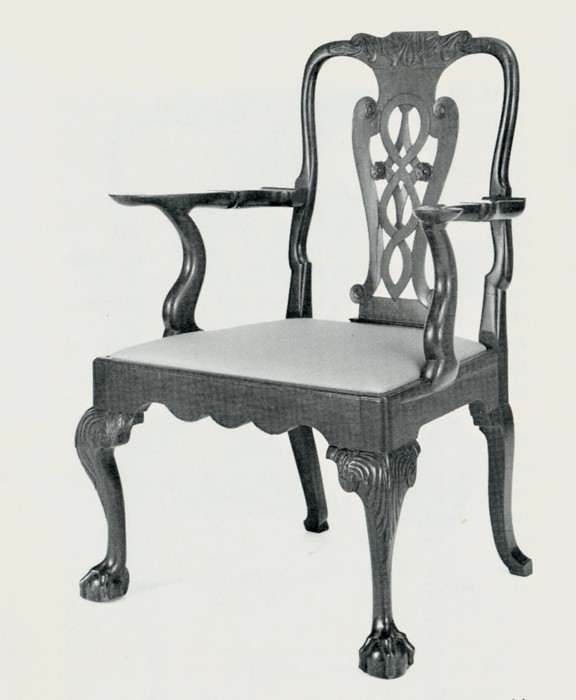
Illustration from John Bivins Jr., The Furniture of Coastal North Carolina, 1700–1820 (Chapel Hill: University of North Carolina Press for the Museum of Early Southern Decorative Arts, 1988), p. 157. (Photo, Museum of Early Southern Decorative Arts.) This armchair is illustrated below in fig. 11.
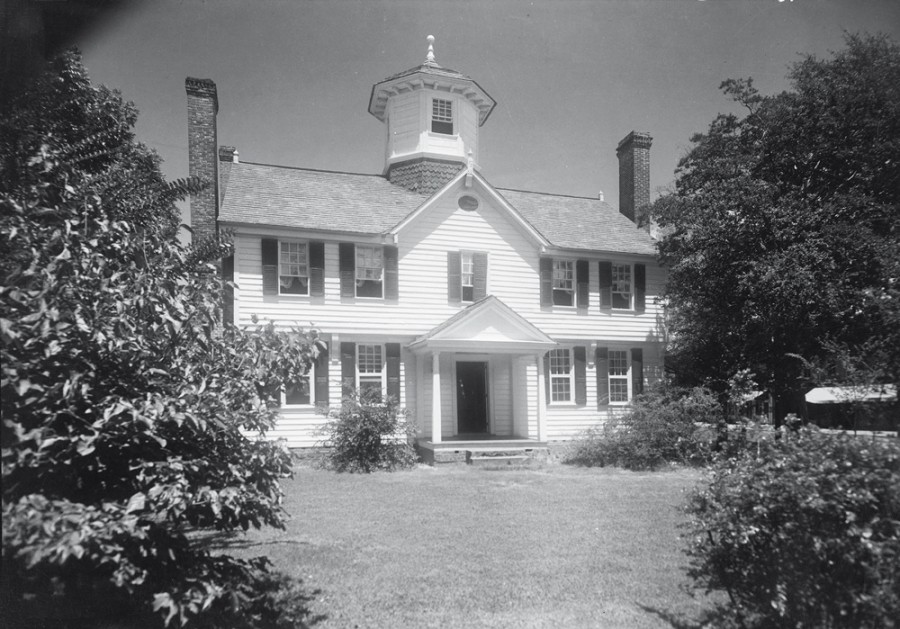
Cupola House, 408 South Broad Street, Edenton, North Carolina, ca. 1758. (Courtesy, Historic American Buildings Survey; photo, Thomas T. Waterman, 1939).
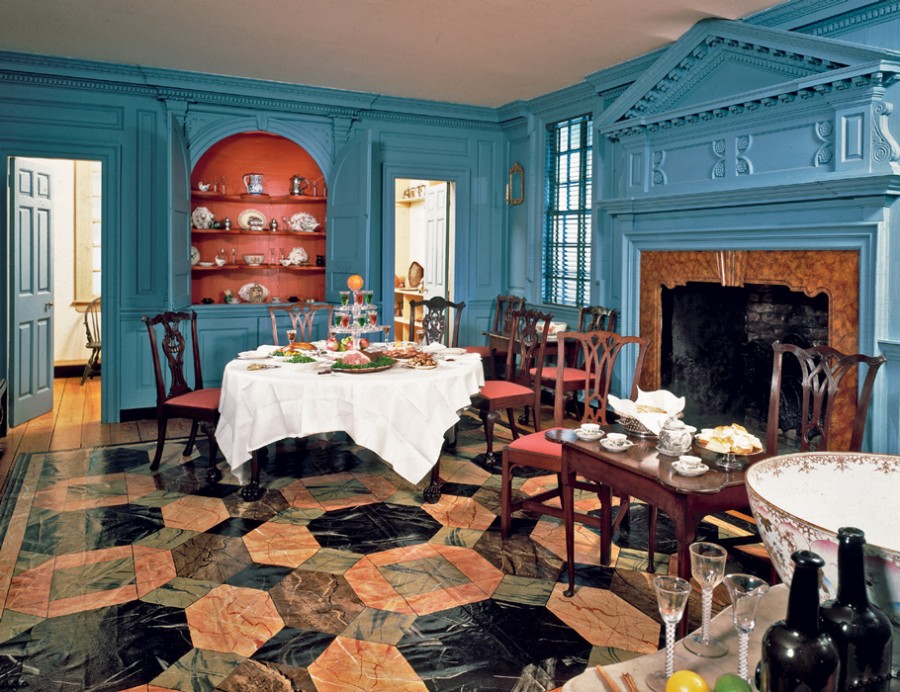
Hall, the Cupola House, 1757–1759, 19 1/2 x 15 1/2 ft. (Courtesy, Cupola House Association, Inc.; photo, Brooklyn Museum.) This photo shows the installation of the woodwork at the Brooklyn Museum. The woodwork has recently been given by the Brooklyn Museum to the Cupola House Association, Inc. for reinstallation in 2025.
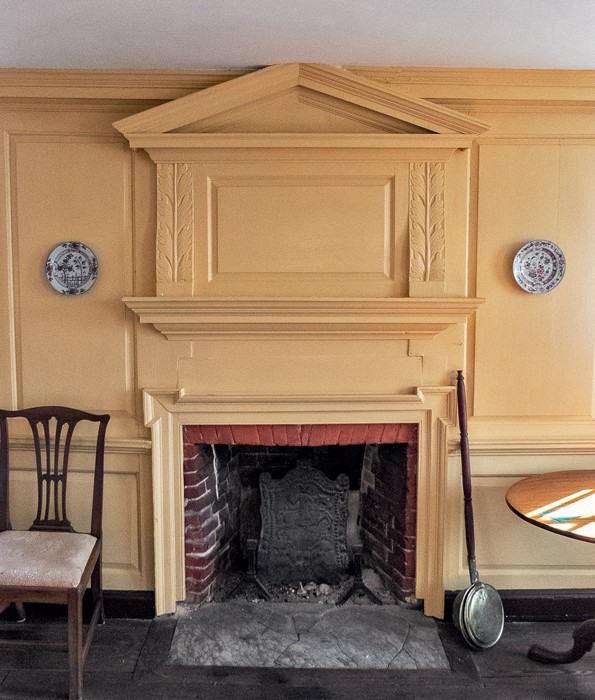
Chimneypiece on the second floor of the Cupola House. (Photo, Museum of Early Southern Decorative Arts.)
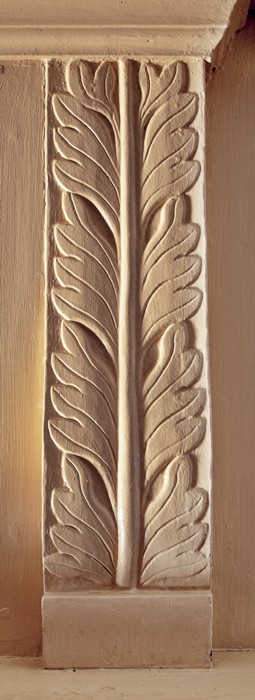
Detail of the carved truss on the right of the chimneypiece illustrated in fig. 5. (Photo, the author.)
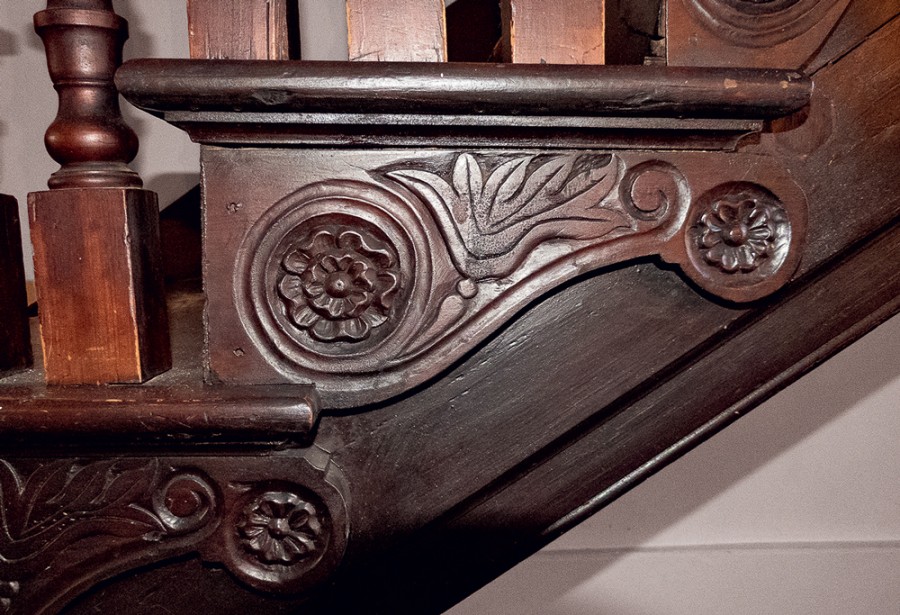
Detail of a stair bracket in the Cupola House. (Photo, the author.)
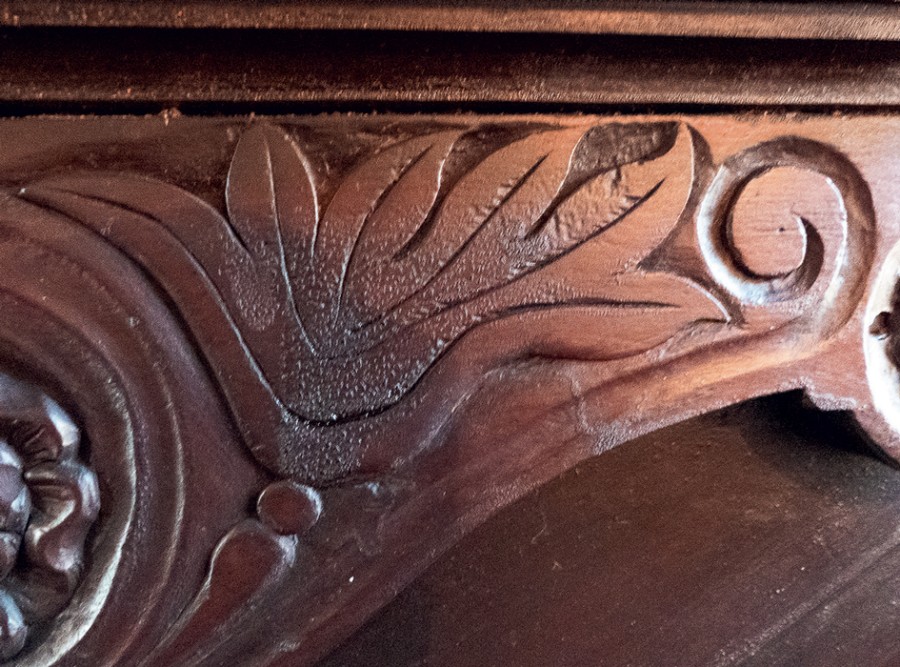
Detail of the carved leafage on the stair bracket illustrated in fig. 7. (Photo, the author.)
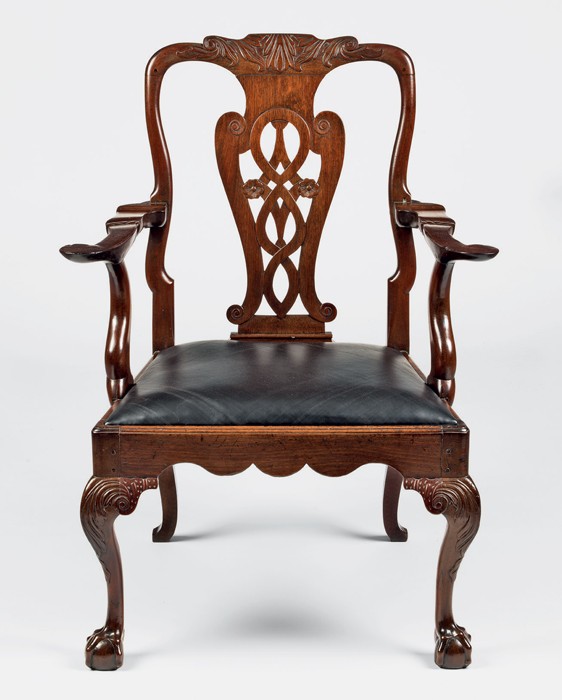
Armchair, vicinity of Edenton, North Carolina, 1745–1765. Mahogany and cherry with yellow pine. H. 39 1/2". (Courtesy, The Colonial Williamsburg Foundation, Museum Purchase.) This rear seat rail is branded “JOHN COX / EDENTON NC” (see fig. 13). All of the chairs in this group are dimensionally the same.
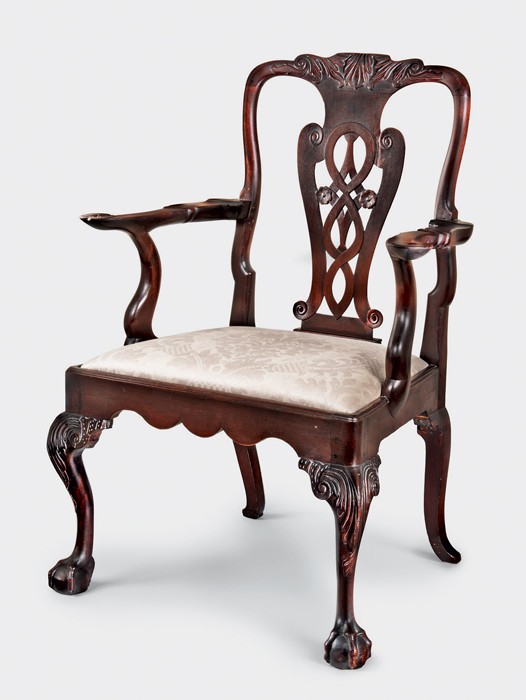
Armchair, vicinity of Edenton, North Carolina, 1745–1765. Mahogany and cherry with yellow pine. (Private collection; photo, Gavin Ashworth.)
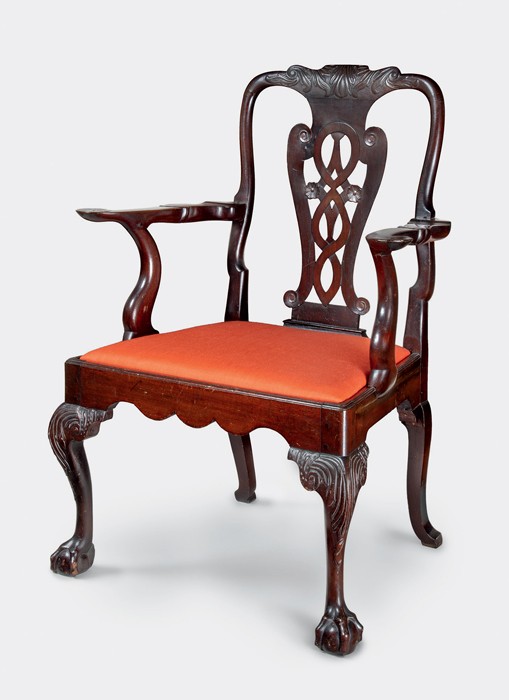
Armchair, vicinity of Edenton, North Carolina, 1745–1765. Mahogany and cherry with cypress and beech. (Courtesy, Museum of Early Southern Decorative Arts; photo, Gavin Ashworth.) This armchair is illustrated in the publication cited in fig. 2.
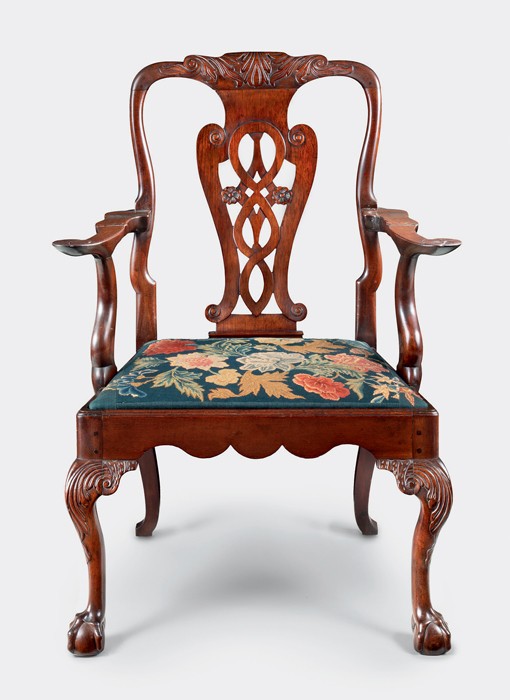
Armchair, vicinity of Edenton, North Carolina, 1745–1765. Mahogany and cherry with yellow pine. (Private collection; photo, Gavin Ashworth.)
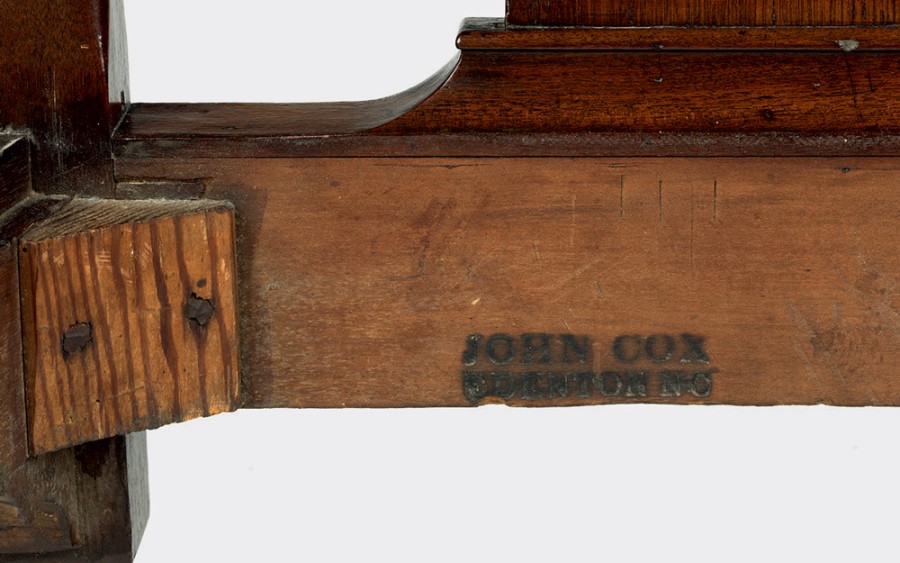
Detail of the brand on the armchair illustrated in fig. 9.
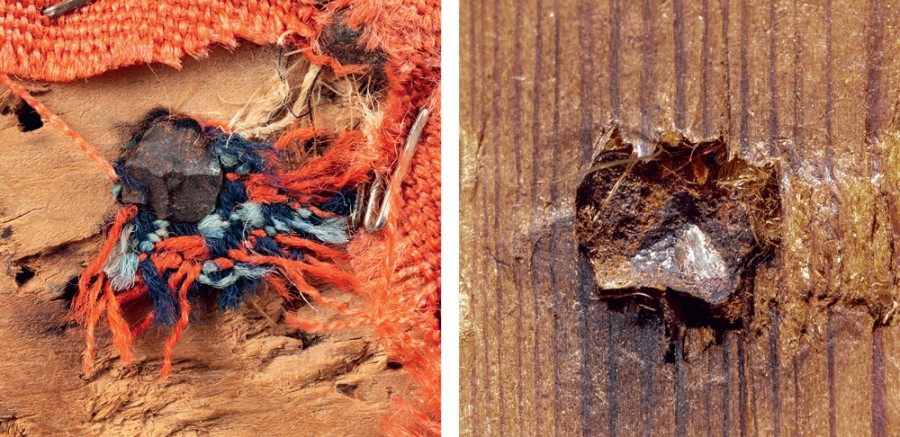
Detail of a fragment of wool worsted trapped under a wrought nail on the beech slip seat of the armchair illustrated in fig. 11 (left) and two threads trapped under a wrought nail on the yellow pine slip seat of the armchair shown in fig. 10 (right). (Photos, Gavin Ashworth.) These are the only slip seats retaining evidence of original show cloth. The chair thought to have been covered in leather (fig. 9) only has evidence of its linen foundation upholstery.
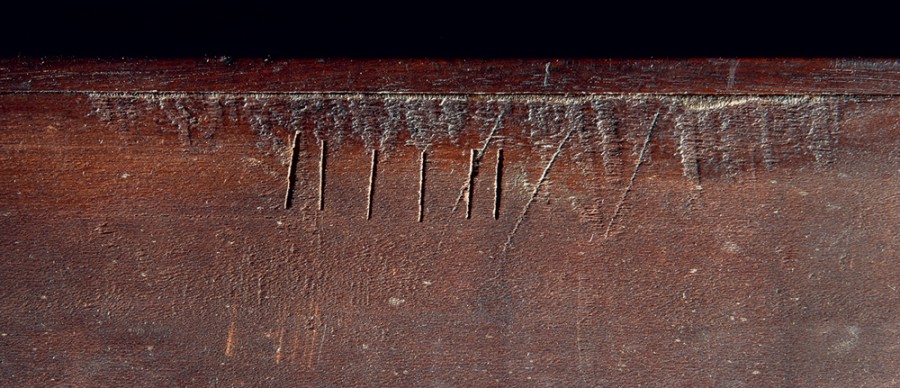
Detail showing the numbering on the rear seat rail of the armchair illustrated in fig. 12. (Photo, Gavin Ashworth.)
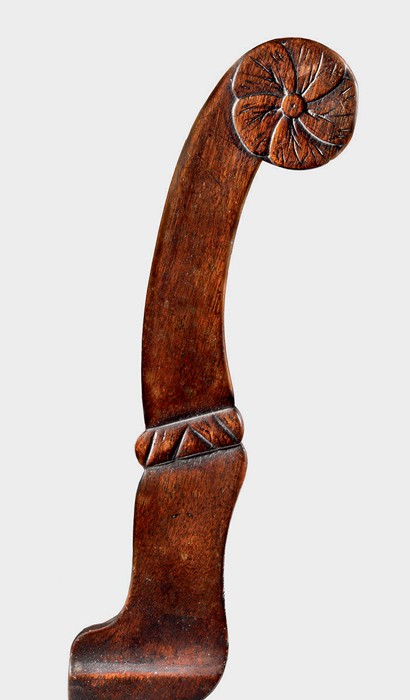
Detail of an arm on the armchair illustrated in fig. 11. (Photo, Gavin Ashworth.)
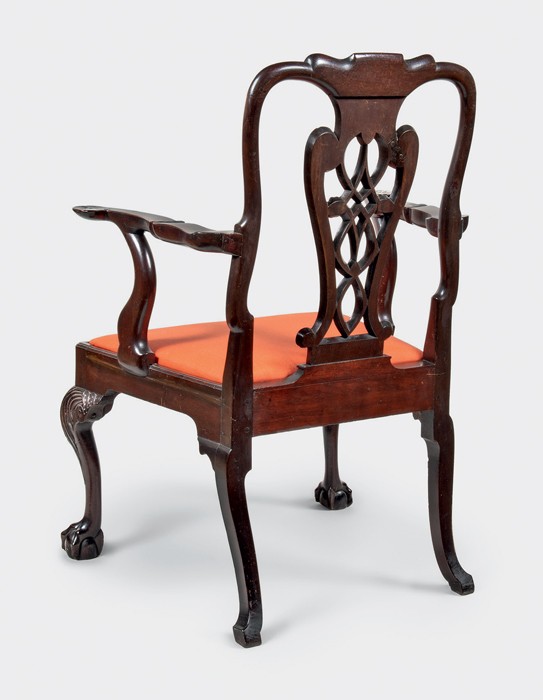
Rear view of the armchair illustrated in fig. 11. (Photo, Gavin Ashworth.)
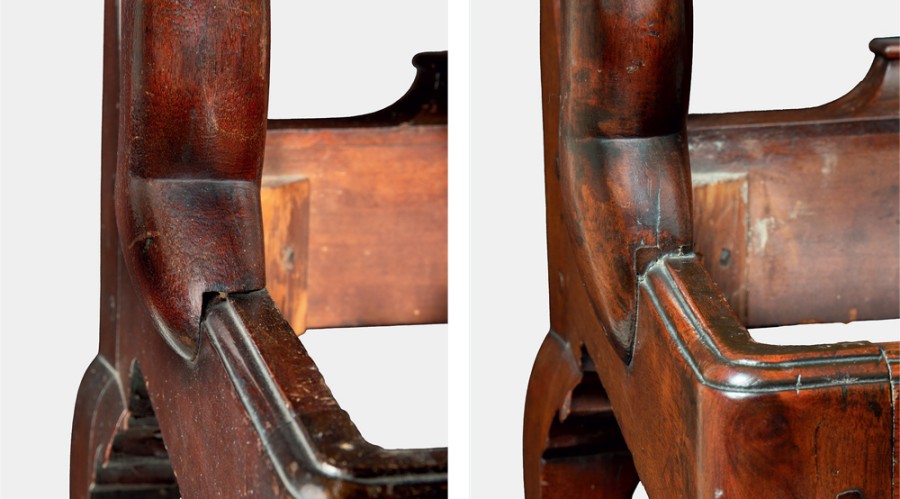
Details showing an arm support and side rail of the armchairs illustrated in figs. 11 (left) and 12 (right). On all of the armchairs in this group, the maker inserted thin strips of wood to fill in the gaps between the flat undersides of the arm supports where they meet the molded seat rails, as seen on the right. The chair on the left is missing the original filler strip. (Photos, Gavin Ashworth.)
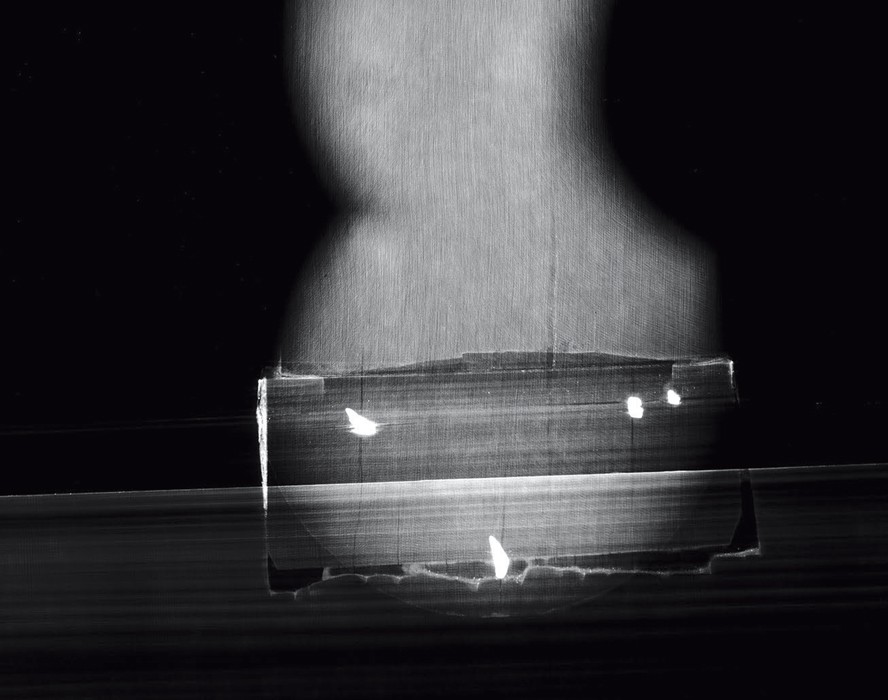
X-radiography showing the tenoned and nailed joint of an arm support and seat rail of the armchair illustrated in fig. 9. (Photo, Chris Swann.)
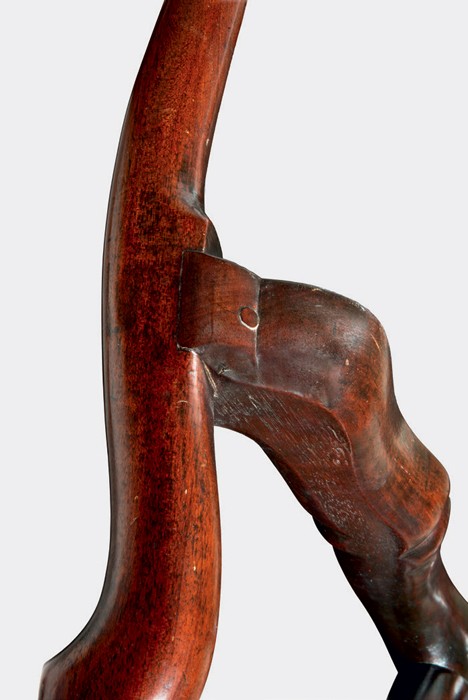
Detail showing how the arms of the chair illustrated in fig. 12 are attached to the rear stiles. (Photo, Gavin Ashworth.)
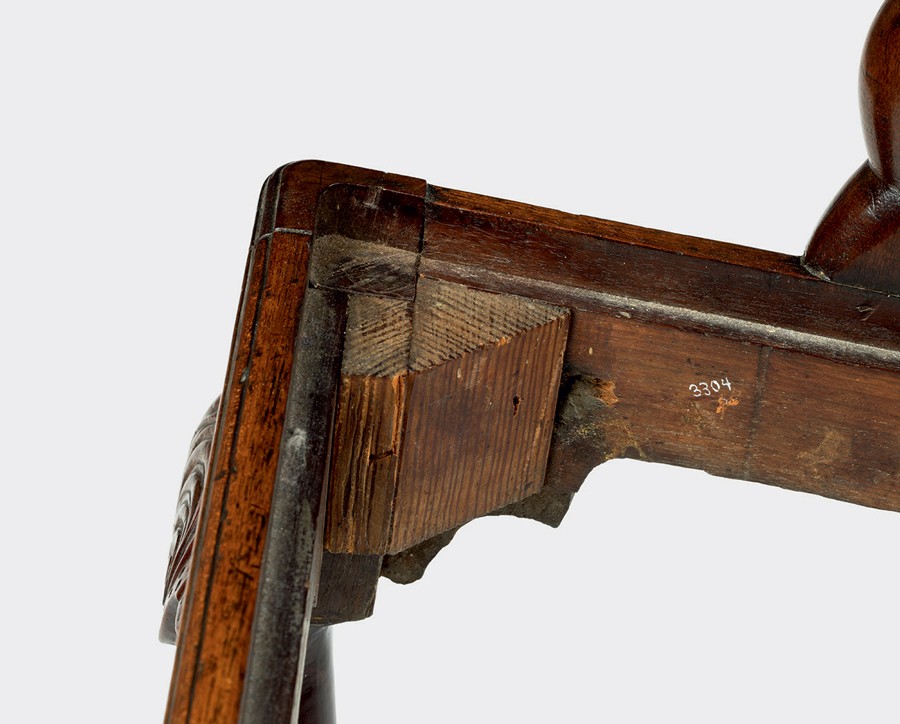
Detail showing the overlapping glue blocks reinforcing a seat rail/leg joint of the armchair illustrated in fig. 9.
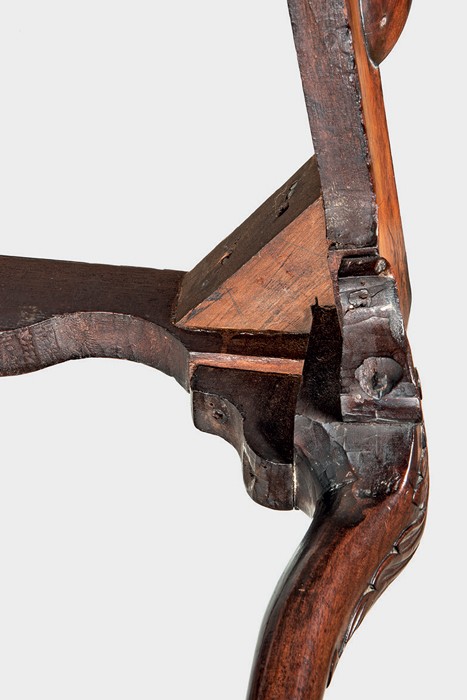
Detail of the armchair illustrated in fig. 12, showing how the knee blocks are attached to the legs and rails and how the blocks and rails were undercut. (Photo, Gavin Ashworth.)
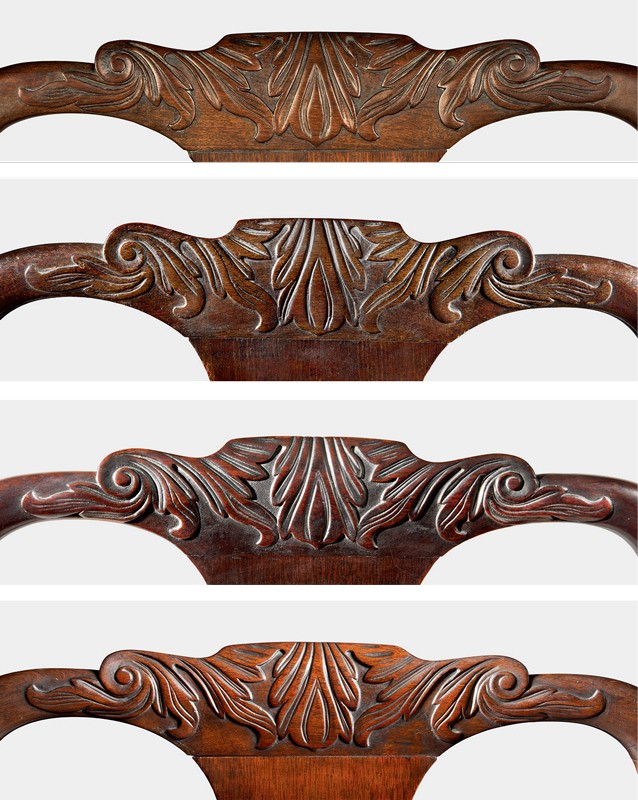
Details showing the crest rail carving of the armchairs illustrated (from top to bottom) in figs. 9–12. (Photos [lower three], Gavin Ashworth.)
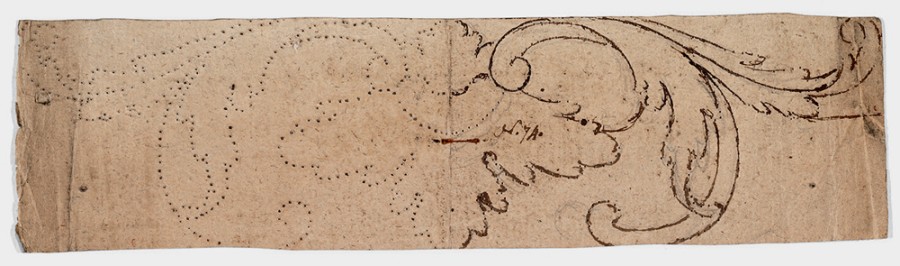
Carving pattern from the shop of Gideon Saint (1729–1799), London, ca. 1760. (Courtesy, Metropolitan Museum of Art; photo, Art Resource NY.)
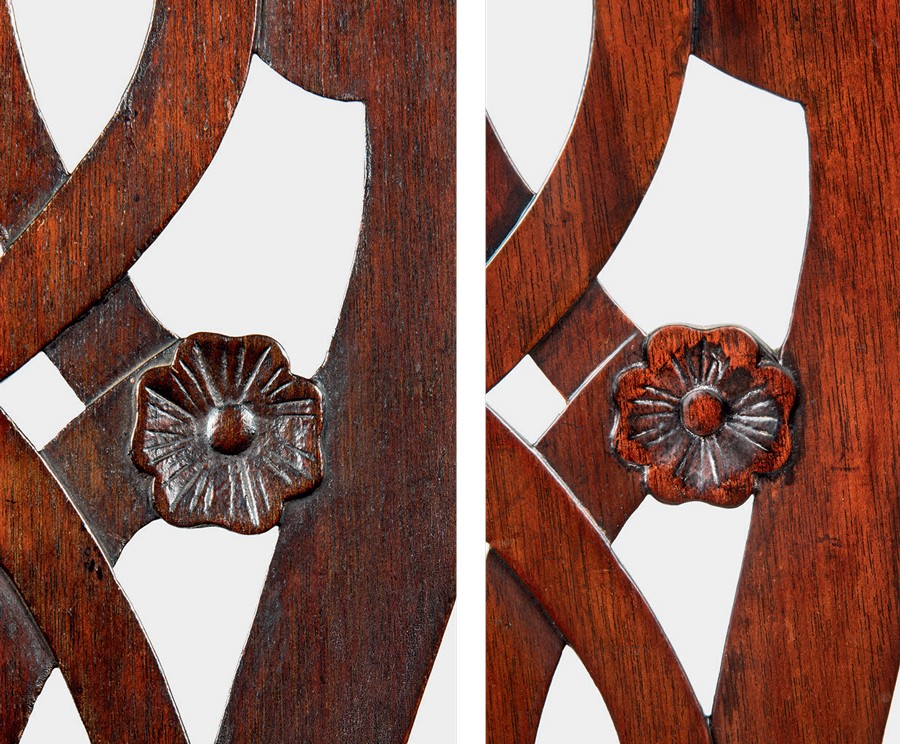
Details showing the splat rosettes of the armchairs illustrated in figs. 11 (left) and 12 (right). (Photos, Gavin Ashworth.)
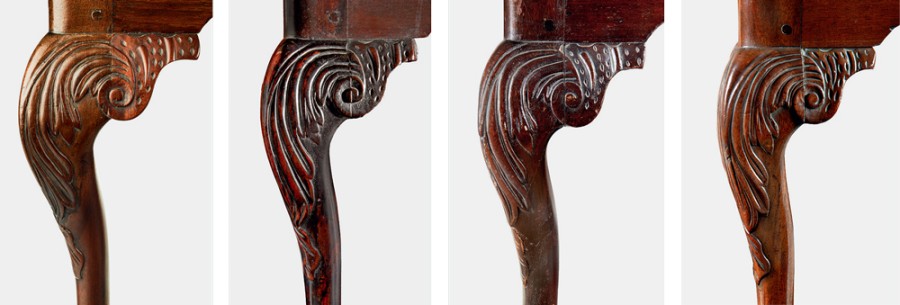
Details showing the knee carving of the armchairs illustrated (from left to right) in figs. 9–12. (Photos [right three], Gavin Ashworth.)
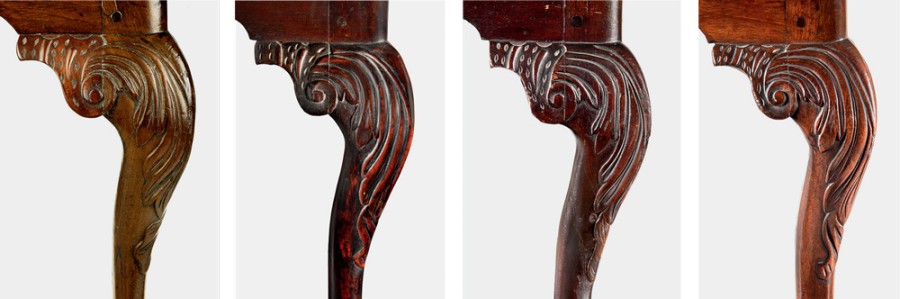
Details showing the knee carving of the armchairs illustrated (from left to right) in figs. 9–12. (Photos [right three], Gavin Ashworth.)
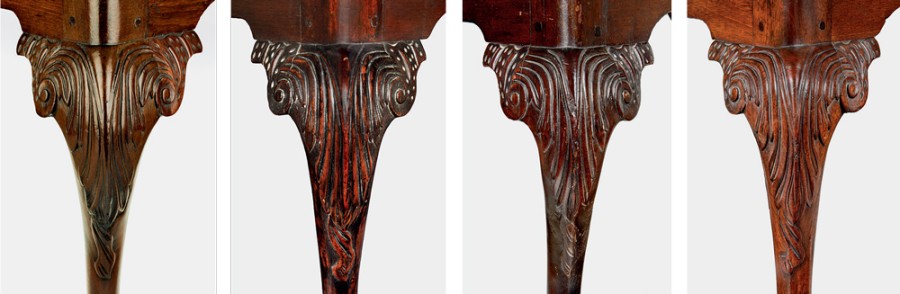
Details showing the knee carving of the armchairs illustrated (from left to right) in figs. 9–12. (Photos [right three], Gavin Ashworth.)
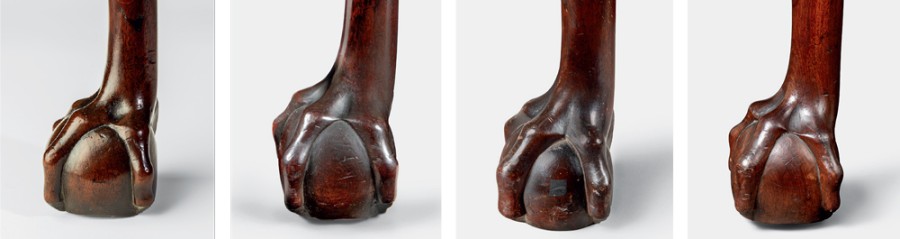
Details showing the claw-and-ball feet of the armchairs illustrated (from left to right) in figs. 9–12. (Photos [right three], Gavin Ashworth.)
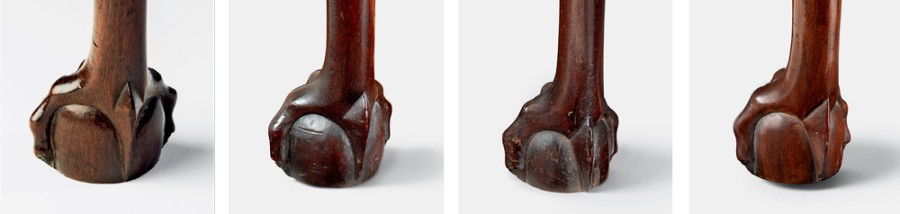
Details showing the claw-and-ball feet of the armchairs illustrated (from left to right) in figs. 9–12. (Photos [right three], Gavin Ashworth.)
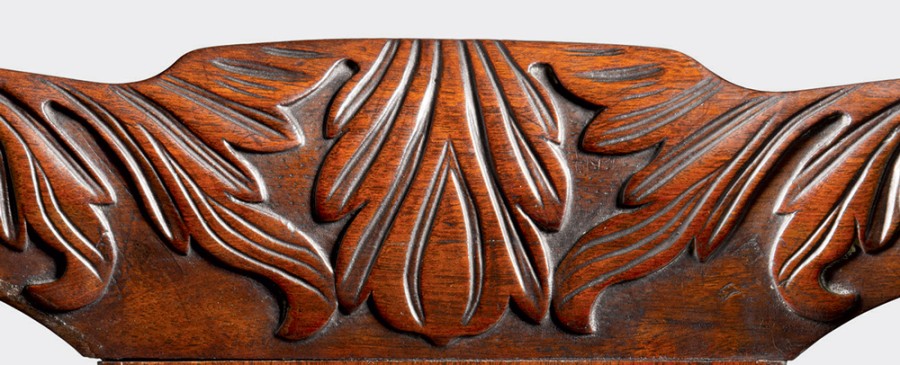
Close view of the carving on the crest rail of the armchair illustrated in fig. 12. (Photo, Gavin Ashworth.) This armchair and the example illustrated in fig. 9 have evidence of stippling around the central leaf element of their crests.
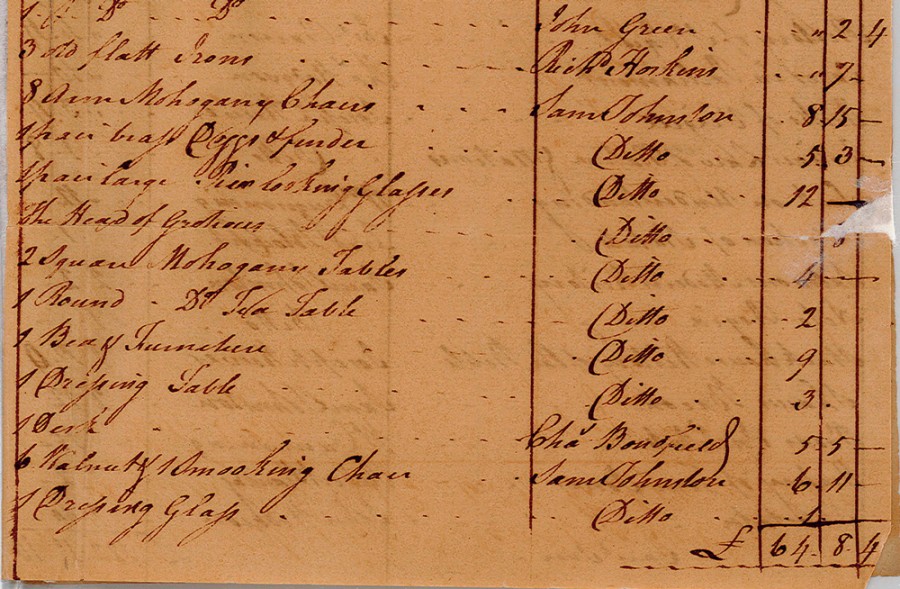
Detail of the “Acct. Sales of the Estate of Francis Corbin Deceased,” September 20, 1768. (Courtesy, State Archives of North Carolina, Raleigh.) For the full account, see Appendix.
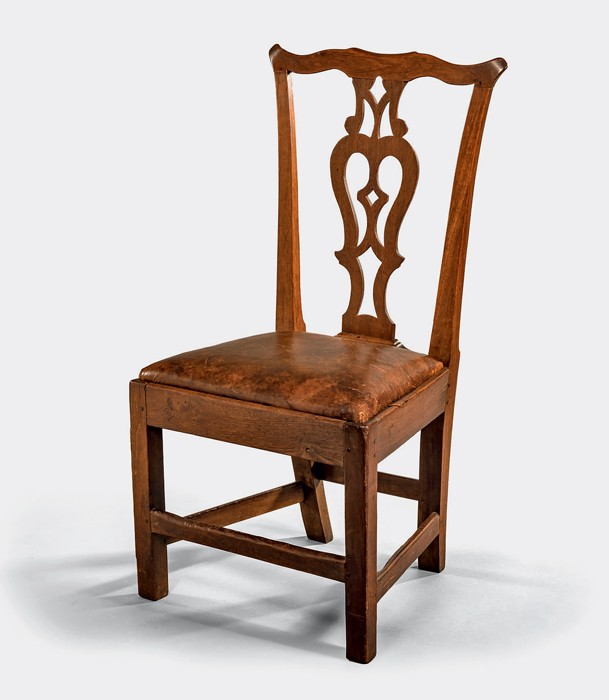
Side chair attributed to Thomas White, Perquimans County, North Carolina, ca. 1768. Walnut with yellow pine. H. 36 1/8". (Courtesy, Museum of Early Southern Decorative Arts.)
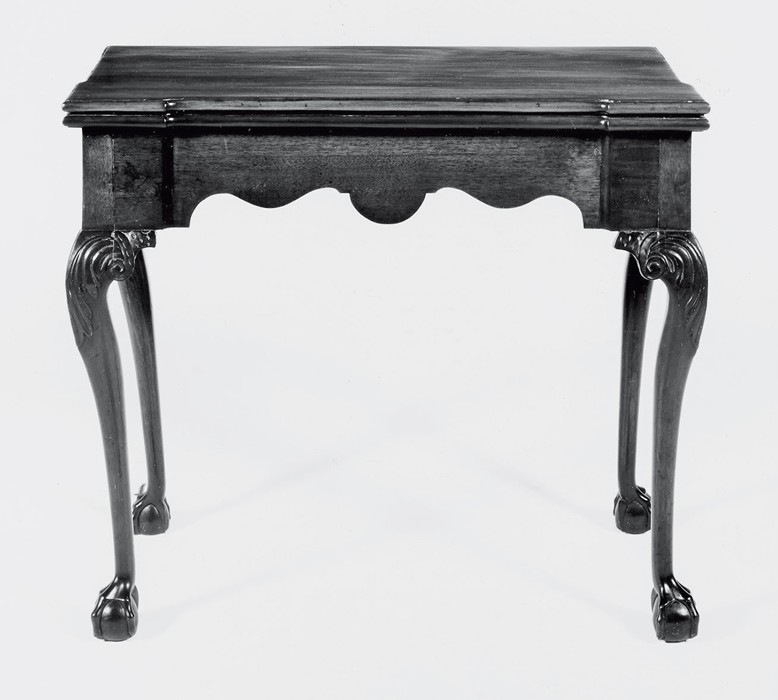
Table (fragmentary), vicinity of Edenton, North Carolina, 1745–1765. Mahogany. (Courtesy, Sotheby’s American Heritage Society Auction of Americana [New York: Sotheby’s, November 27–30 and December 1, 1979], lot 1725; photo, MESDA Object Database Files NN-224.) The legs are all that survive from the original table.
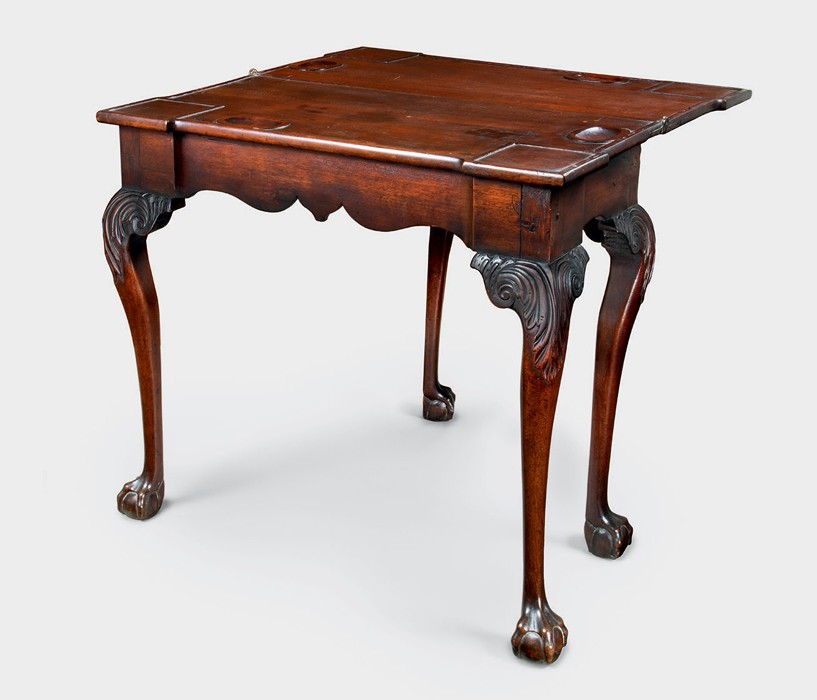
Card table, vicinity of Edenton, North Carolina, 1745–1765. Mahogany and cherry with yellow pine and cherry. H. 27 3/8", W. 29 1/2" (top), D. 14 3/8" (top) (closed). (Private collection; photo, Gavin Ashworth.) The knee blocks are replaced.
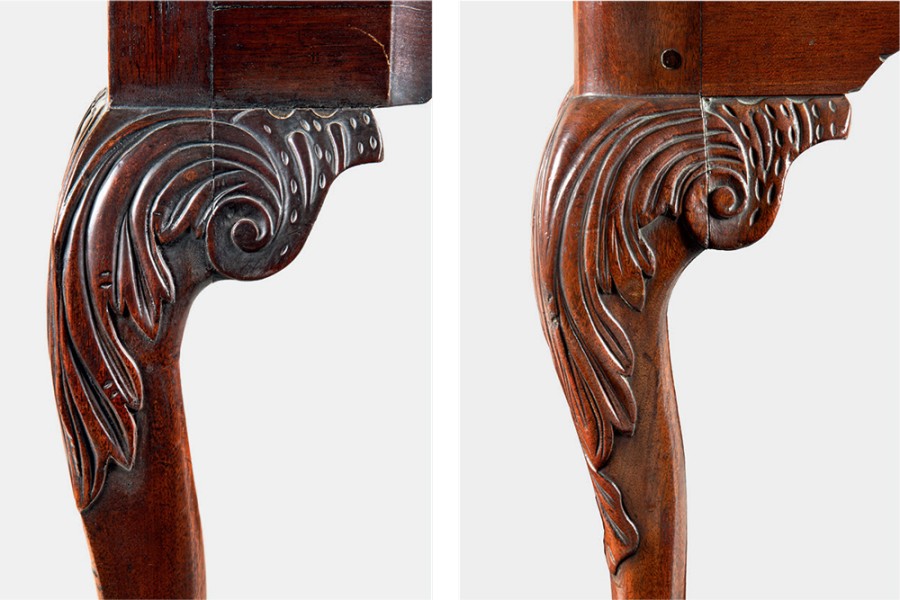
Detail showing the knee carving on the card table illustrated in fig. 35 (left) and the armchair illustrated in fig. 12 (right). (Photos, Gavin Ashworth.)
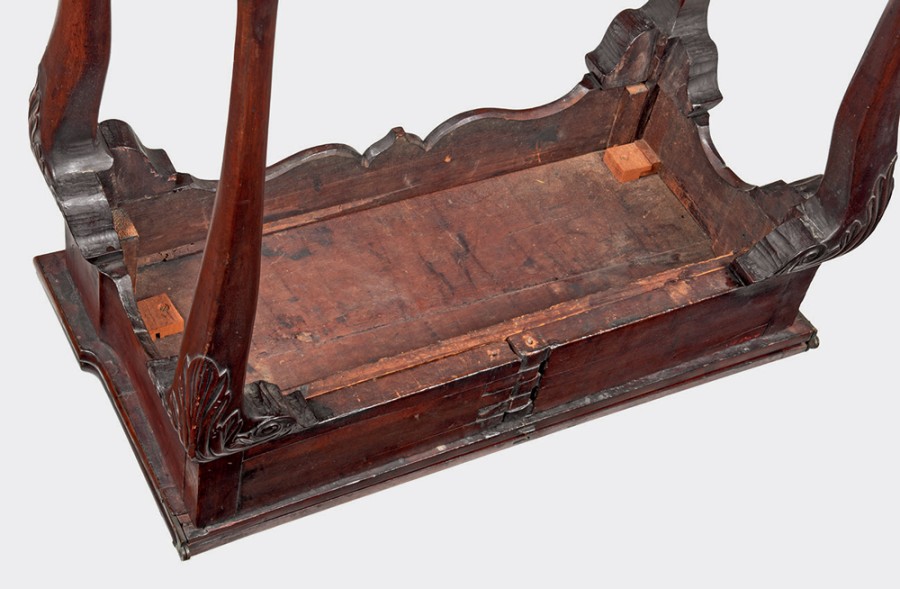
Underside of the card table illustrated in fig. 35. (Photo, Gavin Ashworth.)
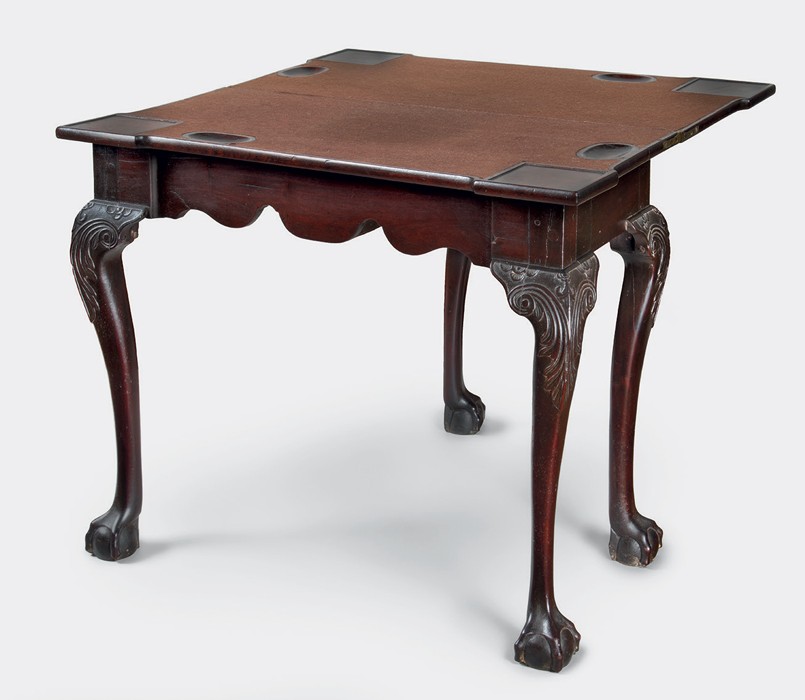
Card table, vicinity of Edenton, North Carolina, 1760–1775. Mahogany with red oak and walnut. H. 27 3/8", W. 31 3/4" (top), D. 15 3/4" (closed). (Private collection; photo, Gavin Ashworth.) This table and the example shown in fig. 39 are an original pair.
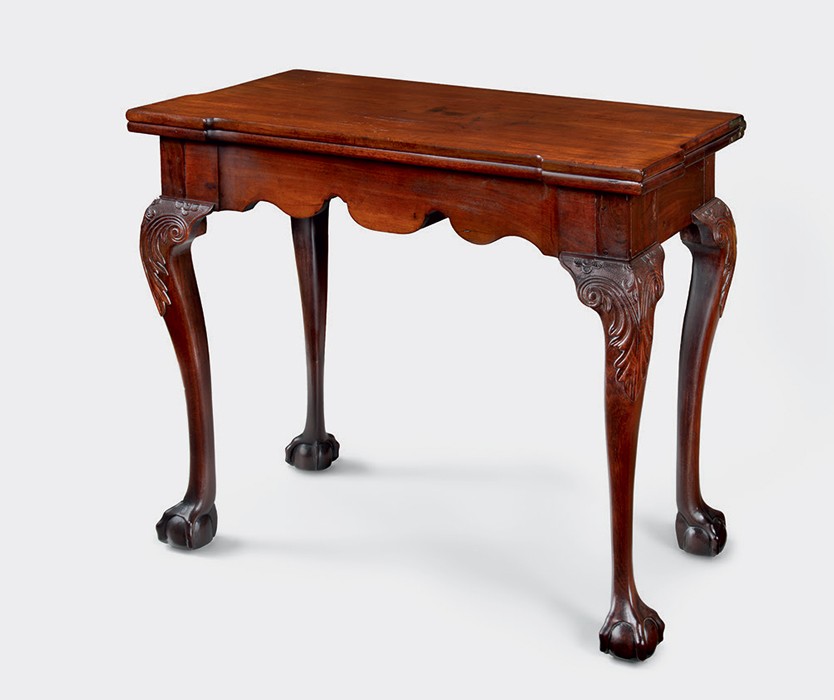
Card table, vicinity of Edenton, North Carolina, 1760–1775. Mahogany with red oak and walnut. H. 27 3/8", W. 31 3/4" (top), D. 15 3/4" (closed). (Courtesy, Museum of Early Southern Decorative Arts; photo, Gavin Ashworth.) This table and the example shown in fig. 38 are an original pair. This table is illustrated in the article cited in fig. 1.
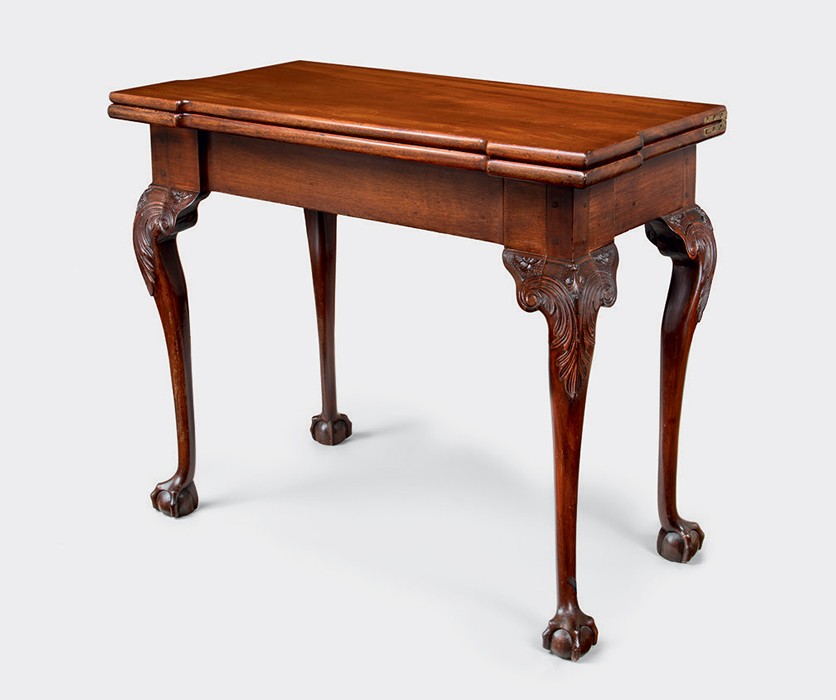
Card table, vicinity of Edenton, North Carolina, 1760–1775. Mahogany with oak, birch, and tulip poplar. H. 27 7/8", W. 31" (knees), D. 16" (knees). (Private collection; photo, Gavin Ashworth.) The top and knee blocks are replaced.
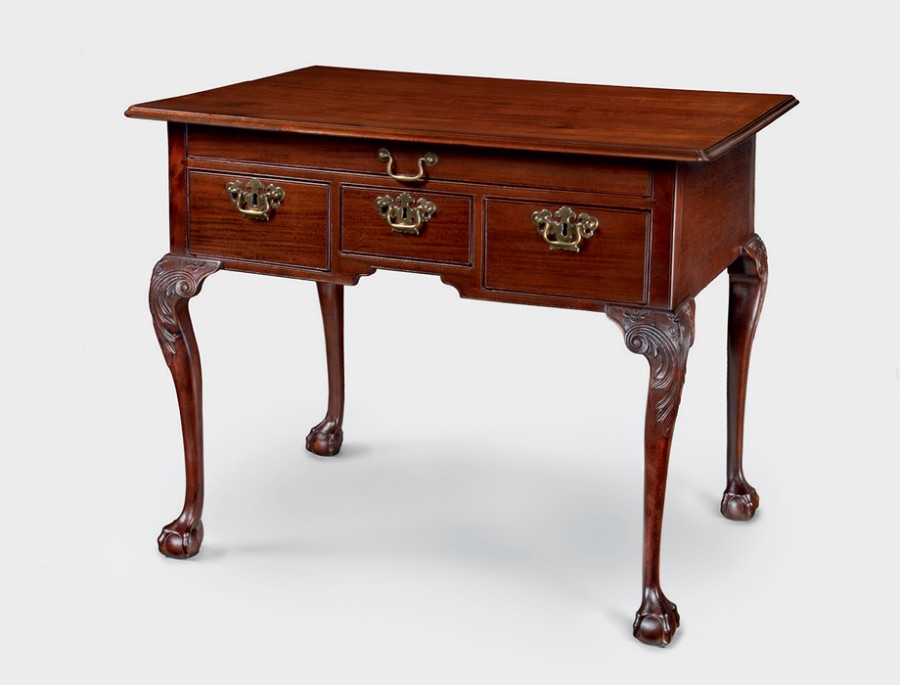
Writing table, vicinity of Edenton, North Carolina, 1760–1775. Mahogany with oak and yellow pine. H. 29", W. 36 1/2", D. 21 3/4". (Courtesy, Museum of Early Southern Decorative Arts; photo, Gavin Ashworth.) This table is illustrated in the article cited in fig. 1.
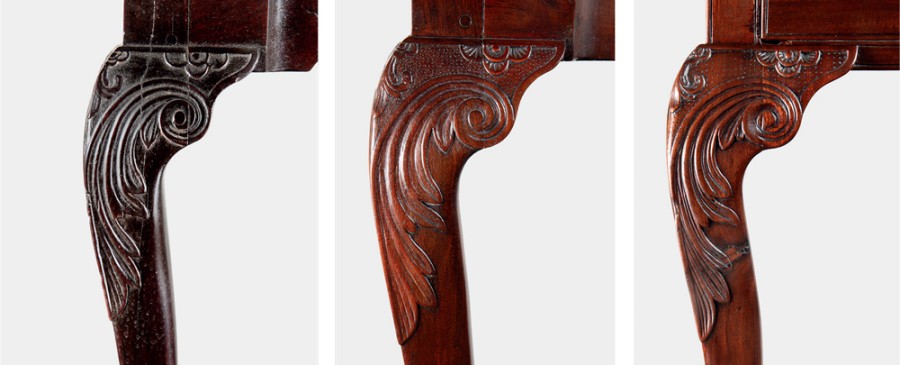
Details showing the knee carving (from left to right) on the card tables illustrated in figs. 38 and 40 and on the writing table illustrated in fig. 41. (Photos, Gavin Ashworth.)
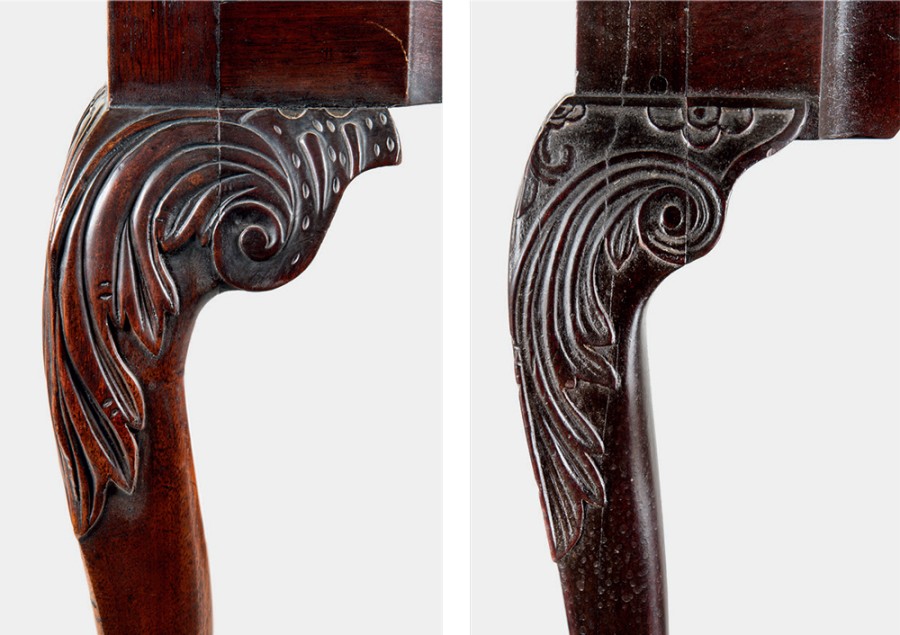
Details showing the knee carving (from left to right) on the card tables illustrated in figs. 35 and 38. (Photos, Gavin Ashworth.) The knee designs feature linear leafage, but the outlining, modeling, and shading are very different.
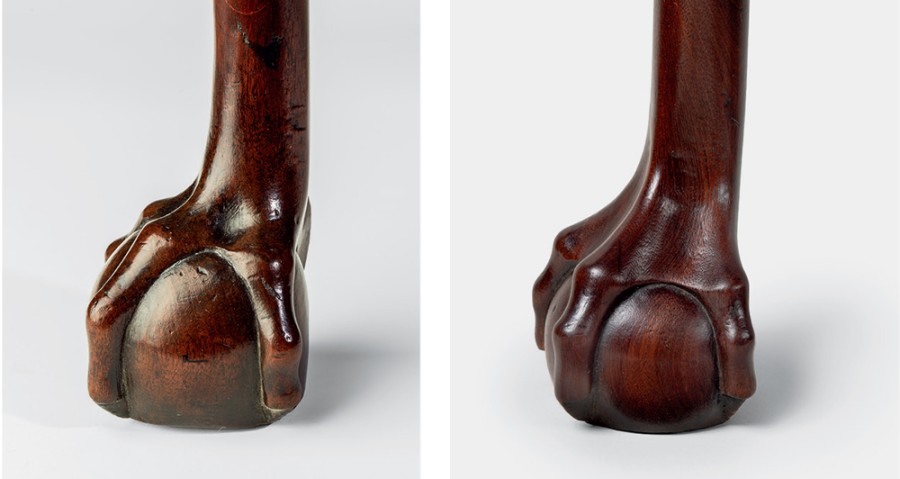
Details showing a foot of the armchair illustrated in fig. 9 (left) and of the writing table illustrated in fig. 41 (right). (Photo [on right], Gavin Ashworth.) These feet differ in almost every respect. The foot of the armchair has a taller ball and no webbing, whereas that of the writing table has a more flattened ball and webbing. These feet also differ in the modeling of the front and side toes.
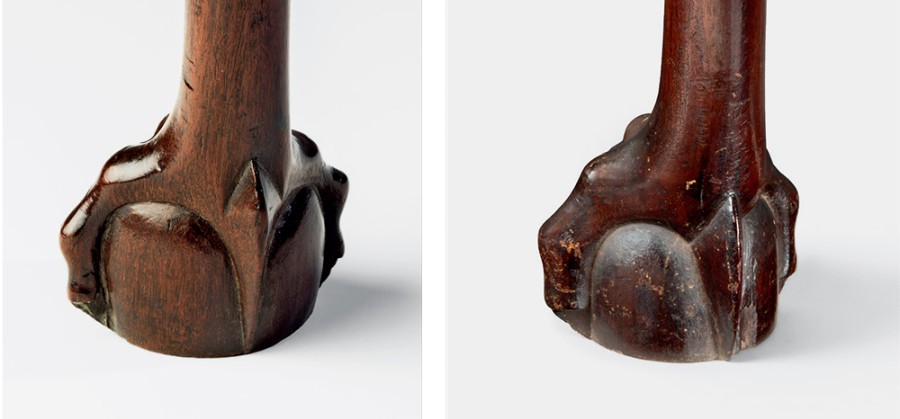
Details showing a foot of the armchair illustrated in fig. 9 (left) and of the writing table illustrated in fig. 41 (right). (Photo [on right], Gavin Ashworth.) Although both feet have blade shaped rear toes, the toes on the armchair originate higher on the ankle and are broader, with facets at the top. These differences can be seen on all of the furniture in the early and later groups.
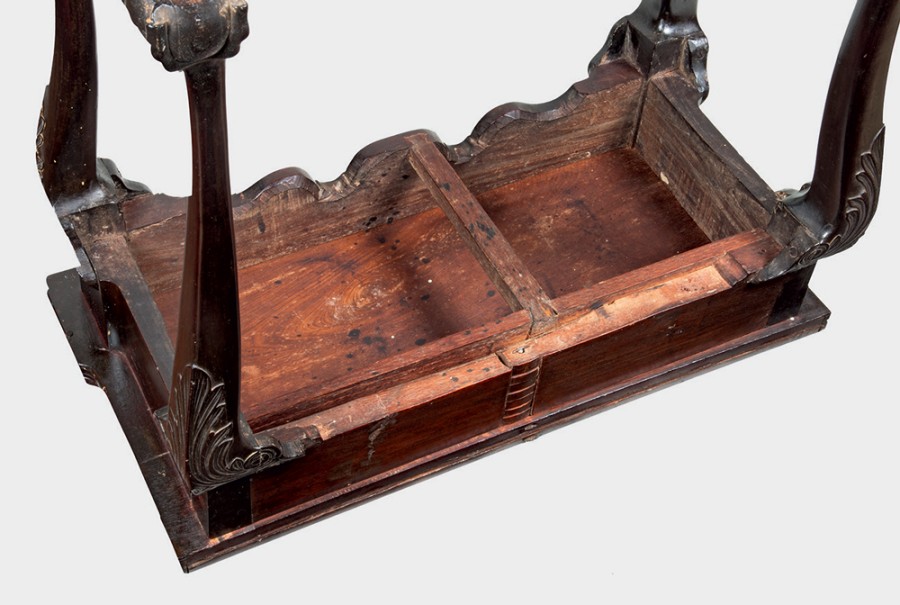
Underside of the card table illustrated in fig. 38. (Photo, Gavin Ashworth.)
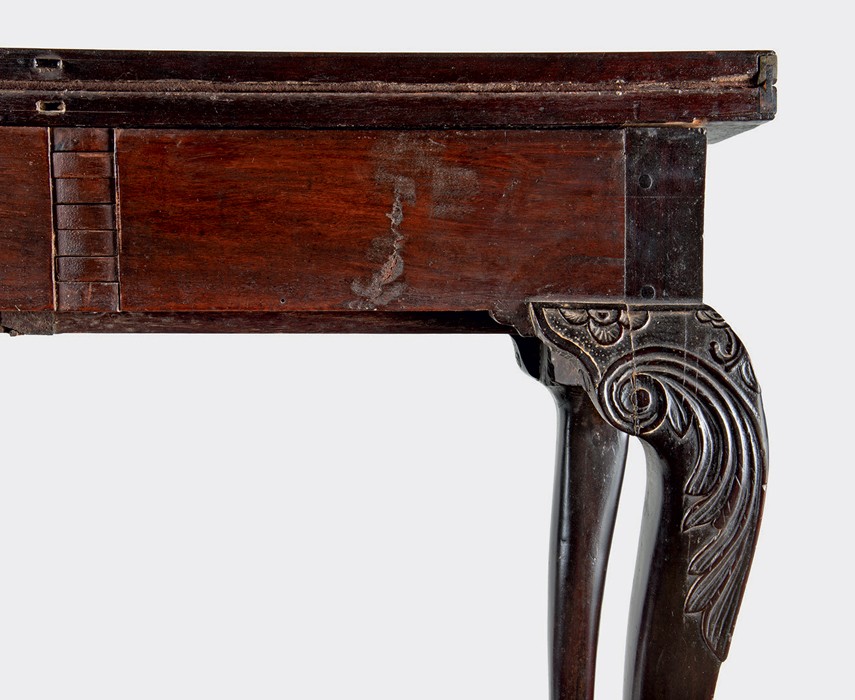
Detail showing the fly rail joint and an overlapping knee block on the card table illustrated in fig. 38. (Photo, Gavin Ashworth.)
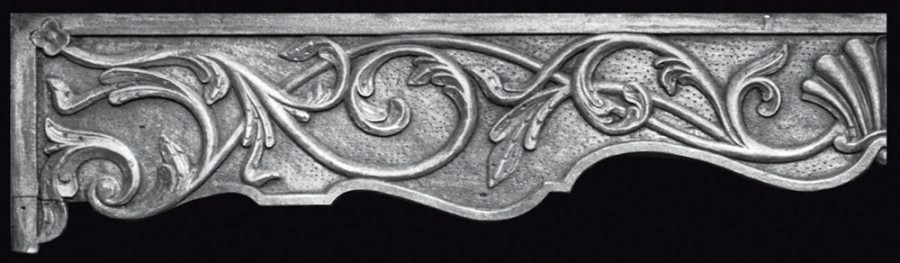
Detail of the carved frieze of the staircase from the Blair House, Edenton, North Carolina, ca. 1765. (Courtesy, Museum of Early Southern Decorative Arts.) The hallway and one room from the Blair House are installed in the Museum of Early Southern Decorative Arts.
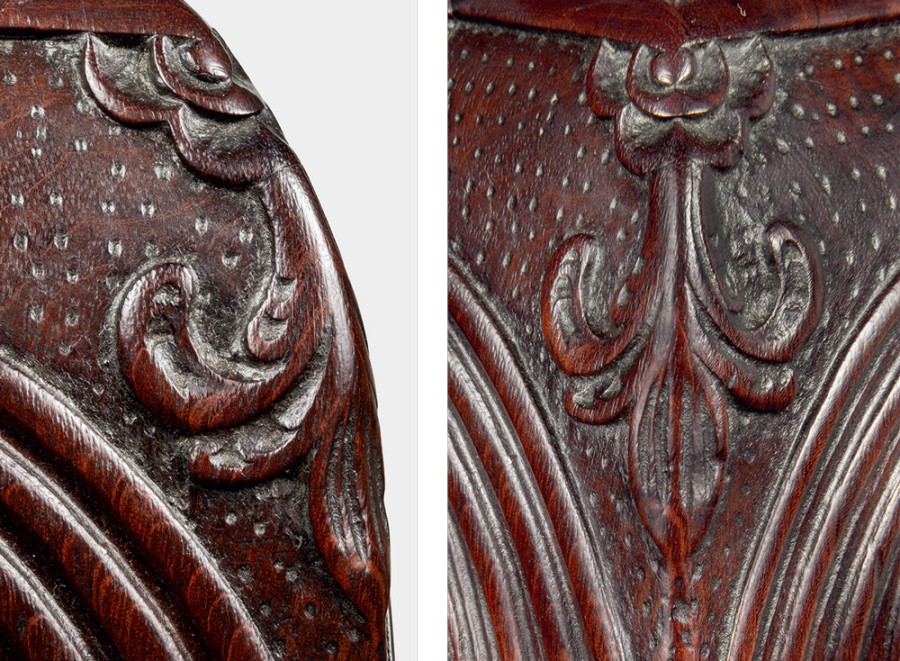
Details of the knee carving on the writing table illustrated in fig. 41. (Photos, Gavin Ashworth.)
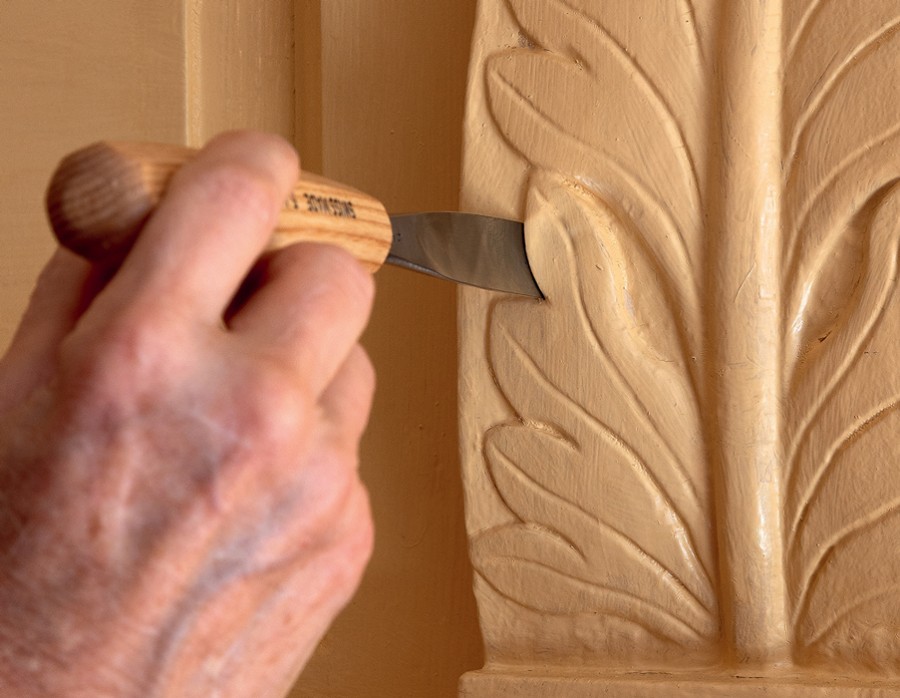
Detail approximating figure 52 in Don Jordan, Tom Newbern, and Jim Melchor, The Cupola House Carver (Edenton, N.C.: Elizabeth Van Moore Foundation, 2021). (Photo, Rob Hunter.) The authors denied permission to reproduce illustrations from their book.
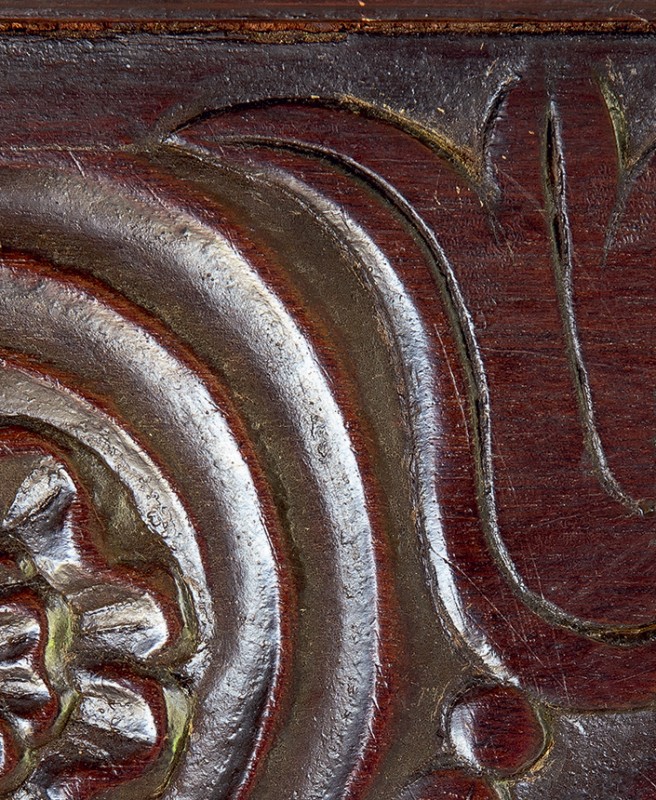
Close-up of the leaf carving on the bracket illustrated in fig. 7. (Photo, Rob Hunter.) As this detail reveals, the carver responsible for the work in the Cupola House had far more ambition than skill. The leaves are not modeled, their lobes are articulated with erratic “shading” cuts, and the ground is rough and uneven. Although not rising to the level of workmanship expected from someone trained as a carver, the leaf carving on the two groups of furniture illustrated and discussed here is far superior to the Cupola House work. The ground around the furniture carving is reasonably well controlled, and the leaves are modeled and shaded.
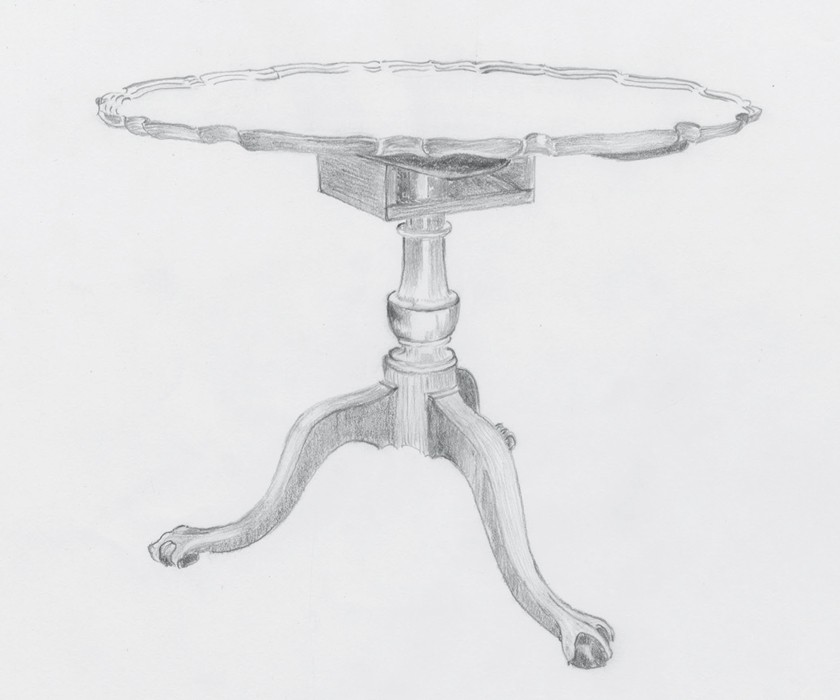
Artist’s rendering of the tea table discussed in “Cupola House Tea Table” and illustrated in figure 23 of Jordan, Newbern, and Melchor, The Cupola House Carver. (Artwork, Wynne Patterson). The authors denied permission to reproduce illustrations from their book.
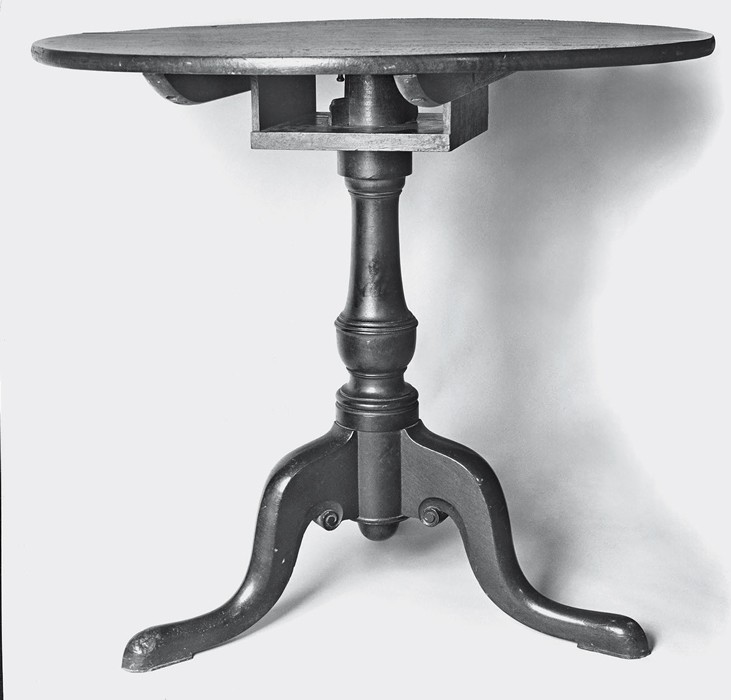
Tea table, vicinity of Edenton, North Carolina, or English, 1750–1770. Mahogany. H. 27 3/8", Diam. 30 1/4". (Private collection; MESDA Object Database Files S-12173.)
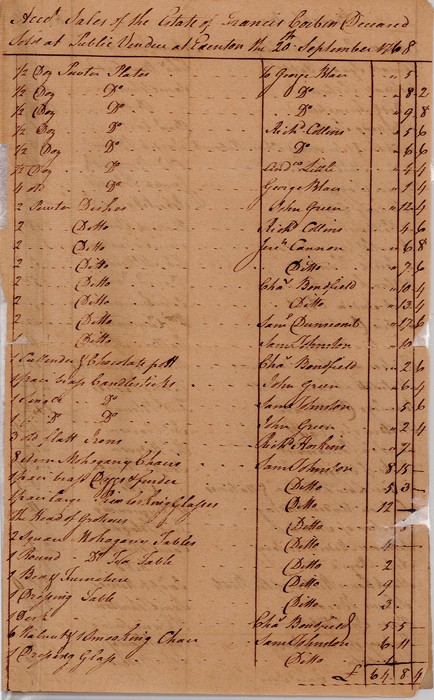
“Acct. Sales of the Estate of Francis Corbin Deceased”
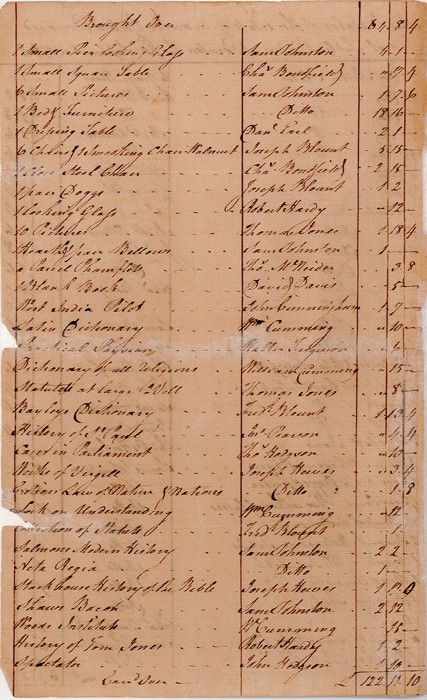
“Acct. Sales of the Estate of Francis Corbin Deceased”
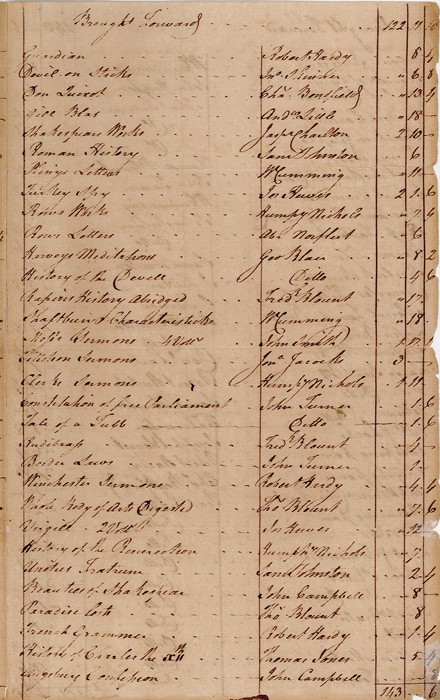
“Acct. Sales of the Estate of Francis Corbin Deceased”
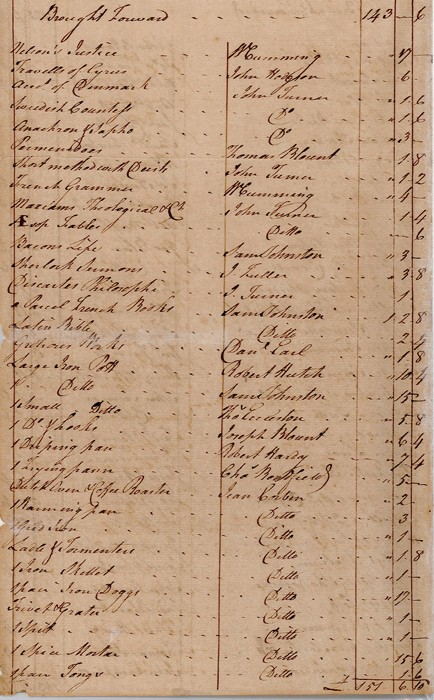
“Acct. Sales of the Estate of Francis Corbin Deceased”
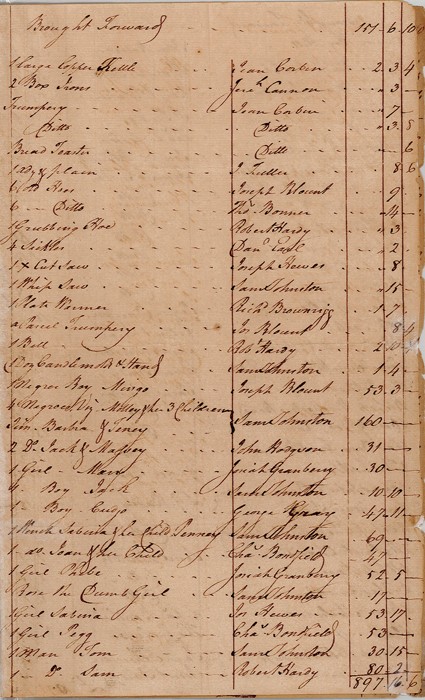
“Acct. Sales of the Estate of Francis Corbin Deceased”
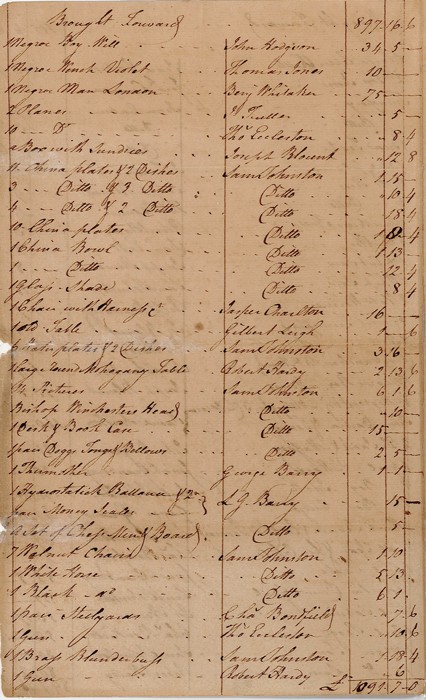
“Acct. Sales of the Estate of Francis Corbin Deceased”
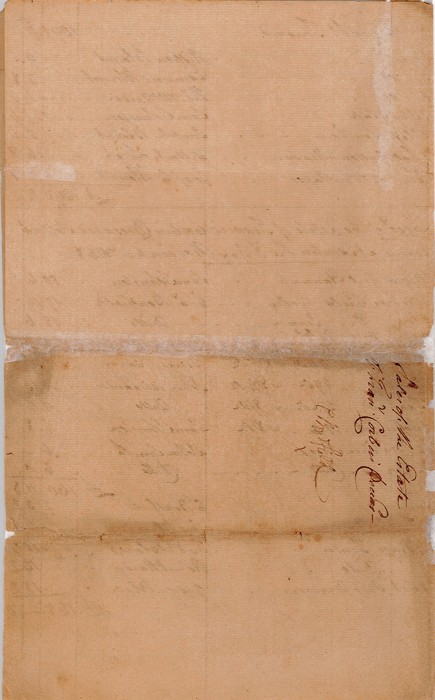
“Acct. Sales of the Estate of Francis Corbin Deceased”