I WAS SITTING ONLY a few miles north of the spot where the potter Thomas Commeraw (1771 or 1772–1823) died when I rediscovered his racial identity on a fateful day in 2003. The world he left behind in 1823 was one that knew nothing of the computer I used to find him; it was also one destined to forget much about him over the ensuing decades. This was, sadly, the culmination of the final tragic chapter of Commeraw’s life, an ending in stark contrast to the one he and his fellow travelers dreamed up as they set sail from New York harbor in early 1820 to Sierra Leone: A man “very generally known” in his day slipped through the fingers of history and was rediscovered 180 years after his death by some guy sitting in a home office in a Baltimore suburb, tooling around on the internet.[1]
In fairness, I wasn’t exactly tooling around—I was trying to locate an important Baltimore potter in the 1800 and 1810 federal censuses. These documents, mandated by the Constitution and conducted every ten years since 1790, are now resources used ubiquitously for what might be considered the most surface-level genealogical work. For some inexplicable reason, they had never been properly consulted by New York stoneware researchers, a fact that spurred me to try to dig up new information on Manhattan potter Henry Remmey (ca. 1770–ca. 1841), who later moved to Baltimore and transformed the Mid-Atlantic stoneware craft. Staring into one of those gargantuan computer monitors that didn’t go away until well into the twenty-first century, looking line by line for Mr. Remmey, I stumbled upon a simple listing that came to profoundly affect my life: “Thomas Comerau B” (fig. 1). That slightly embellished script character B, scrawled on the page of the 1810 Census by a local grocer collecting data for the federal government, spoke volumes, for any question I had about its meaning was made plain by the constituency of the Commeraw household that year: six people of color.[2] The 1800 Census (fig. 2), which I quickly flipped to in a state of disbelief, spoke even more plainly on this matter: Thomas Commeraw was “a Black.”[3]
I say I was in a state of disbelief because until that moment, I thought I knew this potter pretty well, having grown up around the countless stoneware vessels my father routinely brought into our home and sold at numerous antiques shows each year. That Thomas Commeraw was just another potter of European descent churning out stoneware alongside other white potters like the Croliuses and Remmeys (fig. 3). How naively had I sat down at that PC that day.
I of course quickly realized the import of what I had found, that one of the key stoneware manufacturers in the chief city of American stoneware production during a vital period in the craft’s development was Black— and that I had discovered a forgotten early African American craftsman who deserved to have his story told. But this was only the first in a long sequence of discovery after discovery—so many amassed over a two-decade period that it is difficult to single any one of them out. Some stand out to me for both how gratifying they were and how frustratingly they highlight how difficult it has been to reassemble this man’s story.
See, for instance, my time at the New York Genealogical & Biographical Society, in their old 1920s building at 122 East 58th Street, a structure designed by the great-great nephew of one of the navy officers who helped take Thomas Commeraw to Africa.[4] It was while sitting at one of their microfilm readers in the spring of 2007 that I first laid eyes upon important documents like the 1819 New York City jury census, the only reliable one giving Commeraw’s age, which allowed us to estimate the year of his birth; and the 1813 death record of his wife, Mary. But it was what I did not find there that perhaps stings me more than any other moment in this entire research adventure.
Beginning in the 1930s, the society compiled and published in their wellknown quarterly, the NYG&B Record, a transcription of vital records from the famous Trinity Church on Wall Street in lower Manhattan. This was the church of many prominent New Yorkers of Commeraw’s day, including Alexander Hamilton, who is buried in its churchyard. If we pick up a copy of the April 1945 edition of the Record and turn to page seventy-nine, we will see a list of people married in the summer of 1792. On July 30 a John Adams married Mary Batherton; on August 9 Robert Wilson married Joanna Harding Pike. No other marriages are recorded between those dates. But this is curious, because if we drive to the intersection of Wall Street and Broadway, and enter the church that stands there, and talk the archivist into letting us look inside the appropriate wedding register, we will come to find something else: an entry for August 5, 1792, in which Thomas “Commerau” married Mary Roe (fig. 4). Why was this listing not included in the NYG&B’s publication? One simple reason: there is a notation next to Thomas and Mary’s name that reads “negroes.”[5]
Indeed, Thomas Commeraw’s racial identity represents one of the “hidden truths” Carter Woodson (whose efforts in the first half of the twentieth century established Black History Month) declared he had set about to combat, ones that “exposed the bias in textbooks [and] bared the prejudice of teachers.”[6] Art historian James A. Porter, in his seminal 1943 Modern Negro Art, had likewise written of “the veil [that] for so long a time obscured the past achievements of the Negro artist.”[7] Commeraw’s case is unusual in that he wasn’t an obscure African American artist—he was a well-known African American artisan who was shoehorned into a white persona. This tragic misconception found its roots in the universally owned and oft-cited 1970 and 1987 New York stoneware books of William Ketchum, who chose to bestow upon Thomas Commeraw the last name “Commereau,” going so far as to declare (erroneously) that he marked his pottery with “some variation of COMMEREAU’S | STONEWARE.”[8] These works not only conjured the fictitious white French potter that Commeraw was assumed to be, but engendered large amounts of complacency in the American stoneware community, the power of the printed words inside signaling that Commeraw wasn’t worth researching because there was nothing remarkable to find. But they went further than helping to obscure his ethnicity; they made large portions of his surviving work exceedingly difficult to identify and evaluate.
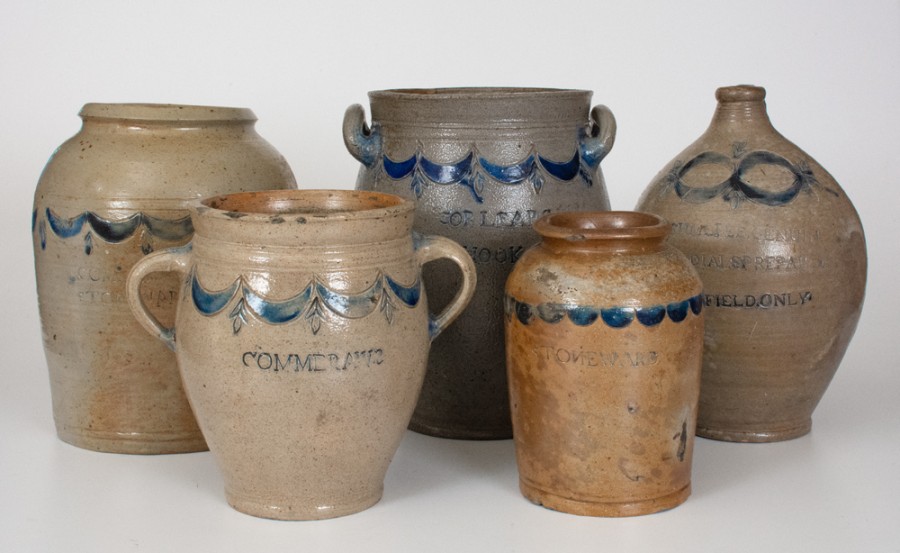
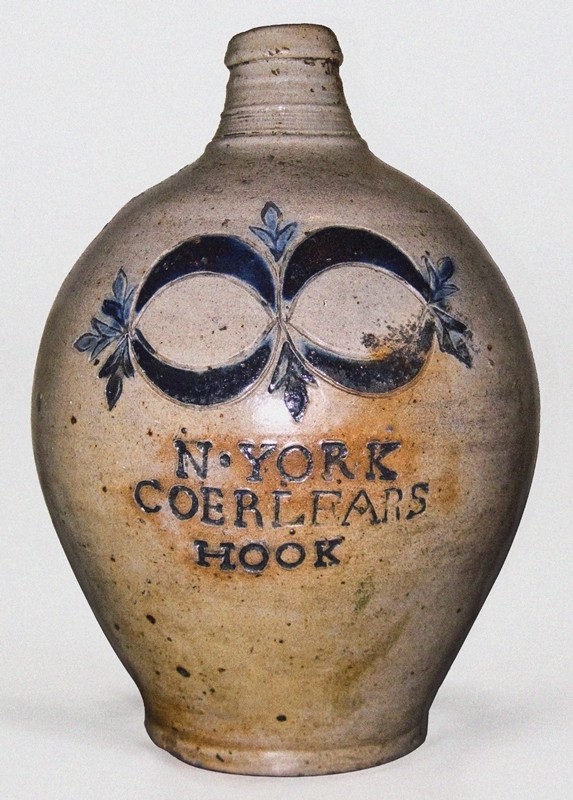
Through a misreading of the historical record, Ketchum claimed that anything marked with the name of the neighborhood where Commeraw’s shop was located—Corlears Hook, on the Lower East Side of Manhattan— could be attributed either to him or to a competitor named David Morgan. It had already become apparent to me through a careful study of examples bearing Commeraw’s name and those bearing Morgan’s that examples like that seen in figure 5 were specifically the work of Commeraw’s shop.[9] But one problem remained: a small but important group of stoneware vessels bearing only the simple impression, “COERLEARS HOOK | N · YORK,” were never confidently attributed to Commeraw prior to this project. Frequently adorned with beautiful freehand incised designs in the manner of the Crolius family, these works have always held a great deal of weight in the minds of collectors for their elaborate decorations and highly successful coloration. Perhaps the most famous of these was acquired by the Metropolitan Museum of Art in 1918 and was for many years displayed alongside other important Manhattan examples overlooking the courtyard in the American Wing (fig. 6). But these were mysterious. Who made them? Was it Commeraw, David Morgan, or someone else entirely?[10]
And so it was with all of this floating around in my mind that in 2010 I first laid eyes upon an important jug in the home of long-time stoneware friends. This jug bore the mysterious “COERLEARS HOOK” mark, but its decoration was not the typical Crolius-inspired one. Instead, it had been impressed with Commeraw’s signature federal-style festoons (fig. 7). It immediately dawned on me that this was in fact a rare transitional example of Commeraw’s work and that he was responsible for the freehand decorated examples just as he was responsible for the impressed ones. Indeed, we can now look at these once obscure objects as exceedingly important examples of early Commeraw work, made in the 1790s. Through their unity of style, of decorative hand, and even of evident throwing ability, these are probably the only vessels we can say confidently were made with Commeraw’s own hands from start to finish, when he had just opened a shop that became one of the more prominent early African American businesses nationally (fig. 8).
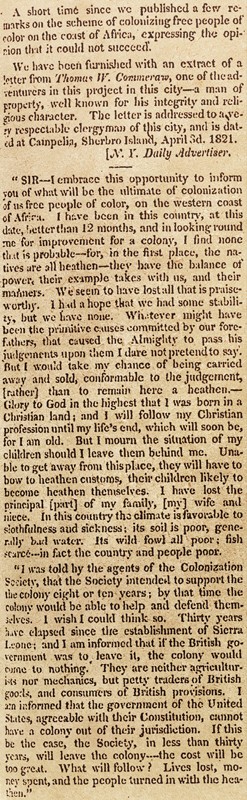
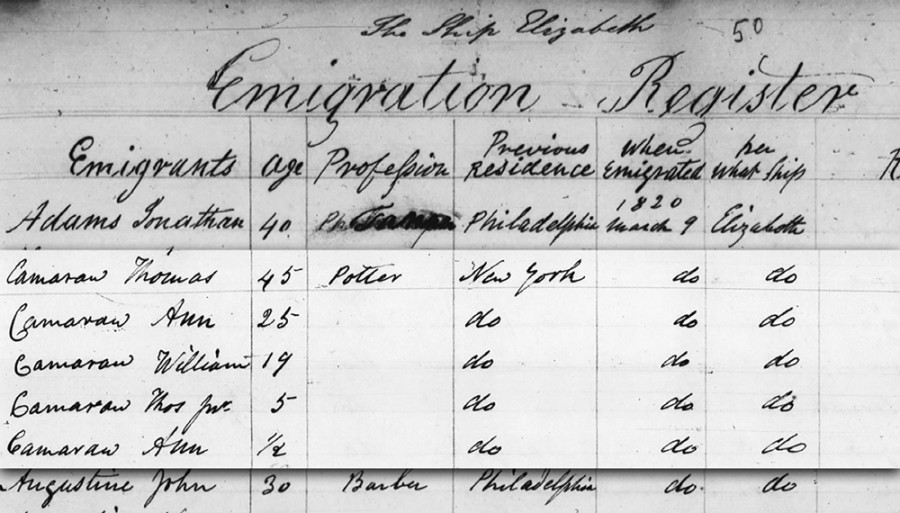
There was Christmas Eve 2006 when—while waiting for dinner that afternoon—and the months in its aftermath, I Googled Commeraw’s name and stumbled upon an eBay listing for a copy of the December 14, 1821, issue of Poulson’s American Daily Advertiser from Philadelphia, which contained one of Commeraw’s letters from Africa (fig. 9). I soon found myself at a microfilm reader at the Library of Congress. A short distance from where I sat, nearly two centuries prior, Commeraw’s life had been changed forever when Congress passed legislation that paved the way for free American Blacks to be sent to Africa. Led in part by Commeraw himself, the group that left New York in early 1820 found itself a pawn in the game of the American Colonization Society, an organization founded on the cause of deporting thousands of Americans of African descent—and one that likewise met on these very Capitol grounds. It was at the Library of Congress that I found Commeraw’s name written over and over again in journals penned during harrowing times on the African coast. The nation he had set forth to found, named Liberia a couple of years after he landed, holds a remarkable place in American history, both for the perseverance of free Black people who chose to risk everything for a cause, and for those whites who wholeheartedly supported it as a way to drive people of African descent out of the country. Why, then, hadn’t I—or anyone else for that matter—realized that a New York City stoneware potter was among the ranks of its first attempted founders? Commeraw’s name was routinely brutally misspelled in nearly all documents related to the expedition (fig. 10).
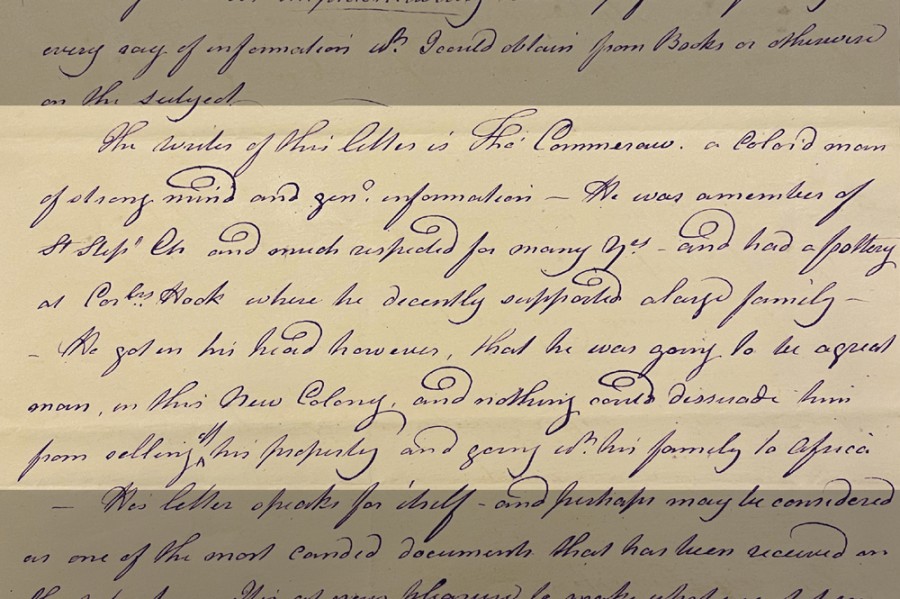
And as this project was finally in its last stages, in the Klingenstein Library at the New-York Historical Society in 2021, right next door to the space where the N-YHS installed its beautiful 2023 show of Commeraw’s work, Crafting Freedom: The Life and Legacy of Free Black Potter Thomas W. Commeraw, I held in my own two hands a document written by Commeraw’s own (white) pastor, the Reverend Henry J. Feltus, in which the minister spoke highly of his parishioner but also took him to task for being consumed with the thought of becoming “a great man” in Africa.[11] (Despite his leadership of numerous local political initiatives, Commeraw and those like him had no ability to achieve political greatness in America, this being a virtually foreign concept to even the staunchest white abolitionist. People like Commeraw who took a gamble on a new African nation were lured in part by whites who played on this insurmountable inequality.) Why was such a monumentally important missive never before seen by someone who cared about Commeraw—not even the appropriate folks at the N-YHS itself? His name had been misspelled “Commeran” in the electronic catalog record, probably written sometime in the last several years (fig. 11).
As is the way with this sort of research, these discoveries and many more—in their time so momentous and often so difficult to ferret out— become part of our collective understanding, eventually recounted publicly as if they have always been common knowledge. I don’t know why I was the vessel chosen to bring them to light, but it was a privilege to do so, and to finally see, with the publication of Commeraw’s Stoneware: The Life and Work of the First African-American Pottery Owner in 2022 and the opening of Crafting Freedom in 2023, Commeraw become the “great man” he so longed to be.[12]