THOSE OF US WHO COLLECT ceramics can usually name that one moment. Standing in an antique store, or perhaps viewing an illustration in a book, something catches the eye that marks the beginning of a collection. With rare exceptions (like Ivor Nöel Hume, who col lected everything from ancient Roman pots to twentiethcentury souvenirs), most ceramic collectors eventually specialize in an area of the field they find artistically pleasing, technically interesting, or perhaps with a localized regional significance.[1]
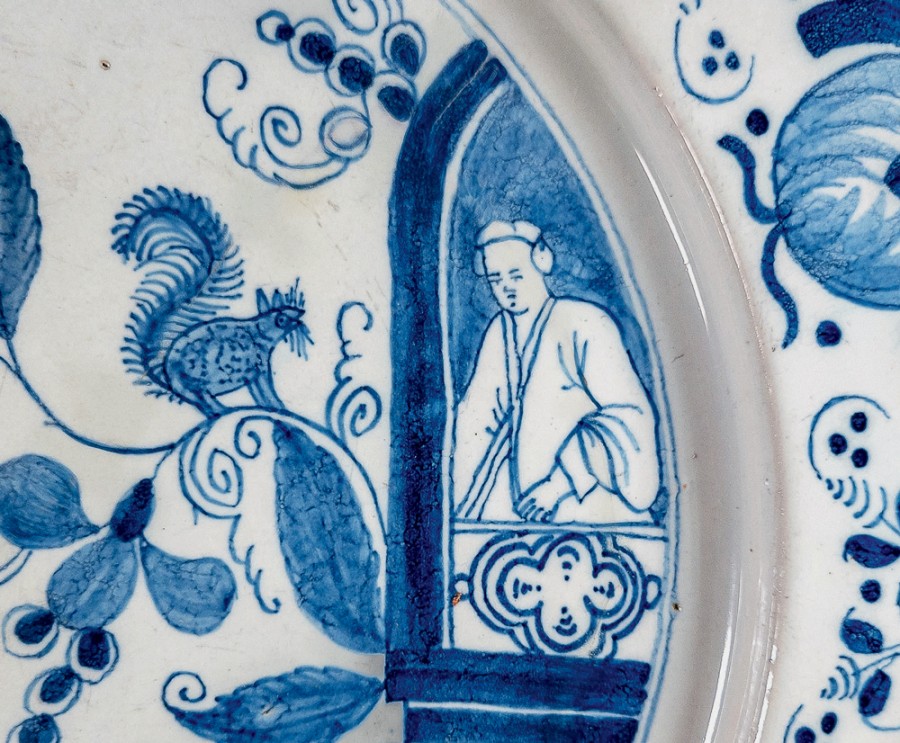
My wife and I both inherited the “collector’s gene”—or is it a virus? Our house is a miniature museum of fossil fish, Civil War photographs, various types of ceramics, and many, many other things. This article will describe a collection we have accumulated over the course of a quarter century—English and Dutch delftware (tinglazed earthenware) depicting squirrels—as well as provide an explanation for its rather unique genesis (fig. 1).
Squirrels
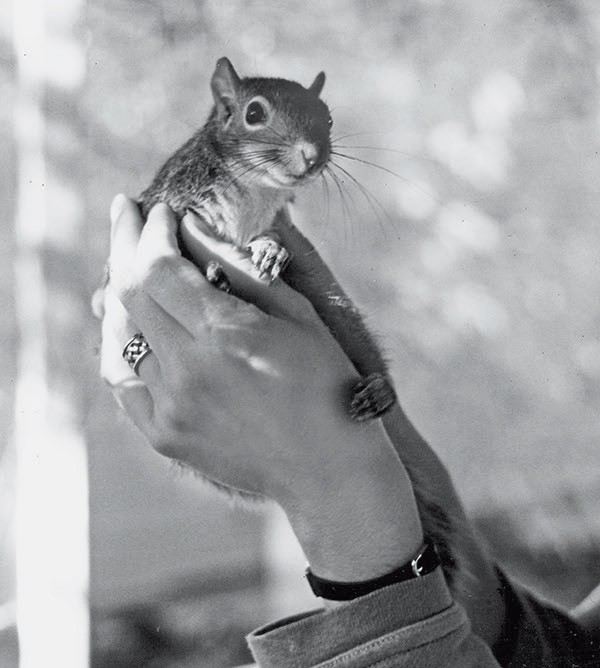
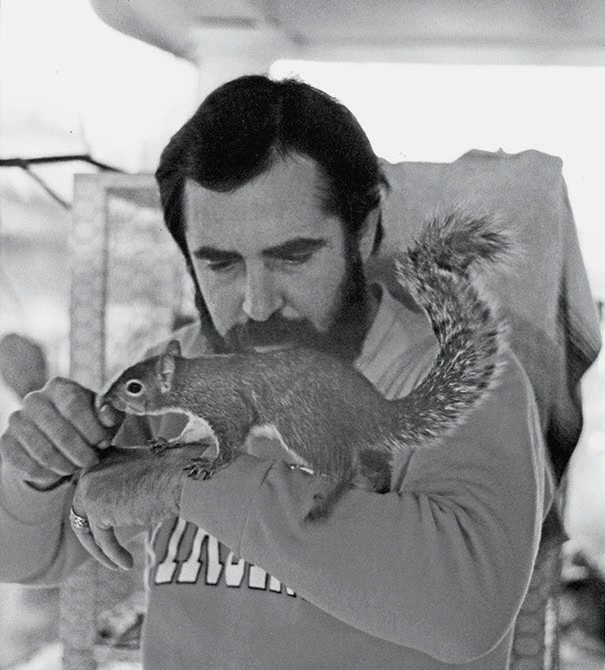
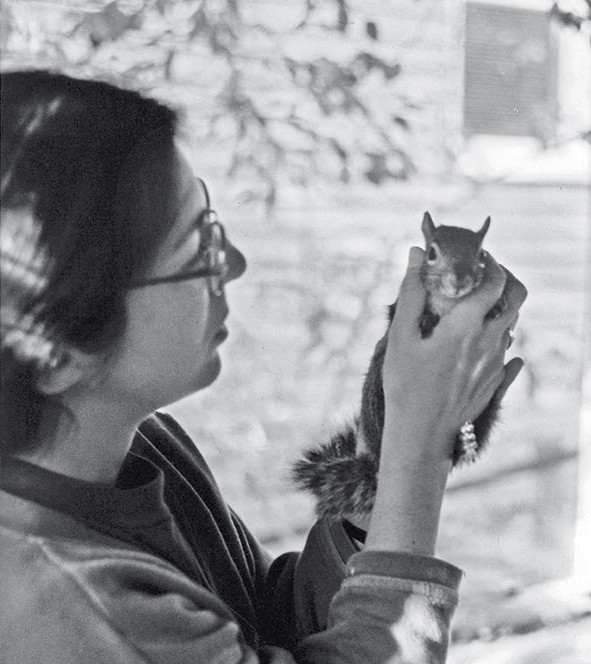
The squirrelrelated component of this equation had its start in our back yard in Annapolis, Maryland. One day in 1992, I was at first startled to see a small, furry creature quickly heading in my direction. After realizing it was just a baby squirrel, I bent over only to have him leap the remaining foot up into my hands. It seems that when a baby squirrel is in trouble it seeks help from anyone it can find; unfortunately all too often the chosen savior turns out to be a cat or dog, which results in an unfortunate outcome. This particular squirrel had made the right choice . . . .
That’s how Donna and I became bottlefeeding squirrel parents (figs. 2–4). At the time, I had been excavating a seventeenthcentury archaeological site called Burle’s Town Land in Maryland, so the name Robert Burle Esq. (Essquirrel) was chosen for the new family member. Burle was a great pet—always ready to play.[2] He lived on our screenedin porch for nearly fourteen years. Since we were aware that having squirrels as pets was a pop ular fashion in the eighteenth century (fig. 5), it seemed somehow appropriate for an archaeologist married to an architectural historian/museum director to have such a companion in our home.
Delftware
As director of the Lost Towns Project in Anne Arundel County, Maryland, I had led a number of archaeological excavations at the town sites of Providence (1649) and London Town (1683).[3] Naturally, tinglazed earthenware (delftware) sherds were a frequently encountered artifact at every site. But it was the excavation at Rumney’s Tavern in London Town that produced the most impressive assemblage of delftware, one that was eventually published in Ceramics in America in 2002.[4] Among other findings, this assemblage demonstrated how such tinglazed plates often appeared to be purchased in sets.
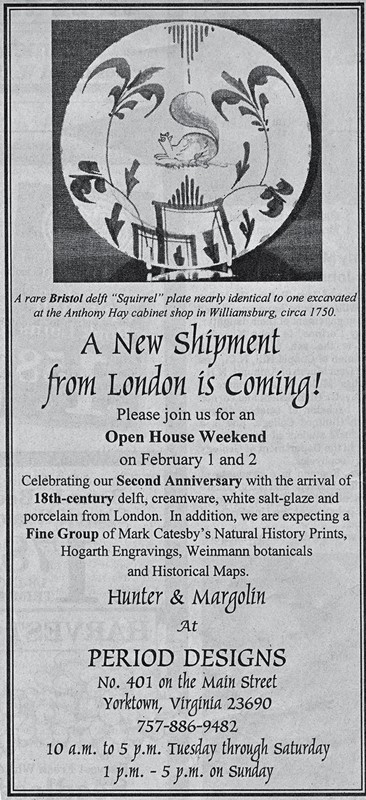
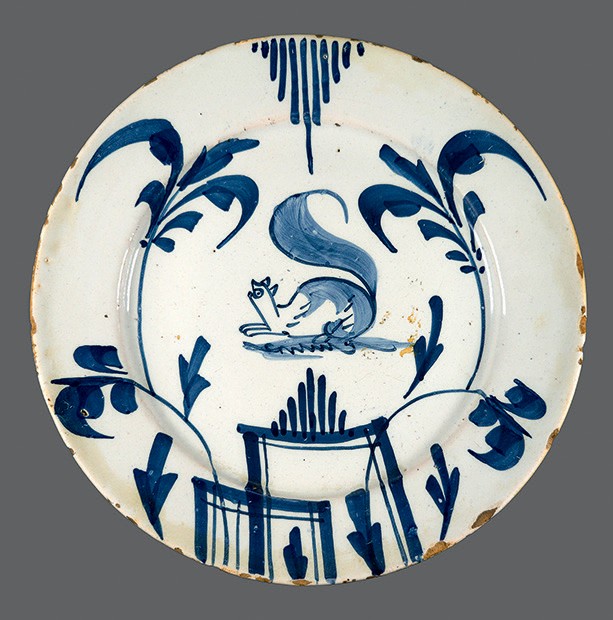
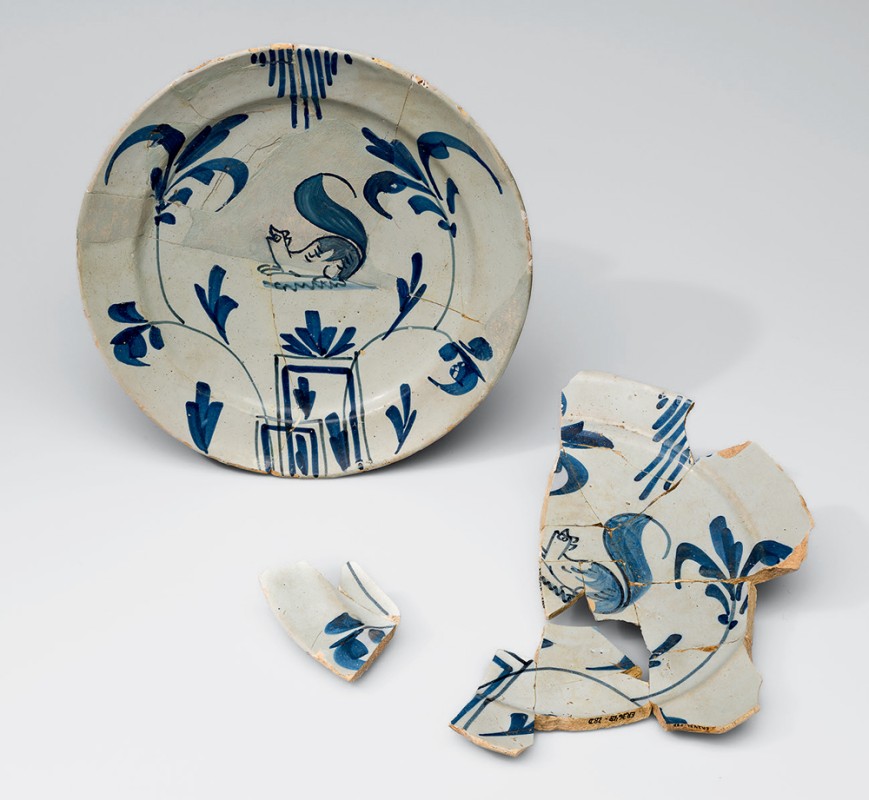
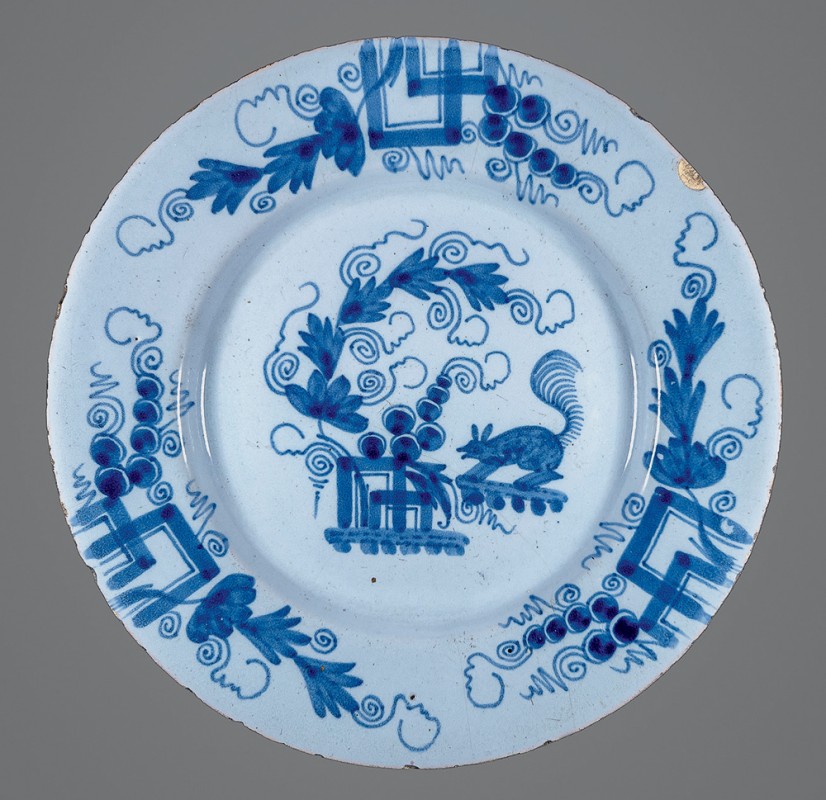
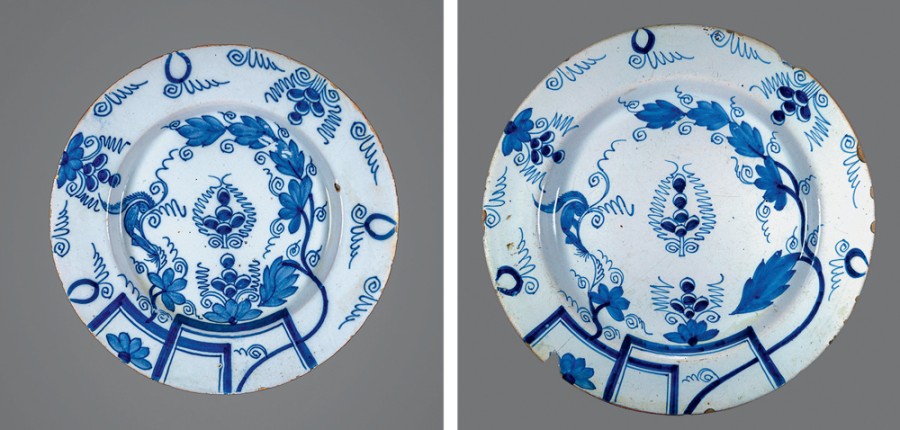
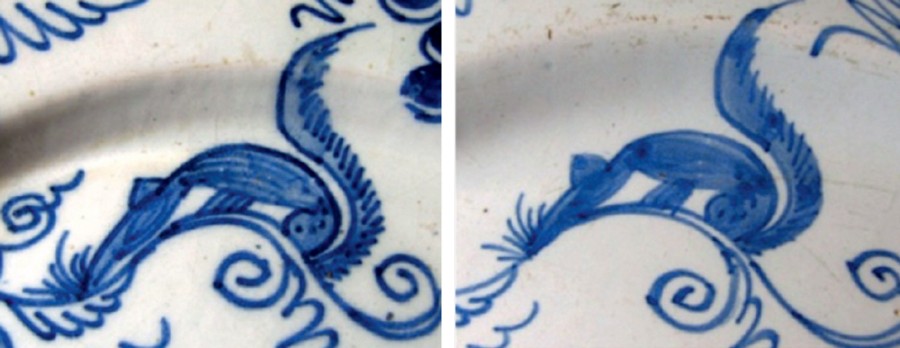
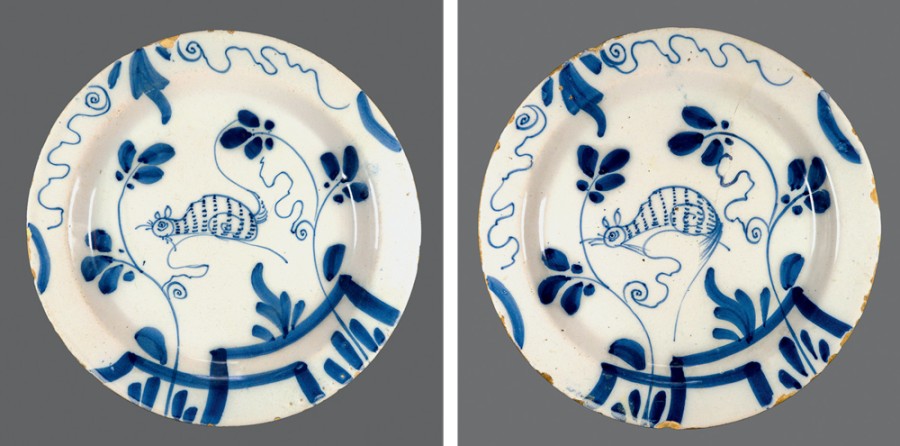
These two disparate lines of the story (squirrels and delftware) came together one day in 1996 on a visit to our friend Rob Hunter’s famous shop in Yorktown, Virginia. Rob (a former assistant curator of ceramics at Colonial Williamsburg) had been trying to convince Colonial Williamsburg to acquire a delftware plate from him on the basis of identical fragments of two plates that had been excavated at the Hay site in Williamsburg (figs. 6–8). Fortunately for us, they had declined, and so Rob offered the piece to Donna and me. Despite the financial strain, we knew instantly we needed a squirrel plate and happily purchased it. A collection had begun.
Since that date, we have tried to acquire every early English or Dutch delftware piece depicting squirrels that we could find. At this point we have accumulated six large chargers, eight plates, one flower brick, and sixteen different tiles, all of which will be described in this paper. Most of these vessels and tiles were acquired through eBay or other online auctions, especially from the Netherlands. Of particular importance, however, was the help provided by knowledgeable ceramic specialist dealers in England, including Jonathan Horne, Garry Atkins, Martyn Edgell, and others.
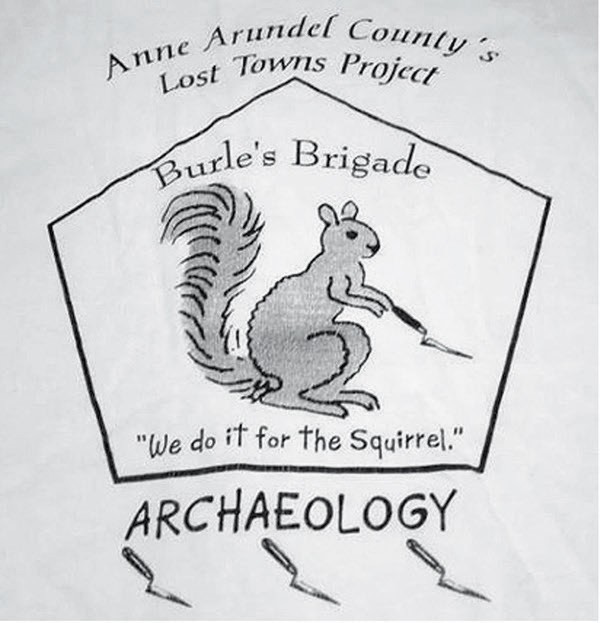
For years we used any duplicate squirrel tiles we obtained as gifts, for departing project staff members, graduations, or wedding gifts since by this point Burle had become a virtual mascot for the Lost Towns team of archaeologists, even being depicted on a Tshirt designed by the crew (fig. 9).
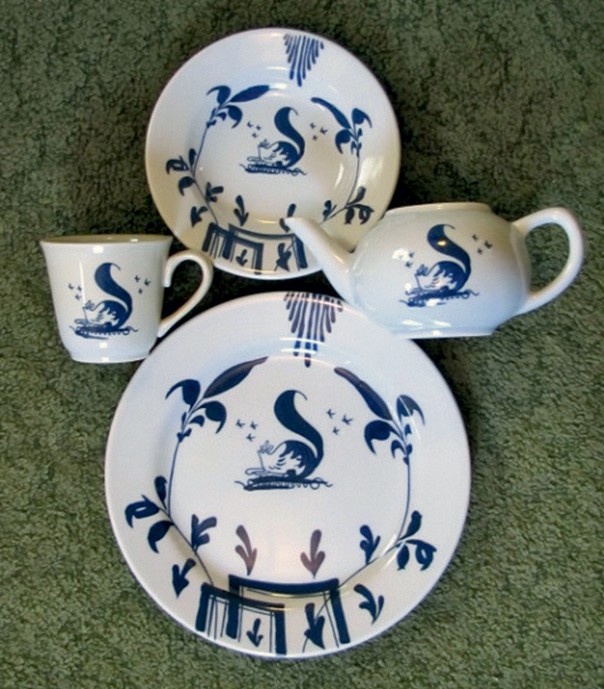
An interesting side note occured within a year or two of our acquiring that first plate. Colonial Williamsburg began massproducing porcelain ceramic sets based on their recoveries of delftware at the Hay workshop (which they oddly decided to call the “Christiana Campbell” pattern after one of the restored taverns in the town) (fig. 10). We soon acquired a number of place settings for ourselves since they had utilized nearly the exact iconography of our plate. We have been using them on a daily basis now for a quarter century.
Squirrels and Grapes on Chinese Ceramics
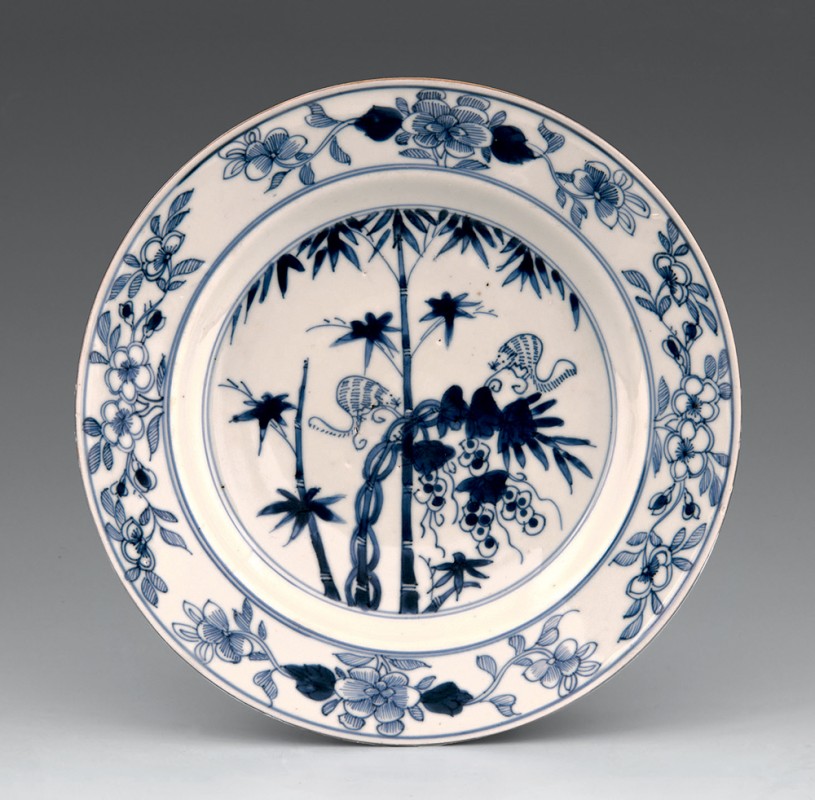
The squirrel iconography utilized by English and Dutch potters was often attempting to reflect the designs they had seen on expensive imported Chinese porcelain. Scenes of squirrels and grapevines were popular in Chinese design and appear on a range of objects, from textiles to ceramics, during the Ming (1368–1644) and Qing (1644–1912) dynasties.
In Chinese design, many elements are symbolic—meant to convey a message or idea. In traditional Chinese culture, sons were crucial to carrying on their family’s name, worshiping their ancestors, and supporting their parents when they got older; thus many images express a wish to have many sons. Squirrels were thought to have great reproductive power, and clusters of grapes symbolize abundance, so squirrels and grapes together represent a wish for fertility and many sons.[5]
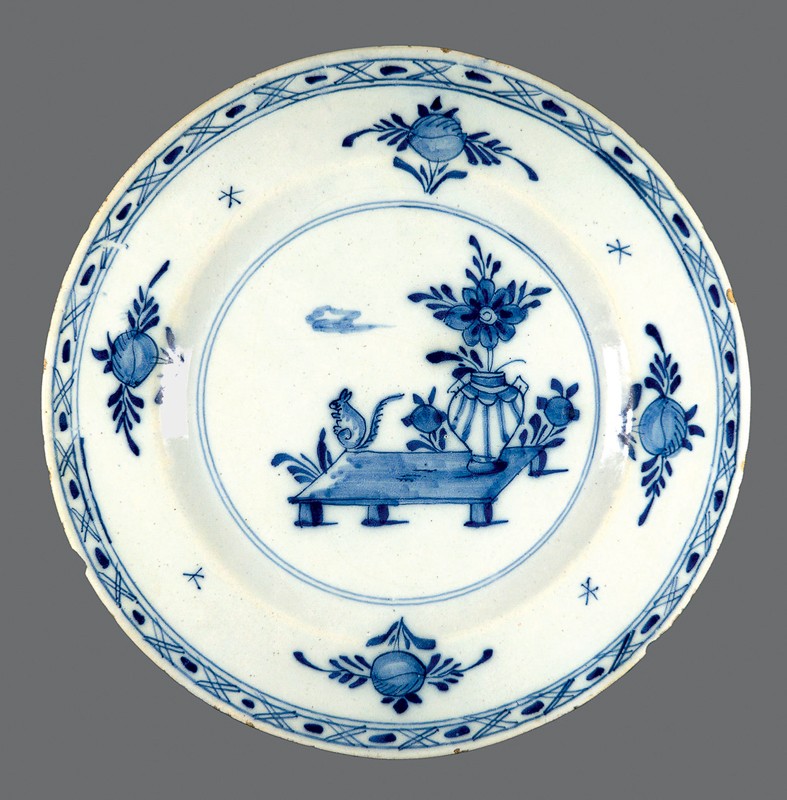
Painters in the porcelainproducing city of Jingdezhen began to use the motif to decorate porcelain destined for export to Europe around 1700, and even though its message of a wish for many sons would have been lost on Western consumers, the design proved popular and was used on dinner and tea wares into the 1750s (fig. 11).[6] Examples went all over the globe, going to such farflung places as Turkey, South Africa, Germany, Sweden, England, and the American colonies.[7] At least eight plates, part of a service no doubt, have been excavated at Mount Vernon, where they were broken and thrown away sometime in the 1740s or 1750s. They probably belonged to Lawrence Washington (1718–1752) and his wife, Anne Fairfax (1728–1761), who lived at Mount Vernon from 1743 until 1752, when the estate passed to Lawrence’s halfbrother, George (1732–1799).[8]
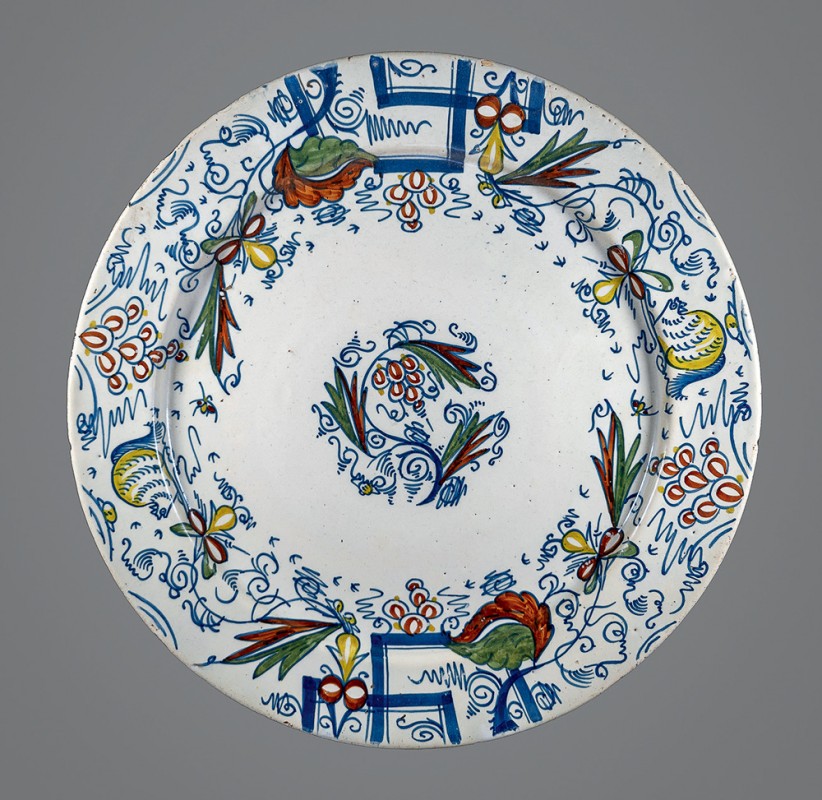
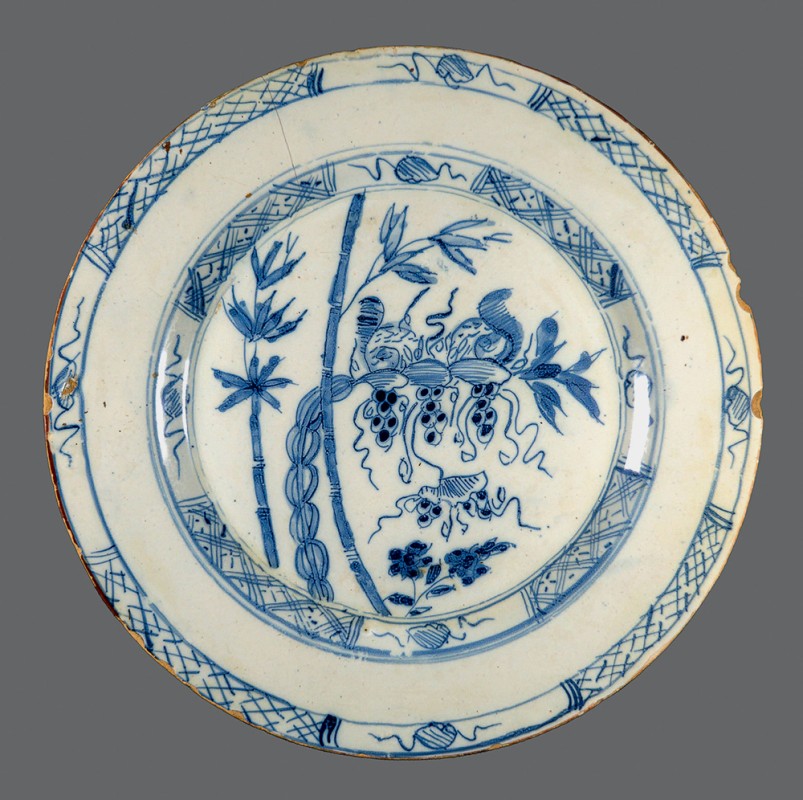
Two overlapping angular brackets are often seen at the bottom of the tinglazed earthenware versions of the design. Modern scholars uniformly refer to them as “gates,” but these are not known to be present in Chinese depictions of squirrels and grapes. It has been suggested that they are loosely based on latticework fences, which are sometimes shown in a zig zag formation that appears on many pieces of eighteenthcentury Chinese export porcelain. But as one plate in the collection makes quite clear, they are actually degenerative depictions of grape trellises with similarly degenerative vines, grapes, and flowers growing from them (fig. 12).
It seems doubtful that the English and Dutch potters attempting to copy this squirrelandgrapes iconography understood this fertility connection, but their usual attempts to reproduce it resulted in variations that appear so abstract as to be not immediately recognizable. And, as we shall see, many of the Dutch tiles depicting squirrels seem to be rooted in a more straightforward desire to show the creatures as part of a larger menagerie of wild and domesticated animals of the world.
The Collection
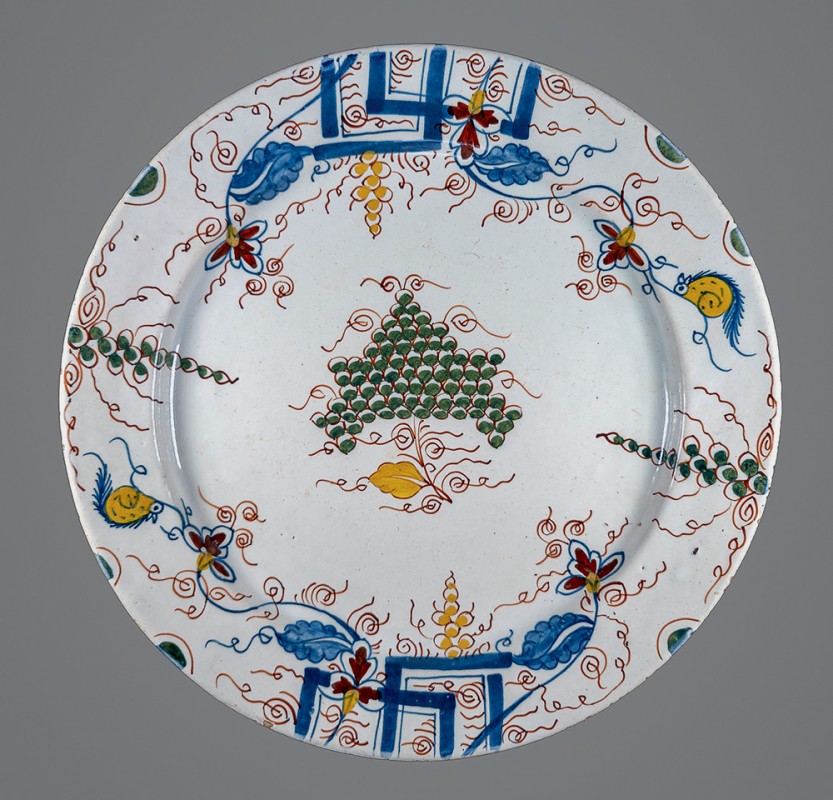
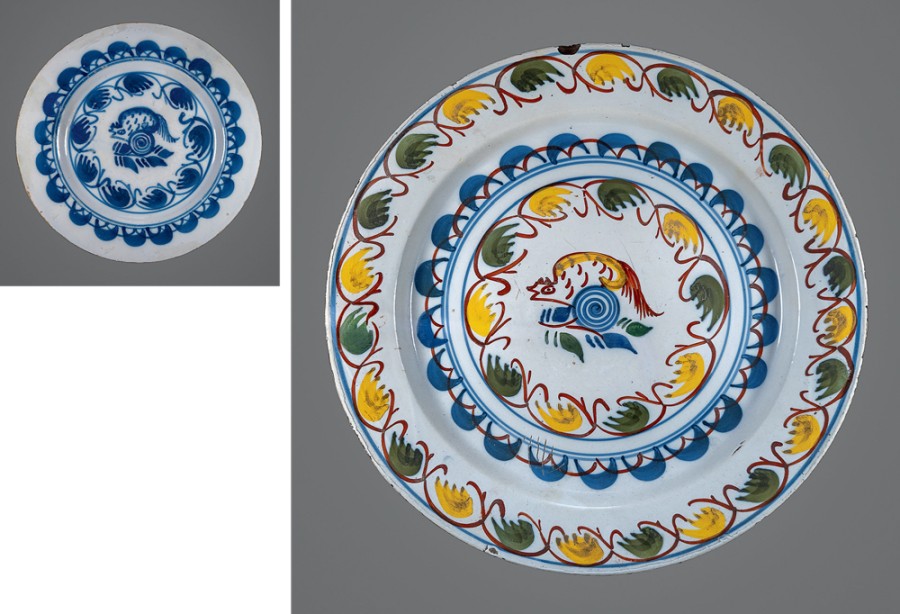
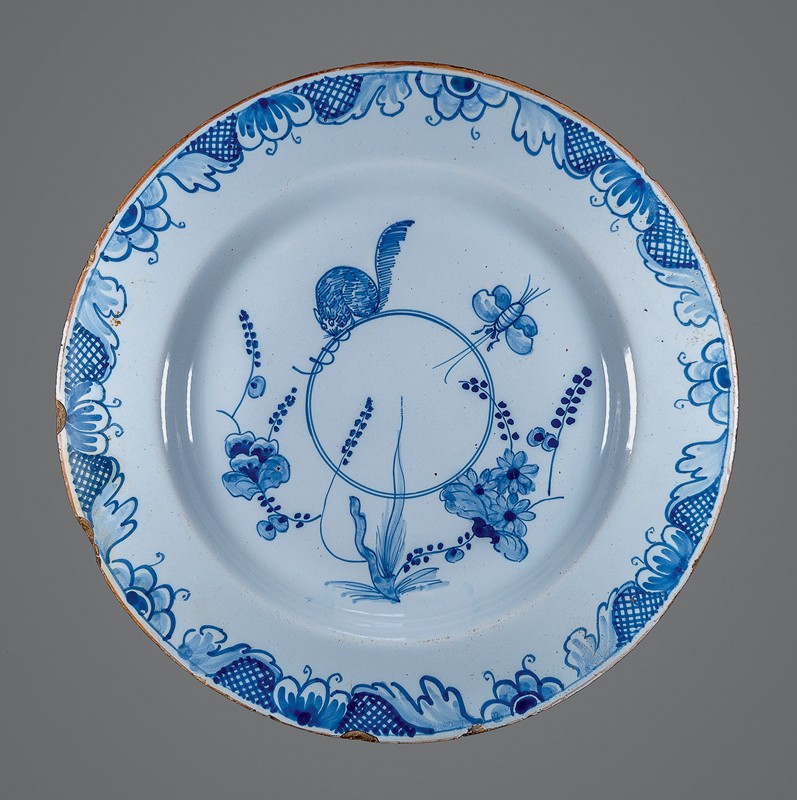
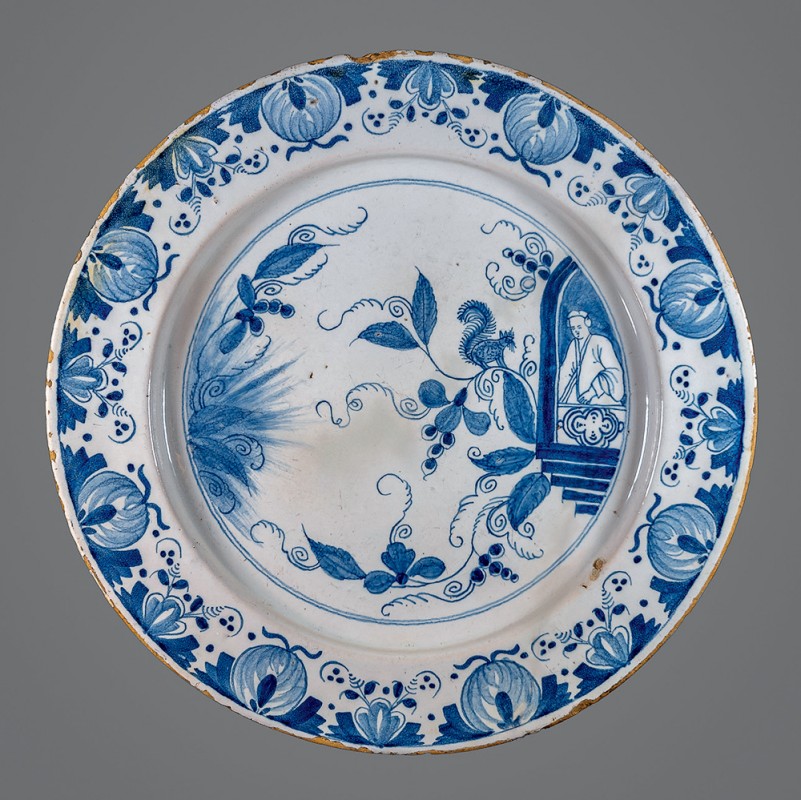
At this point, our collection includes six chargers, or large dishes, ranging in size from ten inches in diameter to thirteen and a quarter inches in diameter (figs. 13–18). Used for serving food, all were made in the British Isles, and while distinguishing among the products of London, Bristol, Liverpool, and Dublin is difficult, most have been attributed to Bristol. All seem to have been made around the middle of the eighteenth century.
Four out of the six chargers (figs. 13, 14, 17 and 18b) have a wide rim, shallow curved sides to the well, and stand on a foot ring—what John Aus tin described as profile F in his catalog of English tinglazed earthenware at Colonial Williamsburg. This profile is “common to all areas” of tinglazed production in the British Isles. The charger in figure 12 has deeper, curving sides to the well, which Austin defined as profile E and which is also common to all areas.[9]
There are currently eight plates in the collection. The smallest is seven and fiveeighths inches in diameter, while the three largest have diameters of eight and threequarters inches (figs. 7, 15, 18–22). Like the chargers, most were likely made in Bristol around the second quarter of the eighteenth century. Chargers and plates were often made with the same designs, making production easier for the makers and assembling matched sets easier for the merchants and consumers. While sets rarely survive, we separately found a plate and a charger that must have come from the same pottery (figs. 18, 19).
The plates show a variety of profiles, including what is thought to be the earliest, profile A (fig. 7); one that has profile B (fig. 22), which is attributed to London or Dublin; and three that have profile D (figs. 18a, 20 and 21), which Austin remarks is “uncommon at Bristol.”[10]
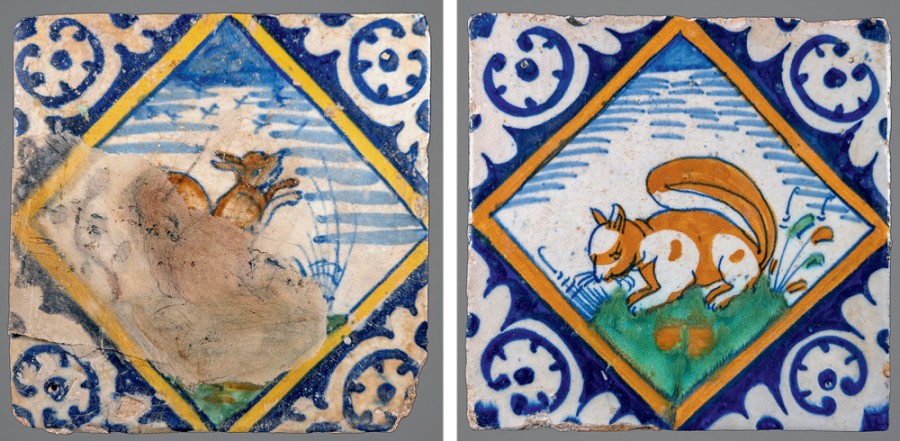
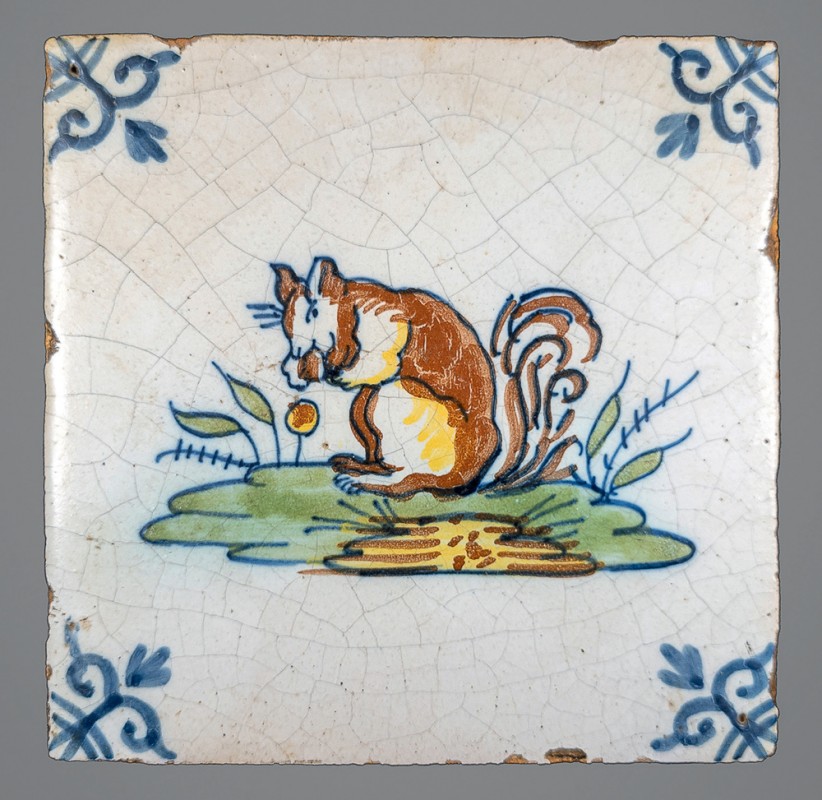
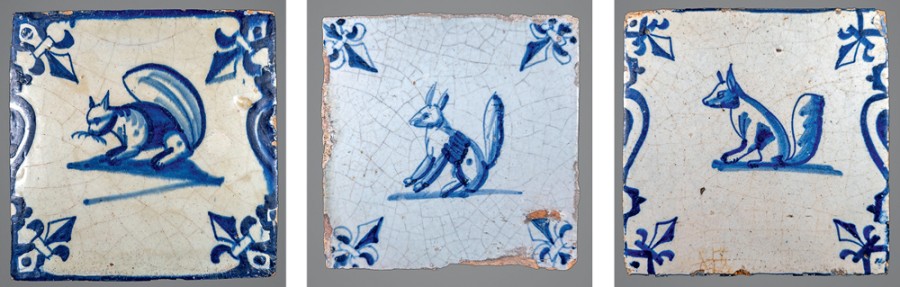
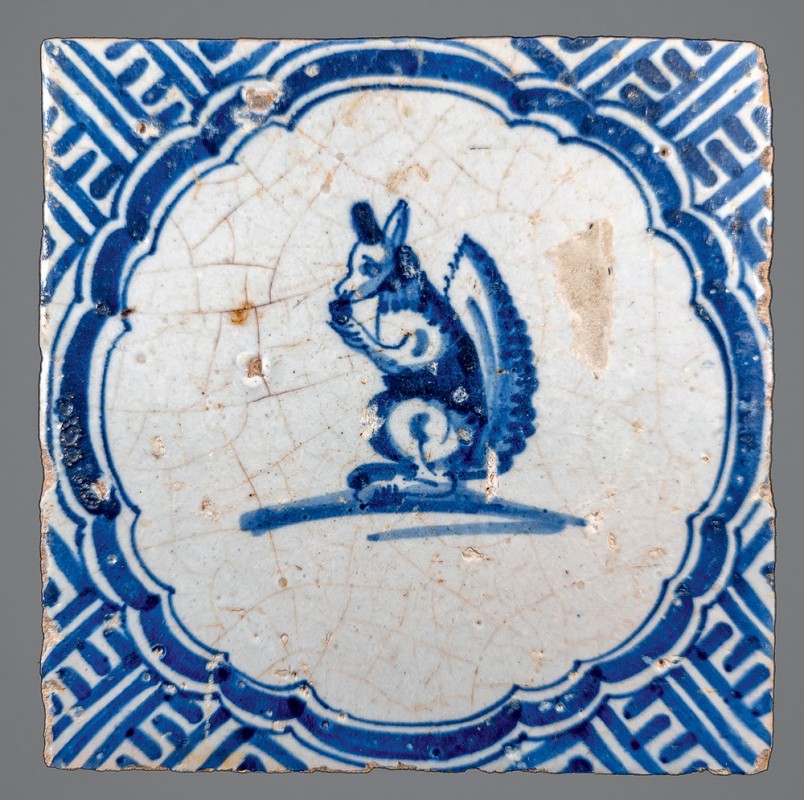
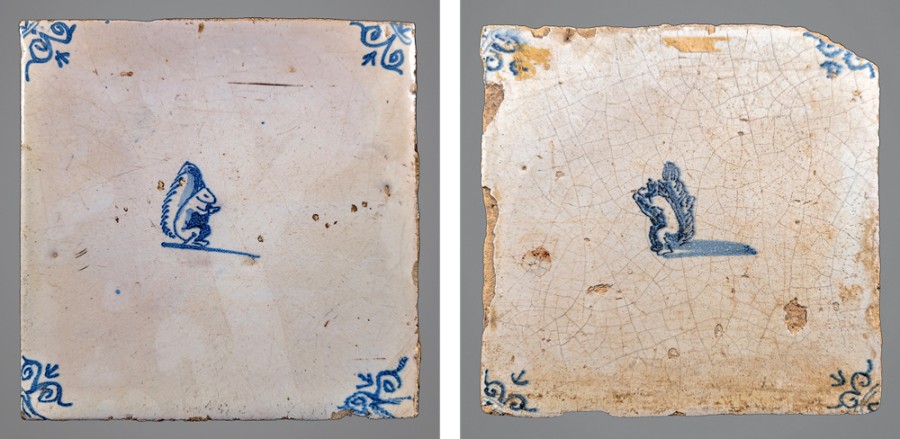
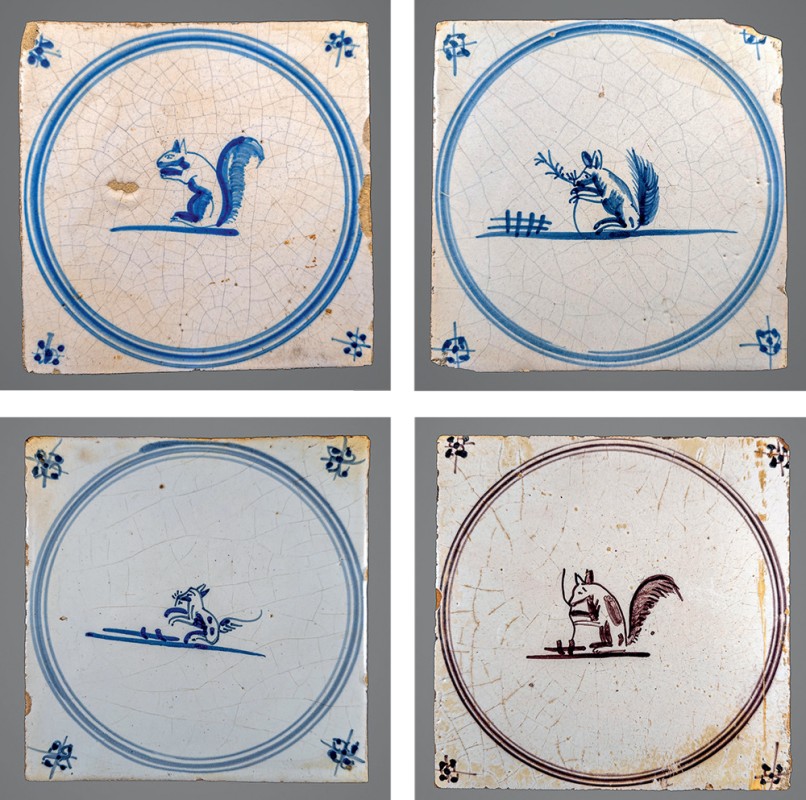
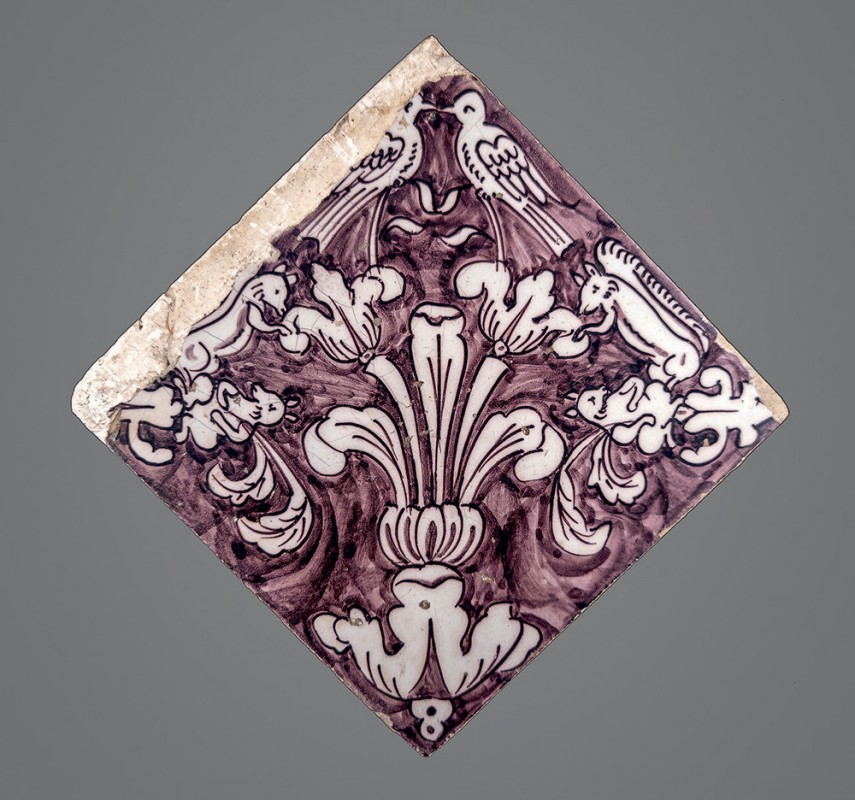
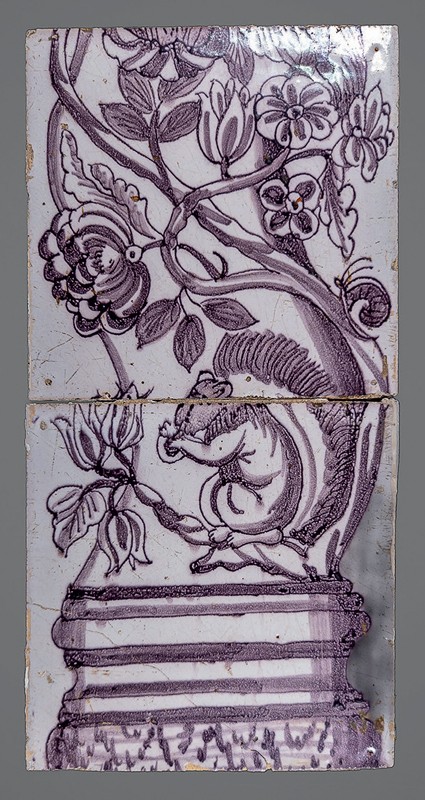
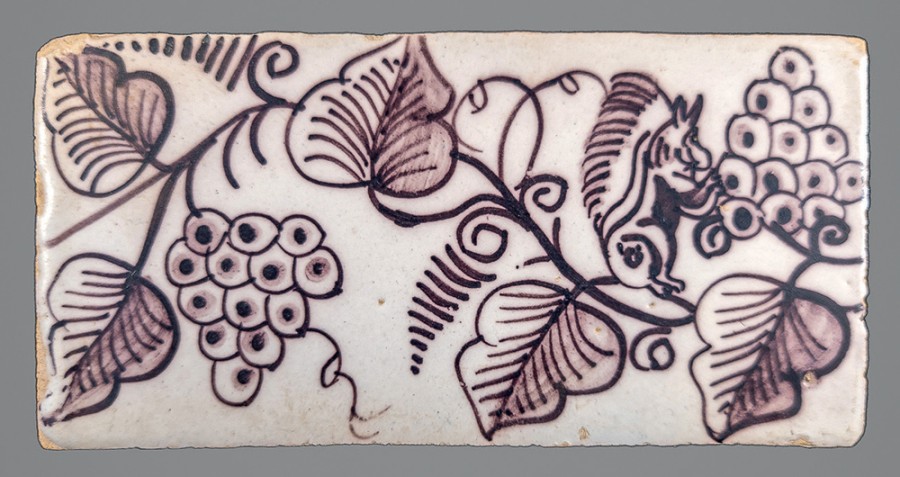
There are currently sixteen tiles in the collection (figs. 23–30). Unlike the plates and chargers, which appear to be uniformly of English manufacture, the tiles appear (with one or two exceptions) to be Dutch products. They also seem to be attempting to show squirrels as part of a menagerie of other animals also depicted on tiles and thus are less reliant on stylistically unusual Chinese prototypes. In general, the tiles therefore tend to portray the animal more realistically. The tiles range in date from possibly as early as the late sixteenth century into the early nineteenth century.
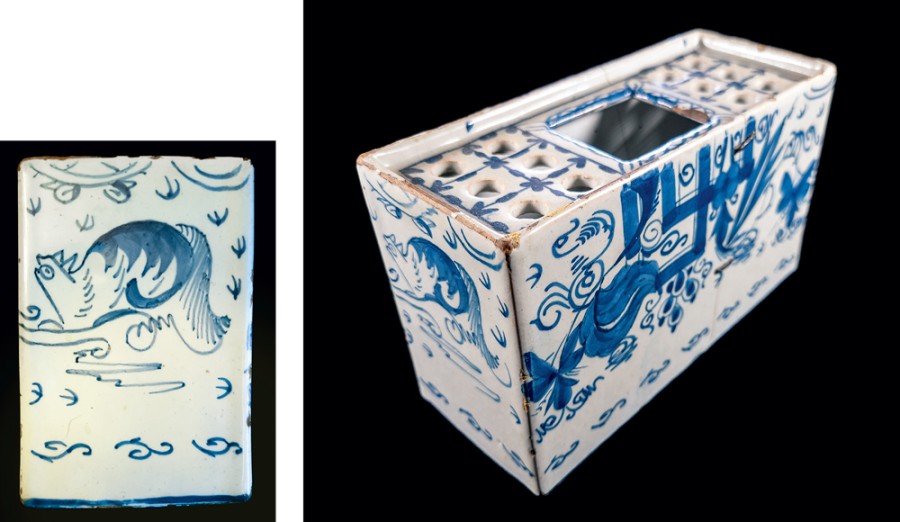
While chargers, plates, and tiles are by far the more common types of tinglazed earthenware decorated with squirrels, the creatures are also known to appear on several other forms, including punch bowls and flower bricks (fig. 32). While the contemporary name is unknown, flower bricks are designed to hold water in which cut flowers are placed for decorative purposes.
Summation
The principal goal of this paper was simple: to describe an assemblage of thirty delftware vessels and tiles with squirrel iconography, and to explain the rather unusual origins of the collection. In doing so, however, my training as an archaeologist demands a discussion about what, if anything, has been learned from this endeavor.
One certainty is that virtually all of the chargers and plates are of English manufacture, mostly from Bristol. In a quarter century of searching, I have yet to see a Dutch plate with a squirrel or find one described in the literature. Of course, that statement is quite different than a blanket assertion that such pieces were not made.
Quite the opposite is true for the delftware tiles. Clearly the vast majority is of Dutch origin, with only one or two that are possibly English. Squirrel andgrape iconography on English tiles does occur, but only very rarely. The Dutch tile’s iconography seems to be predicated more on the simple depictions of various members of the animal kingdom. These tiles lack the grapevine that is usually associated with the squirrel depictions on English plates, and thus they are very unlikely to be carrying any fertility implications derived from Chinese symbology.
Another issue that has become evident is the general difficulty associated with attempting to assign origins or dates to vessels and tiles. It appears that vessel shapes are often useful, but ceramic experts are not always in agreement on their meaning. Assigning origins by style seems to rest on the accumulated expertise of curators, dealers, or collectors, but their conclusions are seldom explained. Unfortunately, too little data seem to be available from concrete sources like archaeological excavations of kiln sites.
This is all compounded when assigning dates to these objects. General time periods—as in the quarter to halfcentury range—seem simple, but more specificity is seldom supported by accurate data points. In analyzing a delftware assemblage from London Town, Maryland,[11] great success was achieved by utilizing the examples of dated English delftware shown in Lipski and Archer’s work.[12] It was therefore surprising to discover that their work simply did not provide similar utility in dating the objects in our collection.
Despite the paucity of significant conclusions, however, accumulating this collection has allowed Donna and me to specialize in an area of ceramics that brings great satisfaction. The hunt for specific additions brings a form of excitement that is familiar to any collector. But in this instance squirrel iconography also provides a form of tribute to a departed, and missed, member of the family—Robert Burle Esq.