


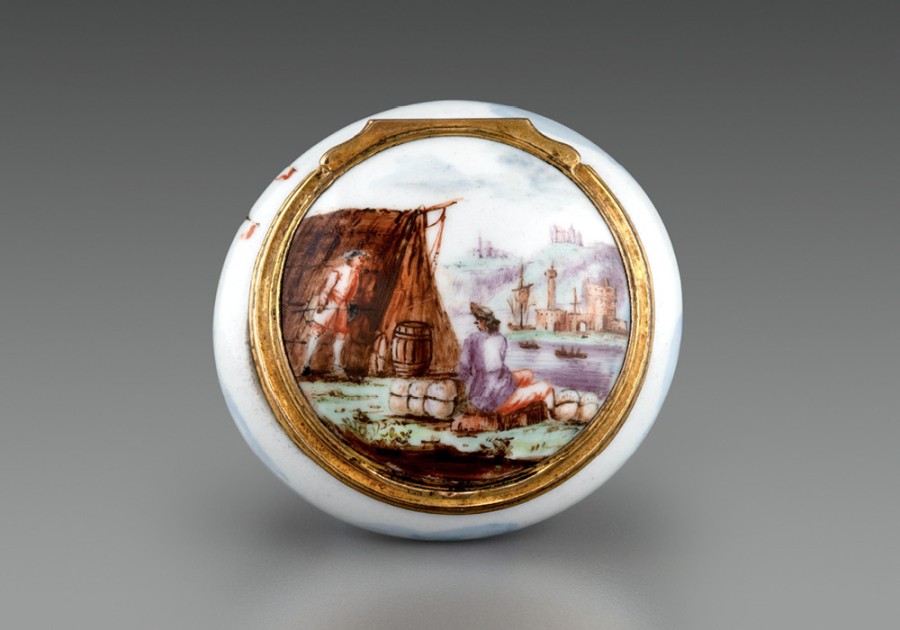
Detail of the lid of the snuff box illustrated in fig. 2. (Chipstone Foundation; photo, Gavin Ashworth.)
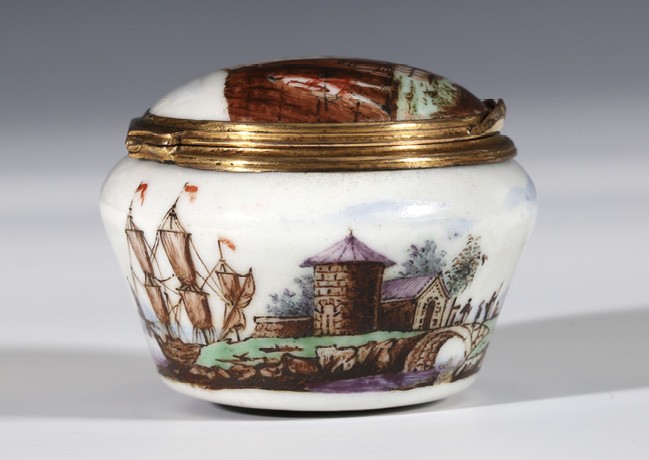
Snuff box, attributed to the A-marked group, east London, England, ca. 1744–1745. Hard-paste porcelain with enamels. D. 2 3/8". (Chipstone Foundation; photo, courtesy Errol Manners.)
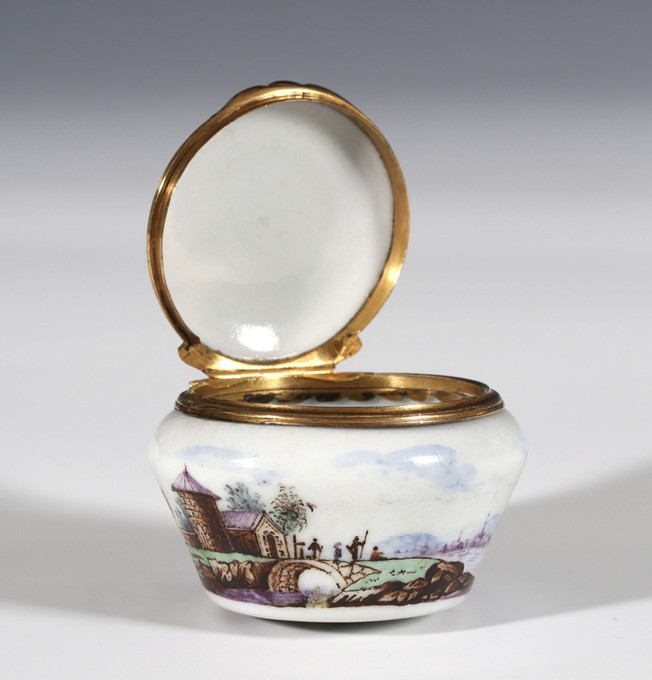
View of the snuff box illustrated in fig. 2 with the lid open showing its gilded copper collar. (Chipstone Foundation; photo, courtesy Errol Manners.)
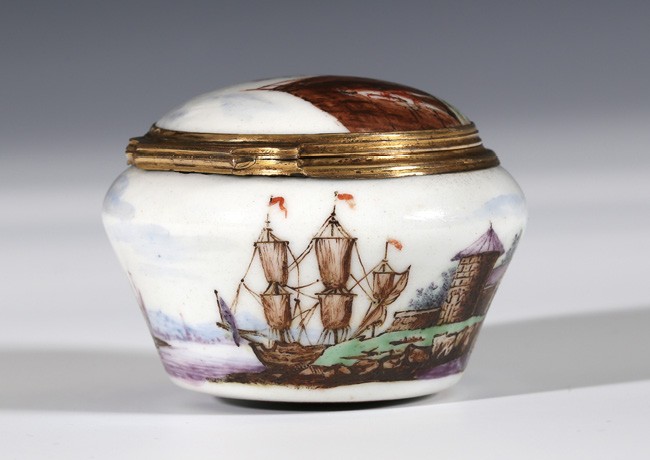
Side view of the snuff box illustrated in fig. 2 with sailing vessel and castle. (Chipstone Foundation; photo, courtesy Errol Manners.)
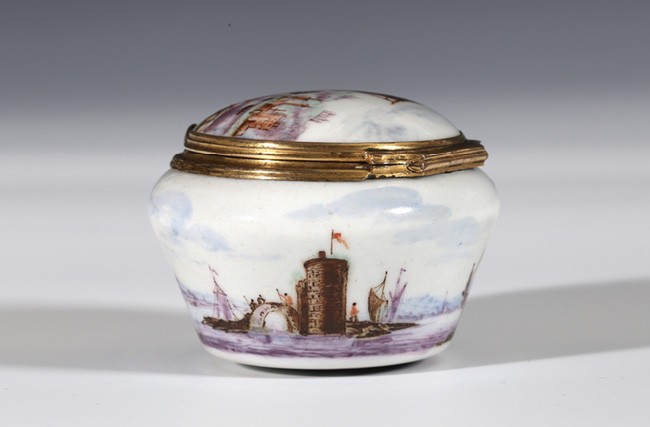
Side view of the snuff box illustrated in fig. 2 with castle and bridge. (Chipstone Foundation; photo, courtesy Errol Manners.)
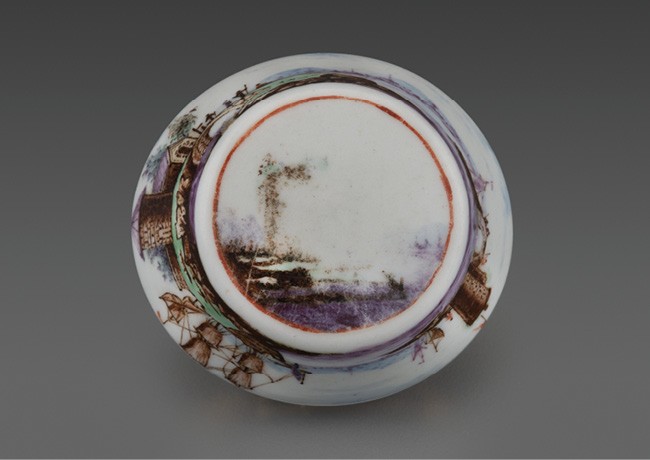
View of the bottom of the snuff box illustrated in fig. 2. (Chipstone Foundation; photo, Gavin Ashworth.)
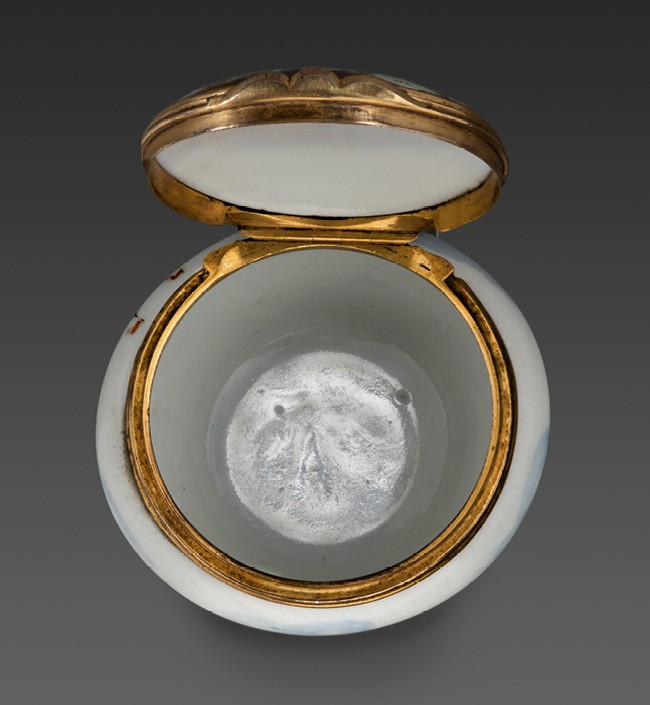
View of the interior bottom of the snuff box illustrated in fig. 2 revealing a faintly incised “A” mark. (Chipstone Foundation; photo, Gavin Ashworth.)
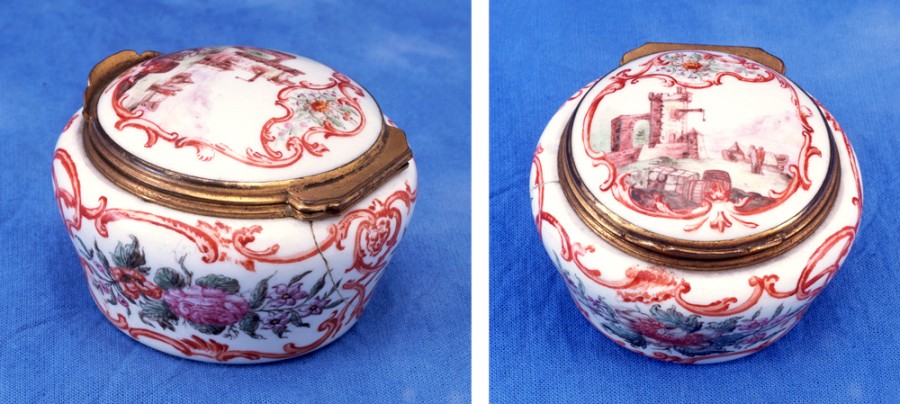
Snuff box, attributed to the A-marked group, east London, England, ca. 1744–1745. Hard-paste porcelain with enamels. Diam. 2 3/8". (National Museum of Wales, Cardiff, De Winton Collection of Continental Porcelain, acc. no. D.W. 552). Enameled with an “A” or “V” incised. The body of the box is decorated with various flowers and leaves within panels of intertwined scrolls. A scene set within a scrolled cartouche comprising a castellated building and barrels is depicted on the lid.
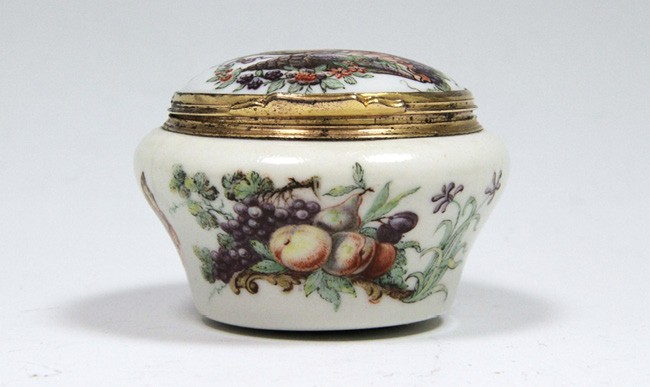
Snuff box, attributed to the A-marked group, east London, England, ca. 1744–1745. Hard-paste porcelain with enamels. Diam. 2 3/8". (Private collection.) The body and lid are enameled with a butterfly, fruit, flowers, and leaves.
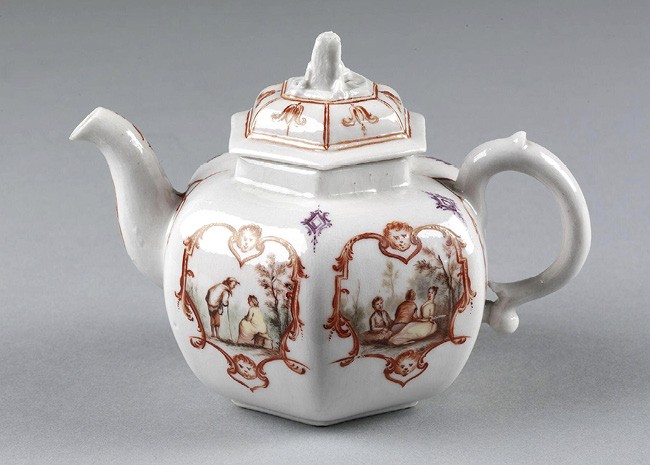
Hexagonal teapot, attributed to the A-marked group, east London, England, ca. 1744–1745. Hard-paste porcelain with enamels. H. 4 1/4." (V&A Museum collections, C.207-1937.) Underglaze blue “A” under base and inside lid. The iron-red cartouche and the mascarons link this teapot to the Cardiff snuff box illustrated in fig. 8.
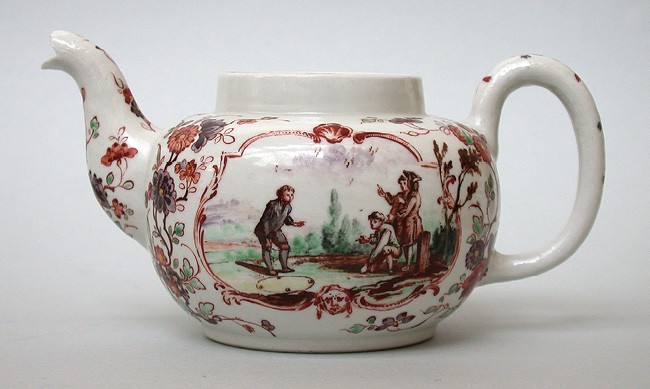
Teapot, attributed to the A-marked group, east London, England, ca. 1744–1745. Hard-paste porcelain with enamels. H. 3 7/16". Underglaze “A” on base. (V&A Museum collections, C.1-1991.) This teapot, formerly in the Geoffrey Godden Collection, uses scenes from a series of youthful diversions designed by Gravelot and published by Cole on October 24, 1740. The two scenes depicted are titled Bow and Arrows and Playing with Marbles. The pot is also linked to the Cardiff snuff box by way of an iron-red cartouche and mascarons.
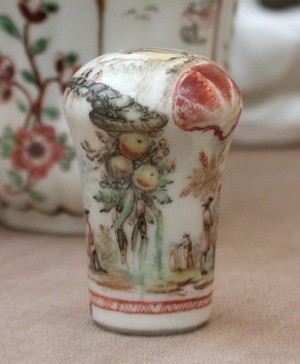
Cane handle, attributed to the A-marked group, east London, England, ca. 1744–1745. Hard-paste porcelain with enamels. H. 1 3/4". Unmarked. (V&A Museum collections, C.148-1993.) Three flanking scenes supposedly in the Meissen manner with a prominent shell in iron red. Elizabeth Adams, “‘Birmingham’ Porcelain,” Antique Dealer and Collectors Guide (November 1992): 22–27.
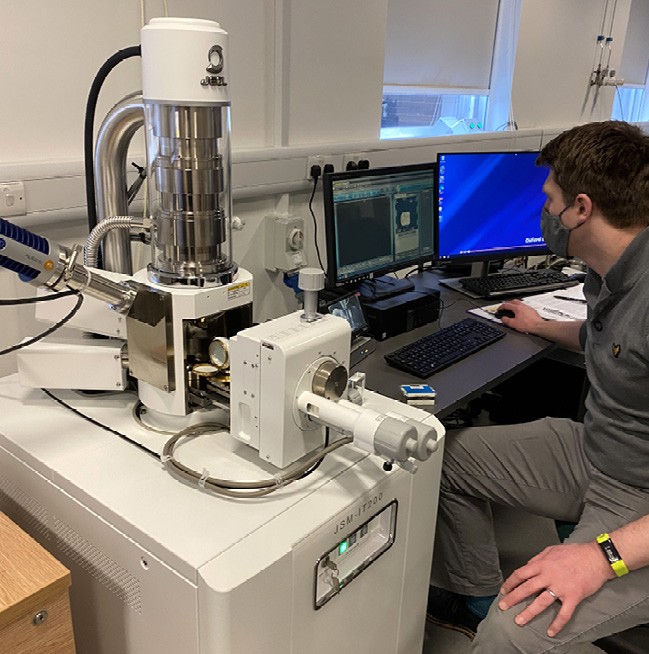
The JEOL JSM-IT200 SEM coupled with an Oxford Xplore 15mm2 EDX detector, Brunel University, London, operated by Dr. Ashley Howkins. The snuff box can be seen on its side with its lid open prior to being inserted into the SEM chamber (red arrow)
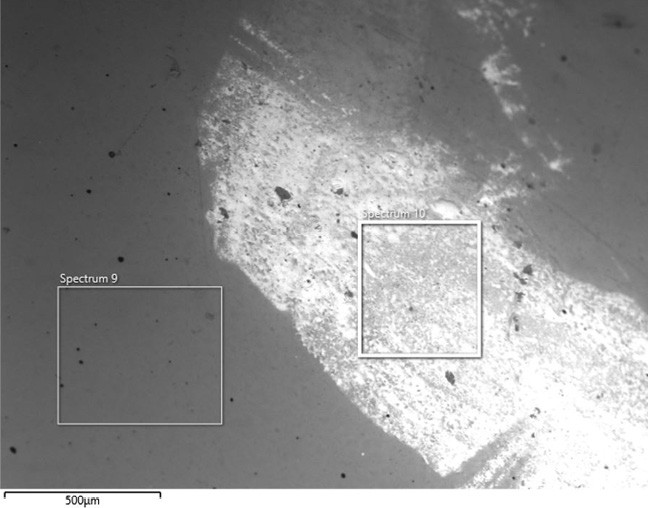
Compositional back-scattered electron SEM micrograph acquired from the area of the red flag enamel design on the main body of the porcelain snuff box illustrated in fig. 2. The high-contrast region (brighter) is from the pigmentation of the red enamel, whereas the gray regions are from the background white glaze of the porcelain. Boxes demonstrate small area EDX analyses carried out within areas of interest.
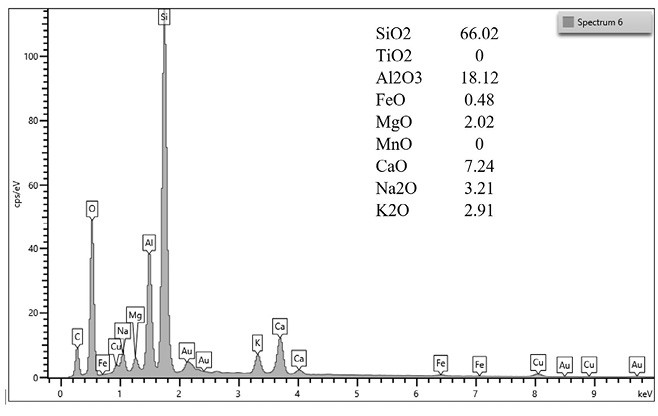
Spectrum 6 of the porcelain body on the rim to the snuff box adjacent to gold-copper collar, free of glaze. The calculated analysis shown in the right in the figure has had both gold (3.36 wt% Au2O3) and copper (1.95 wt% CuO) removed.
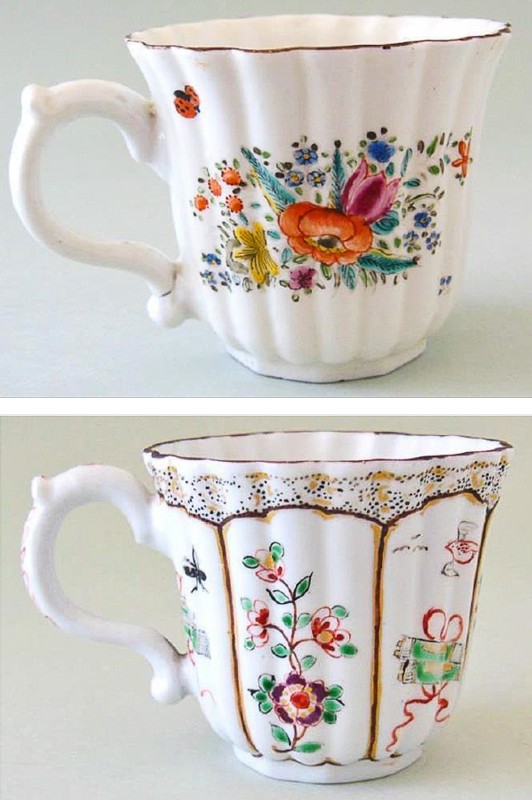
Two coffee cups, attributed to the A-marked group, east London, England, ca. 1744–1745. Hard-paste porcelain with enamels. H. of top cup 2 3/8", H. of bottom cup 2 1/4". (Private collections; courtesy of John Wiley & Sons, Ltd.) Both are slip-cast with decagonal foot rims. The cup on the top is decorated with European-style flower sprays; the cup on the bottom has six alternating vertical panels with flowers, scrolls, and a bird.
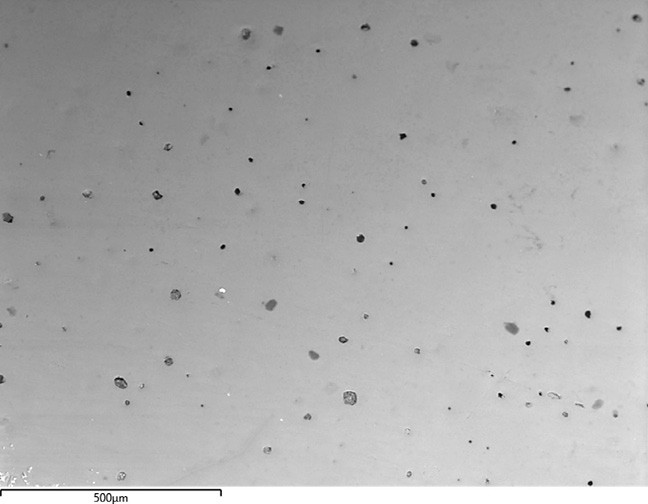
Image of glaze surface analyzed for Spectrum 13 on the snuff box.
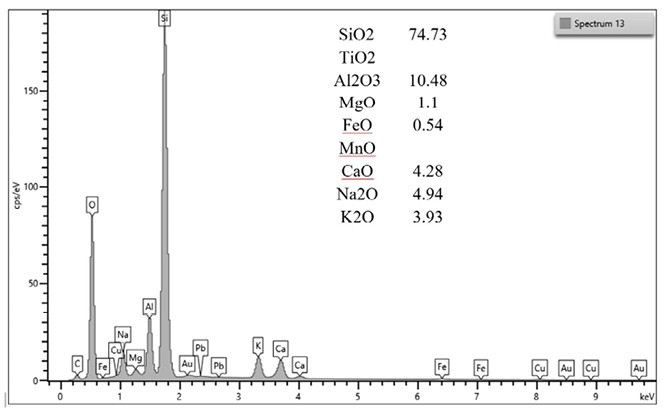
Analysis for the glazed surface illustrated in fig. 17 with analysis (wt%) provided in top right. Gold (0.82 wt% Au2O3), copper (0.34 wt% CuO), and lead (0.53 wt% PbO)—regarded as contaminants—have been removed and the resultant analysis summed to 100%.
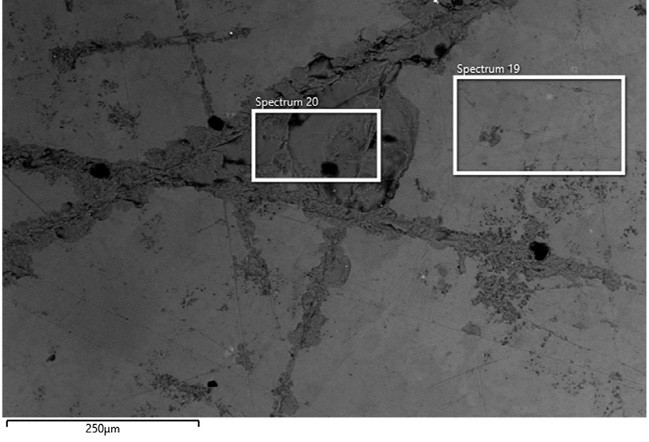
Image of the glaze surface on the base of the snuff box analyzed for Spectra 19 and 20.
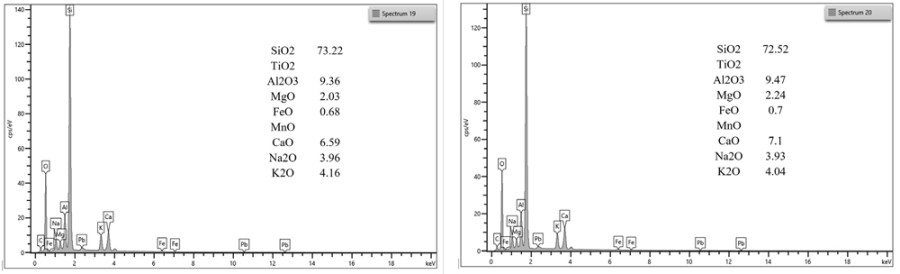
Spectra 19 and 20 generated from the glazed base of the snuff box. For both analyses lead was regarded as a contaminant and removed. The resultant analyses were then been summed to 100 wt% and the values reproduced in the top right of both figures in wt%.
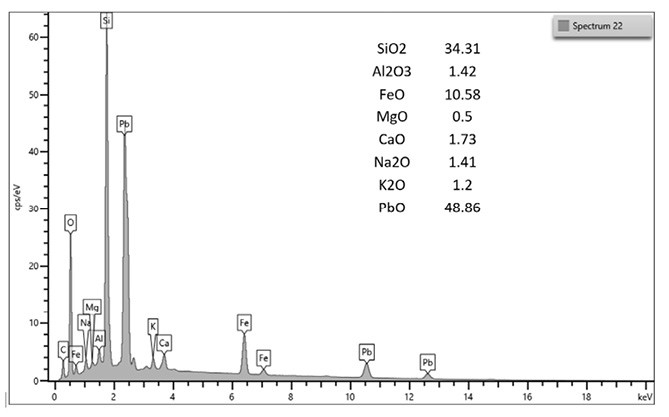
Spectrum 22 of red enamel at the edge of the snuff box rim showing a high lead (48.9 wt% PbO) and silica (34.3 wt% SiO2) and prominent iron (10.6 wt% FeO).